
Life, 1920-11-04 · page 36 of 60
Life — November 4, 1920 — page 36: what you’re looking at
What you’re looking at
This *Life* magazine page contains two satirical pieces about American politics and social policy, likely from around 1920. **"As We Convalesce"** mocks the disruption caused by a presidential campaign (appears to reference the Harding-Cox election of 1920). The satire escalates absurdly: a waiter delayed, a stagecoach driver taking a wrong turn, a banker sleeping through his subway stop. The joke culminates in suggesting random selection—"drawing a name from a hat"—would be preferable to actual voting, since it might accidentally produce a competent president. This is cynical commentary on both electoral politics and voter apathy among the wealthy. **"At Last Alone"** satirizes Prohibition Commissioner Kramer's claim that America will be unrecognizable in ten years under Prohibition (enacted in 1920). Life's editors sardonically suggest the country will become so isolated and undesirable that *nobody will want to know it*—a sharp critique of Prohibition's social consequences. They imply America has other means of self-destruction beyond alcohol bans. Both pieces ridicule government overreach and elite indifference to civic duty.
📄 Transcribed text from this page (OCR, searchable)
Machine-transcribed from the original scan — historical spelling and the odd misread are preserved.
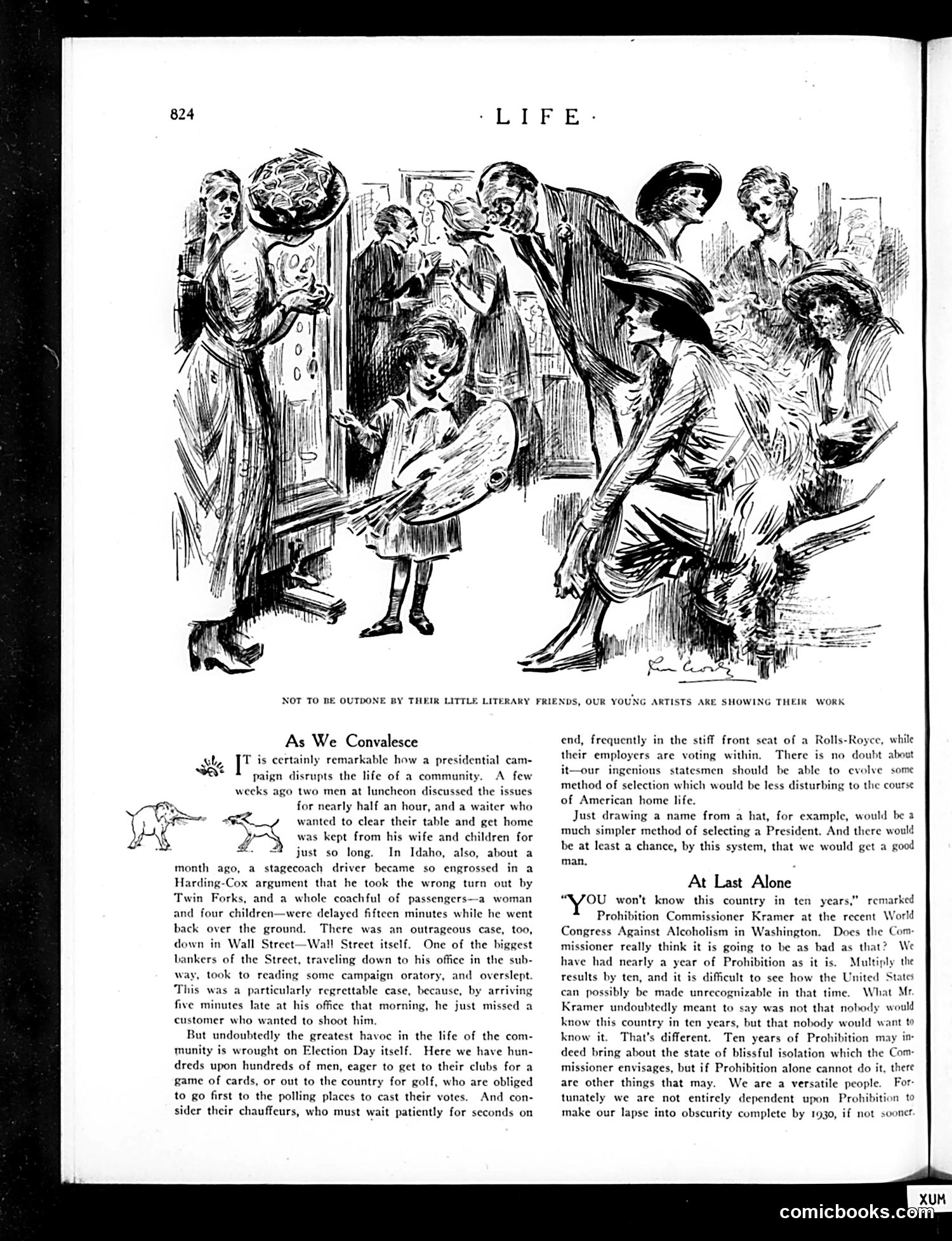
NOT TO BE OUTDONE BY THEIR LITTLE LITERARY FRIENDS, OUR YOUNG ARTISTS ARE SHOWING THEIR WORK As We Convalesce T is certainly remarkable how a presidential cam- paign disrupts the life of a community. A few ago two men at luncheon discussed the issues for nearly half an hour, and a waiter who wanted to clear their table and get home was kept from his wife and children for just so long. In Idaho, also, about a month ago, a stagecoach driver became so engrossed in a Harding-Cox argument that he took the wrong turn out by Twin Forks, and a whole coachful of passengers—a woman and four children—were delayed fifteen minutes while he went back over the ground. There was an outrageous case, too, down in Wall Street—Wall Street itself. One of the biggest bankers of the Street, traveling down to his office in the sub- way, took to reading some campaign oratory, and overslept. This was a particularly regrettable case, because, by arriving five minutes late at his office that morning, he just missed a customer who wanted to shoot him. But undoubtedly the greatest havoc in the life of the com- munity is wrought on Election Day itself. Here we have hun- dreds upon hundreds of men, eager to get to their clubs for a game of cards, or out to the country for golf, who are obliged to go first to the polling places to cast their votes. And con- sider their chauffeurs, who must wait patiently for seconds on end, frequently in the stiff front seat of a Rolls-Royce, while their employers are voting within, There is no doubt about it—our ingenious statesmen should be able to evolve si method of selection which would be less disturbing to the course of American home life. Just drawing a name from a hat, for example, would be 3 much simpler method of selecting a President. And there would be at least a chance, by this system, that we would get a good man, At Last Alone “you won't know this country in ten years,” remarked Prohibition Commissioner Kramer at the recent World Congress Against Alcoholism in Washington. Does the Com- missioner really think it is going to be as bad as that? We have had nearly a year of Prohibition as it is. Multiply the results by ten, and it is dificult to see how the United States can possibly be made unrecognizable in that time. What Mr. Kramer undoubtedly meant to say was not that nobody would know this country in ten years, but that nobody would want to know it. That's different. Ten years of Prohibition may in- deed bring about the state of blissful isolation which the Com- missioner envisages, but if Prohibition alone cannot do it, there are other things that may. We are a versatile people. For- tunately we are not entirely dependent upon Prohibition to make our lapse into obscurity complete by 1930, if not sooner comicbooks.co XUM ny