
Life, 1920-11-04 · page 32 of 60
Life — November 4, 1920 — page 32: what you’re looking at
What you’re looking at
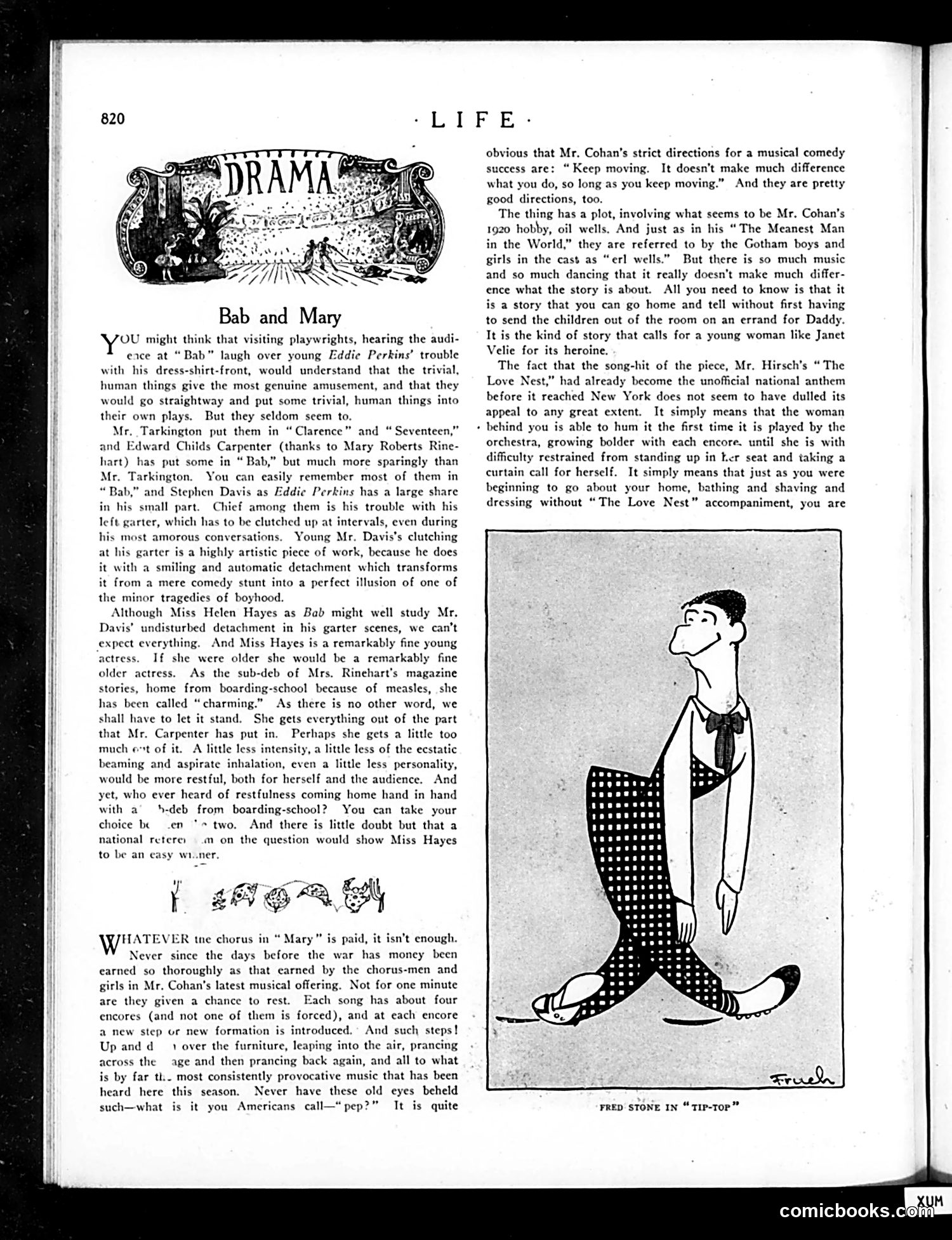
This Life magazine drama review discusses two Broadway productions: "Bab" and "Mary." The page critiques the plays and performances, particularly praising young actor Stephen Davis for his comedic business with a slipping garter—transforming a simple physical gag into genuine comedy through understated acting. The accompanying cartoon (credited to "Frueh") illustrates Fred Stone in "Tip-Top," showing a lanky male performer in an exaggerated pose with polka-dotted pants—likely satirizing the physical comedy and "pep" (energy/showmanship) characteristic of 1920s musical theater. The reviews reflect contemporary theatrical tastes: appreciation for human authenticity over artifice, and recognition that audiences enjoyed vaudeville-style physical humor and elaborate musical numbers with constant choreography and movement—what Mr. Cohan's philosophy reduced to: "keep moving."
📄 Transcribed text from this page (OCR, searchable)
Machine-transcribed from the original scan — historical spelling and the odd misread are preserved.
‘LIFE. Pome? LN ZT Bab and Mary yo might think that visiting playwrights, hearing the audi- ence at “Bab” laugh over young Eddie Perkins’ trouble with his dress-shirt-front, would understand that the tri human things give the most genuine amusement, and that they would go straightway and put some trivial, human things into their own plays. But they seldom seem to. Mr. Tarkington put them in “Clarence” and “ Seventeen,” and Edward Childs Carpenter (thanks to Mary Roberts Rine- hart) has put some in “Bab,” but much more sparingly than Mr. Tarkington. You can easily remember most of them in “Bab,” and Stephen Davis as Eddie Perkins has a large share in his small part. Chief among them is his trouble with his left garter, which has to be clutched up at intervals, even during his most amorous conversations. Young Mr. Davis's clutching at his garter is a highly artistic piece of work, because he does it with a smiling and automatic detachment which transforms it from a mere comedy stunt into a perfect illusion of one of the minor tragedies of boyhood. Although Miss Helen Hayes as Bab might well study Mr. Davis’ undisturbed detachment in his garter scenes, we can’t expect everything. And Miss Hayes is a remarkably fine young If she were older she would be a remarkably fine older actress. As the sub-deb of Mrs. Rinehart’s magazine stories, home from boarding-school because of measles, she has been called “ charmin; As there is no other word, we shall have to let it stand. She gets everything out of the part that Mr. Carpenter has put in. Perhaps she gets a little too much et of it. A little less intensity, a little less of the ecstatic beaming and aspirate inhalation, even a little less personality, would be more restful, both for herself and the audience. And yet, who ever heard of restfulness coming home hand in hand with a -deb from boarding-school? You can take your choice be .en ‘> two, And there is little doubt but that a m on the question would show Miss Hayes to be an easy wianer. | soa ey HATEVER tne chorus in “ Mary” is paid, it isn’t enough. Never since the days before the war has moncy been earned so thoroughly as that earned by the chorus-men and girls in Mr. Cohan’s latest musical offering. Not for one minute are they given a chance to rest. Each song has about four encores (and not one of them is forced), and at each encore a new step or new formation is introduced. And such steps! Up and d 1 over the furniture, leaping into the air, prancing across the age and then prancing back again, and all to what is by far th. most consistently provocative music that has been heard here this season. Never have these old eyes beheld such—what is it you Americans call—“ pep?” It is quite actress. national reteres obvious that Mr. Cohan’s strict directions for a musical comedy success are: “Keep moving. It doesn’t make much difference what you do, so long as you keep moving.” And they are pretty good directions, too. The thing has a plot, involving what seems to be Mr. Cohan’s 1920 hobby, oil wells, And just as in his “The Meanest Man in the World,” they are referred to by the Gotham boys and girls in the cast as “erl wells.” But there is so much music and so much dancing that it really doesn't make much differ- ence what the story is about. All you need to know is that it is a story that you can go home and tell without first having to send the children out of the room on an errand for Daddy. It is the kind of story that calls for a young woman like Janet Velie for its heroine. The fact that the song-hit of the piece, Mr. Hirsch’s “ The Love Nest,” had already become the unofficial national anthem before it reached New York does not seem to have dulled its appeal to any great extent. It simply means that the woman behind you is able to hum it the first time it is played by the orchestra, growing bolder with each encore. until she is with difficulty restrained from standing up in her seat and taking a curtain call for herself. It simply means that just as you were beginning to go about your home, bathing and shaving and dressing without “The Love Nest” accompaniment, you are FRED STONE IN “TIP-TOP” comicbooks.co