
Life, 1920-11-04 · page 29 of 60
Life — November 4, 1920 — page 29: what you’re looking at
What you’re looking at
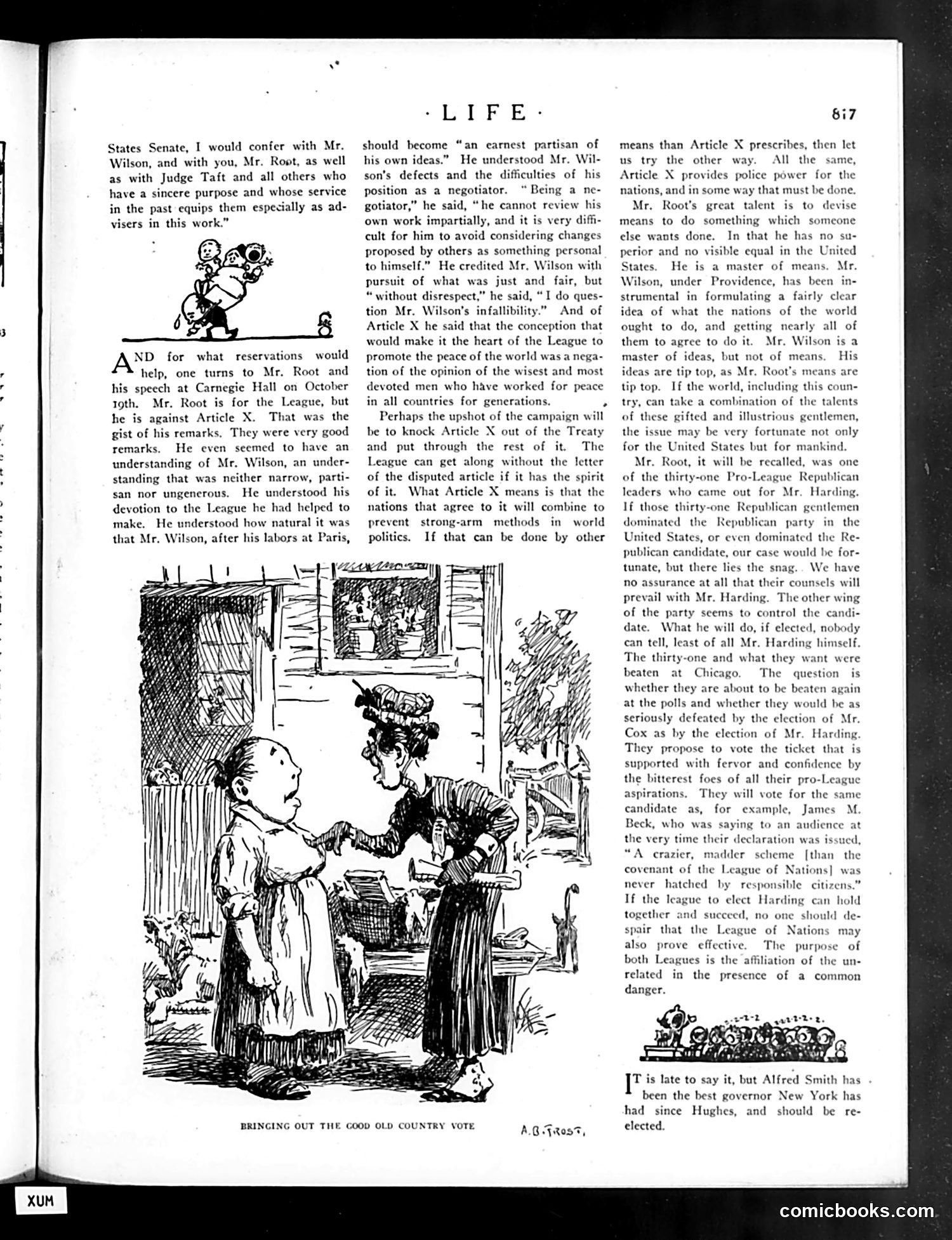
This page discusses post-WWI League of Nations politics. The text debates **Article X** of the League covenant, which would obligate member nations to collectively resist aggression. **Key figures mentioned:** - **President Wilson**: Portrayed as idealistic but inflexible, having formulated the League concept - **Elihu Root**: A respected Republican statesman and lawyer who supports the League but opposes Article X - **James M. Beck**: A Pro-League Republican leader mentioned as example **The satire:** The cartoon "Bringing Out the Good Old Country Vote" (by A.B. Frost) depicts rural voters being mobilized—likely satirizing how political parties were exploiting traditional constituencies during the 1920 presidential election debate over League membership. **The political context:** Republicans were divided between Wilson-sympathetic internationalists (Root's faction) and isolationists opposing Article X. The text expresses concern that isolationist Republicans might dominate the party platform, undermining substantive League support regardless of which candidate wins.
📄 Transcribed text from this page (OCR, searchable)
Machine-transcribed from the original scan — historical spelling and the odd misread are preserved.
States Senate, I would confer with Mr. Wilson, and with you, Mr. Root, as well as with Judge Taft and all others who have a sincere purpose and whose service in the past equips them especially as ad- visers in this work.” ‘D for what reservations would help, one turns to Mr. Root and his speech at Carnegie Hall on October 1gth. Mr. Root is for the League, but he is against Article X. That was the gist of his remarks, They were very good remarks. He even seemed to have an understanding of Mr. Wilson, an under- standing that was neither narrow, parti- san nor ungenerous. He understood his devotion to the League he had helped to make. He understood how natural it was that Mr. Wilson, after his labors at Paris, 4) hy ‘ ir OZ 0 G. BRINGING OUT T GOOD OLD COUNTRY VOTE -LIFE.- should become “an earnest partisan of his own ideas.” He understood Mr. Wi son’s defects and the difficulties of his position as a negotiator. “Being a ne- gotiator,” he said, “he cannot review his own work impartially, and it is very diffi- cult for him to avoid considering changes proposed by others as something personal to himself.” He credited Mr, Wilson with pursuit of what was just and fair, but “without disrespect,” he said, “I do ques- tion Mr. Wilson's infallibilit And of Article X he said that the conception that would make it the heart of the League to promote the peace of the world was a nega- tion of the opinion of the wisest and most devoted men who have worked for peace in all countries for generations. > Perhaps the upshot of the campaign will be to knock Article X out of the Treaty and put through the rest of it. The League can get along without the letter of the disputed article if it has the spirit of it. What Article X means is that the nations that agree to it will combine to prevent strong-arm methods in world politics. If that can be done by other A.B .FRosT, 6i7 means than Article X prescribes, then let us try the other All the Article X provides police power for the nations, and in some way that must be done. Mr. Root’s great talent is to devise means to do something which someone else wants done. In that he has no su- perior and no visible equal in the United States. Mr. Wilson, under Providence, has been in- strumental in formulating a fairly clear idea of what the nations of the world ought to do, and getting nearly all of them to agree to do it. Mr. Wilson is a master of ideas, but not of means. His ideas are tip top, as Mr. Root’s means are tip top. If the world, including this coun- try, can take a combination of the talents of these gifted and illustrious gentlemen, way. same, He is a master of means. the issue may be very fortunate not only for the United States but for mankind. Mr. Root, it will be recalled, was one of the thirty-one Pro-League Republican leaders who came out for Mr. Harding. If those thirty-one Republican gentlemen dominated the Republican party in. the United States, or even dominated the Re- publican candidate, our case would be for- tunate, but there lies the snag.. We have no assurance at all that their counsels will prevail with Mr. Harding. The other wing of the party seems to control the candi- date. What he will do, if elected, nobody can tell, least of all Mr. Harding himself. ne and what they want were Chicago. The question is whether they are about to be beaten again at the polls and whether they would be as seriously defeated by the election of Mr. Cox as by the election of Mr. Harding. They propose to vote the ticket that is supported with fervor and confidence by the bitterest foes of all their pro- aspirations, ague They will vote for the same for James M. Beck, who was saying to an audience the very time their declaration was issued, “Ac madder scheme [than the covenant of the League of Nations] was never hatched by responsible citizens.” If the league to elect Harding can hold together 1 succeed, no one sl spair that the League of Nations may also The purpose of both Leagues is the affiliation of the un- related in the presence of a common danger. candidate as, example, ier, uld de- prove effective. T is late to say it, but Alfred Smith has been the best governor New York has had since Hughes, and elected. should be re- comicbooks.com