
A complete issue · 44 pages · 1920
Life — September 16, 1920
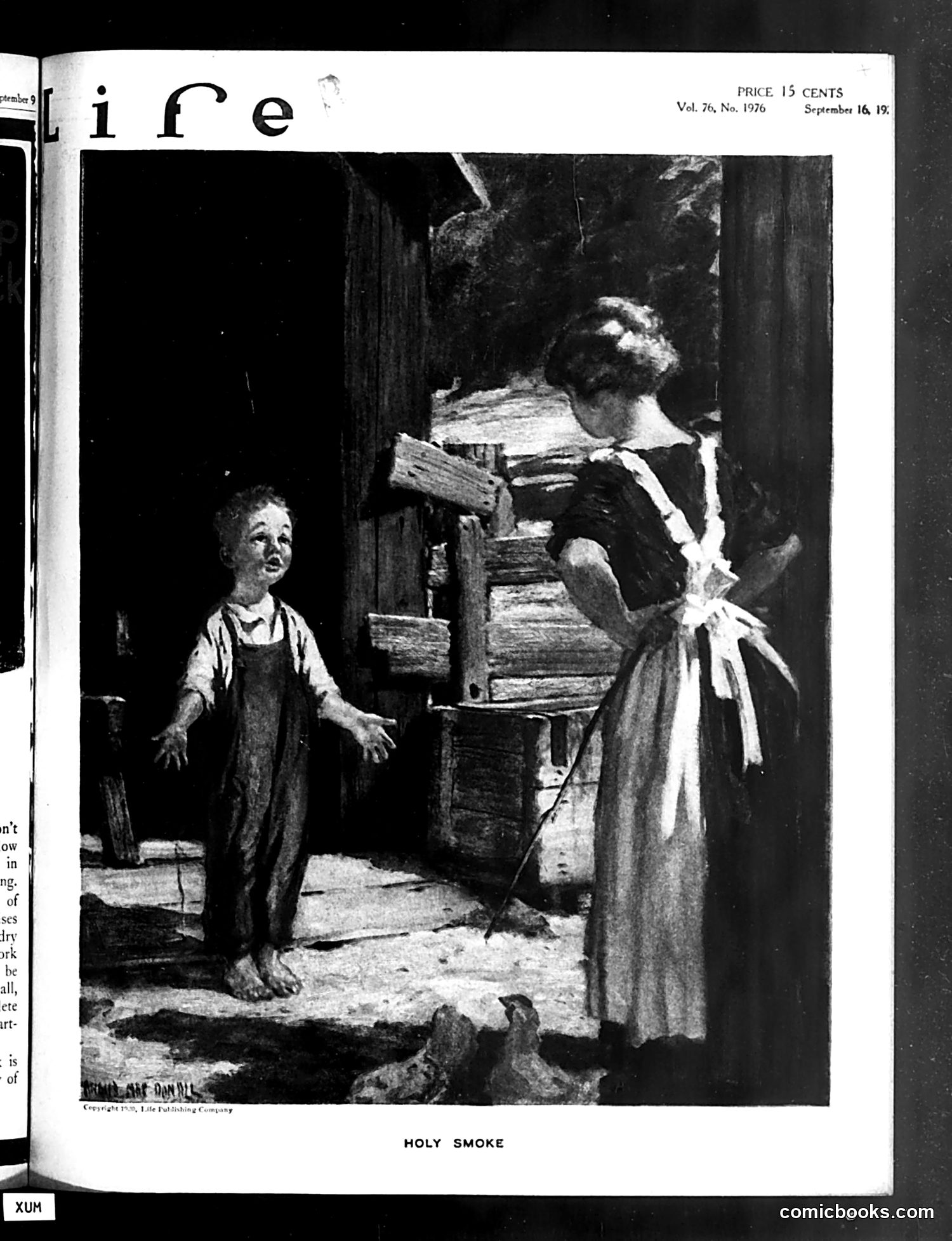
This illustration depicts a domestic scene satirizing child-rearing practices of the era. A barefoot child stands in a humble interior while an adult woman (likely the mother) gestures toward smoke or steam, apparently using fear of smoke or fire as a disciplinary tactic. The title "Holy Smoke" is a mild exclamation, but the cartoon's point appears to be social commentary on harsh or questionable parenting methods—specifically using fear to control children's behavior. This reflects early 20th-century debates about child welfare and progressive versus traditional disciplinary approaches. The image critiques what the magazine's audience would have recognized as outdated or inappropriate child management techniques by presenting it with ironic title and visual bluntness.
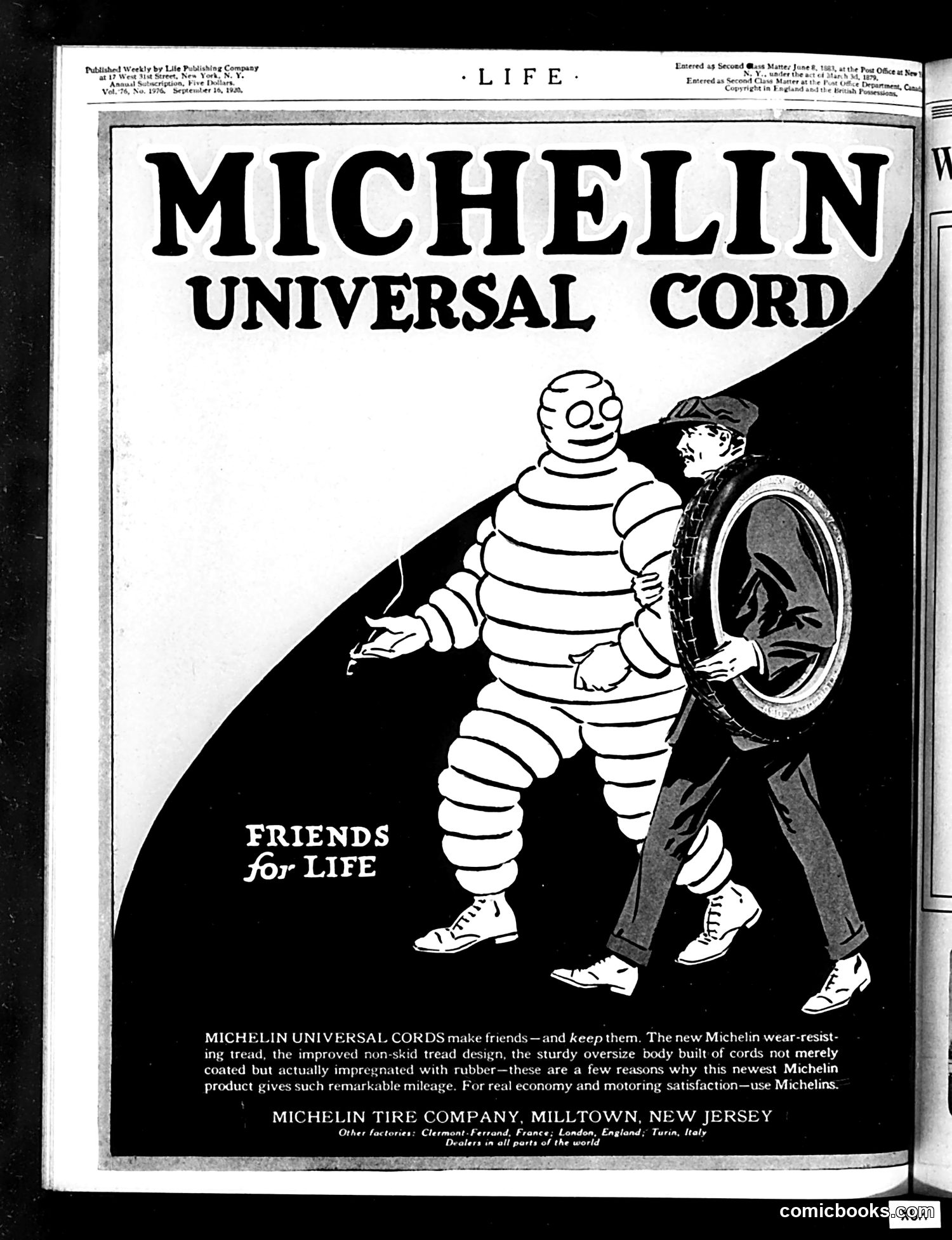
This is primarily a **Michelin tire advertisement**, not political satire. The page features the famous Michelin Man mascot (Bibendum) — the rotund character made of stacked tire rings — alongside a mechanic examining a tire. The ad's tagline "Friends for Life" emphasizes durability and reliability. The accompanying text highlights Michelin Universal Cords' wear-resistance, rubber coating, and "remarkable mileage" as selling points for "real economy and motoring satisfaction." The Michelin Man was already an established corporate mascot by this 1925 Life magazine appearance. The illustration uses the character's distinctive puffy appearance to visually reinforce the product's resilience and strength — suggesting tires that last as long as this cheerful, enduring figure.
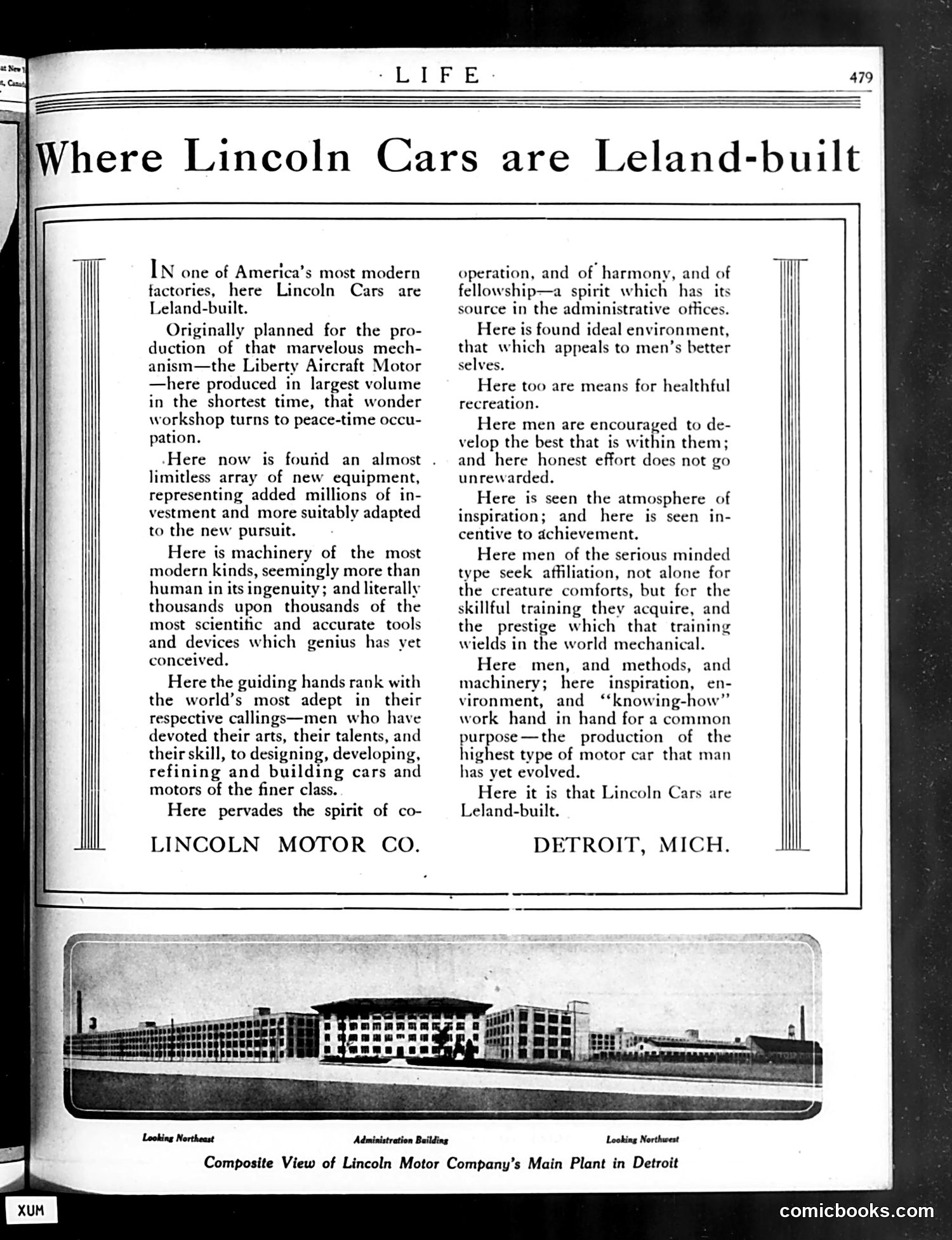
This page is **not a cartoon or satire** — it's a straightforward **advertisement for Lincoln Motor Company**, published in Life magazine (page 479). The ad promotes Lincoln's manufacturing facility in Detroit, Michigan, emphasizing modern factory conditions, skilled workers, and quality craftsmanship. The text celebrates the company's "spirit of cooperation" and describes advanced machinery and precision tools. The bottom shows a composite photograph of Lincoln Motor Company's main plant in Detroit, displaying multiple large industrial buildings. This represents early 20th-century **corporate advertising** that appealed to readers by highlighting American industrial progress, worker welfare ("means for healthful recreation"), and engineering excellence — typical messaging for luxury automobile manufacturers of that era seeking to justify premium prices through manufacturing prestige.
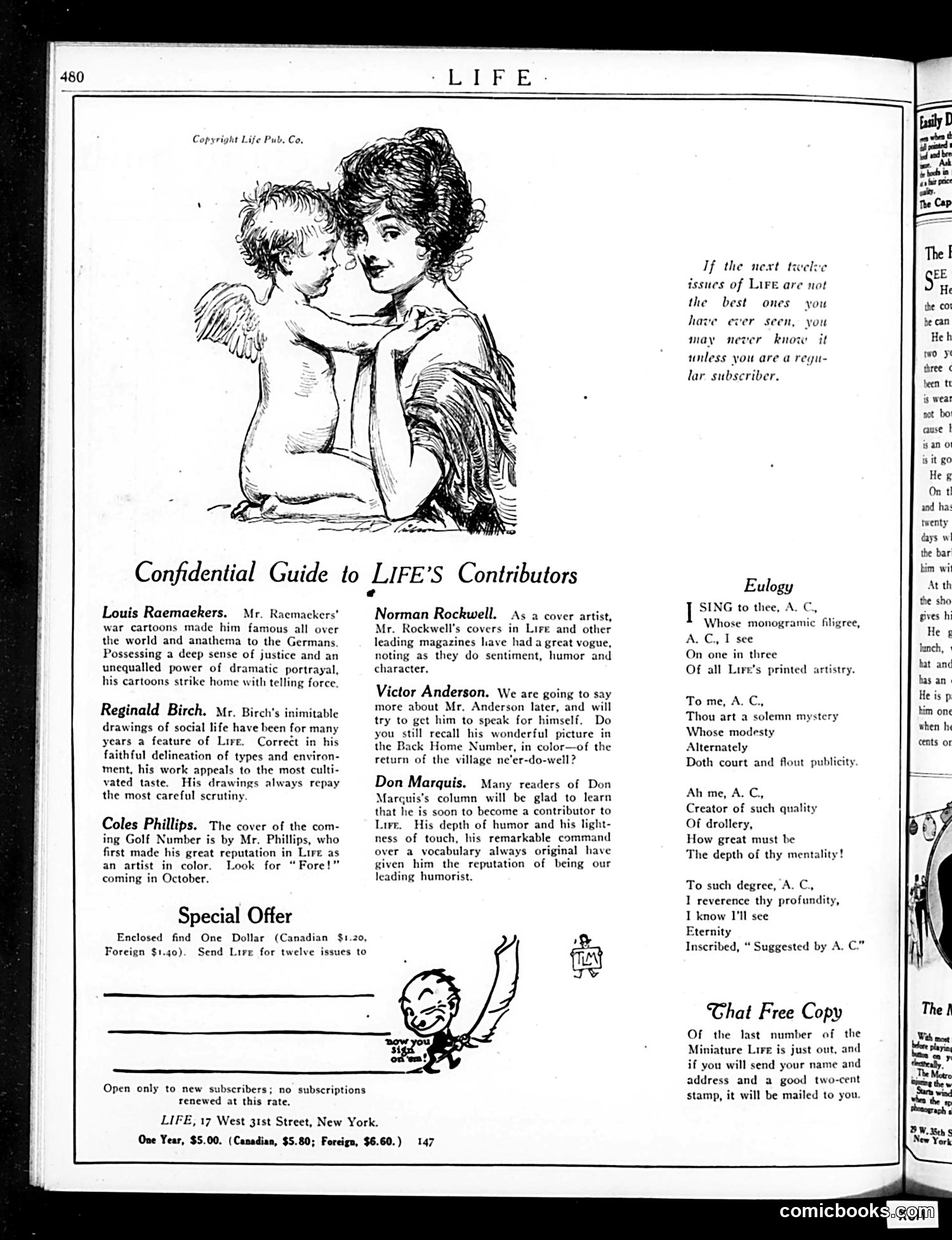
This page is primarily a **contributor acknowledgment and subscription advertisement** rather than political satire. The main illustration shows a woman with a cherub or child figure—a sentimental classical image typical of early 20th-century magazine aesthetics. The "Confidential Guide to LIFE's Contributors" credits cartoonists and artists including Louis Raemaekers (known for WWI-era political cartoons), Norman Rockwell, Victor Anderson, and others. The text emphasizes their artistic reputations and contributions to the magazine. The bottom half features a **subscription offer** ($5 yearly) and a whimsical cartoon mascot. An "Eulogy" section credits "A. C." for quality contributions. Overall, this is **house advertising** celebrating LIFE's creative talent rather than commentary on current events or politics.
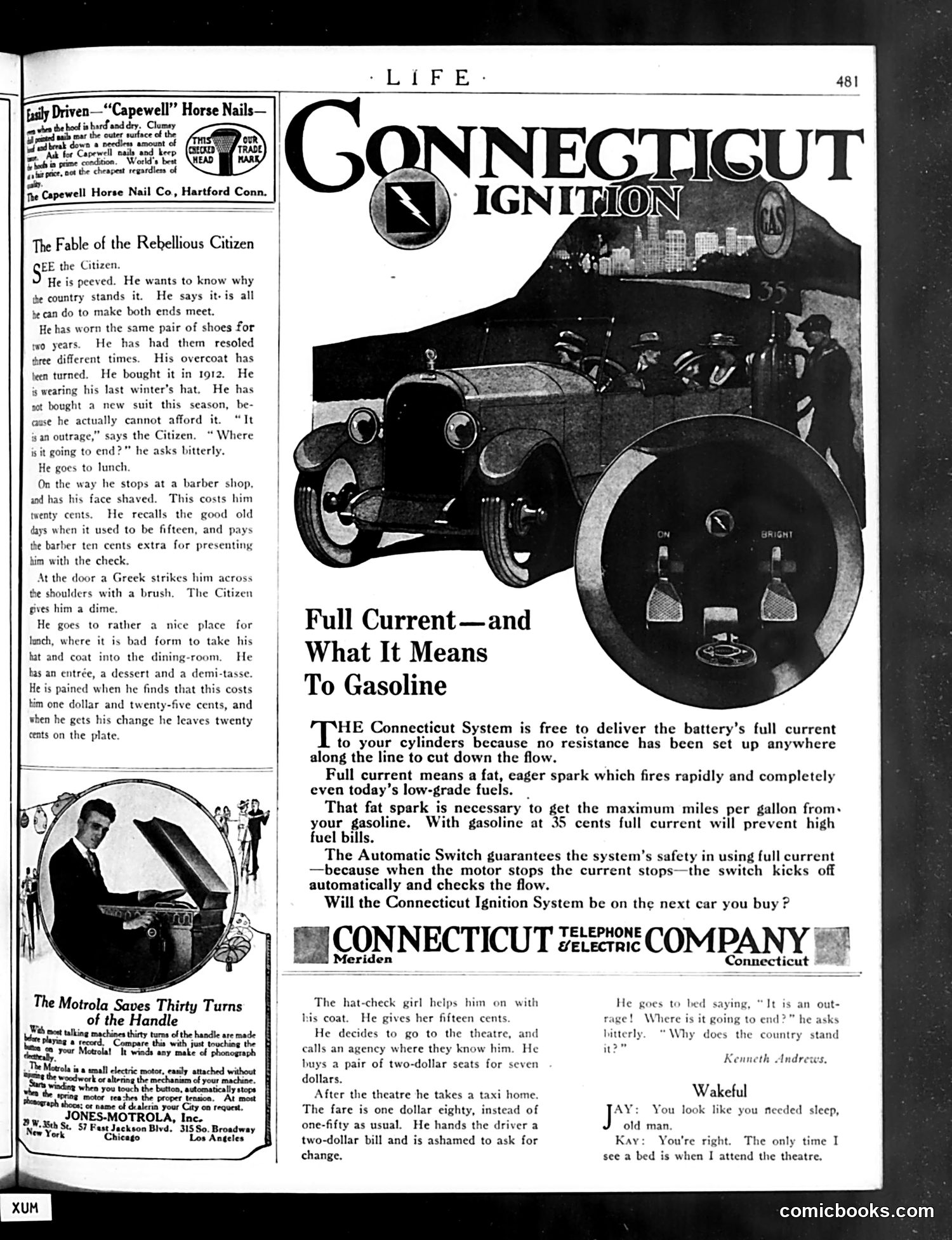
This page is primarily **advertising**, not satire or political commentary. The dominant content is a Connecticut Telephone & Electric Company advertisement for their "Connecticut Ignition System" for automobiles. The ad features a vintage car and electrical control panel, promoting the system's ability to deliver consistent electrical current for reliable engine ignition and fuel efficiency (promising maximum mileage at 35 cents per gallon of gasoline). The left column contains "The Fable of the Rebellious Citizen," a short satirical story about a complaining everyman who ironically funds his own grievances through taxation and consumer spending—a gentle critique of hypocrisy. Below it is an advertisement for the Motorola Series automobile radio. The page represents typical 1920s-era magazine content: automotive technology promotion mixed with light social humor.
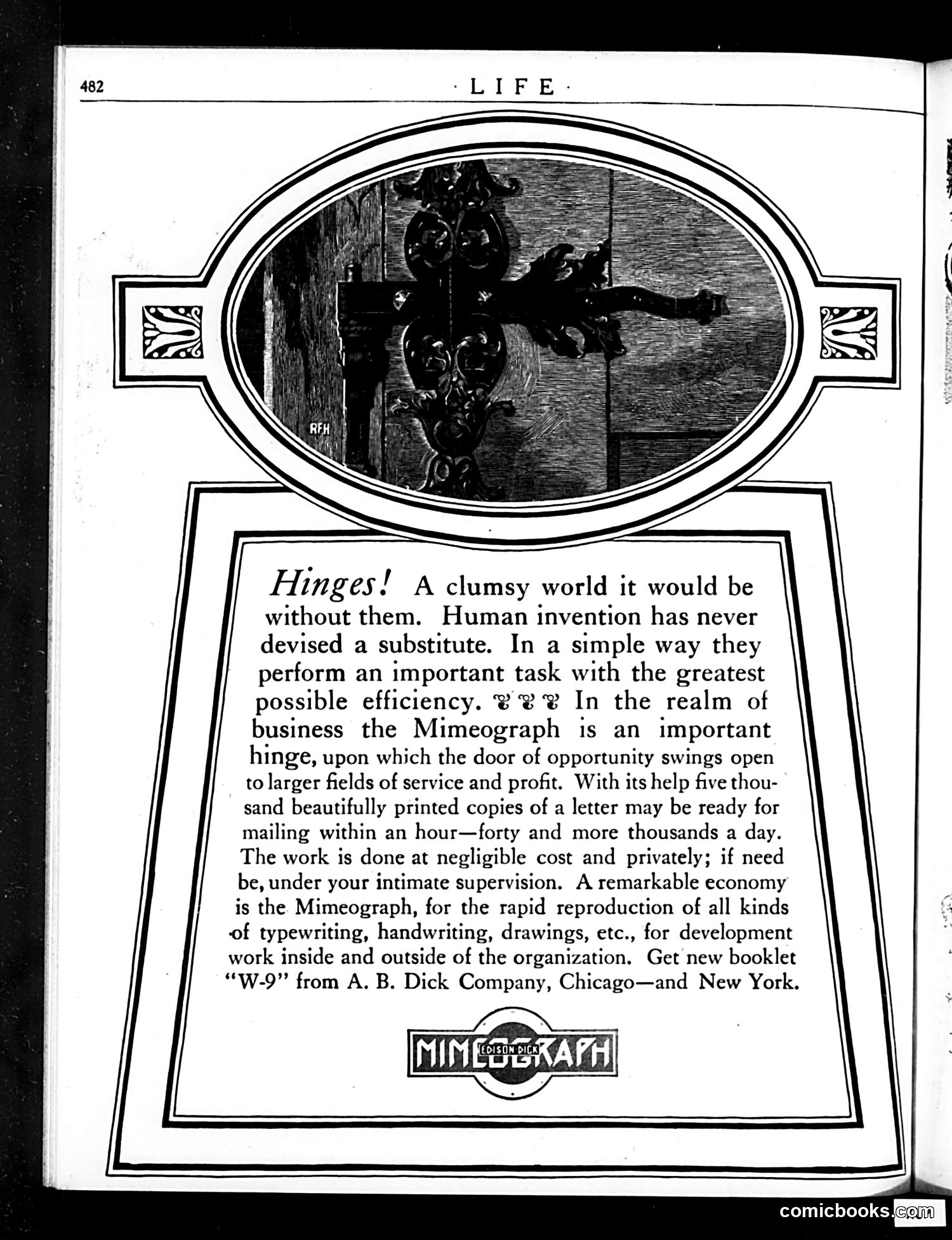
This page is primarily **advertising**, not satire or editorial content. The Mimeograph advertisement occupies most of the space, with only a decorative illustration at the top showing what appears to be ornate hinges on a door. The text uses an extended metaphor comparing hinges to the Mimeograph machine—both are described as essential, efficient devices that enable important functions. The ad claims the Mimeograph is a "hinge" for business opportunity, allowing rapid reproduction of letters, documents, and drawings at minimal cost. The illustration's connection to the text is thematic rather than satirical: it simply visualizes the "hinge" concept to support the product pitch. This is straightforward commercial messaging, not political or social commentary.
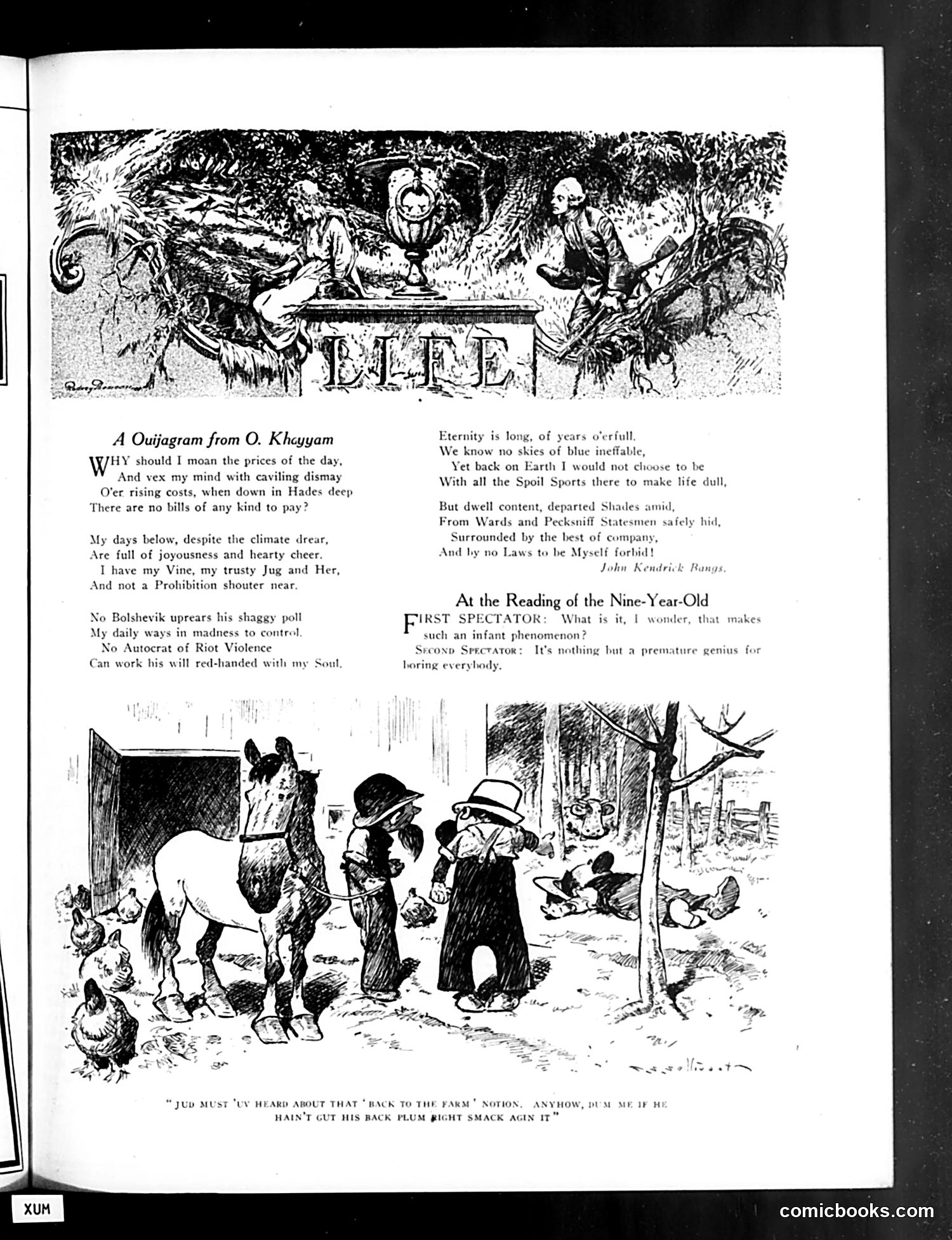
This page contains literary content and illustration rather than political satire. The top section reproduces "A Ouijagram from O. Khayyam"—verses attributed to Omar Khayyam (the medieval Persian poet) combined with commentary by John Kendrick Bangs. The poem expresses contentment with simple pleasures (wine, companionship) despite life's hardships, while mocking Prohibition and Russian communist upheaval ("No Bolshevik uprears his shaggy poll"). The lower illustration titled "At the Reading of the Nine-Year-Old" depicts two adults observing a child's precocious behavior, with a caption about the child's "back to the farm" notion. This appears to be humorous commentary on childhood pretension rather than political satire.
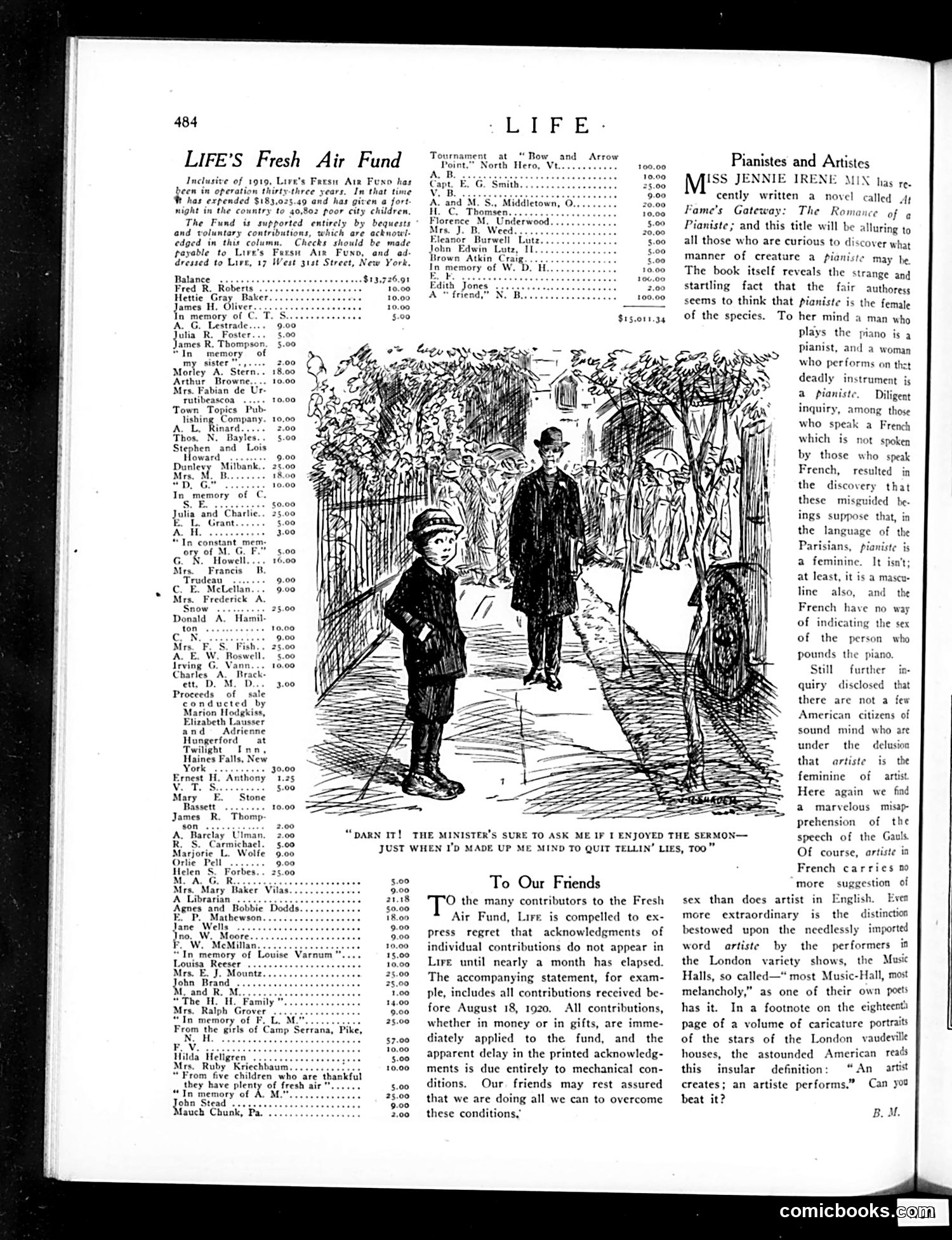
This page contains a satirical cartoon and fundraising material. The main illustration depicts two figures on a street—a small boy in the foreground and a tall man behind him. The caption reads: "DARN IT! THE MINISTER'S SURE TO ASK ME IF I ENJOYED THE SERMON—JUST WHEN I'M MADE UP ME MIND TO QUIT TELLIN' LIES, TOO" **The satire:** The joke targets childhood honesty and religious hypocrisy. The boy has decided to stop lying but fears the minister will force him to choose between truthfulness and politeness—since he clearly didn't enjoy the sermon. It's a gentle commentary on how social conventions (being polite to clergy) can pressure children to abandon their newfound moral commitments. The remainder of the page lists contributors to *Life's* Fresh Air Fund, a charitable initiative providing recreation for poor children.
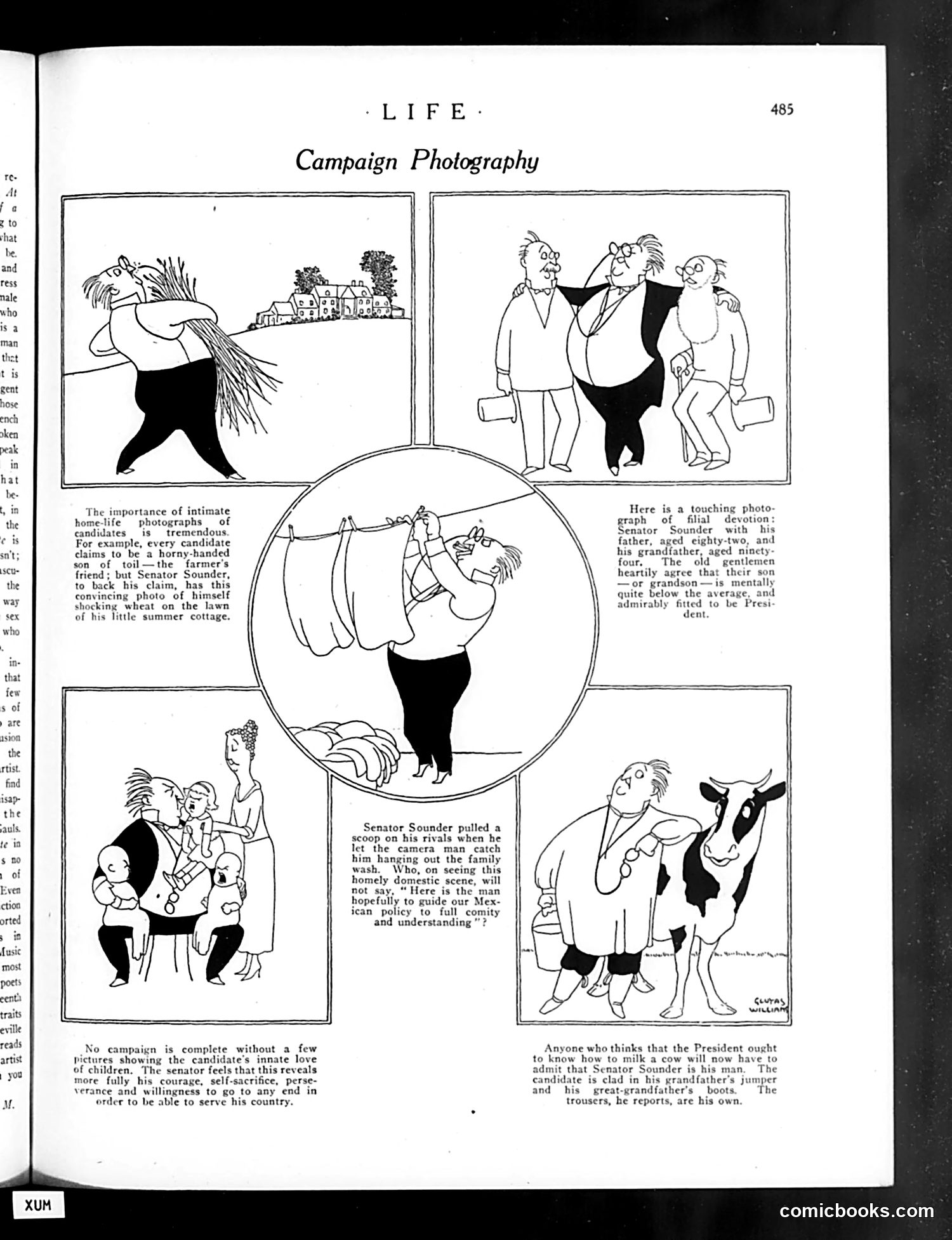
This Life magazine page satirizes political campaign photography practices. The cartoons mock how candidates stage "intimate" photos to appear relatable to voters. The top left shows a candidate photographed shocking wheat on his "little summer cottage"—presenting himself as a working farmer. The top right depicts a candidate posed with children to demonstrate "filial devotion" and family values. The center and bottom panels reference "Senator Sounder," who apparently staged a photo of himself "hanging out the family wash" to appear domestic. The final cartoon shows him milking a cow—suggesting politicians adopt false rural personas for campaign purposes. The satire critiques the artificiality of campaign imagery: candidates adopt costumes and manufactured scenarios to manipulate voters' perceptions of their character and relatability.
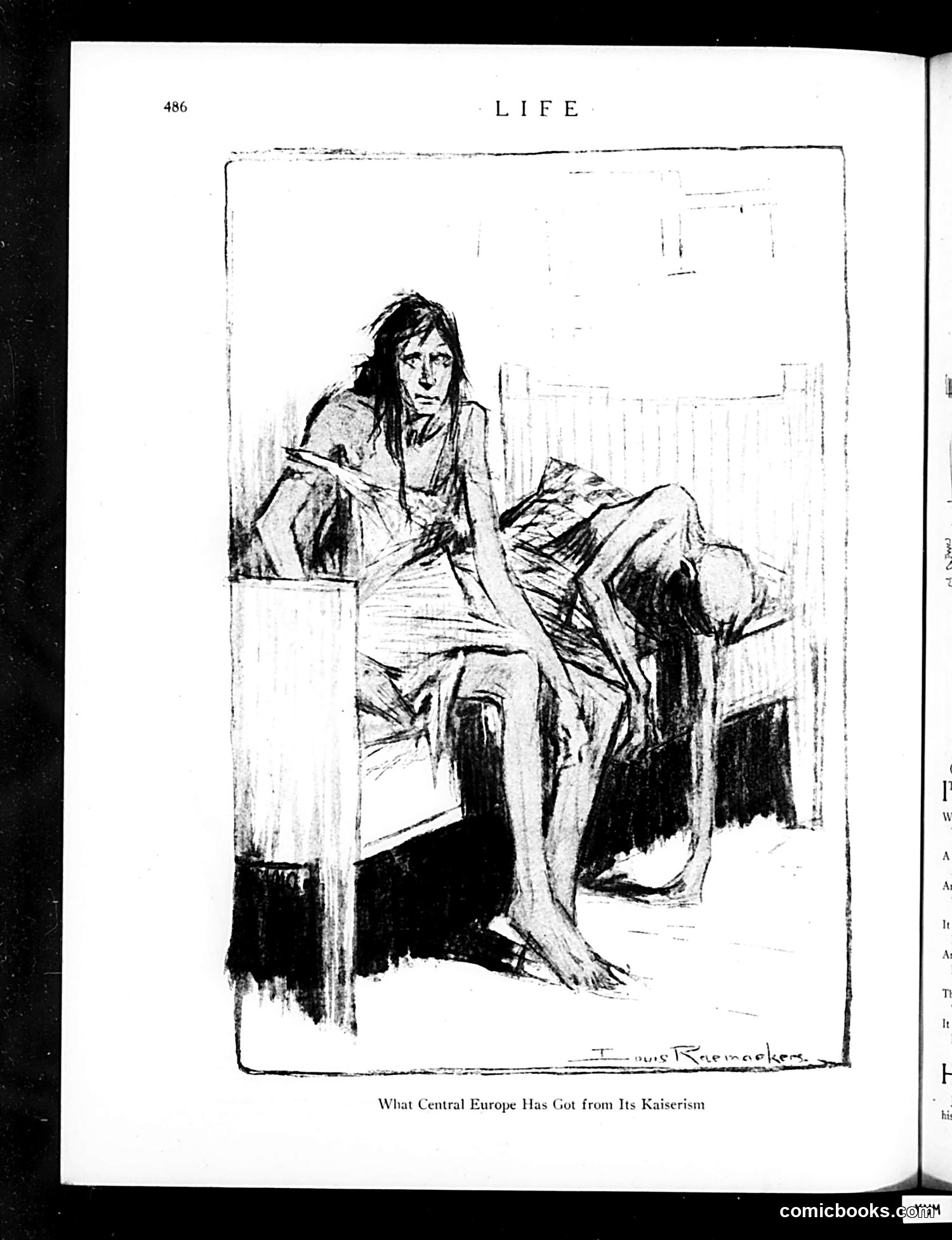
This satirical cartoon from *Life* magazine critiques the consequences of German imperial rule ("Kaiserism") in Central Europe during the early 20th century. The sketch depicts a gaunt, emaciated woman—likely representing Central Europe or a Central European nation—sitting in a chair, appearing starved and suffering. Her thin frame and distressed expression suggest deprivation and hardship. The satire argues that German imperial dominance under the Kaiser brought poverty and suffering rather than prosperity to the region. This reflects anti-German sentiment common in American publications, particularly during or after World War I, when German military and political influence over Central European territories was widely viewed as exploitative and destructive.
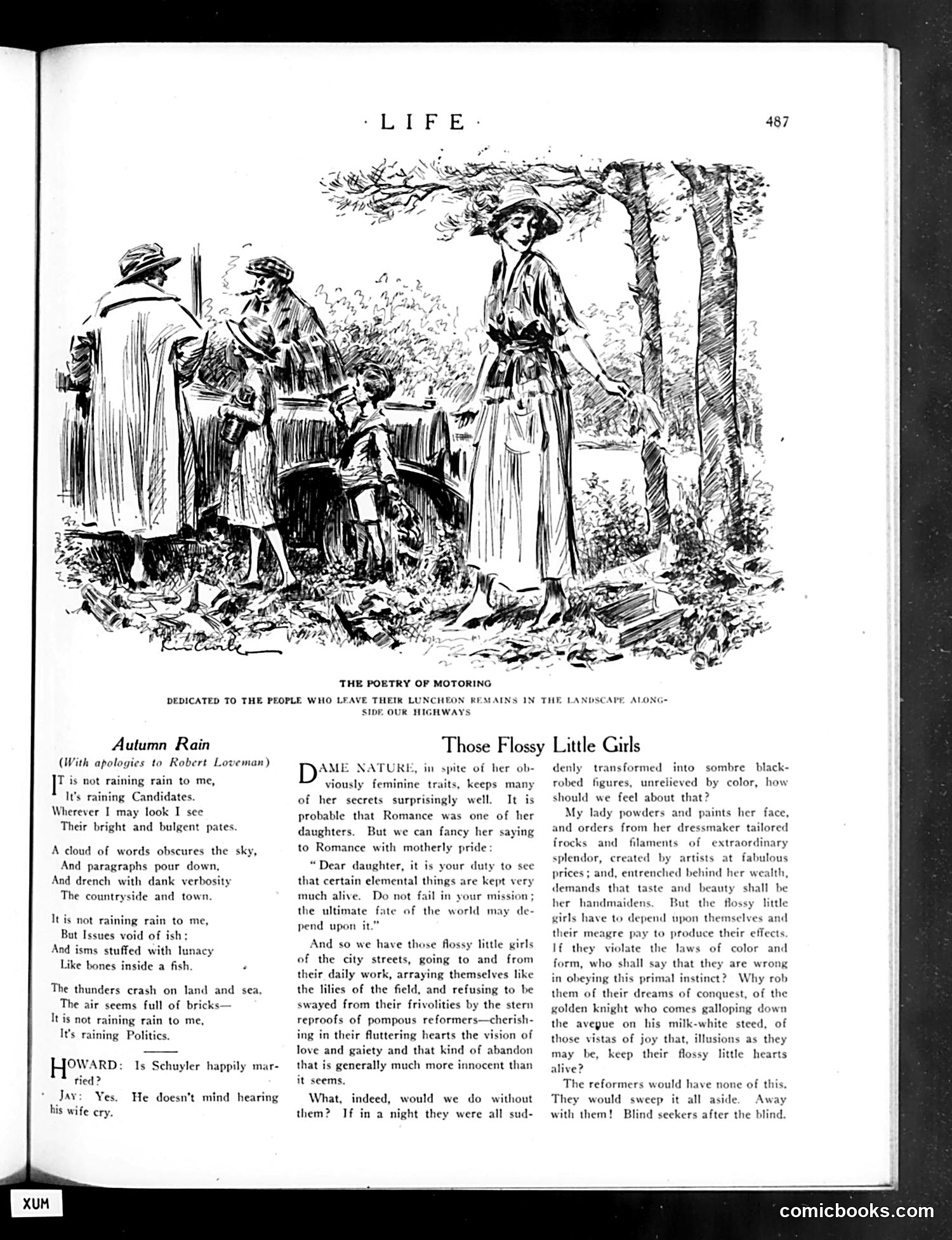
This page contains two distinct pieces: **"Autumn Rain"** is a poem (with "apologies to Robert Loveman") that humorously complains about rainy weather through various metaphors—clouds, paragraphs, issues, thunderstorms, and politics. **The main illustration and article** titled "The Poetry of Motoring" is dedicated satirically "to the people who leave their luncheon remains in the landscape alongside our highways." The sketch shows well-dressed women and children in a woodland picnic setting. The accompanying essay titled "Those Flossy Little Girls" critiques upper-class women who engage in outdoor motor trips, sarcastically praising their romantic notions while implicitly mocking their littering and refined pretensions. The satire targets the disconnect between these women's self-image and their actual behavior toward the natural landscape.
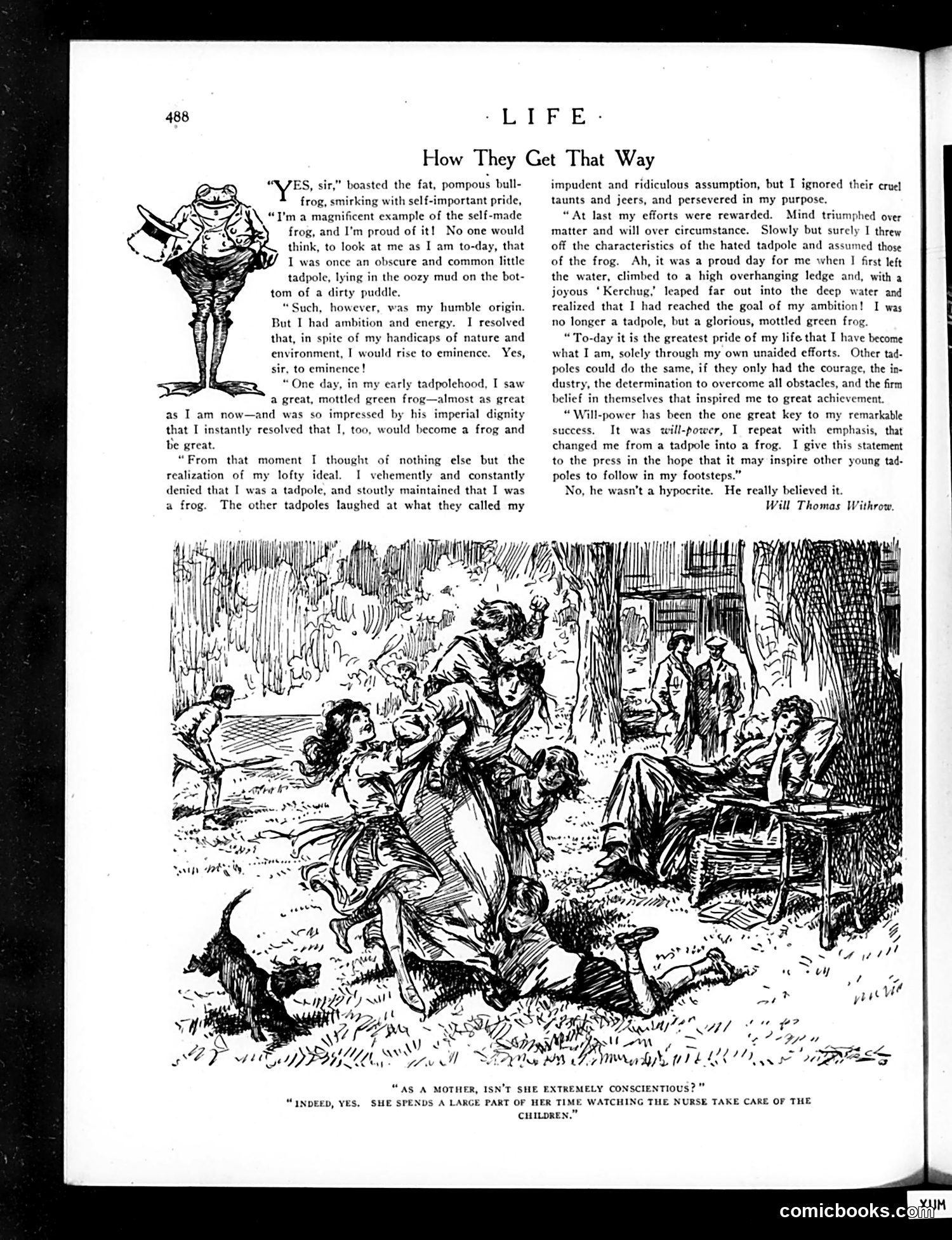
This is a fable about ambition and self-improvement. A tadpole, born in "obscure mud," dreams of becoming a great frog. Despite ridicule from other tadpoles, he persists through determination and "will-power," eventually transforming into a distinguished frog. The bottom illustration depicts a domestic scene where a mother watches a nurse tend children, suggesting the story's moral applies to human society too—that proper care and development (like a tadpole's transformation) produces respectable adults. The satire gently mocks self-made success narratives while endorsing the era's belief in personal determination and proper upbringing. It's a motivational parable for Life magazine's readers, celebrating the idea that humble origins needn't limit one's future if you possess sufficient will and ambition.
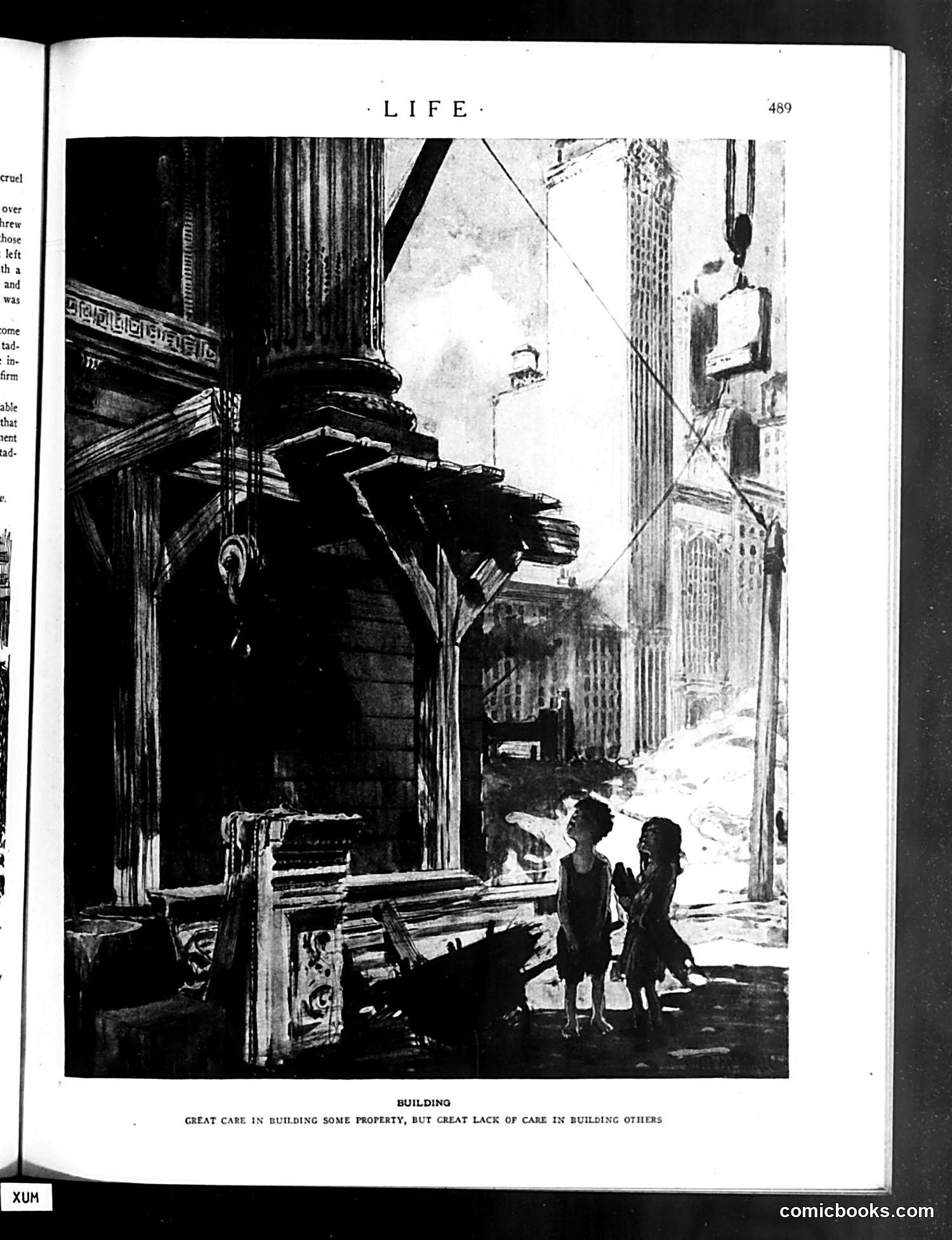
This page features a photograph rather than a cartoon, showing two children standing in a dilapidated urban alley or courtyard surrounded by deteriorating buildings. The caption reads: "BUILDING: GREAT CARE IN BUILDING SOME PROPERTY, BUT GREAT LACK OF CARE IN BUILDING OTHERS." The image is social commentary on economic inequality and urban housing conditions. It contrasts wealthy property development (implicitly receiving investment and maintenance) against slum housing where poor residents, represented by the children, live in squalid, neglected conditions. The satire highlights the hypocrisy and indifference of property owners and urban developers who lavish resources on some structures while allowing others to decay dangerously—a critique of class disparity in early 20th-century American cities.
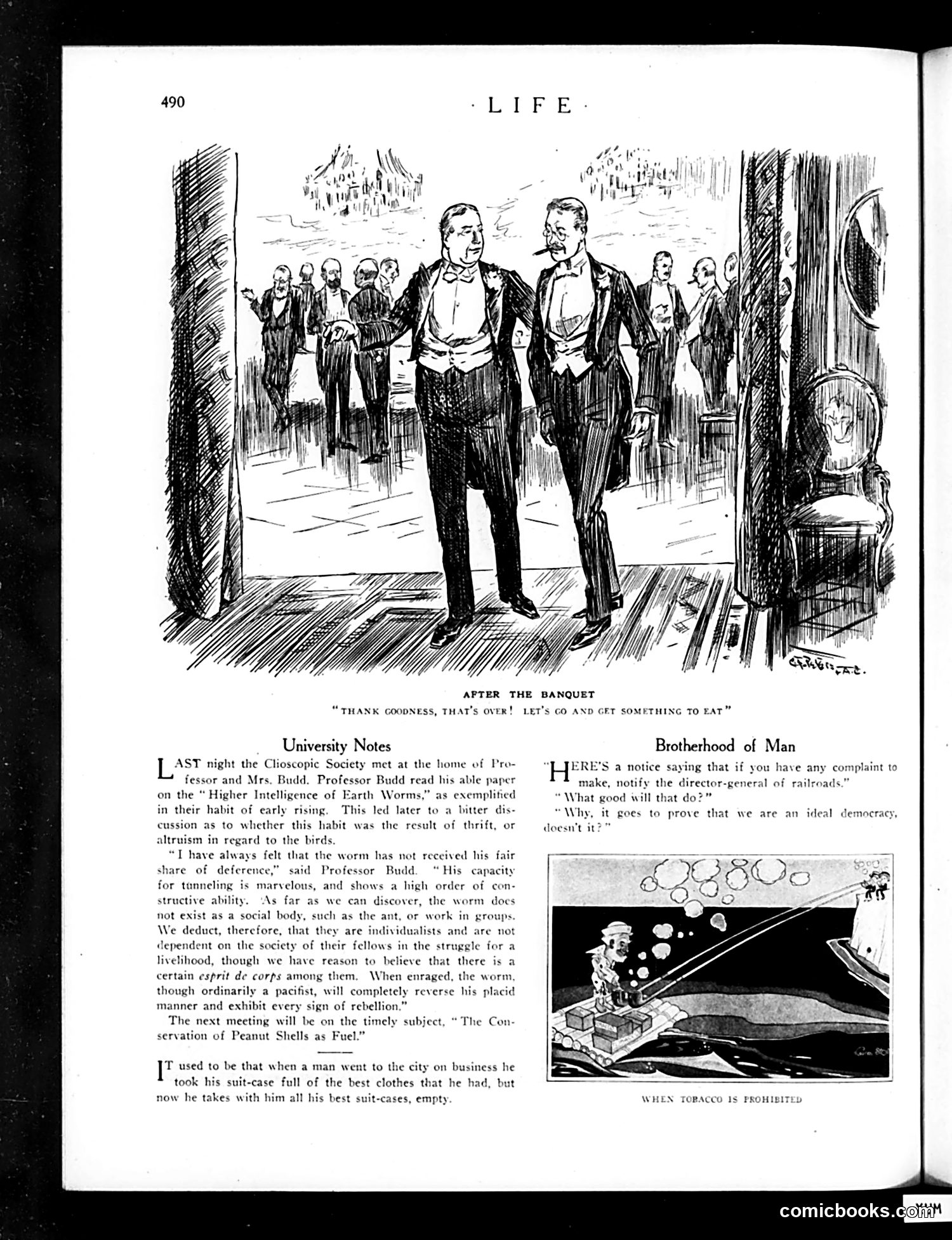
The top cartoon depicts two well-dressed men in formal attire leaving a banquet, with one saying "Thank goodness, that's over! Let's go and get something to eat." This satirizes tediously long formal dinners where the food is inadequate or unsatisfying—a common complaint about elite social obligations. The lower section contains two distinct pieces: "University Notes" discusses the Chiosophic Society debating earthworms' intelligence, satirizing academic pedantry. "Brotherhood of Man" includes a notice about railroad complaints procedures, mocking bureaucratic inefficiency, alongside a cartoon labeled "When Tobacco is Prohibited" showing humorous consequences of tobacco prohibition—likely referencing early 20th-century prohibition debates.
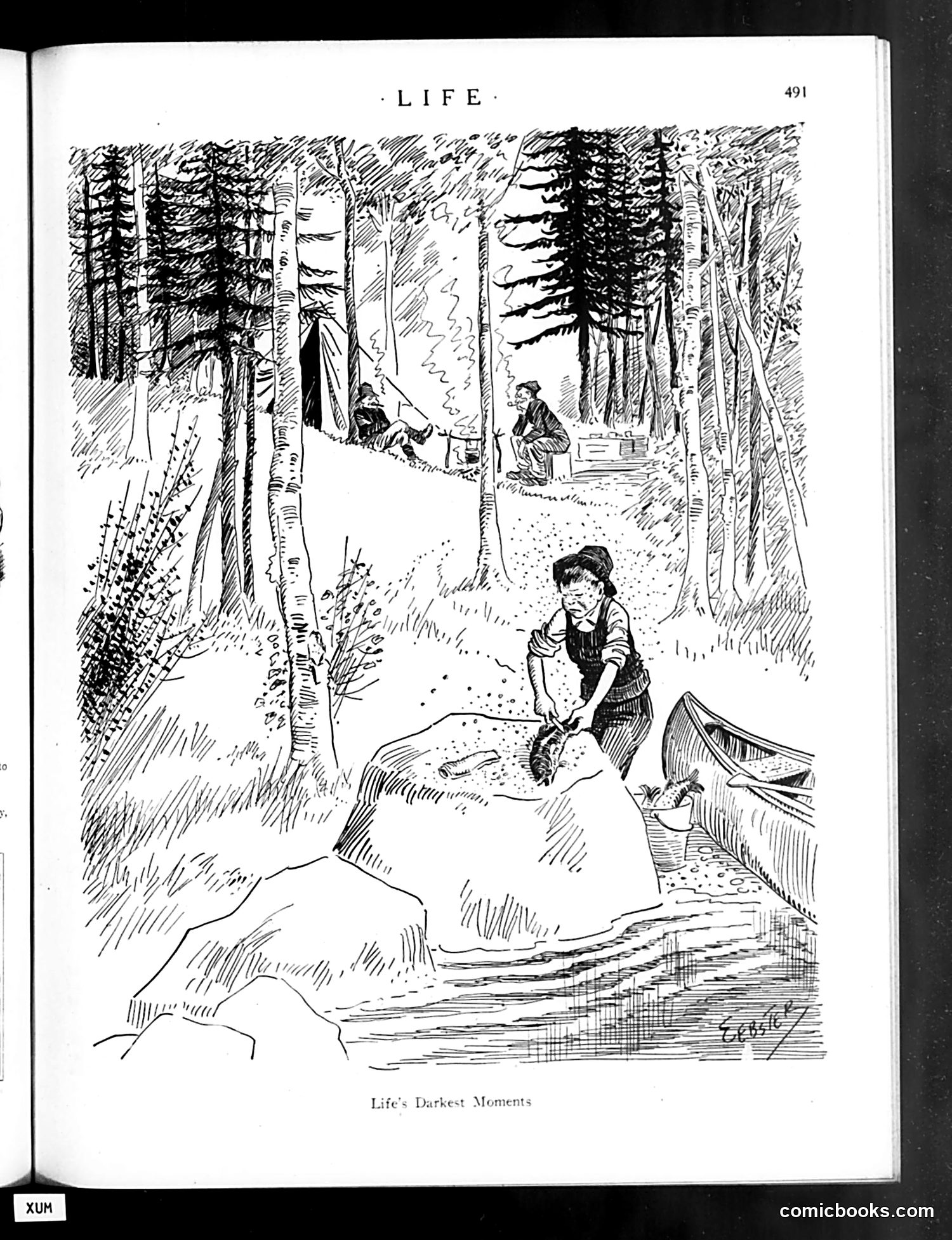
This illustration depicts a camping or wilderness scene where a man in the foreground is digging or working with a shovel near a tent and stream. Two other figures are visible in the background among tall trees. The caption reads "Life's Darkest Moments." The satire appears to comment on the difficulties and hardships of camping or outdoor recreation—activities that were becoming popular leisure pursuits in early 20th-century America. The phrase "darkest moments" suggests irony: what should be an enjoyable escape into nature becomes grueling physical labor and discomfort. The sketch mocks the romanticized notion of wilderness camping by showing its unglamorous reality: hard work, primitive conditions, and tedious tasks rather than relaxation or adventure.
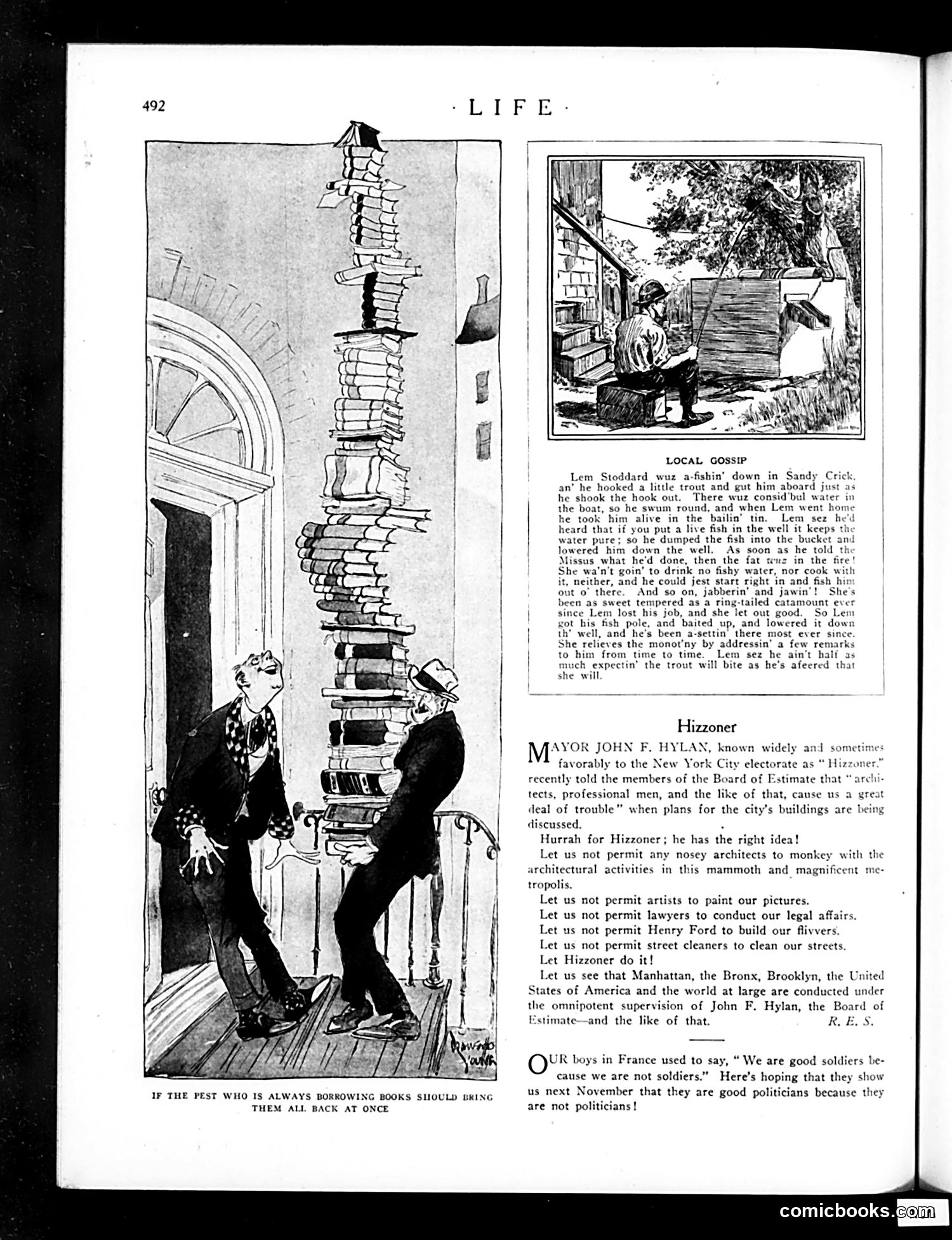
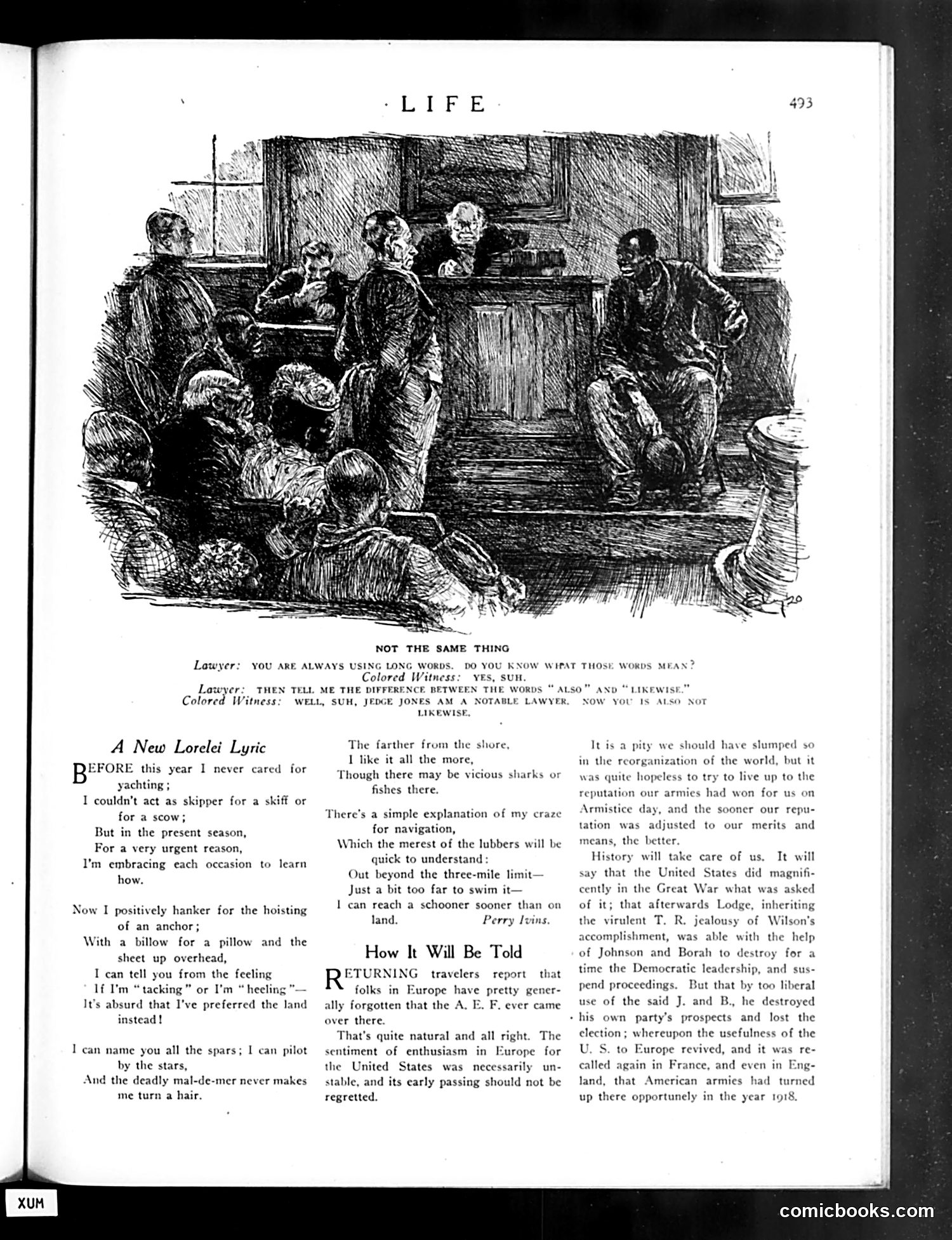
The page contains two distinct pieces: **Top Cartoon - "Not the Same Thing":** A courtroom scene depicting a lawyer questioning a Black witness about vocabulary. The lawyer asks if the witness knows what "long words" mean, specifically requesting the difference between "also" and "likewise." The witness responds affirmatively, then the lawyer notes that Judge Jones is "a notable lawyer" who is "also not likewise"—a nonsensical, patronizing exchange. This is racial satire mocking the courtroom's condescension toward a Black witness, treating him as intellectually inferior while using deliberately absurd logic to humiliate him. **"A New Lorelei Lyric":** A poem about suddenly taking up yachting, with the punchline suggesting the speaker wants to escape to international waters (beyond the three-mile limit) to avoid legal jurisdiction—likely referencing Prohibition-era bootlegging or tax evasion. **"How It Will Be Told":** Commentary on postwar European attitudes toward American soldiers, suggesting Americans' wartime heroism would be forgotten and their reputation would decline.
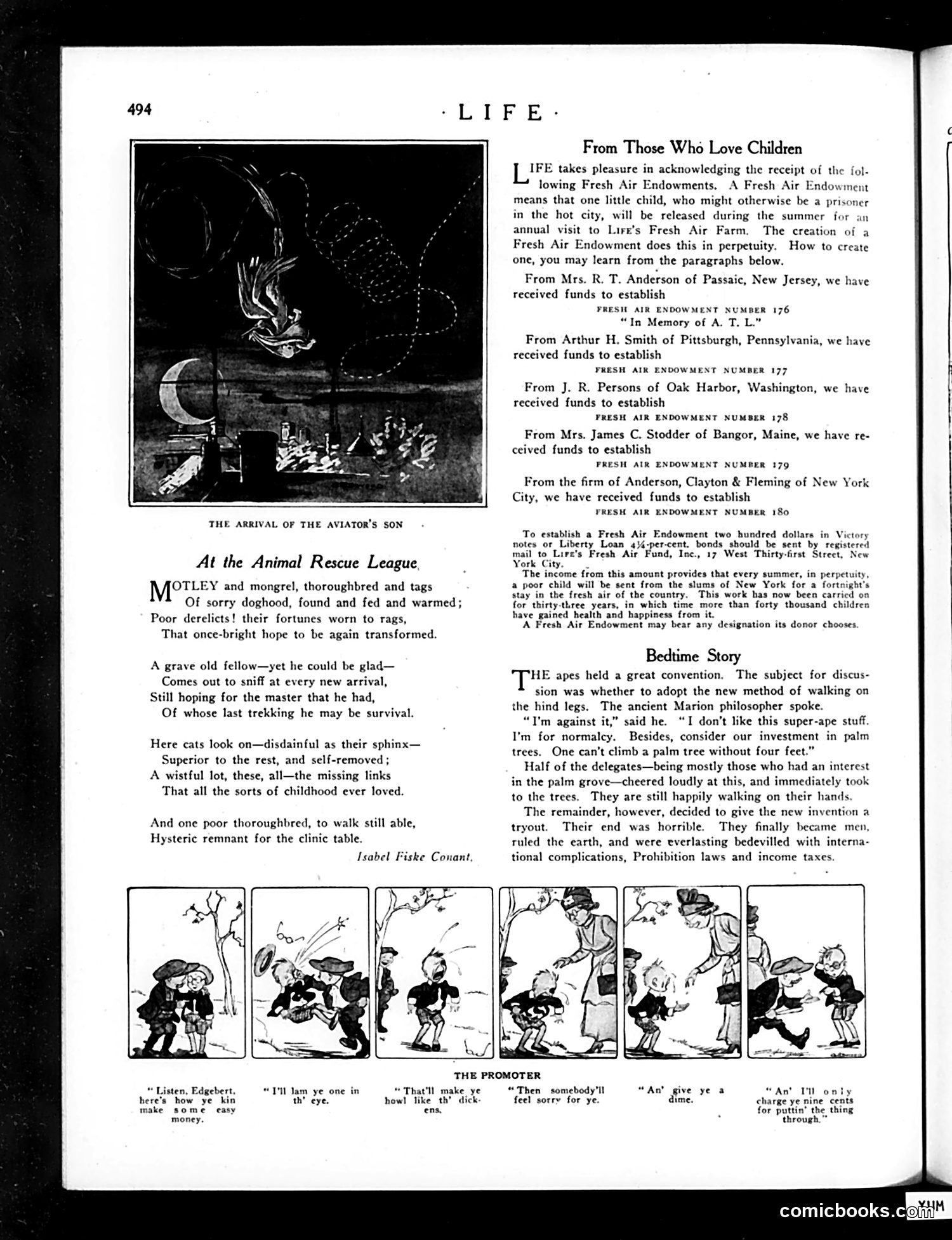
This page contains three distinct satirical pieces: **"The Arrival of the Aviator's Son"** presents a sentimental poem about animals at a rescue league—dogs hoping for lost masters, dignified cats observing, and suffering creatures awaiting clinic care. The title's irony is unclear from the image alone, but the poem celebrates compassion for abandoned animals. **"From Those Who Love Children"** announces the Life magazine Fresh Air Fund, which sponsors poor urban children's summer stays in the countryside. It lists donors establishing endowments (numbered 176-180) in perpetuity, requesting $200 donations. This represents Progressive-era charity work, helping city children escape tenement heat. **"Bedtime Story"** satirizes evolutionary progress and modern civilization. Apes debate walking upright; those invested in palm trees (the status quo) resist change. Those who evolve become humans, gaining "international complications, Prohibition laws and income taxes"—implying modernity brings bureaucratic misery rather than advancement. **"The Promoter"** shows a con artist teaching a boy to make money through deception, likely critiquing get-rich-quick schemes.
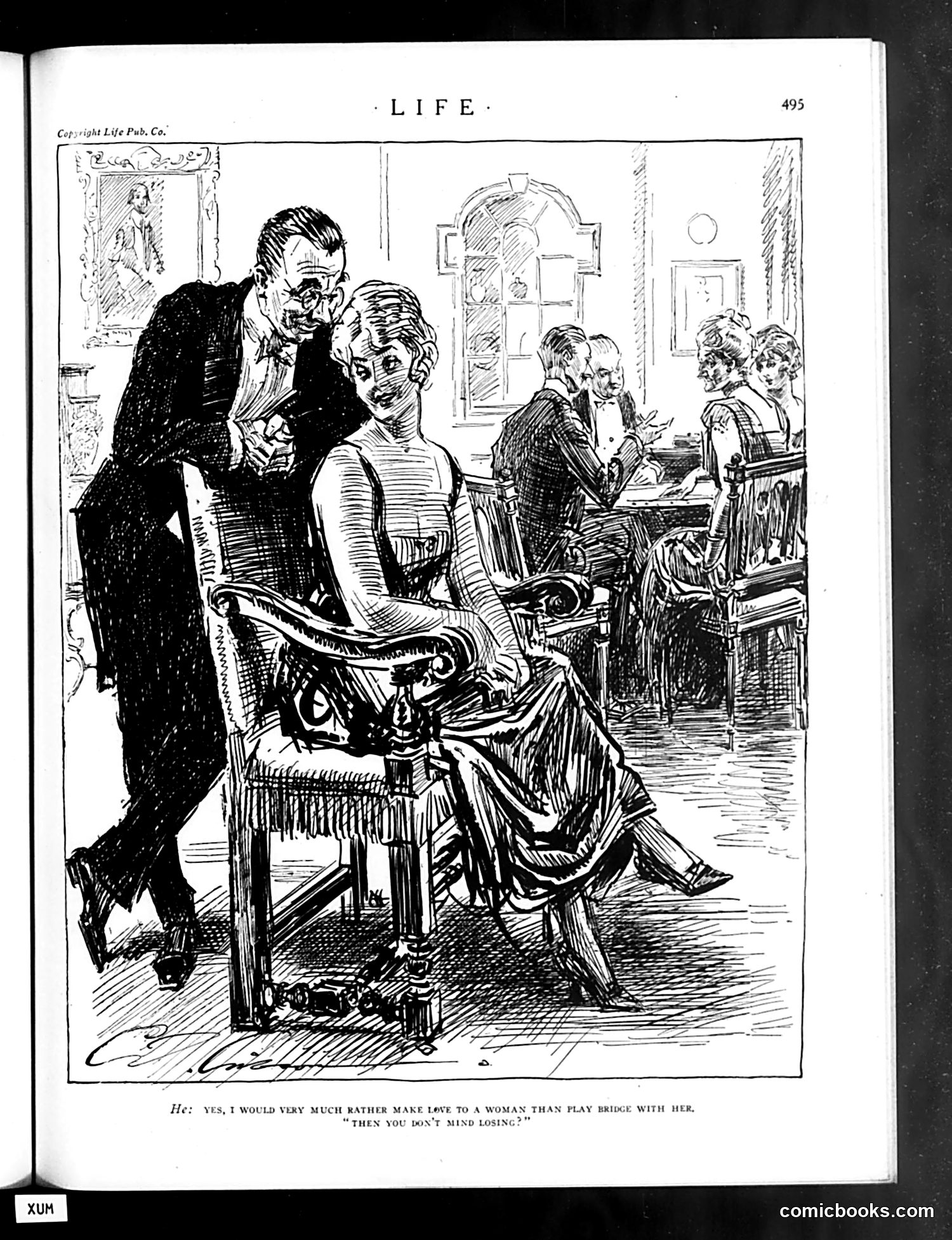
This is a single-panel cartoon satirizing gender relations and leisure activities among the upper class. A man, surrounded by socialites at what appears to be a formal gathering, makes a flirtatious declaration to a woman that he'd prefer romance to playing bridge (a popular card game of the era). Her witty response—"Then you don't mind losing?"—contains a double meaning: she's simultaneously implying that romance with her would result in his defeat, and perhaps suggesting that choosing romance over bridge means he'll lose at the card game itself. The joke hinges on the woman's cleverness in turning his flirtation into a sharp retort, reflecting early-twentieth-century satirical humor about courtship, competition, and female wit in high society.
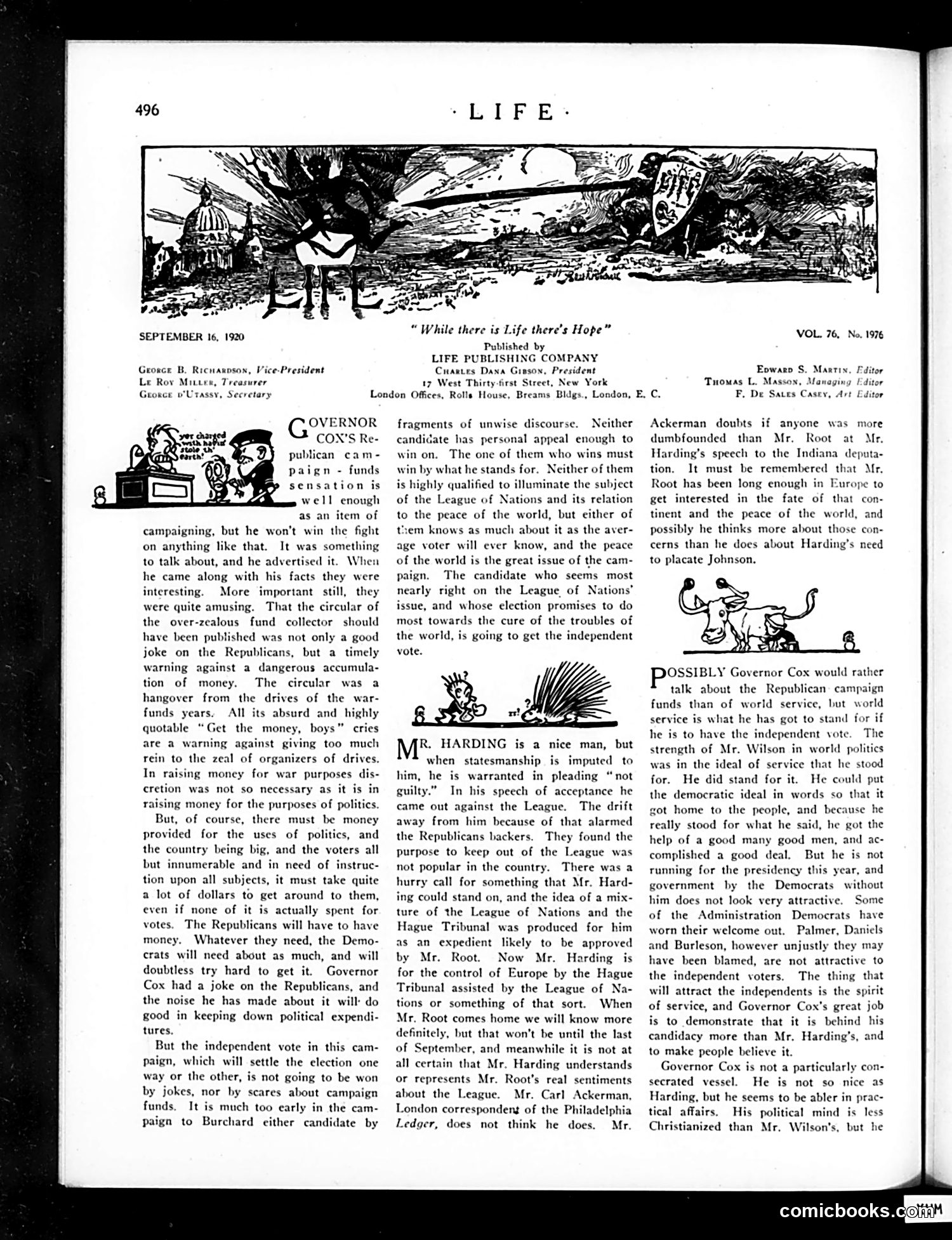
This editorial page critiques the 1920 presidential campaign, particularly Republican candidate Warren G. Harding and his handling of the League of Nations issue. **The Figures:** - "Governor Cox" (Democratic candidate James M. Cox) is praised for exposing Republican campaign fund-raising excesses - "Mr. Harding" (Republican candidate Warren G. Harding) is criticized as unprepared on major issues - "Mr. Root" (likely Elihu Root, Republican elder statesman) appears to be secretly controlling Harding's League of Nations position **The Satire:** Life argues that while Cox scored a political joke exposing GOP fundraising impropriety, the real election will be decided by substantive policy positions, not scandal. The magazine suggests Harding lacks genuine conviction on the League of Nations—the campaign's central issue—and that his stated position is actually a compromise fabricated by Root to make Harding more electable. **Key Context:** The 1920 election centered on post-WWI foreign policy, particularly U.S. participation in the League of Nations, which remained deeply controversial among Republicans and the American electorate.
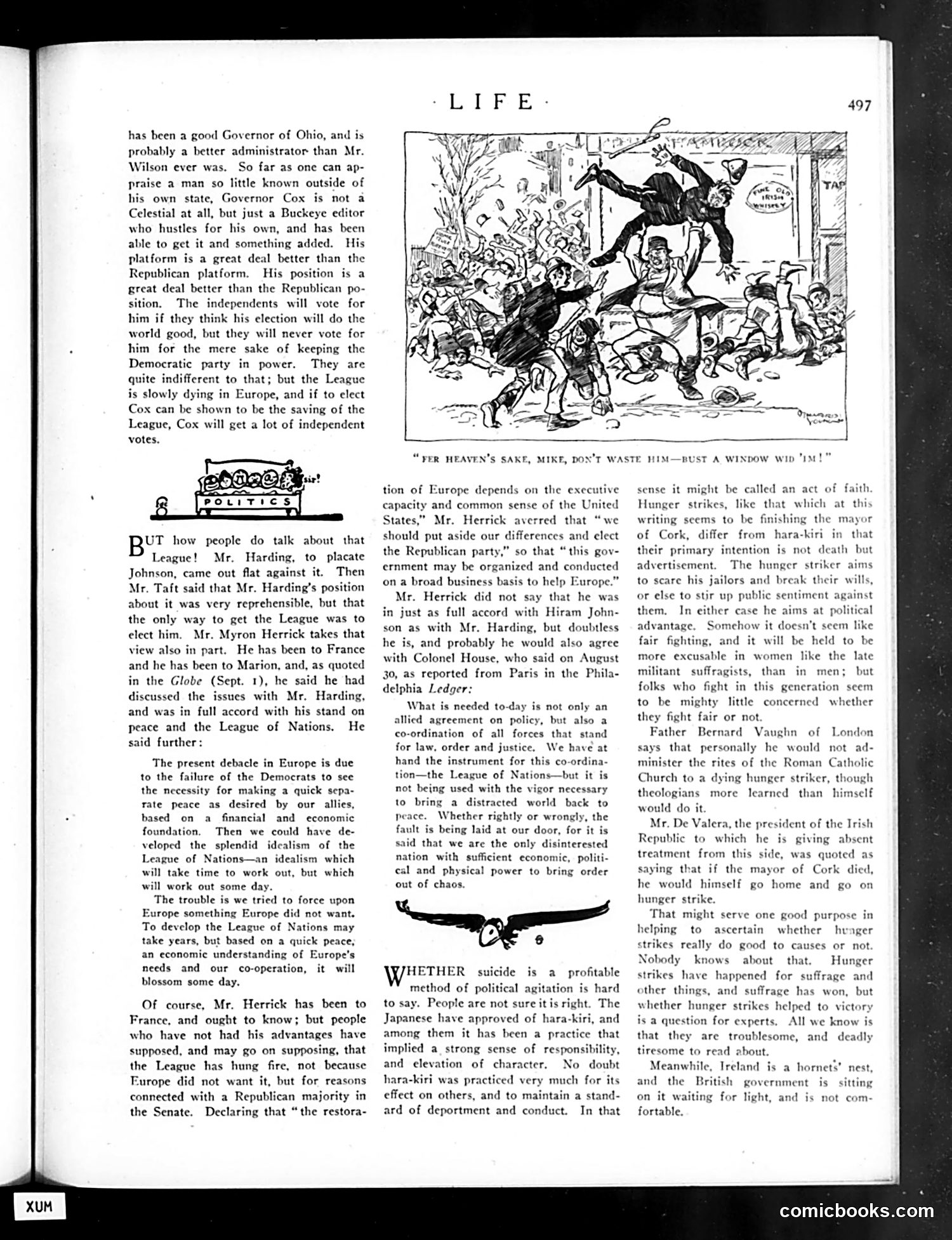
## Main Cartoon The illustration depicts a chaotic street scene with a figure (likely representing a political agitator or striker) being physically restrained or attacked by police and civilians. The caption reads "FER HEAVEN'S SAKE, MIKE, DON'T WASTE HIM—BUST A WINDOW WID 'IM!" This appears to satirize violent protest tactics and street disorder, mocking both the agitators and the response to them. ## Political Context The page discusses the 1920 U.S. presidential election, contrasting Democrat James Cox's platform favorably with Republican Warren Harding's stance on the League of Nations. The text critiques Republican claims that only they can restore European order, sarcastically suggesting that Republicans in the Senate actually blocked League action. ## The Satire's Point The cartoon and accompanying text together mock the futility and chaos of radical political agitation (possibly labor strikes or radical activism) while simultaneously criticizing Republican hypocrisy about international peace efforts. The cartoon's crude humor undercuts claims that disorder serves any legitimate political purpose.
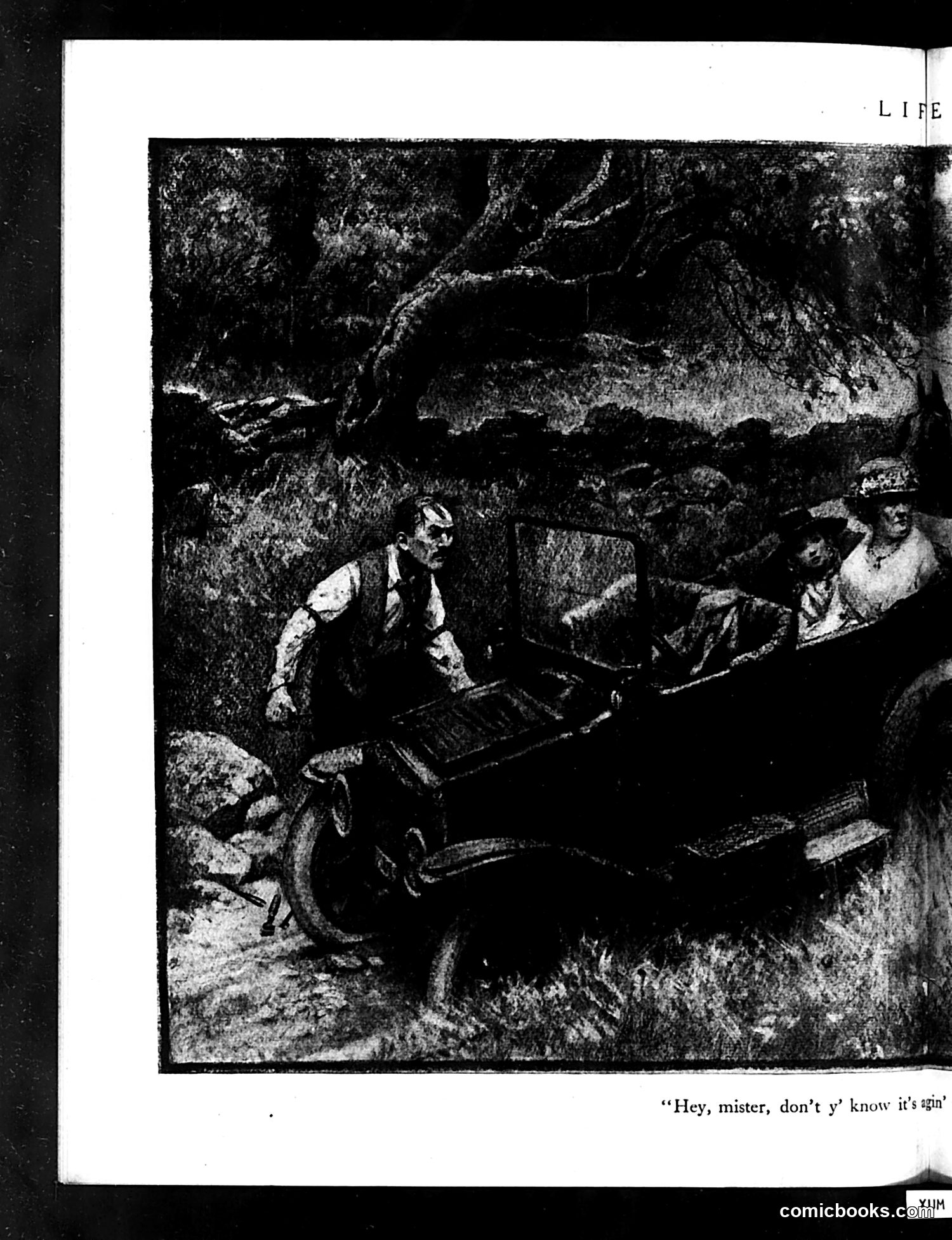
This appears to be a cartoon from Life magazine satirizing attitudes toward mining or industrial labor. The scene shows workers in what looks like a mine or quarry, with one figure (appearing to be an authority figure or foreman on the left) confronting others. The incomplete caption—"Hey, mister, don't y' know it's agin'"—suggests someone is breaking an unwritten rule or law, likely about workplace conditions or labor practices. The garbled OCR text at the bottom ("comicbooks.cemal") prevents full interpretation of the caption's meaning. However, the cartoon appears to mock either worker ignorance of regulations, or conversely, the absurdity of workplace restrictions. The dark, rough artistic style emphasizes the gritty working conditions depicted. Without the complete caption, the specific political or social critique remains unclear.
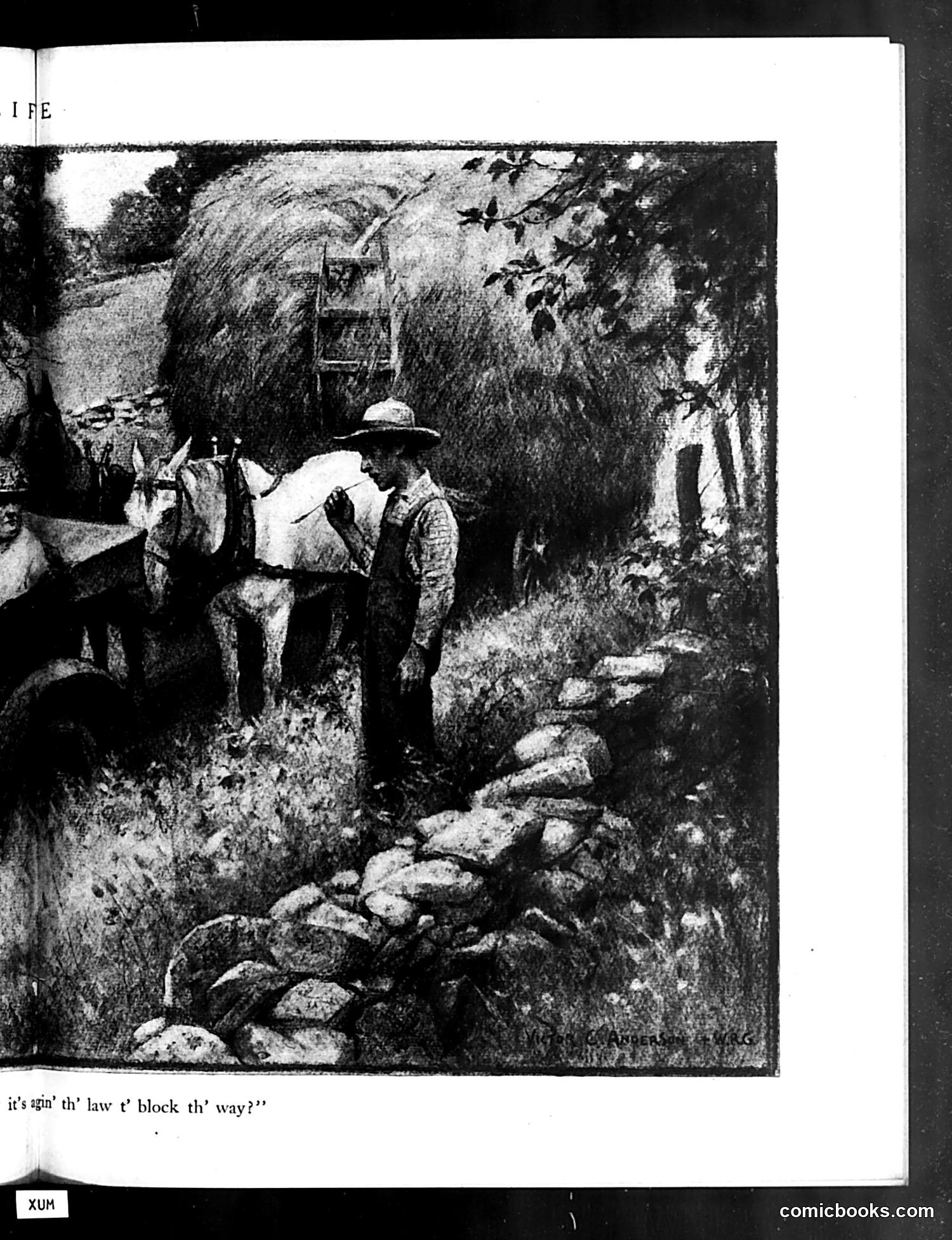
This appears to be a satirical cartoon from Life magazine depicting a rural or frontier scene. A man in a hat stands before what looks like a barricade or obstruction made of rocks, with the caption reading: "it's agin' th' law t' block th' way?" The cartoon uses dialectal speech ("agin'" for "against," "'t'" for "to") to characterize a rural or working-class speaker questioning whether blocking a passage is illegal. The satire likely comments on disputes over property rights, obstruction, or access—possibly referencing contemporary legal or regulatory conflicts. Without additional context about Life magazine's publication date or surrounding content, the specific political situation remains unclear, though the humor derives from the tension between informal frontier justice and formal law.
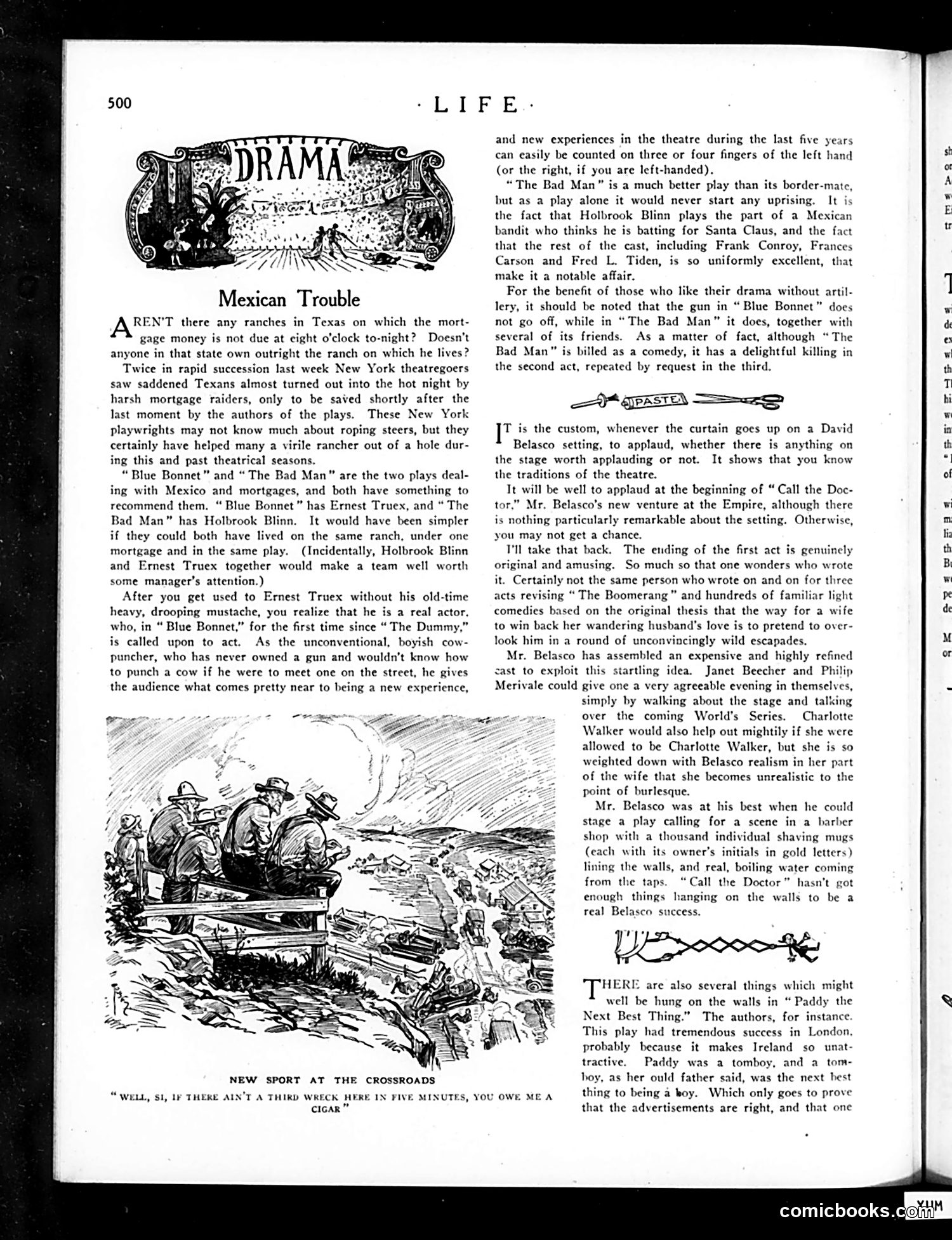
This page reviews two contemporary Broadway plays set in Mexico/Texas dealing with ranchers facing mortgage foreclosure: "Blue Bonnet" (starring Ernest Truex) and "The Bad Man" (starring Holbrook Blinn). The critic humorously notes that New York playwrights, despite knowing little about actual ranching, have become skilled at dramatically saving fictional Texans from mortgage disaster. The plays represent a theatrical trend capitalizing on "Mexican trouble" as dramatic material. The cartoon "New Sport at the Crossroads" depicts two men at a rural intersection, one betting they'll see a third car wreck within five minutes—satirizing the era's increasing automobile accidents as casual entertainment, reflecting 1910s-20s concerns about the automobile's danger to public safety.
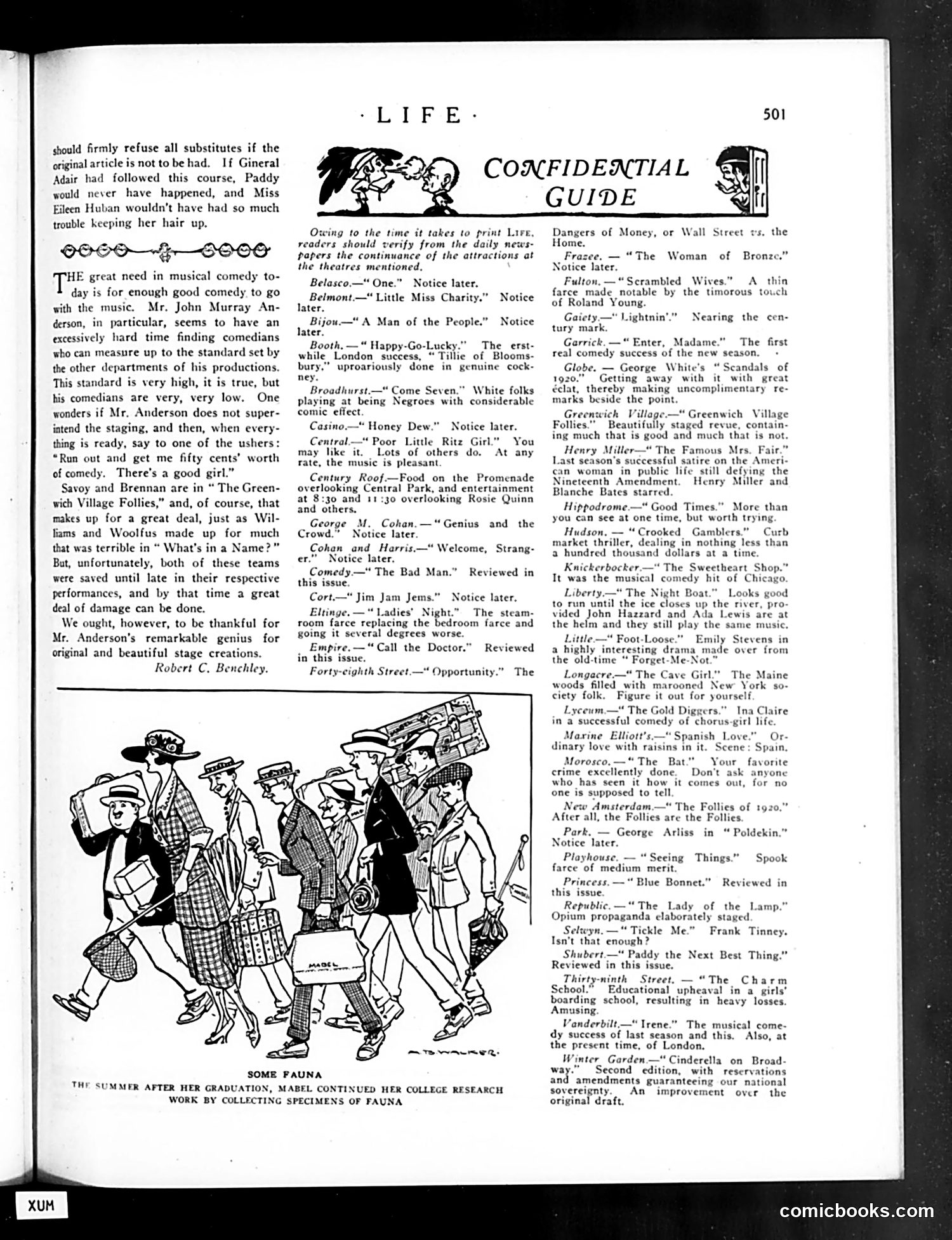
This page from Life magazine (date unclear from image) contains theater reviews disguised as a "Confidential Guide" to Broadway productions. The opening article by Robert C. Benchley critiques musical comedy, particularly John Murray Anderson's productions, arguing they lack sufficient comedy to match their music and staging quality. Benchley humorously suggests Anderson simply tells ushers to "run out and get me fifty cents' worth of comedy." The bulk of the page lists current Broadway shows with brief notices—"The Scandals of 1920," "Greenwich Village Follies," "Lightnin'," and others—offering capsule reviews. The cartoon below, captioned "Some Fauna," depicts a woman collecting theatrical "specimens" after college, satirizing perhaps both academic pretension and theatergoers' obsessive interest in Broadway productions. The satire targets both theatrical mediocrity and the theater-obsessed culture of 1920s New York.
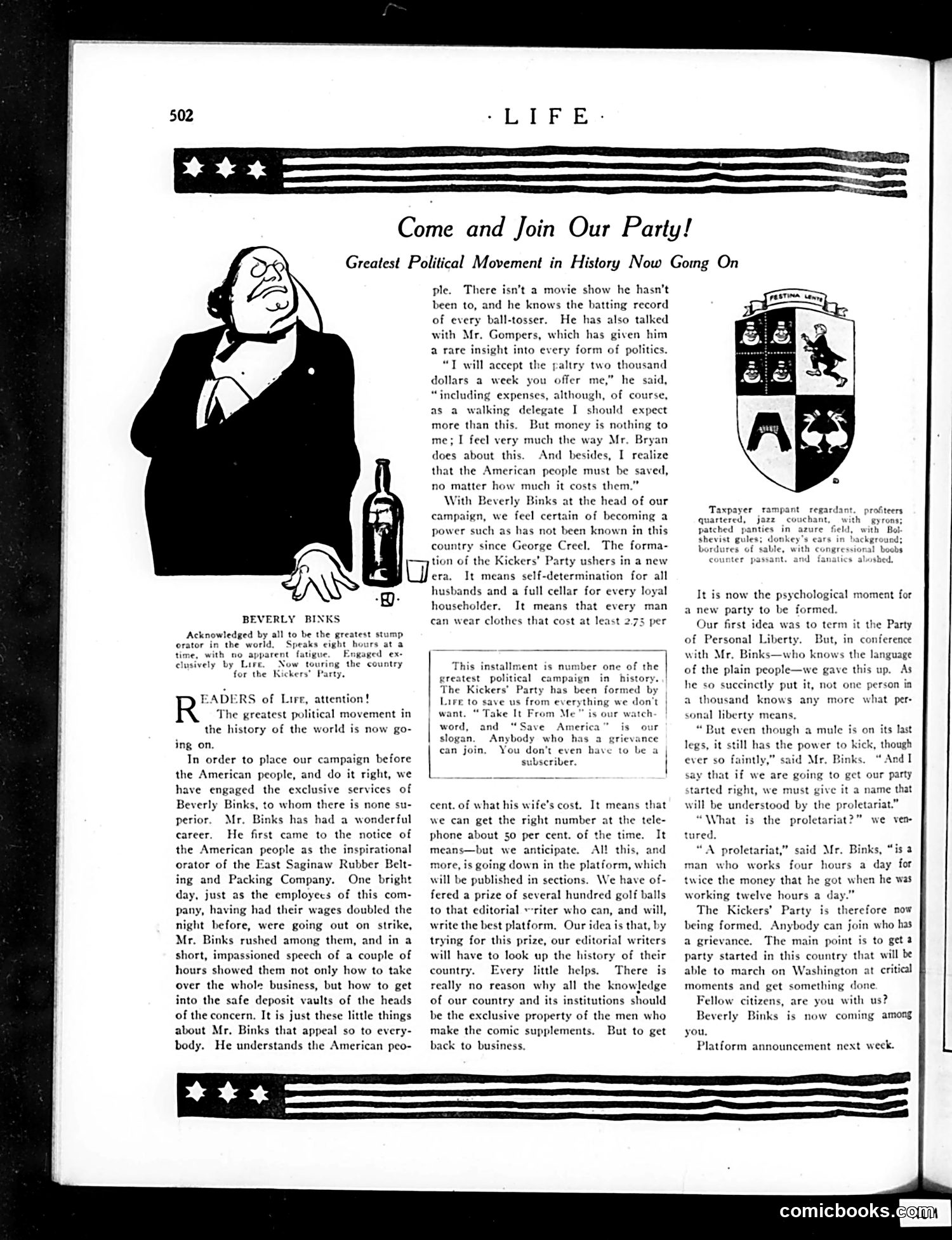
This Life magazine page satirizes the proliferation of new political parties and charismatic but vacuous campaign figures in early 20th-century America. The "Kickers' Party," presented as a genuine movement, is clearly a fictional parody. Beverly Binks—a caricatured demagogue—exemplifies the type: a bombastic orator who speaks for hours, appeals to working-class grievances, and makes grandiose promises (full cellars, cheaper clothes, better phone connections) without substance. The satire targets several things: the ease with which new parties form around personality rather than principle; the gap between flowery rhetoric and actual policy; and the public's susceptibility to manipulation. References to George Creel (WWI propagandist), Gompers (labor leader), and Bryan (populist) ground the mockery in real political figures and movements. The absurd heraldic coat-of-arms and promise that "anybody" can join without being a subscriber emphasize the frivolousness of the enterprise. Life is mocking both gullible voters and opportunistic politicians—a timeless satirical target.
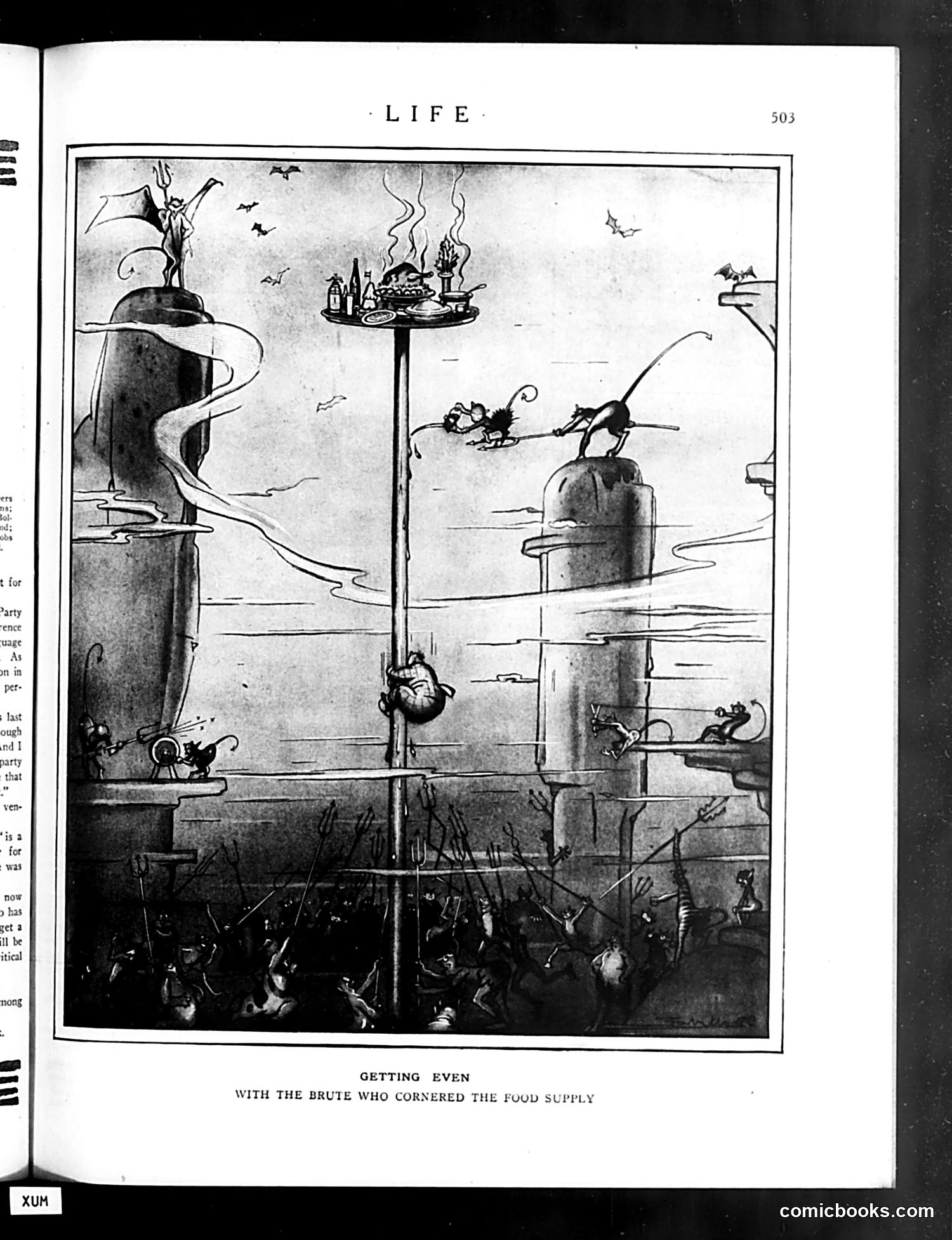
This is a satirical cartoon from *Life* magazine depicting an underground scene of conflict over food resources. The title "Getting Even with the Brute Who Cornered the Food Supply" suggests economic or wartime rationing concerns. The illustration shows anthropomorphized animals (rats and mice appear prominent) in what seems to be a subterranean setting with industrial or storage structures above. The "brute" likely represents either a greedy merchant, hoarder, or possibly a political figure accused of monopolizing food during scarcity. The cartoon's message appears to satirize food hoarding or black-market activity, showing the common people's retaliatory response to those who controlled essential supplies. Without a specific date visible, the exact historical context—whether WWI, Depression-era, or another period of shortage—remains unclear, though the industrial imagery and rationing theme suggest early-to-mid 20th century concerns.
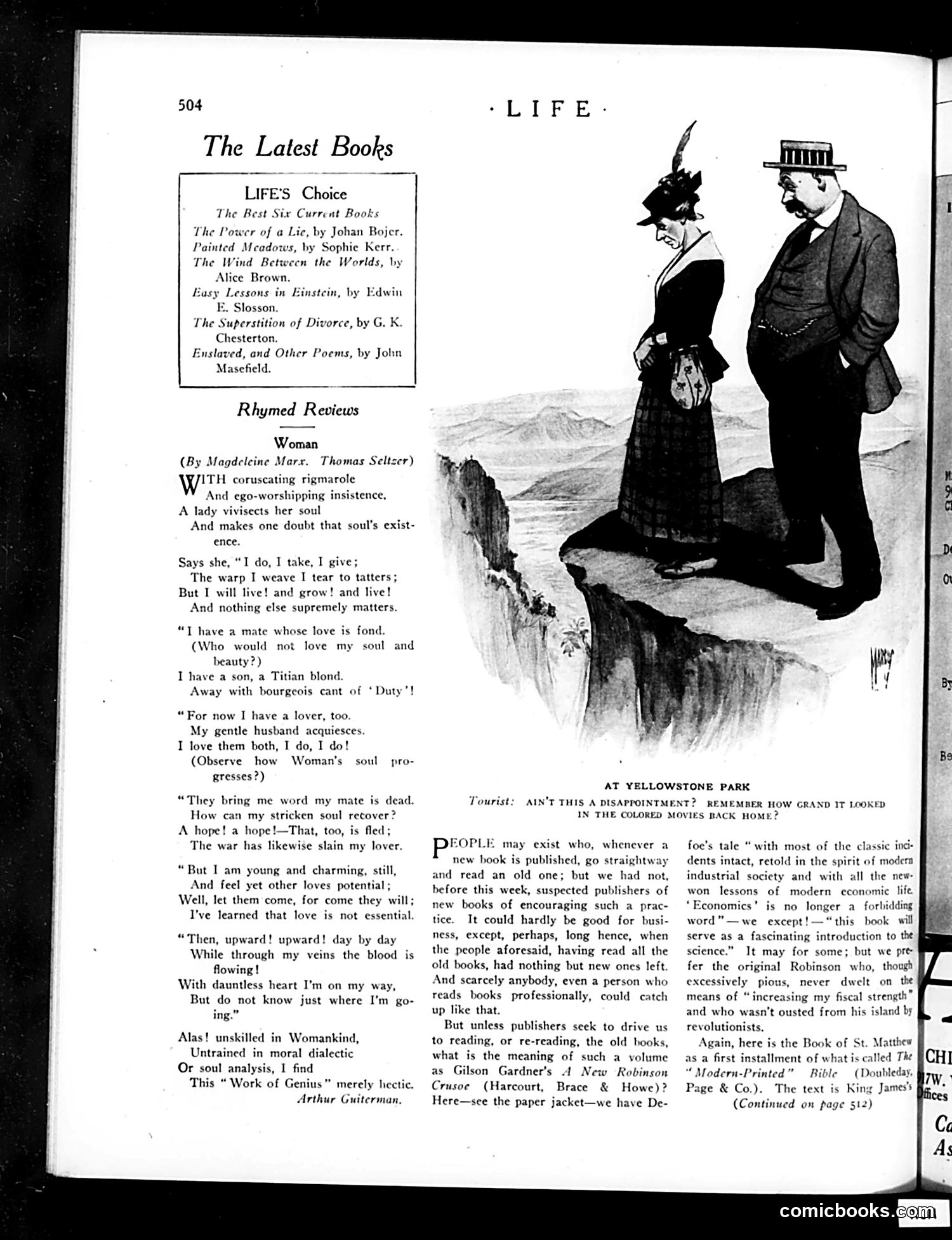
This page contains book reviews rather than political cartoons. The main satirical content is Arthur Guiterman's poem "Woman," which mocks what appears to be a modernist literary work depicting a self-absorbed female character who prioritizes personal fulfillment over traditional duties. The poem ridicules her ego-centered philosophy and her casual approach to marriage and infidelity, presenting her as shallow and "merely hectic." The small cartoon at bottom shows a tourist at Yellowstone Park disappointed that the natural wonder doesn't match the glamorous "colored movies" (early color film) seen back home—satirizing how cinema inflates expectations versus reality. The book reviews criticize publishers for encouraging readers to re-read classics instead of buying new books, and mock a modern retelling of *Robinson Crusoe* that adds economics lessons, suggesting such "improvements" ruin timeless stories. The overall tone is conservative, mocking both modernist literature and commercialism.
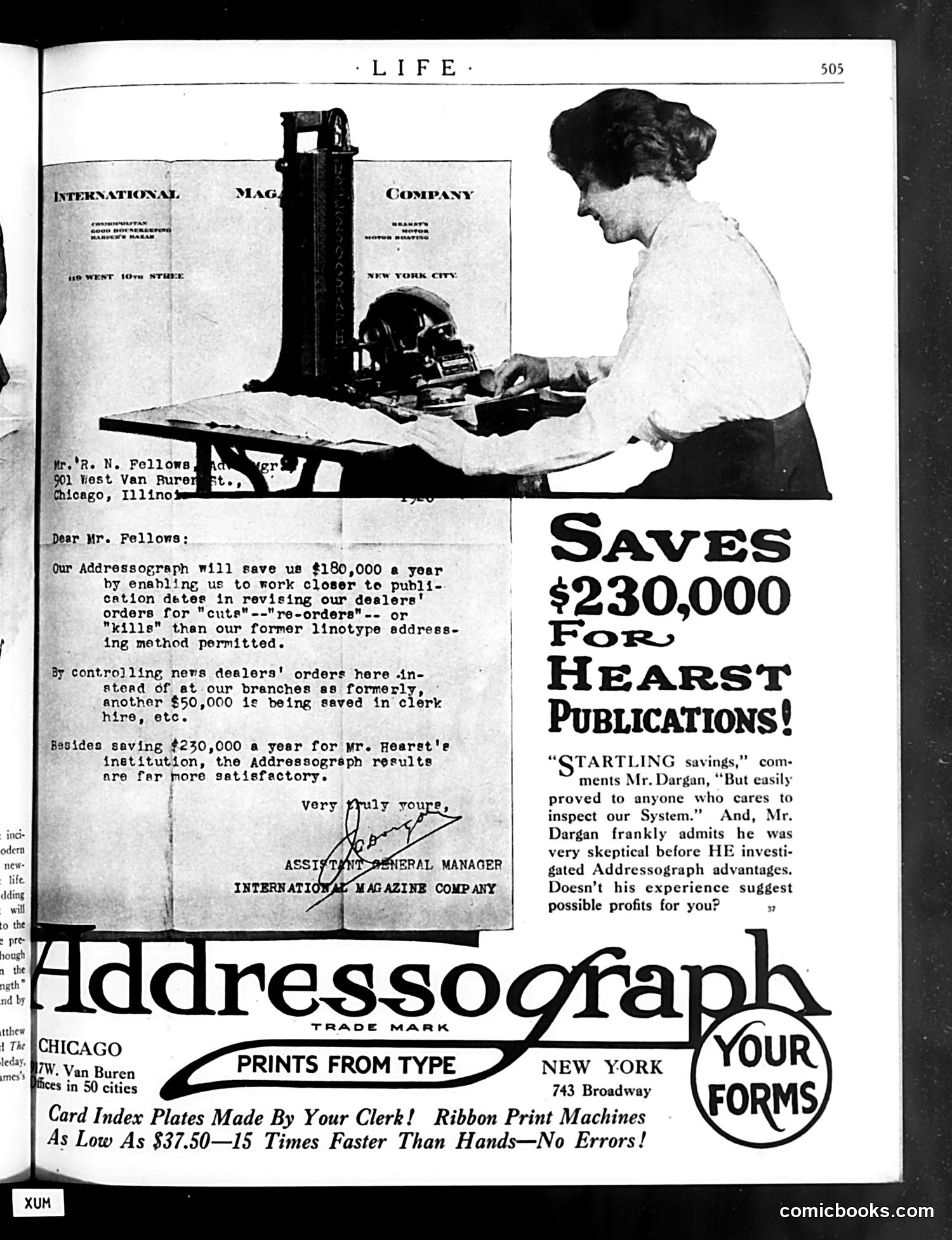
This is primarily a **business advertisement**, not satire. It promotes the "Addressograph"—an early mechanical addressing/printing machine—by showcasing its use at William Randolph Hearst's publishing empire. The ad features a letter from an International Magazine Company manager claiming the Addressograph saves Hearst's operation $230,000 annually by automating address printing and streamlining dealer order management. A photograph shows a woman operating the machine. The satire, if any, is subtle: the ad emphasizes efficiency gains and cost-cutting at a major media corporation while Hearst was a prominent figure. However, the page functions primarily as **product marketing** rather than political commentary. The Addressograph company uses Hearst's name and purported endorsement as a credibility tool to attract other business customers—a standard advertising strategy of the era. No specific political figures or events are directly lampooned here.
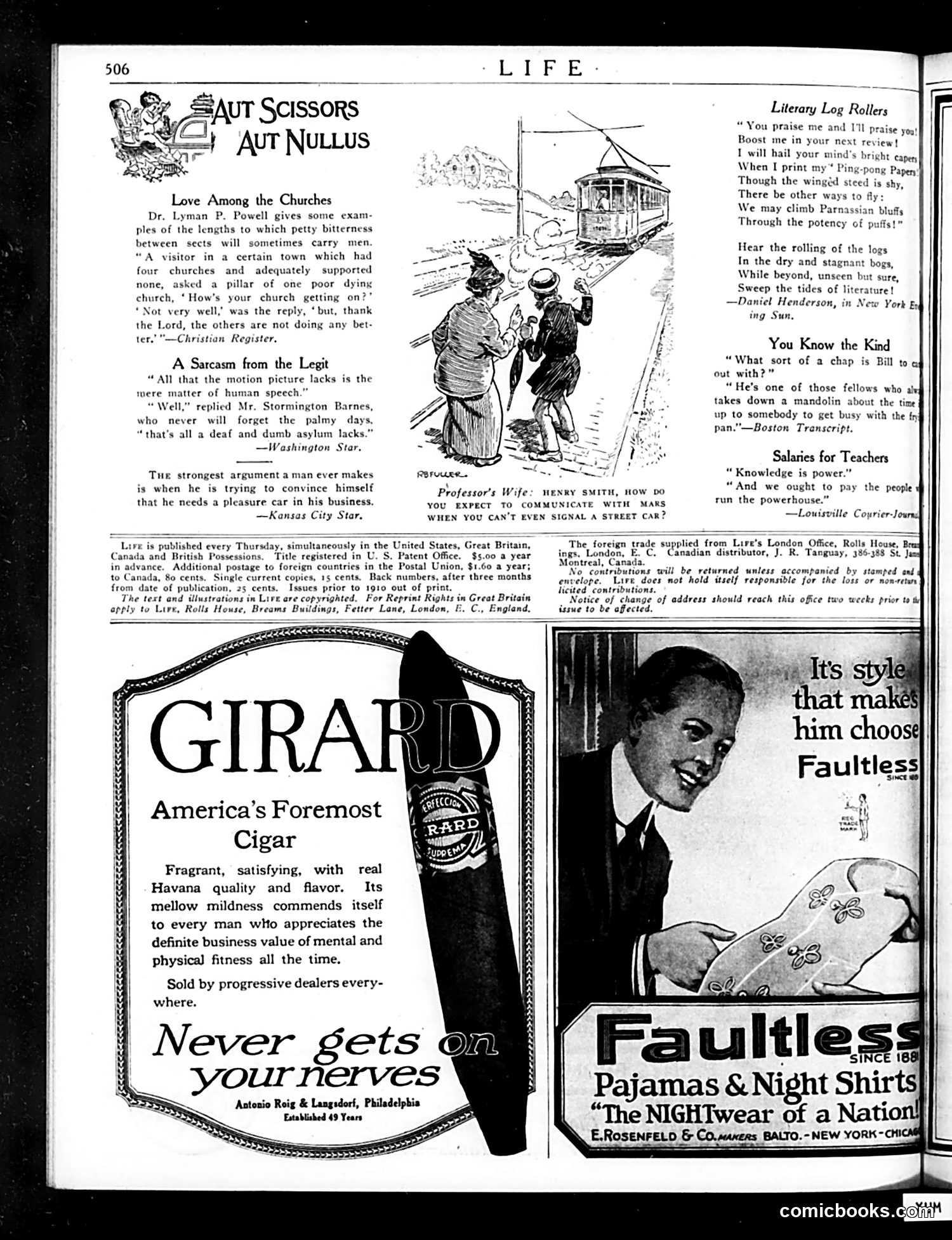
This page satirizes mutual back-scratching among literary critics and authors. The cartoon and accompanying poem mock a corrupt practice where writers and reviewers publicly praise each other's work regardless of quality—the "log rolling" metaphor refers to rolling logs downriver (implying easy, mutual movement). The text includes Daniel Henderson's poem about "rolling of the logs / In the dry and stagnant bogs," criticizing how authors boost each other through "puffs" (exaggerated praise) rather than genuine literary merit. A separate anecdote contrasts this with motion pictures, which lack "mere matter of human speech"—suggesting even silent films had more integrity than this incestuous literary world. The page also includes unrelated satirical pieces on church rivalries and other social topics. Two period advertisements (Girard cigars and Faultless pajamas) occupy the lower half.
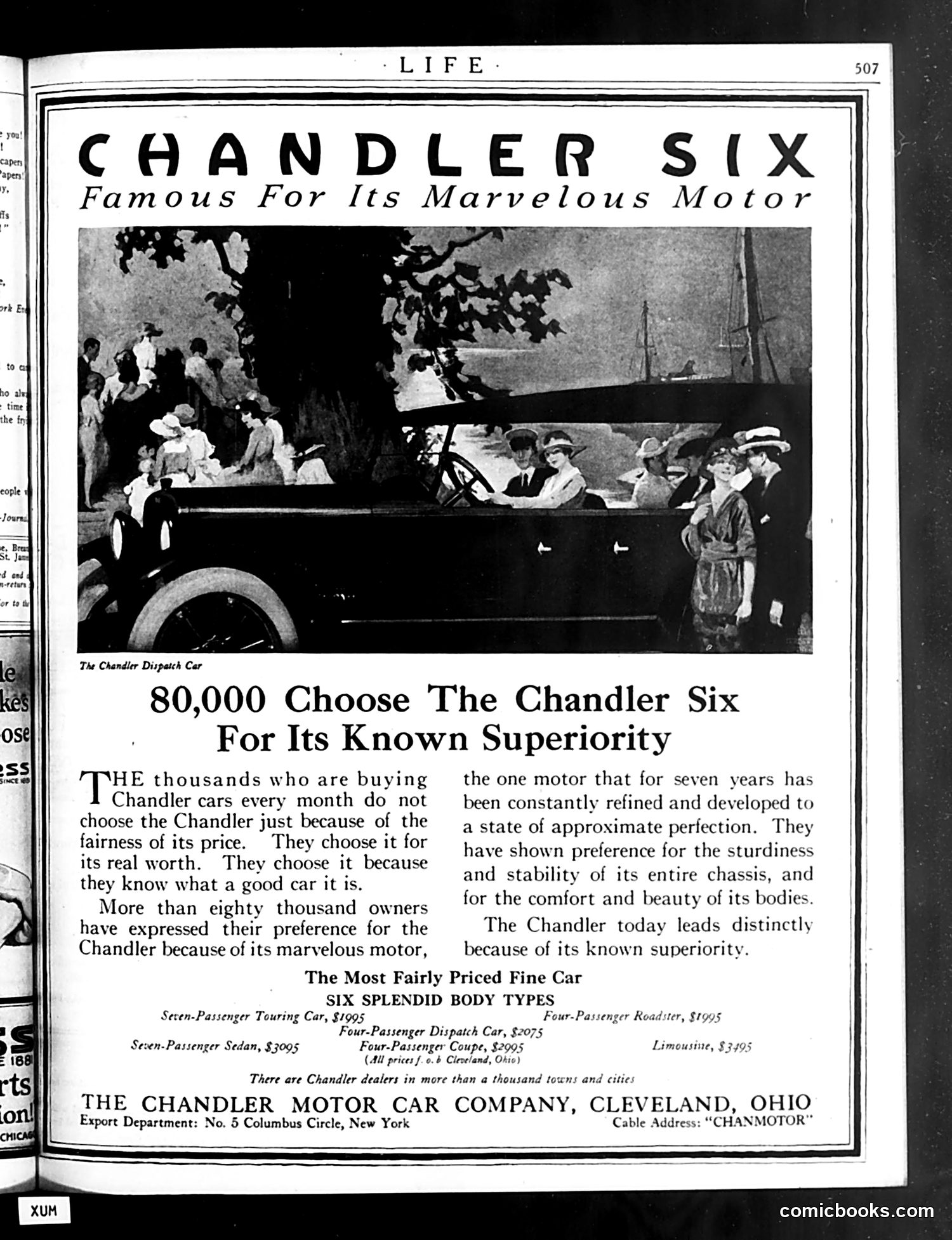
This page is **not a cartoon or satire**—it's a straightforward automobile advertisement from *Life* magazine's early 20th-century period. The ad promotes the Chandler Six motor car, manufactured in Cleveland, Ohio. The large photograph shows a well-dressed group of people in and around an open-air touring car, emphasizing the vehicle's appeal to affluent consumers. The advertisement's central claim is that 80,000 owners have chosen Chandler cars for their superior motor and construction quality, not merely low price. It lists six body styles ranging from $1,995 to $3,495—substantial sums for the era, positioning Chandler as a premium vehicle. The ad's tone suggests the automotive market was competitive, requiring manufacturers to emphasize reliability and craftsmanship to justify pricing. The extensive dealer network ("more than a thousand towns and cities") indicates Chandler's national distribution ambitions during the early automobile era.
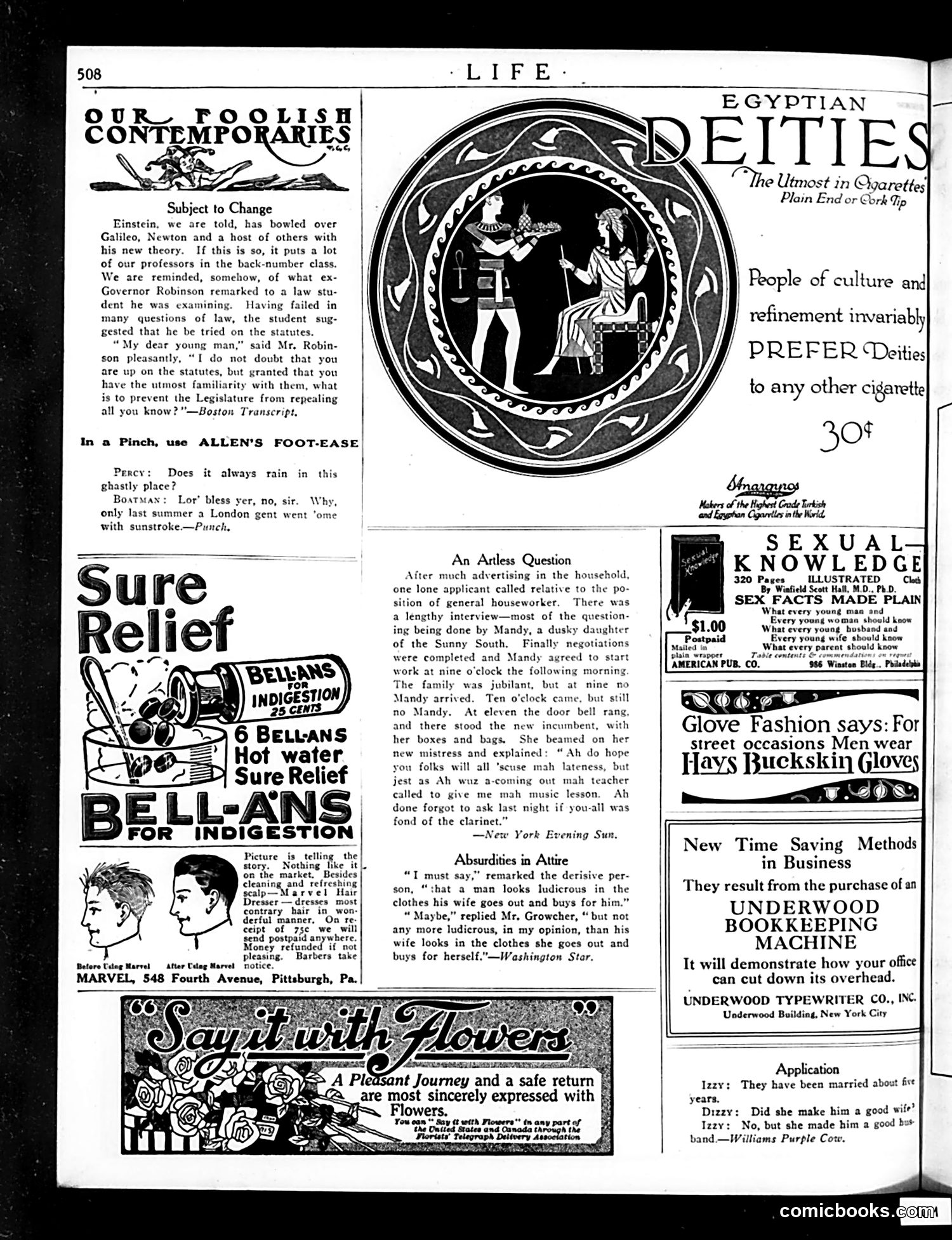
This satirical piece mocks academic certainty by invoking Einstein's revolutionary physics theory. The joke compares Einstein's overturning of classical physics (Galileo, Newton) to a law professor's warning that legislators can repeal any statute a student memorizes. The satire suggests that intellectual "truths"—whether scientific or legal—are only as permanent as those in power allow them to be. It's a clever jab at how institutions present established knowledge as timeless while remaining vulnerable to sudden change from authority figures. The anecdote references ex-Governor Robinson, establishing this as American political commentary circa the 1920s, when Einstein's theories were still novel public knowledge and generated both fascination and skepticism among educated readers.
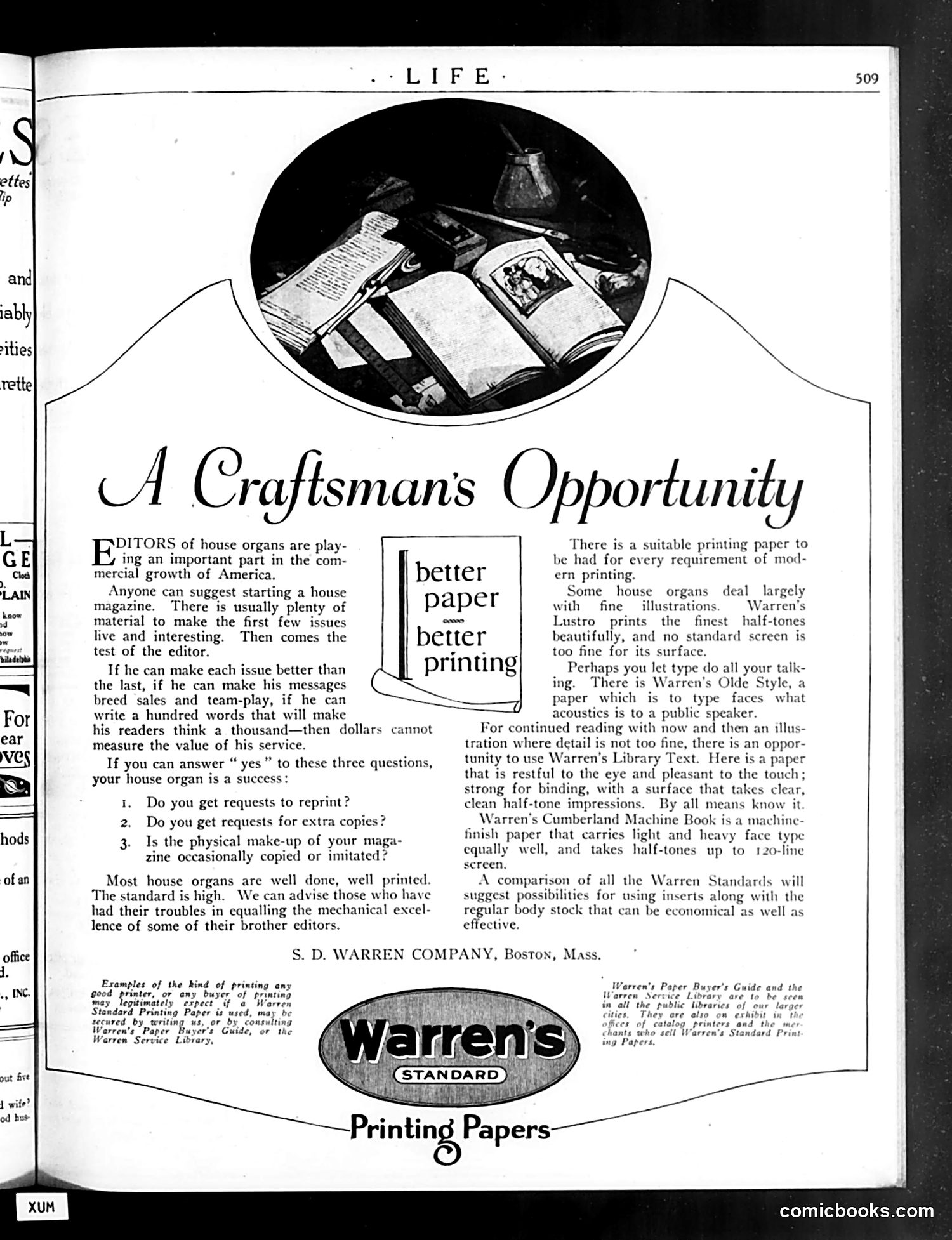
This is **not a cartoon but a trade advertisement** disguised as editorial content—a common early 20th-century magazine practice. The piece addresses editors of "house organs" (corporate newsletters/internal publications). It argues that producing quality in-house magazines—through better paper and printing—builds company loyalty and sales. The three success metrics listed (reprint requests, copy requests, imitation) frame the house organ as a business tool. The advertisement then pivots to promoting Warren Standard Printing Papers, listing specific products (Lustro, Olde Style, Library Text, Cumberland Machine Book) for different printing needs. The circular photo at top shows typical editor's materials (books, papers, tools). **For modern readers:** This reflects the Progressive Era faith in professional standards and corporate communication. The "craftsman" framing dignified industrial work, while treating employee publications as serious business instruments—not primarily for worker benefit, but for corporate messaging and morale control.
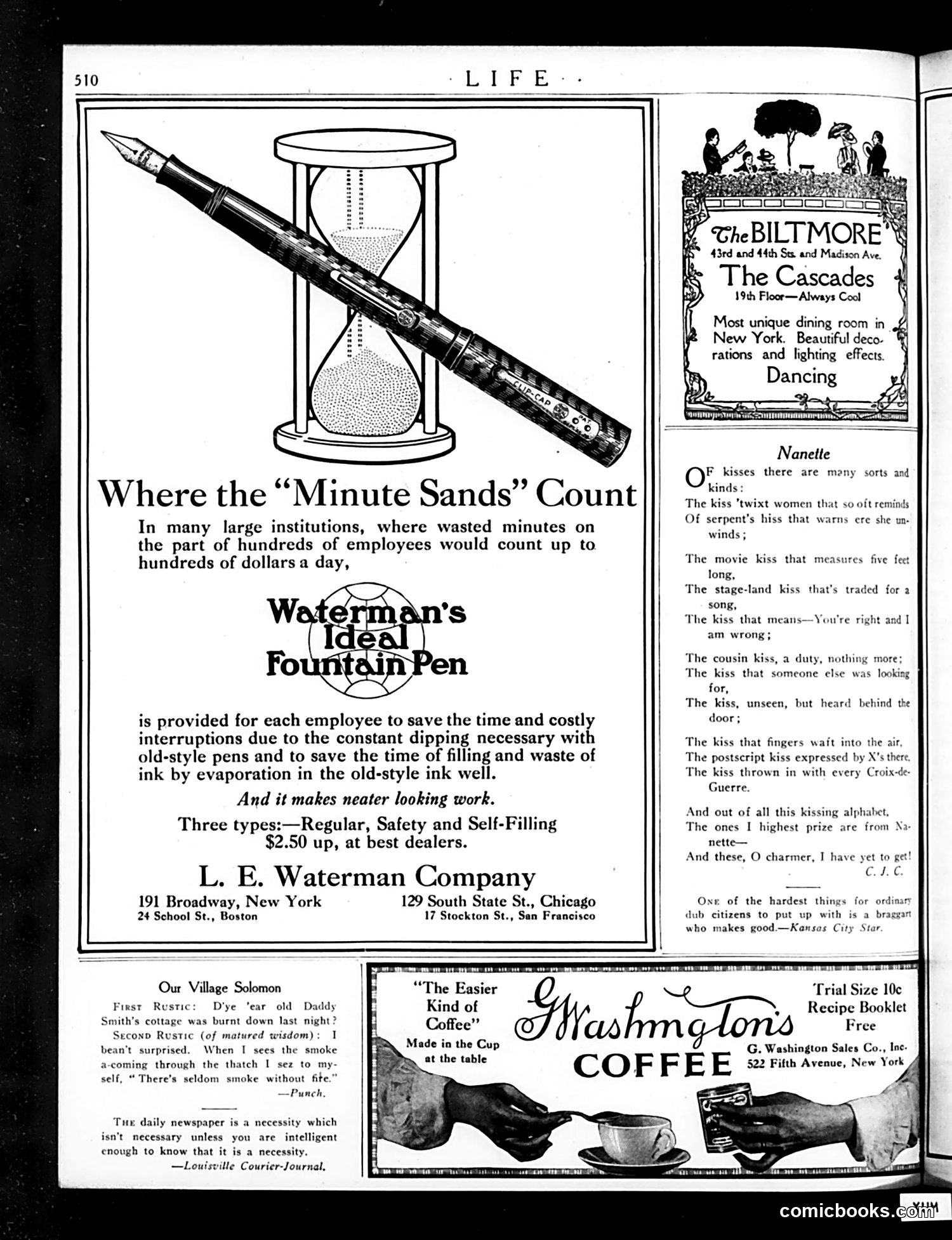
This page is primarily **advertising**, not satire or political commentary. It contains three major ads: 1. **Waterman's Ideal Fountain Pen**: Markets time-saving benefits to businesses. The "Minute Sands" imagery suggests wasted minutes accumulate into lost dollars—a pitch to large institutions concerned with employee efficiency. This reflects early-20th-century industrial management's focus on productivity. 2. **The Biltmore Hotel/Cascades Restaurant**: A luxury dining venue advertisement emphasizing elegance and dancing. 3. **Washmalton's Coffee**: Advertises convenience ("made in the cup at the table"). The page also includes lighter content: a poem about kissing types (appearing to reference wartime romance, with mention of "Croix-de-Guerre"), and two brief humorous anecdotes—one from *Punch* magazine about village wisdom, another quoting a newspaper's necessity. There is **no political cartoon**. The hourglass is decorative advertising imagery, not satire.
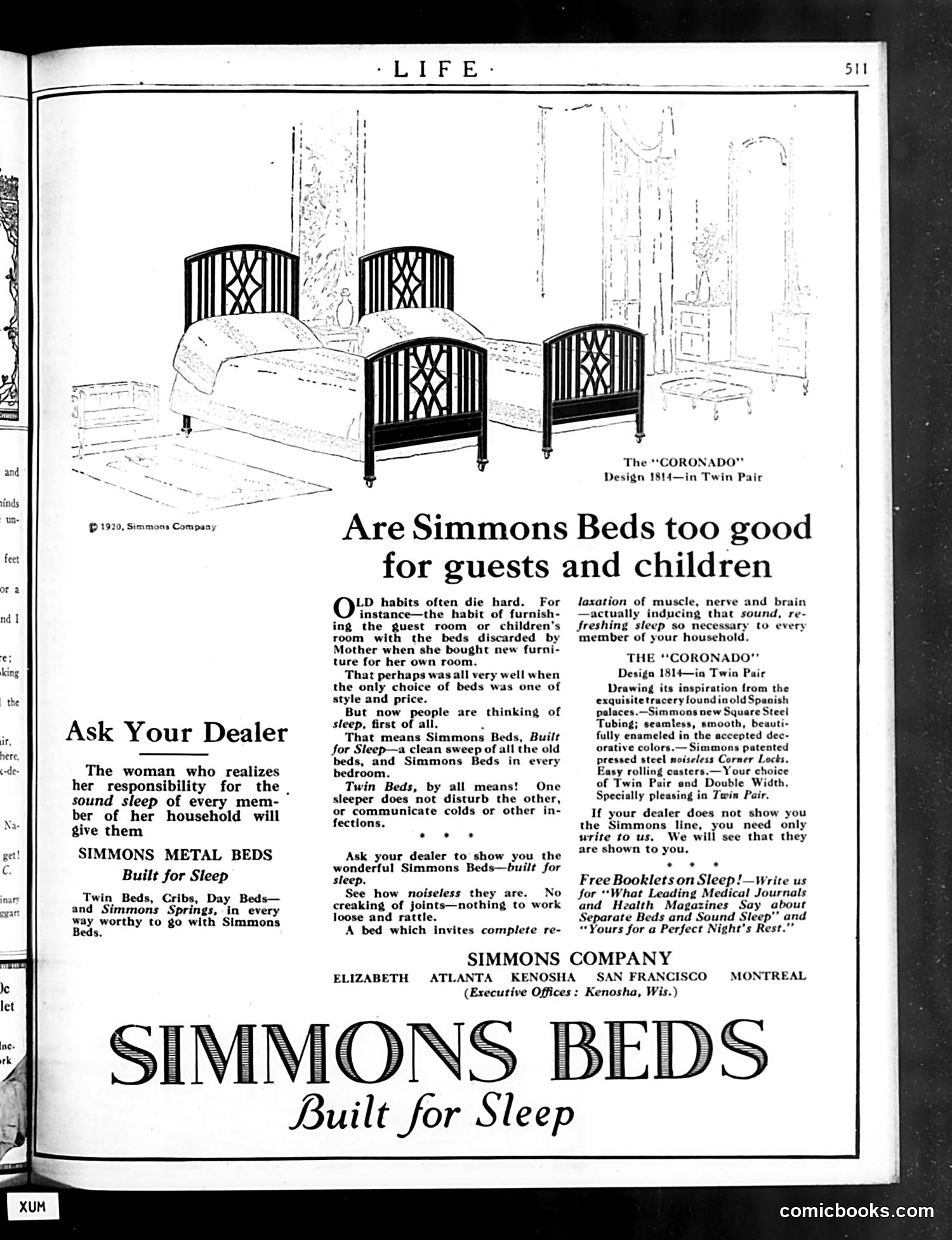
This is a **1920 Simmons Company advertisement**, not a political cartoon. The page promotes metal bed frames, specifically the "Coronado" twin bed design. The ad's central argument addresses a social convention of the era: the practice of furnishing guest rooms and children's bedrooms with hand-me-down furniture discarded by the homeowner. The ad suggests this habit is outdated. The modern angle: The advertisement appeals to contemporary health consciousness—emphasizing that quality sleep matters, positioning separate twin beds as hygienic (preventing cold transmission between sleepers) and promoting the idea that *all* household members deserve proper beds, not just the primary family. The target audience is the homemaker ("the woman who realizes her responsibility"), positioning bed quality as part of her household management duties. This reflects early 20th-century gendered domestic advertising. The page includes product specifications, dealer instructions, and offers free booklets on sleep health—standard advertising copy of the period.
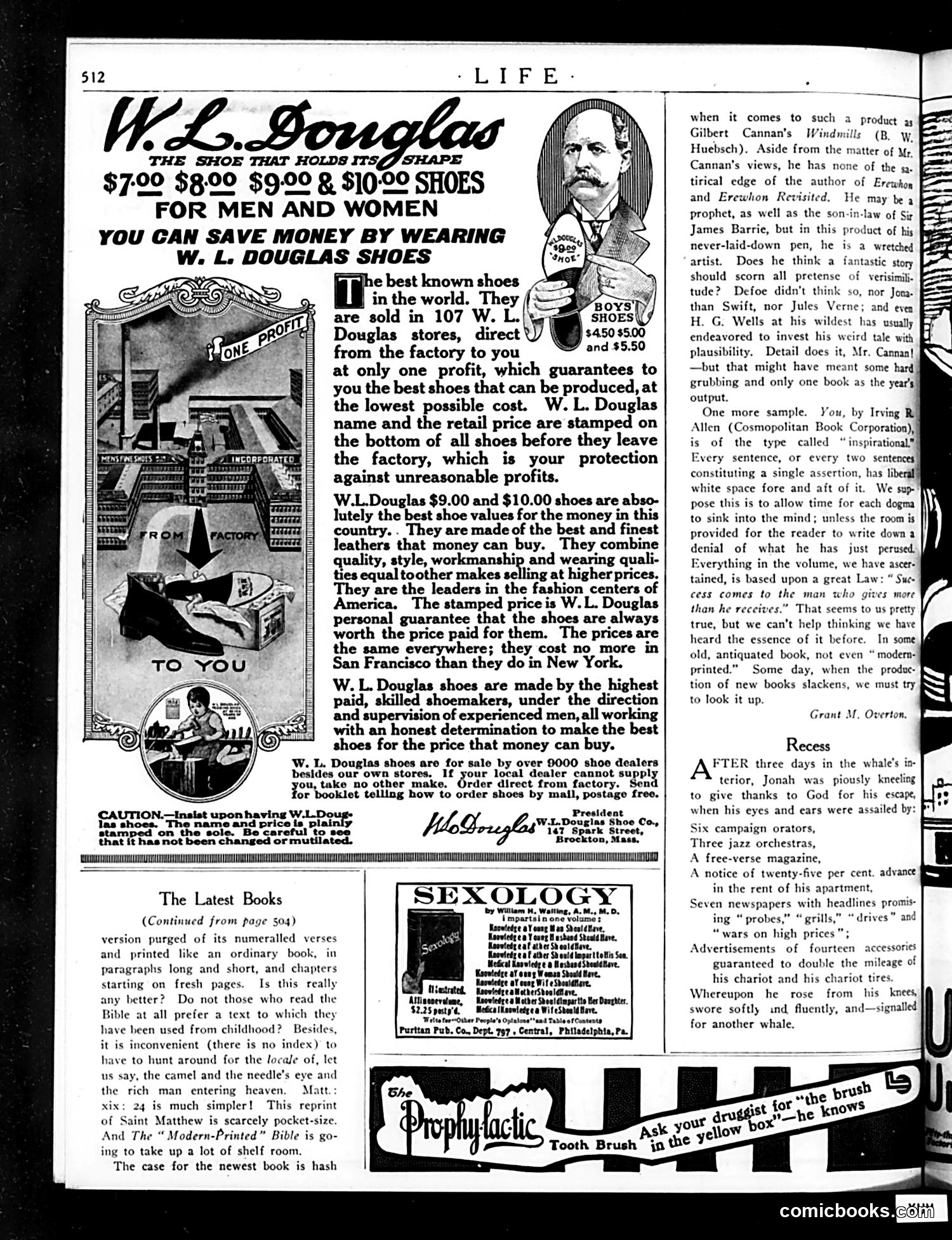
This page is primarily **advertising**, not political satire. It features a large W.L. Douglas Shoes advertisement promoting footwear at $7-$10 price points. The ad emphasizes direct factory-to-consumer sales eliminating middleman profits—a common early 20th-century marketing pitch appealing to consumer economy consciousness. The remaining content includes book reviews (discussing novels like Gilbert Cannan's *Windmills*) and advertisements for *Sexology* by William H. Walling and the Prophylactic Tooth Brush. **No significant political cartoon or satire appears on this page.** The Douglas Shoes ad uses industrial imagery showing factory operations, but this is straightforward commercial illustration rather than satirical commentary. The page represents typical Life magazine content from this era—a mix of advertising and literary criticism aimed at middle-class readers concerned with value and culture.
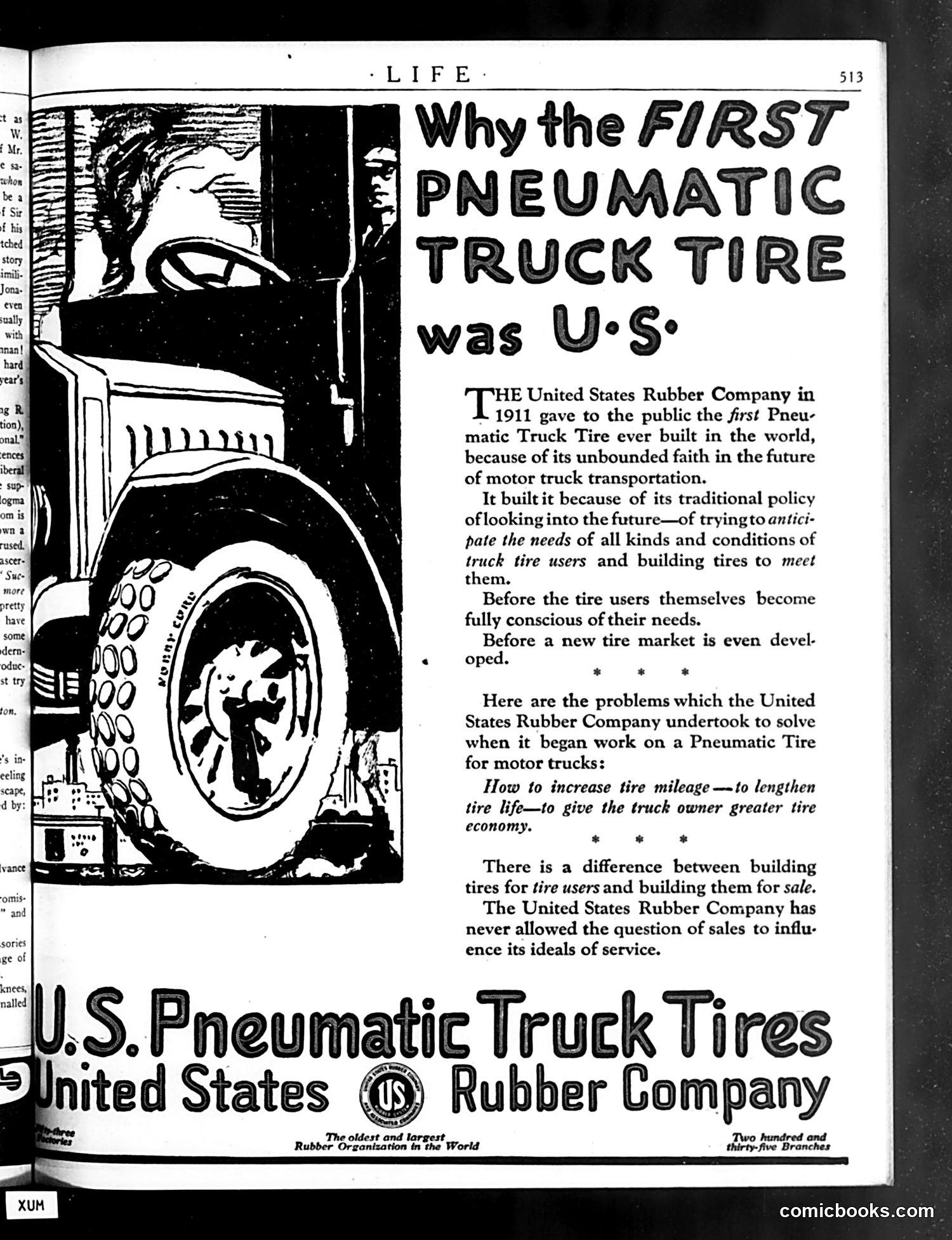
This is **not a cartoon or satire**—it's a straightforward **advertisement** for United States Rubber Company's pneumatic truck tires, appearing in Life magazine (page 513). The page features an illustration of an early truck with a prominent pneumatic tire and a driver. The ad claims U.S. Rubber invented the first pneumatic truck tire in 1911, positioning the company as visionary and service-focused rather than sales-driven. The rhetoric emphasizes anticipating customer needs *before* markets develop, and distinguishes between "building tires for tire users" versus "building them for sale"—implying moral superiority through user-centered design over mere profit-seeking. For modern readers: this represents early 20th-century corporate messaging that conflates innovation with altruism, a familiar advertising strategy still used today.
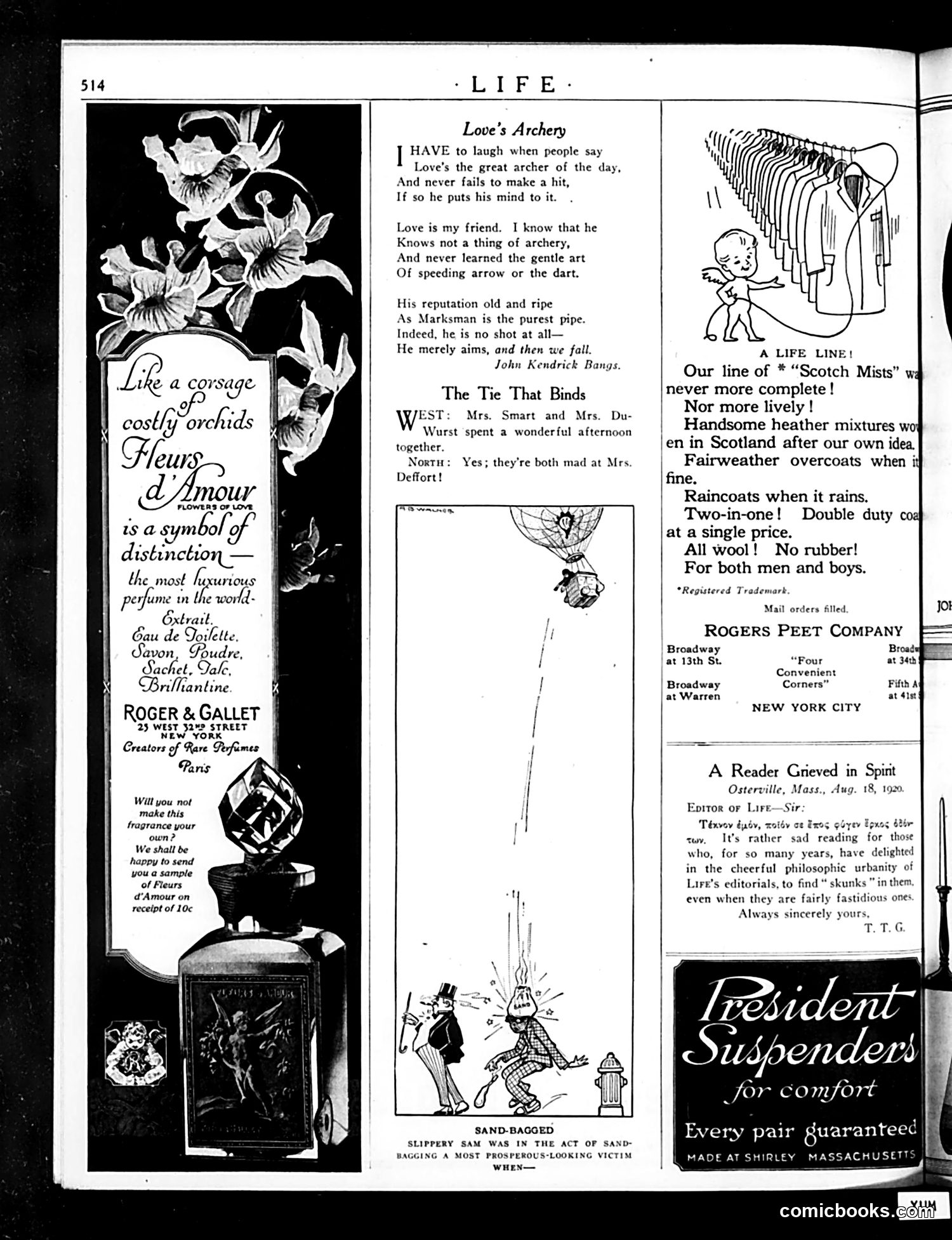
This page is primarily **advertising with light satirical content**. The main elements: **Advertisements:** - Roger & Gallet perfume (left), Rogers Peet Company clothing (right), and President Suspenders (bottom) dominate the layout. **Satirical Content:** - "Love's Archery" by John Kendrick Bangs: A humorous poem mocking the cliché that "Love is a great archer." Bangs sardonically argues Love is actually a poor shot—people "merely aim, and then we fall." - "The Tie That Binds": A brief joke about two women, Mrs. Smart and Mrs. Duwurst, spending time together despite both being angry at Mrs. Deffort—the "tie" binding them is shared annoyance. - "Sand-Bagged" cartoon: Depicts a criminal ("Slippery Sam") about to rob someone when a clothesline (a "life line") saves the victim. Dark humor about accidental rescue. - Reader's letter: A correspondent laments that Life's editorials, once cheerful, now contain "skunks"—likely meaning negative or cynical content. The page reflects typical 1920 Life magazine: light social satire mixed with advertisements.
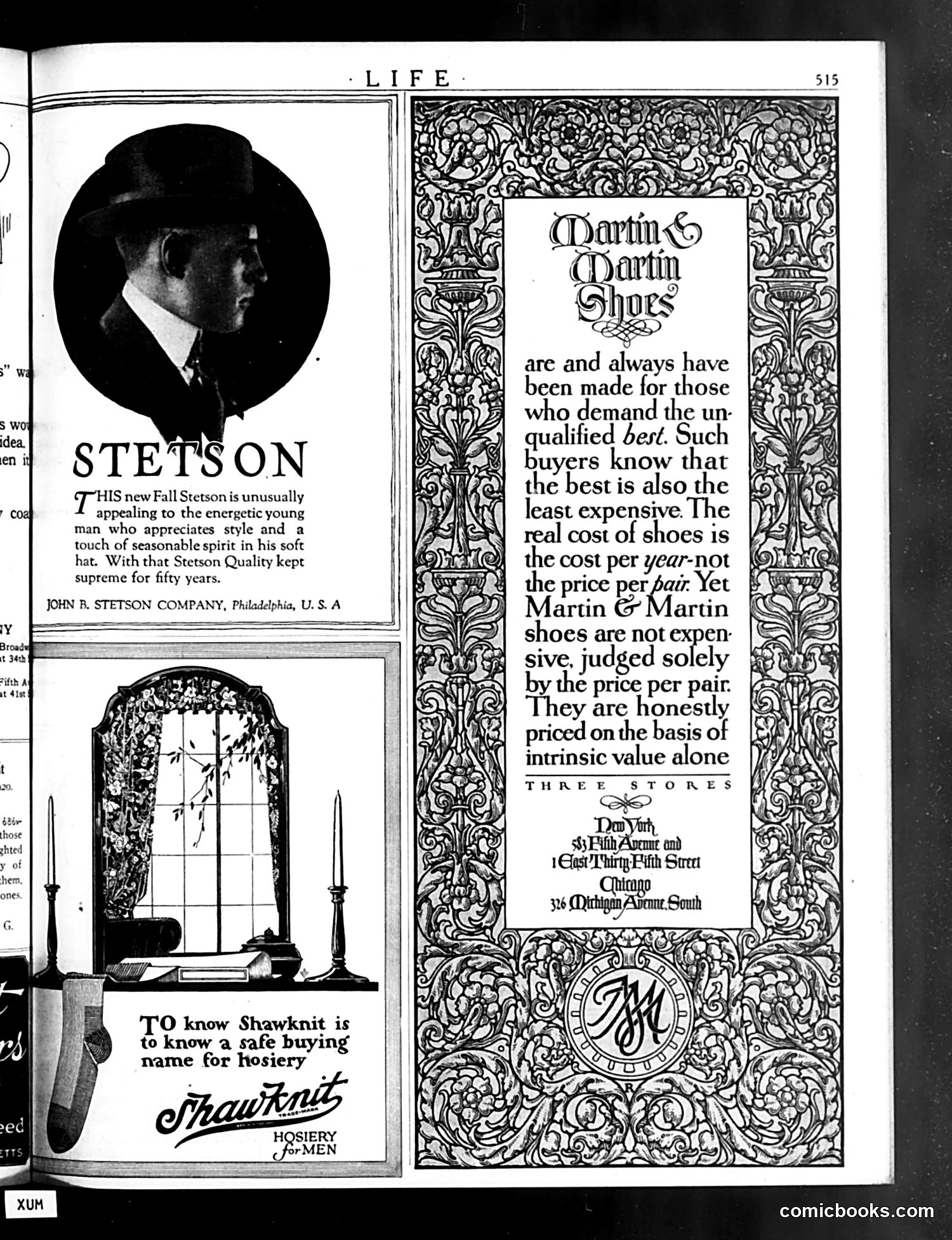
This is primarily an **advertising page** rather than satirical content. It contains three separate product advertisements typical of early 20th-century magazines: 1. **Stetson hats** — appeals to young men valuing style and quality, emphasizing fifty years of established reputation 2. **Shawknit hosiery** — presents the brand name as a reliable, safe purchasing choice for men's socks 3. **Martin & Martin shoes** — argues that quality footwear represents better long-term value ("cost per year") than judging by price alone, with locations listed in New York and Chicago The page reflects **period consumer values**: appeals to masculinity, emphasis on durability and reputation, and the argument that premium pricing reflects genuine quality rather than mere expense. There is no political satire or caricature present—these are straightforward commercial endorsements using the decorative typography and layout typical of Life magazine's advertising sections.
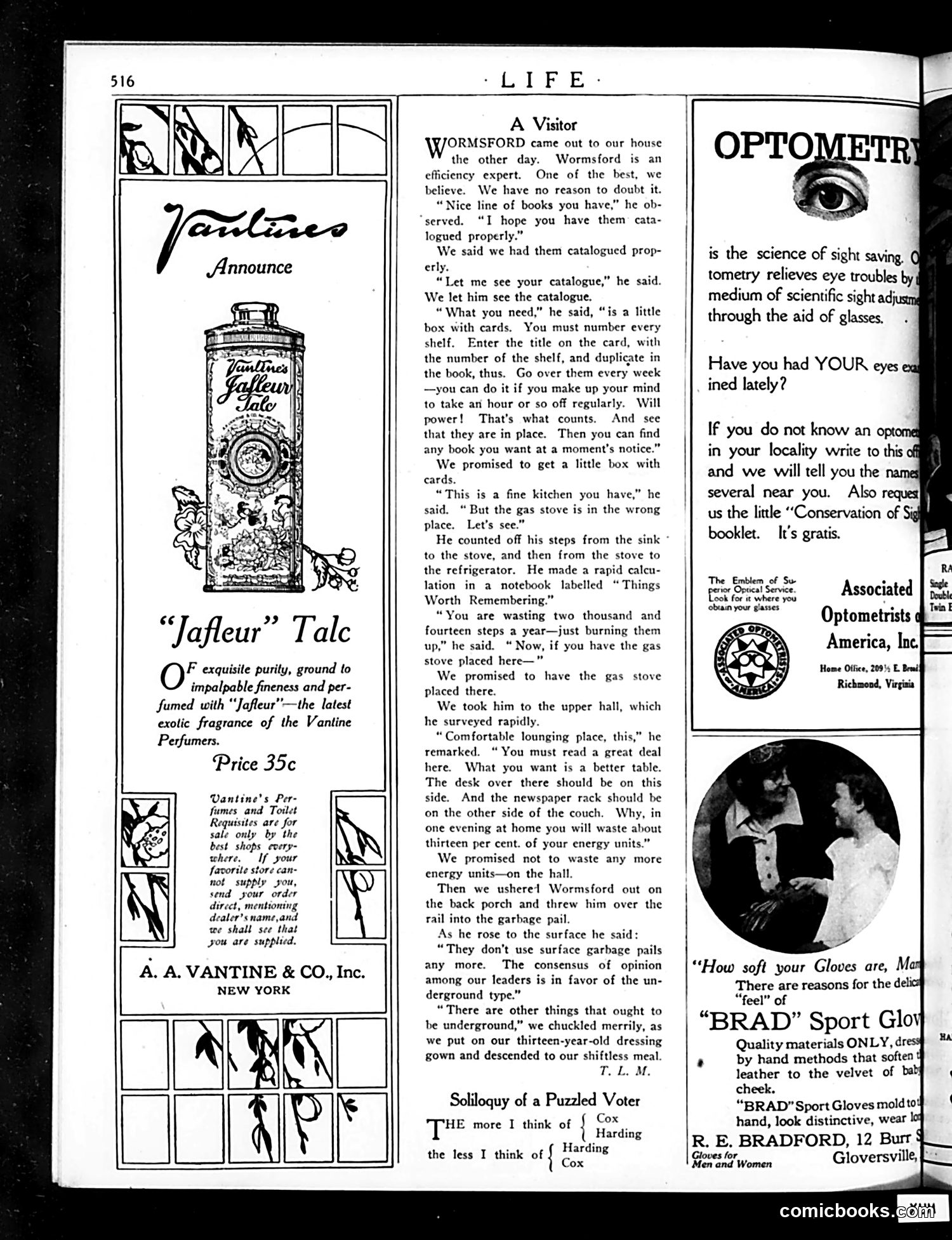
This humorous story mocks the early 20th-century "efficiency expert" movement, when consultants claimed scientific management could optimize every aspect of life. "Wormsford," the visiting expert, embodies this absurdity: he systematizes the homeowner's book collection with numbered cards, reorganizes the kitchen to reduce "wasted steps," and calculates that furniture placement wastes "thirteen percent" of evening energy. The satire's point is clear: the expert reduces human life to quantifiable metrics and "energy units," treating homes as factories. The homeowner's response—literally throwing Wormsford into the garbage—represents popular frustration with this intrusive, dehumanizing rationalization of domestic life. Even in the garbage, Wormsford pedantically notes modern waste disposal trends, highlighting how the efficiency mindset distorts all perception. The piece satirizes misapplied scientism and expert overreach in everyday life.
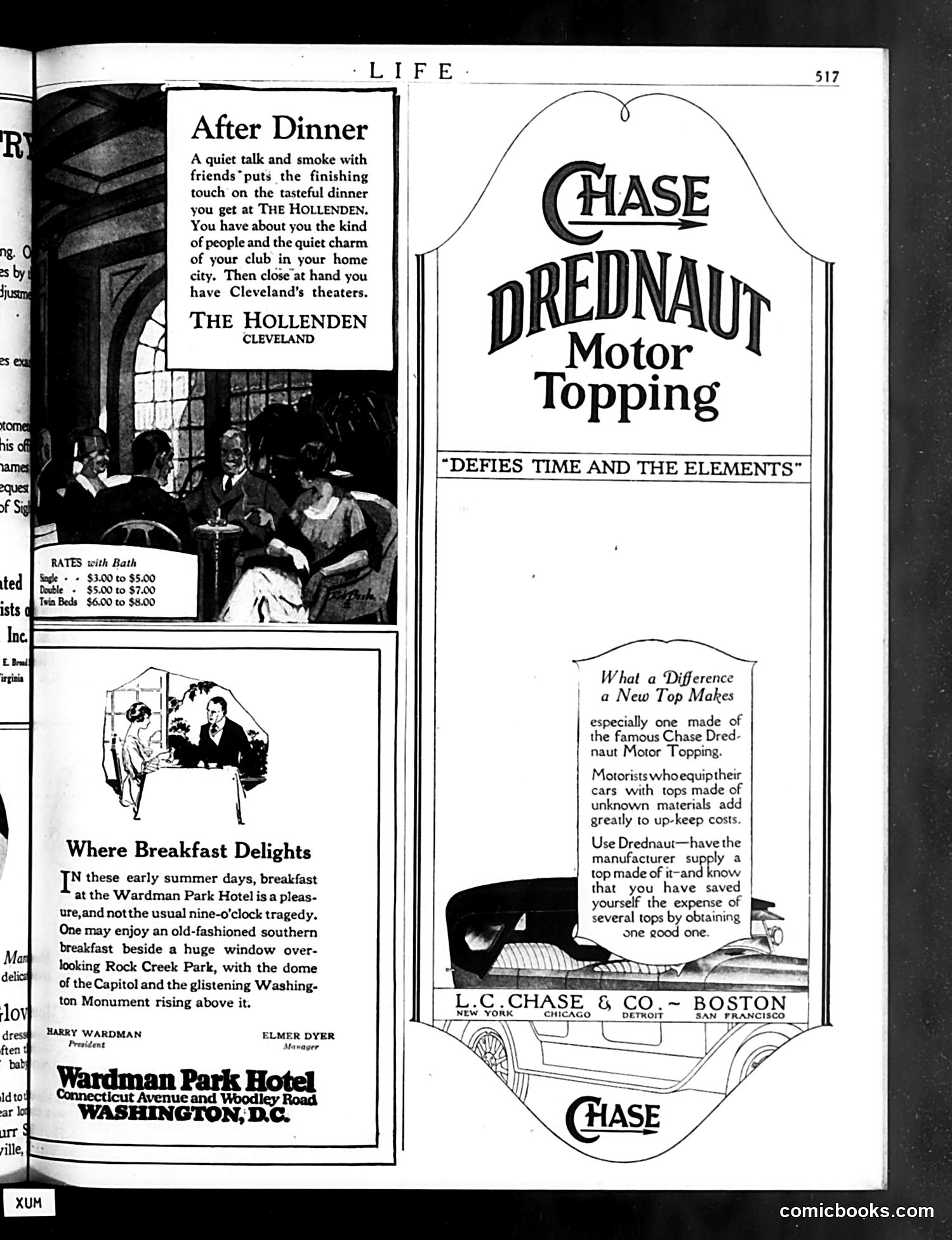
This page consists entirely of **advertisements**, not political cartoons or satire. The ads promote three establishments and products: 1. **The Hollenden (Cleveland)** — a hotel advertising post-dinner socializing and theater access 2. **Wardman Park Hotel (Washington, D.C.)** — highlighting breakfast views of Rock Creek Park and the Capitol 3. **Chase Drednaut Motor Topping** — a car convertible top material The Chase ad is the most substantial, claiming its product "defies time and the elements" and suggesting competitors' unknown-material tops require expensive frequent replacement. This is straightforward product advertising emphasizing durability and cost savings—not satire. The page reflects early 20th-century American consumer culture: luxury hotels catering to affluent travelers and automotive accessories as car ownership becomes common. There is no cartoon commentary or political content visible.
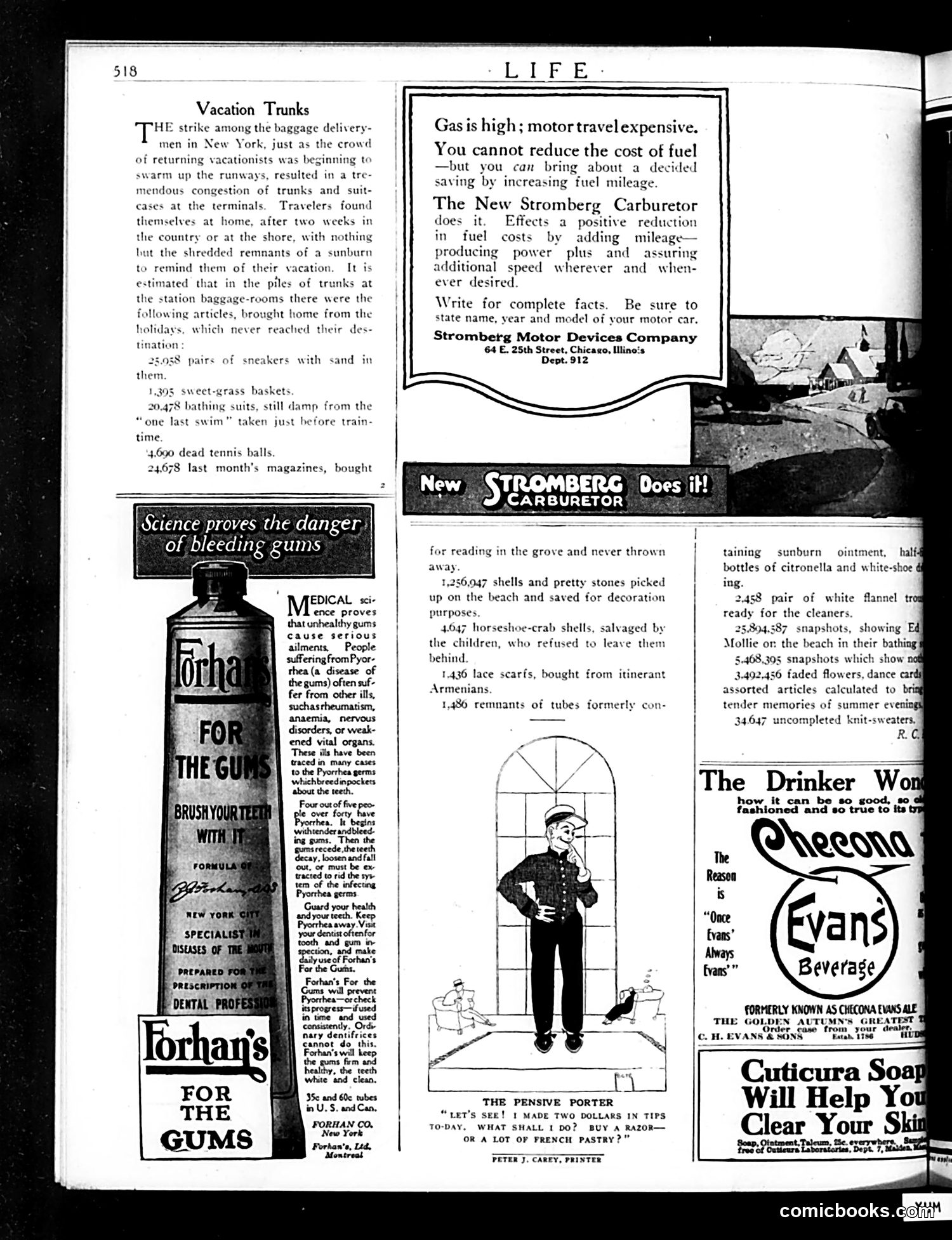
This page is primarily **advertising**, with one significant cartoon. The main cartoon, titled "The Pensive Porter," depicts a uniformed porter deliberating over how to spend two dollars earned in tips—choosing between buying a razor or French pastry. This is **social satire** about working-class economics during the 1920s, suggesting porters earned meager wages supplemented only by tips, forcing them to make basic purchasing decisions between necessities (grooming) and small luxuries (food). The "Vacation Trunks" section is humorous inventory of items travelers inevitably bring home—damp bathing suits, dead tennis balls, magazines, shells, snapshots—mocking the detritus of middle-class vacationing. The remaining content consists of period advertisements: Forhan's toothpaste (warning of pyorrhea/gum disease), Stromberg carburetors (promising fuel economy), Cuticura soap, and Chicona Evans beverages. These ads reflect early-20th-century consumer anxieties about health and modern conveniences.
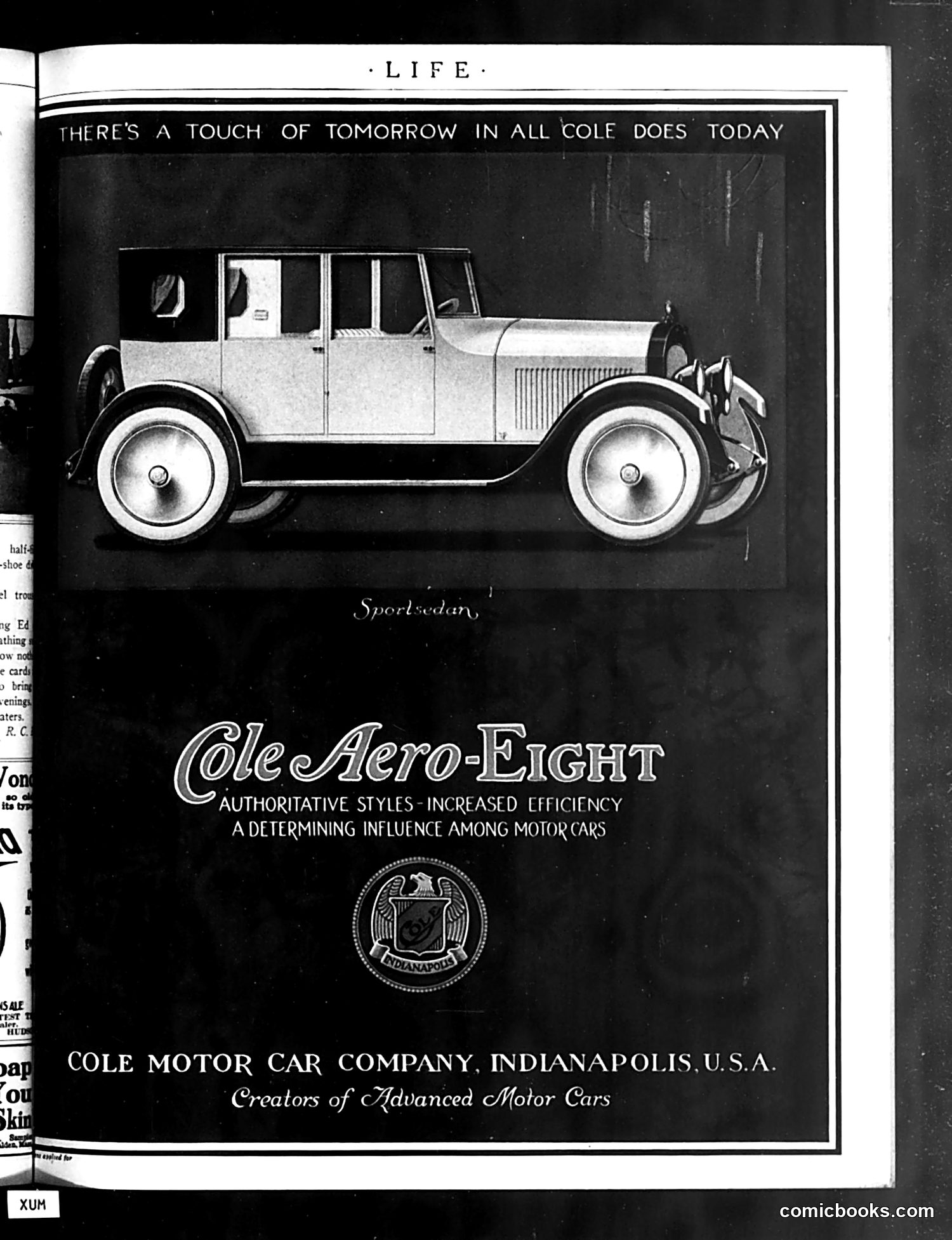
This is a **Cole Motor Car Company advertisement**, not a political cartoon or satire. The page appears in Life magazine's advertising section. The ad promotes the "Cole Aero-Eight" automobile, a sportwear model shown in side profile. The tagline—"There's a touch of tomorrow in all Cole does today"—markets the vehicle as forward-thinking and innovative. The phrase "Authoritative Styles—Increased Efficiency" and "A Determining Influence Among Motor Cars" emphasize the car's design and performance leadership. Cole Motor Car Company was based in Indianapolis and positioned itself as a creator of "Advanced Motor Cars." This represents typical early-20th-century automotive advertising rhetoric, appealing to consumers' desires for modern, efficient vehicles. No satire or political commentary is present; this is straightforward product marketing.
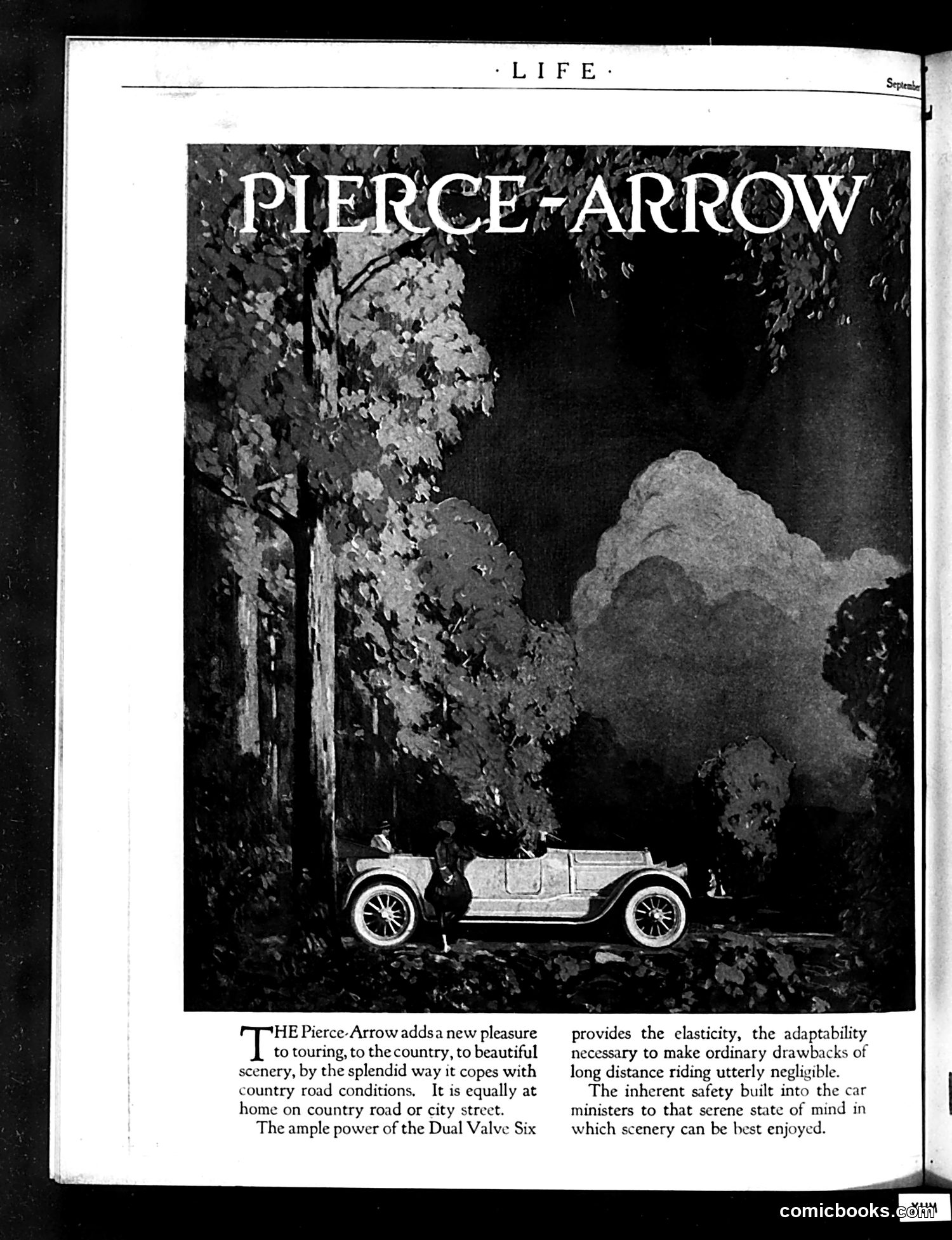
This is **not a political cartoon or satire**, but rather a **product advertisement** for Pierce-Arrow automobiles, appearing in Life magazine. The image shows a luxury car positioned dramatically in a forest or wooded setting at night, framed by tall trees and atmospheric clouds. The advertisement copy emphasizes the vehicle's capabilities: its powerful Dual Valve Six engine provides reliability on both country roads and city streets, with enough "elasticity and adaptability" to handle rough terrain without difficulty. The marketing pitch appeals to early automotive consumers interested in touring and scenic drives—suggesting that Pierce-Arrow's engineering allows drivers to relax and enjoy landscapes rather than worry about road conditions. This reflects the era when automobiles were becoming leisure vehicles for the affluent classes, capable of venturing beyond urban centers into rural America.