
Life, 1920-09-16 · page 24 of 44
Life — September 16, 1920 — page 24: what you’re looking at
What you’re looking at
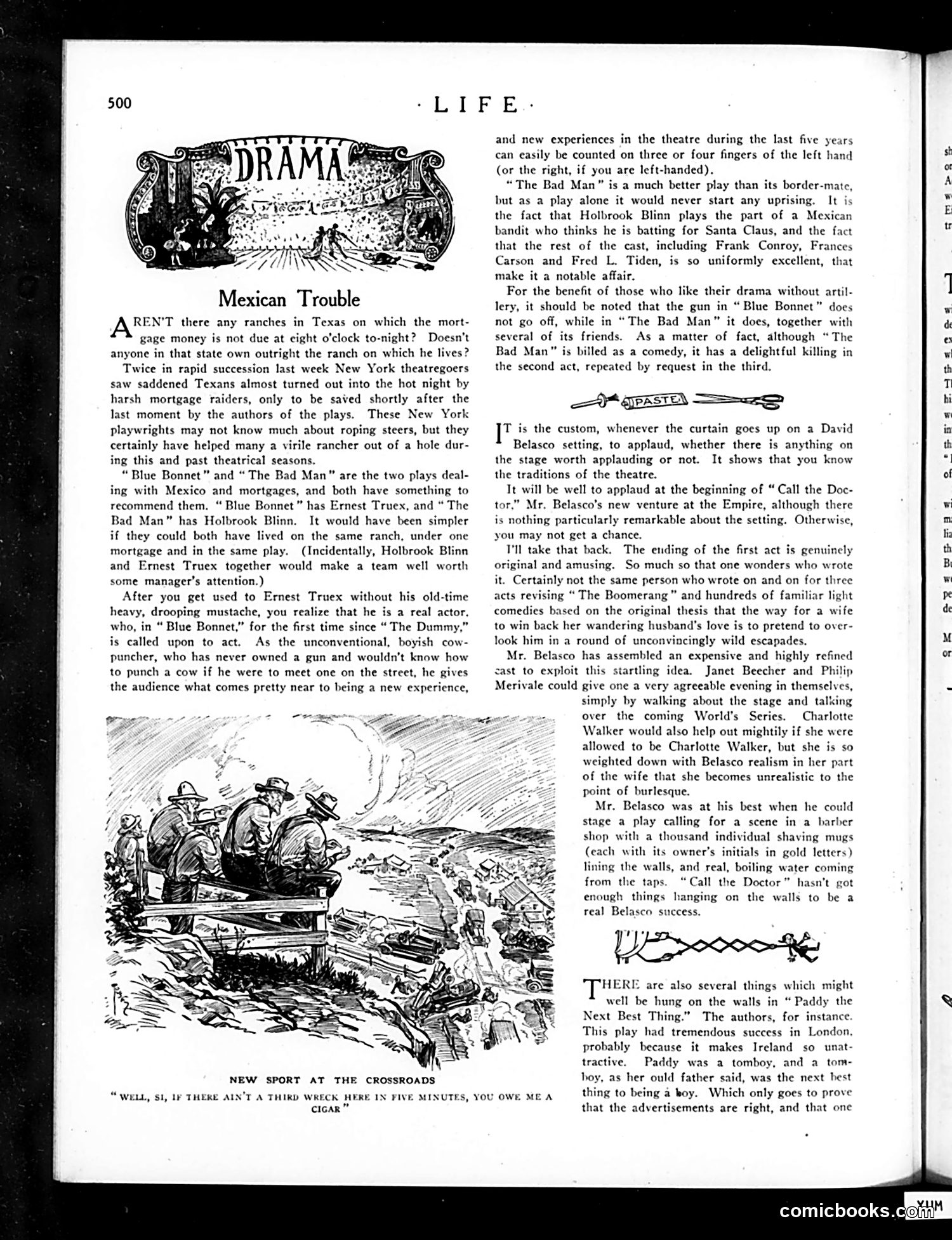
This page reviews two contemporary Broadway plays set in Mexico/Texas dealing with ranchers facing mortgage foreclosure: "Blue Bonnet" (starring Ernest Truex) and "The Bad Man" (starring Holbrook Blinn). The critic humorously notes that New York playwrights, despite knowing little about actual ranching, have become skilled at dramatically saving fictional Texans from mortgage disaster. The plays represent a theatrical trend capitalizing on "Mexican trouble" as dramatic material. The cartoon "New Sport at the Crossroads" depicts two men at a rural intersection, one betting they'll see a third car wreck within five minutes—satirizing the era's increasing automobile accidents as casual entertainment, reflecting 1910s-20s concerns about the automobile's danger to public safety.
📄 Transcribed text from this page (OCR, searchable)
Machine-transcribed from the original scan — historical spelling and the odd misread are preserved.
“LIFE. Mexican Trouble REN’T there any ranches in Texas on which the mort- gage money is not due at cight o'clock to-night? Doesn't anyone in that state own outright the ranch on which he lives? Twice in rapid succession last week New York theatregoers saw saddened Texans almost turned out into the hot night by harsh mortgage raiders, only to be saved shortly after the last moment by the authors of the plays. These New York playwrights may not know much about roping steers, but they certainly have helped many a virile rancher out of a hole dur- ing this and past theatrical seasons. “Blue Bonnet” and “ The Bad Man” are the two plays deal- ing with Mexico and mortgages, and both have something to recommend them. “Blue Bonnet” has Ernest Truex, and “ The Bad Man” has Holbrook Blinn. It would have been simpler if they could both have lived on the same ranch, under one mortgage and in the same play. (Incidentally, Holbrook Blinn and Ernest Truex together would make a team well worth some manager’s attention.) After you get used to Ernest Truex without his old-time heavy, drooping mustache, you realize that he is a real actor, who, in “ Blue Bonnet,” for the first time since “The Dummy,” is called upon to act. As the unconventional, boyish cow- puncher, who has never owned a gun and wouldn’t know how to punch a cow if he were to meet one on the street, he gives the audience what comes pretty near to being a new experience, NEW SPORT AT THE CROSSROADS “WELL, SI, 1F THERE AIN'T A THIRD WRECK HERE IN FIVE MINUTES, YOU OWE ME A CIGAR” and new experiences in the theatre during the last five years can easily be counted on three or four fingers of the left hand (or the right, if you are left-handed). “The Bad Man” is a much better play than its border-mate, but as a play alone it would never start any uprising. It is the fact that Holbrook Blinn plays the part of a Mexican bandit who thinks he is batting for Santa Claus, and the fact that the rest of the cast, including Frank Conroy, Frances Carson and Fred L. Tiden, is so uniformly excellent, that make it a notable affair. For the benefit of those who like their drama without artil- lery, it should be noted that the gun in “ Blue Bonnet” does not go off, while in “The Bad Man” it does, together with several of its friends. As a matter of fact, although “The Bad Man” is billed as a comed; has a delightful killing in the second act, repeated by request in the third. Ae SSeS T is the custom, whenever the curtain goes up on a David Belasco setting, to applaud, whether there is anything on the stage worth applauding or not. It shows that you know the traditions of the theatre. It will be well to applaud at the beginning of “Call the Doc- tor,” Mr. Belasco’s new venture at the Empire, although there is nothing particularly remarkable about the setting. Otherwise, you may not get a chance. I'll take that back. The ending of the first act is genuinely original and amusing. So much so that one wonders who wrote it. Certainly not the same person who wrote on and on for three acts revising “ The Boomerang” and hundreds of familiar light comedies based on the original thesis that the way for a wife to win back her wandering husband's love is to pretend to over- look him in a round of unconvincingly wild escapades. Mr. Belasco has assembled an expensive and highly refined cast to exploit this startling idea. Janet Beecher and Philip Merivale could give one a very agreeable evening in themselves, simply by walking about the stage and talking over the coming World's Series. Charlotte Walker would also help out mightily if she were allowed to be Charlotte Walker, but she is so weighted down with Belasco realism in her part of the wife that she becomes unrealistic to the point of burlesque. Mr. Belasco was at his best when he could stage a play calling for a scene in a barber shop with a thousand individual shaving mugs (each with its owner's initials in gold letters) lining the walls, and real, boiling water coming from the taps. “Call the Doctor” hasn't got enough things hanging on the walls to be a real Belasco success. DP pocos Se HERE are also several things which might well be hung on the walls in “ Paddy the Next Best Thing.” The authors, for instance. This play had tremendous success in London, probably because it makes Ireland so unat- tractive. Paddy was a tomboy, and a tom- hoy, as her ould father said, was the next hest thing to being a boy. Which only goes to prove that the advertisements are right, and that one comicbooks.