
Life, 1920-09-16 · page 21 of 44
Life — September 16, 1920 — page 21: what you’re looking at
What you’re looking at
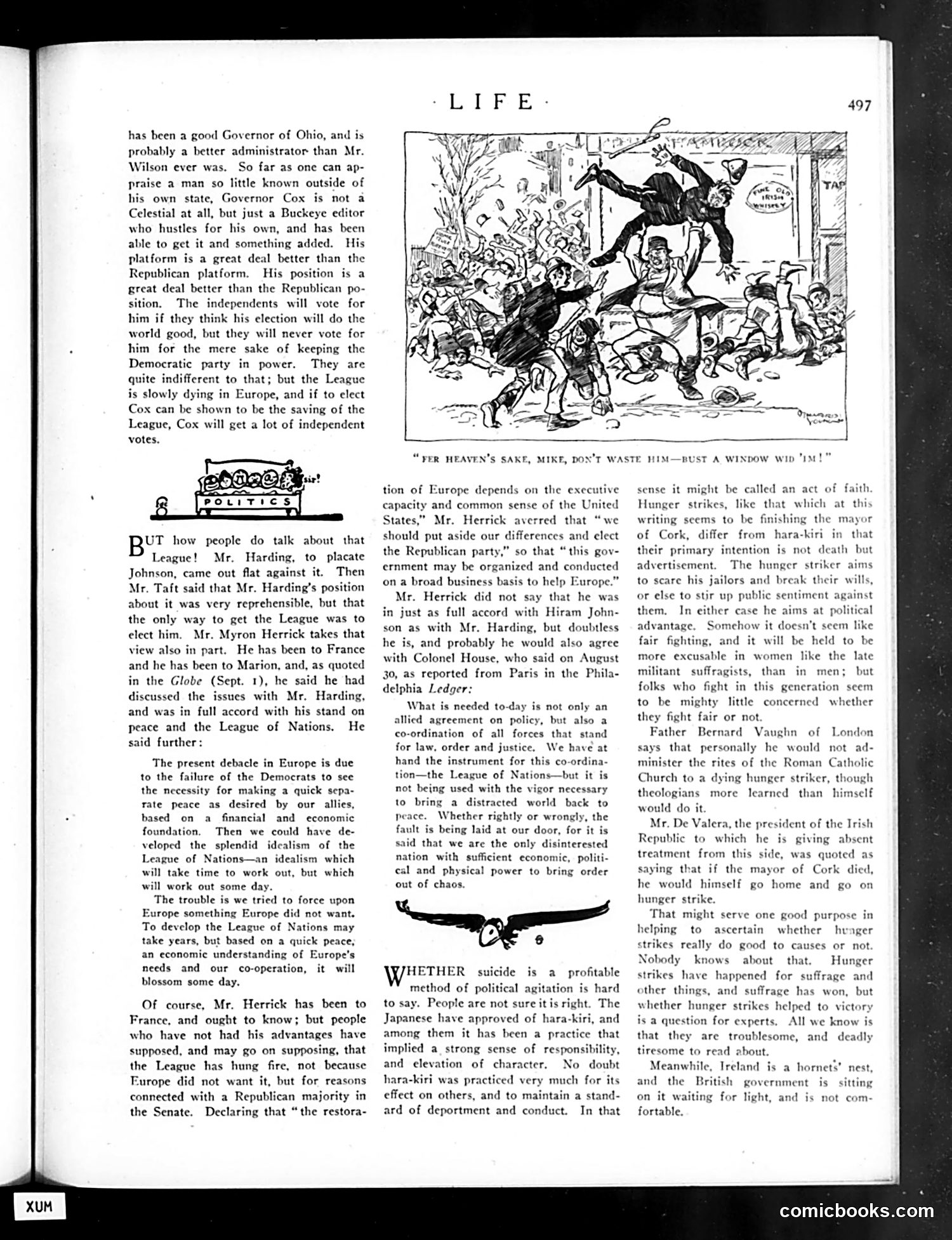
## Main Cartoon The illustration depicts a chaotic street scene with a figure (likely representing a political agitator or striker) being physically restrained or attacked by police and civilians. The caption reads "FER HEAVEN'S SAKE, MIKE, DON'T WASTE HIM—BUST A WINDOW WID 'IM!" This appears to satirize violent protest tactics and street disorder, mocking both the agitators and the response to them. ## Political Context The page discusses the 1920 U.S. presidential election, contrasting Democrat James Cox's platform favorably with Republican Warren Harding's stance on the League of Nations. The text critiques Republican claims that only they can restore European order, sarcastically suggesting that Republicans in the Senate actually blocked League action. ## The Satire's Point The cartoon and accompanying text together mock the futility and chaos of radical political agitation (possibly labor strikes or radical activism) while simultaneously criticizing Republican hypocrisy about international peace efforts. The cartoon's crude humor undercuts claims that disorder serves any legitimate political purpose.
📄 Transcribed text from this page (OCR, searchable)
Machine-transcribed from the original scan — historical spelling and the odd misread are preserved.
has been a good Governor of Ohio, and is probably a better administrator than Mr. Wilson ever was. So far as one can ap- praise a man so little known outside of his own state, Governor Cox is not a Celestial at all, but just a Buckeye editor who hustles for his own, and has been able to get it and something added. His platform is a great deal better than the Republican platform. His position is a great deal better than the Republican po- sition. The independents will vote for him if they think his election will do the world good, but they will never vote for him for the mere sake of keeping the Democratic party in power. They are quite indifferent to that; but the League is slowly dying in Europe, and if to elect Cox can be shown to be the saving of the League, Cox will get a lot of independent JT how people do talk about that League! Mr. Harding, to placate Johnson, came out flat against it. Then Mr. Taft said that Mr. Harding’s position about it was very reprehensible, but that the only way to get the League was to elect him. Mr. Myron Herrick takes that view also in part. He has been to France and he has been to Marion, and, as quoted in the Globe (Sept. 1), he said he had discussed the issues with Mr. Harding, and was in full accord with his stand on peace and the League of Nations. He said further: The present debacle in Europe is due to the failure of the Democrats to see the necessity for making a quick sepa- rate peace as desired by our allies, based on a financial and economic foundation. Then we could have de- veloped the splendid idealism of the League of Nations—an idealism which ill take time to work out, but which will work out some day. The trouble is we tried to force upon Europe something Europe did not want. To develop the League of Nations may take years, but based on a quick peace, an economic understanding of Europ needs and our co-operation, it will blossom some day. Of course, Mr. Herrick has been to France, and ought to know; but people who have not had his advantages have supposed, and may go on supposing, that the League has hung fire, not because Europe did not want it, but for reasons connected with a Republican majority in the Senate. Declaring that “the restora- “FER HEAVEN'S SAKE, MIKE, DON’T WASTE HIM tion of Europe depends on the executive capacity and common sense of the United States,” Mr. Herrick averred that “we should put aside our differences and elect the Republican party,” so that “this gov- ernment may be organized and conducted on a broad business basis to help Europe.” Mr. Herrick did not say that he was in just as full accord with Hiram John- son as with Mr. Harding, but doubtless he is, and probably he would also agree with Colonel House, who said on August 30, as reported from Paris in the Phila- delphia Ledger: What is needed to-day is not only an allied agreement on policy, but also a co-ordination of all forces that stand for law, order and justice. We have at hand the instrument for this co-ordina- tion—the League of Nations—but it is not being used with the vigor necessary to bring a distracted world back to peace. Whether rightly or wrongly, the fault is being laid at our door, for it is said that we are the only disinterested nation with sufficient economic, politi- cal and physical power to bring order out of chaos. 8 HETHER a_ profitable method of political agitation is hard to say. People are not sure it is right. The Japanese have approved of hara-ki among them it has been a practice that implied a strong sense of responsibility, and elevation of character. No doubt suicide is hara-kiri was practiced very much for its effect on others, and to maintain a stand- ard of deportment and conduct. In that BUST A WINDOW WID' sense it might be called an act of faith Hunger strikes, like that which at this writing seems to be finishing the mayor of Cork, differ from hara-kiri in that their primary intention is not death but advertisement. to scare his jailors and break their wills, The hunger striker aims or else to stir up public sentiment against them. In either case he aims at political advantage. fair fighting, and it will be held to be more excusable in women like the late militant suffragists, than in men; but folks who fight in this generation seem to be mighty little concerned whether they fight fair or not. Father Bernard Vaughn of London says that personally he would not ad- minister the rites of the Roman Cathc Church to a dying hunger striker, though theologians more learned than himself would do it Mr. De Valera, the president of the Irish Republic to which he is giving absent treatment from this side, was quoted as saying that if the mayor of Cork died, he would himself go home and go on hunger strike. mehow it doesn’t seem like That might serve one good purpose in to ascertain whether henger strikes really do good to causes or not. Nobody about that. Hunger strikes have happened for suffrage and other things, and suffrage has won, but whether hunger strikes helped to vic helping knows is a question for experts. All we know is that they are troublesome, and deadly tiresome to read about. Meanwhi Ireland is a hornets’ nest, and the British government is sitting on it waiting for light, and is not com- fortable. comicbooks.com