
Life, 1920-09-16 · page 28 of 44
Life — September 16, 1920 — page 28: what you’re looking at
What you’re looking at
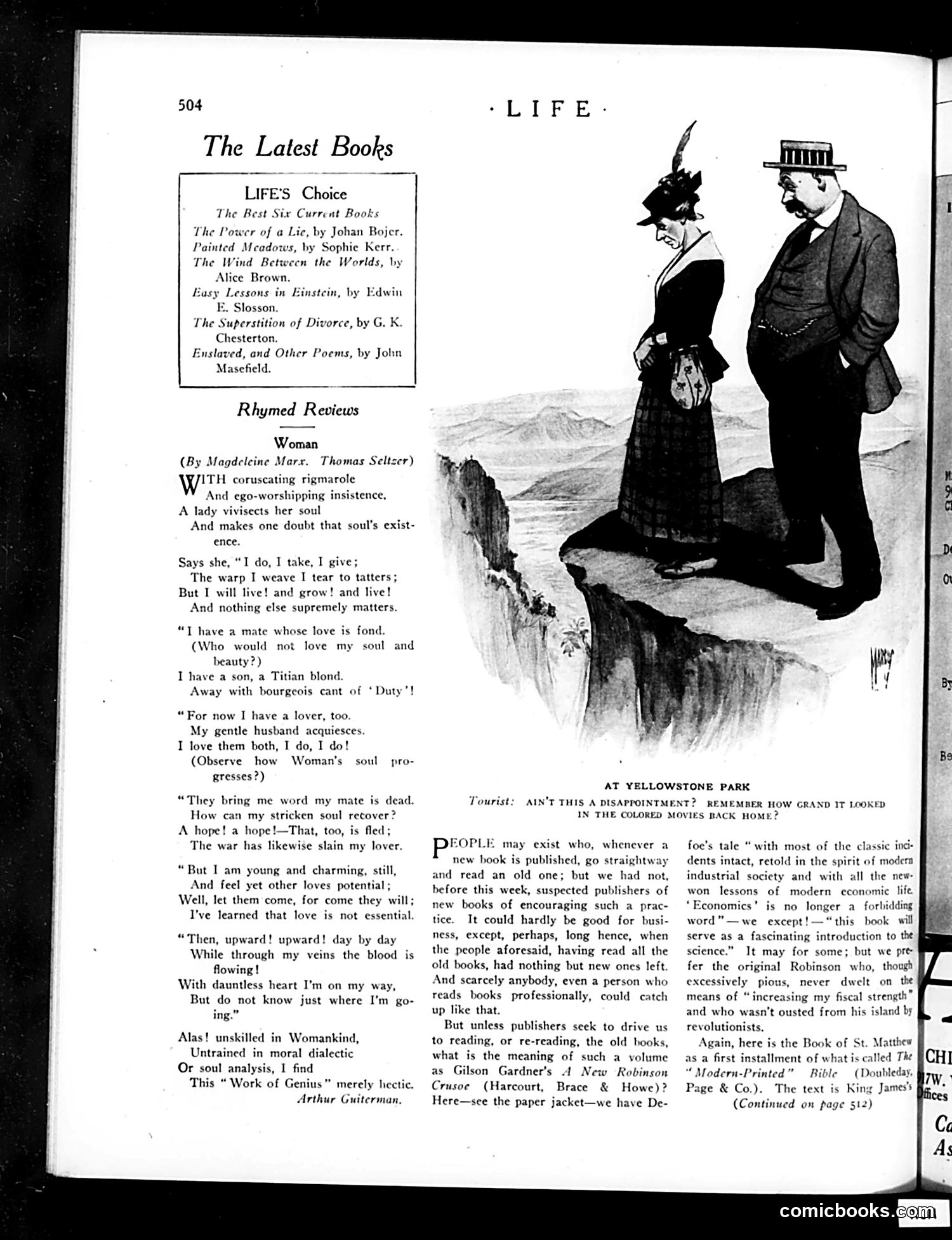
This page contains book reviews rather than political cartoons. The main satirical content is Arthur Guiterman's poem "Woman," which mocks what appears to be a modernist literary work depicting a self-absorbed female character who prioritizes personal fulfillment over traditional duties. The poem ridicules her ego-centered philosophy and her casual approach to marriage and infidelity, presenting her as shallow and "merely hectic." The small cartoon at bottom shows a tourist at Yellowstone Park disappointed that the natural wonder doesn't match the glamorous "colored movies" (early color film) seen back home—satirizing how cinema inflates expectations versus reality. The book reviews criticize publishers for encouraging readers to re-read classics instead of buying new books, and mock a modern retelling of *Robinson Crusoe* that adds economics lessons, suggesting such "improvements" ruin timeless stories. The overall tone is conservative, mocking both modernist literature and commercialism.
📄 Transcribed text from this page (OCR, searchable)
Machine-transcribed from the original scan — historical spelling and the odd misread are preserved.
The Latest Books LIFE’S Choice The Best Six Current Books The Power of a Lie, by Johan Bojer. Painted Mcadows, by Sophie Kerr. The Wind Between the Worlds, by Alice Brown. Lessons in Einstein, by Edwin Slosson. The Superstition of Divorce, by G. K. Chesterton. Enslaved, and Other Poems, by John Masefield. Rhymed Reviews Woman Magdeleine Marx. Thomas Seltzer) ITH coruseating rigmarole And ego-worshipping insistence, A lady vivisects her soul And makes one doubt that soul's exist- ence. Says she, “I do, I take, I give; The warp I weave I tear to tatters; But I will live! and grow! and live! And nothing else supremely matters. “T have a mate whose love is fond. (Who would not love my soul and beauty?) have a son, a Titian blond. Away with bourgeois cant of ‘Duty’! For now I have a lover, too. My gentle husband acquiesces. love them both, I do, I do! (Observe how Woman's gresses?) soul pro- “They bring me word my mate is dead. How can my stricken soul recover? A hope! a hope!—That, too, is fled; The war has likewise slain my lover. “But Iam young and charming, still, And feel yet other loves potential ; Well, let them come, for come they will; I've learned that love is not essential. “Then, upward! upward! day by day While through my veins the blood is flowing! With dauntless heart I'm on my way, But do not know just where I'm go- ing.” Alas! unskilled in Womankind, Untrained in moral dialectic Or soul analysis, I find This “ Work of Genius” merely hectic. Arthur Guiterman, AT YELLOWSTONE PARK Tourist: AIN'T THIS A DISAPPOINTMENT? REMEMBER HOW GRAND IT LOOKED IN THE COLORED MOVIES BACK HOME? OPLE 4 new hook is published, go straightway and read an old one; but we had not, before this week, suspected publishers of new books of encouraging such a prac- tice. It could hardly be good for bus ness, except, perhaps, long hence, when the people aforesaid, having read all the old books, had nothing but new ones left. And scarcely anybody, even a person who reads books professionally, could catch up like that. But unless publishers seek to drive us to reading, or re-reading, the old hooks, what is the meaning of such a volume as Gilson Gardner’s A New Robinson Crusoe (Harcourt, Brace & Howe)? Here—sce the paper jacket—we have De- y exist who, whenever a foe's tale “ with most of the classic ind dents intact, retold in the spirit of modern industrial society and with all the new won lessons of modern economic life ‘Economics’ is no longer a forbidding word” —we except!—“this book will serve as a fascinating introduction to the science.” It may for some; but we pre- fer the original Robinson who, though excessively pious, never dwelt on the means of “increasing my fiscal strength” and who wasn't ousted from his island by revolutionists, Again, here is the Book of St. Matthew as a first installment of what is called The Modern-Printed” Bible (Doubleday, Page & Co.). The text is King James's (Continued on page 512) comicbooks.¢gingy