
Life, 1920-09-16 · page 20 of 44
Life — September 16, 1920 — page 20: what you’re looking at
What you’re looking at
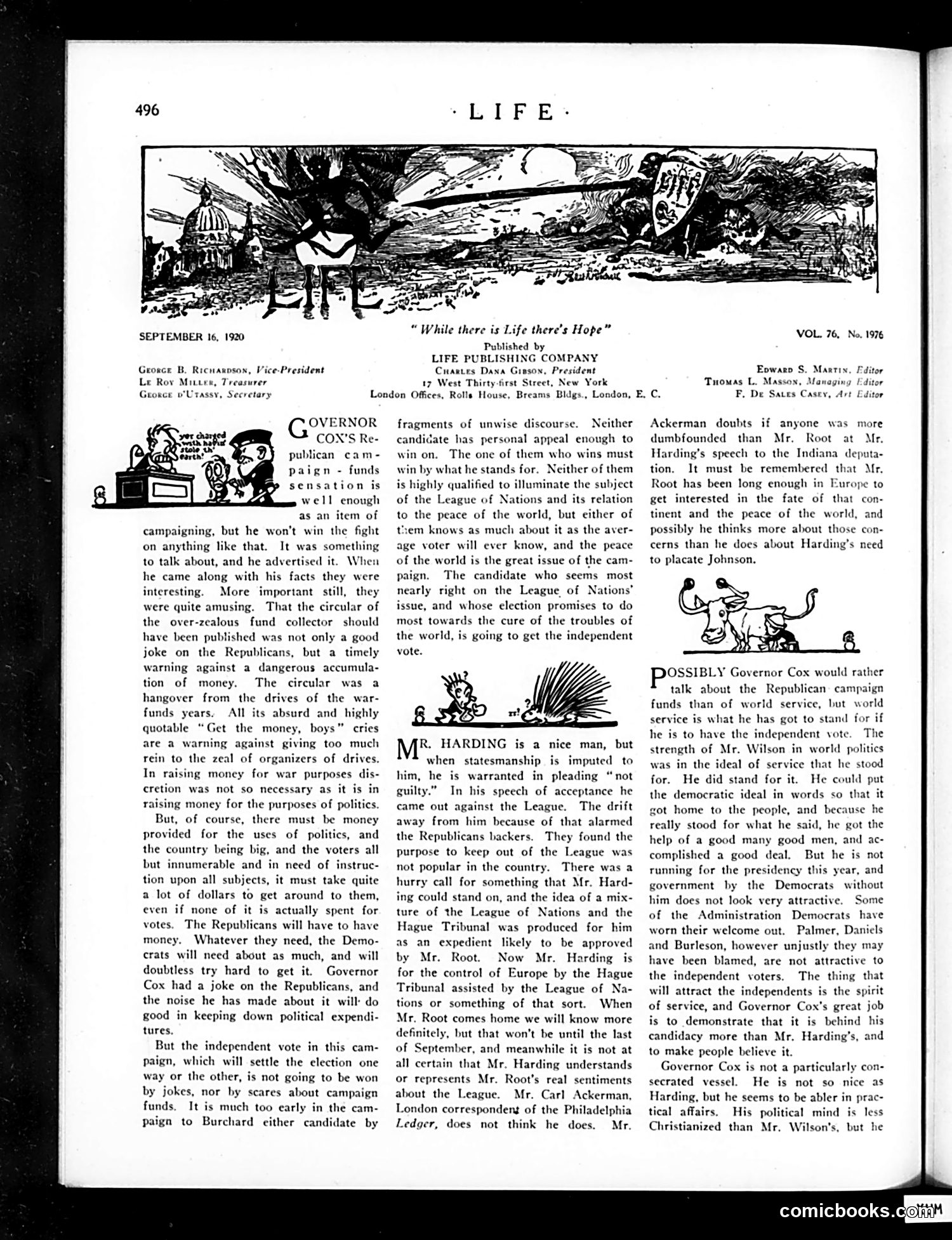
This editorial page critiques the 1920 presidential campaign, particularly Republican candidate Warren G. Harding and his handling of the League of Nations issue. **The Figures:** - "Governor Cox" (Democratic candidate James M. Cox) is praised for exposing Republican campaign fund-raising excesses - "Mr. Harding" (Republican candidate Warren G. Harding) is criticized as unprepared on major issues - "Mr. Root" (likely Elihu Root, Republican elder statesman) appears to be secretly controlling Harding's League of Nations position **The Satire:** Life argues that while Cox scored a political joke exposing GOP fundraising impropriety, the real election will be decided by substantive policy positions, not scandal. The magazine suggests Harding lacks genuine conviction on the League of Nations—the campaign's central issue—and that his stated position is actually a compromise fabricated by Root to make Harding more electable. **Key Context:** The 1920 election centered on post-WWI foreign policy, particularly U.S. participation in the League of Nations, which remained deeply controversial among Republicans and the American electorate.
📄 Transcribed text from this page (OCR, searchable)
Machine-transcribed from the original scan — historical spelling and the odd misread are preserved.
SEPTEMBER 16, 1920 Groce B. Ricnanpson, Vice-President Lr Rov Mitre, Treasurer Guoxce v'Urassy, Secretary OVERNOR CON’S Re- publican cam- paign - funds sensation is well enough as an item of campaigning, but he won't win the fight on anything like that. It was something to talk about, and he advertised When he came along with his facts they were interesting. More important still, they were quite amusing. That the circular of the over-zealous fund collector should have been published was not only a good joke on the Republicans, but a timely warning against a dangerous accumula- tion of money. The circular was a hangover from the drives of the war- funds years. All its absurd and highly quotable “Get the money, boys” cries are a warning against giving too much rein to the zeal of organizers of drives. In raising money for war purposes dis- cretion was not so necessary as it is in raising money for the purposes of politics. But, of course, there must be money provided for the uses of politics, and the country being big, and the voters all but innumerable and in need of instruc- tion upon all subjects, it must take quite a lot of dollars to get around to them, even if none of it is actually spent for votes. The Republicans have to have money. Whatever they need, the Demo- crats will need about as much, and will doubtless try hard to get it. Governor Cox had a joke on the Republicans, and the noise he has made about it will do good in keeping down political expend tures, But the independent vote in this cam- paign, which will settle the election one way or the other, is not going to be won by jokes, nor by scares about campaign funds. It is much too early in the cam- paign to Burchard either candidate by London Offices, Rolls House, Breams Bligs., “While there is Life there’s Hope” Published by LIFE PUBLISHING COMPANY Cuartes Daxa Greso, President 17 West Thirty-first Street, New York fragments of unwise discourse. Neither candidate has personal appeal enough to win on. The one of them who wins must win by what he stands for. Neither of them is highly qualified to illuminate the subject of the League of Nations and its relation to the peace of the world, but either of them knows as much about it as the aver- age voter will ever know, and the peace of the world is the great issue of the cam- paign. The candidate who seems most nearly right on the League of Nations’ issue, and whose election promises to do most towards the cure of the troubles of the world, is going to get the independent R, HARDING when statesmanship is imputed to him, he is warranted in pleading “not guilty.” In his speech of acceptance he came out against the League. The drift away from him because of that alarmed the Republicans backers. They found the purpose to keep out of the League was not popular in the country. There was a hurry call for something that Mr. Hard- ing could stand on, and the idea of a mix- ture of the League of Nations and the Hague Tribunal was produced for him as an expedient likely to be approved by Mr. Root. Now Mr. Harding is for the control of Europe by the Hague Tribunal assisted by the League of Na tions or something of that sort. When Mr. Root comes home we will know more definitely, but that won't be until the last of September, and meanwhile it is not at all certain that Mr. Harding understands or represents Mr. Root's real sentiments about the League. Mr. Carl Ackerman, London correspondeng of the Philadelphia Ledger, does not think he does. Mr. is a nice man, but London, E, C. VOL. 76, No. 1976 Eowarp S. Martin, Fuitor Tuomas L. Masson, Managing Editor F, Dr Sates Casty, Art Editor Ackerman doubts if anyone was more dumbfounded than Mr. Root at Mr, Harding’s speech to the Indiana deputa- tion. It must be remembered that Mr. Root has been long enough in Europe to get interested in the fate of that con- tinent and the peace of the world, and possibly he thinks more about those con- cerns than he does about Harding’s need to placate Johnson. OSSIBLY Governor Cox would rather talk about the Republican campaign funds than of world service, but world service is what he has got to stand for if he is to have the independent vote. The strength of Mr. Wilson in world politics was in the ideal of service that he stood for. He did stand for it. He could put the democratic ideal in words so that it got home to the people, and because he really stood for what he said, he got the help of a good many good men, and ac- complished a good deal, But he is not running for the presidency this year, and government by the Democrats without him does not look very attractive. Some of the Administration Democrats have worn their welcome out. Palmer, Daniels and Burleson, however unjustly they may have been blamed, are not attractive to the independent voters. The thing that will attract the independents is the spirit of service, and Governor Cox's great job is to demonstrate that it is behind his candidacy more than Mr. Harding’s, and to make people believe it. Governor Cox is not a particularly con- secrated vessel. He is not so nice as Harding, but he seems to be abler in prac- tical affairs. His political mind is less Christianized than Mr, Wilson's, but he comicbooks.