
Life, 1920-09-16 · page 33 of 44
Life — September 16, 1920 — page 33: what you’re looking at
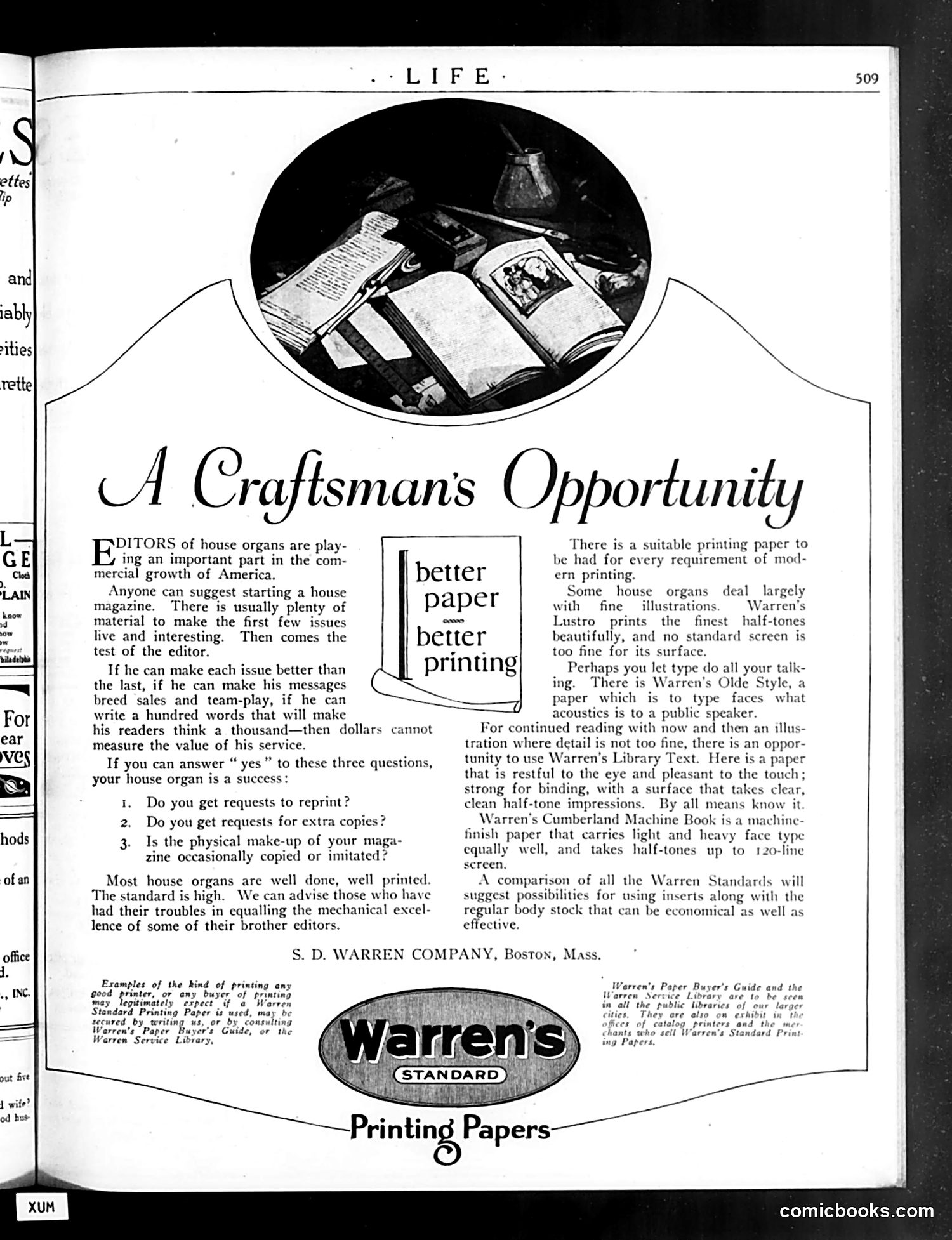
What you’re looking at
This is **not a cartoon but a trade advertisement** disguised as editorial content—a common early 20th-century magazine practice. The piece addresses editors of "house organs" (corporate newsletters/internal publications). It argues that producing quality in-house magazines—through better paper and printing—builds company loyalty and sales. The three success metrics listed (reprint requests, copy requests, imitation) frame the house organ as a business tool. The advertisement then pivots to promoting Warren Standard Printing Papers, listing specific products (Lustro, Olde Style, Library Text, Cumberland Machine Book) for different printing needs. The circular photo at top shows typical editor's materials (books, papers, tools). **For modern readers:** This reflects the Progressive Era faith in professional standards and corporate communication. The "craftsman" framing dignified industrial work, while treating employee publications as serious business instruments—not primarily for worker benefit, but for corporate messaging and morale control.
📄 Transcribed text from this page (OCR, searchable)
Machine-transcribed from the original scan — historical spelling and the odd misread are preserved.
DITORS of house organs are play- ing an important part in the com- mercial growth of America. Anyone can suggest starting a house magazine. There is usually plenty of material to make the first few issues live and interesting. Then comes the test of the editor. If he can make each issue better than the last, if he can make his messages breed sales and team-play, if he can write a hundred words that will make his readers think a thousand—then dollars cannot measure the value of his service. If you can answer “ yes” to these three questions, your house organ is a success: Do you get requests to reprint? Do you get requests for extra copies? Is the physical make-up of your ma zine occasionally copied or imitated ? Most house organs are well done, well printed. The standard is high. We can advise those who have had their troubles in equalling the mechanical excel- lence of some of their brother editors. better paper better printing There is a suitable printing paper to be had for every requirement of mod- ern printing. Some house organs with fine _ illustrations. Warren's Lustro prints the finest half-tones beautifully, and no standard screen is too fine for its surface. Perhaps you let type do all your talk- ing. There is Warren’s Olde Style, a paper which is to type faces what acoustics is to a public speaker. For continued reading with now and then an illus- tration where detail is not too fine, there is an oppor- tunity to use Warren’s Library Text. Here is a paper that is restful to the eye and pleasant to the touch; strong for binding, with a surface that takes clear, clean half-tone impressions. By all means know it. Warren's Cumberland Machine Book is a machine- finish paper that carries light and heavy face type equally well, and takes half-tones up to 120-line screen, A comparison of all the Warren Standards will suggest possibilities for using inserts along with the regular body stock that can be economical as well as effective. deal largely S. D. WARREN COMPANY, Boston, Mass. Examples of the kind of printing any good printer, or any buyer of printing may legitimately expect if a Warren Standard Printing Paper is used, may be secured by writing us, or by conswi Warren's Poper Buyer's Guide, or t Warren Service Library, Warren's Paper Buyer's Guide and the Warren Service Library are to be scen in all the public libraries of CSTANDARD ) Lay csi Mat comicbooks.com