
Life, 1920-09-16 · page 11 of 44
Life — September 16, 1920 — page 11: what you’re looking at
What you’re looking at
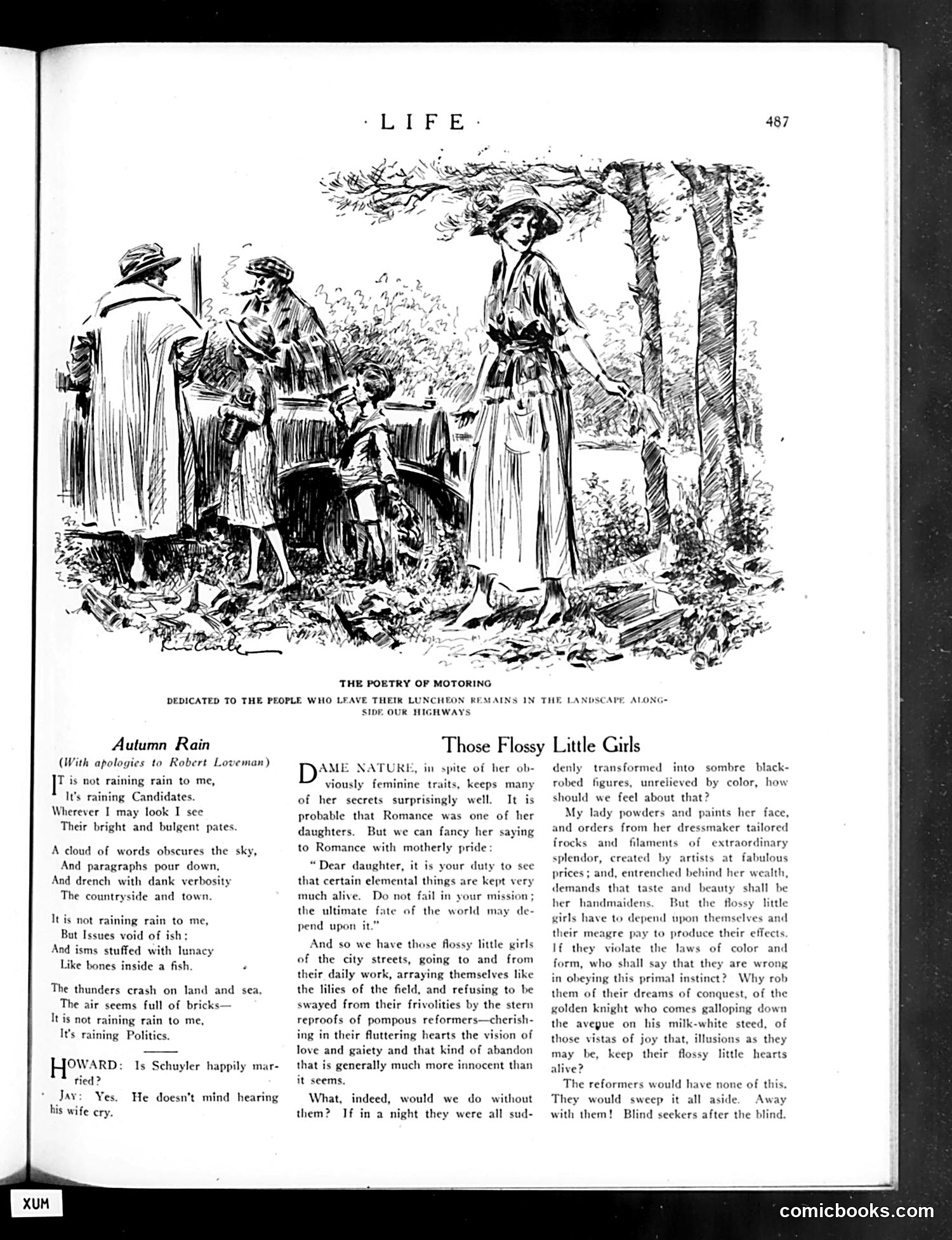
This page contains two distinct pieces: **"Autumn Rain"** is a poem (with "apologies to Robert Loveman") that humorously complains about rainy weather through various metaphors—clouds, paragraphs, issues, thunderstorms, and politics. **The main illustration and article** titled "The Poetry of Motoring" is dedicated satirically "to the people who leave their luncheon remains in the landscape alongside our highways." The sketch shows well-dressed women and children in a woodland picnic setting. The accompanying essay titled "Those Flossy Little Girls" critiques upper-class women who engage in outdoor motor trips, sarcastically praising their romantic notions while implicitly mocking their littering and refined pretensions. The satire targets the disconnect between these women's self-image and their actual behavior toward the natural landscape.
📄 Transcribed text from this page (OCR, searchable)
Machine-transcribed from the original scan — historical spelling and the odd misread are preserved.
DEDICATED TO THE PEOPLE WHO LFAVE THEIR LU Autumn Rain (With apologies to Robert Loveman) [ is not raining rain to me, It's raining Candidates. Wherever I may look I see Their bright and bulgent pates. A cloud of words obscures the sky, And paragraphs pour down, And drench with dank verbosity The countryside and town. It is not raining rain to me, But Issues void of ish; And isms stuffed with lunacy Like bones inside a fish. The thunders crash on land and sea, The air seems full of bricks— It is not raining rain to me, It's raining Politics. Howaro: Is Schuyler happily mar- tied ? Jay: Yes. his wife ery. He doesn't mind hearing THE POETRY OF MOTORING SIDE. OUR HIGHWAYS HEON REMAINS IN THE LANDSCAPE ALONG- Those Flossy Little Girls AME NATURE, in spite of her ob- viously feminine traits, keeps many of her secrets surprisingly well. It is probable that Romance was one of her daughters. But we can fancy her saying to Romance with motherly pride: “Dear daughter, it is your duty to see that certain elemental things are kept very much alive. Do not fail in your mission ; the ultimate fate of the world may de- pend upon it.” And so we have those flossy little girls of the city streets, going to and from their daily work, arraying themselves like the lilies of the field, and refusing to be swayed from their frivolities by the stern reproofs of pompous reformers—cherish- ing in their fluttering hearts the vision of love and gaiety and that kind of abandon that is generally much more innocent than it seems. What, indeed, would we do without them? If in a night they were all sud- denly transformed into sombre black- robed figures, unrelieved by color, how should we feel about that? My lady powders and paints her face, and orders from her dressmaker tailored frocks and filaments of extraordinary splendor, created by artists at fabulous prices; and, entrenched behind her wealth, demands that taste and beauty shall be But the flossy little girls have to depend upon themselves and her handmaidens their meagre pay to produce their effects. If they violate the laws of color and form, who shall say that they are wrong in obeying this primal instinct? Why rob them of their dreams of conquest, of the golden knight who comes galloping down the aveygue on his milk-white steed, of those vistas of joy that, illusions as they may be, keep their flossy little hearts alive? The reformers would have none of this, They would sweep it all aside. Away with them! Blind seekers after the blind. comicbooks.com