
A complete issue · 52 pages · 1920
Life — September 2, 1920
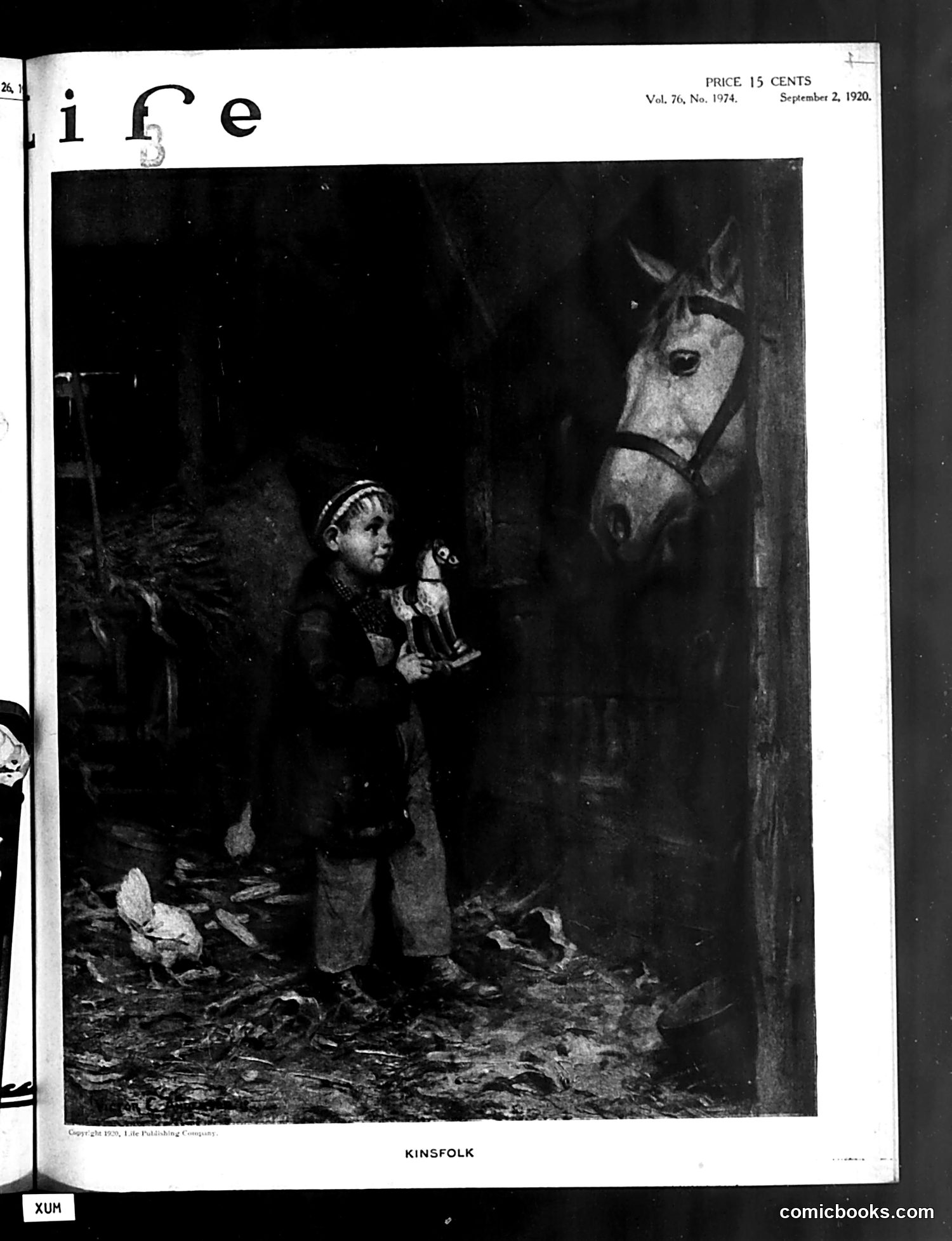
This page from *Life* magazine (September 2, 1920) shows a photograph titled "KINSFOLK" rather than a cartoon. The image depicts a young child in what appears to be a stable or barn, standing beside a horse's head. The child is holding something small (possibly food or a treat) toward the horse. The title "KINSFOLK" appears to be a humorous caption suggesting kinship or familial resemblance between the child and the horse—a common satirical device of the era that could reference either the child's appearance or behavior, or perhaps social commentary about rural/working-class families. Without additional context from accompanying text on the page, the specific satirical intent remains unclear.
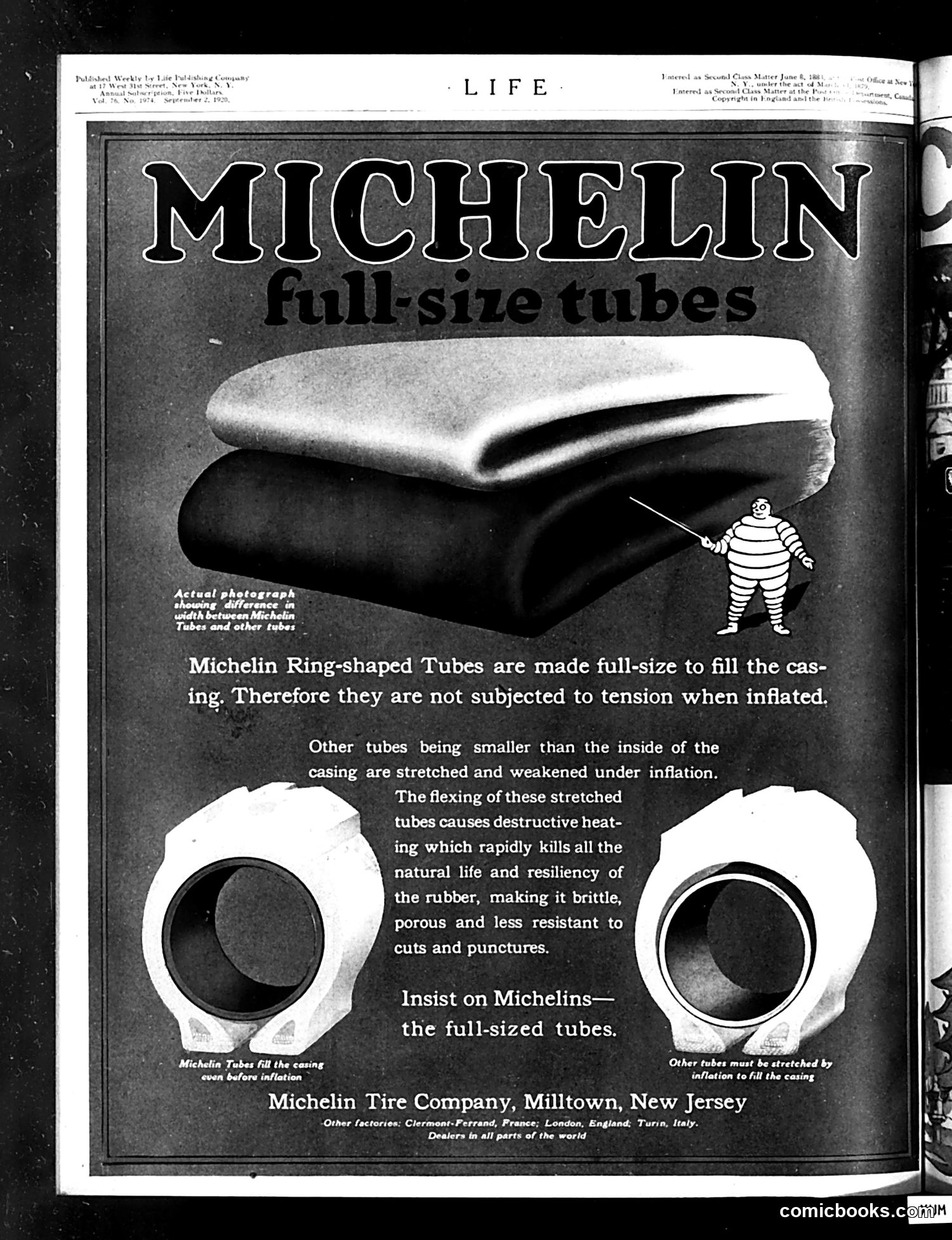
This is **not satire or political commentary**—it's a straightforward product advertisement for Michelin full-size inner tubes, likely from the early 1900s. The ad compares Michelin tubes (shown filling the tire casing evenly) against unnamed competitor tubes (which must stretch to fit). The Michelin mascot, Bibendum (the rotund character pointing), endorses the product. The key sales pitch: stretched tubes generate destructive heat during inflation, weakening rubber and making it brittle and puncture-prone. Michelin's full-size tubes avoid this problem. The visual diagrams—cross-sections showing even versus stretched tube profiles—function as technical proof rather than cartoon humor. This represents early automotive advertising emphasizing engineering superiority.
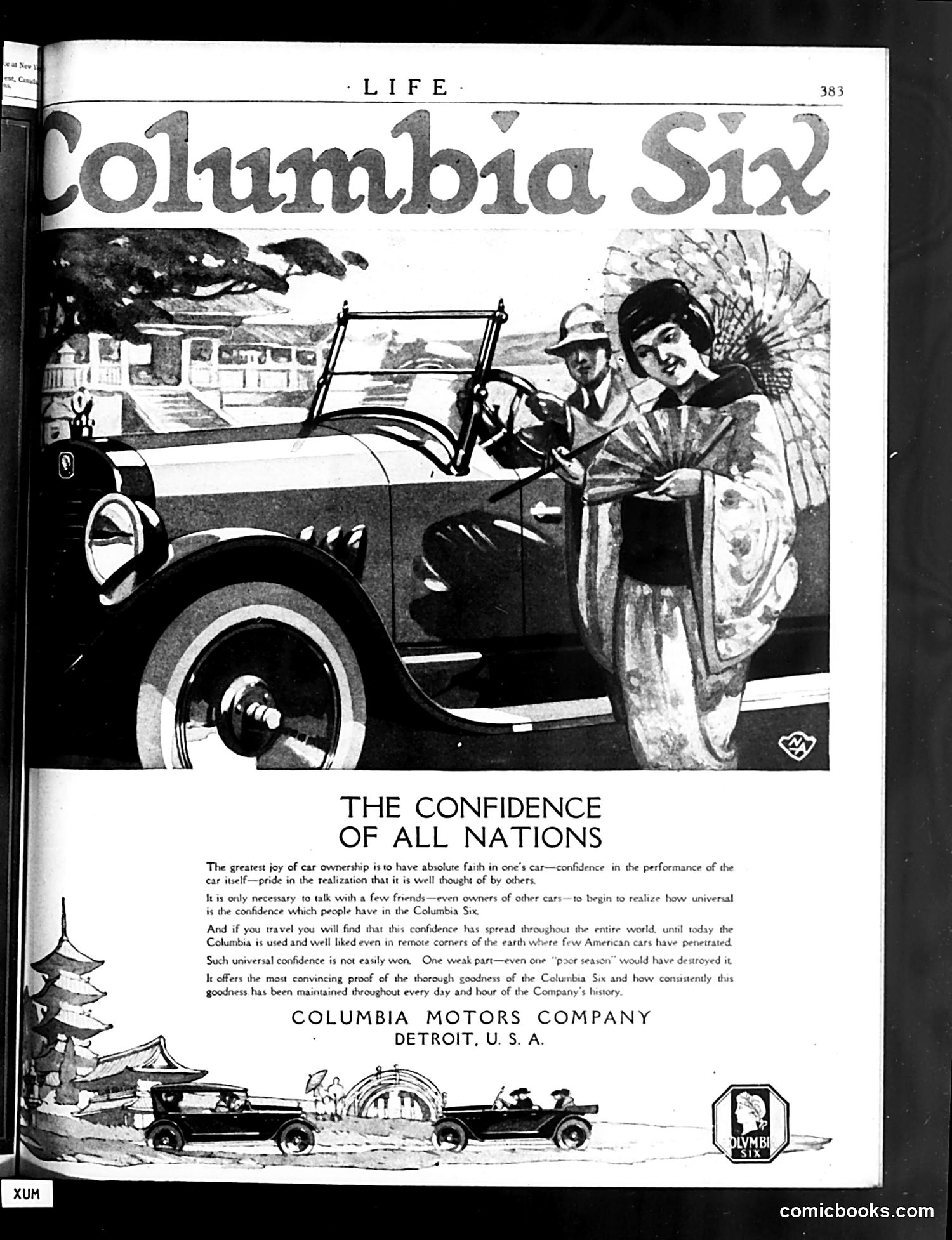
This is a **car advertisement**, not political satire. The page promotes the Columbia Six automobile from Columbia Motors Company (Detroit). The main illustration shows a stylishly dressed couple in a open-air motorcar, with the woman holding a decorative parasol. The accompanying text emphasizes global consumer confidence in the Columbia Six's reliability and performance—claiming the vehicle has earned trust "throughout the entire world" and maintained this reputation consistently. The smaller illustrations at bottom show the car in various international settings, reinforcing the marketing message of worldwide approval and quality. This reflects early 20th-century advertising strategy: positioning a consumer product as universally trusted and internationally validated to appeal to American buyers' aspirations.
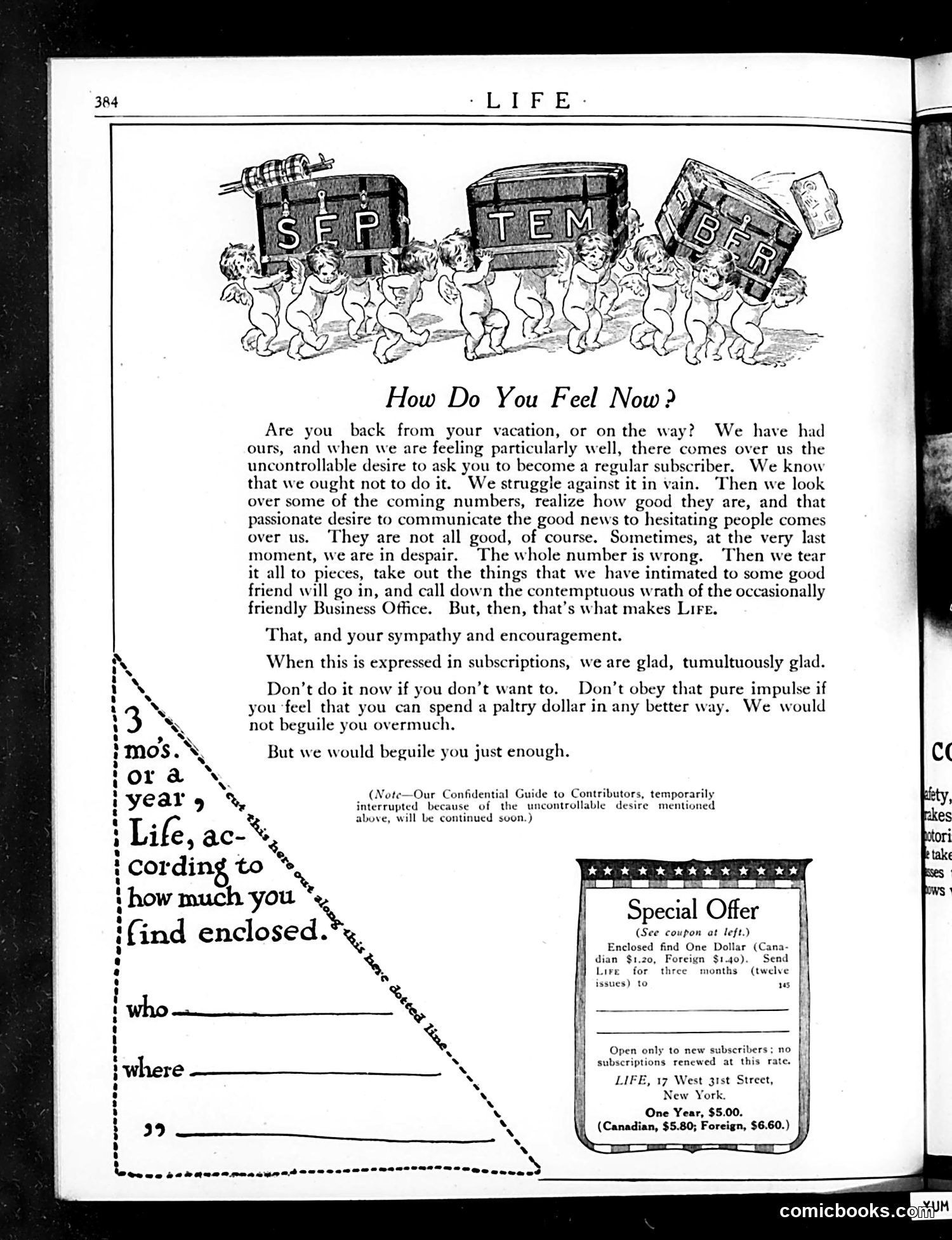
The illustration shows cherubs carrying large blocks labeled "SEP," "TEM," and "BER"—spelling out September. This appears to be a seasonal reference to the month when readers typically return from summer vacations. The accompanying text, "How Do You Feel Now?", uses humorous self-deprecation to solicit subscriptions. The magazine acknowledges the common impulse to ask vacationing readers to subscribe, then playfully admits this impulse is annoying. The tone is deliberately contradictory: they ask for subscriptions while claiming not to really want them, creating comedy through ironic manipulation. The page is primarily a subscription drive, with a special offer box below promising three months of Life for one dollar to new subscribers. The humor lies in Life's self-aware acknowledgment of aggressive marketing tactics.
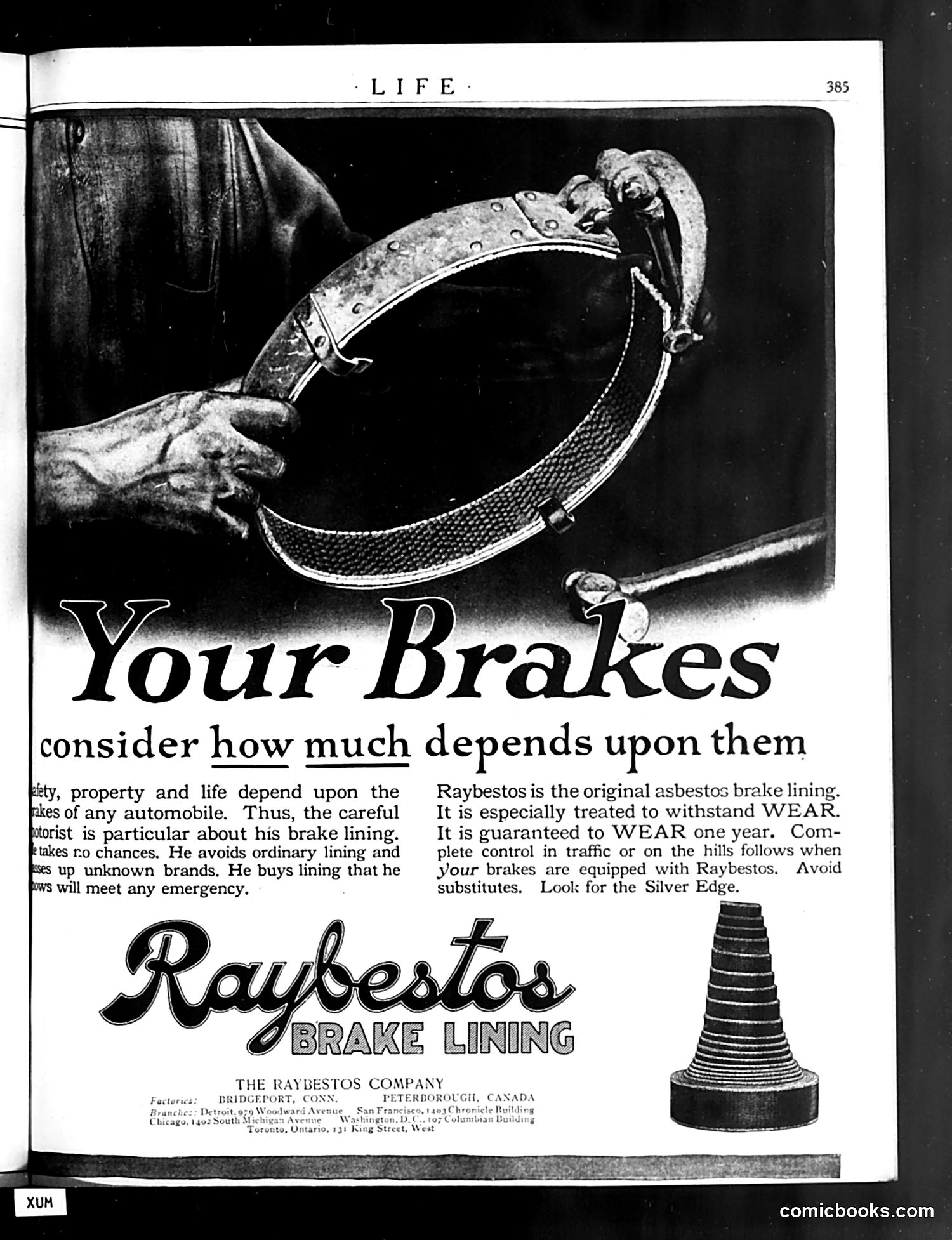
This page is **primarily an advertisement**, not satire or political commentary. It's a vintage ad for Raybestos brake lining, appearing in Life magazine (page 385). The ad uses a photograph of a hand holding an automobile brake drum to emphasize the product's importance. The headline "Your Brakes—consider how much depends upon them" appeals to consumer safety concerns, arguing that "safety, property and life depend upon the rates of any automobile." The copy promotes Raybestos as "the original asbestos brake lining," highlighting its durability and wear-resistance. It warns against inferior substitutes and instructs buyers to "look for the Silver Edge." There is no political satire here—just mid-20th-century product marketing emphasizing reliability and safety to motorists.
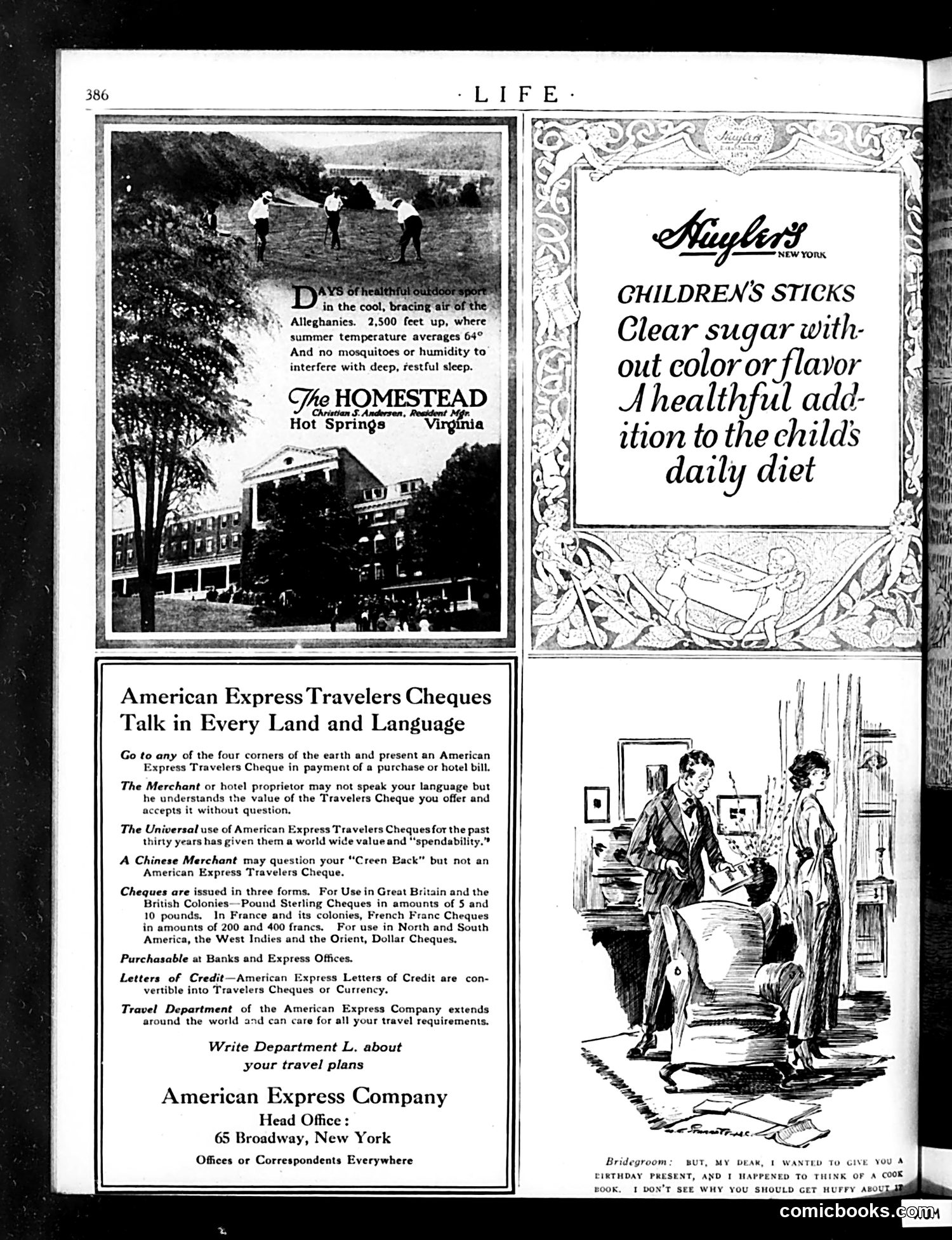
This page is predominantly **advertising** rather than editorial content or satire. The visible ads include: - **The Homestead** resort in Hot Springs, Virginia, promoting outdoor recreation and healthy air - **Nayley's Children's Sticks**: clear sugar candy marketed as a "healthful addition to the child's daily diet" - **American Express Travelers Cheques**: describing their universal acceptance for international travel The bottom illustration appears to be a domestic humor cartoon about a husband and wife discussing a gift, but the caption is only partially visible and unclear in context. There is **no evident political satire** on this page. It reflects early 20th-century advertising's casual health claims (sugar as "healthful") and the luxury travel market targeted at affluent Americans.
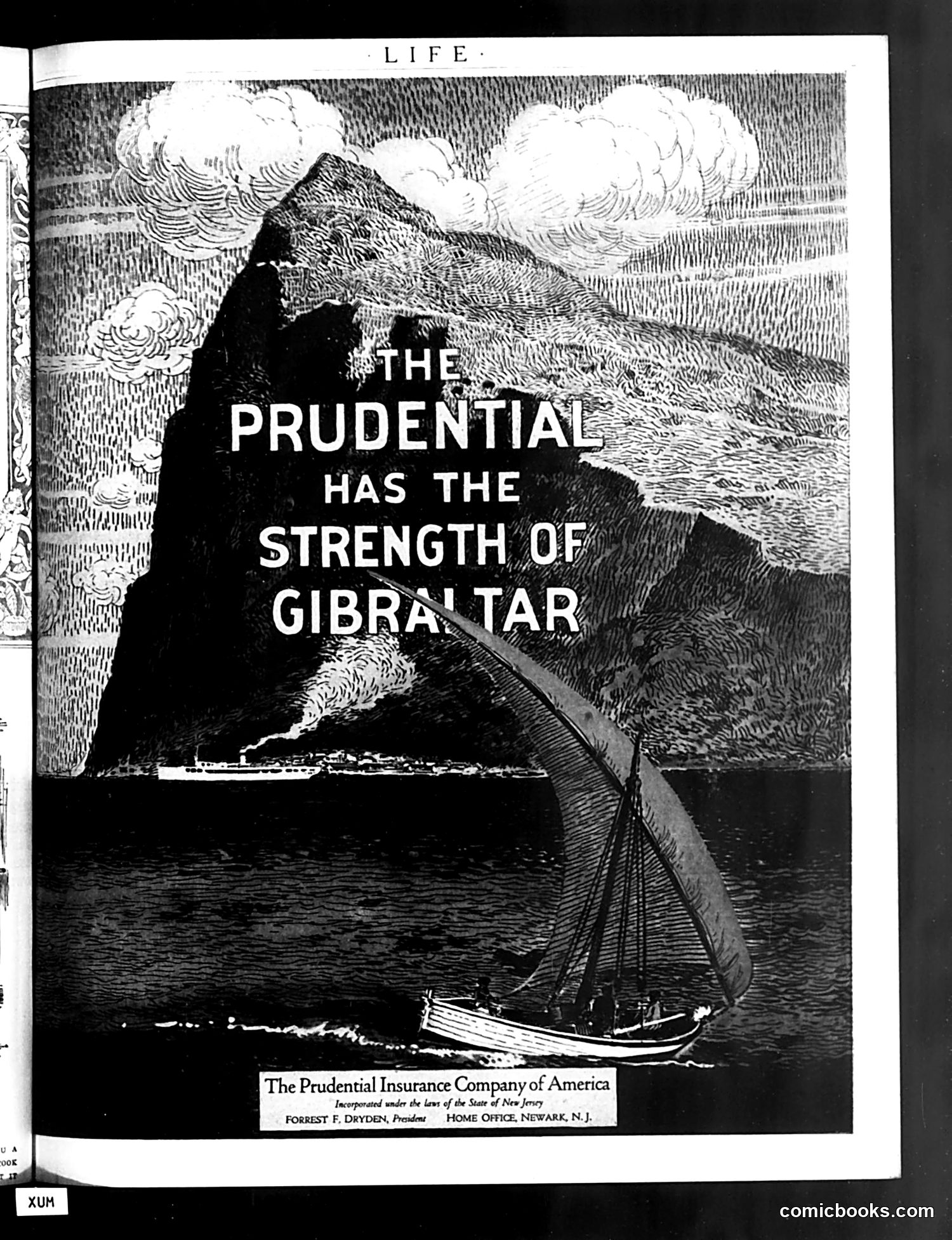
This is a **Prudential Insurance Company advertisement** from *Life* magazine, not a political cartoon. The page features an engraving-style illustration of the Rock of Gibraltar beside a sailing ship on water, with the tagline "THE PRUDENTIAL HAS THE STRENGTH OF GIBRALTAR." The ad uses a geographic metaphor: Gibraltar's famous massive rock formation symbolizes permanence, stability, and immovable strength. By claiming Prudential possesses comparable strength, the advertisement assures potential customers that the insurance company is as solid and dependable as an ancient geological landmark. The visual composition—dramatic rocky landscape against the sea—emphasizes durability and reliability, qualities essential for building consumer confidence in a financial institution. This is corporate branding through metaphorical association.
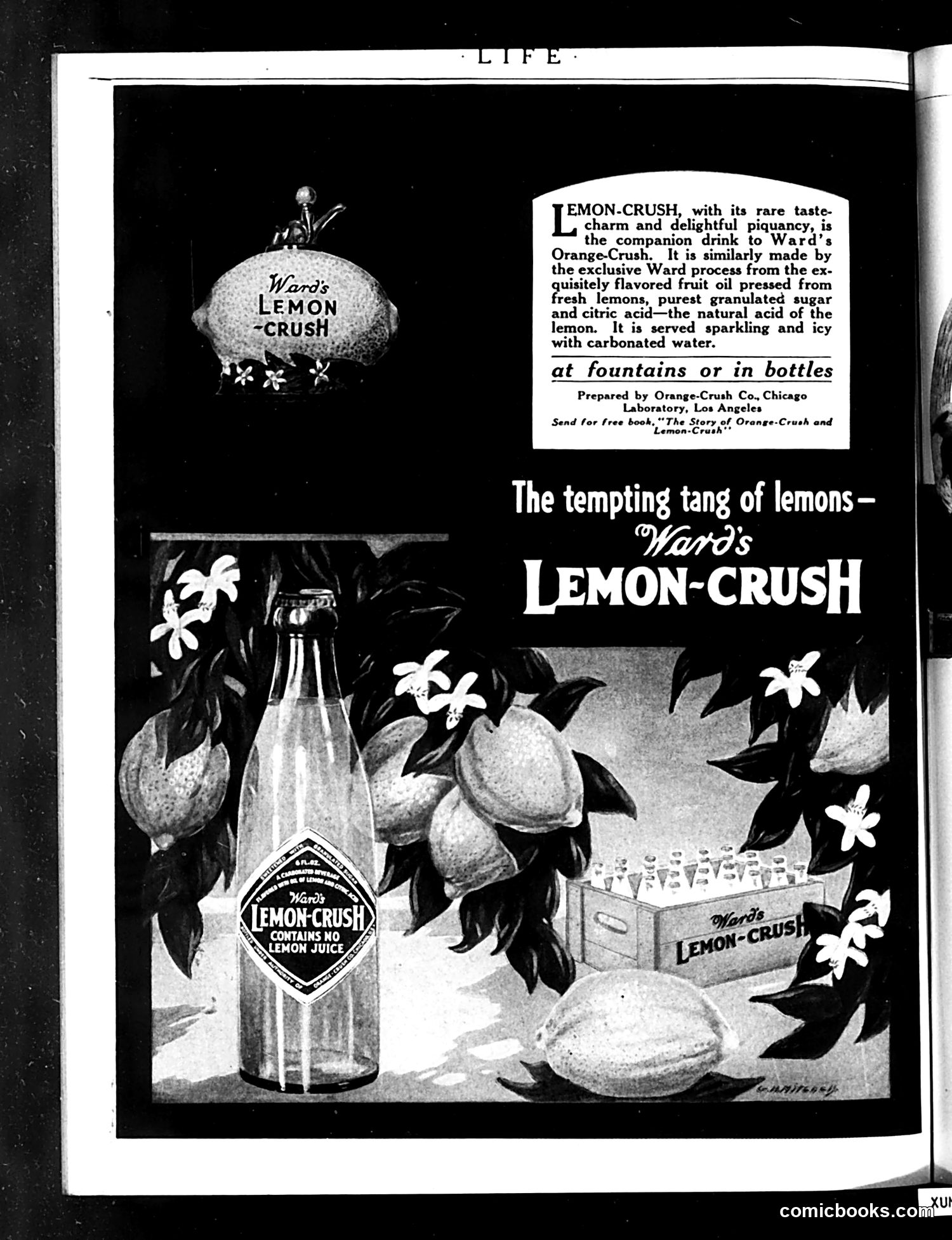
This page is **primarily an advertisement**, not political satire. It promotes Ward's Lemon-Crush beverage across two ads. The top ad describes Lemon-Crush as a companion drink to Ward's Orange-Crush, made from fresh lemon oil, granulated sugar, and citric acid—served sparkling and icy at fountains or in bottles. The larger bottom advertisement features a bottle surrounded by lemon trees and blossoms, emphasizing natural ingredients. A label on the bottle states "Contains No Lemon Juice"—an ironic selling point suggesting the drink uses processed lemon flavor rather than actual juice, which apparently was considered more desirable or consistent quality at the time. The ads are professionally illustrated but contain no political commentary or satirical content.
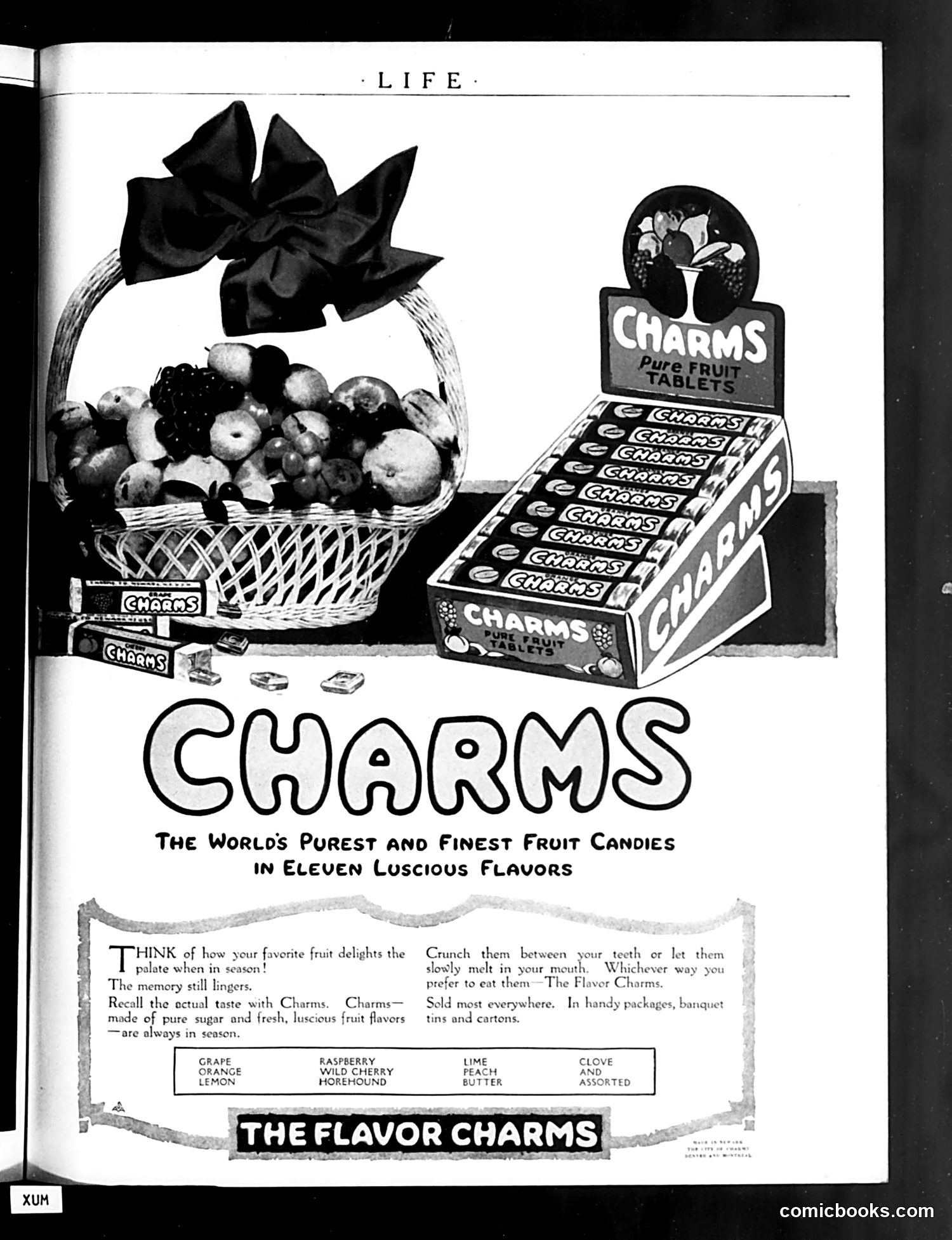
This is a **full-page advertisement** for Charms candy, not political satire or editorial content. The page presents Charms Pure Fruit Tablets as "The World's Purest and Finest Fruit Candies in Eleven Luscious Flavors." The visual composition includes a decorative fruit basket with a black bow and a product display box showing stacked Charms packages. The ad emphasizes flavor variety (orange, lemon, raspberry, wild cherry, etc.) and suggests consuming methods—crunching or letting them melt. There is **no political cartoon or satire** on this page. It's straightforward commercial advertising using typical early-20th-century marketing language about product purity and availability in "handy packages, banquet tins and cartons." The decorative styling reflects period advertising aesthetics.
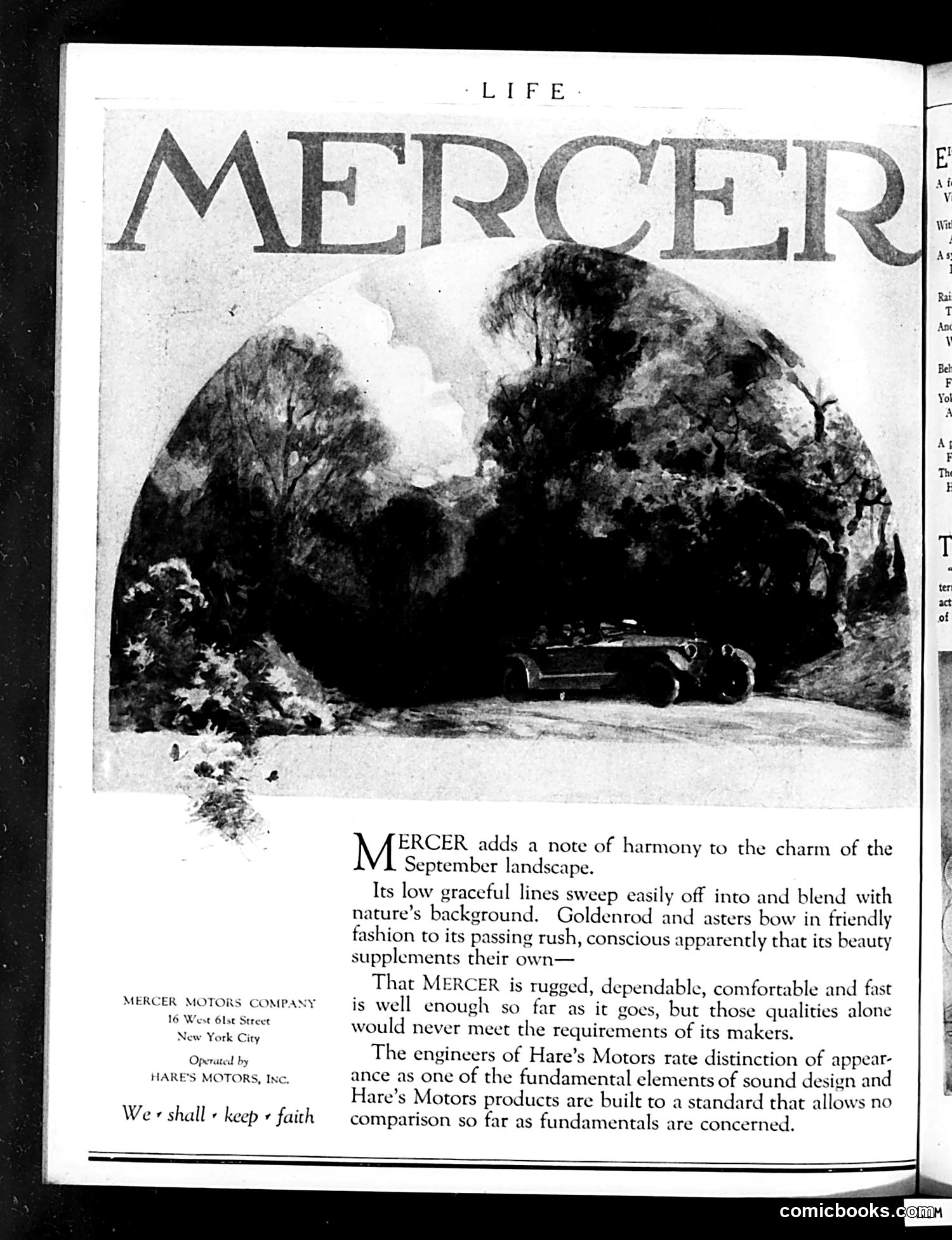
This is an **advertisement**, not a political cartoon. The page promotes the Mercer automobile, manufactured by Mercer Motors Company in New York City (operating under Hare's Motors, Inc.). The ad features a photograph of a Mercer car driving through a natural rock archway or tunnel, framed by trees and landscape. The text uses poetic language to link the car's elegant design to nature's beauty ("adds a note of harmony to the charm of the September landscape"). The marketing emphasizes that while Mercer cars are "rugged, dependable, comfortable and fast," their true distinction lies in superior engineering standards and design quality set by Hare's Motors—appealing to consumers who valued craftsmanship alongside performance. This represents early-20th-century automotive advertising's strategy of associating products with natural beauty and aspirational lifestyle.
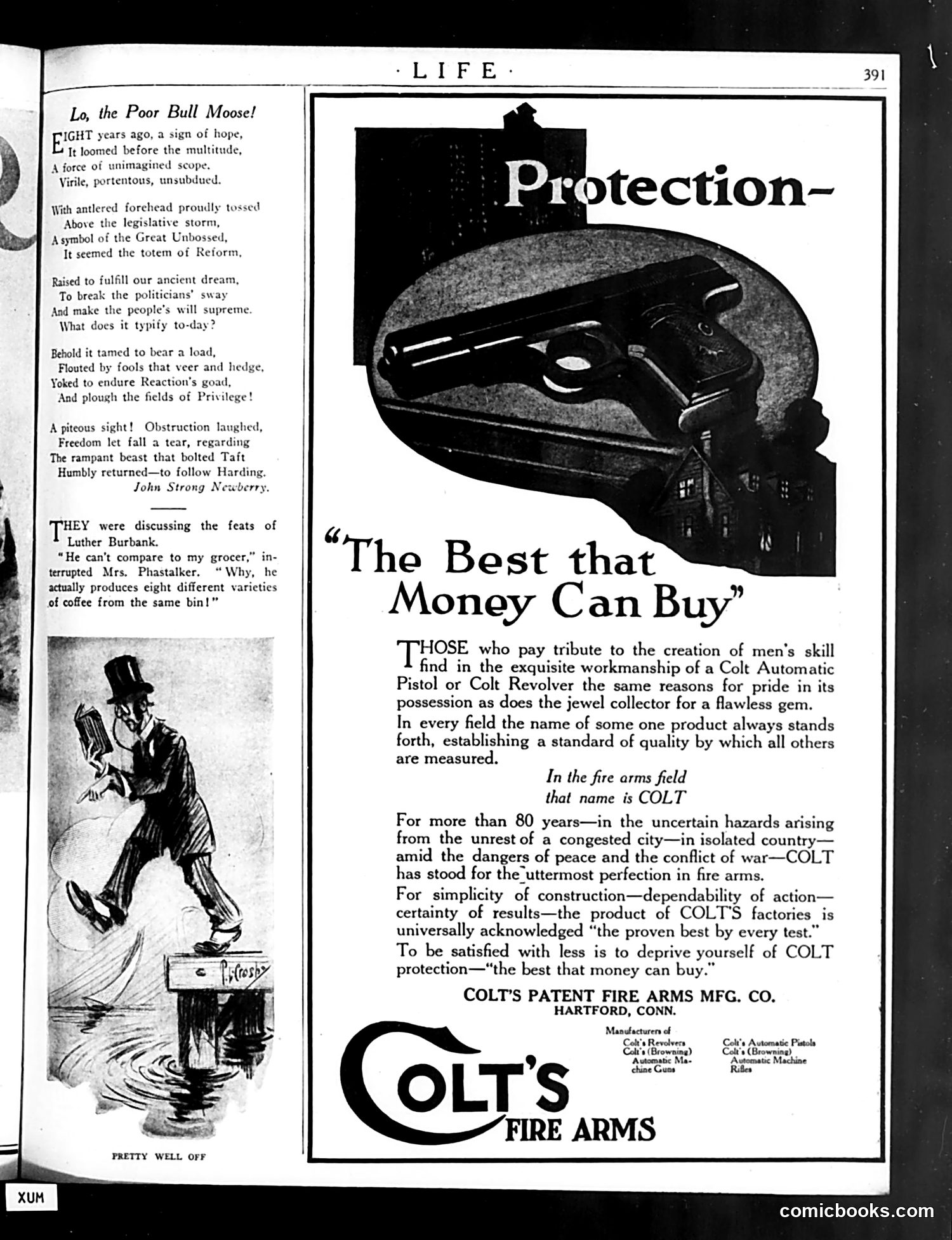
This page contains a political poem ("Lo, the Poor Bull Moose!") on the left and a Colt firearms advertisement on the right. The poem references the "Bull Moose" — likely Theodore Roosevelt's Progressive Party (symbolized by a bull moose) from around 1912. The verse satirizes the movement's initial promise as a reform force ("A symbol of the Great Unbiased"), mocking how it failed to deliver ("tamed to bear a load" / "ploughs the fields of Privilege"). The attribution to "John Strong Nursery" appears to be a satirical pen name. The advertisement is unrelated political content — a straightforward Colt Firearms pitch emphasizing quality and reliability over 80 years, targeted at those valuing craftsmanship. The juxtaposition suggests Life magazine's editorial stance: skepticism toward populist political movements alongside mainstream commercial messaging.
This is a **full-page advertisement**, not a cartoon or satirical content. The ornate decorative border surrounding the text is typical of early 20th-century magazine design, but it serves no satirical purpose. The ad promotes **Martin & Martin Shoes**, claiming they cost less per year to wear than competitors because of superior quality and durability. It boasts that many pairs have lasted seven to eight years or longer, emphasizing "true economy" through quality rather than low price. The company lists three retail locations (New York and Chicago) and offers mail service worldwide. The italicized text and formal typography reflect period advertising conventions. This represents straightforward product promotion rather than satire or political commentary.
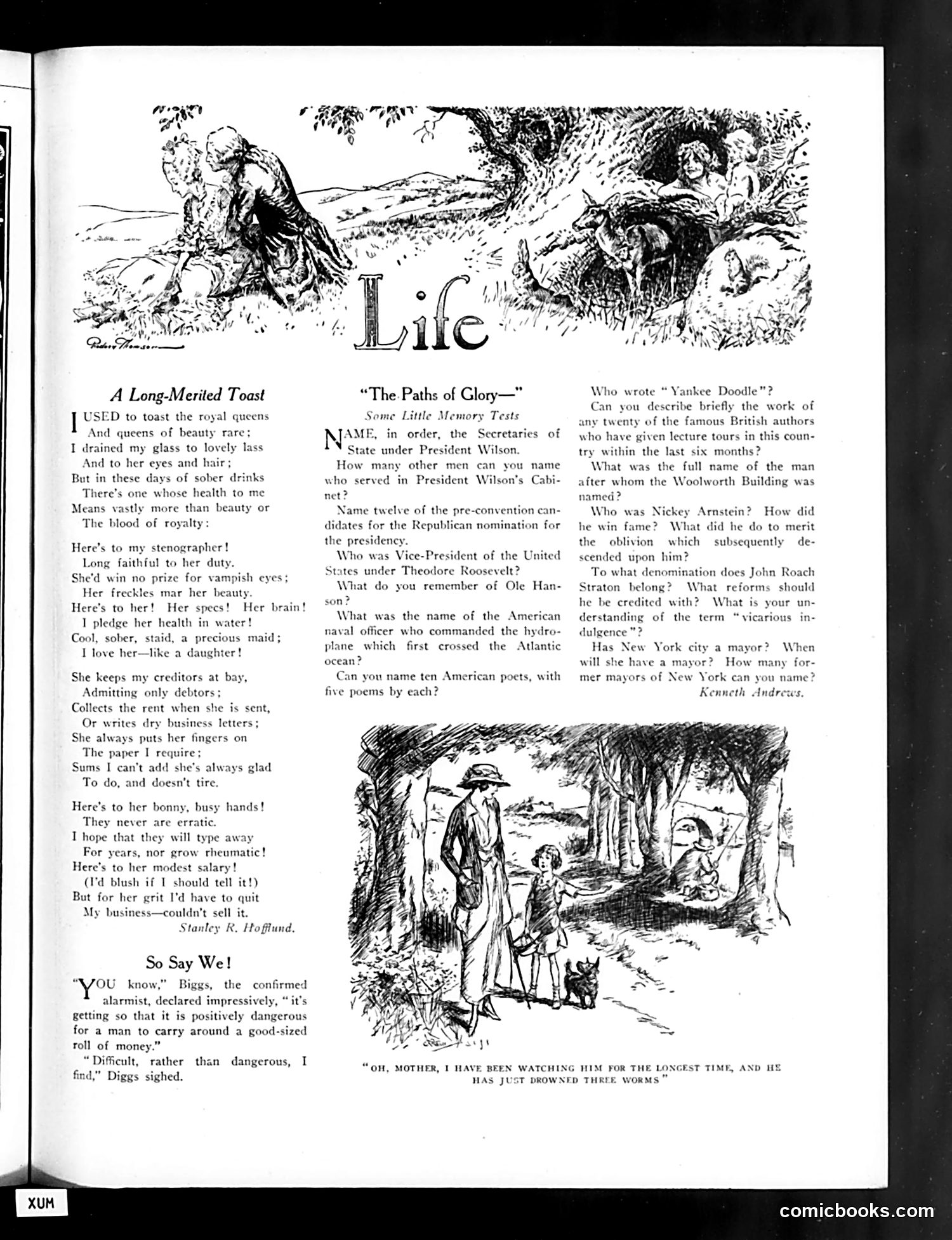
This page contains three distinct pieces: a poem "A Long-Merited Toast" by Stanley K. Hoglund celebrating a stenographer's competence and loyalty; a quiz section titled "The Paths of Glory" testing readers' knowledge of American political and cultural figures (Wilson's cabinet members, Roosevelt's vice president, poets, etc.); and a brief humorous exchange called "So Say We!" where characters named Biggs and Diggs debate whether carrying large sums of money is dangerous. The central illustration depicts a man and child in a wooded setting with the caption about watching someone drown worms—a visual gag disconnected from surrounding text. The page reflects early 20th-century concerns: workplace loyalty, civic knowledge, and everyday anxieties about money and safety.
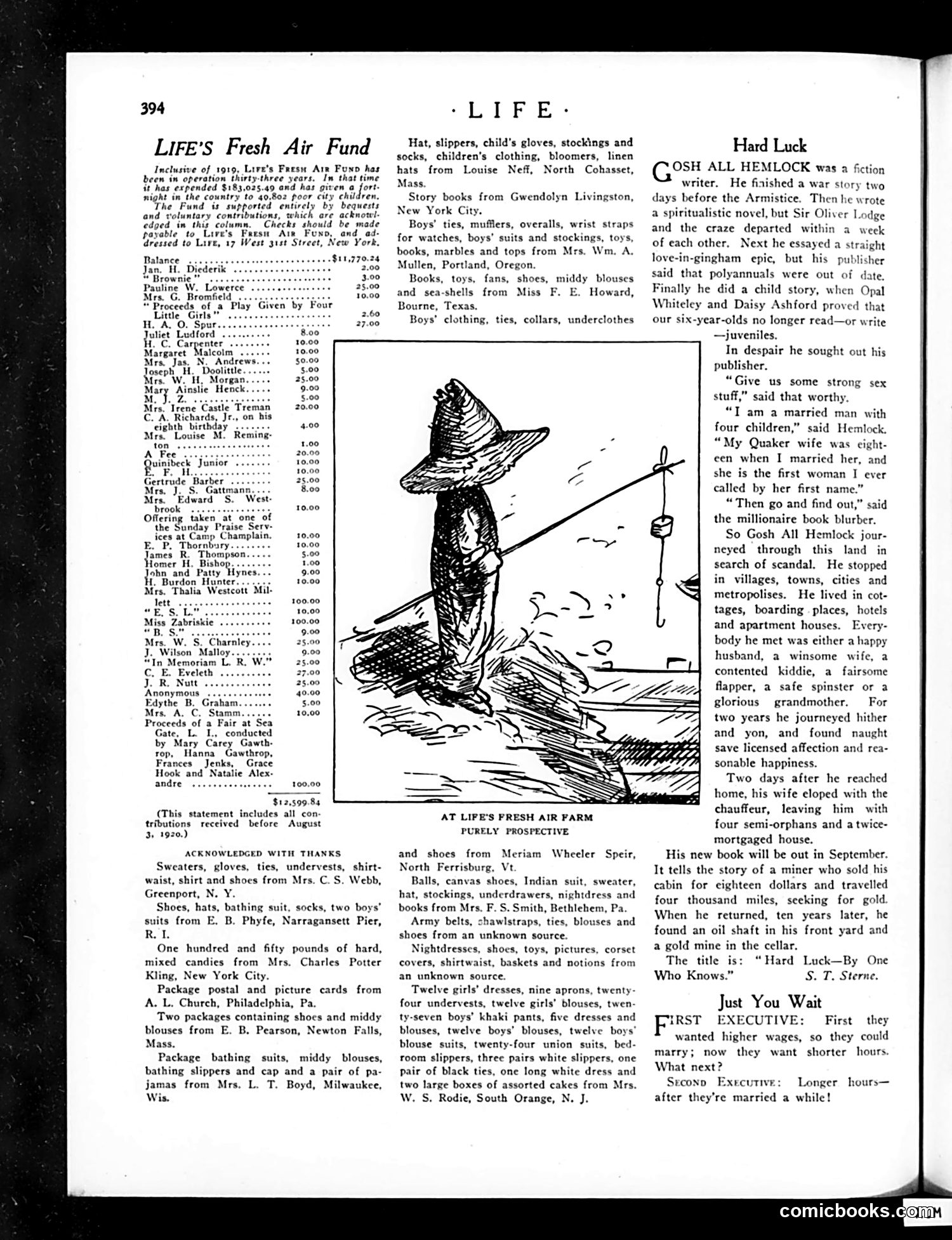
This cartoon illustrates Life magazine's charitable **Fresh Air Fund**, which provided vacations for underprivileged children. The sketch shows a thin, ragged child fishing from a log—depicting the "prospective" beneficiary awaiting aid. The accompanying text lists donations of clothing and goods (hats, shoes, stockings, books, toys) from readers nationwide, demonstrating middle-class philanthropic participation. The humor lies in the contrast: the idealized pastoral scene (child peacefully fishing) versus the grim reality of urban poverty the fund addressed. It's gentle satire promoting charitable giving while acknowledging the desperation of poor children who needed such assistance—a common Progressive Era concern about child welfare and social responsibility.
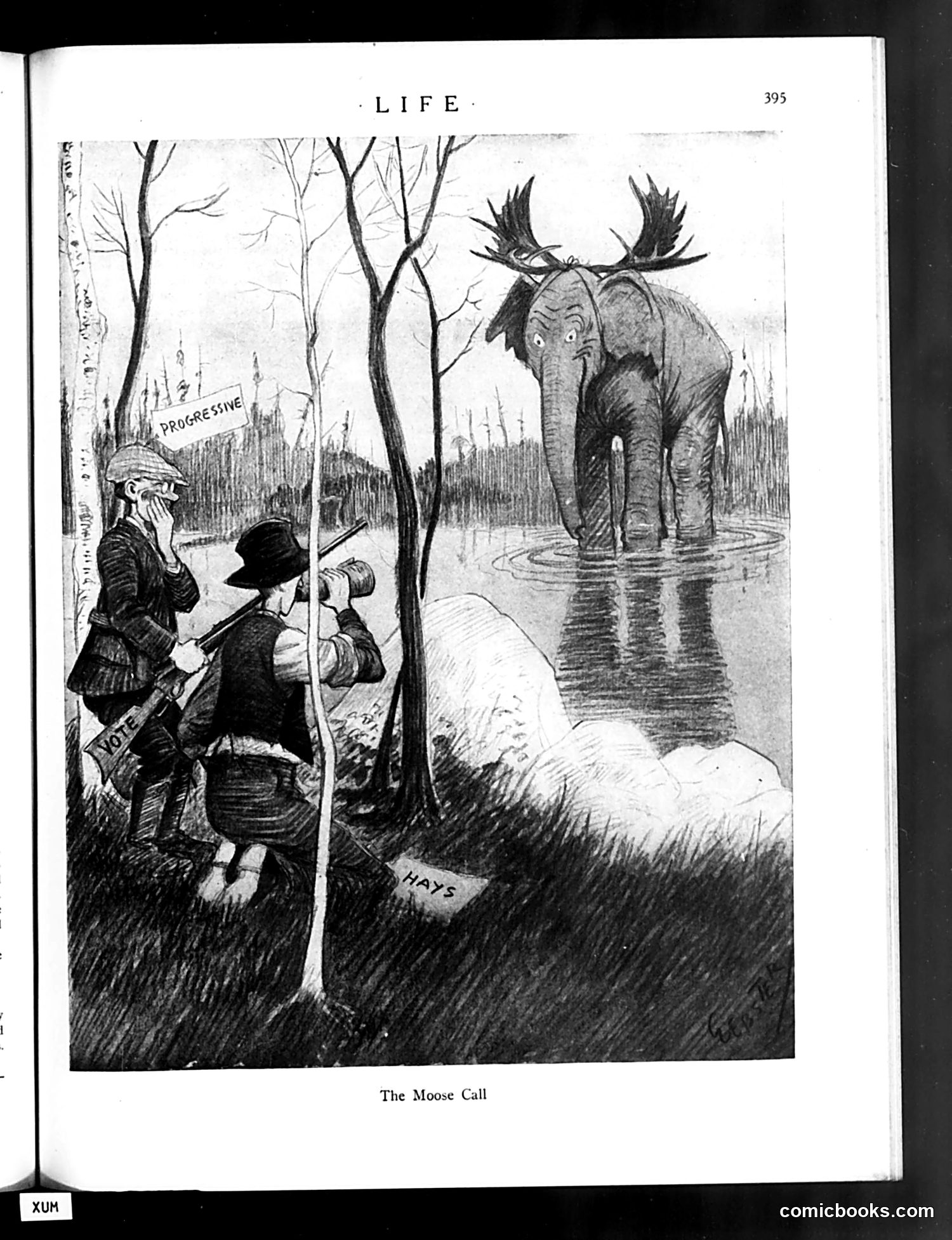
This satirical cartoon depicts two men observing a large moose in water. One man holds binoculars and wears a "Progressive" badge, while the other is labeled "Hays." The moose itself appears grotesquely exaggerated with prominent antlers. The cartoon likely references the Progressive Party's 1912 presidential campaign (symbolized by the moose mascot). The "Hays" figure appears to be Will Hays, a Republican politician. The satire seems to mock the Progressives' pursuit of political power, suggesting their "moose call" (campaign appeal) is luring them toward something monstrous or dangerous. The imagery critiques the Progressive movement's ambitions during this politically fractious period.
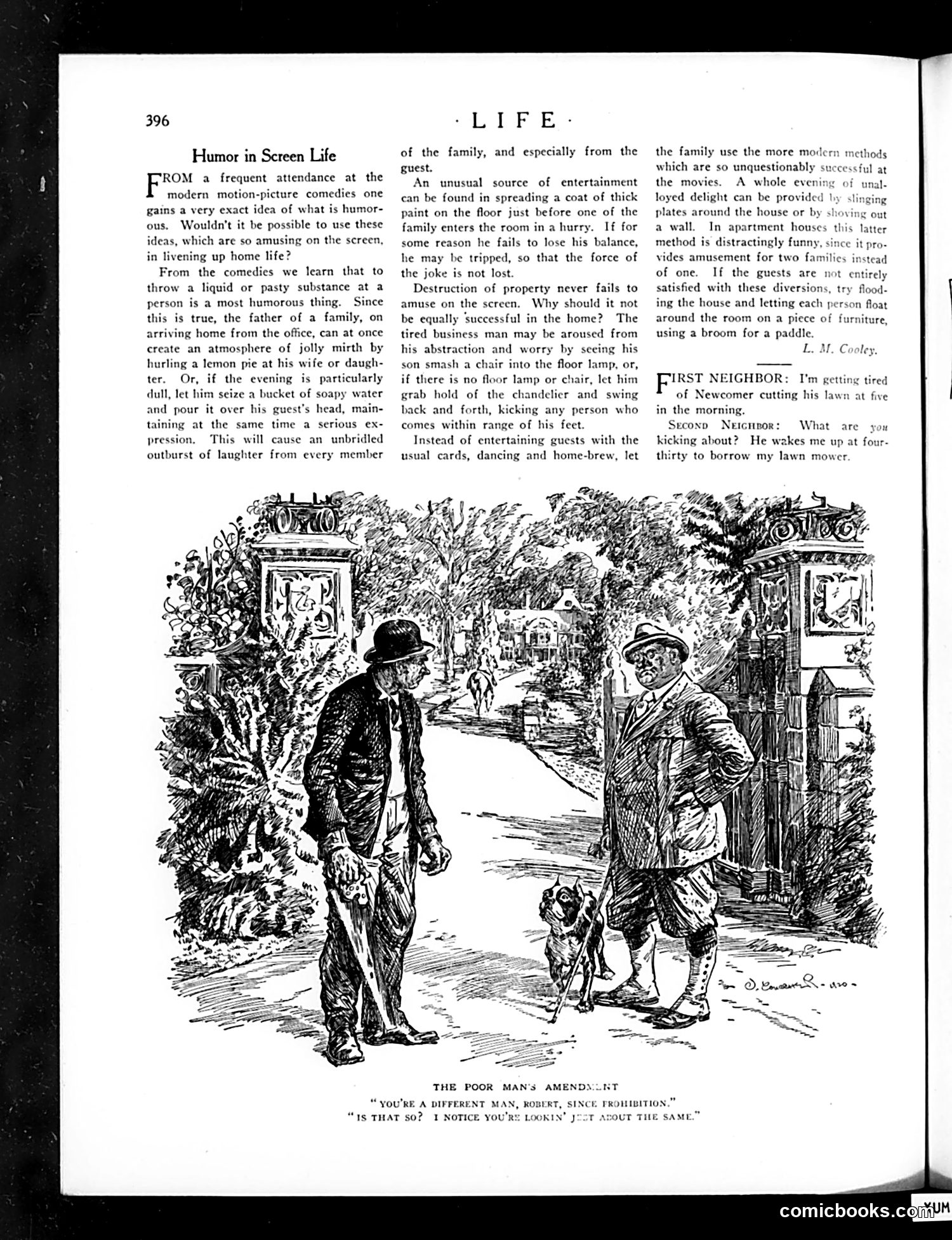
This cartoon satirizes **Prohibition**—the ban on alcohol sales (1920-1933). The caption reads: "You're a different man, Robert, since Prohibition" / "Is that so? I notice you're lookin' just about the same." The joke mocks the claim that Prohibition would transform society for the better. One man (likely named Robert) supposedly became "different" after the alcohol ban, but his friend observes he looks identical—suggesting Prohibition failed to deliver promised moral improvements. The scruffy appearance and setting indicate these are working-class men, hence "the Poor Man's Amendment." The cartoon expresses skepticism about whether Prohibition actually changed behavior or just created hypocrisy among ordinary people.
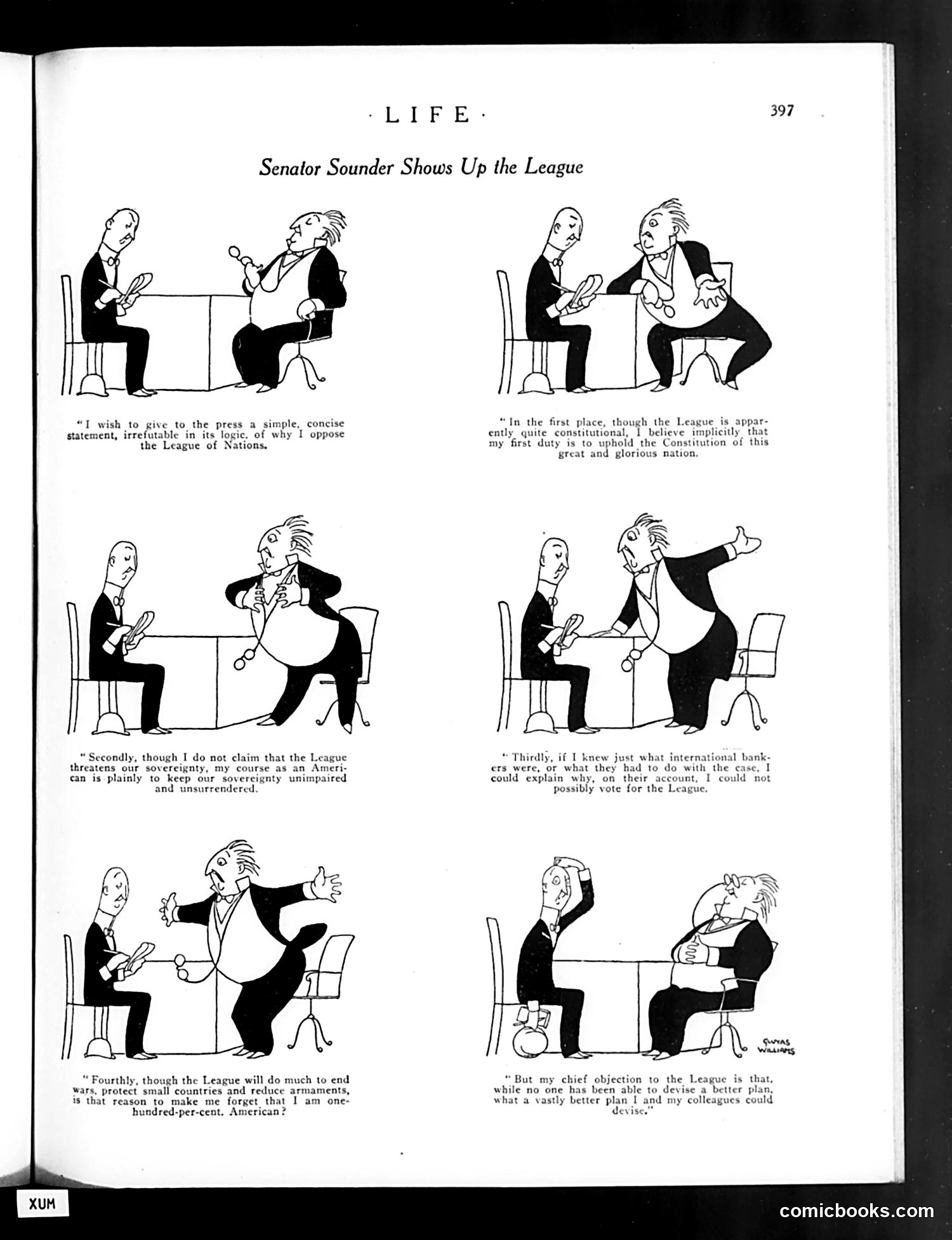
This political cartoon satirizes opponents of the League of Nations (Wilson's post-WWI international organization, debated circa 1919-1920). The unnamed "Senator Sounder" presents increasingly contradictory objections: he claims the League threatens sovereignty while acknowledging it doesn't; professes ignorance about international banking yet blames it; says the League will reduce wars but opposes it anyway; and demands 100% Americanism while offering no alternative plan. The satire's point is clear: the Senator's arguments are hollow rhetoric masking isolationism and partisan obstruction. His gestures grow more animated and his logic more circular with each panel, visually emphasizing the incoherence. The cartoonist mocks senators who opposed the League with vague patriotic appeals rather than substantive critiques—a common criticism of League opponents in the historical debate.
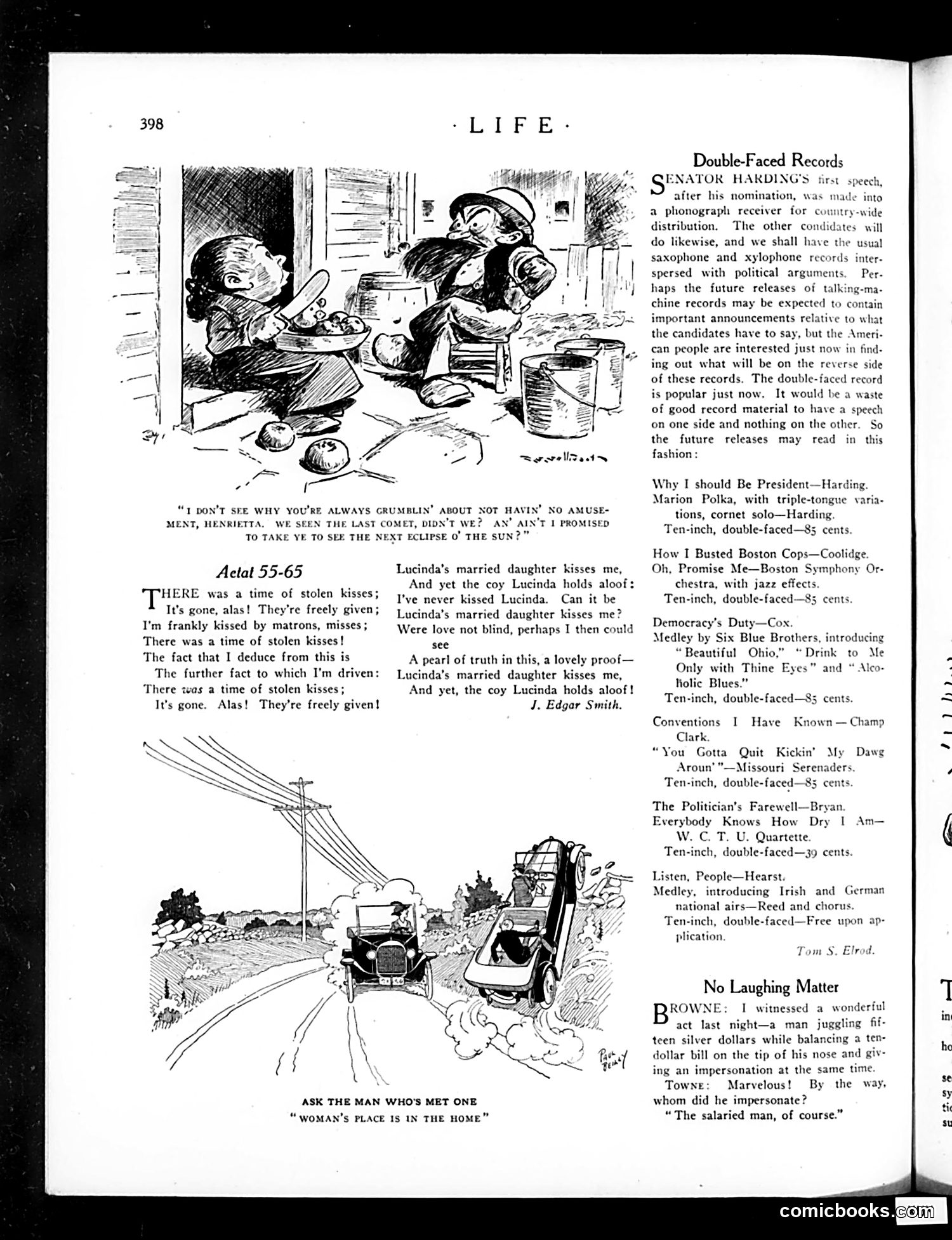
This page satirizes the 1920 presidential election, specifically the new practice of distributing candidate speeches on phonograph records. The satire imagines "double-faced" (two-sided) records where political speeches occupy one side, while the reverse side features popular entertainment—jazz, polkas, and novelty songs. The joke targets candidates **Harding, Coolidge, Cox, Champ Clark, and Bryan**, suggesting that Americans care more about the entertainment value than the actual political content. By pairing serious speeches with frivolous music (including references to Prohibition via "How Dry I Am"), the author mocks both politicians' attempts at mass communication and the public's shallow engagement with politics. The cartoons above depict domestic scenes and rural life, appearing thematically separate from the phonograph satire. The overall message: modern politics has become entertainment, with substance secondary to amusement.
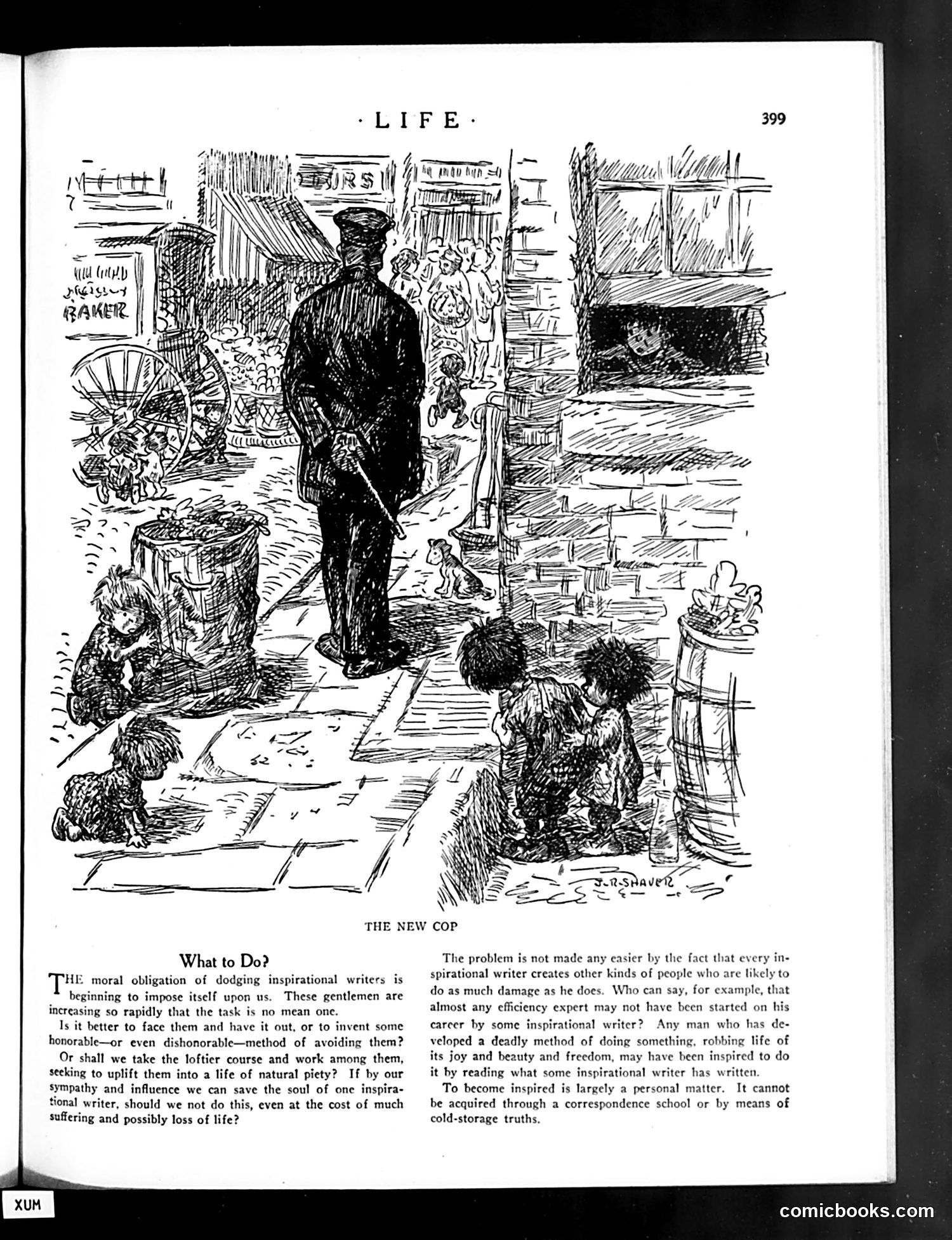
This cartoon satirizes "inspirational writers" and self-help literature proliferating in early 20th-century America. The sketch shows a uniformed police officer standing among street children in an urban setting, illustrated by J.H. Shaver. The accompanying essay mocks the moral obligation society feels toward these inspirational figures, whose proliferation the author claims is becoming unmanageable. The satire's central argument: inspirational writers may inadvertently create "efficiency experts" and other harmful types who strip life of "joy and beauty and freedom." The cartoon likely depicts a "new cop" as an embodiment of the problem—perhaps someone inspired by such writers to impose rigid morality on the poor. The piece argues that genuine inspiration is personal and cannot be mass-produced through correspondence schools or manufactured "truths," critiquing the commercialization and bureaucratization of self-improvement culture.
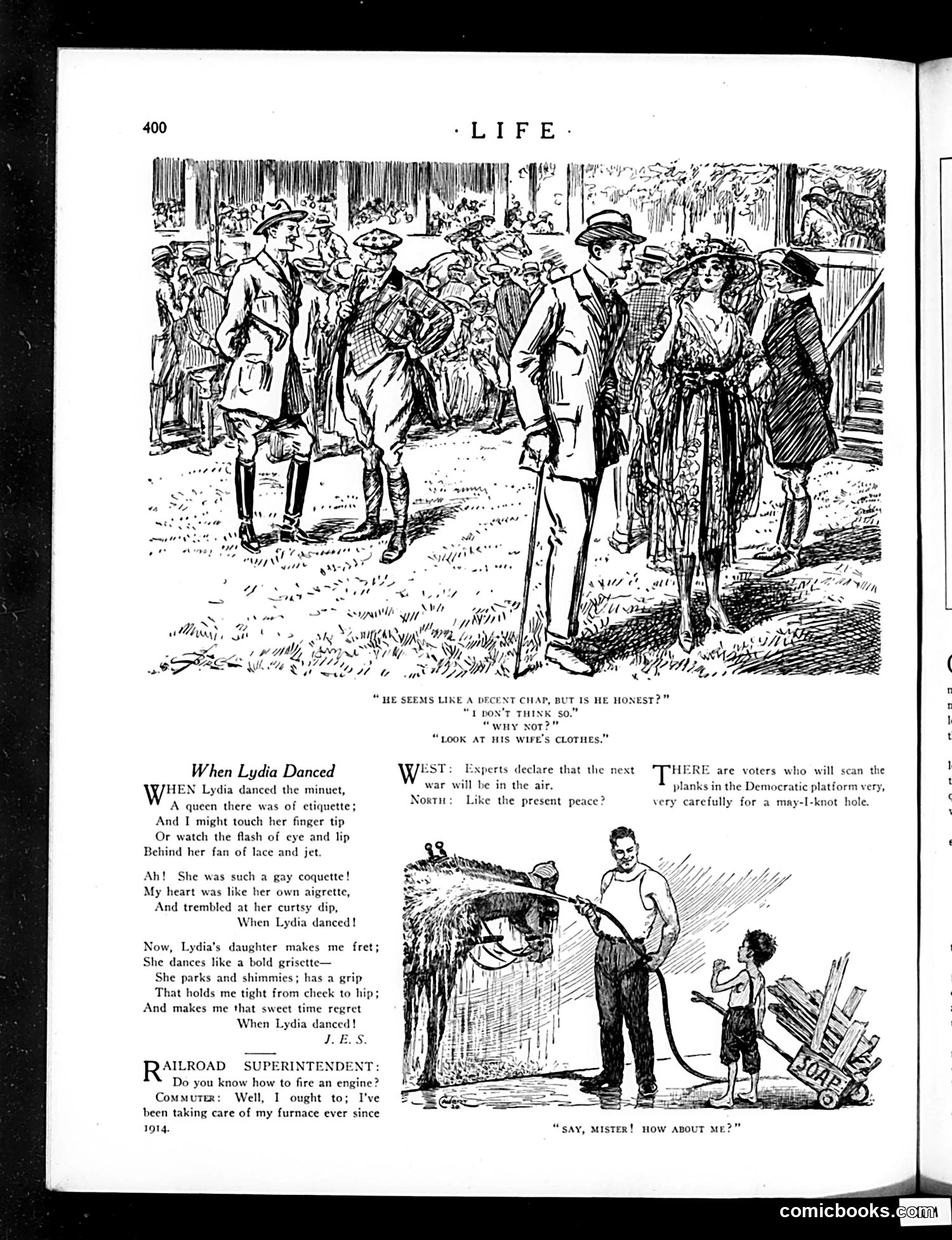
This page contains three distinct satirical pieces: **Top cartoon**: A social commentary on class judgment. Two men gossip about a third man's character, concluding he's dishonest simply because "his wife's clothes" are expensive. The satire mocks superficial class assumptions—the notion that a man's honesty can be judged by his wife's wardrobe, likely critiquing both snobbery and hypocrisy about wealth display. **"When Lydia Danced"**: A nostalgic poem contrasting old-fashioned propriety with modern behavior. The speaker recalls a refined, restrained minuet-dancing woman, then laments her daughter dances the "shimmy" (a 1920s jazz dance) with uninhibited physicality. This reflects generational anxiety about changing morals and the "flapper" era. **Bottom cartoons**: Two brief joke exchanges. The railroad superintendent joke plays on a commuter mistaking home furnace experience for engine knowledge. The political panel sarcastically suggests Democratic voters scrutinize their platform for loopholes ("may-I-knot hole"). The page reflects 1920s concerns: class pretension, generational conflict, and political skepticism.
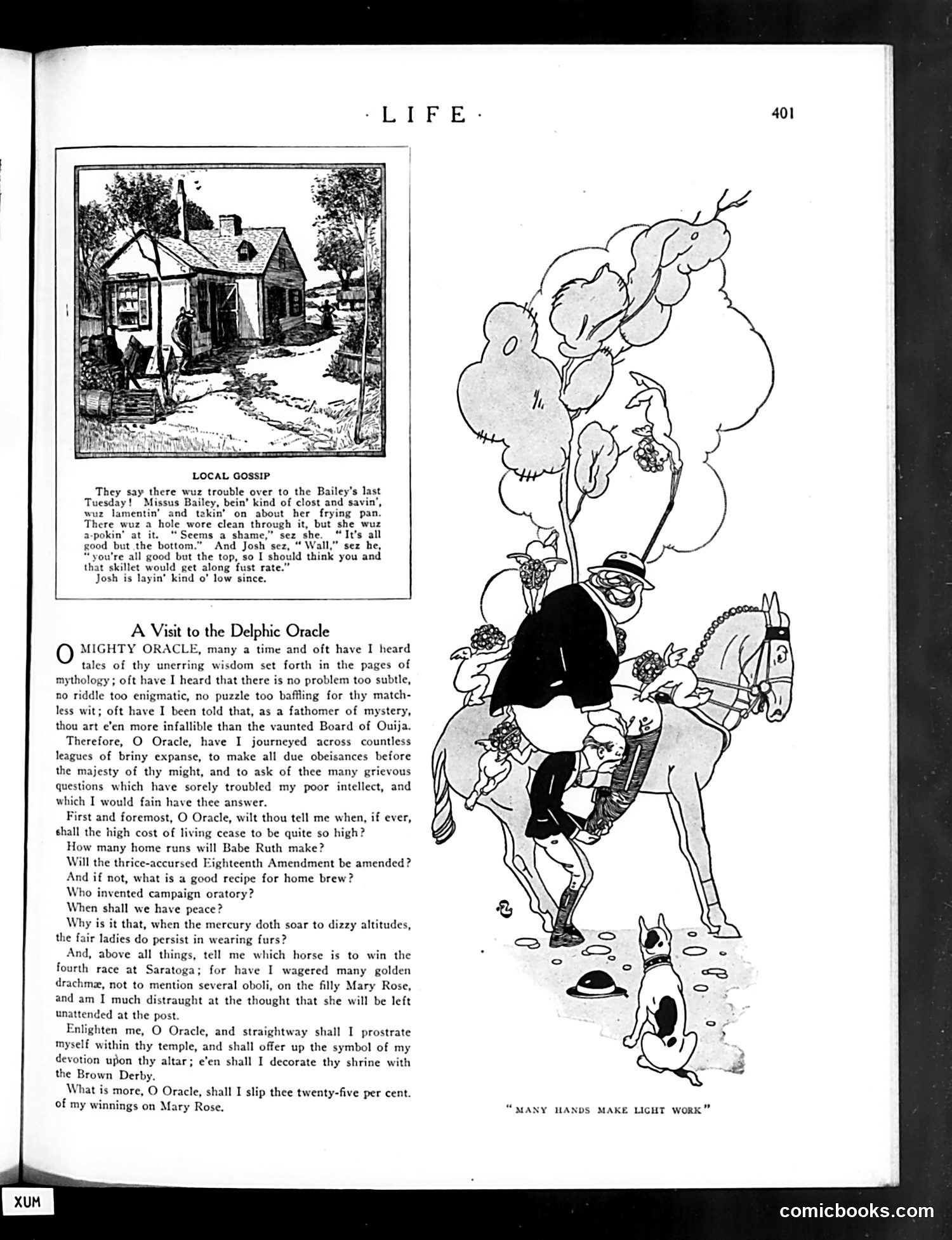
This satirical piece mocks contemporary concerns of the 1920s by presenting them as questions to an ancient Greek oracle. The supplicant humorously asks about urgent issues of the day: Prohibition (the "thrice-accursed Eighteenth Amendment"), the high cost of living, baseball star Babe Ruth's home run record, and horse racing tips—treating trivial modern anxieties with mock-serious classical language. The joke targets both the era's obsession with these issues and the absurdity of seeking divine wisdom for them. The reference to "Mary Rose" (a horse he's wagered on) and the offer of 25% of winnings as tribute parodies superstition and the period's fascination with oracles and fortune-telling. The accompanying cartoon of a rider on a bucking horse labeled "MANY HANDS MAKE LIGHT WORK" appears to illustrate the chaos of managing multiple concerns simultaneously—visual reinforcement of life's complicated modern challenges.
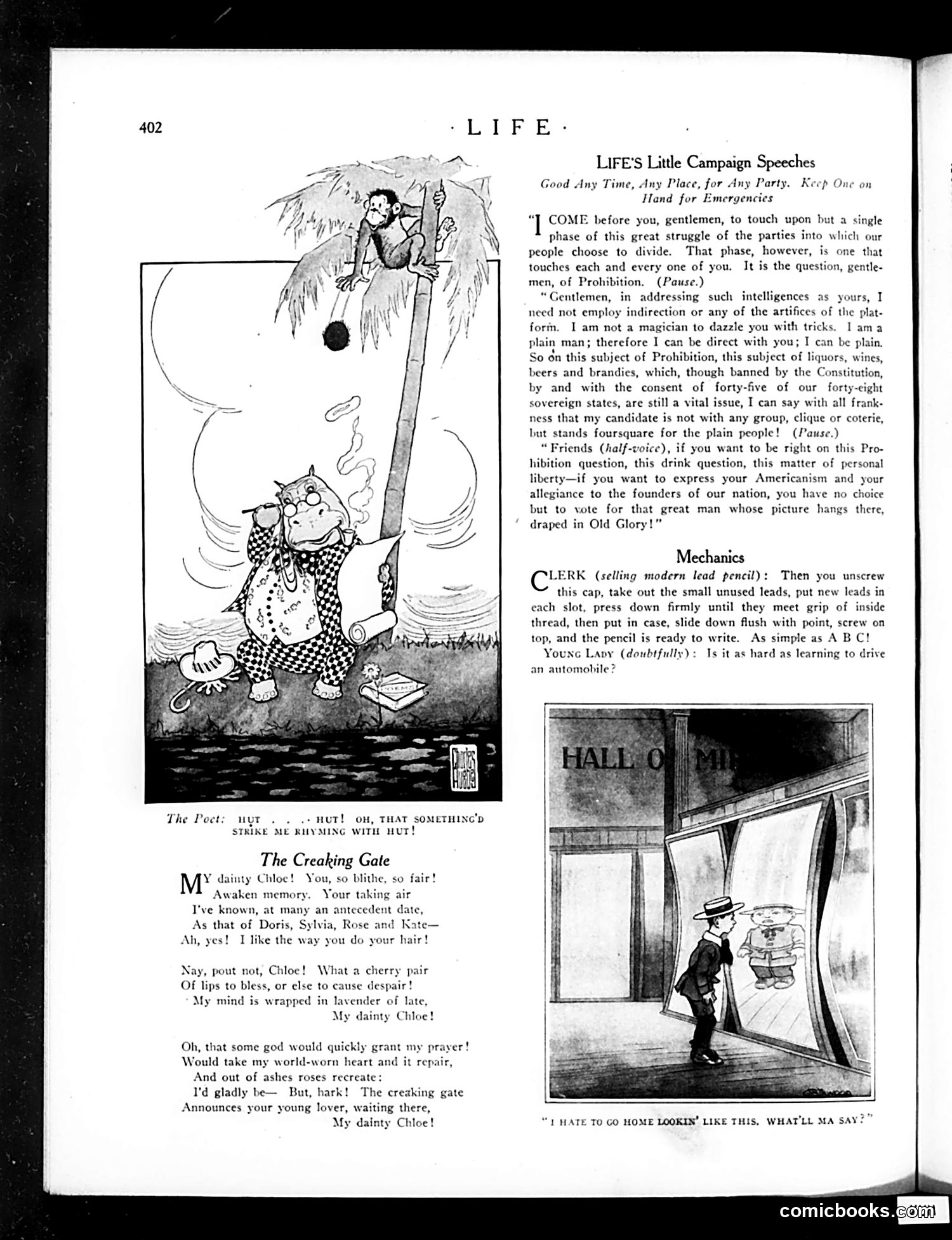
**"Life's Little Campaign Speeches"** satirizes hollow political rhetoric. The mock speech about Prohibition uses absurdly vague language—claiming the candidate stands "foursquare for the plain people" while avoiding any actual position. The satirist mocks how politicians use earnest, patriotic-sounding language ("Old Glory," "Americanism") while remaining deliberately noncommittal on divisive issues like alcohol prohibition (then a major political controversy). **"The Creaking Gate"** is a sentimental romantic poem interrupted by reality—a young lover arriving, cutting short an older man's flowery courtship of the woman. **"Mechanics"** jokes about product complexity: a clerk's absurdly elaborate instructions for refilling a pencil are compared to learning to drive an automobile, suggesting modern conveniences are becoming needlessly complicated. The cartoons and content reflect early 20th-century American life and humor.
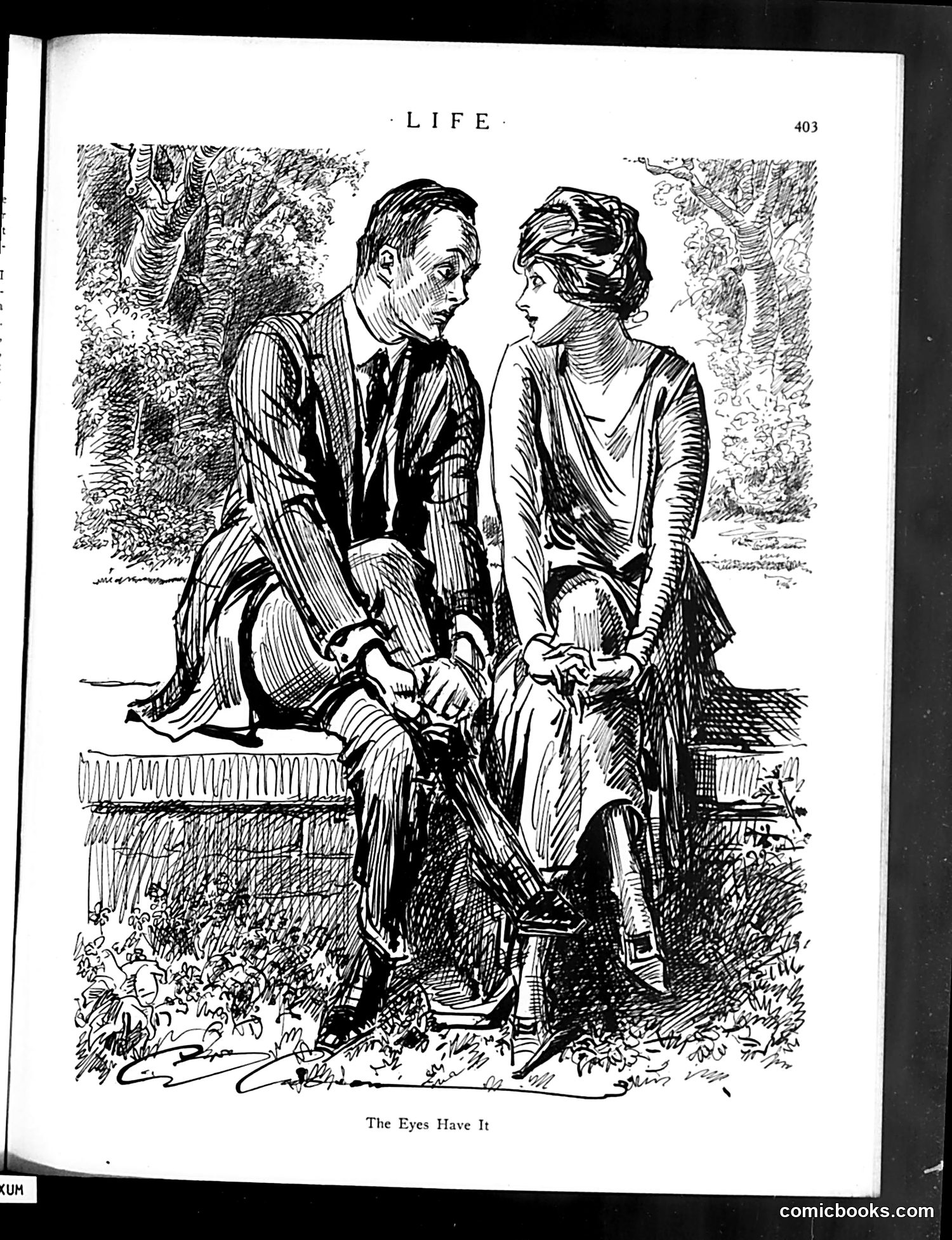
This illustration depicts a man and woman sitting together outdoors on what appears to be a bench or wall, with ivy-covered walls in the background. The title "The Eyes Have It" suggests a commentary on romantic attraction or courtship, likely implying that physical attraction—specifically eye contact or appearance—determines romantic success. The drawing style and formal attire (the man wears a suit and tie) suggest this is early 20th-century social satire from *Life* magazine. The piece appears to mock or comment on dating conventions and the role of superficial attraction in relationships. Without additional context about the specific issue date or artist, the exact target of satire remains unclear, though it likely reflects period anxieties about modern courtship and gender dynamics.
This editorial discusses the 1920 U.S. presidential election between Republican Warren G. Harding and Democrat James M. Cox. The author argues that while Republicans unenthusiastically support their candidate (Harding), Democrats genuinely favor theirs. The piece praises Cox and Vice-Presidential candidate Franklin D. Roosevelt as articulate, honest speakers with solid records. The central criticism targets Harding's vague campaign promises—particularly regarding tariffs and foreign policy. The author defends President Wilson's League of Nations diplomacy, asserting it remains sound policy despite Republican opposition from Senator Henry Cabot Lodge. The satire suggests Republicans offer only empty rhetoric and obstruction, while Democrats present substantive vision and genuine conviction about their candidates' fitness for office.
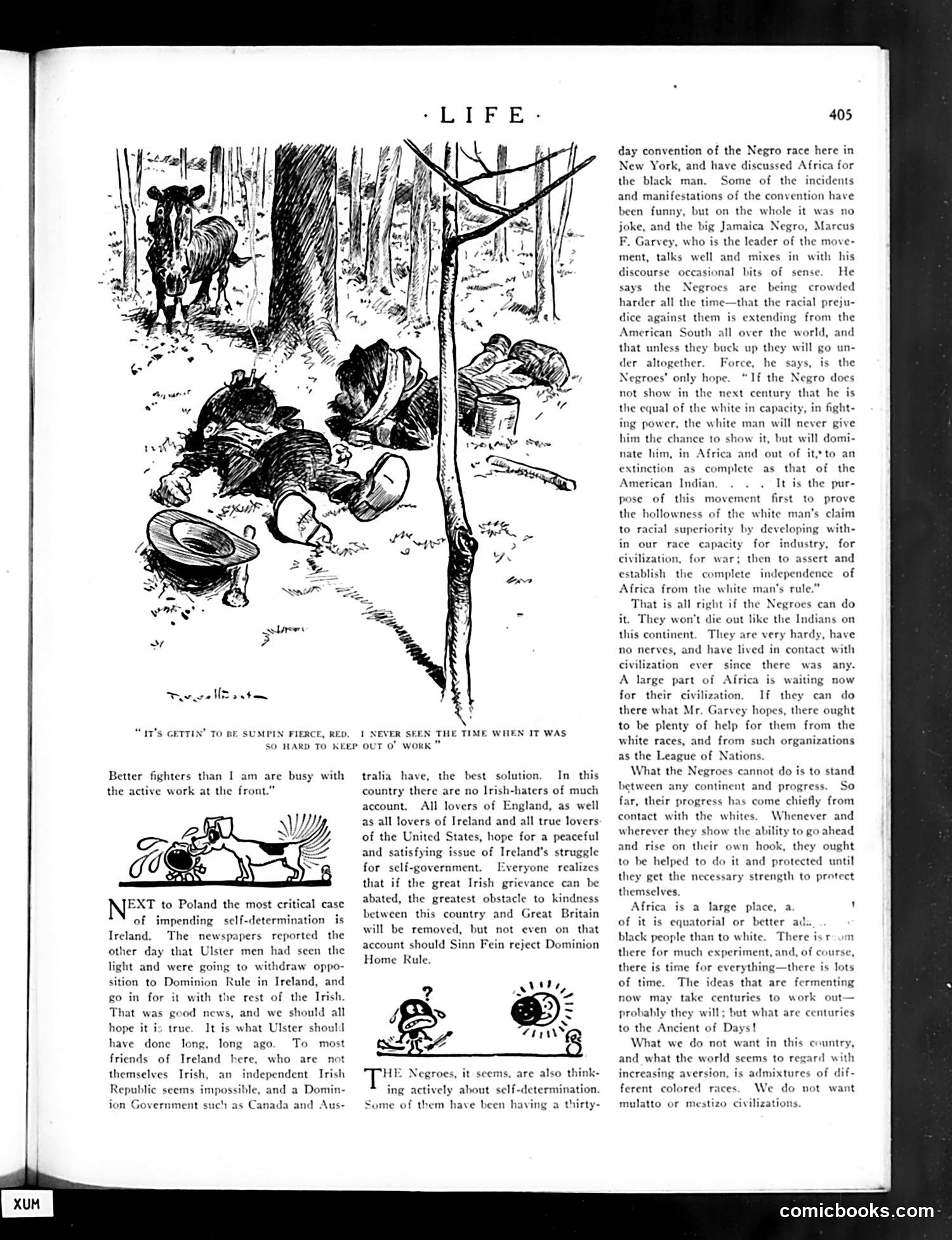
This Life magazine page (p. 405) discusses two contemporary independence movements through editorial commentary. **The cartoons and text address:** 1. **Ireland's self-determination**: The opening discusses Ulster's potential acceptance of Dominion Rule, framing Irish independence as a legitimate aspiration comparable to Canada and Australia. 2. **Marcus Garvey's movement**: The main focus criticizes the "thirty-day convention of the Negro race" in New York. Garvey, a Jamaican leader, advocated Black self-sufficiency and African colonization. The text quotes him warning that without racial advancement, whites will dominate Blacks "in Africa and out of it, to an extinction as complete as that of the American Indian." 3. **The satire's position**: While mocking some convention elements as "funny," the author actually validates Garvey's core argument about racial prejudice while simultaneously patronizing Black capability—suggesting Africans need white assistance for progress ("plenty of help from the white races"). The page reflects 1920s attitudes: acknowledging legitimate grievances while maintaining paternalistic skepticism about non-white self-governance.
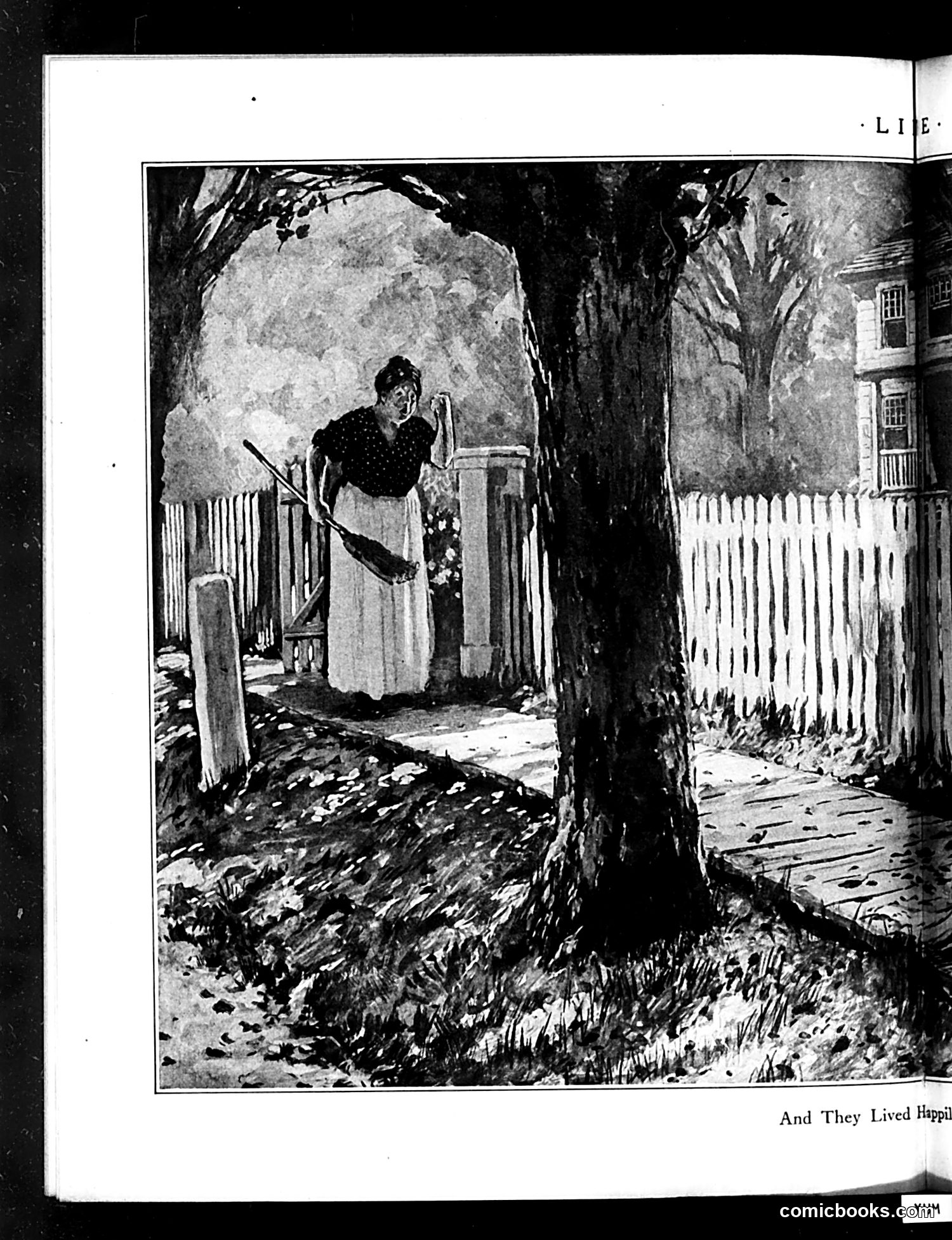
This appears to be an illustration from Life magazine showing a domestic scene with a woman holding an oar near a tree-lined path, white picket fences visible on either side, and a house in the background. The caption reads "And They Lived Happi[ly]" (text cut off). Without additional context or visible text explaining the cartoon's specific reference, the image appears to depict a fairy-tale or storybook ending scenario—a woman in what seems to be a bucolic, idealized domestic setting. The oar suggests either a recent boat journey or possibly an unusual element meant to create irony or satire about romanticized domestic life. The specific satirical point remains unclear from the image alone without knowing the publication date or surrounding article context.
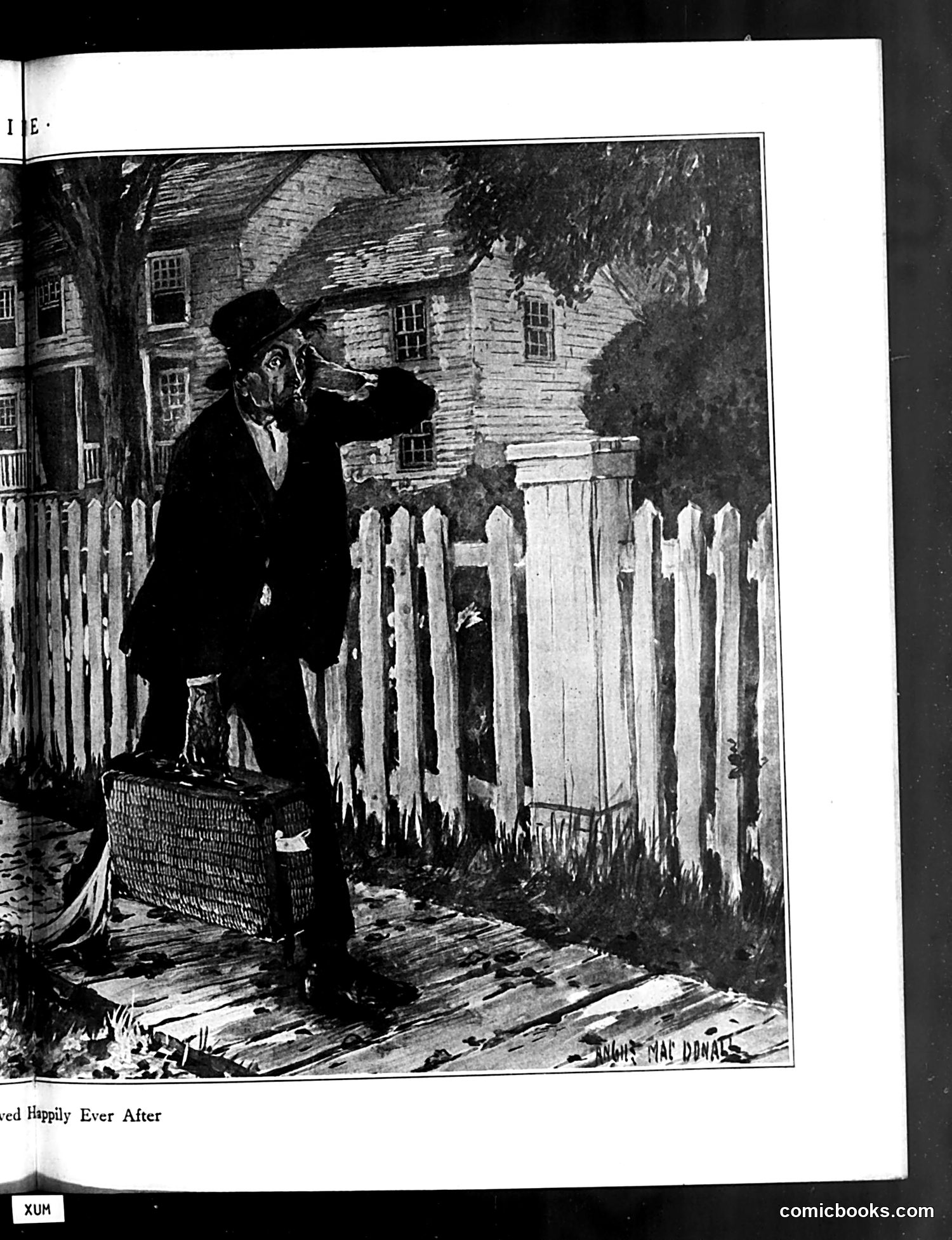
The OCR text is largely illegible, but the image itself shows a satirical illustration signed by what appears to be "Mac Donald" (visible in the lower right). The cartoon depicts a man in formal dress and top hat, carrying a suitcase, standing outside a white picket fence before a colonial-era house. His posture and the suitcase suggest departure or travel. The caption fragment visible reads "...ed Happily Ever After," suggesting this illustrates a narrative conclusion. Without clearer text or context about the publication date and surrounding content, the specific political or social satire remains unclear. The scene could reference domestic life, marriage, emigration, or economic circumstances of the era, but I cannot definitively identify which contemporary figure or situation this targets or lampoons.
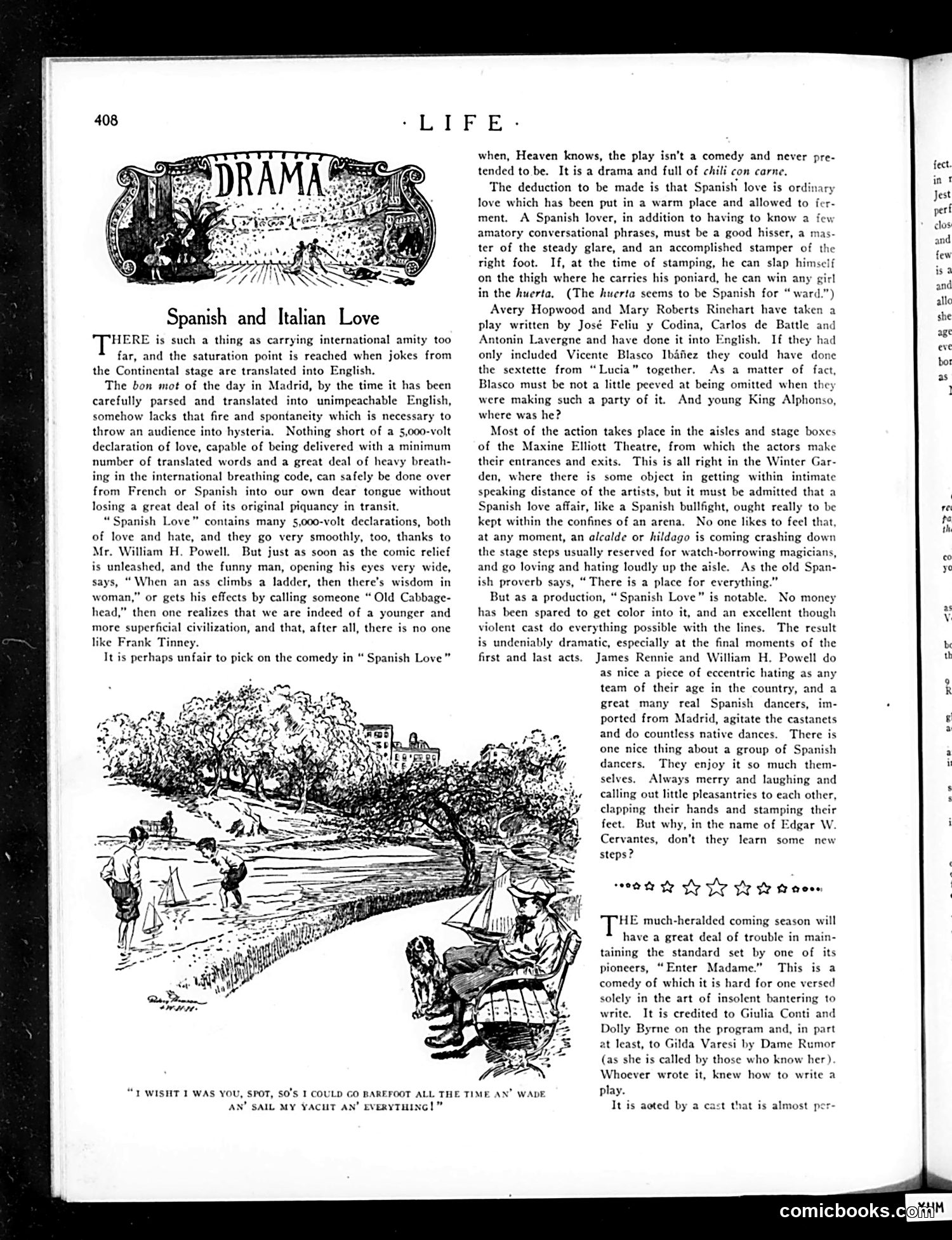
This is a theater review critiquing the play "Spanish Love," adapted for English audiences from Continental (European) stage works. The satirical point: sophisticated Continental humor loses its punch in translation and English production. The critic mocks how Spanish dramatic conventions—intense declarations, stamping feet, slapping thighs near swords—seem overwrought to American audiences. The joke about the "ass climbing a ladder" exemplifies how witty Spanish wordplay becomes silly English patter. The review notes the play stages action in theater aisles and boxes (breaking fourth-wall convention), uses imported Spanish dancers, and features actor Frank Tinney for comic relief. The mention of King Alphonso and references to the huerta (Spanish farmland) ground this in 1920s-era Spain. The underlying satire: American culture finds European theatrical traditions excessive and unsophisticated, yet must import them because homegrown American comedy (represented by Tinney) is considered crude by comparison.
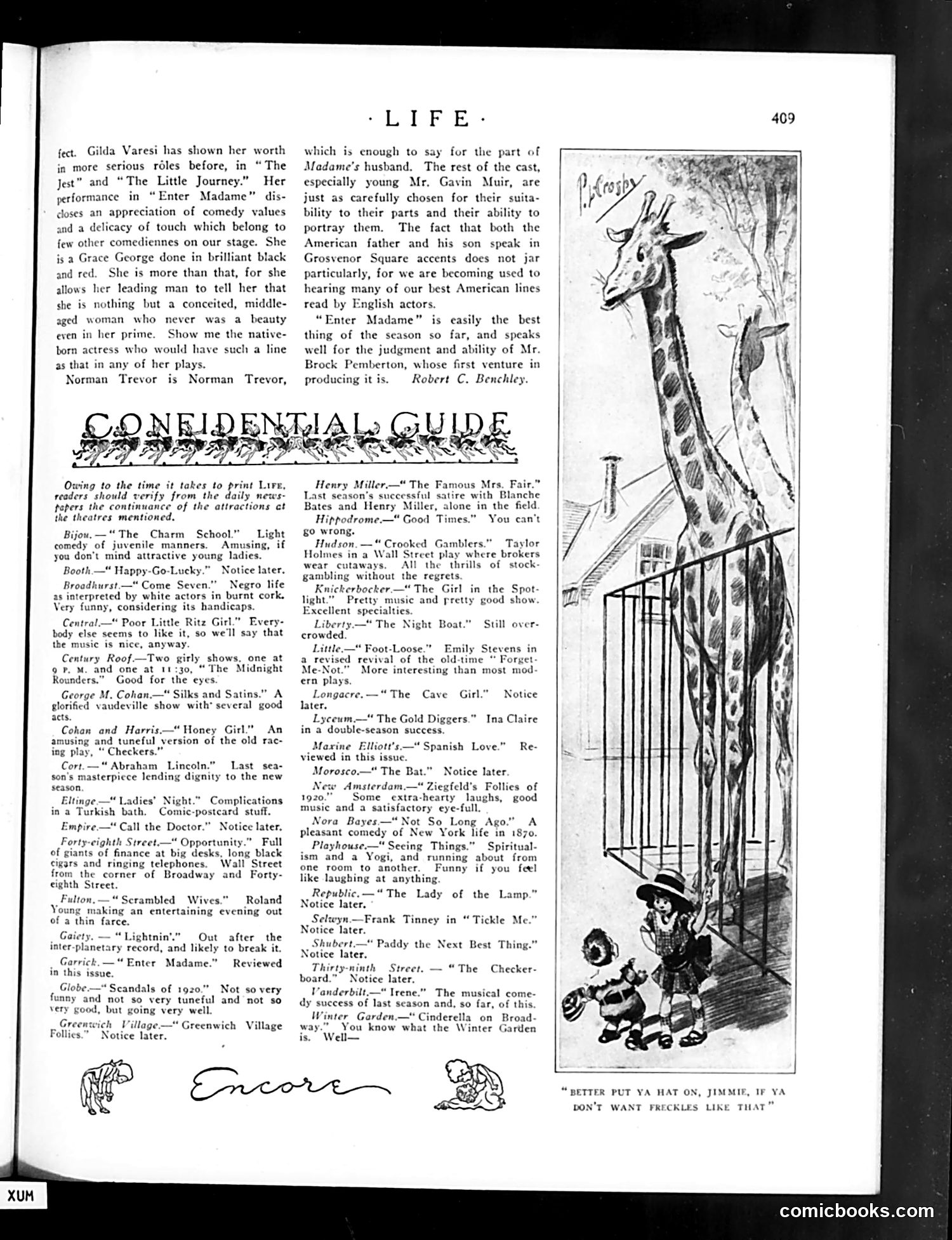
This page is primarily a **theater review column** by Robert C. Benchley, the famous humorist and drama critic. The main content reviews the play "Enter Madame," starring actress Gilda Varesi, praising her performance and the production. The **cartoon illustration** (right side) shows a giraffe in formal dress looking out a window, with the caption "Better put ya hat on, Jimmie, if ya don't want freckles like that." This is a light visual joke about sun exposure causing freckles—the giraffe's spots are humorously compared to freckles. The remainder lists brief reviews of various Broadway productions currently running, in the characteristic snappy style of 1920s theater criticism. Notable references include "Scandals of 1920," "Greenwich Village Follies," and several comedies and musicals. This represents Life magazine's function as a cultural arbiter of entertainment, combining sophisticated dramatic criticism with whimsical illustrations for educated readers.
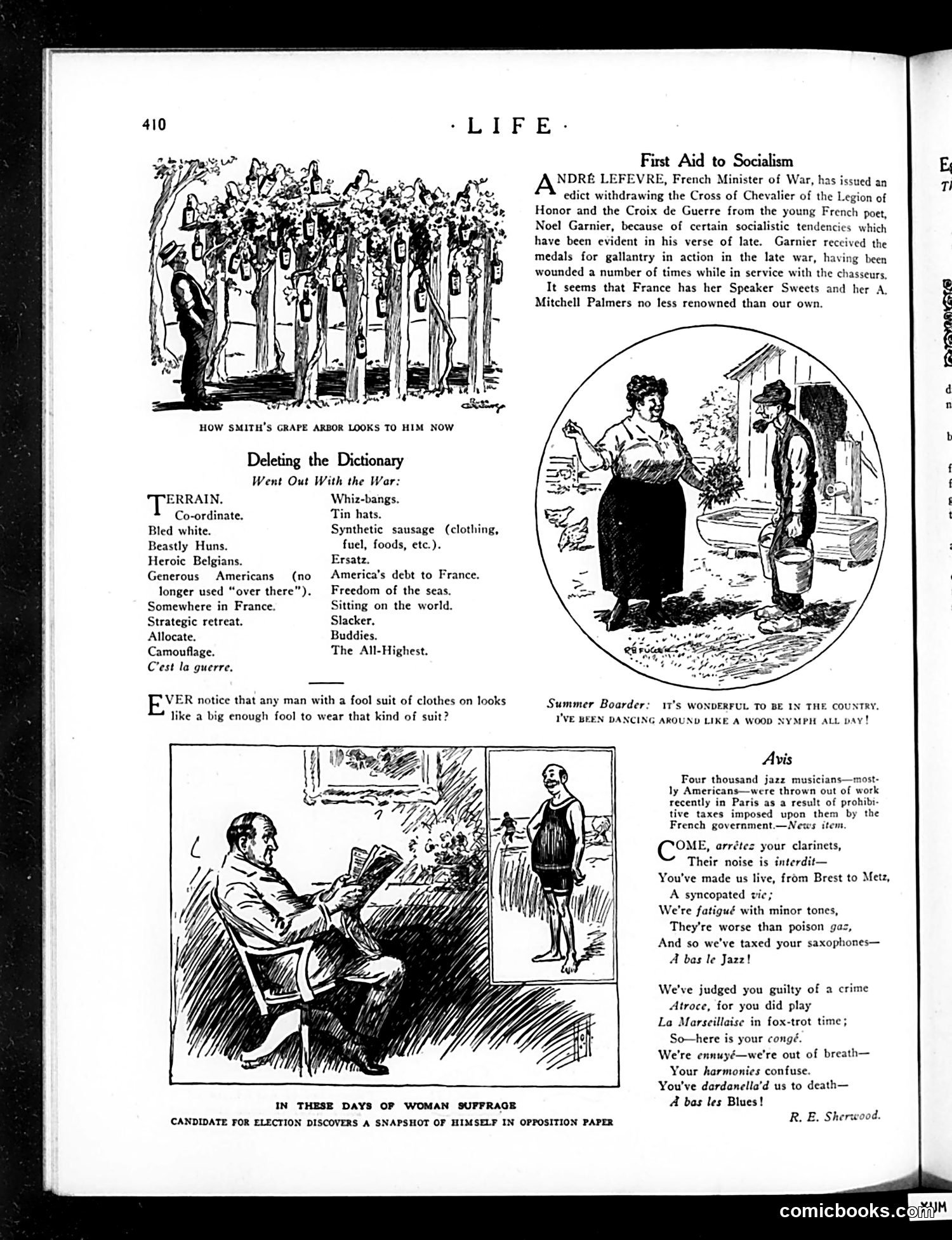
This page satirizes post-WWI attitudes and policies. The top section mocks French authorities for stripping medals from poet Noel Garnier for socialist views, comparing French censorship to American anti-radical efforts (referencing "Speaker Sweets" and Attorney General A. Mitchell Palmer, known for anti-communist crackdowns). The "Deleting the Dictionary" feature humorously lists WWI-era terms becoming obsolete—"Heroic Belgians," "Somewhere in France"—reflecting how quickly wartime language faded. The main cartoon ridicules French taxation of American jazz musicians, depicting France as culturally uptight and ungrateful. The poem sarcastically thanks American musicians for "syncopated" entertainment while taxing them out of work—a pointed jab at French ingratitude toward American wartime allies. A small cartoon about "woman suffrage" shows a political candidate discovering his opponent possesses compromising photographs, satirizing electoral tactics.
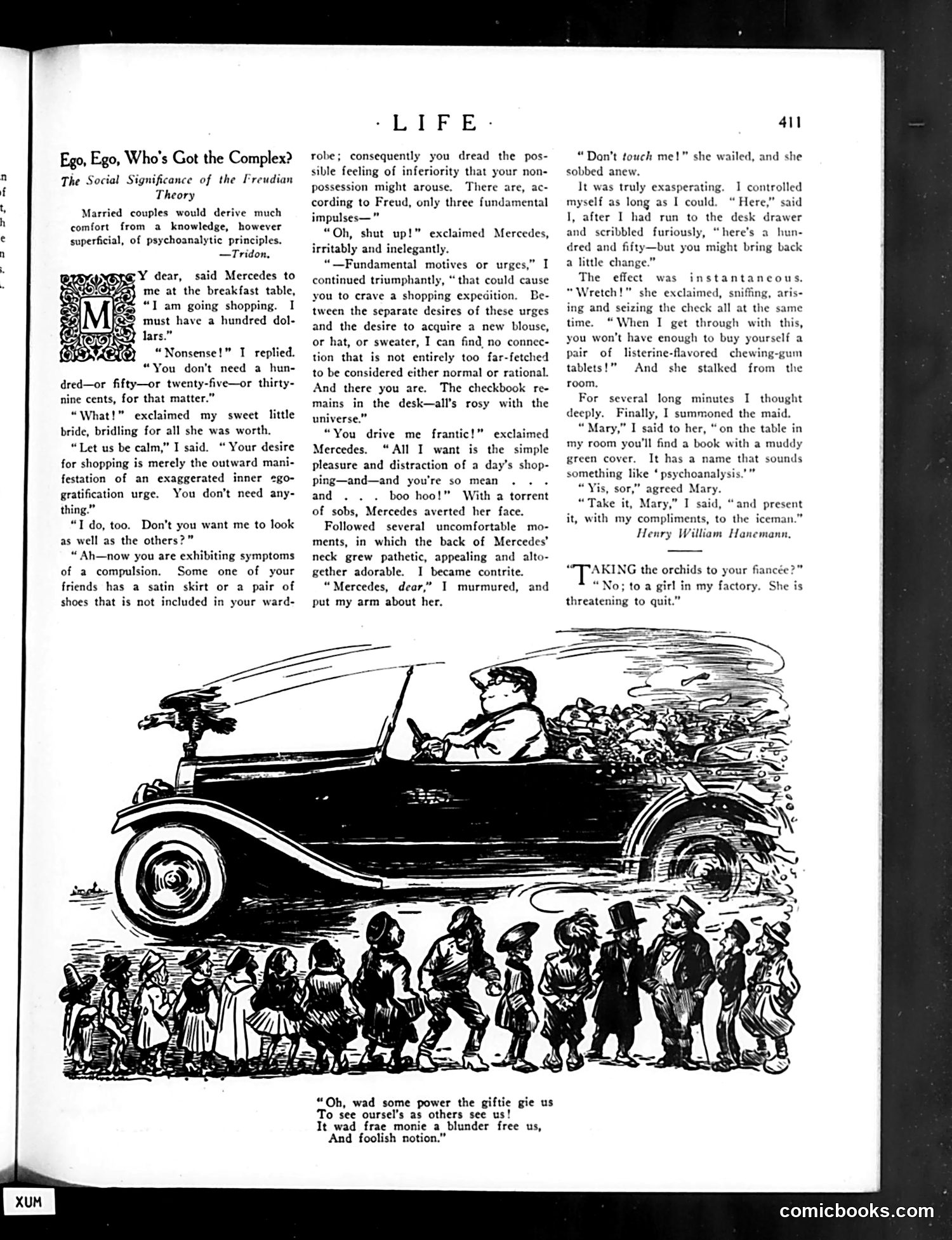
This 1920s Life magazine piece satirizes the trendy application of Freudian psychoanalysis to everyday married life. The author (Henry William Hanemann) depicts a husband who pedantically invokes Freud's theories to deny his wife shopping money, attributing her desires to "ego-gratification urges" and "inferiority complexes" rather than accepting simple wants. The satire's point: armchair psychoanalysis is absurd and ineffective. When the husband finally gives her the money anyway, his wife's instant mood shift proves his pseudo-intellectual analysis was nonsense—she simply wanted to shop. The cartoon below shows envious onlookers admiring a wealthy woman in a car, reinforcing that material desires are straightforward, not hidden psychological drives. The closing joke (giving Freud's book to the iceman) mocks the theory's relevance to ordinary life. This reflects 1920s skepticism toward Freud's popularity among educated Americans applying psychology to domestic disputes.
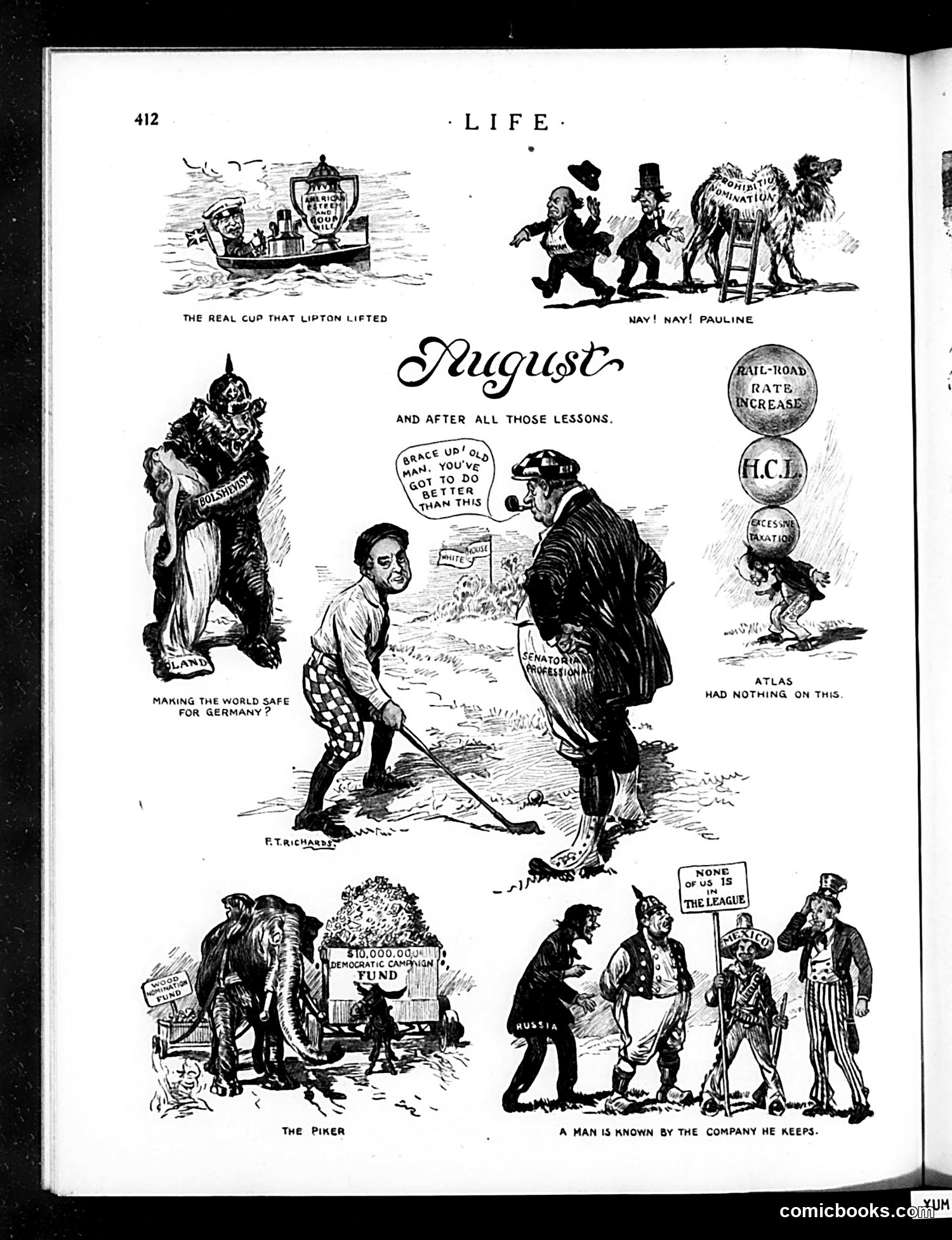
This August 1919 *Life* page satirizes post-WWI politics and American foreign policy through multiple cartoons. The central image shows an old man telling a younger figure to "do better than this"—likely referencing Wilson's League of Nations efforts. "Making the World Safe for Germany?" mocks American policy as potentially benefiting Germany despite the war's outcome. "The Piker" depicts financial excess (the "$10,000,000" elephant) suggesting war profiteering. The railroad and taxation imagery reference postwar economic debates. "A Man is Known by the Company He Keeps" critiques associations with undesirable allies. The top vignettes reference Lipton (likely Sir Thomas Lipton, the tea magnate) and "Pauline" (unclear reference). Overall, the page expresses cynicism about whether American sacrifice achieved its stated idealistic goals.
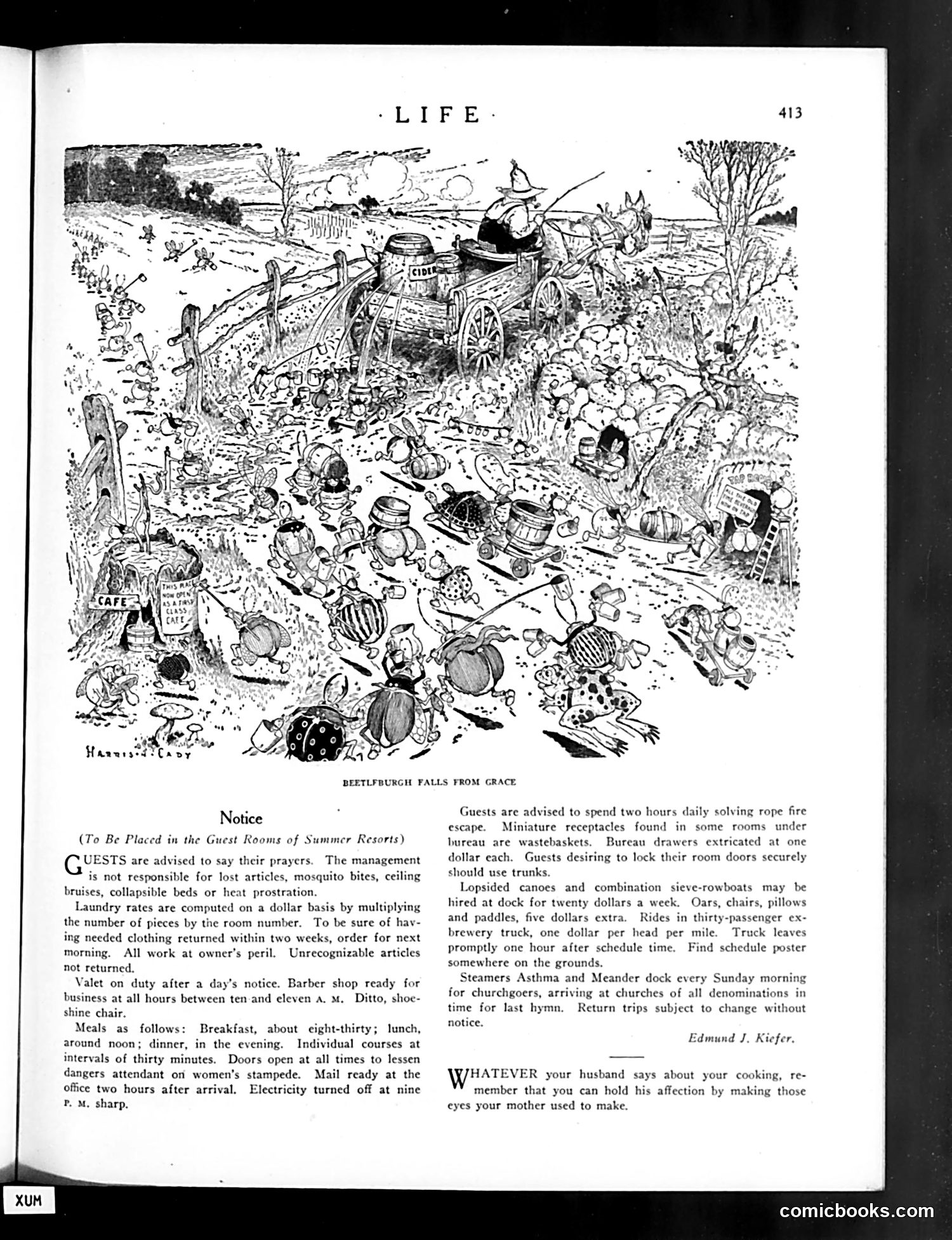
This satirical illustration and accompanying text mock poorly-run summer resorts of the era. The chaotic cartoon depicts a resort in complete disarray—guests amid scattered belongings, a broken-down carriage, and general pandemonium. The "Notice" is a mock-serious list of absurd resort conditions presented as official policy: exorbitant laundry charges calculated by room number, dangerous collapsing beds, unreliable staff, meal schedules with 30-minute gaps between courses, faulty locks requiring trunks, decrepit rental boats, and unreliable steamship service. The satirical tone—presented deadpan as legitimate resort rules—exposes the actual negligence and overcharging guests endured at budget accommodations. The artist is Edmund J. Kiefer. This represents Life magazine's tradition of exposing consumer fraud and poor service through comic exaggeration, making fun of both incompetent resort operators and the desperation of vacationing Americans.
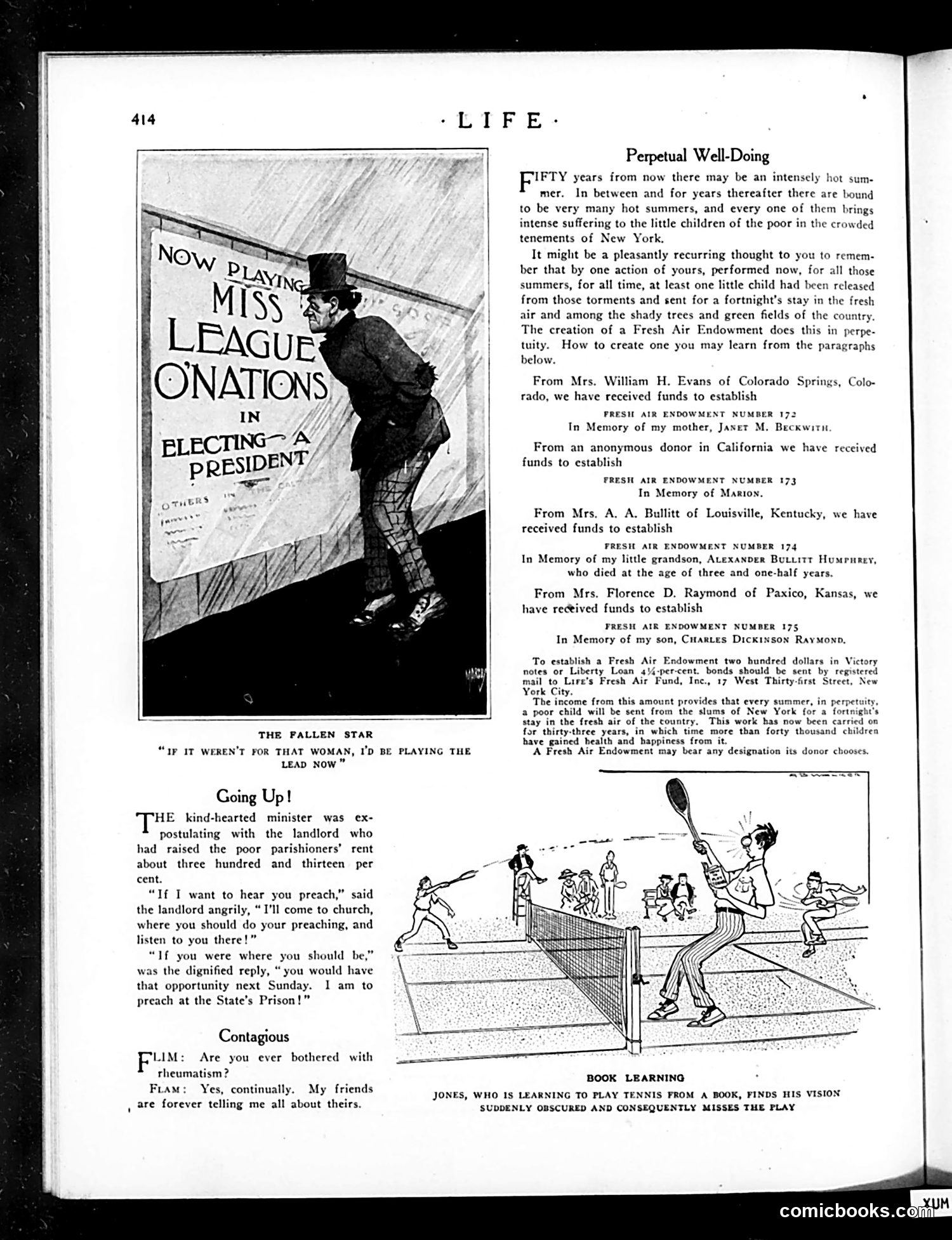
This page contains three separate satirical pieces: **"The Fallen Star"** shows a woman posting a theatrical advertisement, captioned with a man's complaint that he'd be playing the lead role "if it weren't for that woman." The satire targets male actors' tendency to blame women for their career failures rather than accepting responsibility. **"Going Up!"** depicts a minister outmaneuvering a greedy landlord. When the landlord raises poor tenants' rent by 313 percent, the minister responds to the landlord's dismissal of his moral arguments by announcing he'll preach at the State's Prison—implying the landlord belongs there. The satire mocks landlord exploitation of the poor. **"Contagious"** is a brief joke about how hearing others discuss their rheumatism complaints causes one to develop it—satire on hypochondria and social complaining. The page also features extensive content promoting Life's "Fresh Air Endowment," a charitable fund sending poor NYC children to the countryside, listing recent memorial donations.
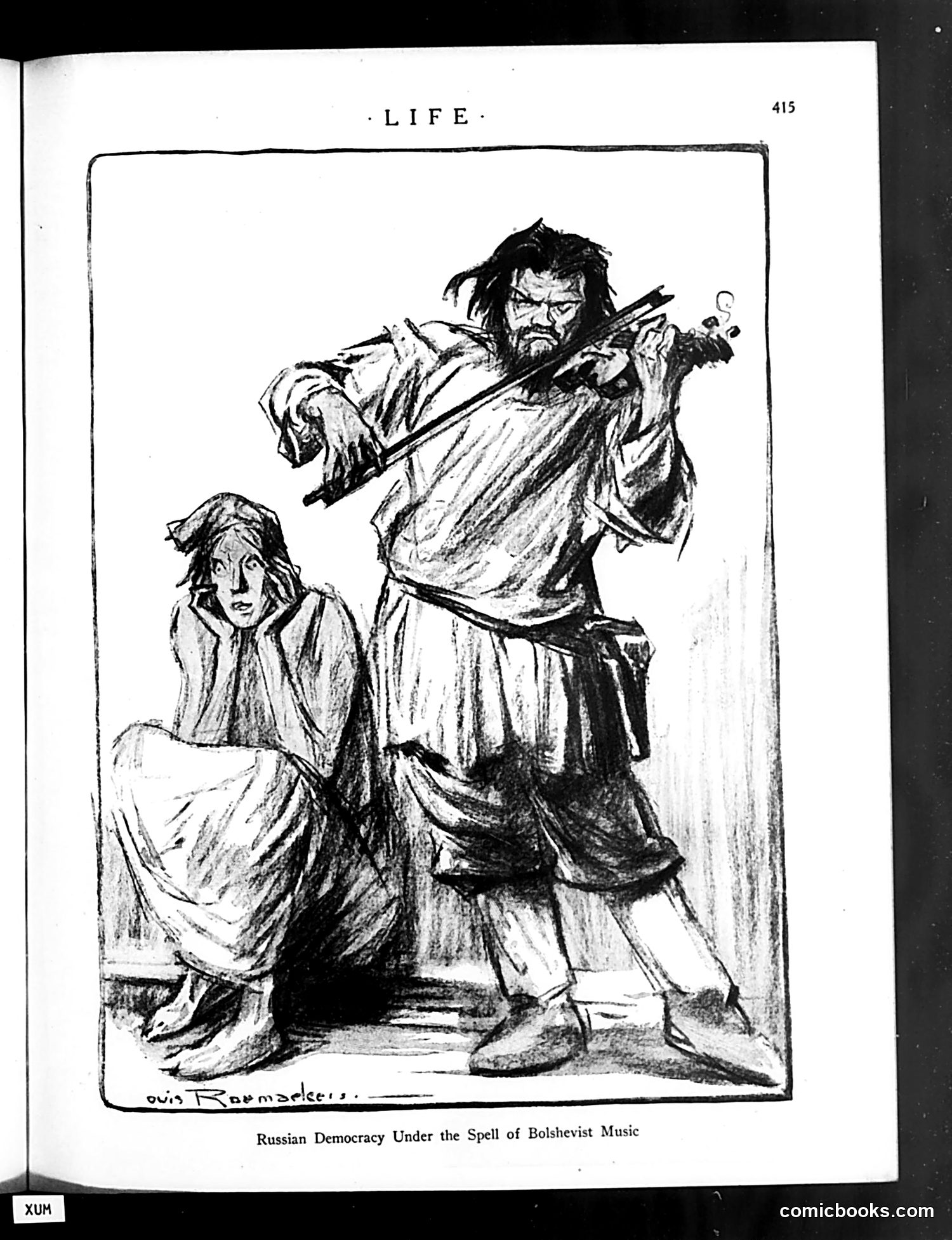
This Life magazine cartoon satirizes the Russian Revolution and Bolshevik takeover. A bearded, menacing figure (representing Bolshevism or Lenin) plays a violin while a smaller, distressed figure (representing Russian democracy or the Russian people) sits hypnotized or entranced below, appearing helpless. The cartoon's central metaphor equates Bolshevik ideology to "music" that has literally enchanted and subjugated Russian democracy. The stark size difference emphasizes the power imbalance. This reflects American anti-communist sentiment of the post-1917 period, portraying Bolshevism as a deceptive, controlling force that has eliminated democratic freedoms through propagandistic "spell-casting" rather than legitimate political persuasion.
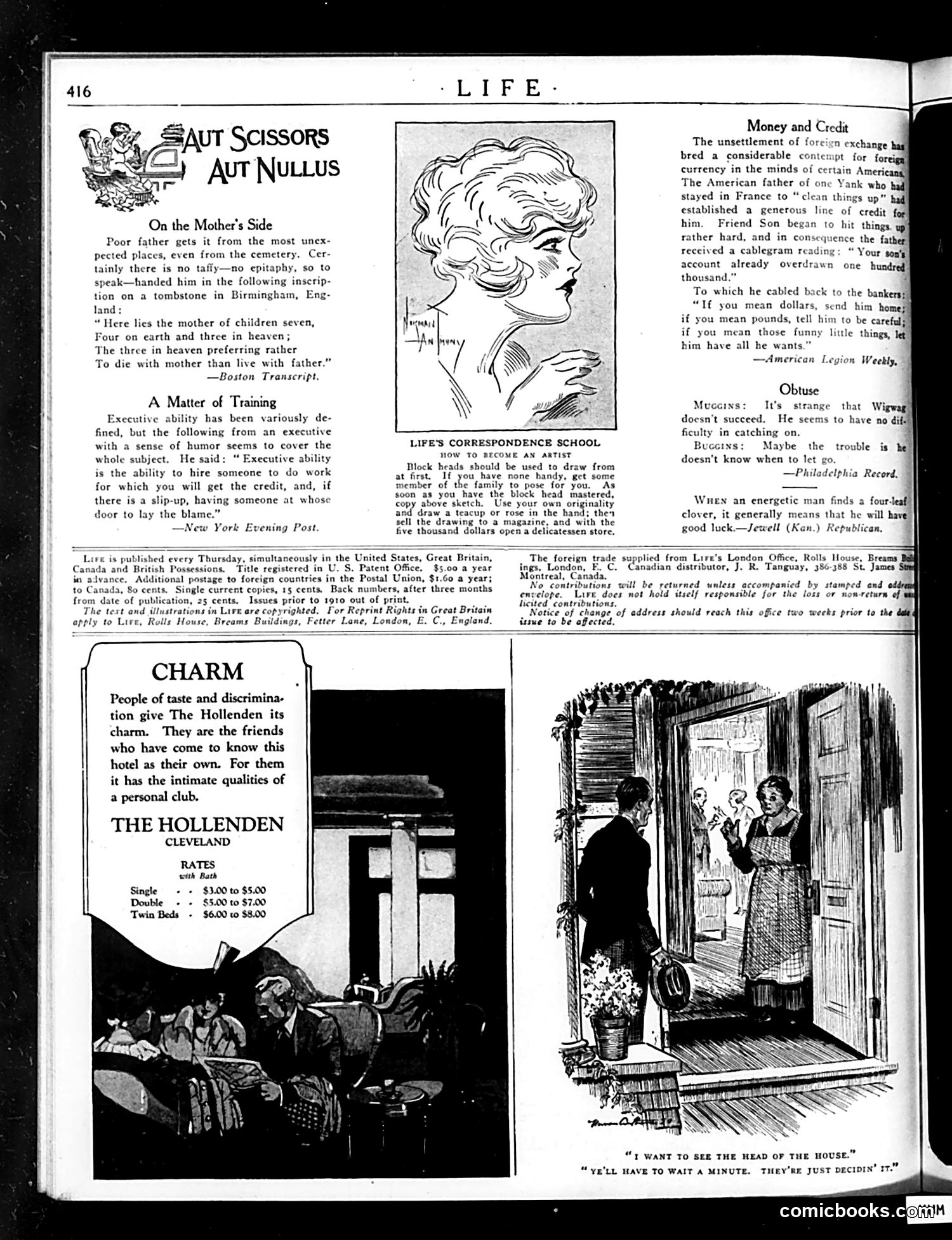
This page contains three unrelated humor pieces and advertisements typical of *Life* magazine's satirical format: **"On the Mother's Side"** presents a gravestone epitaph mocking absent fathers—a Victorian-era joke about paternal neglect or poor character that made mothers prefer their children dead rather than living with dad. The humor relies on dark, misogynistic assumptions about marriage. **"A Matter of Training"** defines "executive ability" cynically as delegating work while taking credit and blaming subordinates—a straightforward satire on corporate hypocrisy that remains relevant today. **"Life's Correspondence School"** humorously suggests using family members as art models, implying they're "block heads" (stupid). It's simple visual wordplay. The remaining items are brief jokes about money exchange, persistence, and luck—lightweight filler content. The page is primarily **advertising-driven**, featuring *The Hollenden* hotel prominently. The cartoons serve mainly as editorial padding around commercial space.
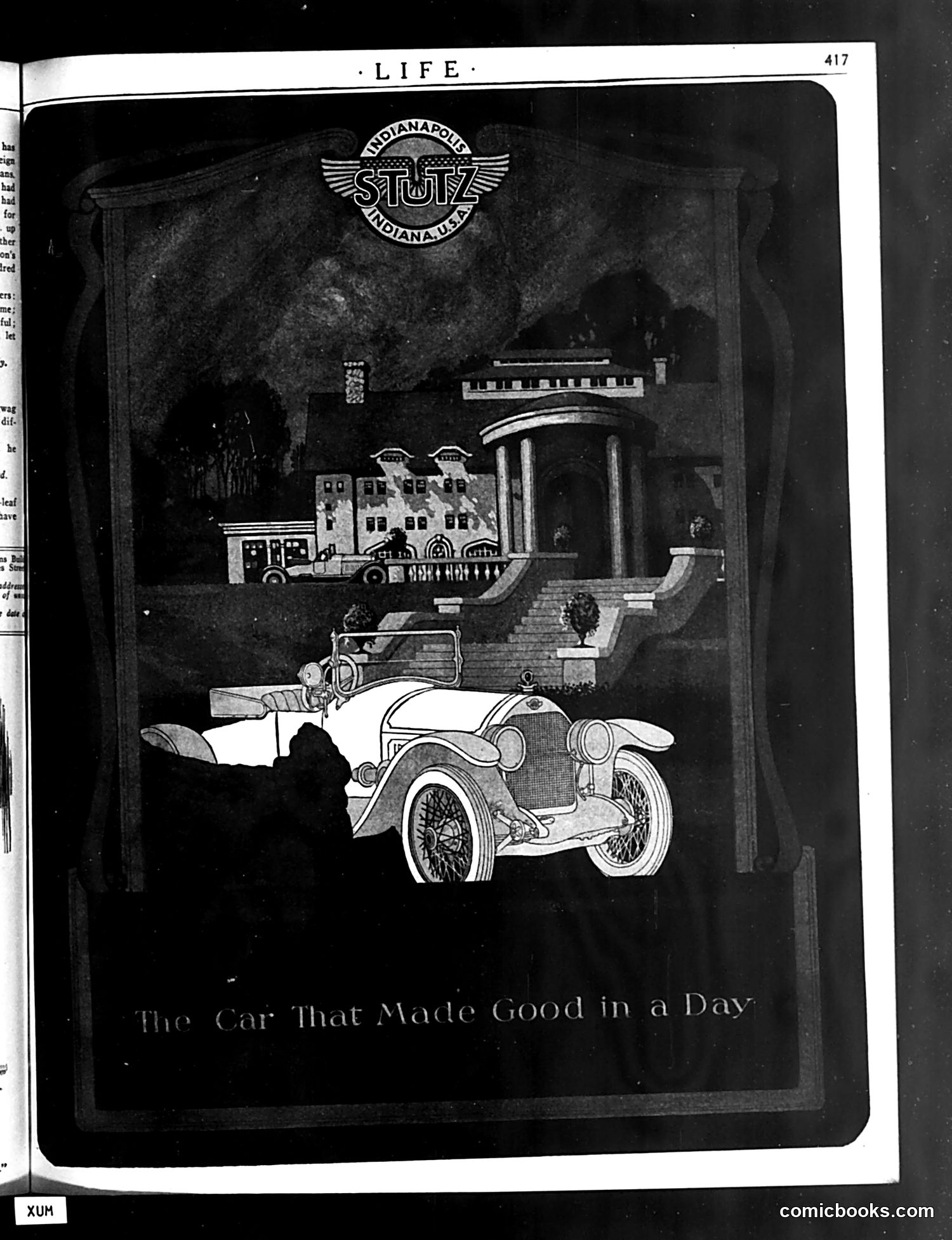
This is a **Stutz motor company advertisement** from *Life* magazine, featuring their logo at the top. The image shows a high-end automobile prominently displayed in the foreground, with an elegant building (suggesting wealth or success) depicted in the background. The tagline "The Car That Made Good in a Day" is a play on the American success narrative—suggesting rapid achievement and prosperity. The advertisement appeals to aspirational readers by associating the Stutz automobile with sophistication, success, and upward mobility. The dramatic nighttime setting and architectural grandeur emphasize luxury and status. This reflects early 20th-century advertising that linked consumer products to personal achievement and social advancement.
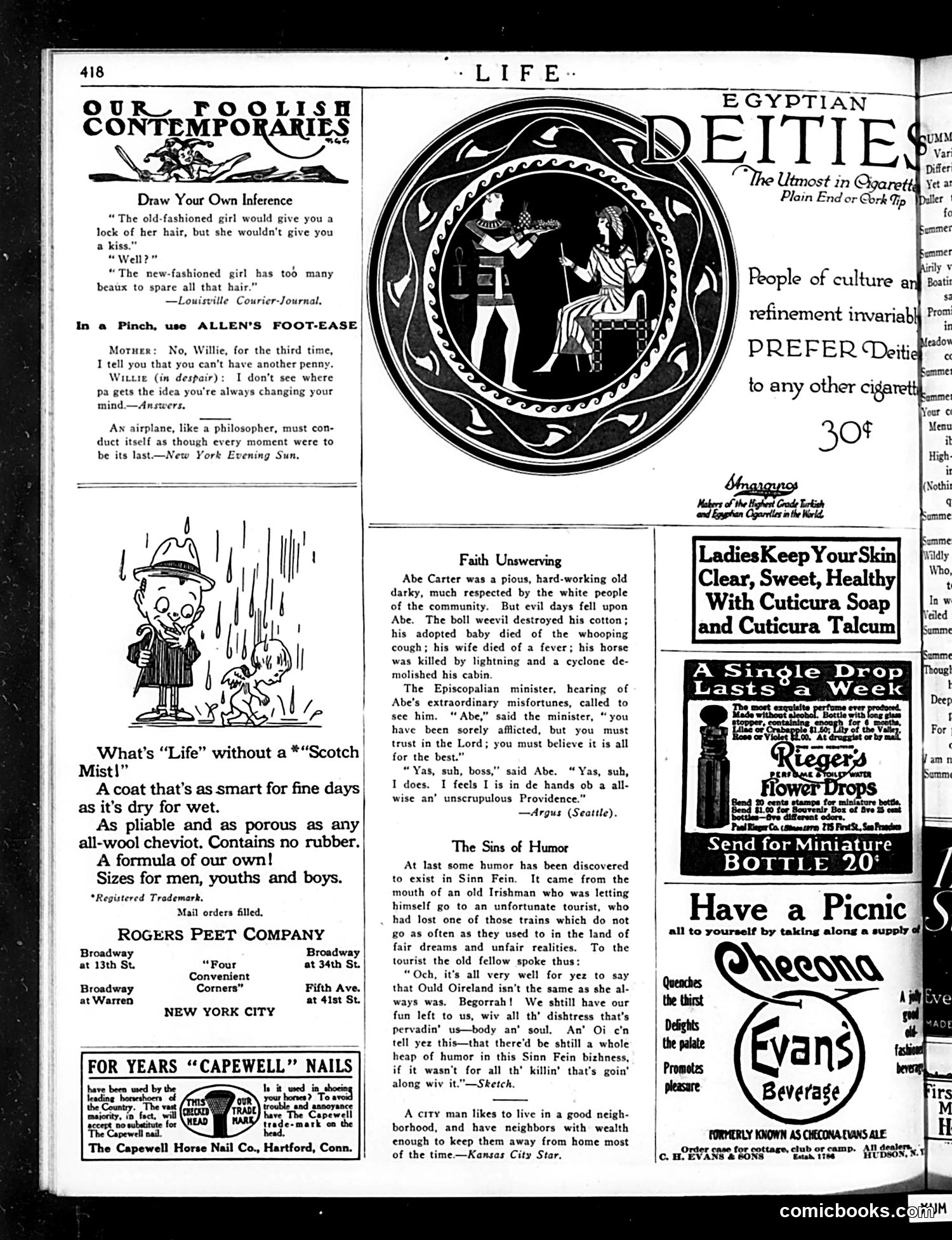
This page is primarily **advertising and humor columns** rather than political satire. The content includes: **"Our Foolish Contemporaries"** section features three brief satirical jokes about modern social behavior: - A joke contrasting old-fashioned girls (who gave hair locks) with new-fashioned girls (who have too many suitors to spare hair) - A domestic humor piece about a child repeatedly asking for money - A philosophical quip comparing airplanes to philosophers **"Faith Unswerving"** tells a dialect-heavy story about "Abe Carter," an elderly Black man suffering multiple disasters (crop failure, dead child, deceased wife, lightning-killed horse) who tells an Episcopal minister he trusts in "an unscrupulous Providence." The humor relies on period stereotypes and dialect humor common to early 20th-century magazines. **"The Sins of Humor"** presents an Irish character complaining about Sinn Féin troubles, using heavy accent. The remainder is **product advertising** (Egyptian cigarettes, Cuticura soap, Evans beverages, Rogers Peet clothing, etc.). The page reflects early 1900s comedic conventions and racial/ethnic stereotyping typical of the era.
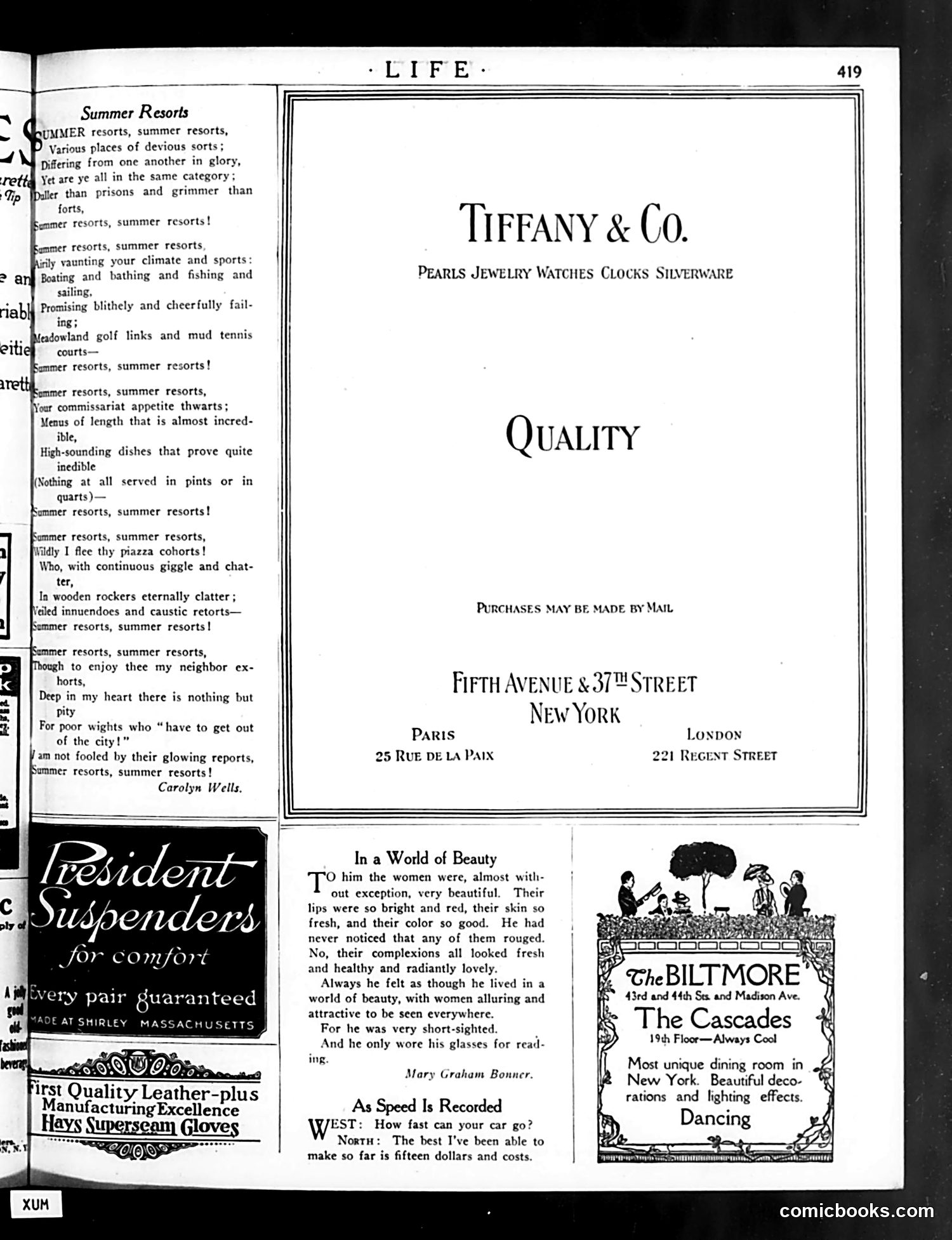
This page is primarily **advertising and light social commentary**, not political satire. The main content includes: **"Summer Resorts" poem by Carolyn Wells**: A humorous critique of vacation destinations, mocking their pretensions. The verse satirizes resorts' false promises—boasting of sports and fine dining while delivering muddy tennis courts and inedible food. It also ridicules the social scene: endless chattering guests in rocking chairs and forced socializing. The author concludes she's unmoved by others' glowing reports. **Advertisements**: Tiffany & Co. (luxury goods), President Suspenders, Hays Superseam Gloves, and upscale NYC dining/hotels dominate the page. **Short humor pieces**: "In a World of Beauty" jokes about a nearsighted man who finds all women beautiful only because he can't see clearly. "As Speed Is Recorded" is a quick joke about car expenses versus speed. The satirical thrust targets **consumer culture and middle-class pretension**—particularly the marketing of leisure and luxury to aspirational Americans. The tone is gentle mockery rather than sharp political critique.
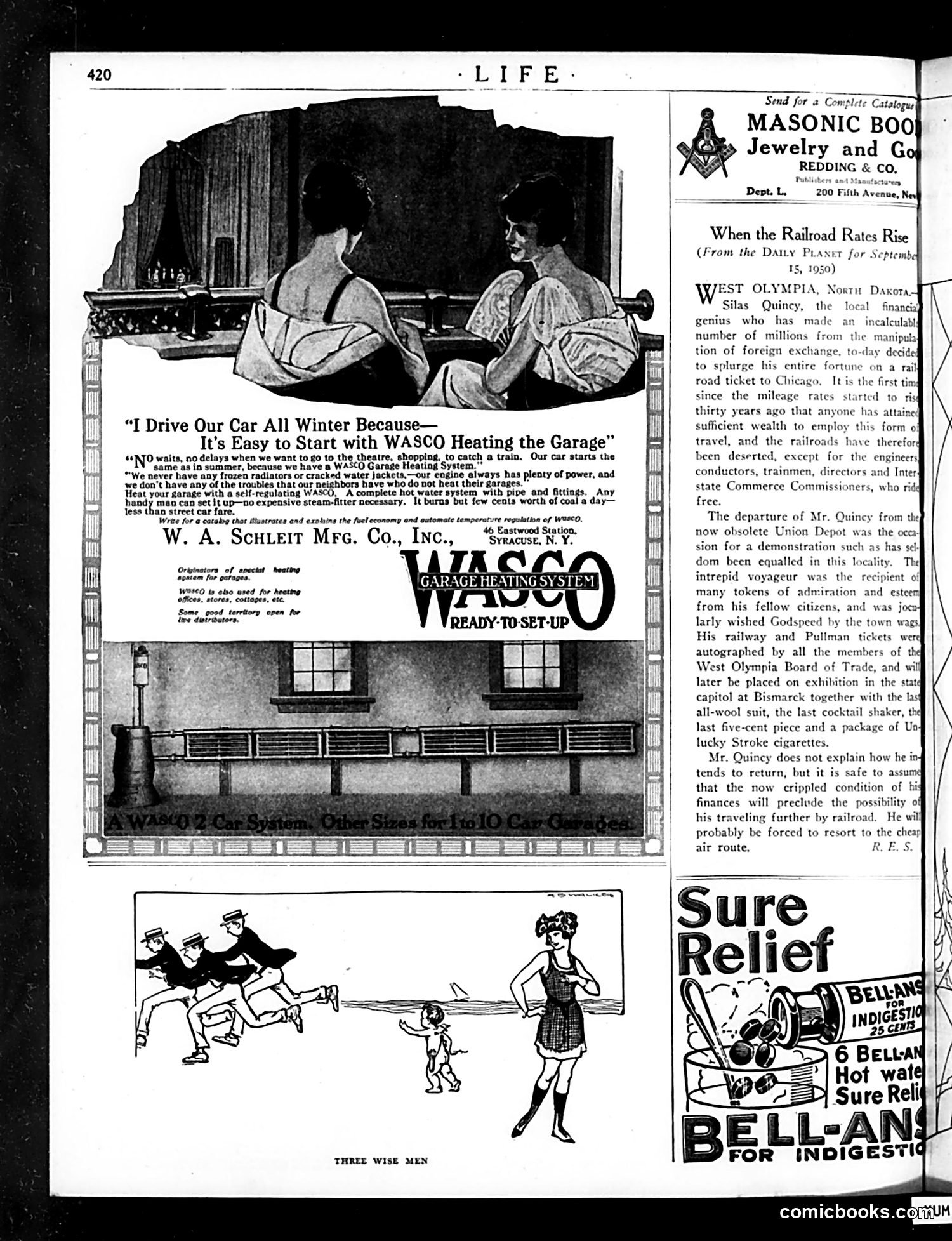
This page contains two distinct pieces of content: **Main Advertisement (Top):** A WASCO garage heating system ad featuring two women in a car. The appeal emphasizes winter convenience—easy engine starts, no frozen radiators, lower cost than street car fare. This reflects 1920s-era concerns about automobile ownership challenges in cold climates. **Satirical Article (Right):** "When the Railroad Rates Rise" mocks railroad economics through the fictional story of Silas Quincy, a wealthy financier who's so rich he can afford a railroad ticket to Chicago—presented as extraordinary because ticket prices have risen so dramatically over thirty years that ordinary people can no longer travel by rail. The satire suggests railroad rates have become prohibitively expensive, making train travel a luxury only the ultra-wealthy can afford. His departure is treated as a historical event worthy of commemoration, with tickets to be displayed in a state capitol alongside other artifacts of a vanishing era. The joke critiques the railroad industry's pricing practices during this period.
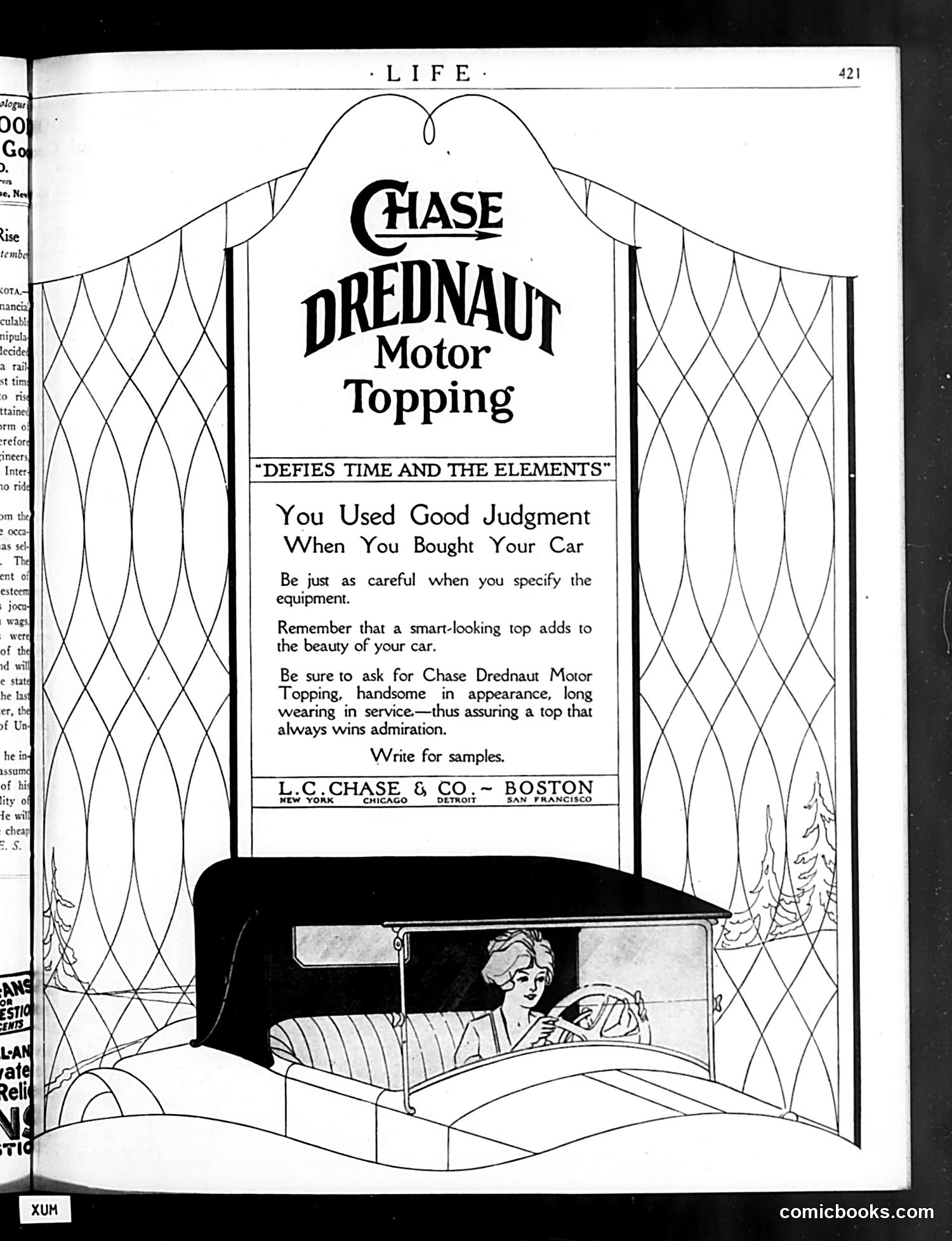
This is a full-page advertisement for Chase Drednaut Motor Topping, not political satire. It appeared in *Life* magazine (page 421) and promotes a car convertible top product. The ad features an illustration of a stylishly dressed woman driving a convertible with the top up, emphasizing the product's aesthetic appeal. The tagline "Defies Time and the Elements" suggests durability and weather resistance—key selling points for convertible tops of the era. The messaging targets car owners who "used good judgment" purchasing quality automobiles, appealing to their desire to maintain that standard with quality accessories. Chase & Co., based in Boston with offices in New York, Chicago, Detroit, and San Francisco, positioned their topping as both functional and fashionable, promising admirers' approval. This reflects early automobile culture when convertible tops were standard features requiring regular maintenance and replacement.
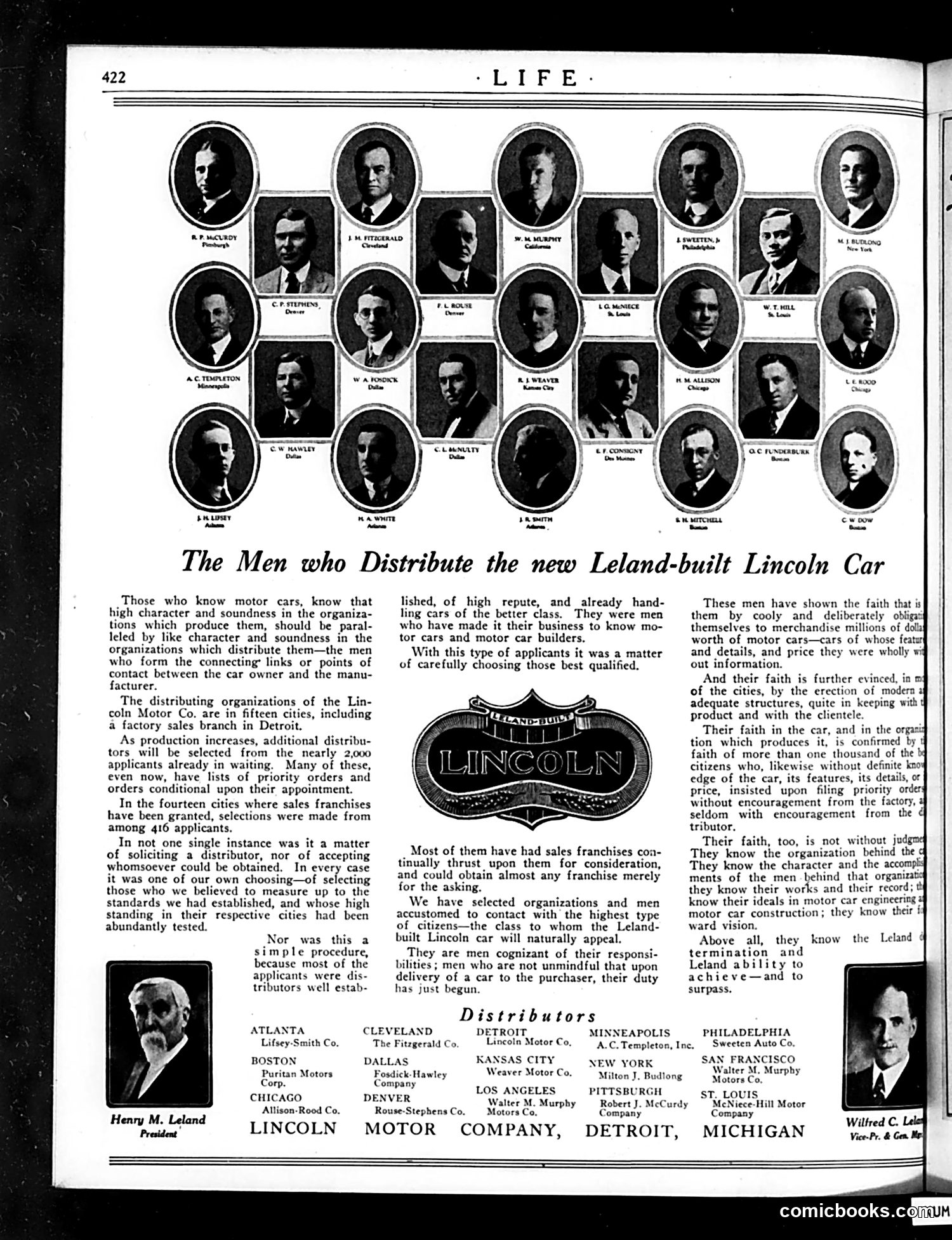
This is **not a cartoon or satire**—it's a full-page advertisement for the Lincoln Motor Company, disguised as editorial content in *Life* magazine. The page features portraits of distributors (car dealers) across America, presenting them as carefully vetted businessmen of high character. The text emphasizes that Lincoln selected these distributors from among 416 applicants, choosing only those with existing reputation and wealth to represent the brand to "the highest type of citizens." **What's notable today:** This represents early 20th-century marketing strategy—using editorial-style layouts to lend credibility, emphasizing exclusivity and social class, and featuring individual portraits to personalize corporate infrastructure. The repeated assertion that distributors showed "faith" despite having no detailed knowledge of the product itself is striking: customers ordered based on the brand's reputation alone. **The figures shown** are real distributors in various cities (Atlanta, Boston, Chicago, etc.), with Henry M. Leland (company founder) and Wilfred C. Leland pictured prominently.
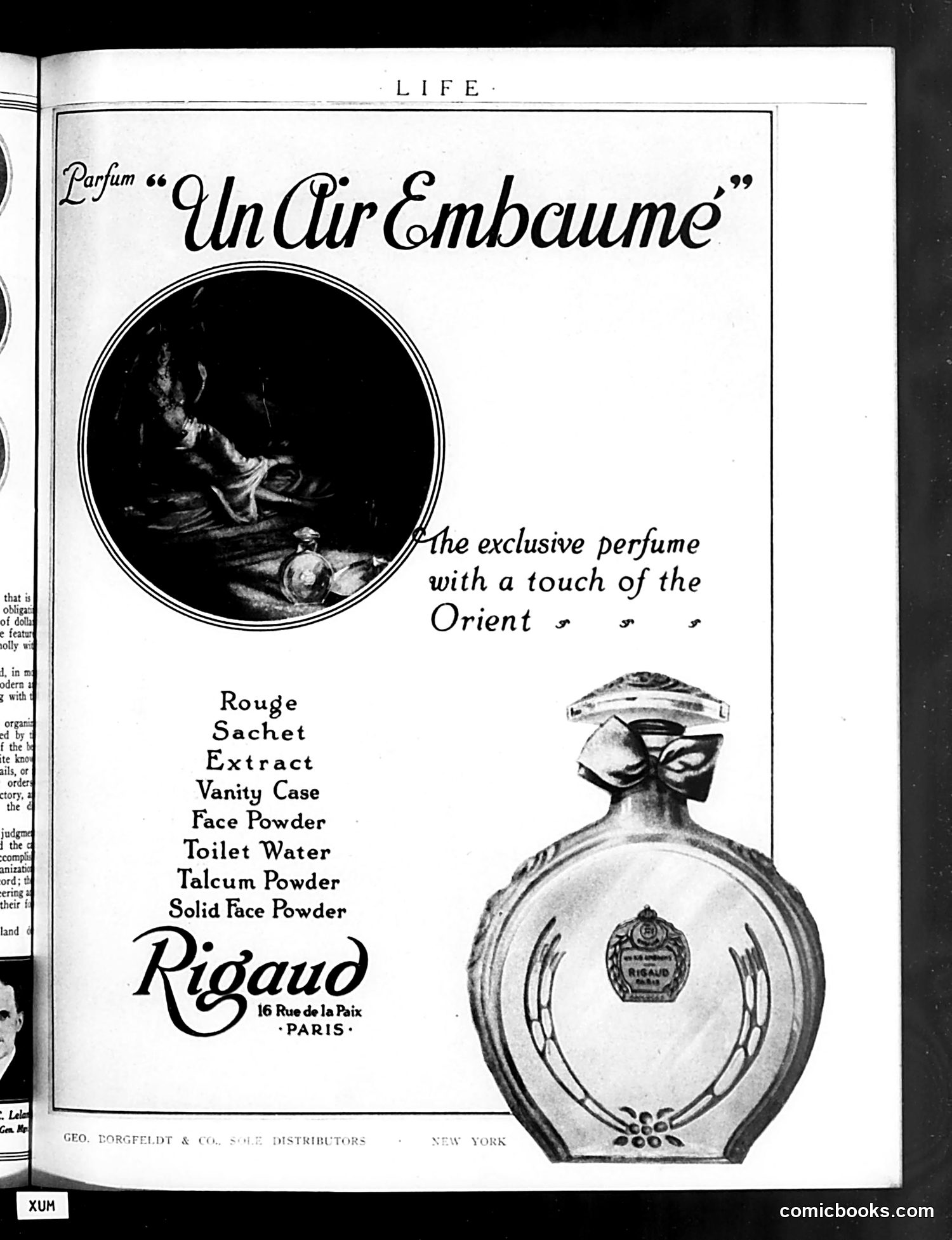
This is a **perfume advertisement**, not political satire. It promotes "Un Cir Embaument" by Rigaud, a Paris-based cosmetics company. The ad markets the fragrance as an "exclusive perfume with a touch of the Orient"—reflecting early 20th-century Western fascination with exoticized Eastern aesthetics. The page lists related beauty products (rouge, powder, extract, etc.) available from the brand. The circular illustration shows a romanticized, orientalist scene. The ornate perfume bottle with a decorative bow is prominently displayed. The distributor is listed as Geo. Borgfeldt & Co. in New York. This is straightforward commercial advertising from *Life* magazine's pages.
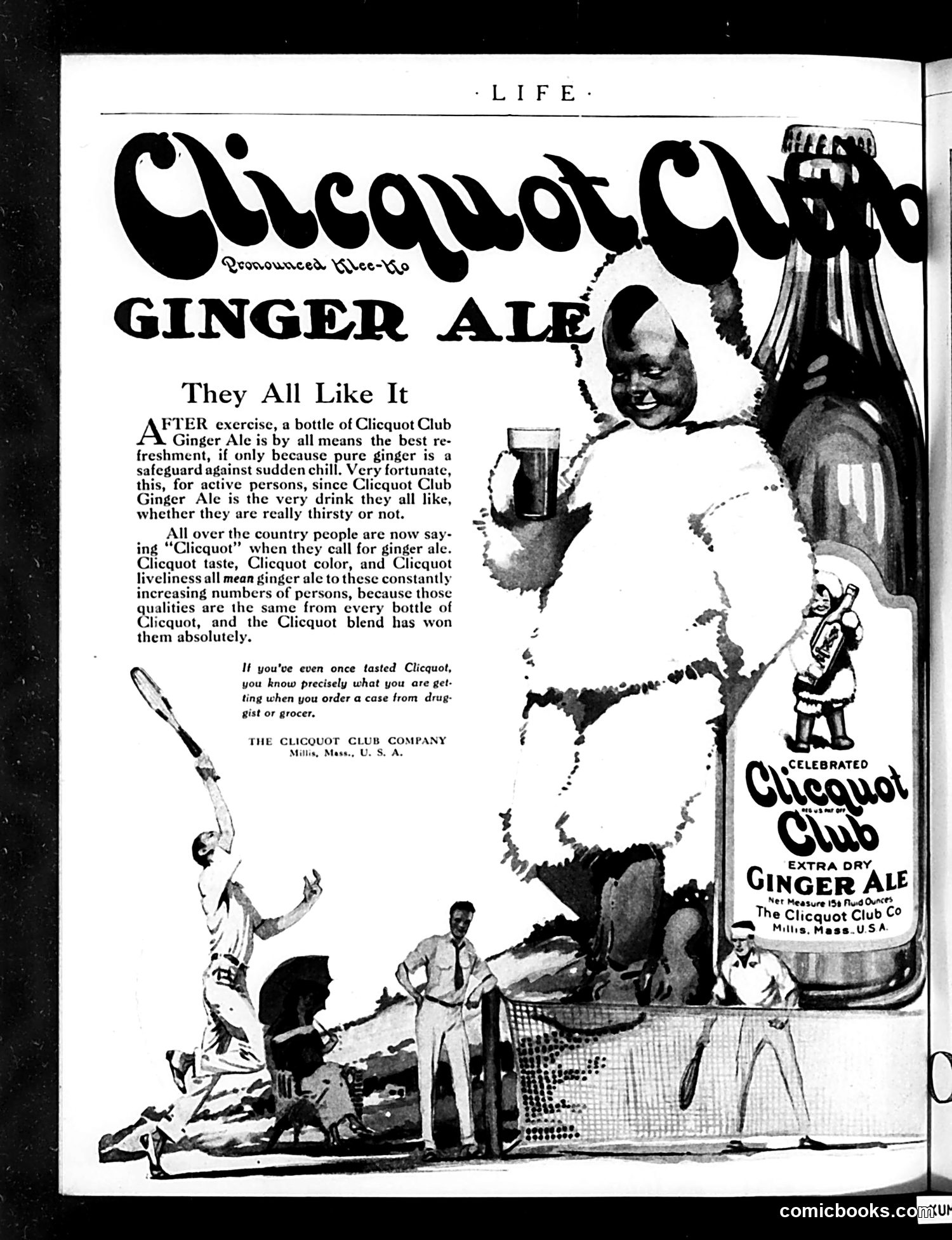
This is primarily a **product advertisement** rather than political satire. It promotes Clicquot Club ginger ale, a non-alcoholic beverage made by the Clicquot Club Company in Mills, Massachusetts. The ad uses active, athletic imagery—baseball players, tennis, boxing—to suggest the drink refreshes people engaged in vigorous exercise. The text emphasizes that "pure ginger" protects against "sudden chill" and positions Clicquot as the preferred choice among active persons. The large bottle illustration and repeated brand messaging ("Clicquot taste, Clicquot color") use early 20th-century advertising techniques to establish brand recognition and consumer loyalty. A notable element: the ad includes a caricatured face (top right), whose racial characteristics appear stereotyped by modern standards, typical of that era's advertising practices. The overall message is straightforward product promotion without satirical commentary.
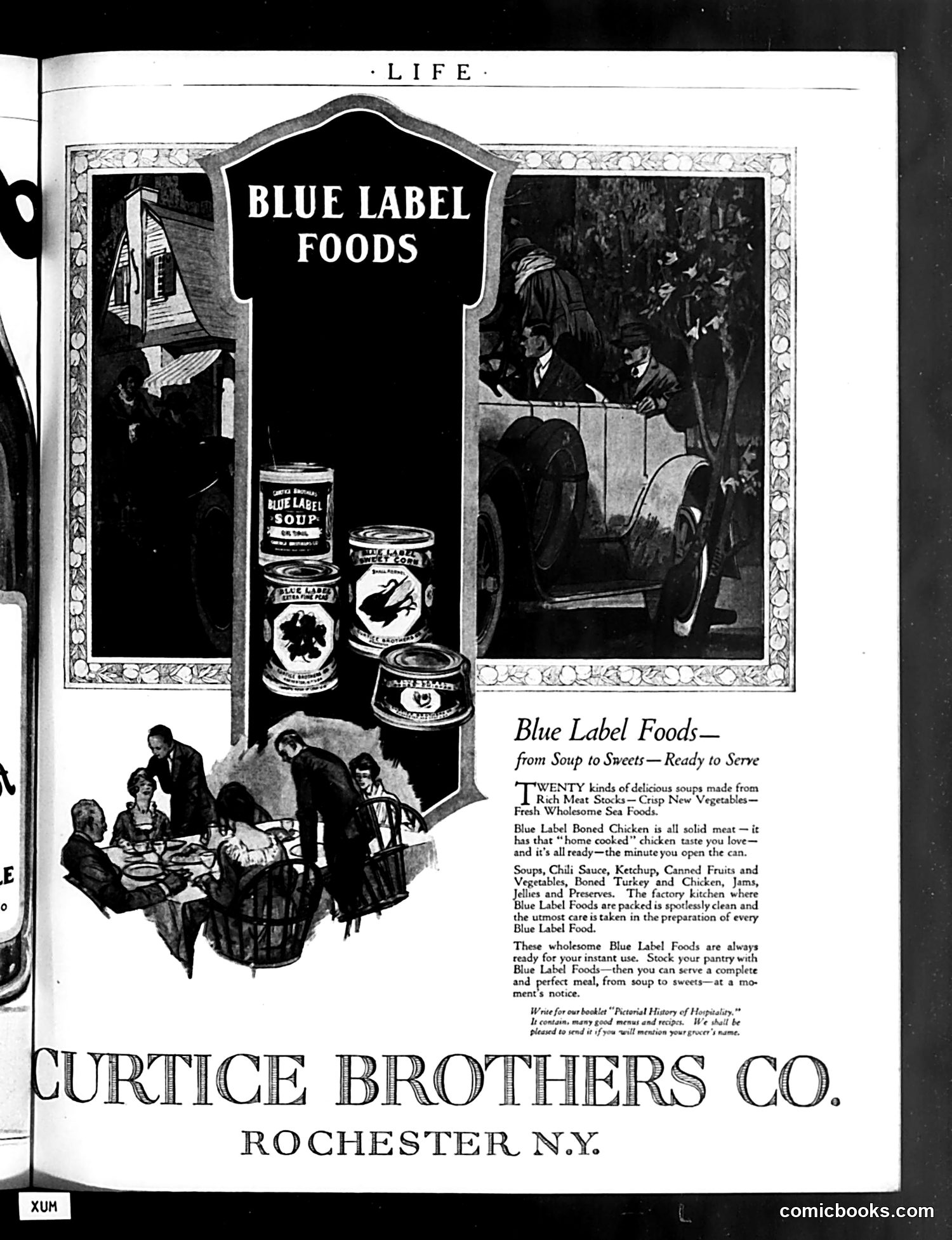
This is **not a cartoon or satire—it's a straightforward product advertisement** for canned foods by Curtice Brothers Co. of Rochester, New York. The page promotes "Blue Label Foods," a line of convenience products including soups, canned meats (boned chicken and turkey), sauces, and preserves. The visual imagery shows domestic scenes: families dining together and people socializing, emphasizing that these ready-to-serve foods enable hosts to prepare complete meals "at a moment's notice." The advertising appeals to the early 20th-century concern with cleanliness ("spotlessly clean factory kitchen") and convenience—selling the idea that modern canned goods allow busy homemakers to serve quality meals without extensive preparation. The tagline "from Soup to Sweets—Ready to Serve" encapsulates the product range's appeal to streamline household labor. There is no political satire or hidden meaning—this is period advertising reflecting consumer values around efficiency and modern food technology.
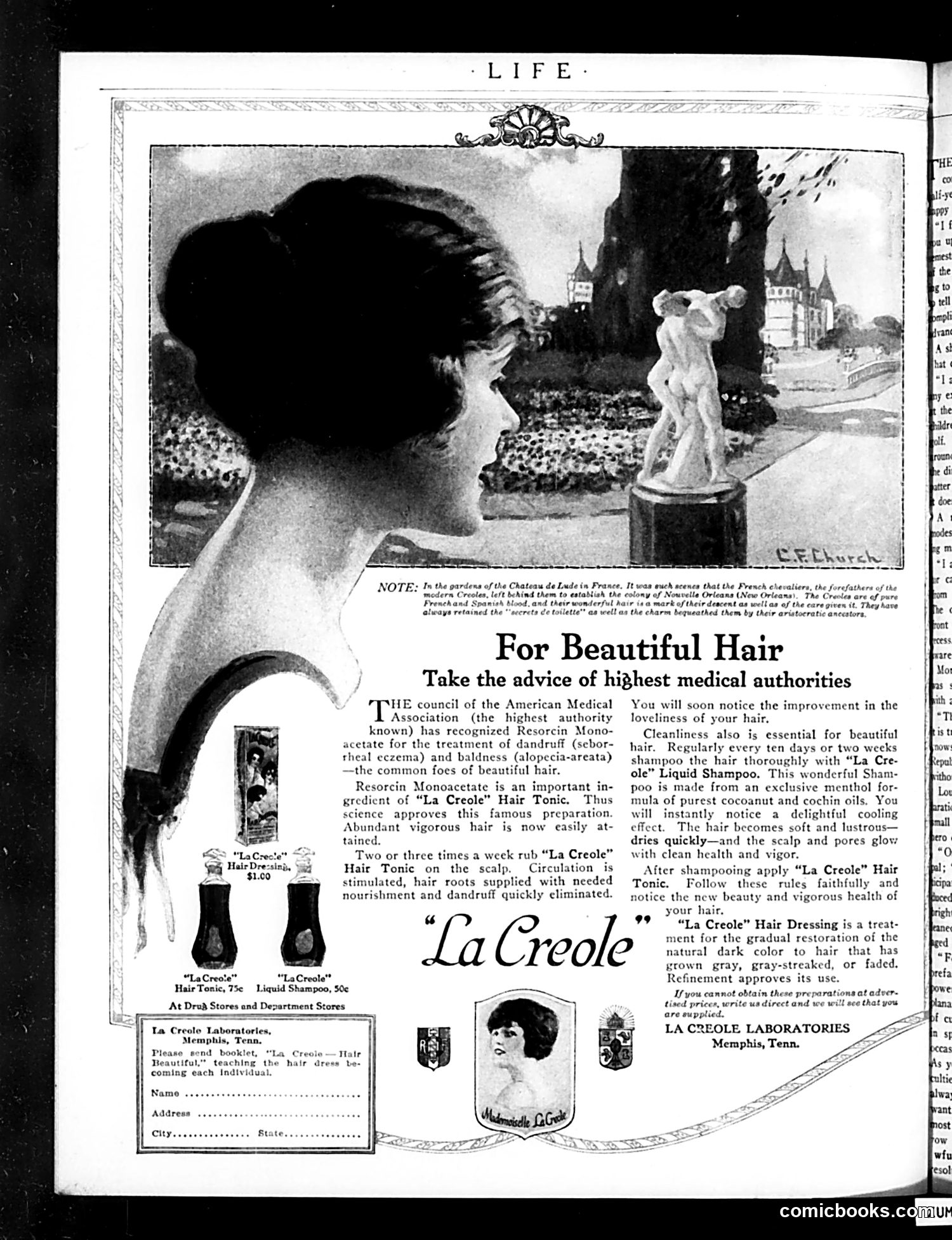
This page is primarily **advertising, not satire**. It promotes "La Creole" hair products (tonic, shampoo, and dressing) manufactured in Memphis, Tennessee. The ad employs **racial and cultural stereotyping** typical of early 20th-century marketing. It references "Creoles" of New Orleans—presenting them as descendants of French aristocrats with naturally superior hair qualities ("wonderful hair is a mark of their descent"). This romanticized origin story serves to market hair products by associating them with exotic European sophistication and racial "purity." The advertisement appropriates Creole identity as a selling point while the actual product targets white American consumers seeking to improve their appearance. The note at top attempts to establish credibility through references to French ancestry and aristocratic beauty secrets. **For modern readers**: This represents how commercial advertising exploited and misrepresented ethnic groups, using romanticized stereotypes to sell products while obscuring the actual complexity of Creole identity and culture.
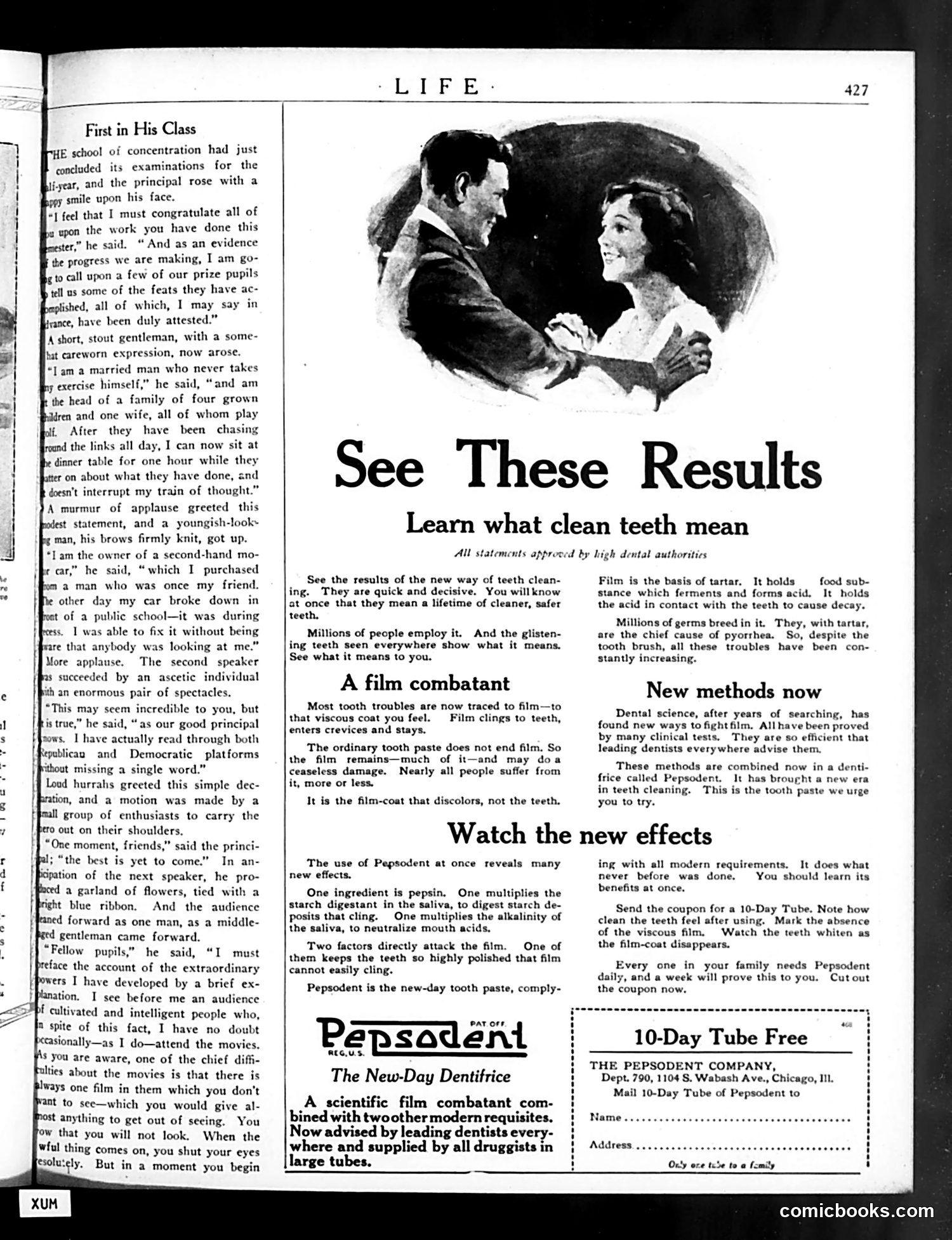
This page contains two distinct elements: a humorous short story and a Pepsodent toothpaste advertisement. **The Story ("First in His Class"):** This is satirical commentary on American values and education. A school principal celebrates students' achievements, but each "prize pupil" describes an ability to *avoid* or *ignore* unpleasant situations: a man who ignores family golf-talk, a man who hid while fixing a car, a man who read political platforms without complaint. The final speaker—who receives the blue-ribbon garland—boasts of his ability to *close his eyes during unwanted movie scenes*. The satire mocks the erosion of genuine accomplishment, suggesting American society celebrates the ability to mentally escape rather than engage meaningfully with life's obligations. **The Advertisement:** Pepsodent pitches "film combatant" toothpaste using pseudo-scientific language about tooth film, tartar, and decay. It's typical period advertising rhetoric claiming unique efficacy and employing dental authority appeals.
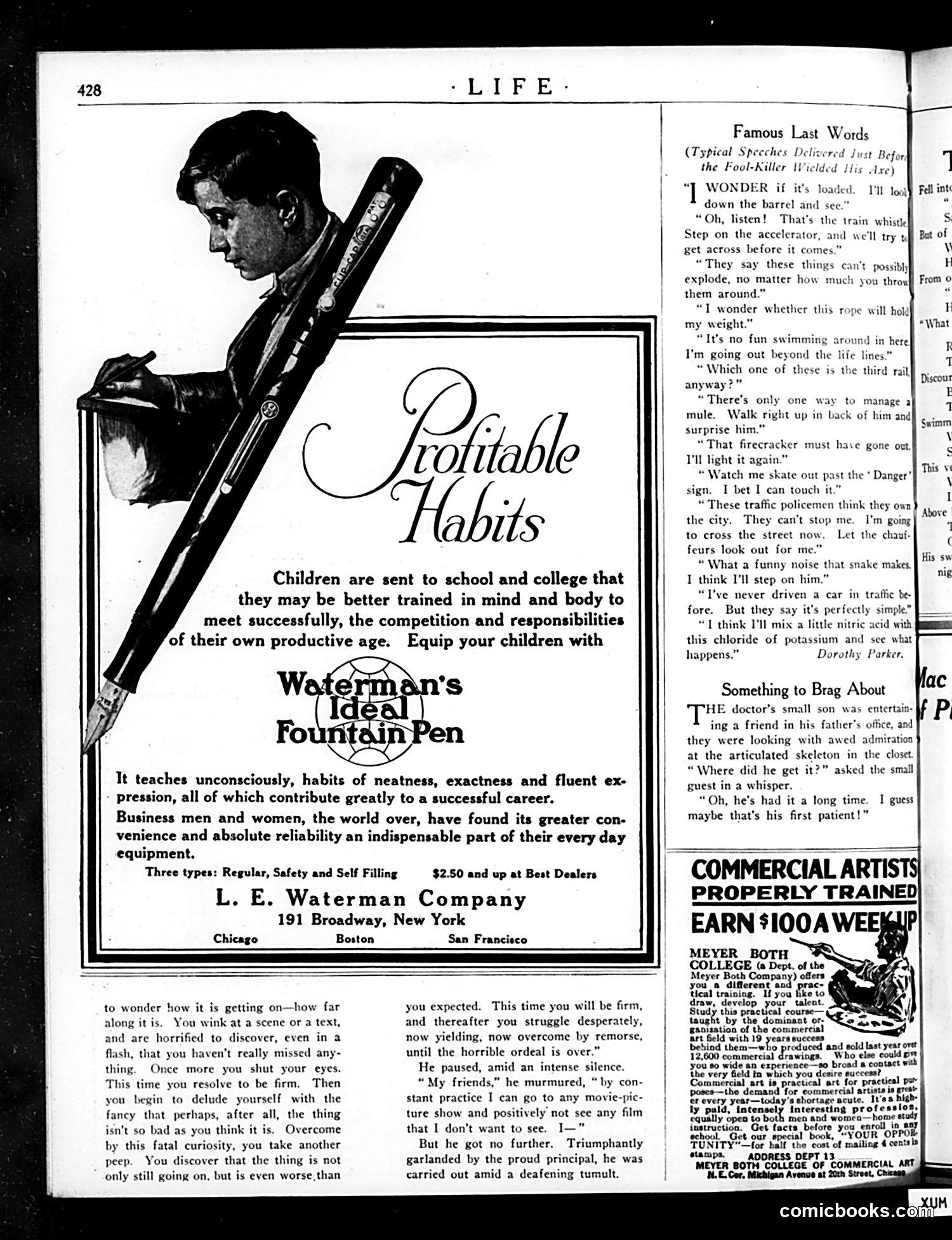
This page contains two distinct elements: **Main Advertisement (Left):** A Waterman fountain pen ad argues that equipping children with quality pens teaches "habits of neatness, exactness and fluent expression"—character traits necessary for success. The illustration shows a man with a pen, connecting writing instruments to professional achievement. This reflects early 20th-century beliefs that proper tools and penmanship shaped personal development. **"Famous Last Words" Humor Column (Right):** A satirical list of foolish statements people make before accidents—"I wonder if it's loaded," "I'll light it again" (about a firecracker), "I think I'll mix a little nitric acid"—attributed to various speakers. The column mocks human recklessness and overconfidence. The "Fool-Killer" reference suggests a folkloric character who punishes stupidity. This reflects Life magazine's tradition of humorous social commentary on human folly. The page also includes unrelated advertisements and short humorous pieces typical of Life's mixed-content format.
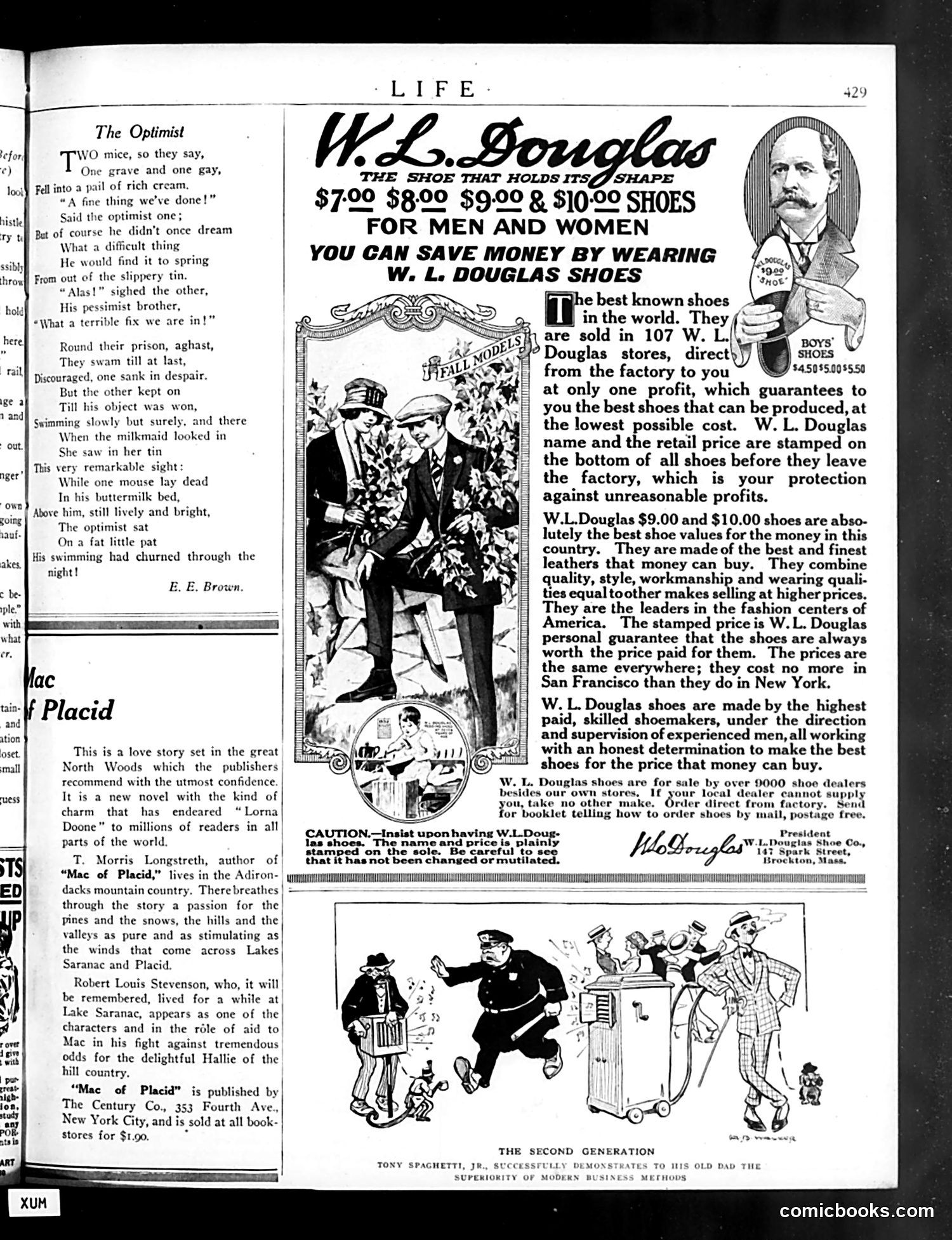
This page mixes literary content with advertising. On the left is "The Optimist," a poem by E.E. Brown about two mice in cream—a moral fable contrasting pessimism with persistence. Below is a book notice for "Mac of Placid," a romantic novel set in the Adirondacks featuring Robert Louis Stevenson as a character. The dominant content is a W.L. Douglas shoe advertisement, a major brand of the era. The ad emphasizes direct factory-to-consumer sales eliminating middleman profits, guaranteed pricing nationwide, and quality craftsmanship. The bottom cartoon, "The Second Generation," shows Tony Spaghetti Jr. demonstrating "modern business methods" to his old-fashioned father—likely satirizing generational business differences and immigrant assimilation, with the Italian surname suggesting contemporary American immigration themes.
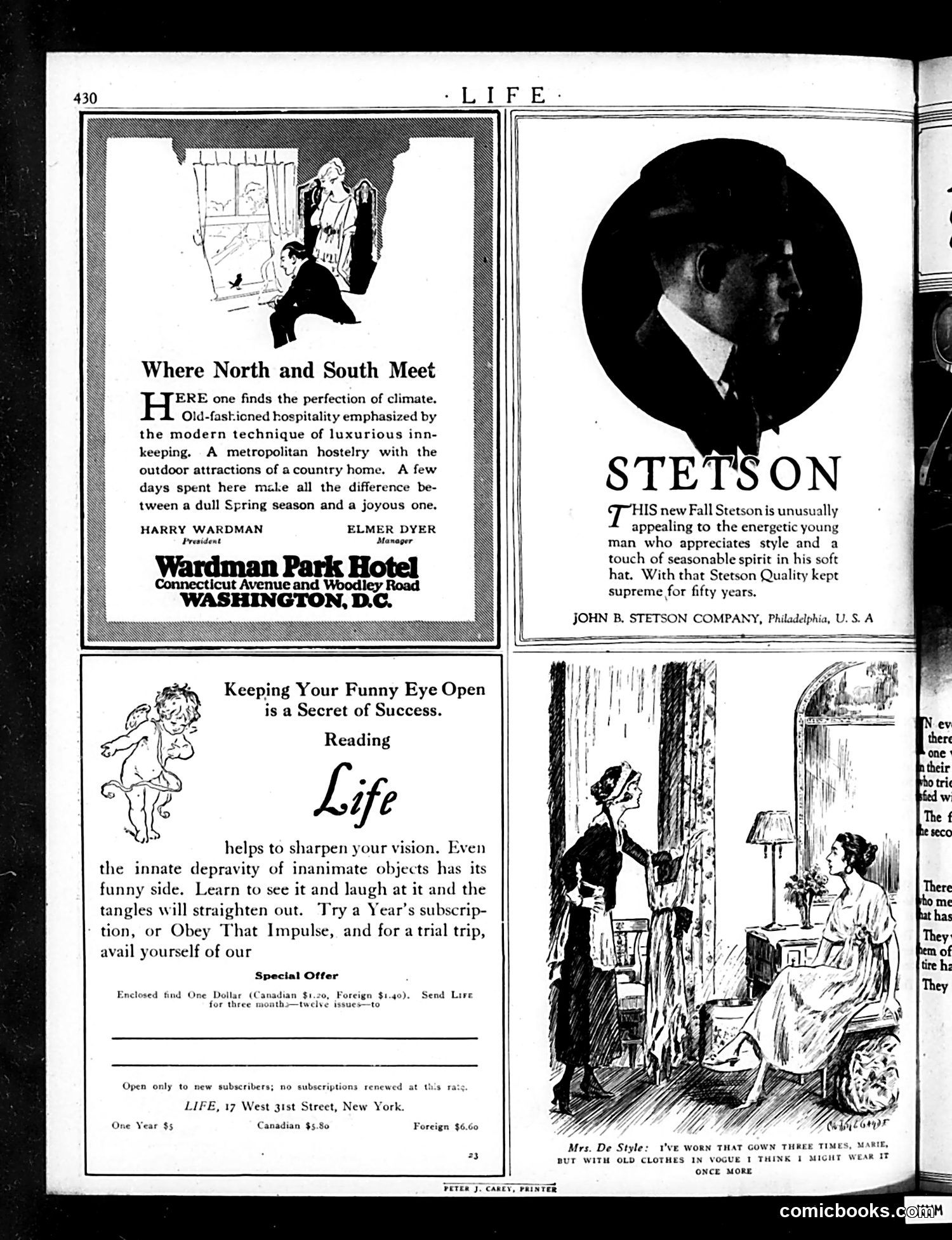
This page is primarily **advertisements** interspersed with satirical content typical of Life magazine's format. The main cartoon (bottom right) satirizes **wartime or economic austerity fashion trends**. "Mrs. De Style" jokes about rewearing an old gown because "old clothes in vogue" makes it acceptable—mocking both wealthy women's vanity and the era's rationing or thrift messaging. The humor lies in her rationalization: she can now justify wearing something shabby as fashionable rather than admit poverty or frugality. Upper advertisements include the Wardman Park Hotel (Washington, D.C.) emphasizing luxury hospitality, and Stetson hats promoting their product to stylish young men. The "Keeping Your Funny Eye Open" section promotes Life magazine subscriptions, using the conceit that reading Life sharpens one's perception of life's absurdities and humor—a self-promotional pitch dressed as philosophy. The pricing suggests this is early-20th-century American content, likely WWI or 1920s era.
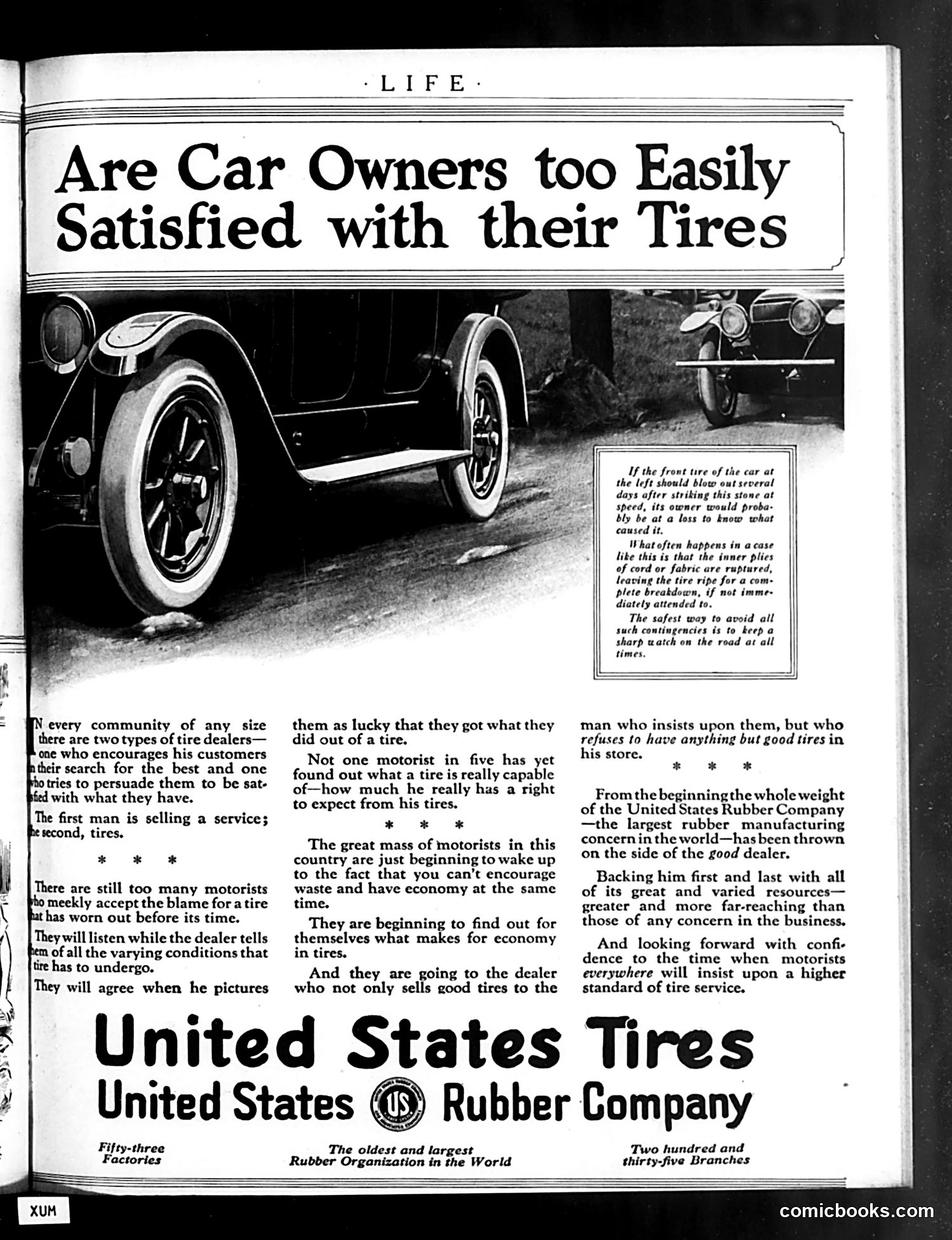
This is **not a cartoon but an advertisement disguised as editorial commentary**. United States Rubber Company uses the "Life" magazine format to critique lazy car owners and dishonest tire dealers. The argument: Some dealers exploit customer ignorance by selling inferior tires and blaming owners for poor maintenance. The company positions itself as the ethical alternative—a dealer who insists on *quality* tires and educates consumers about proper tire care. The accompanying photographs show 1920s-era automobiles with prominent tires, emphasizing the product. **The satire is subtle**: the piece mocks motorists as "too easily satisfied" and too willing to accept blame, while framing US Rubber as the consumer's advocate. This is effective marketing—positioning a major corporation as fighting against industry-wide mediocrity and deception. The inset diagram about road hazards (stones causing hidden tire damage) reinforces the message: good tires prevent accidents; poor ones don't.
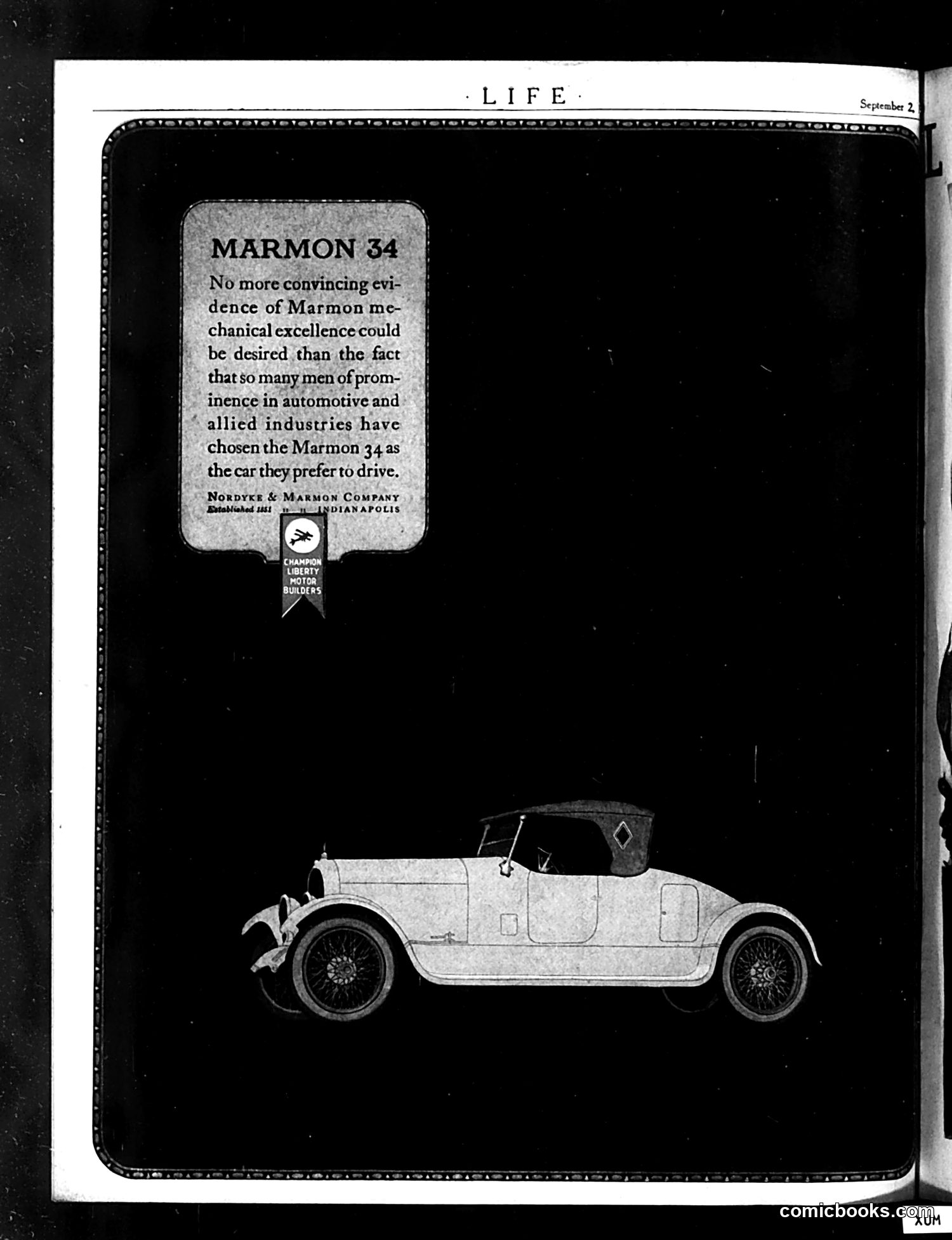
This is a **automobile advertisement**, not political satire. It's a Marmon 34 car ad from the Nordyke & Marmon Company (Indianapolis), appearing in *Life* magazine around the 1920s. The ad makes a straightforward commercial claim: the Marmon 34's excellence is proven by its popularity among prominent automotive industry figures who choose it personally. The illustration shows a side profile of the vehicle—a open-air touring car typical of the era. The appeal is to **prestige and expert endorsement** rather than satire. For modern readers, the car's design (spoke wheels, open cabin, minimal weather protection) reflects early automotive technology. The ad's logic—that industry insiders' choices validate product quality—represents period marketing strategy, before consumer safety regulations or standardized testing existed. This is essentially product placement through implied celebrity/expert endorsement, a technique still used today.