
Life, 1920-09-02 · page 29 of 52
Life — September 2, 1920 — page 29: what you’re looking at
What you’re looking at
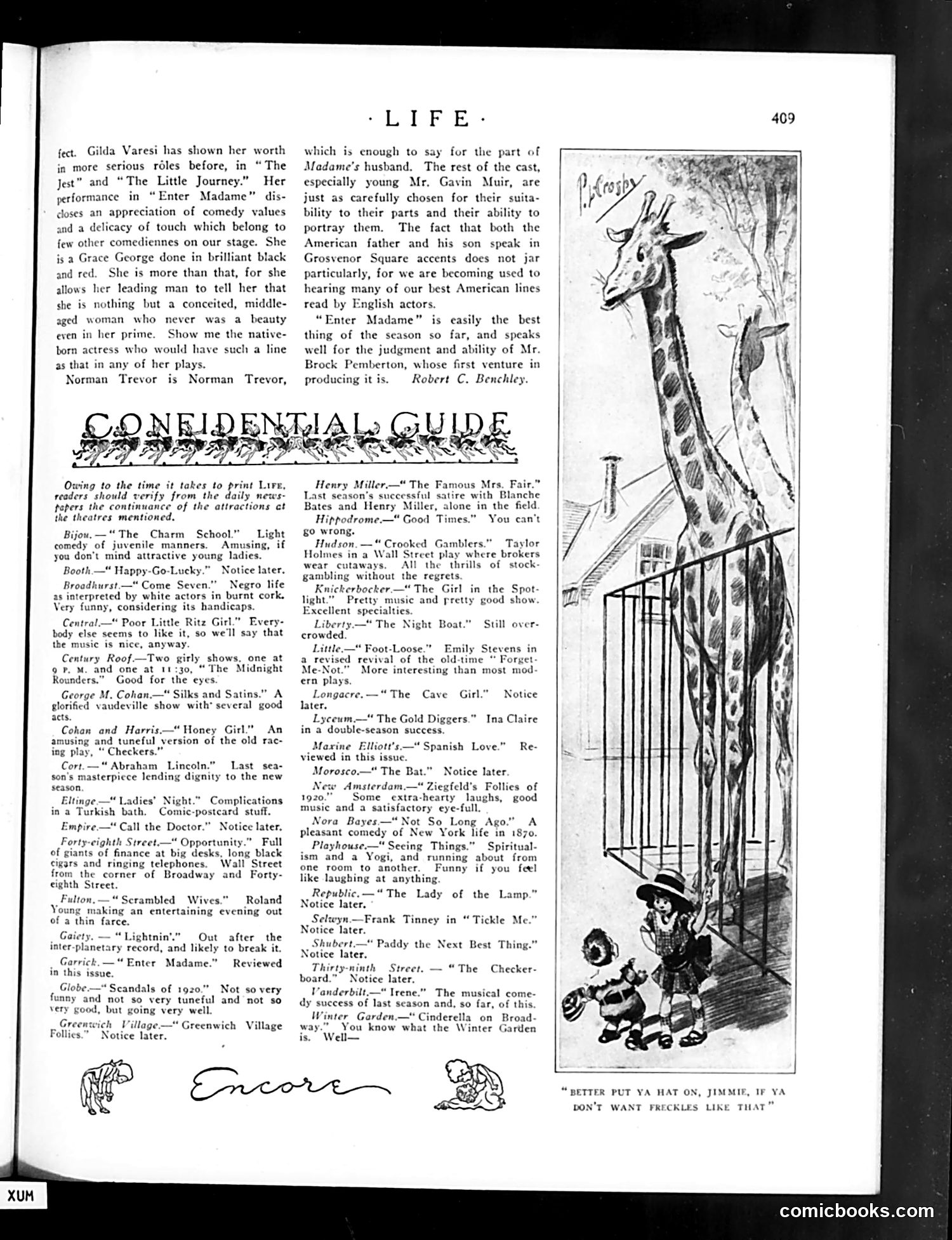
This page is primarily a **theater review column** by Robert C. Benchley, the famous humorist and drama critic. The main content reviews the play "Enter Madame," starring actress Gilda Varesi, praising her performance and the production. The **cartoon illustration** (right side) shows a giraffe in formal dress looking out a window, with the caption "Better put ya hat on, Jimmie, if ya don't want freckles like that." This is a light visual joke about sun exposure causing freckles—the giraffe's spots are humorously compared to freckles. The remainder lists brief reviews of various Broadway productions currently running, in the characteristic snappy style of 1920s theater criticism. Notable references include "Scandals of 1920," "Greenwich Village Follies," and several comedies and musicals. This represents Life magazine's function as a cultural arbiter of entertainment, combining sophisticated dramatic criticism with whimsical illustrations for educated readers.
📄 Transcribed text from this page (OCR, searchable)
Machine-transcribed from the original scan — historical spelling and the odd misread are preserved.
Gilda Varesi has shown her worth “The Jest” and “The Little Journey.” Her performance in “Enter Madame” dis- closes an appreciation of comedy values and a delicacy of touch which belong to few other comediennes on our stage. She is a Grace George done in brilliant black and red. She is more than that, for she allows her leading man to tell her that she is nothing but a conceited, middle- aged woman who never was a beauty even in her prime. Show me the native- born actress who would have such a line as that in any of her plays. Norman Trevor is Norman fect. in more serious roles before, in Trevor, LIFE which is enough to say for the part of Madame’s husband. The rest of the cast, especially young Mr, Gavin Muir, are just as carefully chosen for their suita- bility to their parts and their ability to portray them. The fact that both the American father and his son speak in Grosvenor Square accents does not jar particularly, for we are becoming used to hearing many of our best American lines read by English actors. Enter Madame” is easily the best thing of the season so far, and speaks well for the judgment and ability of Mr. Brock Pemberton, whose first venture in producing it is. Robert C. Benchley. awe PRS Sas cs Owing to the time it takes to print Liv readers should verify from the daily new fopers the continuance of the attractions ct the theatres mentioned, Bijou. —“The Charm School.” Light comedy of juvenile manners. Amusing, if you don't mind attractive young ladies. Booth —“ Happy-Go-Lucky.” Notice later. Broadhurst—" Come Seven.” Negro life as interpreted by white actors in burnt cork. Very funny, considering its handicaps. Central—t Poor Little Ritz Girl.” Every- body else seems to like it, so we'll say that the music is nice, anyway. Century Roof—Two girly shows, one at 9 Pp. M. and one at 11:30, “ The Midnight Rounders.” Good for the eyes. George M. Cohan.—" Silks and Satins.” A glorified vaudeville show with" several good acts. Cohan and Harris—“ Honey Girl.” An amusing and tuneful version of the old rac- ing play Checkers.” Cort. —“ Abraham Lincoln.” Last sea- son's masterpiece lending dignity to the new season Eltinge —“ Ladies’ Night.” Complications in a Turkish bath. Comic-postcard stuff. Empire—" Call the Doctor.” Notice later. Forty-eighth Street—* Opportunity.” | Full of giants of finance at big desks, long black cigars and ringing telephones. Wall Street from the corner of Broadway and Forty- eighth Street. y Fulton, rambled Wives.” Roland Young making an entertaining evening out of a thin farce. Gaiety, —“Lightnin’” Out after the inter-planetary record, and likely to break it. Garrick. —“ Enter Madame.” Reviewed in this issu Globe.—* Scandals of 1920." Not so very funny and not so very tuneful and not so very good, but going very well. Village —" Greenwich Village Notice later. Gi Follies.” Henry Miller—* ane Famous Mrs. Fair.” Last season's succes: atire with Blanche Bates and Henry Miller, ‘alone in the field Hippodrome—" Good Times.” You can’t g0 wrong. Hudson. —“ Crooked Gamblers.” Taylor Holmes in a Wall Street play where brokers wear cutaways. All the thrills of stock gambling without the regrets. Knickerbocker—* The Girl in the Spot- light.” Pretty music and pretty good show. Excellent specialties. Liberty.—" The Night Boat." Still over- crowded Little.— Foot-Loose.” Emily Stevens in a re revival of the old-time “ Forget Me-Not.” More interesting than most mod- ern plays. Longacre. —“ The Cave Girl." Notice later. Lyceum.—" The Gold Diggers.” Ina Claire in a double-season success. Maxine Elliott’s—“ Spanish Love.” viewed in this issue. Morosco.—" The Ba N Re- Notice later. » Amsterdam. iegfeld's Follies of 19. Some extra-hearty laughs, good music and a satisfactory eye-full. Nora Bayes—‘ Not So Long Ago.” A pleasant comedy of New York life in 1870. _ Playhouse.—" Seeing Things.” Spiritual- ism and a Yogi, and running about from one room to another. Funny if you feel like laughing at anything. Republic. —“ The Lady Notice later, Selteyn.—Frank Tinney in “Tickle M Notice later. Shubert,—" Paddy the Next Best Thing.” Notice later. Thirty ninth St board.” Notice later. Vanderbilt,—" Irene.” The musical come- dy success of last season and, so far, of this. Winter Garden.— Cinderella on Broad- way.” You know what the Winter Garden is. Well— of the Lamp.” et. — “The Checker- Encore ~ “BETTER PUT YA HAT ON, JIMMIF, IF YA DON'T WANT FRECKLES LIKE THAT” comicbooks.com