
Life, 1920-09-02 · page 18 of 52
Life — September 2, 1920 — page 18: what you’re looking at
What you’re looking at
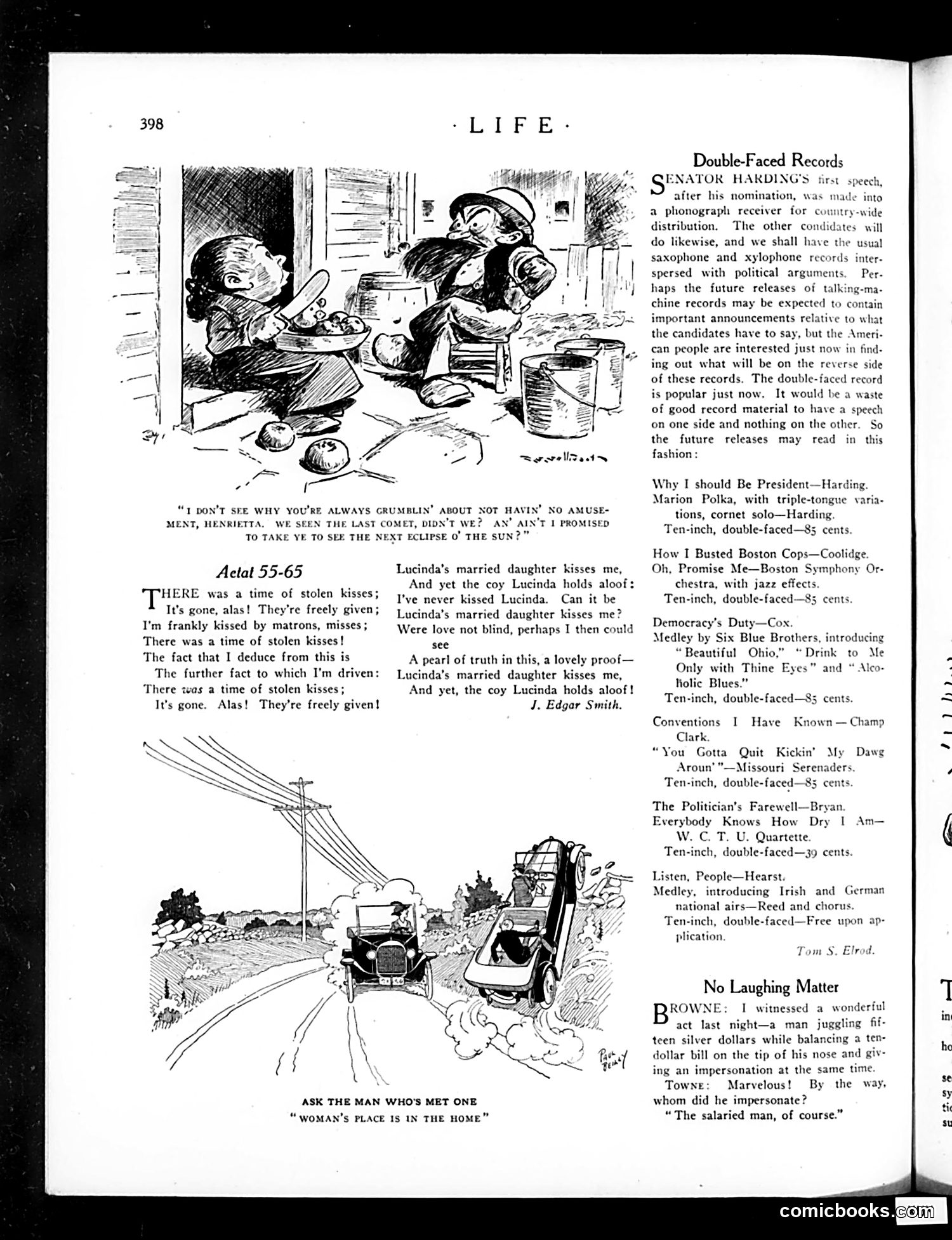
This page satirizes the 1920 presidential election, specifically the new practice of distributing candidate speeches on phonograph records. The satire imagines "double-faced" (two-sided) records where political speeches occupy one side, while the reverse side features popular entertainment—jazz, polkas, and novelty songs. The joke targets candidates **Harding, Coolidge, Cox, Champ Clark, and Bryan**, suggesting that Americans care more about the entertainment value than the actual political content. By pairing serious speeches with frivolous music (including references to Prohibition via "How Dry I Am"), the author mocks both politicians' attempts at mass communication and the public's shallow engagement with politics. The cartoons above depict domestic scenes and rural life, appearing thematically separate from the phonograph satire. The overall message: modern politics has become entertainment, with substance secondary to amusement.
📄 Transcribed text from this page (OCR, searchable)
Machine-transcribed from the original scan — historical spelling and the odd misread are preserved.
“1 DON'T SEE WHY YOU'RE ALWAYS GRUMBLIN’ ABOUT NOT MENT, HENRIETTA, WE SEEN THE LAST COMET, DIDN'T WE? EXT ECLIPSE 0° THE S\ TO TAKE YE TO SEE THE } Aetat 55-65 HERE was a time of stolen kisses; It’s gone, alas! They're freely given; I'm frankly kissed by matrons, misses; There was a time of stolen kisses! The fact that I deduce from this is The further fact to which I'm driven: There was a time of stolen kisses; It's gone. Alas! They’re freely given! S = ~~ aeoellzaain NO AMUSE- "T 1 PROMISED Lucinda’s married daughter kisses me, And yet the coy Lucinda holds aloof: I've never kissed Lucinda. Can it be Lucinda’s married daughter kisses me? Were love not blind, perhaps I then could see A pearl of truth in this, a lovely proof— Lucinda’s married daughter kisses me, And yet, the coy Lucinda holds aloof! J. Edgar Smith. ASK THE MAN WHO'S MET ONE “WOMAN'S PLACE IS IN THE HOME” Double-Faced Records ENATOR HARDING'S first. speech, after his nomination, was made into a phonograph receiver for country-wide distribution. The other condidates will do likewise, and we shall have the usual saxophone and xylophone records inter- spersed with political arguments. Per- haps the future releases of talking-ma- chine records may be expected to contain important announcements relative to what the candidates have to say, but the Ameri- can people are interested just now in find- ing out what will be on the reverse side of these records. The double-faced record is popular just now. It would be a waste of good record material to have a speech on one side and nothing on the other. So the future releases may read in this fashion: Why I should Be President—Harding. Marion Polka, with triple-tongue varia- tions, cornet solo—Harding. Ten-inch, double-faced—85 cents. How I Busted Boston Cops—Coolidge. Oh, Promise Me—Boston Symphony Or- chestra, with jazz effect Ten-inch, double-faced—85 cents. Democracy’s Duty—Cox. Medley by Six Blue Brothers, introducing “Beautiful Ohio,” “Drink to Me Only with Thine Eyes” and “ Aleo- Holic Blues.” Ten-inch, double-faced—83 ce Conventions I Have Known — Champ Clark. “You Gotta Quit Kickin’ My Dawg Aroun’"—Missouri Serenaders. Ten-inch, double-faced—85 cents. The Politician’s Farewell—Bryan. Everybody Knows How Dry I Am— W. C. T. UL Quartette. Ten-inch, double-faced—3o cents. Listen, People—Hearst. Medley, introducing Irish and German national airs—Reed and chorus. Ten-inch, double-faced—Free upon ap- plication Tom S. Elrod. No Laughing Matter ROWNE: act last night—a man juggling fif- teen silver dollars while balancing a ten- dollar bill on the tip of his nose and giv- ing an impersonation at the same time: Towne: Marvelous! By the way, whom did he impersonate? “The salaried man, of course.” I witnessed a wonderful comicbooks.EGraml