
Life, 1920-09-02 · page 19 of 52
Life — September 2, 1920 — page 19: what you’re looking at
What you’re looking at
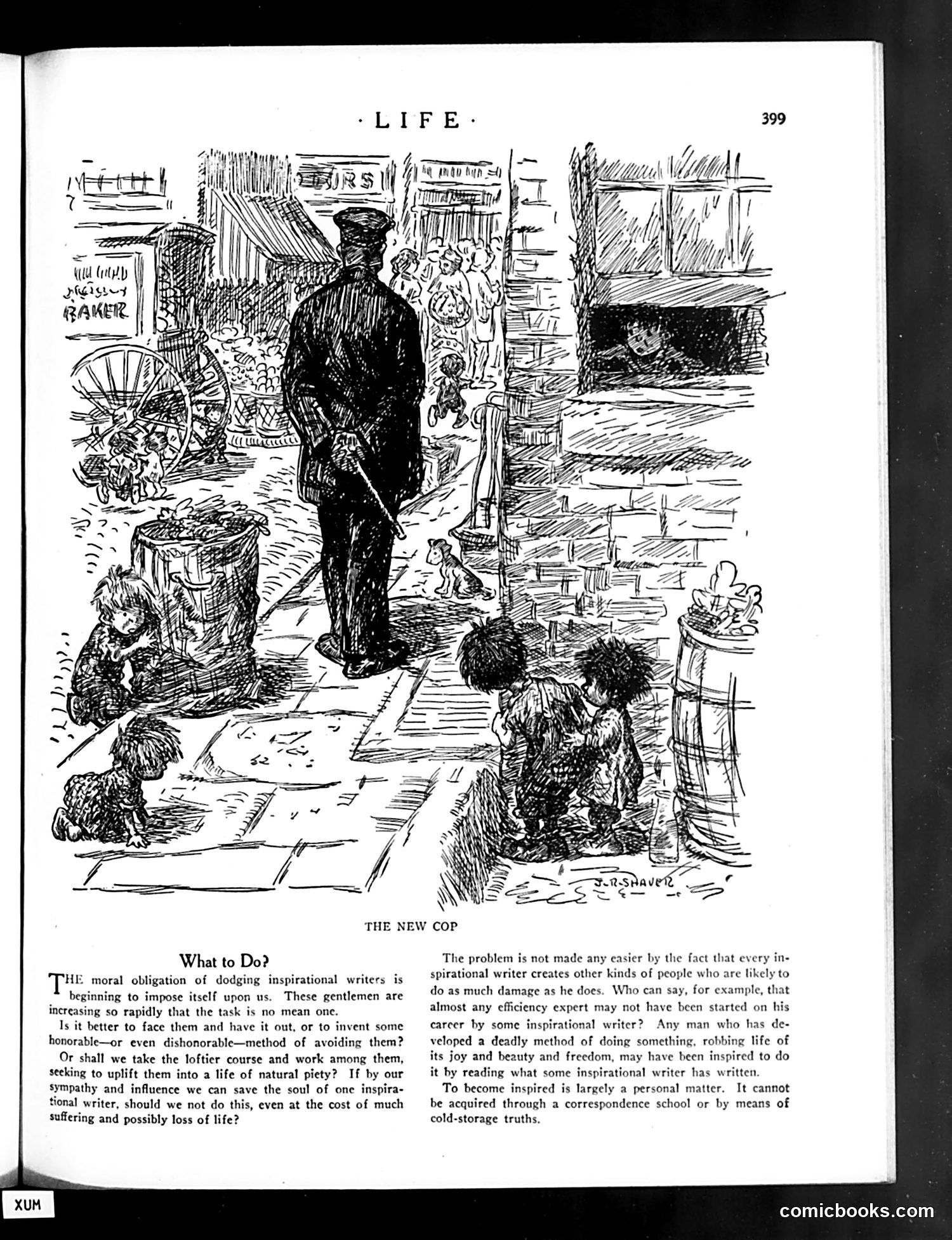
This cartoon satirizes "inspirational writers" and self-help literature proliferating in early 20th-century America. The sketch shows a uniformed police officer standing among street children in an urban setting, illustrated by J.H. Shaver. The accompanying essay mocks the moral obligation society feels toward these inspirational figures, whose proliferation the author claims is becoming unmanageable. The satire's central argument: inspirational writers may inadvertently create "efficiency experts" and other harmful types who strip life of "joy and beauty and freedom." The cartoon likely depicts a "new cop" as an embodiment of the problem—perhaps someone inspired by such writers to impose rigid morality on the poor. The piece argues that genuine inspiration is personal and cannot be mass-produced through correspondence schools or manufactured "truths," critiquing the commercialization and bureaucratization of self-improvement culture.
📄 Transcribed text from this page (OCR, searchable)
Machine-transcribed from the original scan — historical spelling and the odd misread are preserved.
-LI i ———— (uC NWGrgred RAMEN FE- ———— fq angn tans) —_ THE NEW COP What to Do? HE moral obligation of dodging inspirational writers is beginning to impose itself upon us. These gentlemen are increasing so rapidly that the task is no mean one. Is it better to face them and have it out, or to invent some honorable—or even dishonorable—method of avoiding them? Or shall we take the loftier course and work among them, seeking to uplift them into a life of natural piety? If by our sympathy and influence we can save the soul of one inspira- tional writer, should we not do this, even at the cost of much suffering and possibly loss of life? The problem is not made any easier by the fact that every in- spirational writer creates other kinds of people who are likely to do as much damage as he does. Who can say, for example, that almost any efficiency expert may not have been started on his carcer by some inspirational writer? Any man who has de- veloped a deadly method of doing something, robbing life of its joy and beauty and freedom, may have been inspired to do it by reading what some inspirational writer has written. To become inspired is largely a personal matter. It cannot be acquired through a correspondence school or by means of cold-storage truths, comicbooks.com