
Life, 1920-09-02 · page 51 of 52
Life — September 2, 1920 — page 51: what you’re looking at
What you’re looking at
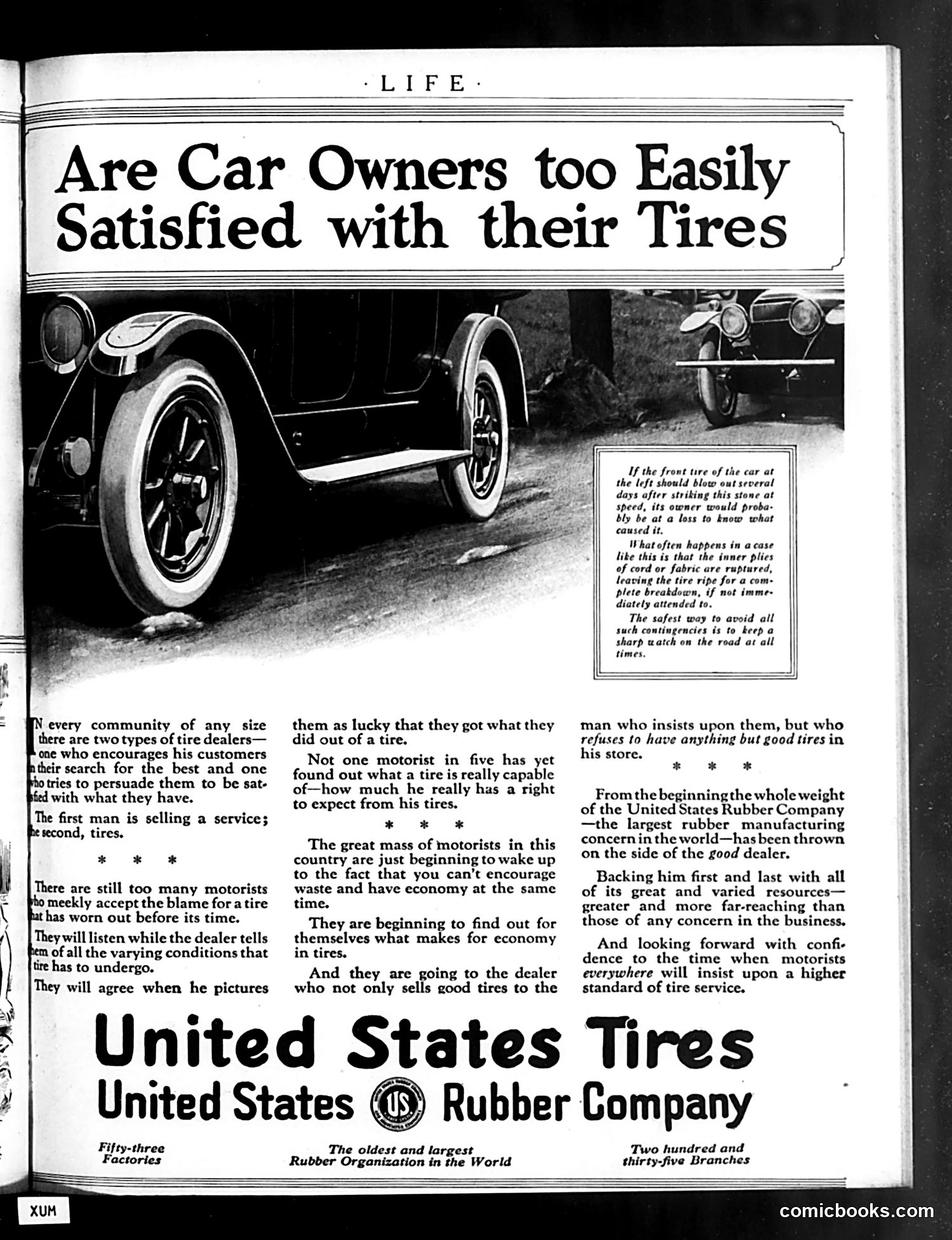
This is **not a cartoon but an advertisement disguised as editorial commentary**. United States Rubber Company uses the "Life" magazine format to critique lazy car owners and dishonest tire dealers. The argument: Some dealers exploit customer ignorance by selling inferior tires and blaming owners for poor maintenance. The company positions itself as the ethical alternative—a dealer who insists on *quality* tires and educates consumers about proper tire care. The accompanying photographs show 1920s-era automobiles with prominent tires, emphasizing the product. **The satire is subtle**: the piece mocks motorists as "too easily satisfied" and too willing to accept blame, while framing US Rubber as the consumer's advocate. This is effective marketing—positioning a major corporation as fighting against industry-wide mediocrity and deception. The inset diagram about road hazards (stones causing hidden tire damage) reinforces the message: good tires prevent accidents; poor ones don't.
📄 Transcribed text from this page (OCR, searchable)
Machine-transcribed from the original scan — historical spelling and the odd misread are preserved.
-LIFE: Are Car Owners too Easily Satisfied with their Tires every community of any size re are two types of tire dealers— one who encourages his customers ntheir search for the best and one tries to persuade them to be sat- pied with what they have. The first man is selling a service; he second, tires. x * * There are still too many motorists ho meekly accept the blame for a tire hat has worn out before its time. They will listen while the dealer tells Pem of all the varying conditions that tire has to undergo. They will agree when he pictures them as lucky that they got what they did out of a tire. Not one motorist in five has yet found out what a tire is really capable of—how much he really has a right to expect from his tires. * * * The great mass of motorists in this country are just beginning to wake up to the fact that you can’t encourage waste and have economy at the same time. They are beginning to find out for themselves what makes for economy in tires, And they are going to the dealer who not only sells good tires to the | Uf the front tare of the car at || | the left should blow out several days after striking this stone at speed, its owner would proba- bly be at a loss to know what caused it, What often happens in acase like this is that the inner plies of cord or fabric are ruptured, leaving the tire ripe for a com- plete breakdown, if not imme- diately attended to. The safest way to avoid all such contingencies is to keep a sharp watch on the road at all times. —_J man who insists upon them, but who refuses to have anything but good tires in his store. * * * From the beginningthe whole weight of the United States Rubber Company —the largest rubber manufacturing concern in the world—has been thrown on the side of the good dealer. Backing him first and last with all of its great and varied resources— greater and more far-reaching than those of any concern in the business. And looking forward with confi- dence to the time when motorists everywhere will insist upon a higher standard of tire service. United States Tires United States Fifty-three Factories The oldest and largest Rubber Organization in the World @) Rubber Company Two hundred and thirty-five Branches comicbooks.com