
Life, 1920-09-02 · page 28 of 52
Life — September 2, 1920 — page 28: what you’re looking at
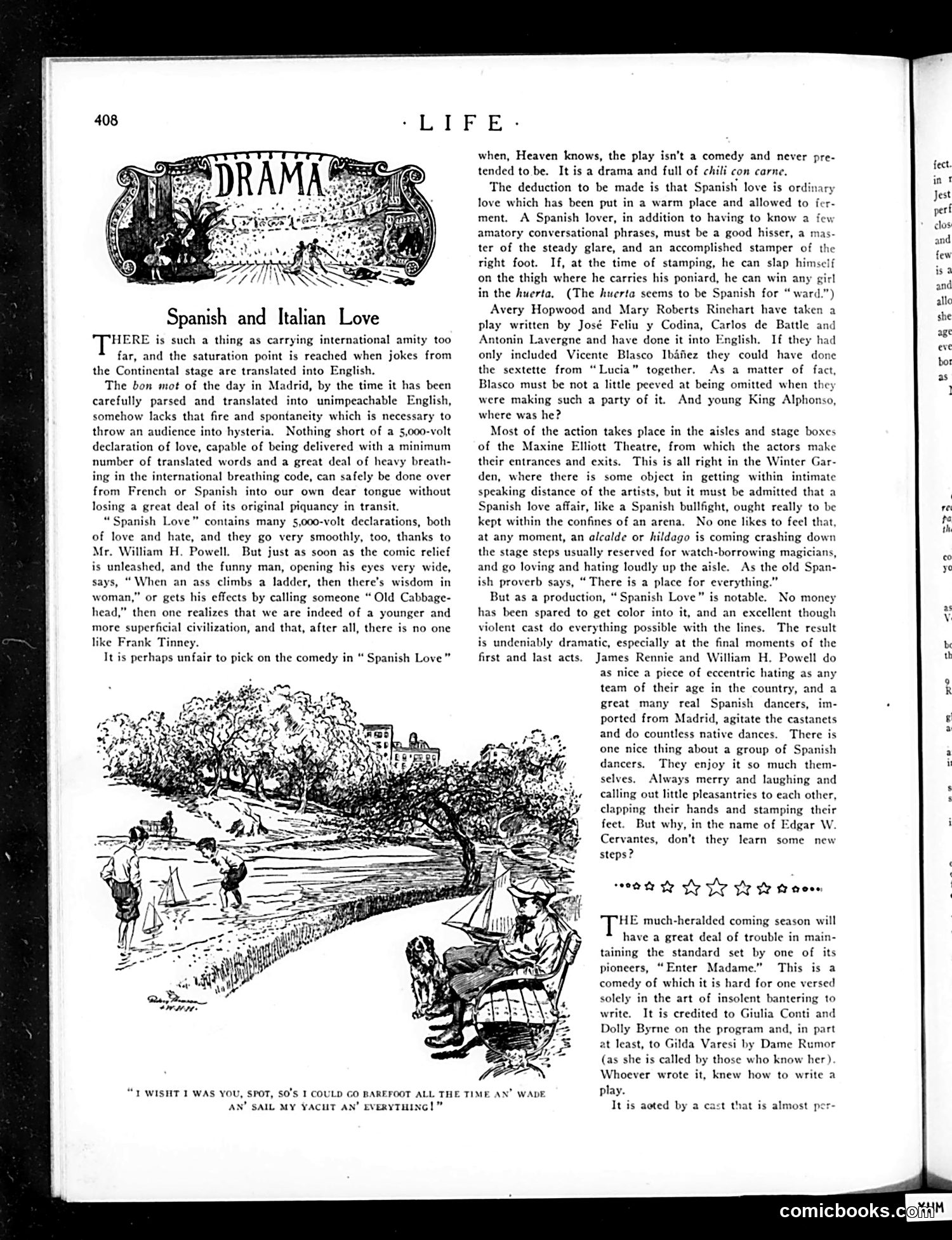
What you’re looking at
This is a theater review critiquing the play "Spanish Love," adapted for English audiences from Continental (European) stage works. The satirical point: sophisticated Continental humor loses its punch in translation and English production. The critic mocks how Spanish dramatic conventions—intense declarations, stamping feet, slapping thighs near swords—seem overwrought to American audiences. The joke about the "ass climbing a ladder" exemplifies how witty Spanish wordplay becomes silly English patter. The review notes the play stages action in theater aisles and boxes (breaking fourth-wall convention), uses imported Spanish dancers, and features actor Frank Tinney for comic relief. The mention of King Alphonso and references to the huerta (Spanish farmland) ground this in 1920s-era Spain. The underlying satire: American culture finds European theatrical traditions excessive and unsophisticated, yet must import them because homegrown American comedy (represented by Tinney) is considered crude by comparison.
📄 Transcribed text from this page (OCR, searchable)
Machine-transcribed from the original scan — historical spelling and the odd misread are preserved.
“LIFE. Spanish and Italian Love HERE is such a thing as carrying international amity too far, and the saturation point is reached when jokes from the Continental stage are translated into English. The bon mot of the day in Madrid, by the time it has been carefully parsed and translated into unimpeachable English, somehow lacks that fire and spontaneity which is necessary to throw an audience into hysteria. Nothing short of a $,000-volt declaration of love, capable of being delivered with a minimum number of translated words and a great deal of heavy breath- ing in the international breathing code, can safely be done over from French or Spanish into our own dear tongue without losing a great deal of its original piquancy in transit. panish Love” contains many §,000-volt declarations, both of love and hate, and they go very smoothly, too, thanks to Mr. William H. Powell. But just as soon as the comic relief is unleashed, and the funny man, opening his eyes very wide, says, “ When an ass climbs a ladder, then there’s wisdom in woman,” or gets his effects by calling someone “ Old Cabbage- head,” then one realizes that we are indeed of a younger and more superficial civilization, and that, after all, there is no one like Frank Tinney. It is perhaps unfair to pick on the comedy in “ Spanish Love” when, Heaven knows, the play isn't a comedy and never pre- tended to be. It is a drama and full of chili con carne. The deduction to be made is that Spanish love is ordi love which has been put in a warm place and allowed to fer ment. A Spanish lover, in addition to having to know a few amatory conversational phrases, must be a good hisser, a mas- ter of the steady glare, and an accomplished stamper of the right foot. If, at the time of stamping, he can slap him: on the thigh where he carries his poniard, he can win any girl in the huerta, (The huerta seems to be Spanish for “ ward.”) Avery Hopwood and Mary Roberts Rinchart have taken a play written by José Feliu y Codina, Carlos de Battle and Antonin Lavergne and have done it into English. If they had only included Vicente Blasco Ibafiez they could have done the sextette from “Lucia” together. As a matter of fact, Blasco must be not a little peeved at being omitted when they were making such a party of it. And young King Alphonso, where was he? Most of the action takes place in the aisles and stage boxes of the Maxine Elliott Theatre, from which the actors make their entrances and exits. This is all right in the Winter Gar- den, where there is some object in getting within intimate speaking distance of the artists, but it must be admitted that a Spanish love affair, like a Spanish bullfight, ought really to be kept within the confines of an arena. No one likes to feel that, at any moment, an alcalde or hildago is coming crashing down the stage steps usually reserved for watch-borrowing magicians, and go loving and hating loudly up the aisle. As the old Span- ish proverb says, “ There is a place for everything.” But as a production, “ Spanish Love” is notable. No money has been spared to get color into it, and an excellent though violent cast do everything possible with the lines. The result is undeniably dramatic, especially at the final moments of the first and last acts, James Rennie and William H. Powell do as nice a piece of eccentric hating as any team of their age in the country, and a great many real Spanish dancers, im- ported from Madrid, agitate the castanets and do countless native dances. There is one nice thing about a group of Spanish dancers. They enjoy it so much them- selves. Always merry and laughing and calling out little pleasantries to each other, clapping their hands and stamping their feet. But why, in the name of Edgar W. Cervantes, don’t they learn some new steps? toad Wy Wie We ane THe much-heralded coming season will have a great deal of trouble in main- taining the standard set by one of its pioneers, “Enter Madame.” This is a comedy of which it is hard for one versed solely in the art of insolent bantering to write. It is credited to Giulia Conti and Dolly Byrne on the program and, in part at least, to Gilda Varesi by Dame Rumor (as she is called by those who know her) Whoever wrote it, knew how to write a “YT WISHT I WAS YOU, SPOT, SO’S I COULD GO BAREFOOT ALL THE TIME AN’ WADE play. AN’ SAIL MY YACHT AN’ EVERYTHING!” It is aoted by a cast that is almost per- comicbooks.com