
Life, 1920-09-02 · page 31 of 52
Life — September 2, 1920 — page 31: what you’re looking at
What you’re looking at
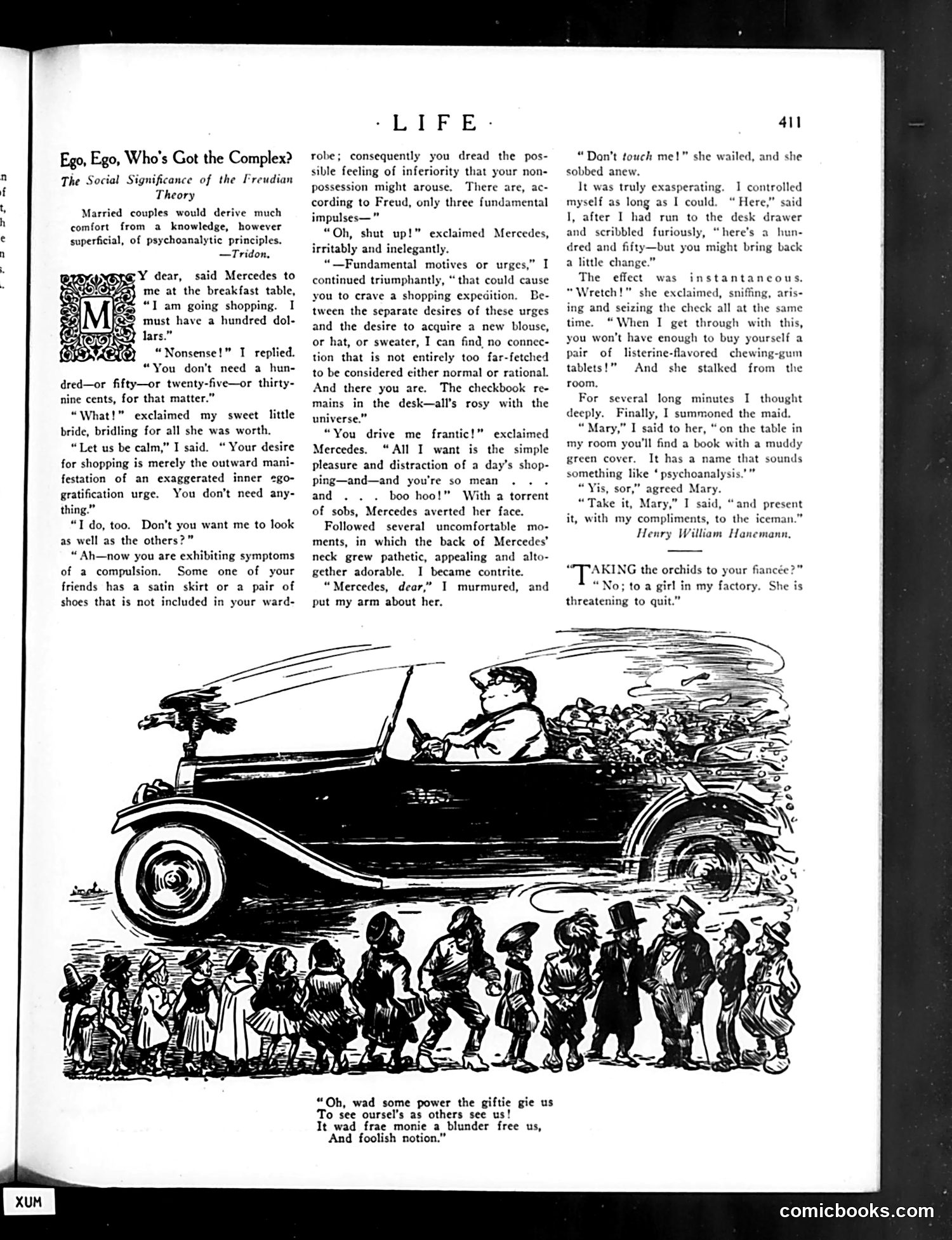
This 1920s Life magazine piece satirizes the trendy application of Freudian psychoanalysis to everyday married life. The author (Henry William Hanemann) depicts a husband who pedantically invokes Freud's theories to deny his wife shopping money, attributing her desires to "ego-gratification urges" and "inferiority complexes" rather than accepting simple wants. The satire's point: armchair psychoanalysis is absurd and ineffective. When the husband finally gives her the money anyway, his wife's instant mood shift proves his pseudo-intellectual analysis was nonsense—she simply wanted to shop. The cartoon below shows envious onlookers admiring a wealthy woman in a car, reinforcing that material desires are straightforward, not hidden psychological drives. The closing joke (giving Freud's book to the iceman) mocks the theory's relevance to ordinary life. This reflects 1920s skepticism toward Freud's popularity among educated Americans applying psychology to domestic disputes.
📄 Transcribed text from this page (OCR, searchable)
Machine-transcribed from the original scan — historical spelling and the odd misread are preserved.
Ego, Ego, Who's Got the Complex? The Social Significance of the Freudian Theory Married couples would derive much comfort from a knowledge, however superficial, of psychoanalytic principles. —Tridon, said Mercedes to me at the breakfast table, “I am going shopping. I 2 must have a hundred dol- lars.” Nonsense!" I replied. “You don't need a hun- dred—or fifty—or twenty-five—or thirty- nine cents, for that matter.” “What!” exclaimed my sweet little bride, bridling for all she was worth. “Let us be calm,” I said. “ Your desire for shopping is merely the outward mani- festation of an exaggerated inner ¢go- gratification urge. You don’t need any- thing.” “T do, too. Don't you want me to look as well as the others?” “ Ah—now you are exhibiting symptoms of a compulsion. Some one of your friends has a satin skirt or a pair of shoes that is not included in your ward- -LIFE. robe; consequently you dread the pos- sible feeling of inferiority that your non- possession might arouse. There are, ac- cording to Freud, only three fundamental impulses—” “Oh, shut up!” exclaimed Mercedes, irritably and inelegantly. “—Fundamental motives or urges,” I continued triumphantly, “that could cause you to crave a shopping expedition. Be- tween the separate desires of these urges and the desire to acquire a new blouse, or hat, or sweater, I can find no connec- tion that is not entirely too far-fetched to be considered either normal or rational. And there you are. The checkbook re- mains in the desk—all’s rosy with the universe.” “You drive me frantic!” exclaimed Mercedes. “All I want is the simple pleasure and distraction of a day’s shop- ping—and—and you're so mean . . . and. . boo hoo!” With a torrent of sobs, Mercedes averted her face. Followed several uncomfortable mo- ments, in which the back of Mercedes’ neck grew pathetic, appealing and alto- gether adorable. I became contrite. “Mercedes, dear,” I murmured, and put my arm about her. “Oh, wad some power the giftie gie us To see oursel’s as others see us! It wad frae monie a blunder free us, And foolish notion.” 411 “Don't touch me!” she wailed, and she sobbed anew. It was truly exasperating. 1 controlled myself as long as I could. “Here,” said I, after I had run to the desk drawer and scribbled furiously, “here's a hun- dred and fifty—but you might bring back a little change.” The effect was instantaneous. “Wretch!" she exclaimed, sniffing, aris- ing and seizing the check all at the same time. “When I get through with this, you won't have enough to buy yourself a pair of listerine-flavored chewing-gum tablets!” And she stalked from the room, For several long minutes I thought deeply. Finally, I summoned the maid. “Mary,” I said to her, “on the table in my room you'll find a book with a muddy green cover. It has a name that sounds something like ‘ psychoanalysis.’" agreed Mary. “Take it, Mary,” I said, “and present it, with my compliments, to the iceman.” Henry William Hanemann, “T: AKING the orchids to your fiancée No; to a girl in my factory. She is threatening to quit.” comicbooks.com