
A complete issue · 54 pages · 1920
Life — March 18, 1920
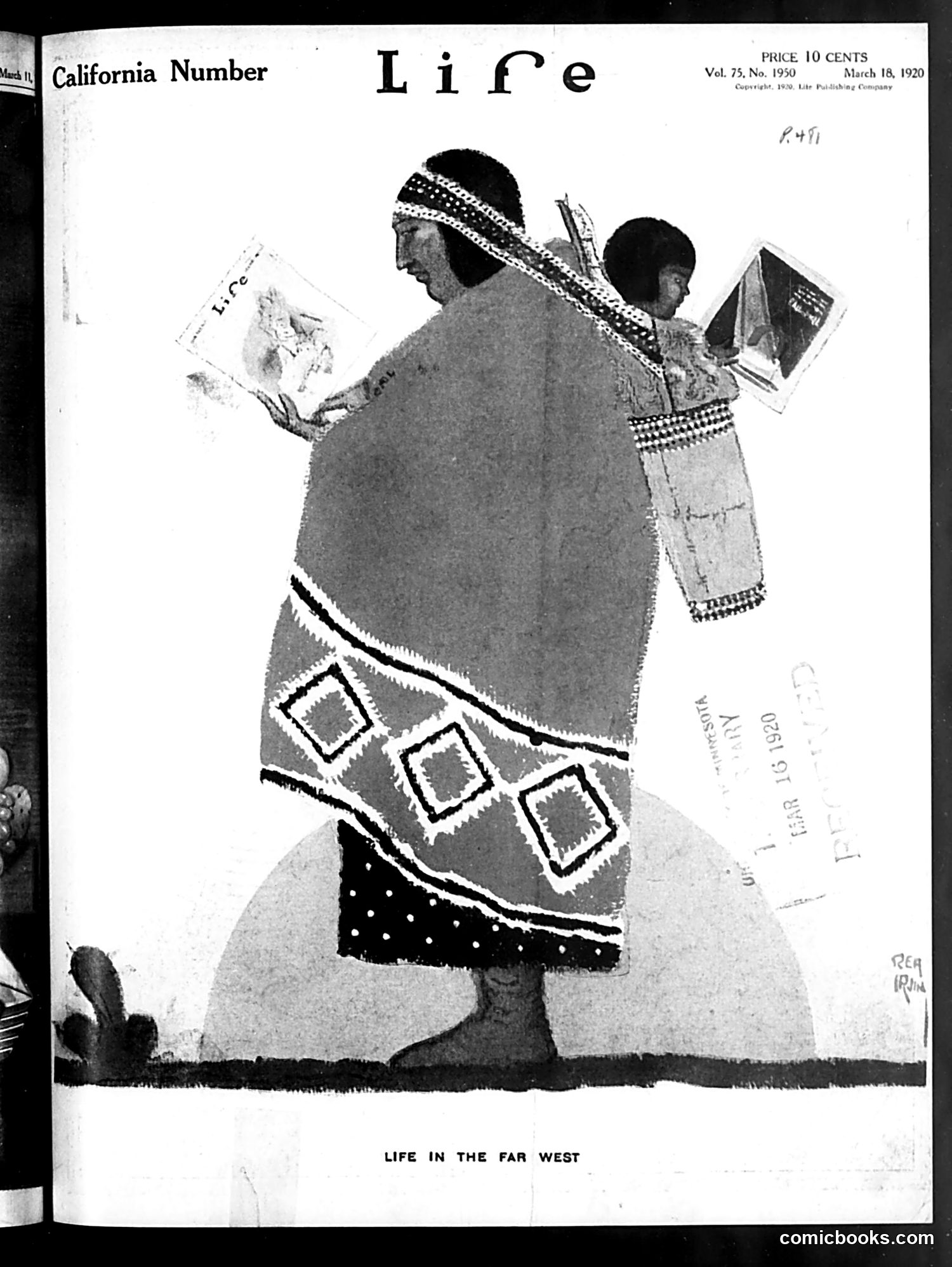
This satirical cover depicts a Native American woman (drawn in the exaggerated style typical of 1920s caricature) carrying two children and holding copies of *Life* magazine. The figure wears traditional clothing with geometric patterns and a headband. The joke appears to critique the romanticized or stereotypical portrayal of Native Americans in contemporary media and popular culture. By showing her reading *Life* itself, the cartoonist may be satirizing how magazines like his own perpetuated simplified, exotic representations of "the Far West" and indigenous peoples for entertainment. The artwork reflects the casual racial caricature common in early 20th-century American humor magazines, now recognized as deeply offensive stereotyping.
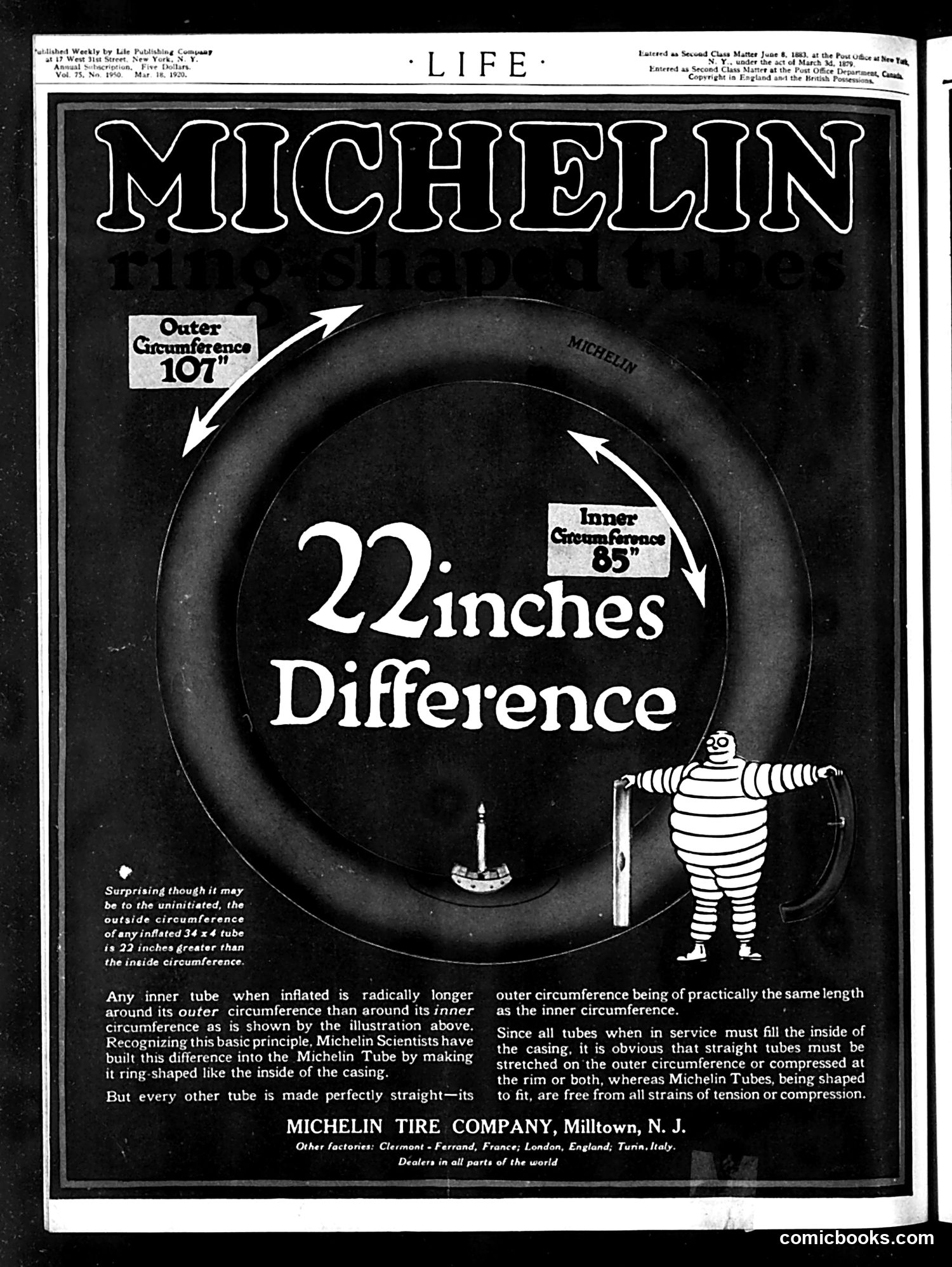
This is **not a political cartoon but a commercial advertisement** for Michelin tires, appearing in Life magazine (circa 1920s based on styling). The ad promotes Michelin's innovative ring-shaped inner tube design. It explains that while inflated inner tubes are longer around their outer circumference than inner circumference (a counterintuitive geometric fact), Michelin's solution—making the tube ring-shaped like the tire casing—eliminates tension and compression problems competitors face. The cartoon figure is **Bibendum, Michelin's famous mascot** (the "Michelin Man"), shown for scale comparison. This is straightforward product advertising emphasizing engineering innovation, not satire.
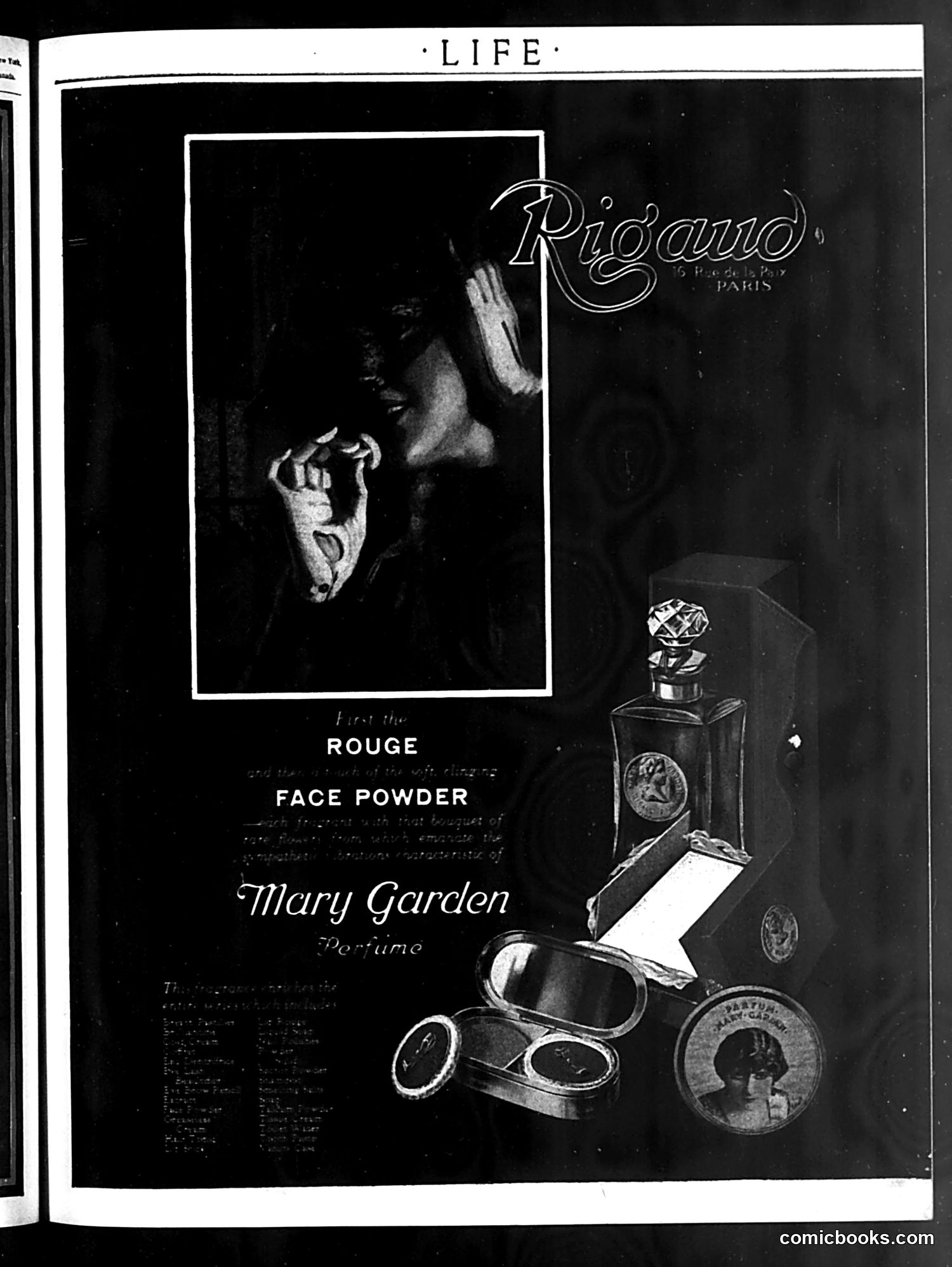
This is primarily a **beauty product advertisement**, not political satire. The page promotes Rigaud Paris cosmetics—specifically rouge, face powder, and perfume under the "Mary Garden" brand name. The image shows a woman's face in dramatic lighting applying makeup, paired with product photographs below (perfume bottles and powder compacts). Mary Garden was a famous Scottish opera singer and actress popular in the early 20th century, whose name was licensed for cosmetics products. The "Rigaud Paris" branding emphasizes French luxury and sophistication—a common marketing strategy for cosmetics of this era. There is no political cartoon or satire present; this is straightforward commercial advertising from Life magazine's revenue-generating pages.
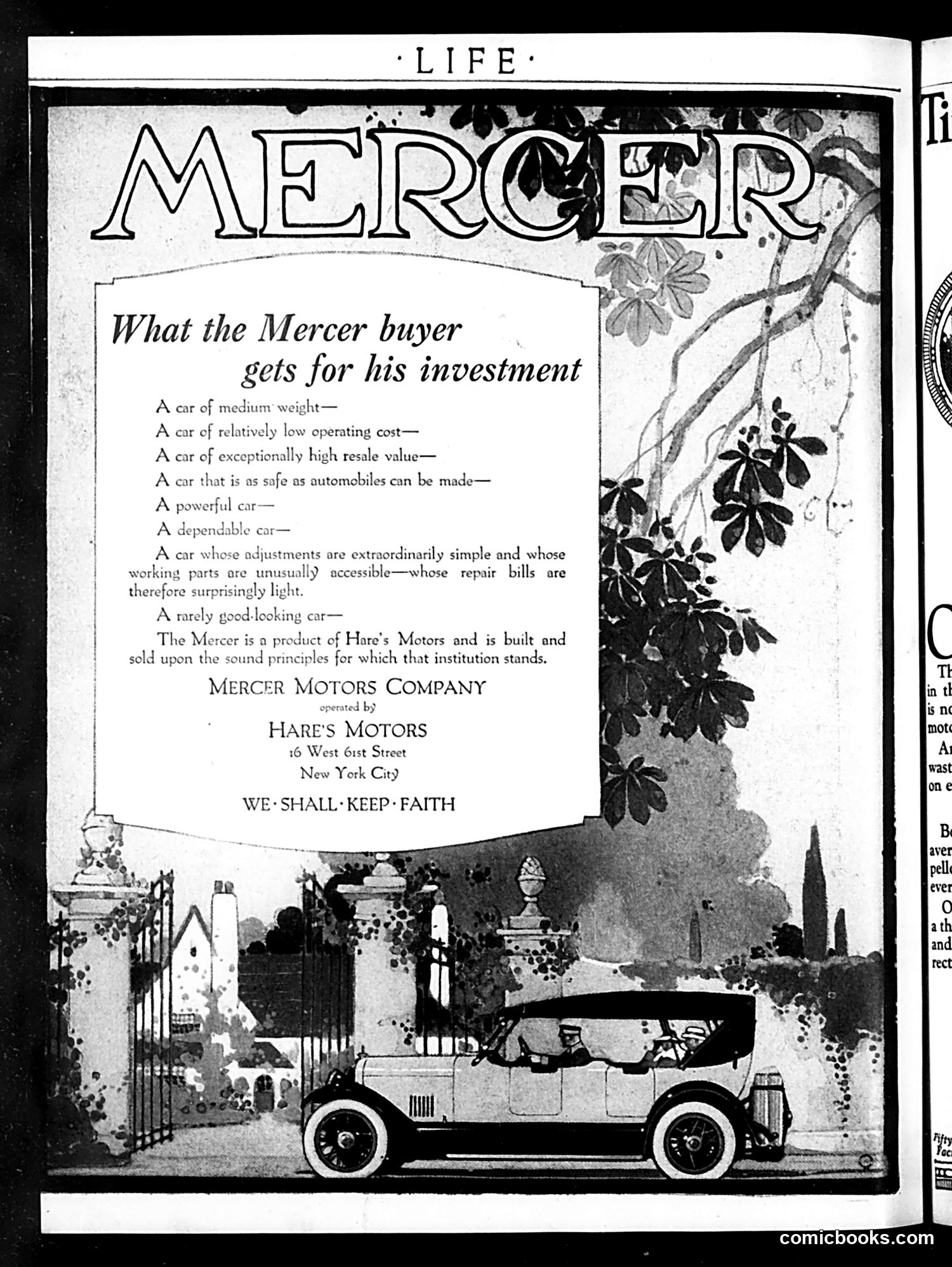
This is a straightforward **automobile advertisement**, not satire or political commentary. The page promotes the Mercer car, manufactured by Mercer Motors Company and sold by Hare's Motors in New York City. The ad emphasizes practical buyer benefits: medium weight, low operating costs, high resale value, safety, power, reliability, and simple maintenance with affordable repairs. The tagline "WE SHALL KEEP FAITH" suggests trustworthiness. The decorative illustration shows the Mercer touring car in an elegant garden setting with classical statuary, appealing to affluent buyers. This aspirational imagery—pairing the automobile with refined aesthetic surroundings—was typical of early automotive marketing, positioning car ownership as a mark of sophistication and good taste.
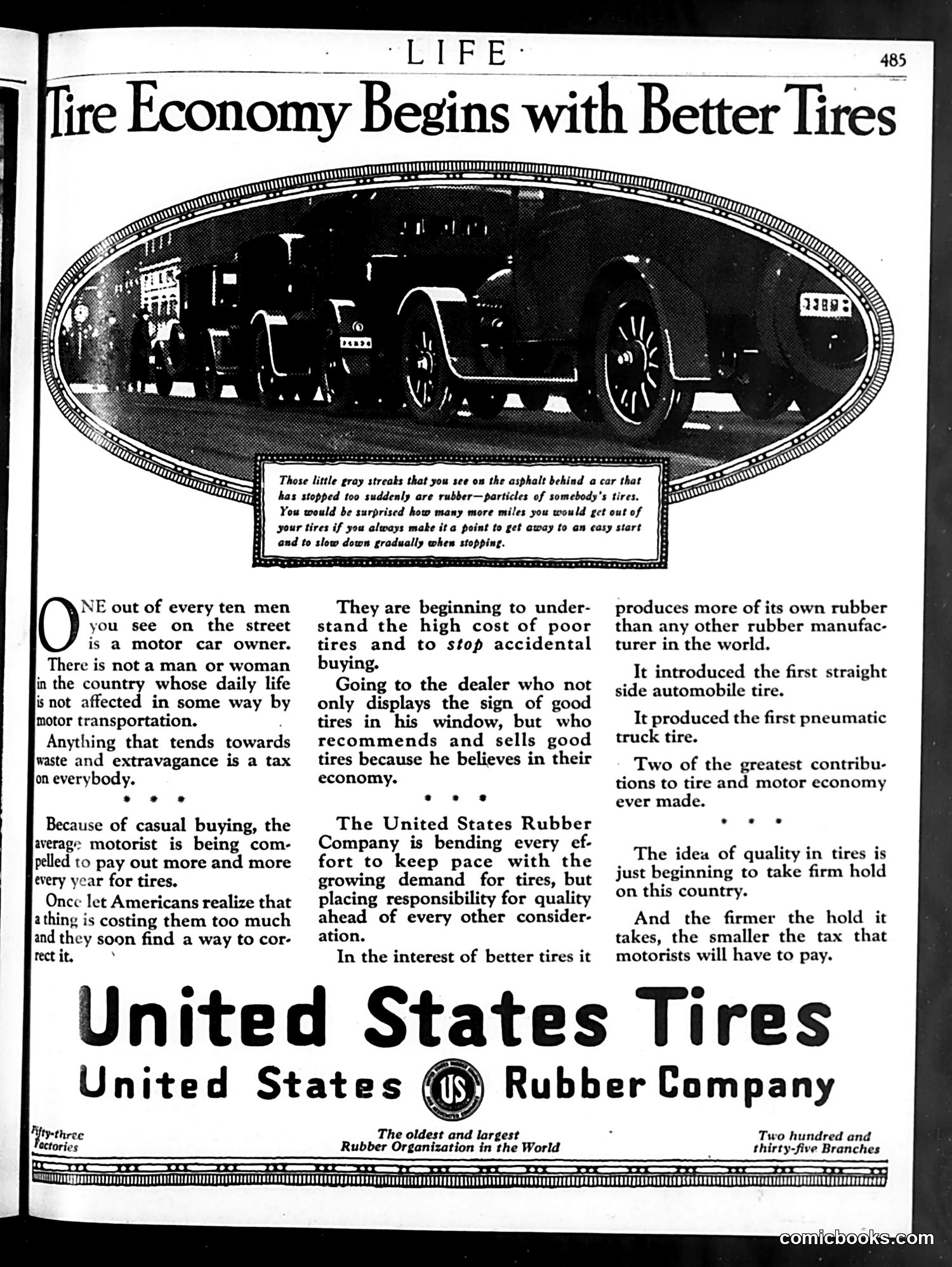
This is primarily **advertising content**, not satire or political commentary. The page promotes United States Rubber Company's tires through an article framed as consumer advice. The article argues that poor tire quality wastes money through excessive replacement and unsafe driving. It credits U.S. Rubber with innovations like the first straight-side automobile tire and first pneumatic truck tire, positioning the company as quality-focused and economically responsible. The satirical element is minimal—the opening illustration shows tire debris on a road, captioned as evidence of wasteful tire failure. The broader message conflates tire economy with patriotic frugality: buying quality tires is presented as a moral duty to reduce waste and taxes. The piece reflects 1920s-era consumer capitalism messaging that linked product quality to civic responsibility.
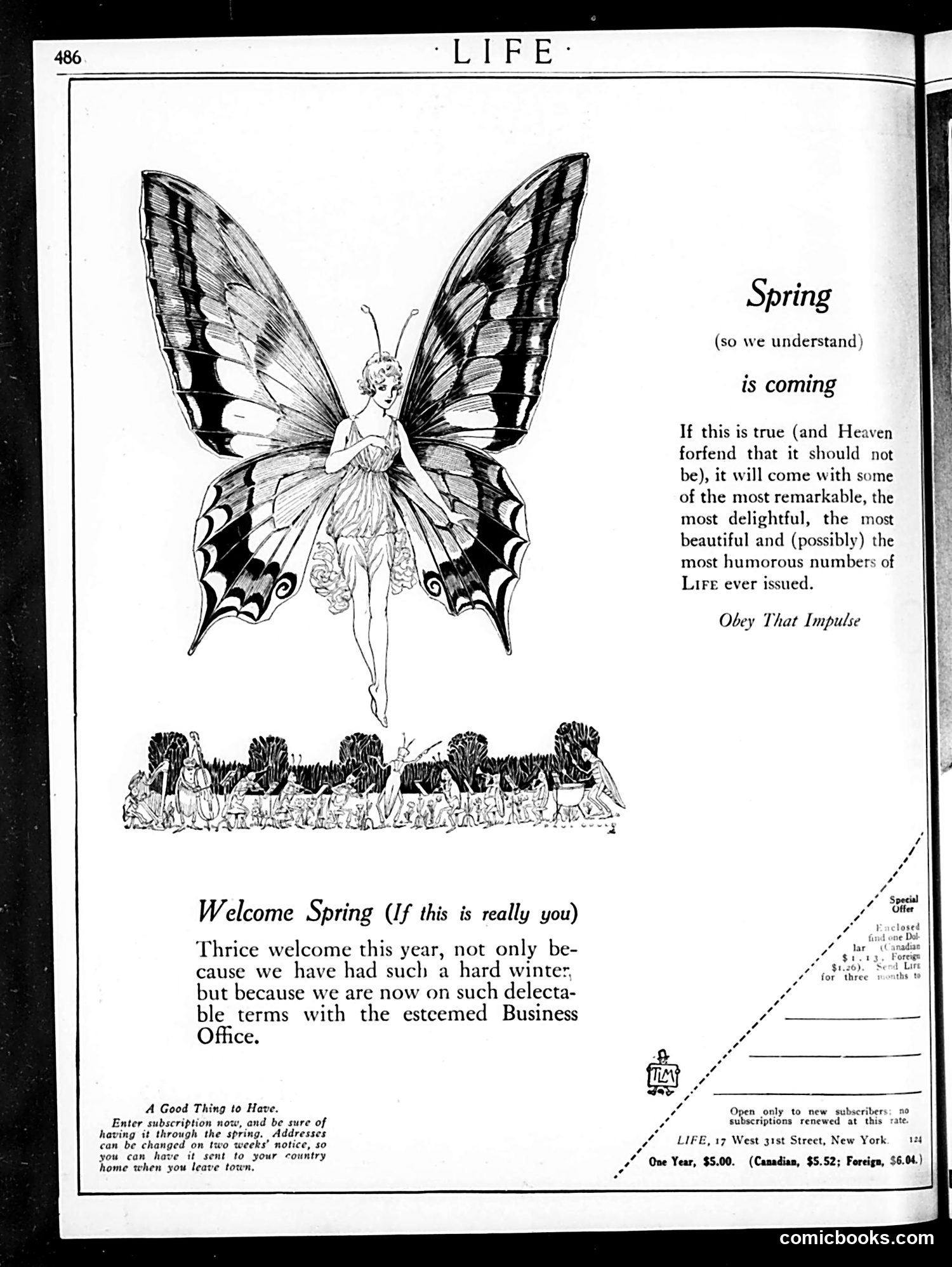
This page is primarily a **subscription advertisement** for Life magazine's spring issue, not a political cartoon. The central image depicts a fairy-like figure with large butterfly wings, representing Spring personified. Below is a line of small figures greeting spring's arrival, suggesting renewal and optimism. The text promises that Life's spring issues will feature "remarkable," "delightful," and "beautiful" content, plus "humorous numbers"—appealing to readers seeking entertainment after a hard winter. There's a subtle joke in "Welcome Spring (If this is really you)," playfully acknowledging that spring's arrival is uncertain or delayed—a relatable seasonal frustration for readers. The subscription pitch emphasizes convenience: readers can arrange delivery before leaving town for spring travel. This is **advertising copy, not satire**, though it uses gentle humor to encourage subscriptions.
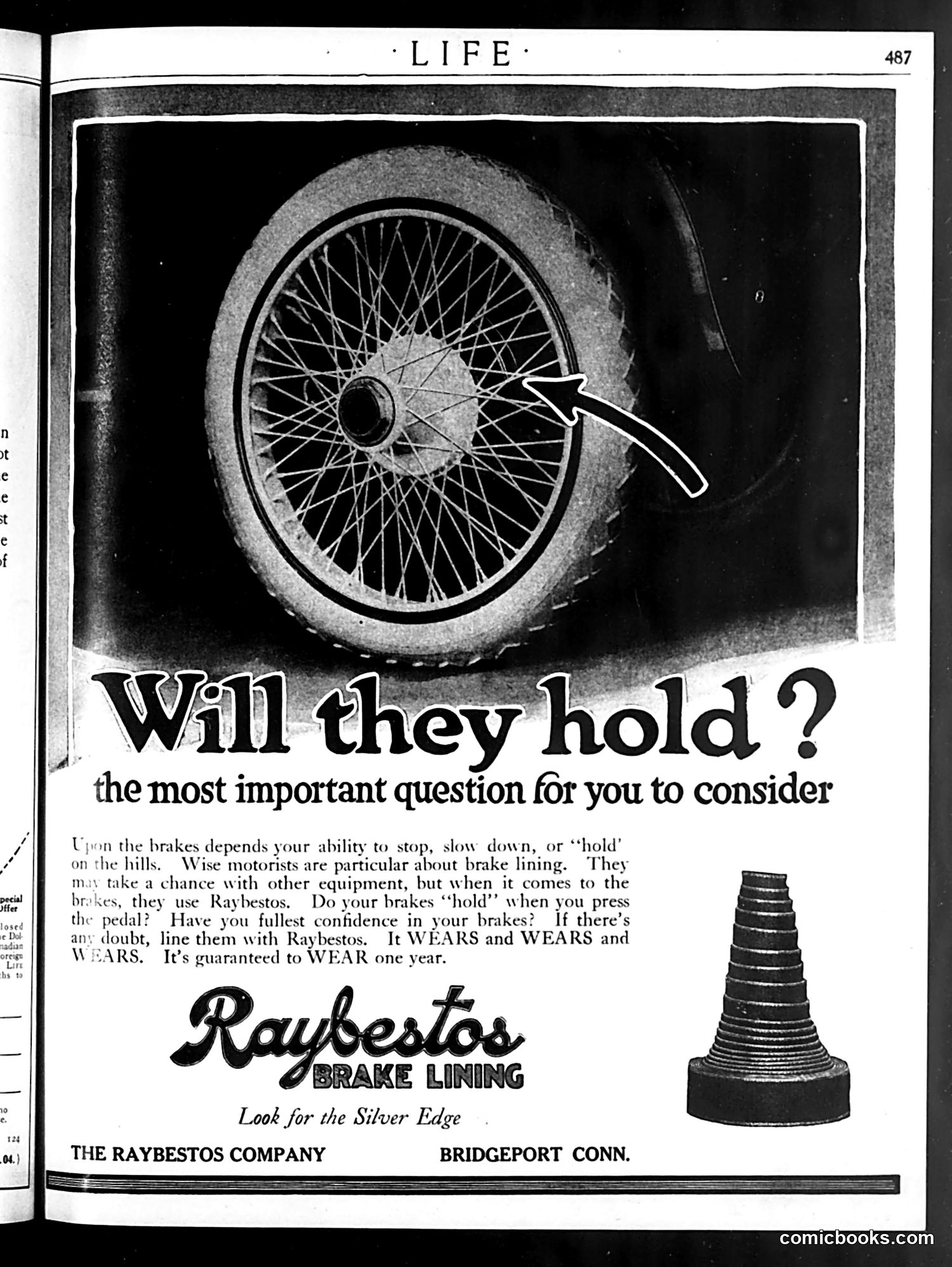
This page is primarily **an advertisement, not satire or political commentary**. It promotes Raybestos brake lining for automobiles. The ad uses a dramatic image of a worn car wheel with the rhetorical question "Will they hold?" to appeal to motorists' safety concerns. The copy emphasizes that brake reliability is crucial—especially on hills—and positions Raybestos as the trustworthy choice because it "WEARS and WEARS" with a one-year guarantee. The small cone-shaped product image (right side) shows the brake lining itself, marked with a "Silver Edge" identifier for brand recognition. This reflects early 20th-century automotive advertising's focus on mechanical reliability as a selling point when cars were still relatively new technology and brake failure was a genuine safety hazard.
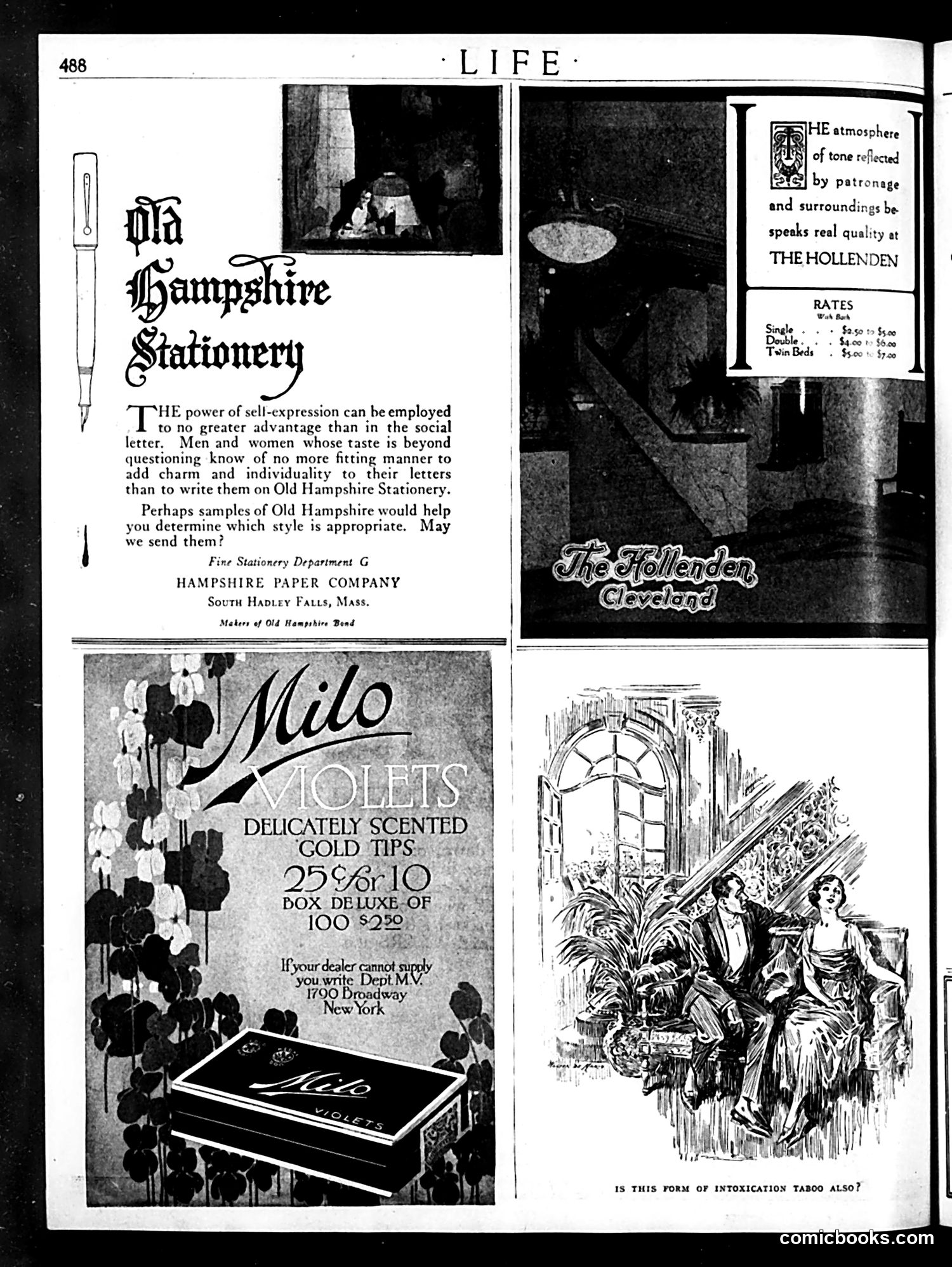
This page is primarily **advertising**, not political satire. It contains four advertisements: 1. **Old Hampshire Stationery** - promotes fine letterhead as a means of social expression and personal distinction 2. **The Hollenden Hotel** (Cleveland) - a hotel advertisement with rates listed 3. **Milo Violets** - delicately scented cigarettes with gold tips, priced at 25¢ or 10 box for $2.25 4. **A sketch** (bottom right) captioned "IS THIS FORM OF INTOXICATION TABOO ALSO?" - appears to reference social attitudes toward smoking/intoxication, likely satirizing prohibition-era concerns The only potentially satirical element is the final sketch, which seems to gently mock anxieties about tobacco use in the context of alcohol prohibition, but the page is overwhelmingly commercial rather than politically editorial.
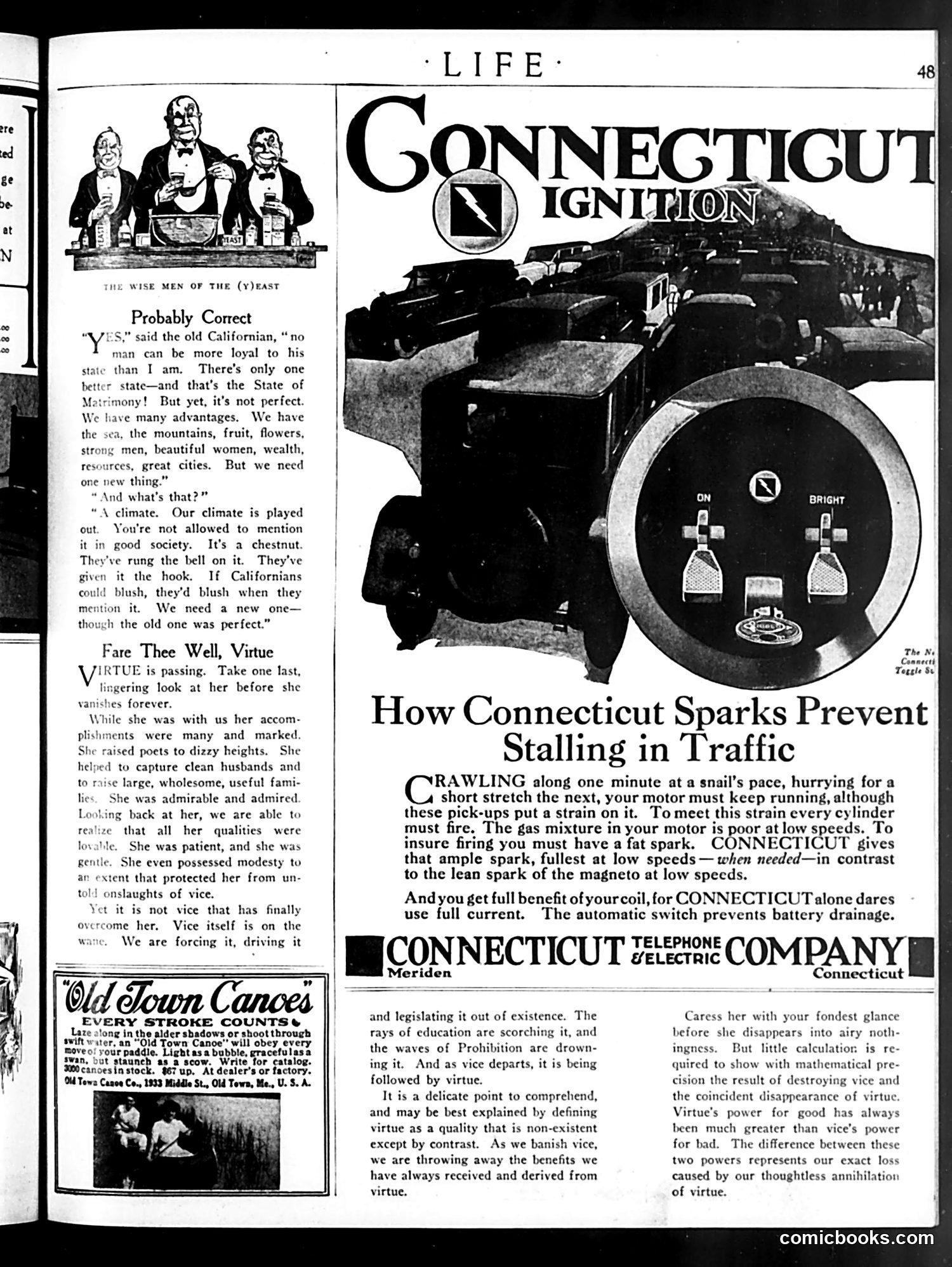
This page is primarily a **full-page advertisement** for Connecticut Telephone & Electric Company, promoting their ignition system for automobiles. The ad uses a humorous approach: it depicts a car engine's ignition dial and claims Connecticut's system prevents stalling in traffic by providing consistent spark at low speeds. The headline promises to solve a real frustration of early motorists—frequent engine stalling during congested driving. The left side contains unrelated editorial content about virtue and morality, plus a separate ad for "Old Town Canoes." The ad's sales pitch emphasizes reliability and technical superiority, targeting car owners frustrated by unreliable ignition systems of the era. This reflects early 1900s automotive technology, when ignition systems were notoriously finicky.
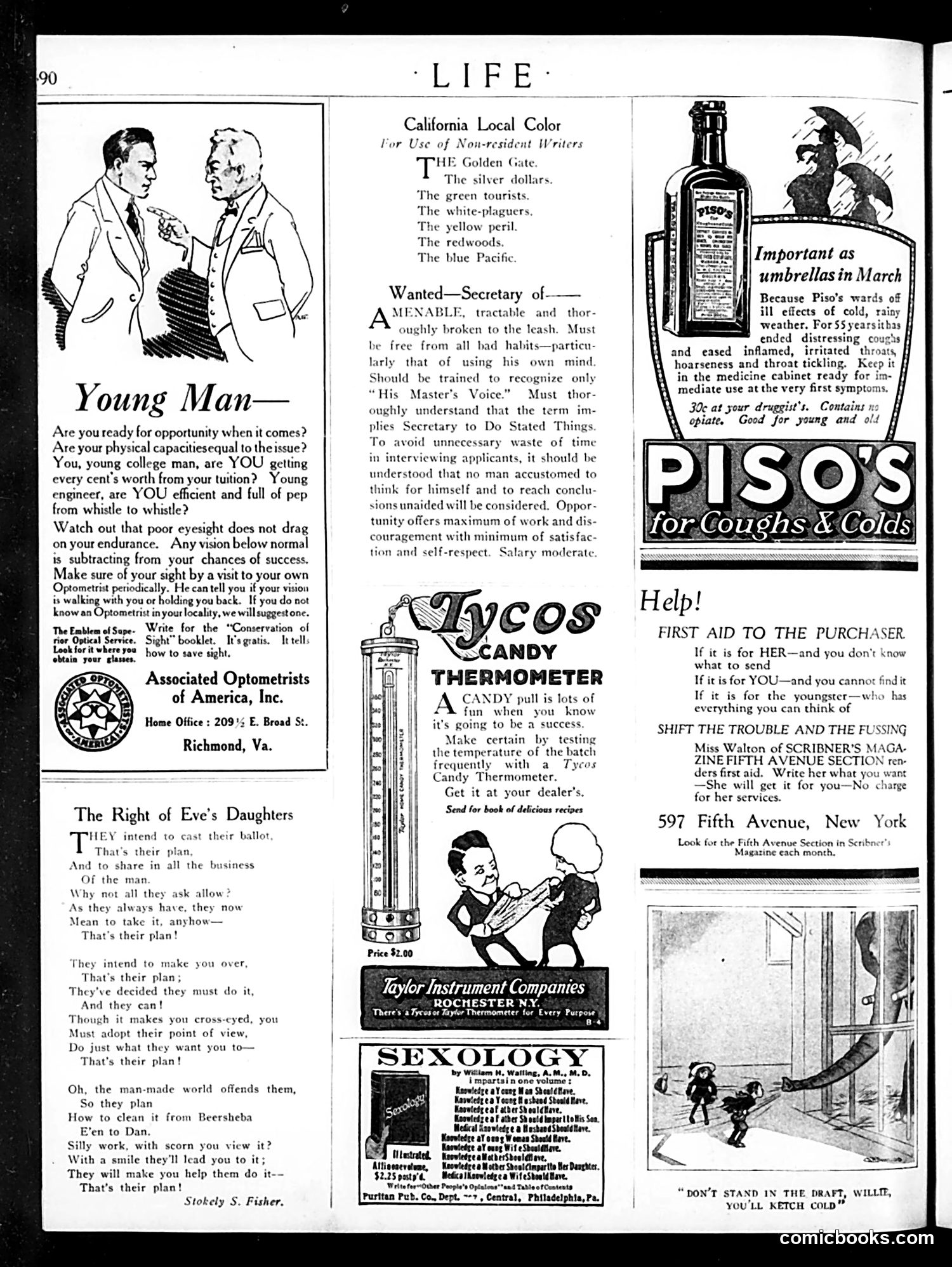
This page is primarily **advertising and miscellaneous content** rather than political satire. The main features are: 1. **"Young Man" advisory** (left): A generic motivational piece about seizing opportunity and self-improvement, directed at young men entering the workforce. 2. **"The Right of Eve's Daughters"** (bottom left): A poem by Stokely S. Fisher advocating for women's participation in business and decision-making—a progressive stance for the era, addressing women's economic rights. 3. **Multiple product advertisements**: Piso's cough syrup, Tycos thermometer, Sexology book, and other period goods. 4. **Cartoon illustration** (bottom right): Shows someone in cold/winter weather near a building entrance—a simple humorous scene with caption "Don't stand in the draft, Willis, you'll ketch cold." The page reflects early 20th-century concerns about gender equality and consumer products rather than political commentary.
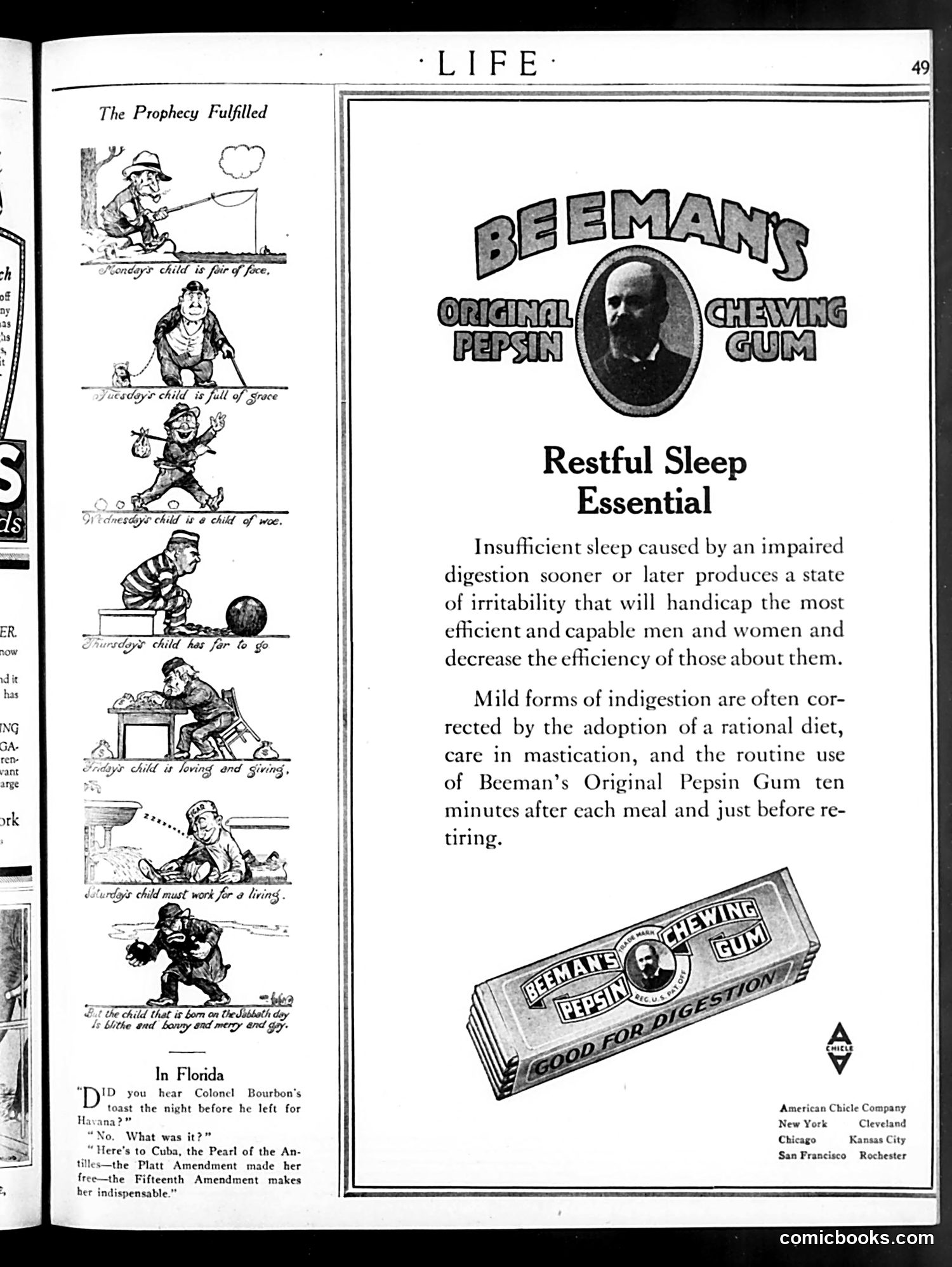
The left side shows a series of six cartoon panels about a "Thursday's child" progressing through life stages, with captions about fate and fortune. The final panel references the biblical saying "the child that is born on the Sabbath day is bonny and blithe and good and gay." The right side is an advertisement for Beeman's Original Pepsin Chewing Gum, claiming it aids digestion and sleep quality. The bottom section, "In Florida," appears to be a separate joke about Colonel Bourbon's toast before leaving for Havana, referencing Cuba and various Constitutional amendments. Without clearer context on the publication date and "Thursday's child" reference, the specific satirical target remains unclear, though it likely comments on destiny or social mobility of the era.
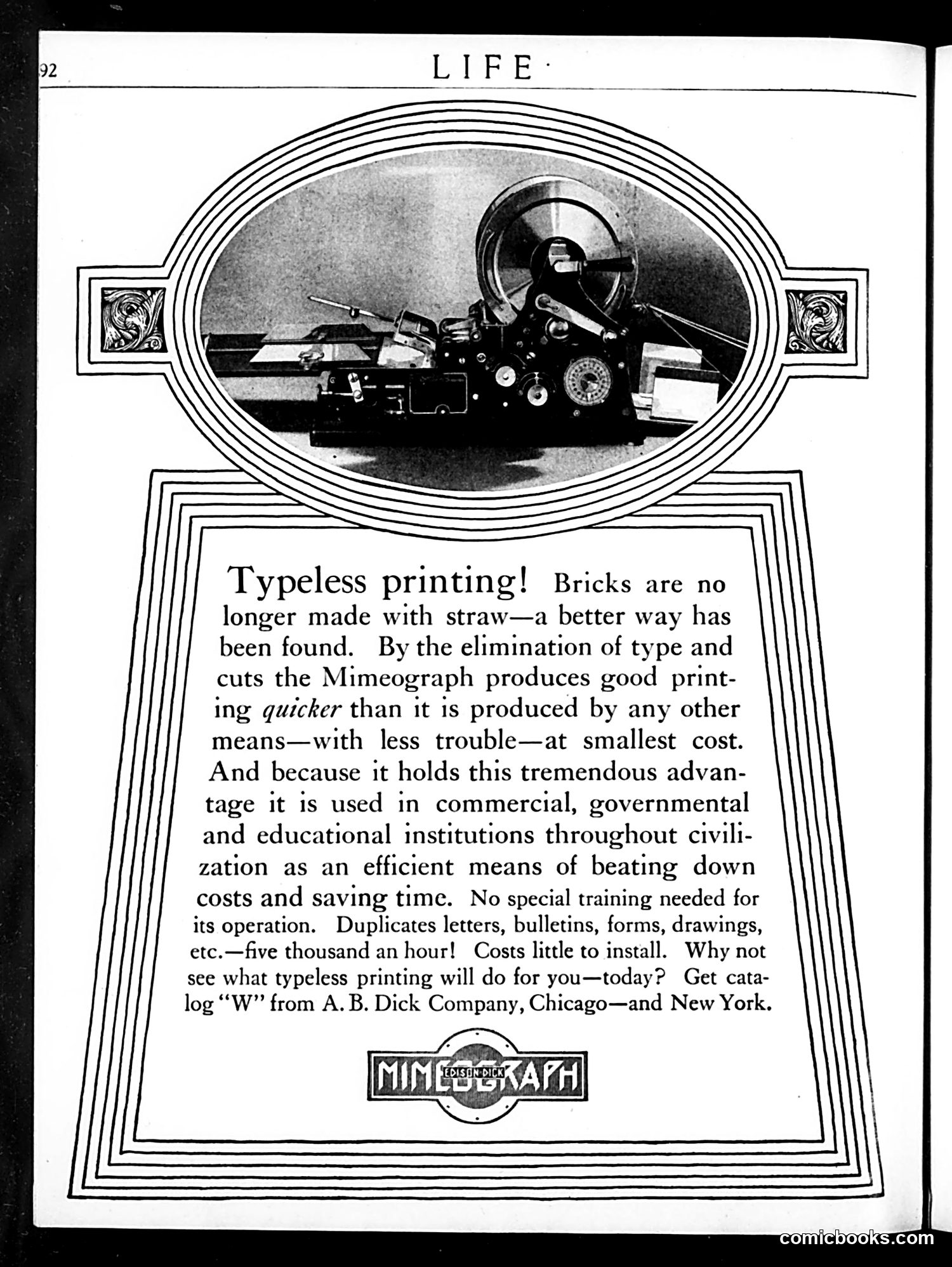
This page is a **print advertisement** for the Mimeograph machine by A.B. Dick Company, not a political cartoon. The ad promotes "typeless printing"—mimeograph technology that eliminates traditional metal type, allowing faster document reproduction. The image shows the machine's mechanical components. The sales pitch emphasizes practical benefits: speed (five thousand copies per hour), low cost, ease of operation requiring no special training, and widespread adoption by businesses, government, and schools. The brick/straw metaphor in the headline suggests mimeography represents progress—a "better way" compared to older printing methods. For modern readers, this highlights how revolutionary photocopying technology seemed in the early 20th century, before digital printing made even mimeographs obsolete.
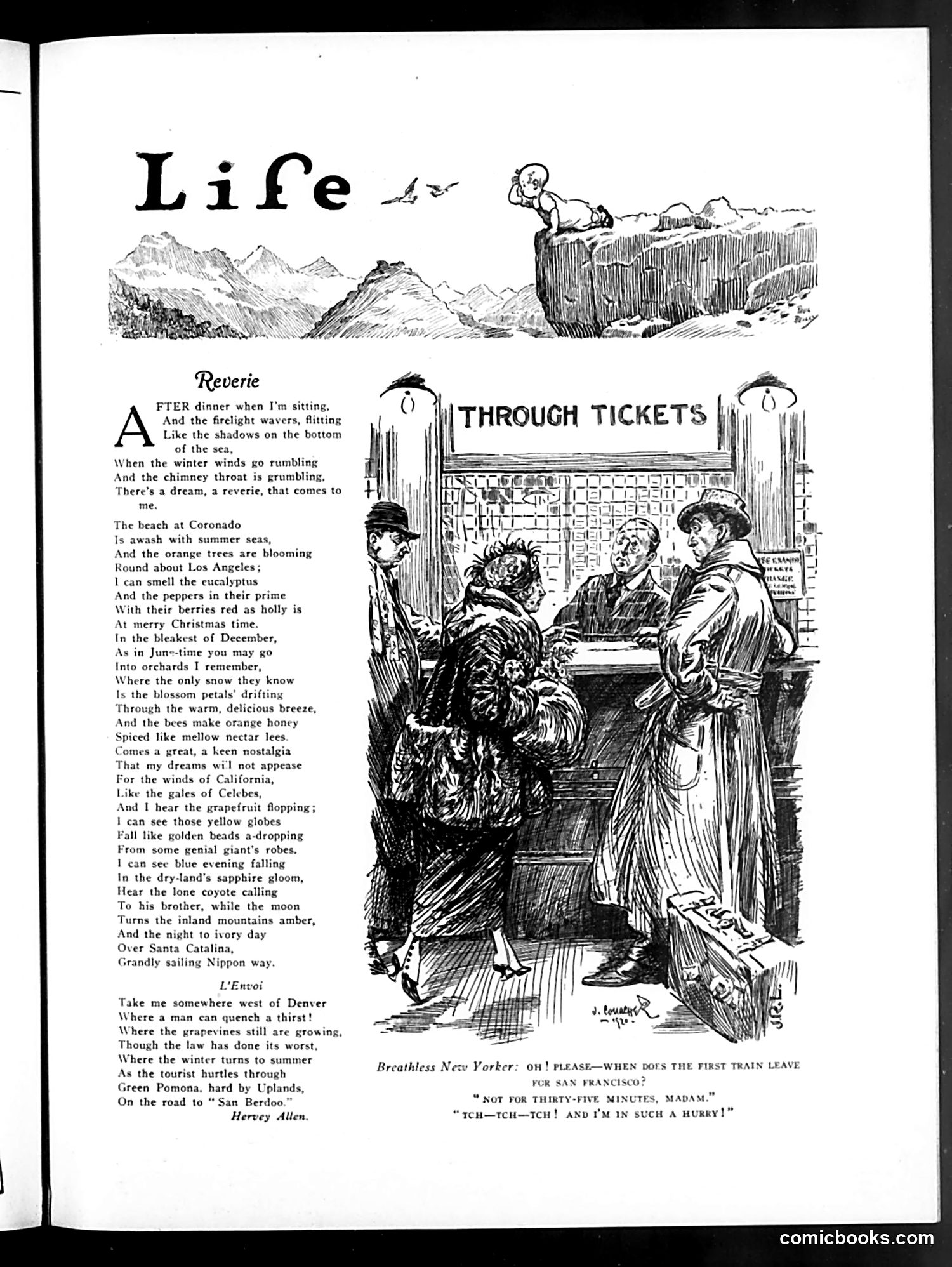
This page features two sections: a poem titled "Reverie" by Harvey Allen about California's attractions, and a cartoon captioned "Through Tickets." The cartoon depicts a harried traveler at a railway ticket window asking about trains to San Francisco. A frustrated ticket agent responds that no trains leave for thirty-five minutes and the passenger is "in such a hurry." The joke satirizes the impatience of American tourists and the absurdity of train travel delays in the early 20th century. The "Reverie" poem romanticizes California destinations—Coronado, Los Angeles, and Catalina—reflecting contemporary American fascination with Western travel and leisure. Together, these pieces humorously contrast idealized California imagery with the frustrating realities of actually getting there by rail.
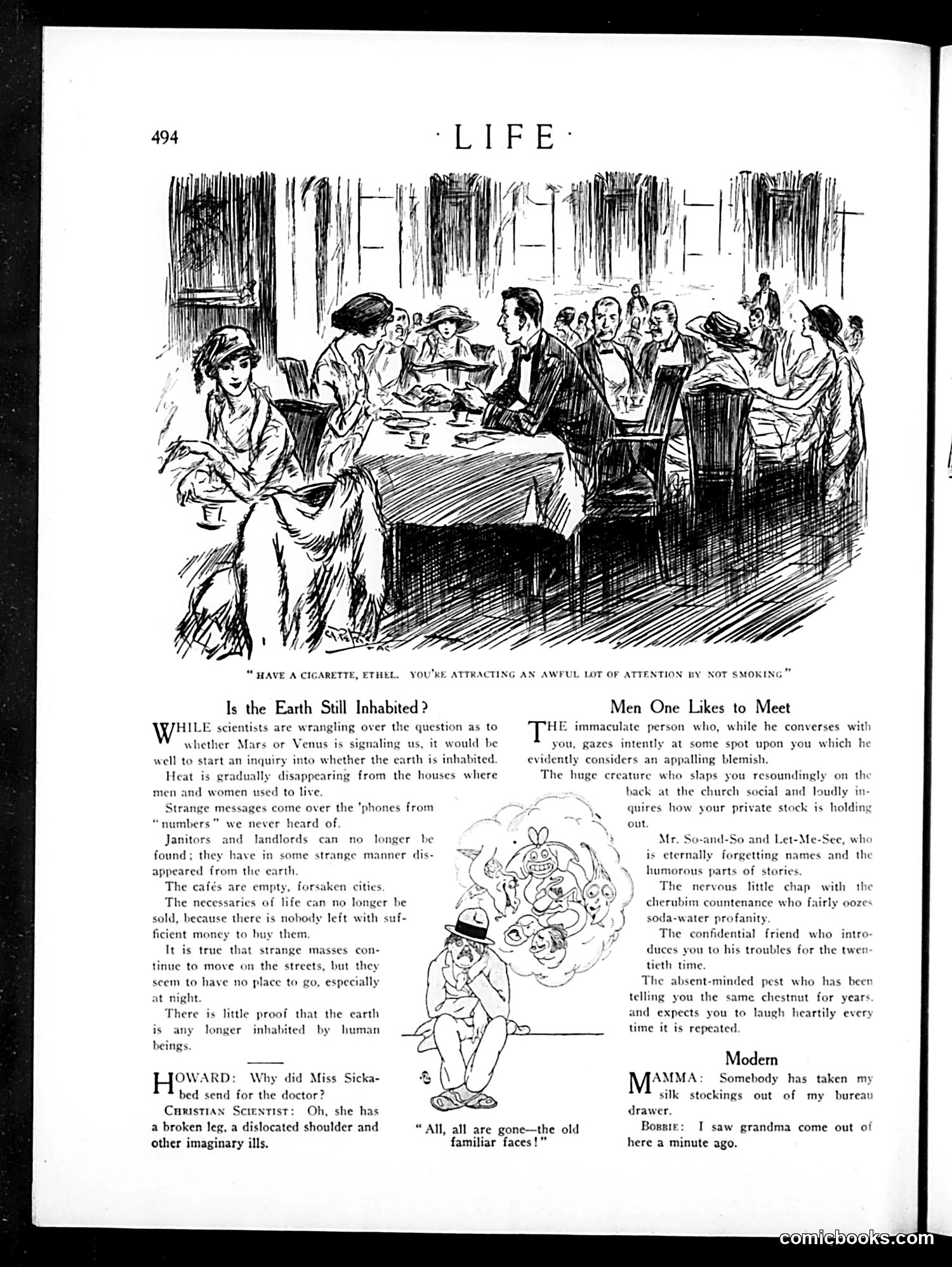
This page contains three satirical pieces targeting early 20th-century social pretension: **Top cartoon**: A woman is told "Have a cigarette, Ethel. You're attracting an awful lot of attention by not smoking"—mocking the social pressure to conform to fashionable behaviors, particularly women smoking in public (then considered scandalous). **Left column** ("Is the Earth Still Inhabited?"): Satirizes urban overcrowding and the disappearance of privacy, suggesting cities have become so densely populated that solitude and traditional domestic life are extinct. **Right column** ("Men One Likes to Meet"): A humorous catalog of annoying social types—forgettable acquaintances, nervous bores, and repetitive pests—the kinds of people one cannot avoid in society. The illustrations feature exaggerated character types typical of period comic satire.
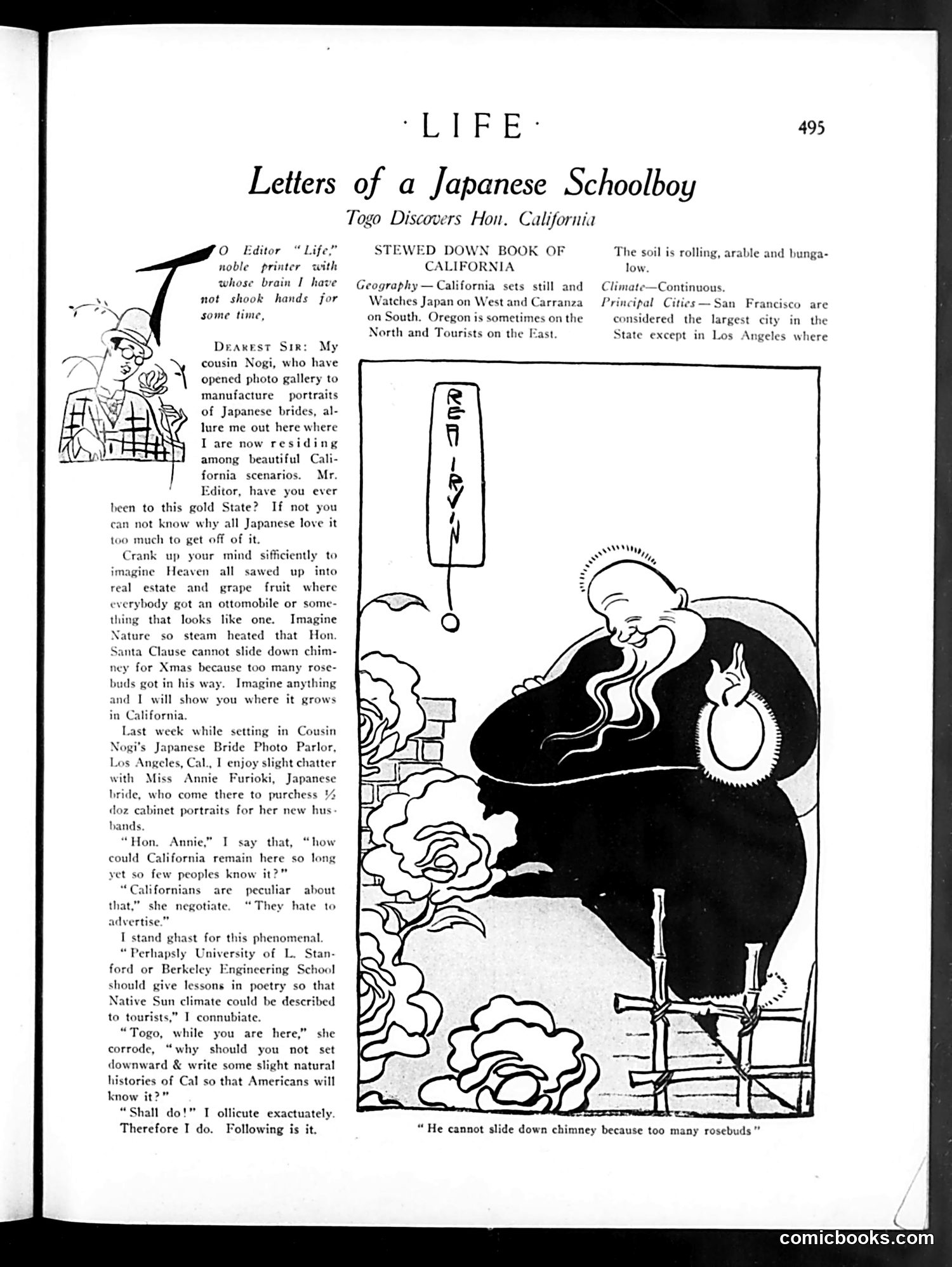
This page features a humorous letter from a Japanese schoolboy visiting California, satirizing both Japanese visitors' enthusiasm for America and California's self-promotional boosterism. The main illustration depicts **Santa Claus unable to descend a chimney** because too many rosebuds obstruct it—a visual joke about California's abundant flowering plants and agricultural wealth. The figure caricatures Santa with exaggerated features typical of early 20th-century ethnic humor. The accompanying letter mocks how Japanese people romanticize California as a paradise ("Heaven all saved up into real estate and grape fruit"), while also gently satirizing Californians' reluctance to advertise their own abundance. The writer ironically suggests universities teach poetry about the "Native Sun climate" to promote tourism. The satire targets both tourist stereotypes and regional pride through the naive perspective of the foreign observer.
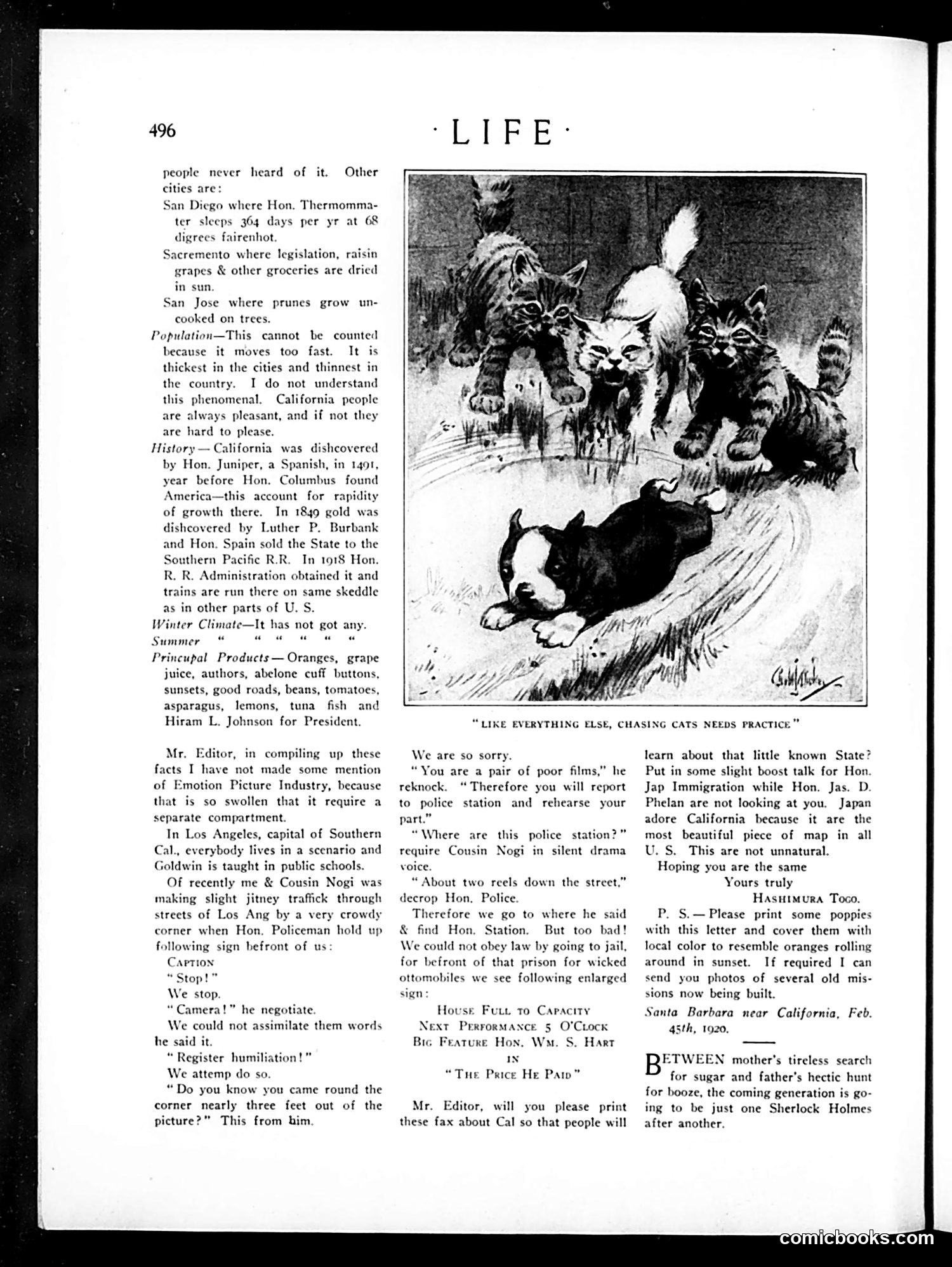
The page contains text about California and a cartoon illustration captioned "Like everything else, chasing cats needs practice." The cartoon depicts a dog chasing several cats in a chaotic scene. Below the cartoon are reader letters to the editor, primarily about California. One letter from "Hashimura Togo" promotes California's attractions and appeals for positive press coverage. The cartoon itself is a straightforward humorous illustration—not political satire. It's a visual joke about a dog pursuing multiple cats, suggesting that even common activities require skill and experience to execute well. The humor is domestic and light, typical of Life magazine's general-interest comedy content from this era.
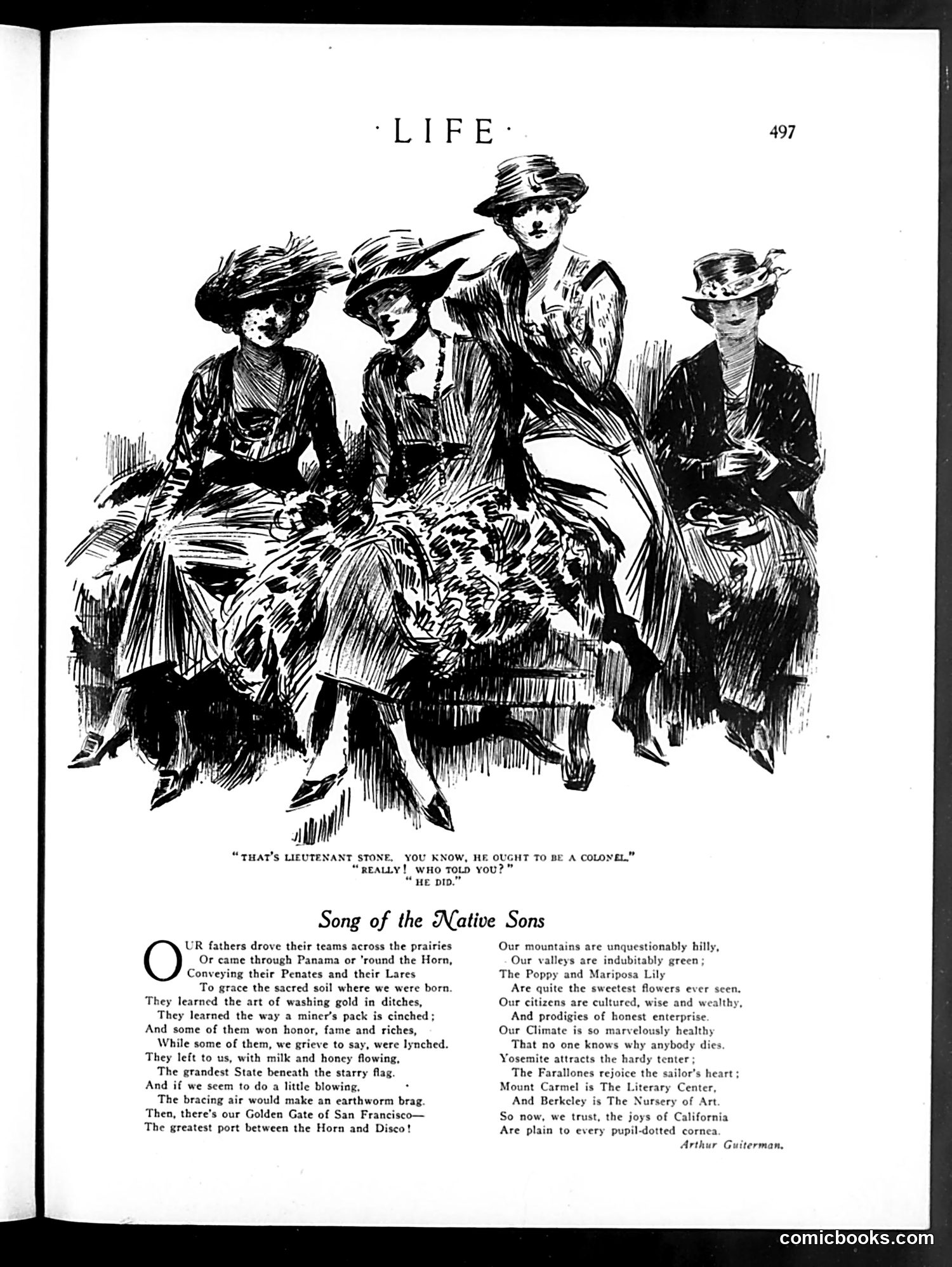
**The Cartoon:** The sketch depicts four well-dressed women discussing a man named Lieutenant Stone. The joke is a classic self-aggrandizement gag: when asked who said Stone should be a colonel, one woman replies "He did"—meaning Stone himself made the claim. This satirizes self-promotion and inflated self-regard. **The Poem:** "Song of the Native Sons" is a boastful, satirical celebration of California written by Arthur Guiterman. It mocks Californians' tendency toward exaggeration and self-importance. While nominally praising the state's natural beauty and pioneer heritage, the poem undermines itself through absurd hyperbole: mountains are "unquestionably hilly," the climate so healthy that "no one knows why anybody dies," and Berkeley is grandly called "The Nursery of Art." **The Point:** Together, these pieces satirize California boosterism and self-congratulatory rhetoric—the state's (and its residents') habit of making grandiose, often ridiculous claims about their superiority. The tone is affectionate mockery rather than harsh criticism.
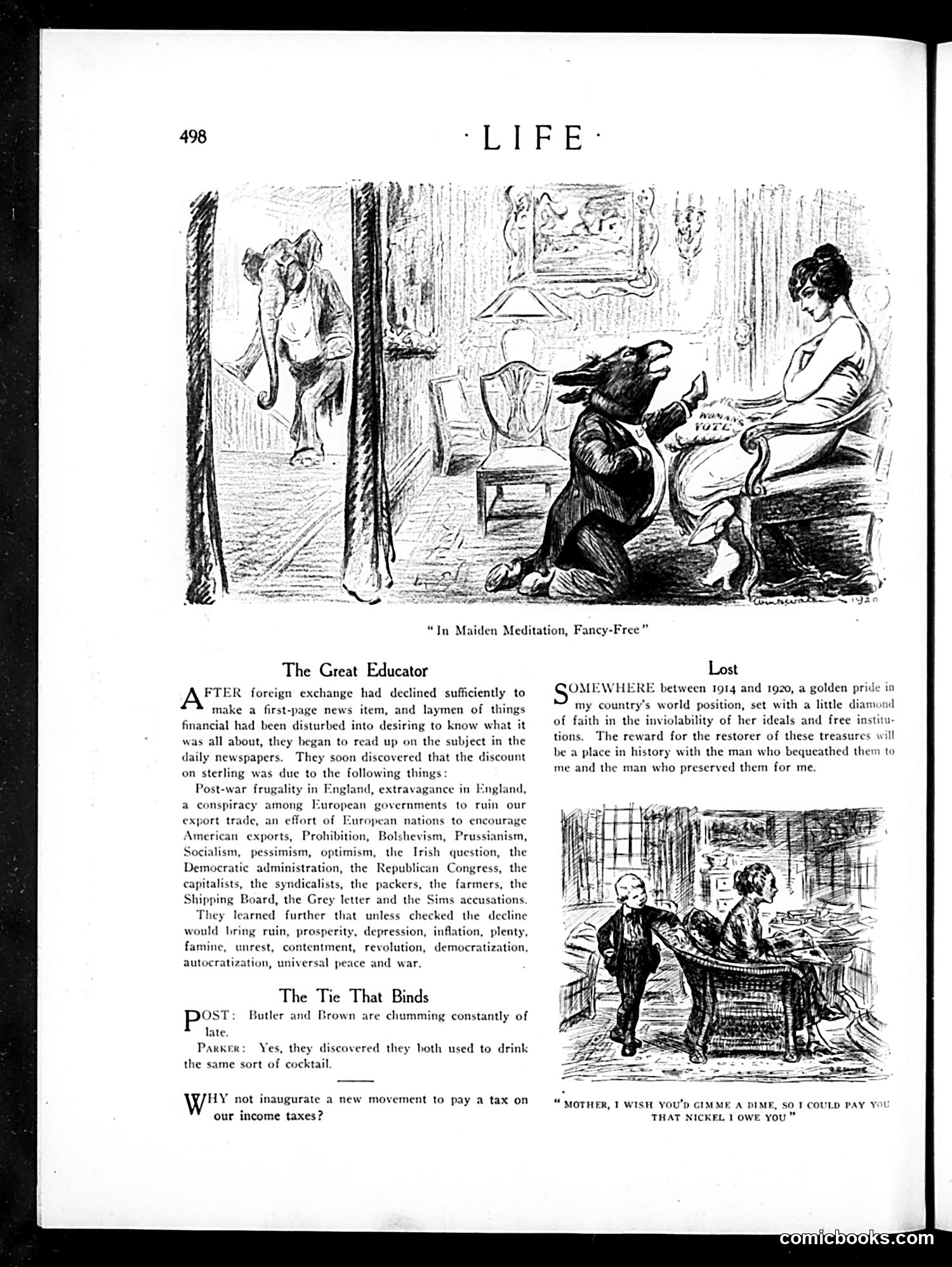
**"The Great Educator"** mocks how ordinary citizens became amateur economists after the 1914-1920 period. As foreign exchange rates became news, laypeople rushed to newspapers seeking explanations, only to encounter contradictory, mutually-exclusive causes: England was simultaneously too frugal AND extravagant; various ideologies and political groups all received blame (Prohibition, Bolshevism, Democrats, Republicans). The satire highlights how post-war economic confusion spawned competing, self-canceling explanations in the press. **"The Tie That Binds"** is a brief joke about two men bonding over drinking the same cocktail—likely satirizing either Prohibition-era bootlegging culture or the shallow basis for wealthy male friendships. **"Lost"** is a nostalgic lament for pre-1914 American prestige and faith in democratic ideals, lost during the war years. The author seeks their return as a historical treasure. **The bottom cartoon** depicts a child asking their mother for money to pay a debt, illustrating absurd circular logic—mirroring perhaps the tangled post-war debt situation between nations.
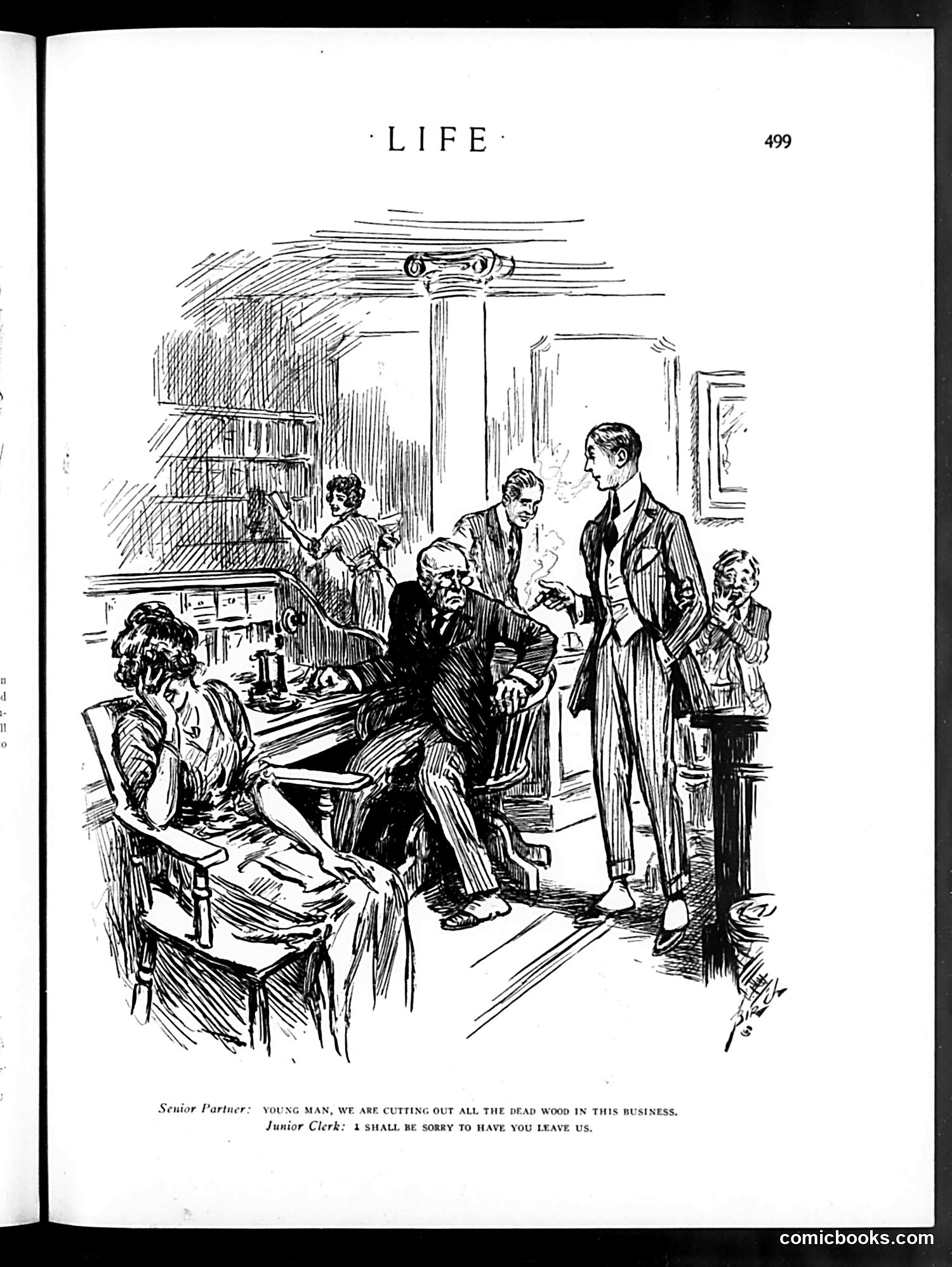
This is a single-panel cartoon satirizing business practices in the early 20th century. A senior partner (seated, elderly man) tells a junior clerk he must be let go, stating: "Young man, we are cutting out all the dead wood in this business." The junior clerk responds: "I shall be sorry to have you leave us." The humor is situational irony: the senior partner announces he's eliminating "dead wood" (inefficient employees), but the junior clerk's polite response implies the senior partner himself is the "dead wood" being removed. The cartoon mocks corporate euphemisms for layoffs and suggests older executives are often the least productive members of firms—a commentary on generational tensions in business.
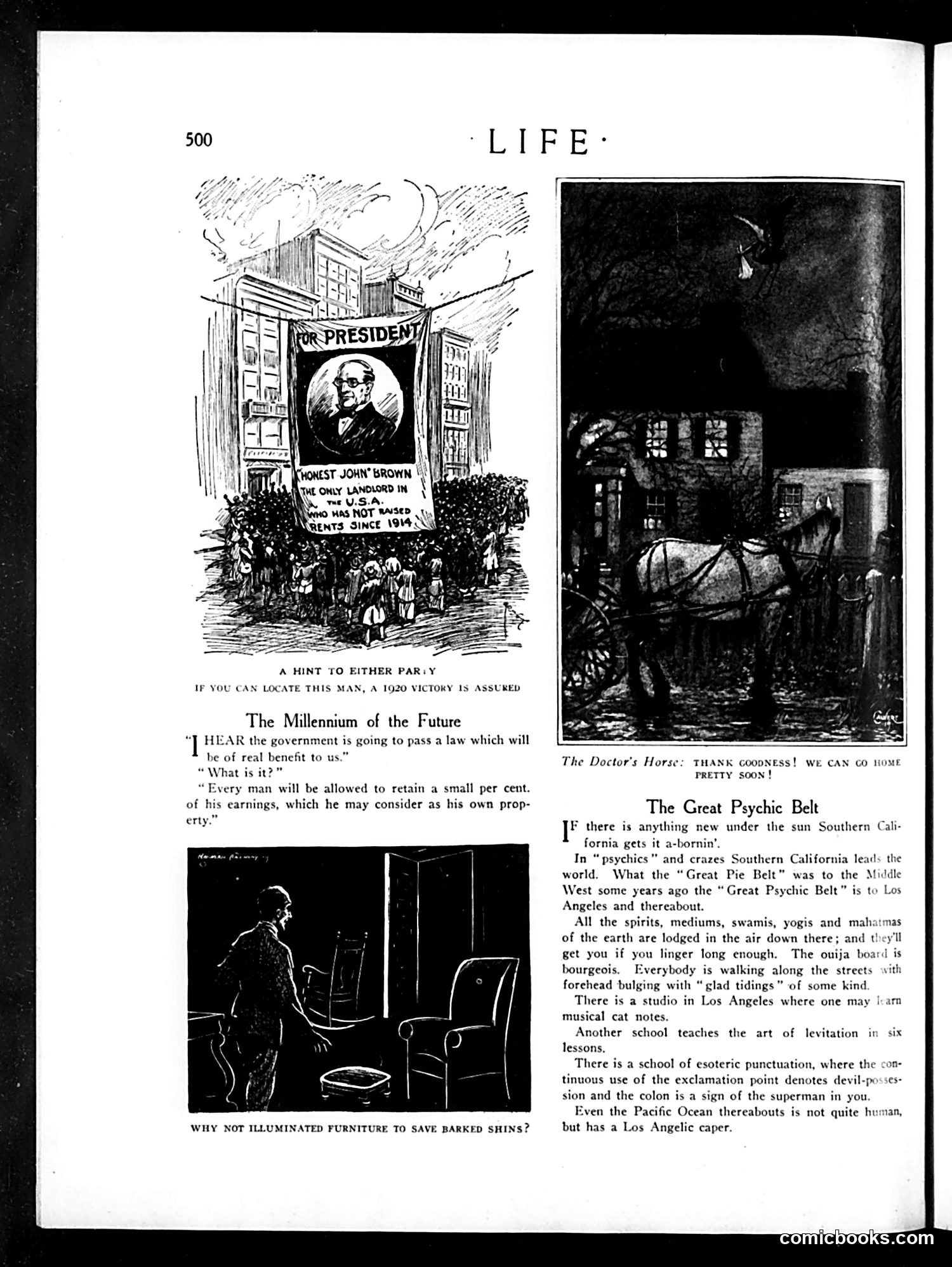
**Top Cartoon**: "Honest John Brown" is a fictional candidate satirizing both major political parties ahead of the 1920 election. The joke is that he's the "only landlord" who hasn't raised rents since 1914—an impossibly ideal figure. Life mocks both parties by suggesting that if they could find such a man, either party would win, implying both are equally desperate and out of touch with working people's housing grievances during post-WWI inflation. **Text Section "Millennium of the Future"**: Satirizes government economic policy, likely referencing proposed labor or tax legislation. The dark joke is that the proposed "benefit" is allowing workers to keep only a tiny percentage of earnings as personal property—depicting government as extracting nearly all wages, painting a dystopian future of near-total wage confiscation. **Lower Sections**: Light satirical pieces mocking Southern California's boom-era spiritual crazes (mediums, ouija boards, "psychic belts"), treating occult fads as regional absurdity.
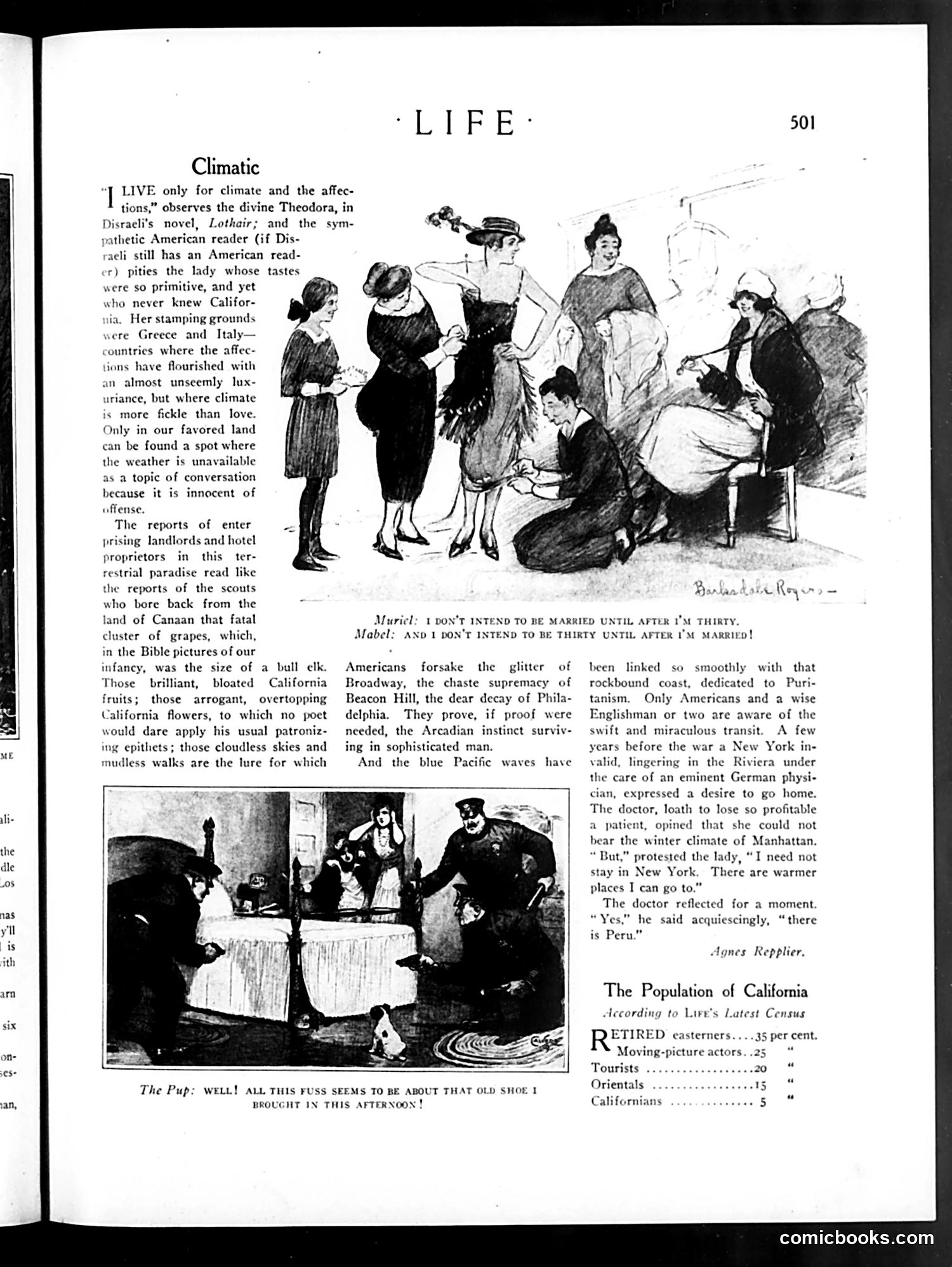
This page satirizes American obsession with California's climate and the types of people it attracts. The essay, attributed to Agnes Repplier, mocks how Americans abandoned East Coast sophistication (Broadway, Beacon Hill, Philadelphia's "dear decay") for California's perfect weather and natural abundance—presented as almost absurdly exaggerated (fruits "the size of a bull elk"). The top cartoon shows women discussing marriage timing with circular logic—a jab at frivolous female reasoning. The lower cartoon depicts a doctor recommending Peru's climate to a patient, satirizing how readily Americans accept climate-based solutions. The "Population of California" census parodies the state's demographic reality: retired easterners, entertainment industry workers, tourists, and Asian immigrants dominate, with actual Californians comprising only 5 percent. This deflates California's mystique by suggesting it's populated entirely by transients and outsiders chasing the climate myth. The overall message: Americans' climate-obsession reveals superficiality and gullibility.
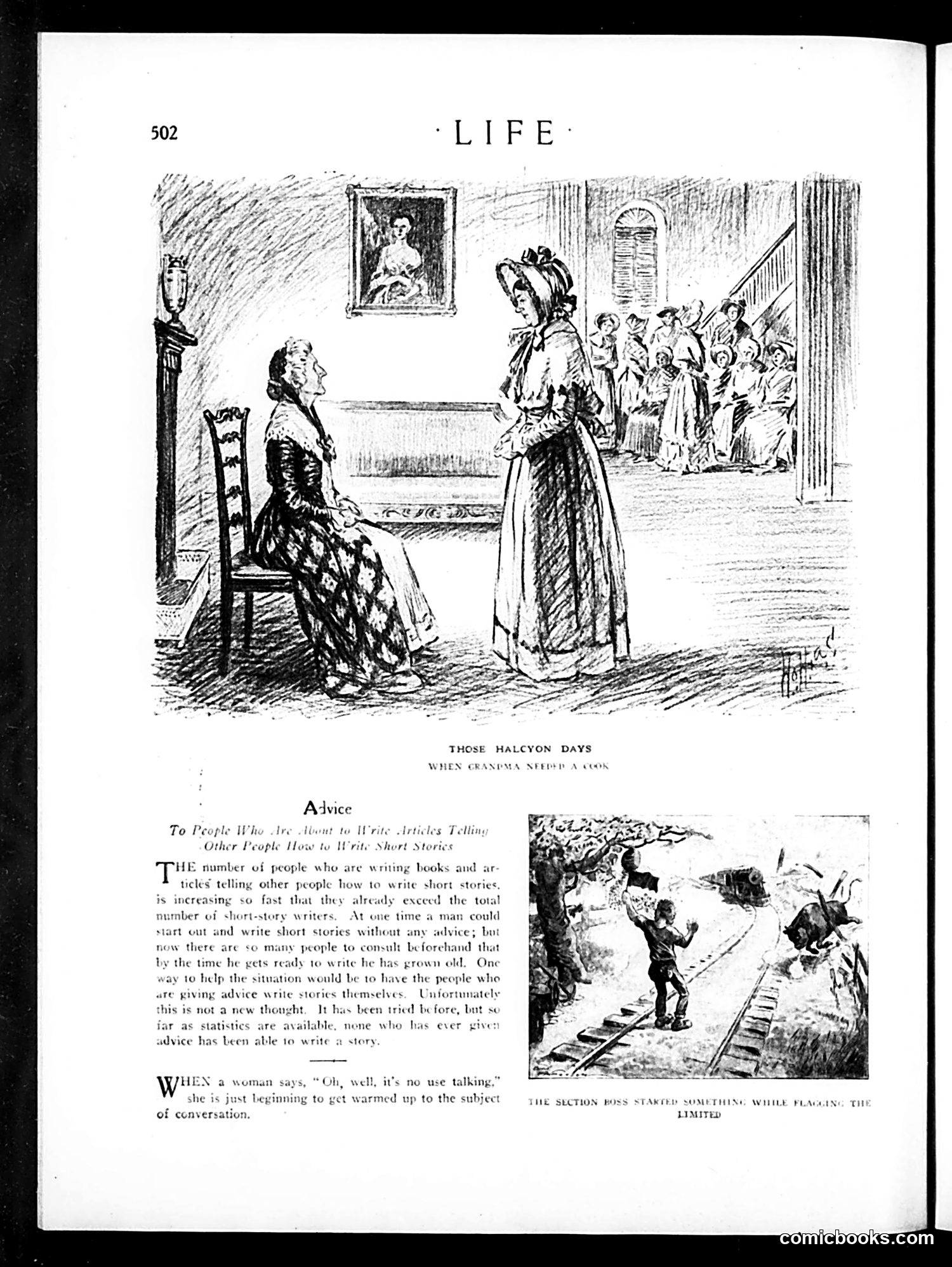
This Life magazine page contains two satirical pieces: **Top Cartoon ("Those Halcyon Days"):** Shows a nostalgic scene of a wealthy woman interviewing a domestic cook—referencing a bygone era when household servants were readily available. The title suggests longing for simpler times. **Main Article ("Advice"):** Satirizes the proliferation of "how-to-write" books and instructional articles. The joke: there are now *more people giving writing advice than actual short-story writers*. Life mocks the irony that those dispensing advice rarely succeed at writing themselves. The piece targets the publishing industry's trend of meta-instructional content—books about writing rather than actual fiction. **Bottom Photo Caption:** References a train accident ("section boss started something"), likely humorous filler. The satire reflects early 20th-century frustration with self-help publishing trends and amateur advice-givers overcrowding the literary marketplace.
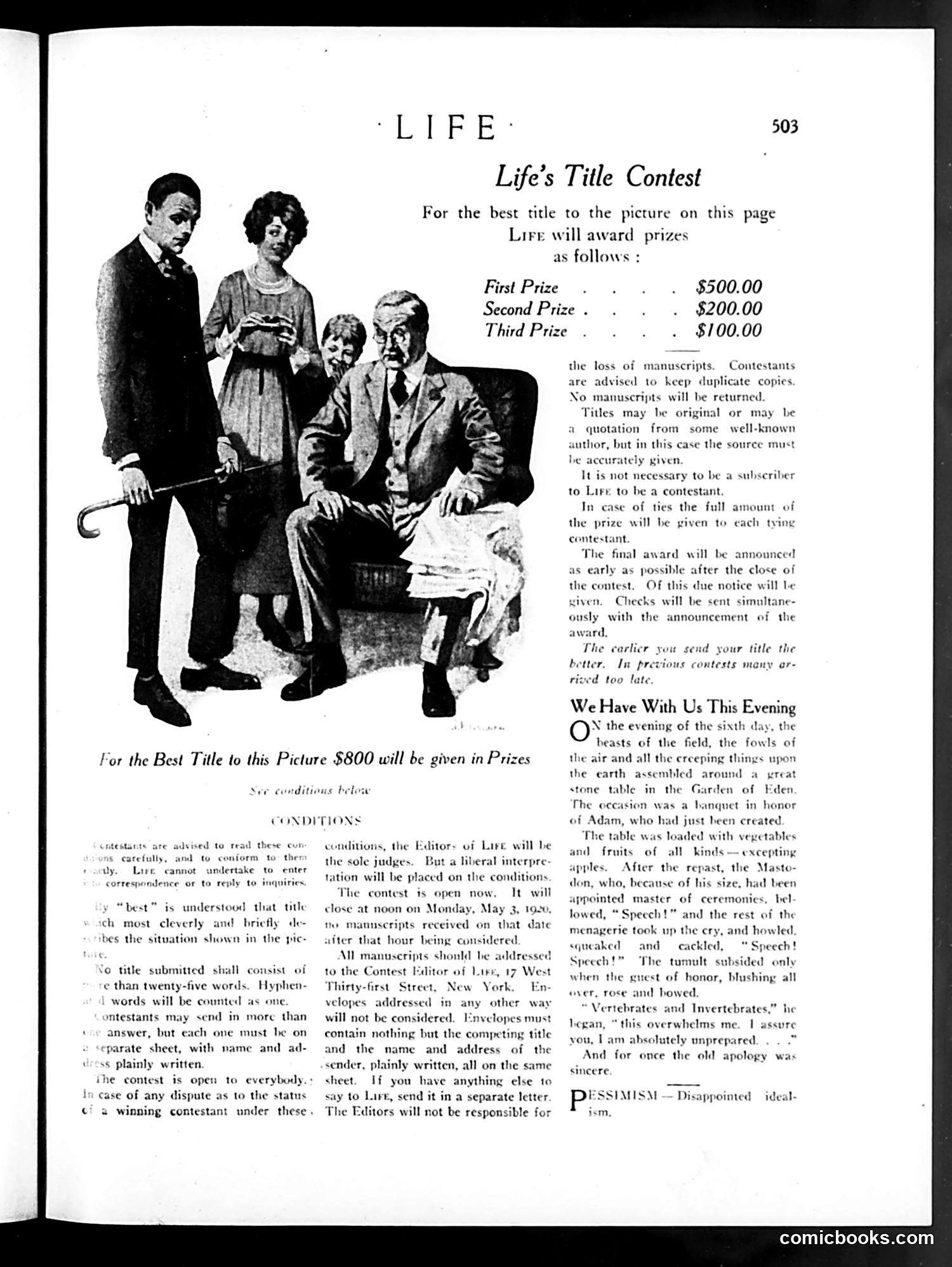
This page announces a contest inviting readers to title the illustration shown—a domestic scene depicting four figures (two men, a woman, and a child) examining what appears to be documents or papers. The magazine offers $800 in prizes ($500 first place, $200 second, $100 third) for the best caption. The accompanying story, "We Have With Us This Evening," is a humorous biblical satire imagining Adam's post-creation banquet in Eden, where animals gather to celebrate. When called upon to speak, Adam nervously admits his complete unpreparedness for the occasion—a joke about human inadequacy presented under the ironic heading "Pessimism—Disappointed Idealism." The page reflects *Life* magazine's format: combining visual humor with literary wit, inviting reader participation, and mixing satirical commentary with light entertainment. The contest rules are detailed and formal, typical of early 20th-century magazine promotions.
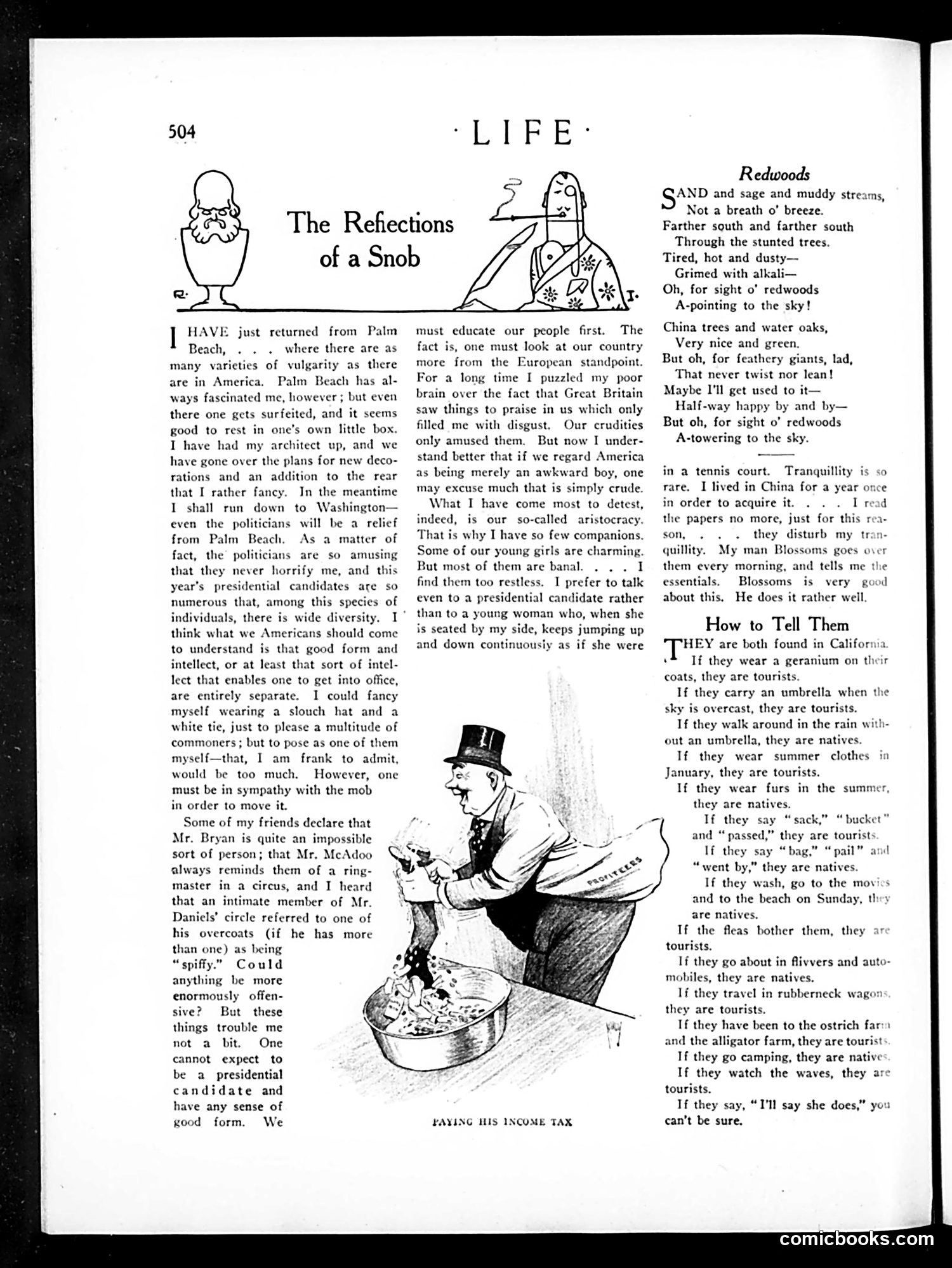
This page satirizes American snobbery and pretension through two main pieces: **"The Reflections of a Snob"** presents a wealthy narrator returning from Palm Beach who expresses contempt for American vulgarity while admitting he secretly envies European sophistication. The satire targets his hypocrisy: he claims disdain for the masses yet acknowledges politicians (Bryan, McAdoo, Daniels appear to be referenced) lack "good form," and he confesses he'd wear working-class attire to manipulate voters. The cartoon showing a man "paying his income tax" illustrates the disconnect between his refined self-image and ordinary financial obligations. **"How to Tell Them"** uses a humorous checklist to distinguish California tourists from natives—tourists wear umbrellas in rain, geraniums, summer clothes in January; natives do the opposite. This mocks both tourist behavior and locals' pretense of rugged individualism. Both pieces ridicule American upper-class affectation: the snob's self-deception about his own vulgarity, and California residents' performative authenticity. The satire suggests genuine refinement and authenticity are rare in America.
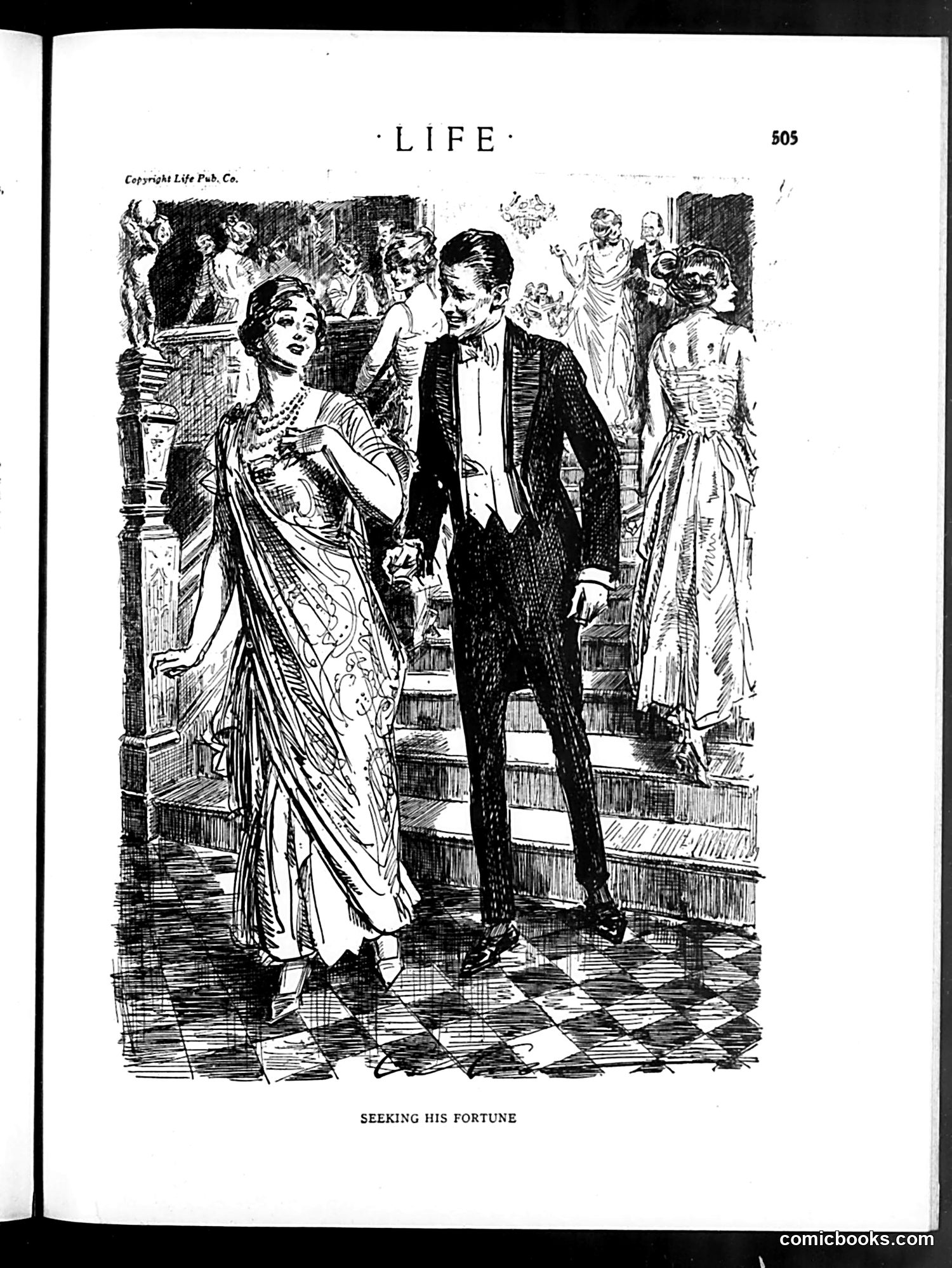
This is a formal social scene—likely a fancy ball or party—depicting a young man in evening dress approaching a woman. The caption "Seeking His Fortune" suggests satirical commentary on social climbing or fortune-hunting through romance. The illustration appears to mock the practice of marrying for wealth, a common theme in early 20th-century satire. The well-dressed man's interaction with the elegantly gowned woman, set against a backdrop of other socialites, suggests he is deliberately pursuing a wealthy or advantageous match rather than genuine romance. The style and setting indicate this targets upper-class social pretensions and the mercenary nature of some romantic pursuits among the wealthy—a recurring subject of Life magazine's humor.
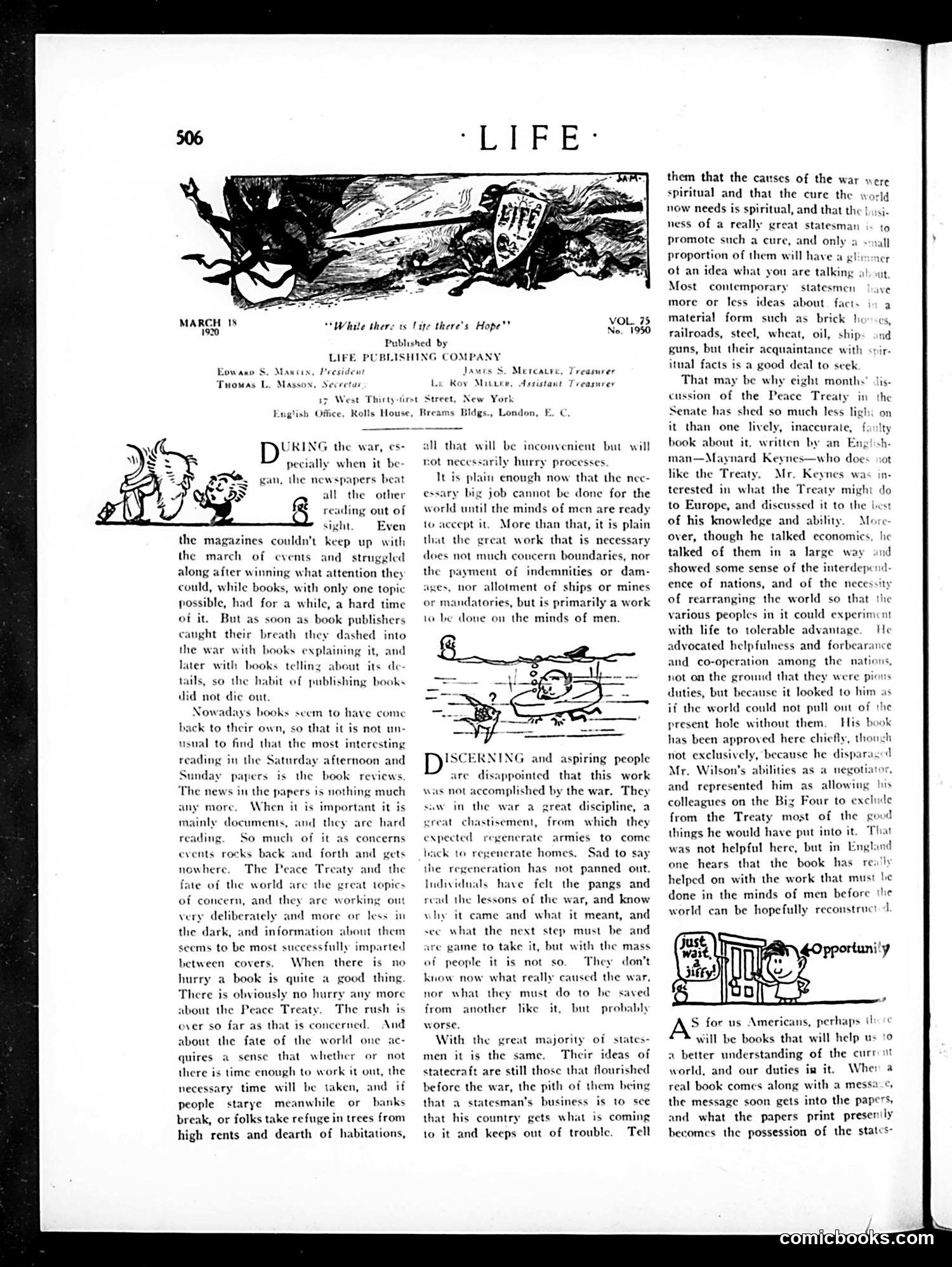
This March 1920 *Life* editorial discusses the post-WWI Peace Treaty negotiations and public disengagement from the process. The two small cartoons illustrate the main argument: The first cartoon (top) shows a dejected figure, representing public apathy—people have lost interest in treaty details now that the war's "rush" has ended. The second cartoon depicts someone in water, likely representing drowning in indifference or being overwhelmed by post-war chaos (homelessness, economic collapse mentioned in text). The editorial's core satire: statesmen still think in pre-war terms (territory, indemnities, ships), while spiritual and psychological reconstruction—the real work needed—requires reshaping human minds. Most people don't understand what caused the war or how to prevent another. The "hope" of the title is ironic: without genuine ideological change, the world remains adrift. Books, the author argues, can better convey this message than newspapers' daily coverage.
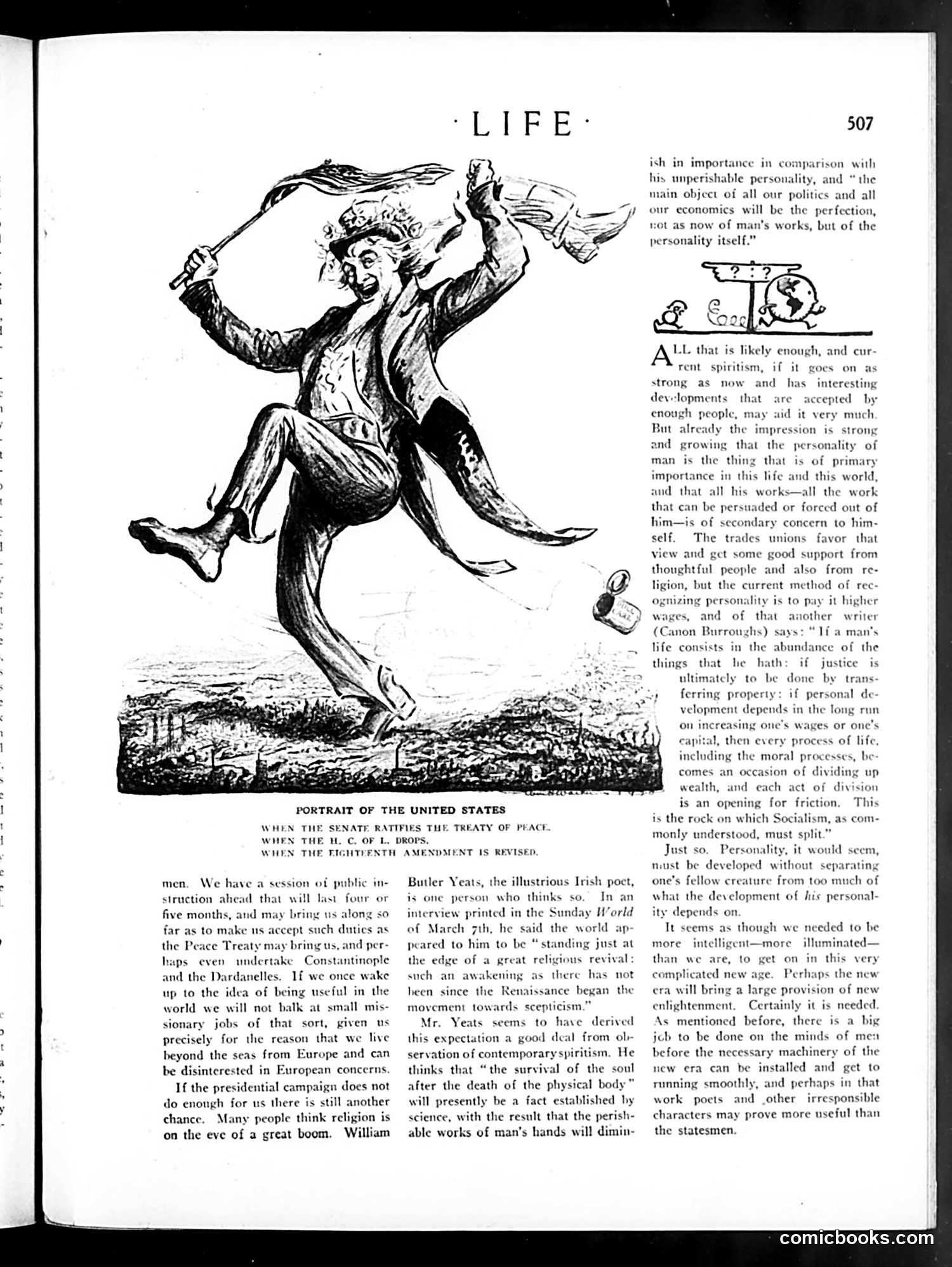
This satirical cartoon depicts Uncle Sam as a gleeful, energetic figure dancing while juggling multiple concerns. The caption's conditions—"When the Senate ratifies the Treaty of Peace / When the H.C. of L. drops / When the Eighteenth Amendment is revised"—suggest these are prerequisites for American prosperity that seem unlikely to occur simultaneously. The cartoon mocks post-WWI American optimism. It references: - The **Treaty of Peace** (likely the Treaty of Versailles) - **H.C. of L.** (High Cost of Living), a major postwar economic issue - The **Eighteenth Amendment** (Prohibition), controversial legislation The accompanying text quotes Irish poet William Butler Yeats on spiritual revival and discusses personality development versus material accumulation—drawing a contrast between idealistic hopes and practical concerns. The satire suggests America's problems are interconnected and won't simply resolve, despite public confidence.
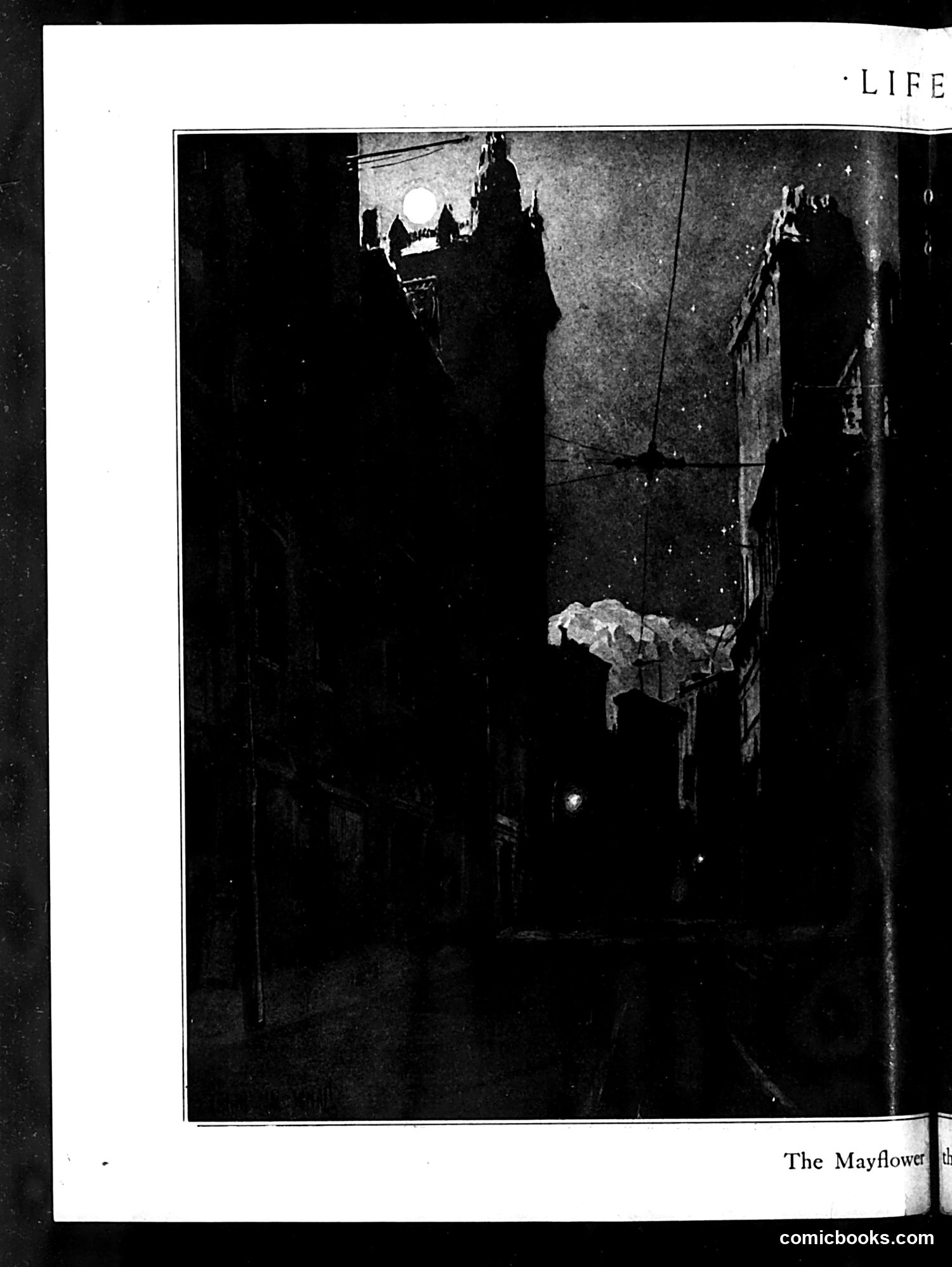
This appears to be a page from Life magazine featuring an illustration titled "The Mayflower" (visible at bottom). The image shows a dark, atmospheric scene depicting what appears to be the interior of a ship's hold or cabin, with shadowy figures and a bright light source (possibly the moon) visible through an opening. However, the OCR text provided contains only technical artifacts and no readable content that would clarify the cartoon's specific political or social commentary. Without legible caption text or article content, I cannot confidently identify which historical event or social commentary this satirizes, though the Mayflower reference suggests commentary on American colonial history, immigration, or Pilgrim-related themes popular in early 20th-century satire. **I cannot reliably explain the specific satire without readable text.**

I can see this is a page from Life magazine with a mostly dark illustration, but the image quality and contrast make it difficult to discern specific details clearly. The partial text visible reads "ower the West" at the bottom left, which appears to be a caption or title fragment, but I cannot confidently identify what it refers to or read the complete text. The illustration itself appears to be a dark, atmospheric scene, possibly depicting figures or action, but the detail is too obscured for me to reliably identify specific characters, caricatures, or the satirical point being made. Without clearer visibility of both the illustration and any accompanying text, I cannot accurately explain what this cartoon meant to contemporary readers.
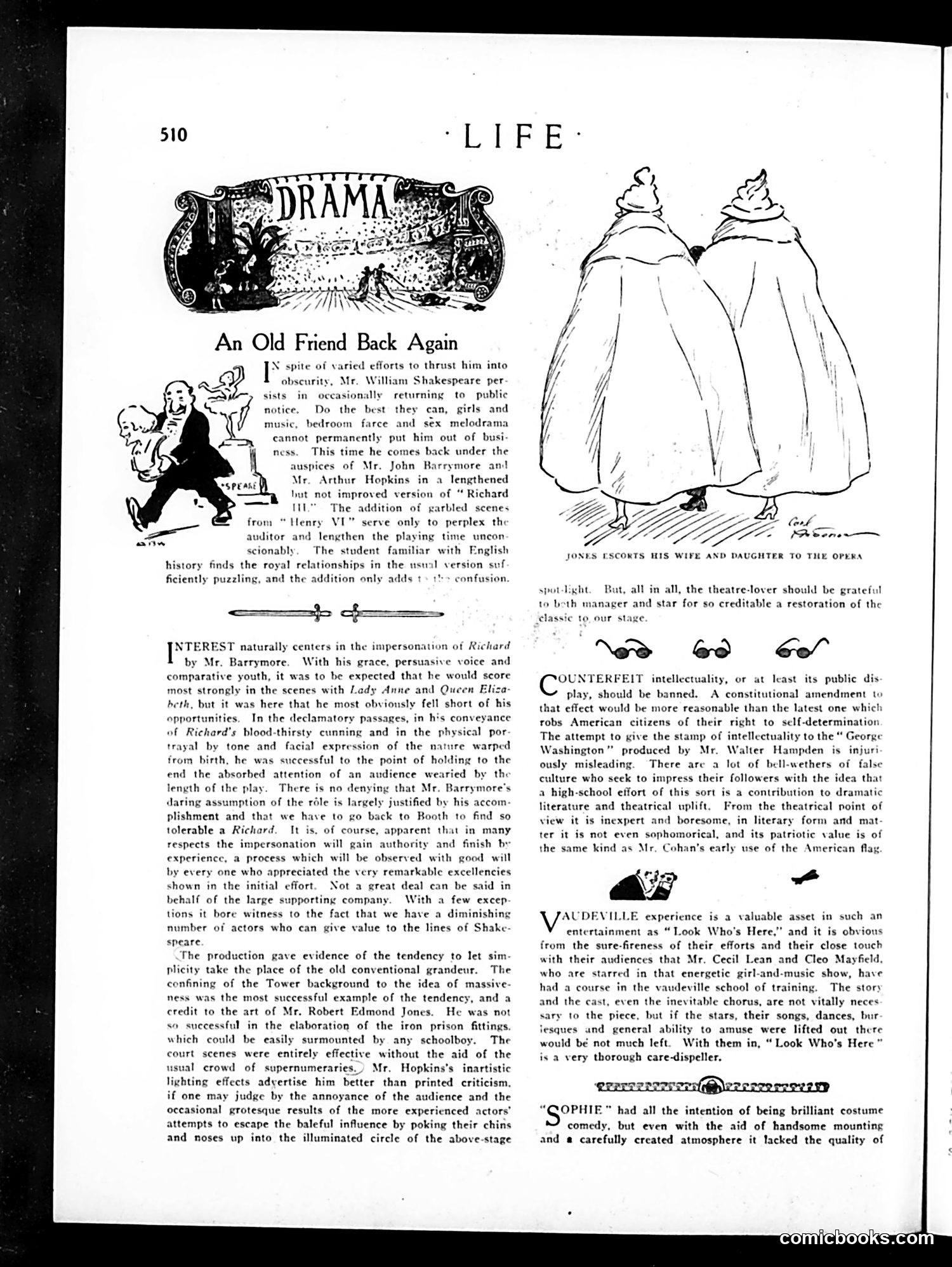
This page reviews John Barrymore's 1920 production of *Richard III*, directed by Arthur Hopkins. The critic praises Shakespeare's enduring appeal despite efforts to displace him with modern entertainment (farce, melodrama, sex comedies). **The main review** analyzes Barrymore's performance as Richard—finding him effective in physical portrayal and cunning passages but weak in romantic scenes with Lady Anne and Queen Elizabeth. The critic credits the supporting production design (Robert Edmond Jones's set work) while criticizing Hopkins's theatrical lighting and the weak supporting cast. **The illustration** shows a man escorting two women in large coats to the opera—likely meant as social commentary about theatre attendance or fashion. **The secondary articles** critique "counterfeit intellectuality" in recent theatrical productions, suggesting some plays use intellectual pretense to elevate mediocre material, and discuss the vaudeville experience of "Look Who's Here" and costume comedy "Sophie." The overall tone reflects early 1920s theatre criticism valuing classical drama and artistic merit over commercial sensationalism.
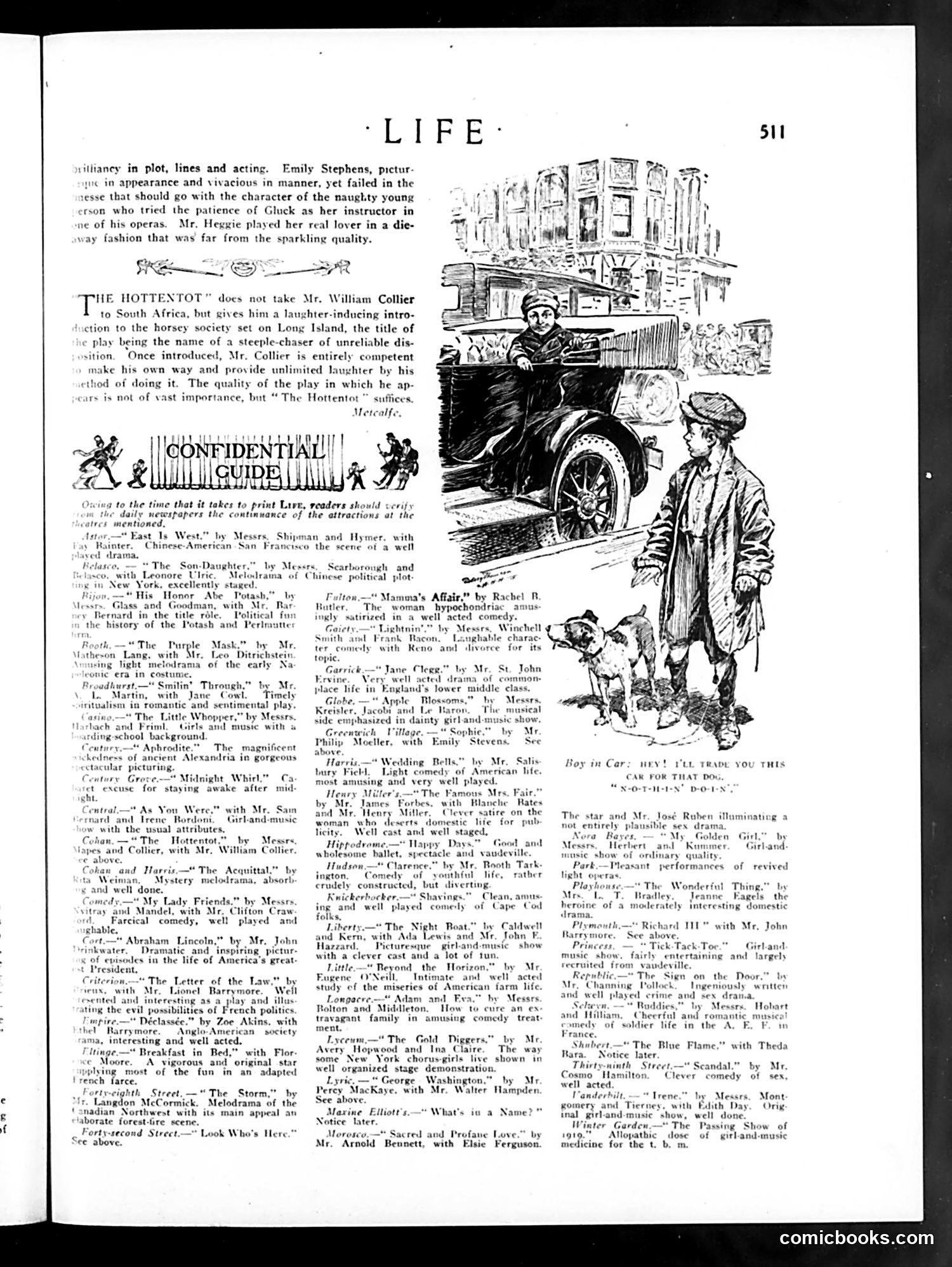
This page is primarily a theater review section rather than a political cartoon. The main illustration shows a street scene with an automobile and pedestrians, captioned "Boy in Car: Hey! I'll trade you this car for that dog" / "N-o-t-h-i-n-'d-o-i-n'." The illustration appears to be satirizing urban class differences—a wealthy boy in an automobile attempting to trade his car for a street dog, with the dog owner's unimpressed response. This reflects early 20th-century themes about material wealth versus simple possessions. The bulk of the page contains theatrical reviews for various Broadway productions, including plays with ethnic humor ("The Hottentot," "East Is West," "The Son-Daughter") typical of the era's entertainment. These reviews mention performers and plot summaries without evident political commentary. The page's satire is primarily social rather than overtly political—mocking pretension, materialism, and theatrical trends of the period rather than specific political figures or events.
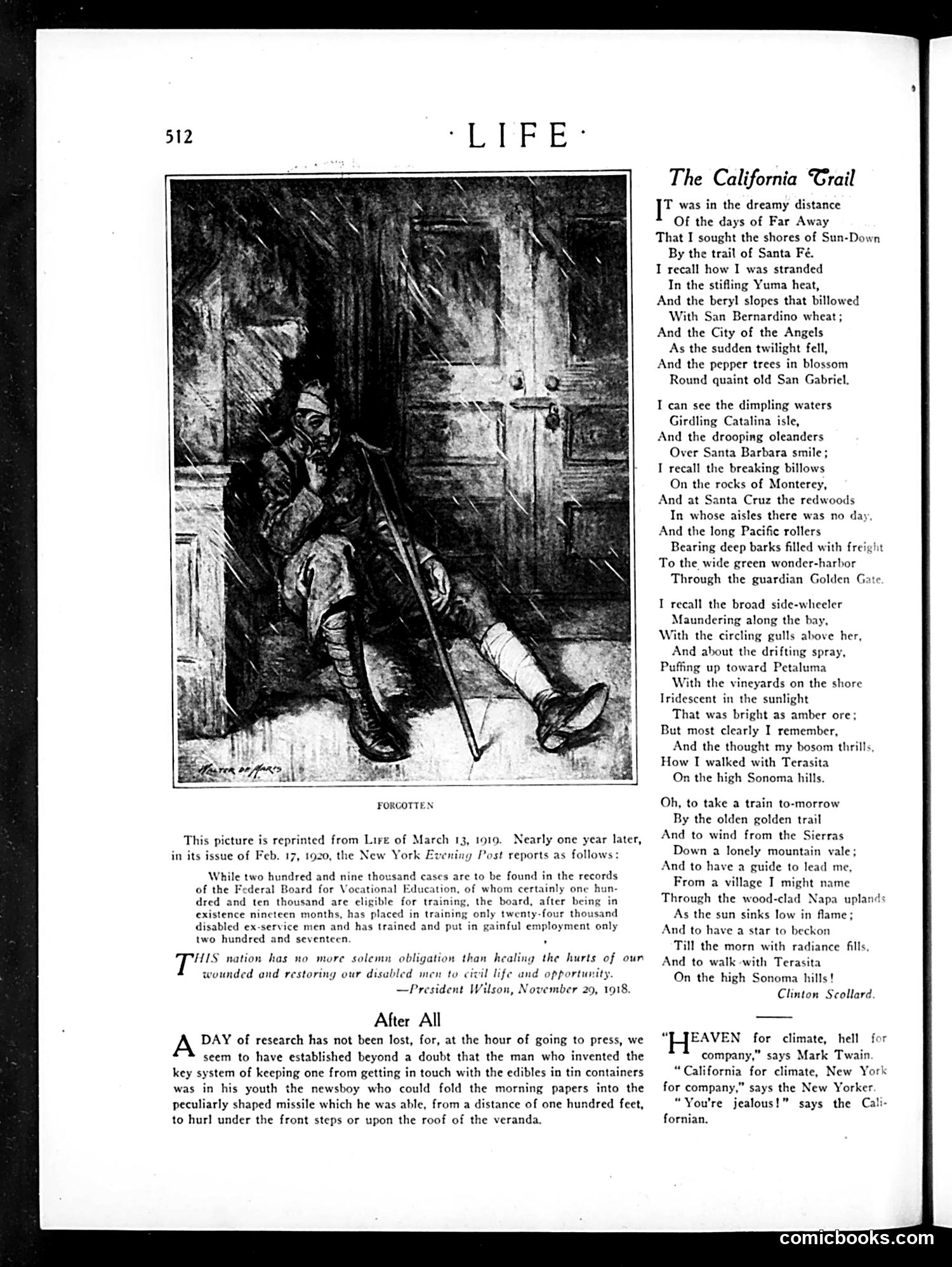
This page contains two distinct pieces: **The "Forgotten" Cartoon/Article (top left):** A 1919 illustration reprinted in 1920 showing a disabled WWI veteran. The accompanying text criticizes government failure: President Wilson promised to heal wounded soldiers, yet the Federal Board for Vocational Education had placed only 24,000 of 209,000 eligible disabled veterans into training, with merely 217 actually employed. The satire is bitter—the government's "solemn obligation" to veterans was largely abandoned. **"After All" (bottom):** A humorous filler article joking that the inventor of tin-can locking mechanisms was likely a childhood newspaper boy skilled at hurling folded papers onto roofs—connecting petty childhood mischief to adult engineering. **"The California Trail" and climate quote section:** A romantic poem about California by Clinton Scollard, followed by competing regional boasts about climate versus company—gentle ribbing between California and New York preferences.
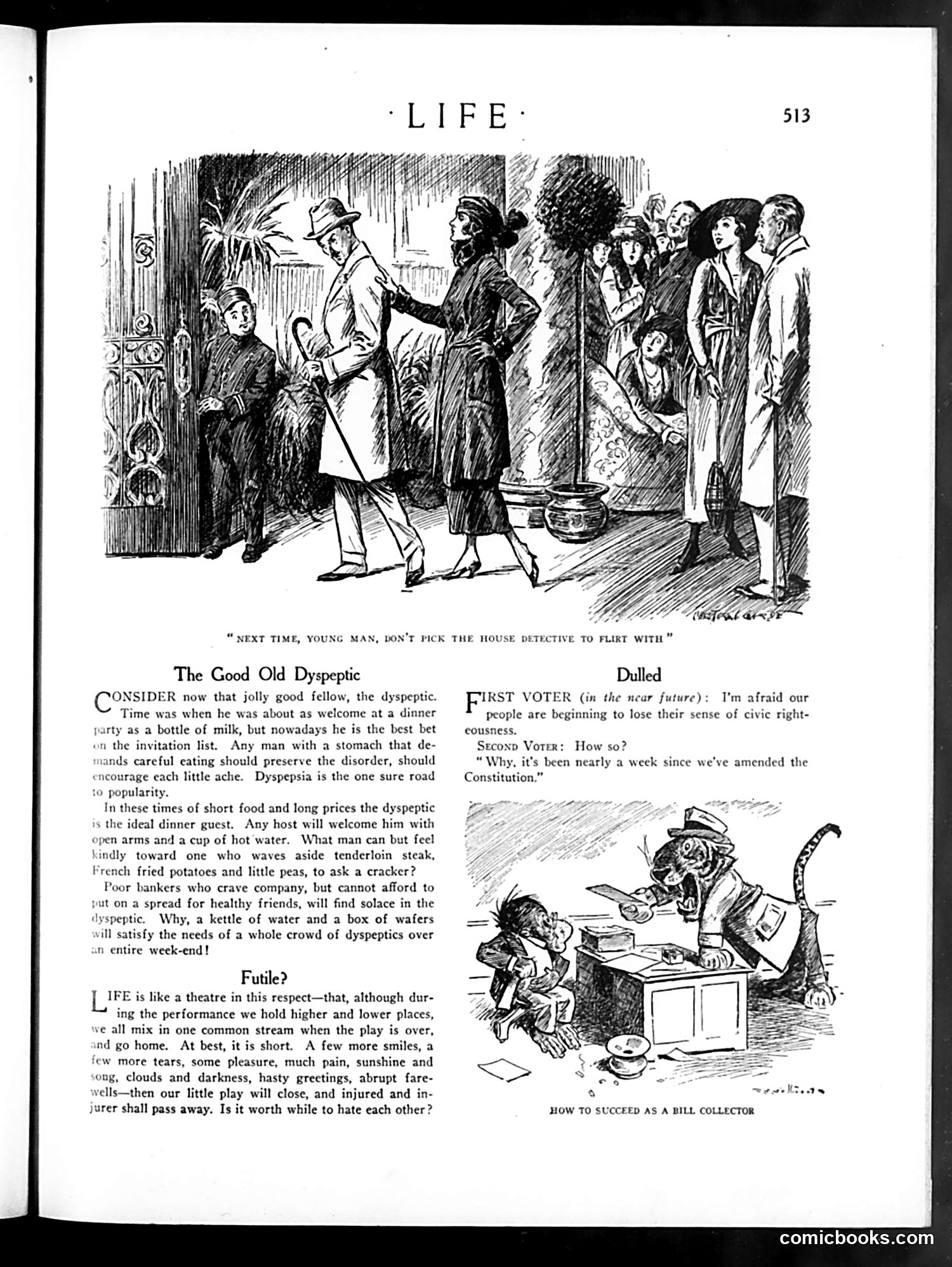
This page contains three separate satirical pieces typical of Life magazine's social commentary: **"The Good Old Dyspeptic"** mocks wartime food rationing by suggesting that having digestive problems has become advantageous—dyspeptics require minimal food (crackers, hot water) at dinner parties, making them ideal guests during times of "short food and long prices." The satire suggests hosts can entertain cheaply by inviting stomach-troubled guests. **"Futile?"** offers philosophical commentary questioning whether hatred between people is worthwhile, given life's brevity and inevitable equality in death. **"Dulled"** satirizes civic apathy, showing two voters discussing how citizens have become indifferent to civic duty. One expresses concern that people are "losing their sense of civic righteousness," with the other remarking it's been nearly a week since the Constitution was amended—implying casual, frequent constitutional changes reflect public disengagement. The top cartoon depicts a hotel scene warning against flirting with house detectives, likely a humorous domestic/relationship commentary.
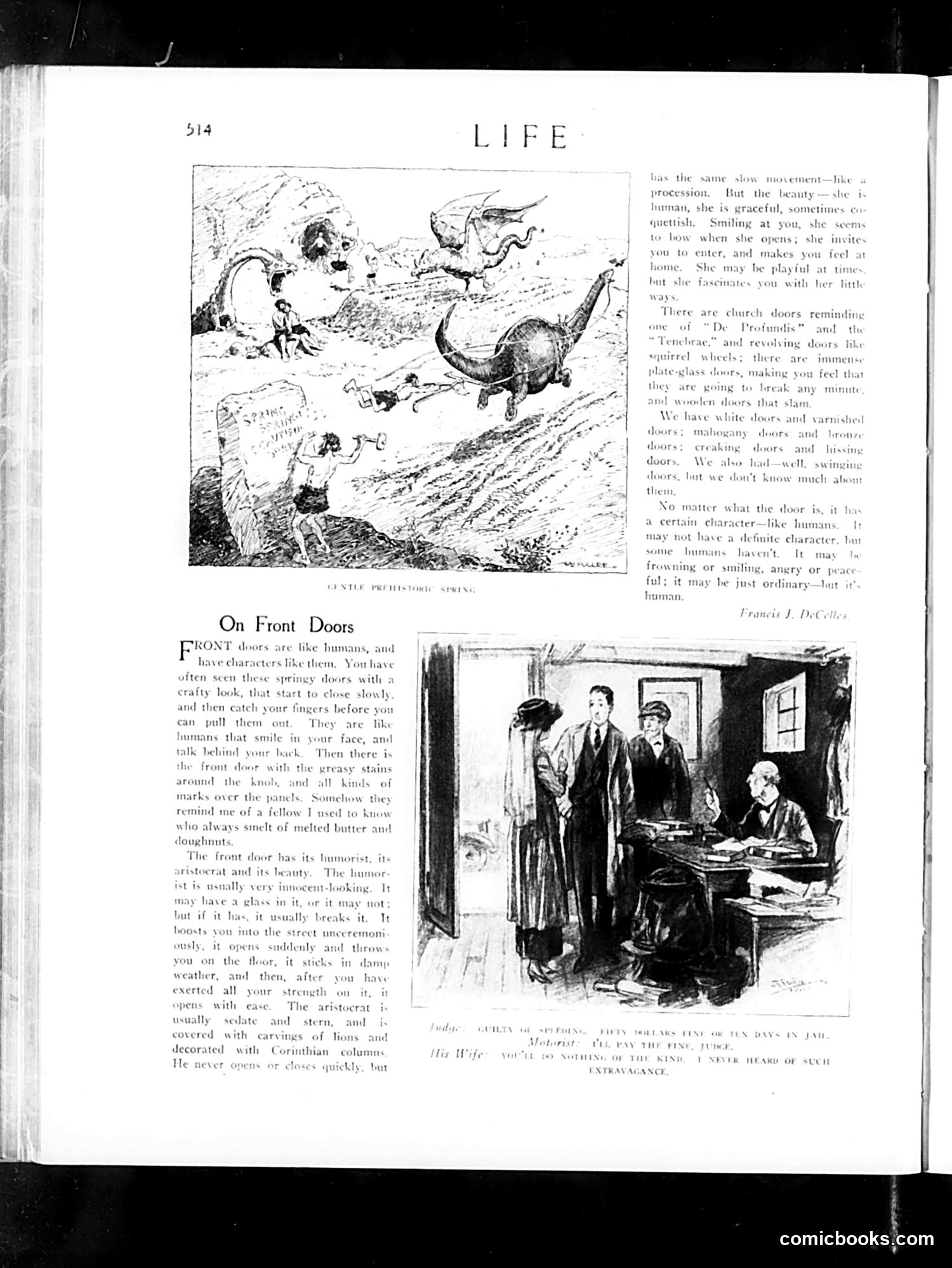
This essay satirizes front doors as having distinct personalities, like humans. The accompanying illustrations show doors as social gatekeepers—one depicts prehistoric cave dwellers with animal-shaped doors, humorously suggesting doors have always defined civilization and social status. The lower illustration shows a domestic scene where visitors arrive at a front door, likely commenting on the social rituals surrounding formal entry into homes. The text humorously describes how front doors reveal character: whether ornate or plain, they signal class status, hospitality, and personality. The satire gently mocks Victorian social pretension—how much weight people place on appearances, including their literal doorways, as markers of respectability and refinement. It's a lighthearted commentary on conspicuous display and social climbing through domestic decoration.
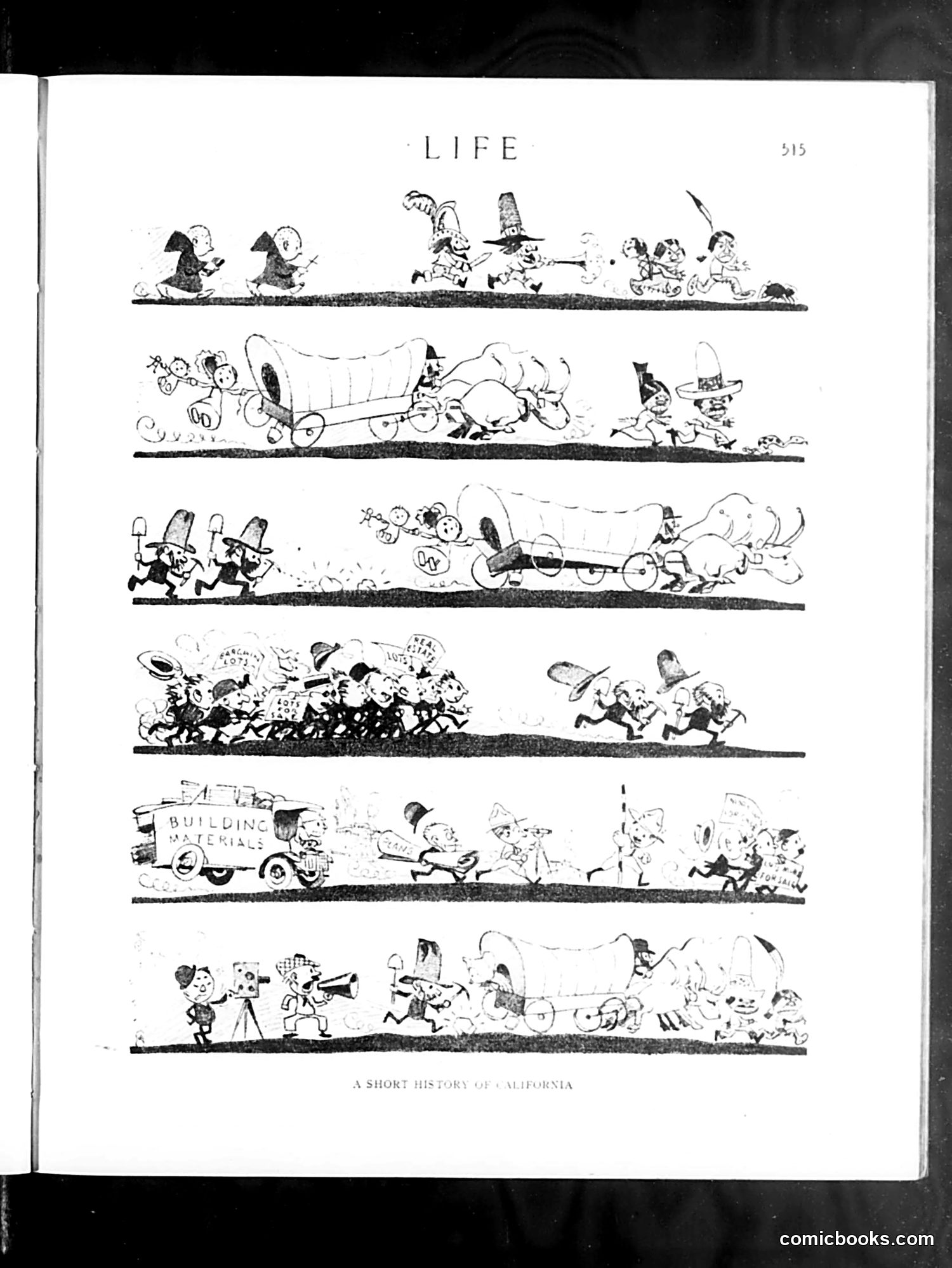
This page presents a humorous visual history of California's development through six horizontal comic strip panels. Each panel depicts a successive stage: early settlers/pioneers, covered wagons and westward expansion, larger wagon trains, what appears to be a gold rush or population boom, construction and building activity (marked "Building Materials"), and finally modern development with various vehicles and activity. The satire critiques California's rapid, chaotic growth and transformation from wilderness to developed state. The increasingly crowded panels suggest accelerating development and population influx. The title's irony—condensing complex history into simple cartoon panels—mocks how such grand narratives are oversimplified. This likely reflects early-to-mid 20th century anxieties about California's breakneck modernization and urbanization.
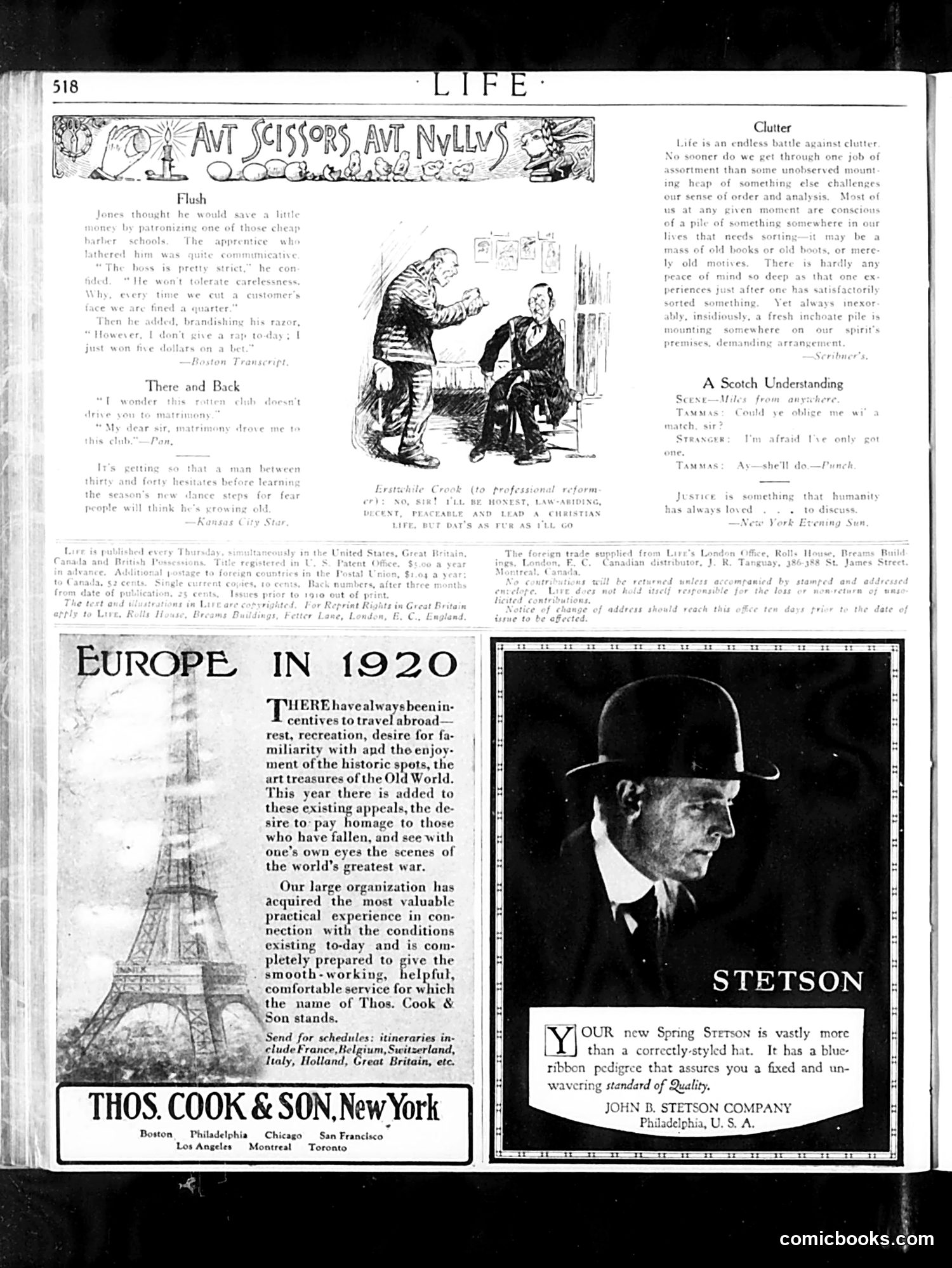
This page is primarily **advertising**, not political satire. The main content consists of two large ads: 1. **Thos. Cook & Son travel advertisement** (left): Promotes European tours in 1920, explicitly capitalizing on post-WWI tourism. It mentions the appeal of seeing "scenes of the world's greatest war"—visitors wanted to witness European battlefields and memorials honoring war dead. Cook & Son claims experience managing travel under current conditions. 2. **Stetson hat advertisement** (right): A straightforward product pitch for their spring hat line, emphasizing quality. The page's upper section contains minor comic sketches and brief humorous pieces ("Flush," "There and Back," "A Scotch Understanding," "Clutter")—typical Life magazine filler content—but these are disconnected vignettes without clear political commentary. The historical context: 1920 marks the immediate post-WWI period when Europeans were rebuilding and Americans began "dark tourism," visiting recent battlefields.
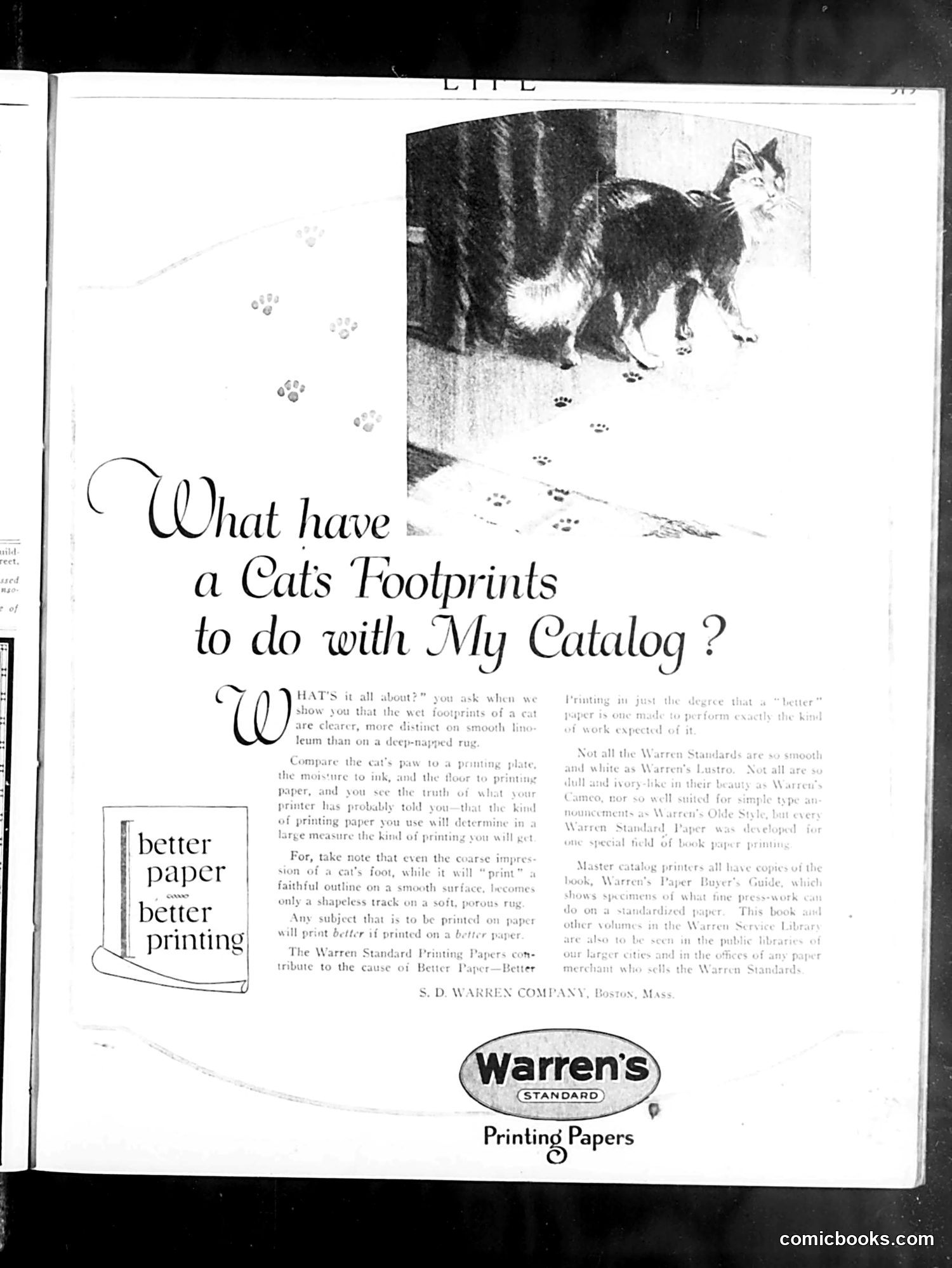
This is an advertisement for Warren's Standard Printing Papers, not a political cartoon. The page uses a clever visual metaphor: it shows a cat with its footprints trailing across a surface, comparing the clarity and distinctness of cat paw prints to the quality of printed reproduction on paper. The ad's rhetorical strategy asks readers to consider that just as a cat's footprints are "clearer, more distinct on smooth linen than on a deep-napped rug," so too will printing quality depend on the paper used. The message promotes Warren's papers as superior for producing sharp, clean printing results—particularly for catalogs and professional printing work. The "better paper = better printing" tagline reinforces that paper quality directly affects print output.
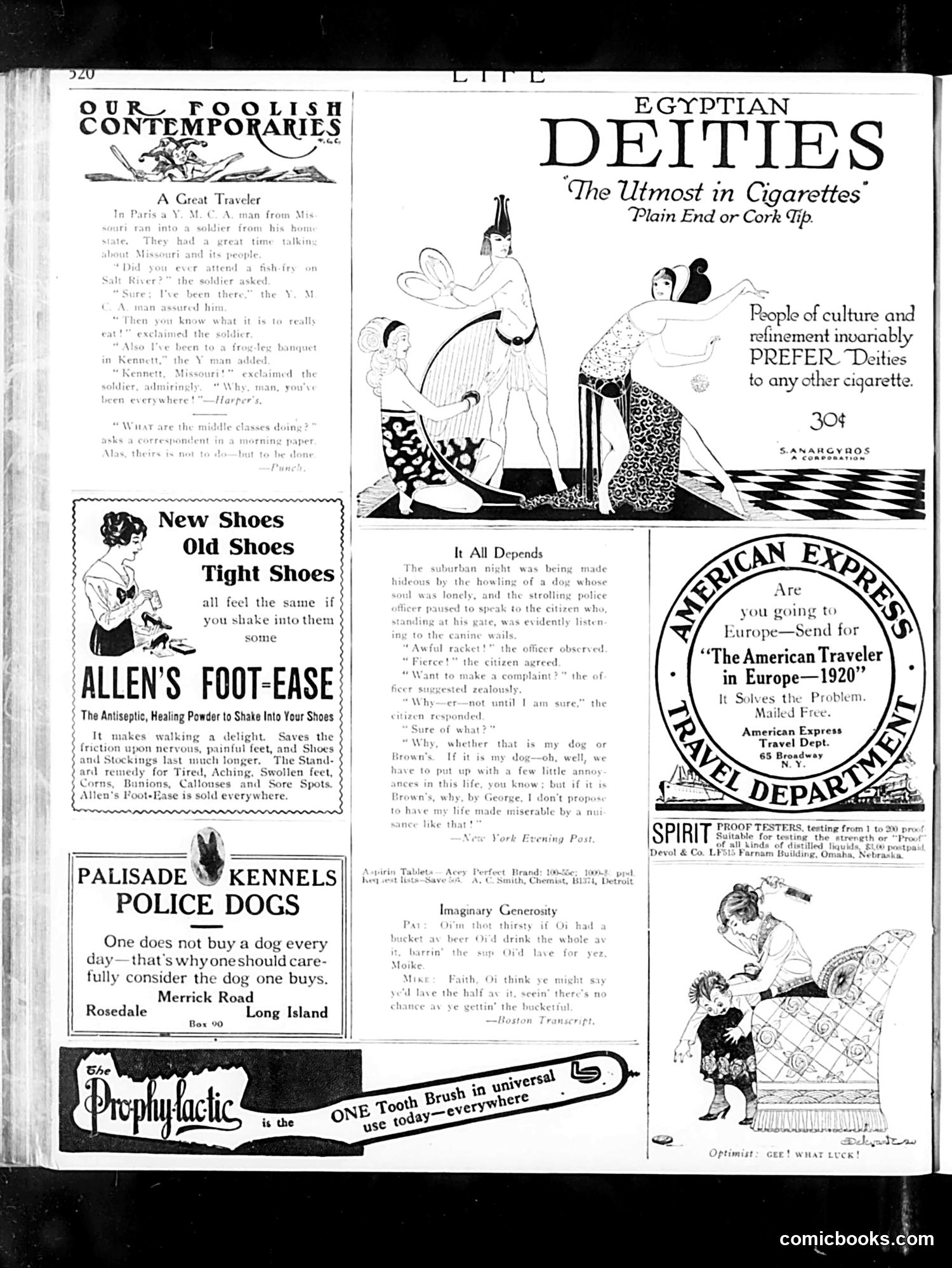
This page is primarily **advertising**, with minimal editorial content. The advertisements reflect 1920s consumer culture and social aspirations. **Key advertisements:** - **Allen's Foot-Ease**: A mundane product ad for foot powder, using practical messaging about shoe comfort. - **Egyptian Deities Cigarettes**: Positions smoking as a marker of "culture and refinement"—a common advertising strategy when cigarettes were still socially acceptable luxury goods. The Egyptian theming appears purely decorative/exotic branding. - **American Express Travel Department**: Appeals to wealthy Americans planning European travel post-WWI, offering travel planning services as a status symbol. - **Palisade Kennels**: A breeding business ad emphasizing careful dog selection. The page contains one small cartoon ("It All Depends" and "Imaginary Generosity") showing domestic/humorous scenes, but these appear minor to the advertising focus. The overall page reflects 1920s aspirational marketing targeting educated, affluent readers.
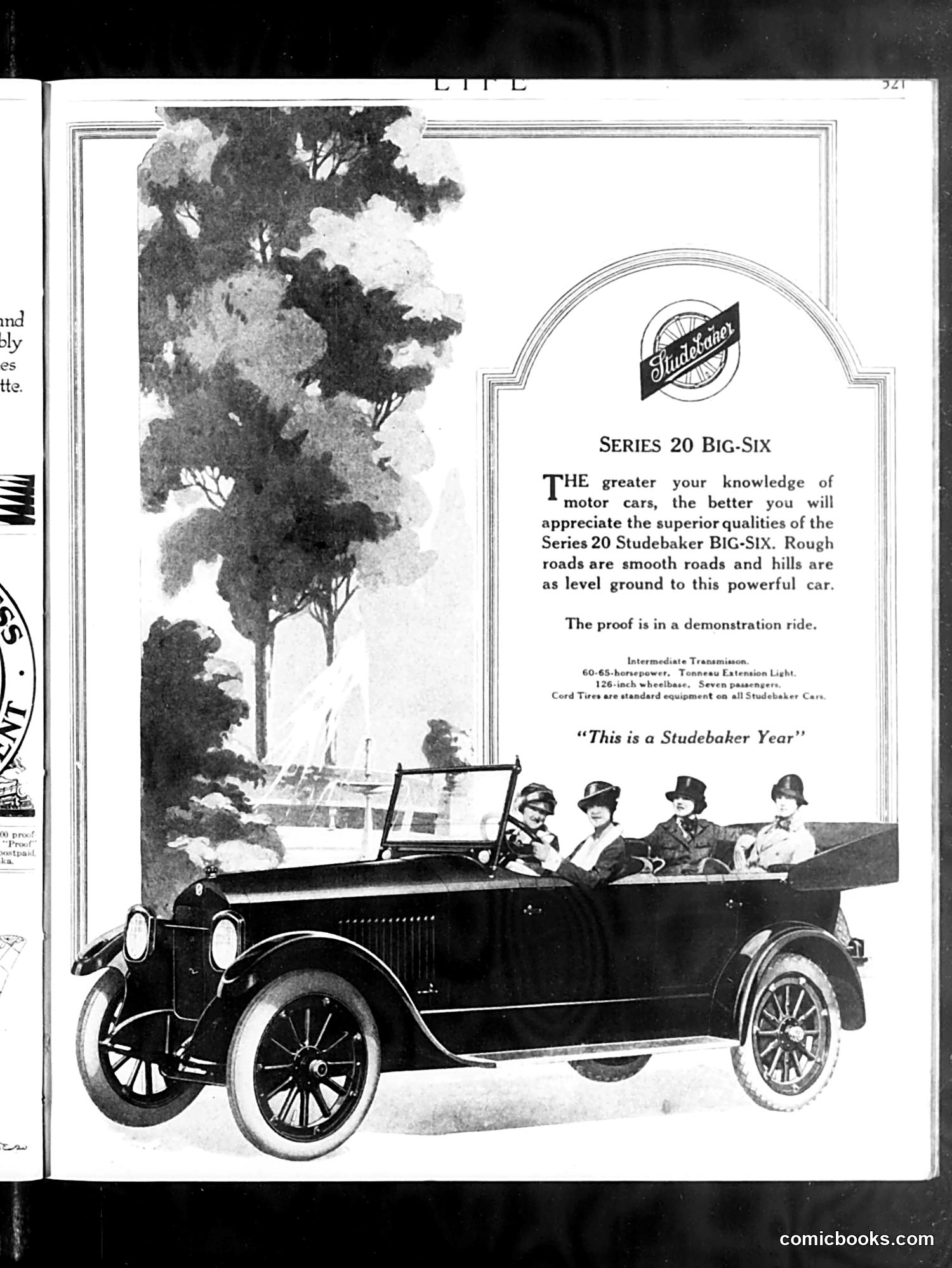
This is a **Studebaker automobile advertisement**, not a political cartoon. The page promotes the Series 20 Big-Six car, emphasizing its powerful performance ("rough roads are smooth roads and hills are as level ground"). The image shows five well-dressed passengers (appearing to be women and men in period clothing with hats) enjoying an open-air ride in the vehicle, positioned against a scenic backdrop of tall trees. The ad copy encourages potential buyers that greater automotive knowledge will help them appreciate the car's superior qualities. The phrase "This is a Studebaker Year" functions as a marketing slogan suggesting the brand's dominance or popularity during this period. The specifications listed (60-65 horsepower, 126-inch wheelbase, cord tires) are technical selling points for the era. This represents early 20th-century automotive marketing using aspirational imagery and performance claims.
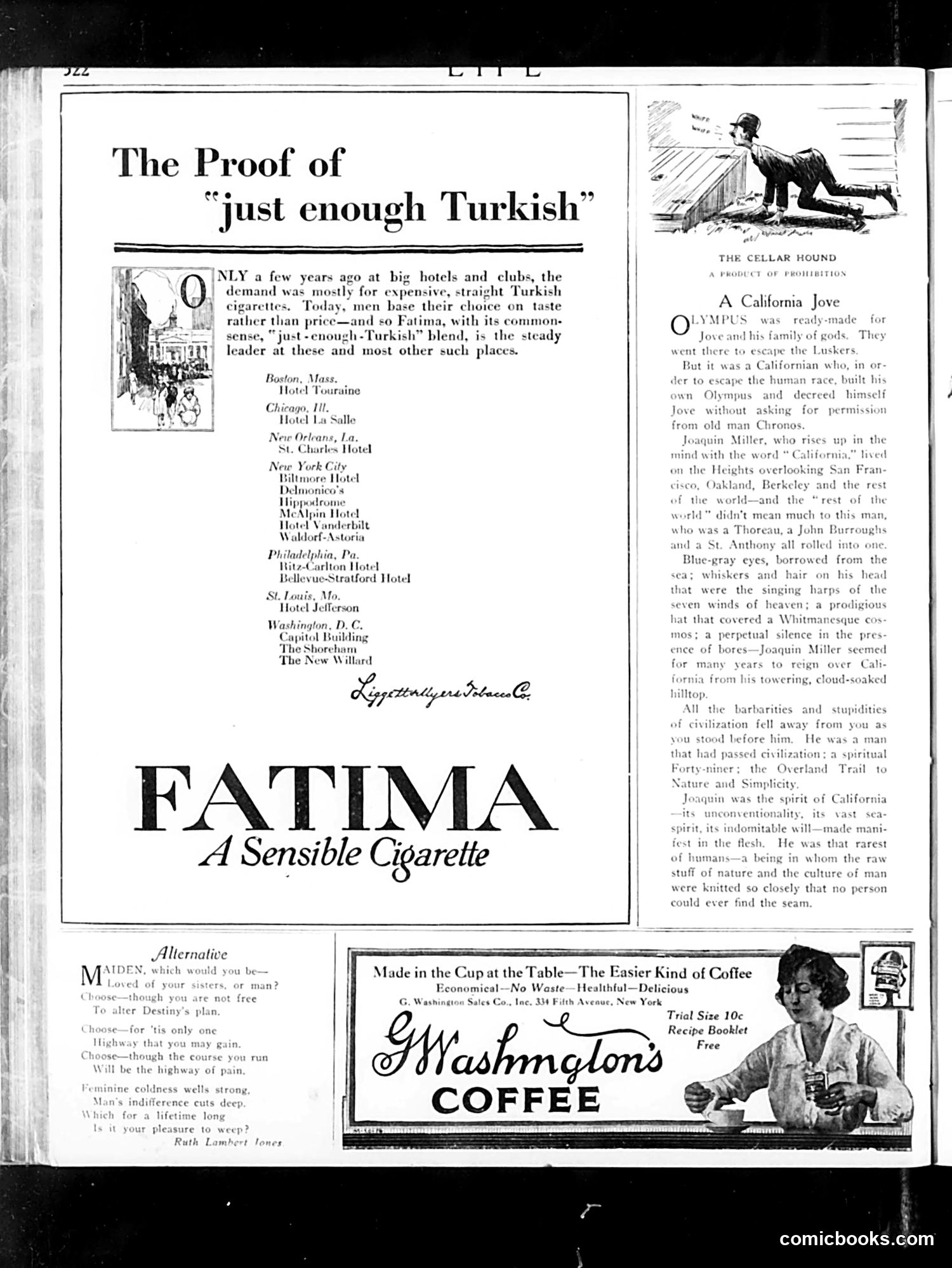
This page combines **advertising with literary content**, not political satire. The left side advertises **Fatima cigarettes**, emphasizing their "just enough Turkish" blend as a moderate, sensible choice. The ad lists prestigious hotels and clubs where Fatima is the preferred brand, appealing to sophistication and good taste among the wealthy. The right side features a short story titled **"The Cellar Hound: A California Love,"** about Joaquin Miller (a real 19th-century California poet), depicted as a spiritual, nature-loving figure who embodies California's unconventional spirit and rejection of civilization. Below is an advertisement for **G. Washington Coffee**, promoting its convenience and economy. The page reflects early 20th-century consumer culture: advertising luxury brands to educated, affluent readers by associating them with refinement, while offering literary content for the same audience. There is no political cartoon or satire present.
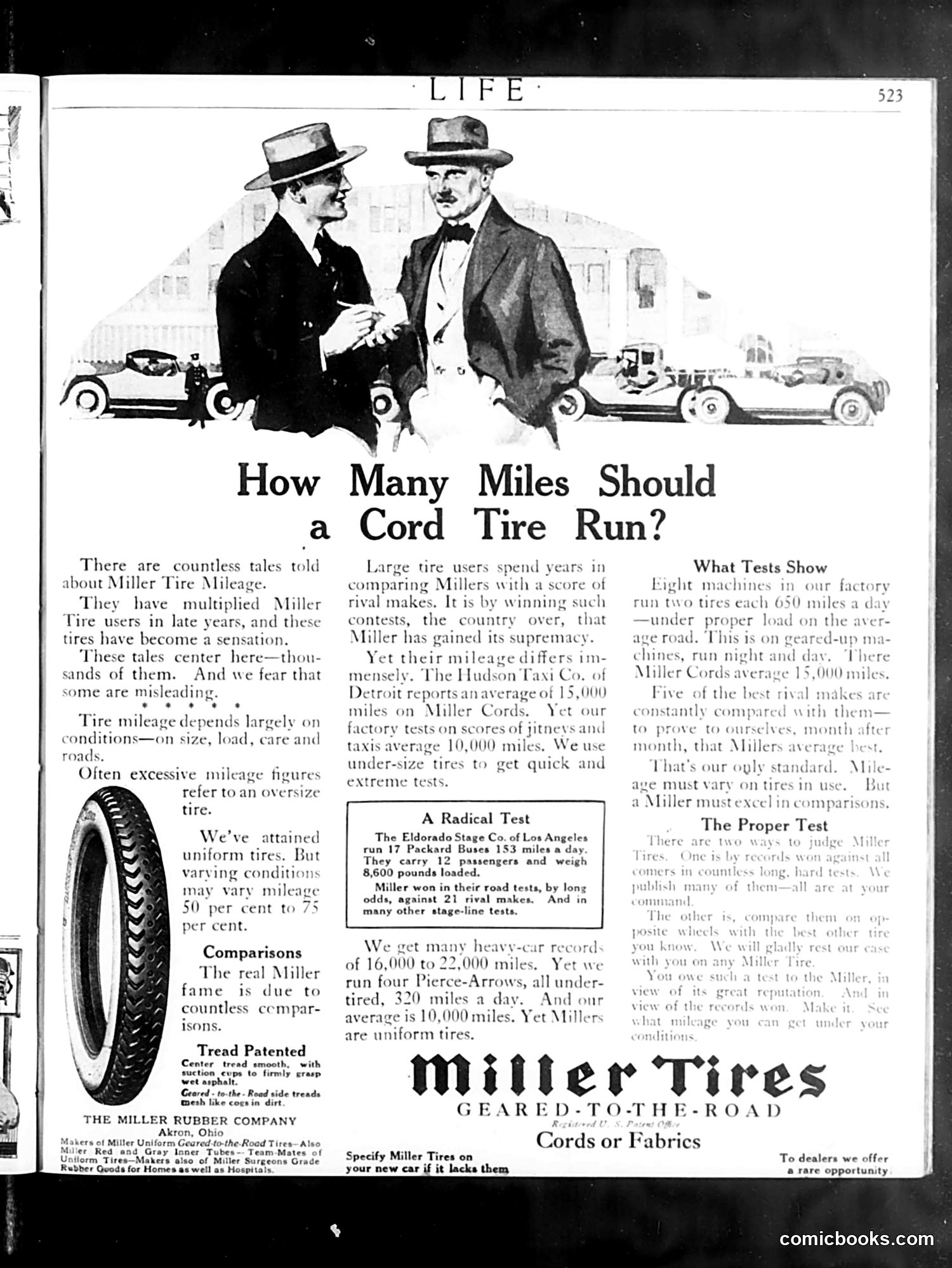
This is primarily a **tire company advertisement**, not political satire. The cartoon shows two well-dressed businessmen in conversation—likely representing a tire salesman and a potential customer—with automobiles in the background. The ad addresses skepticism about Miller Tire mileage claims. The text acknowledges that Miller tires have developed a reputation for exceptional longevity, but counters "countless" anecdotal claims that the company fears are "misleading." Miller defends its products through factory testing data, comparing their tires against competitors across various vehicles (taxis, buses, luxury cars). The company emphasizes that actual mileage varies based on conditions and tire size, while positioning Miller as uniformly superior through rigorous comparison testing. This reflects early 20th-century automotive marketing: establishing brand credibility through empirical testing claims during an era when consumer trust in manufactured goods was still developing.
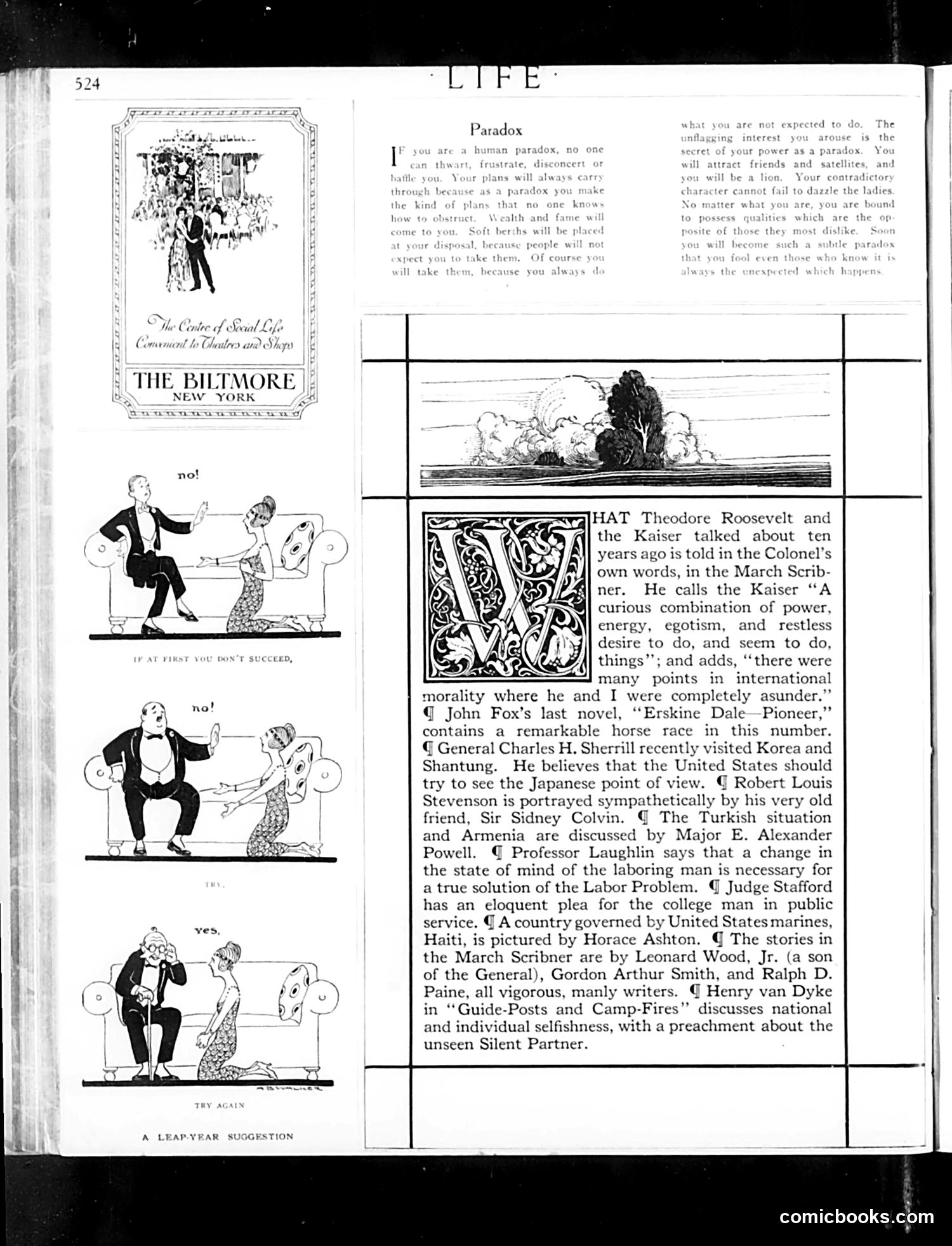
**The "Paradox" Section (top right):** This essay about human paradoxes describes the contradictions inherent in success—that ambitious plans often fail unexpectedly, and that one's greatest strengths become liabilities. **"A Leap-Year Suggestion" Cartoons (left side):** Three sequential panels show a man and woman on a couch. In panels 1-2, he repeatedly says "no!" to her proposal. In panel 3, he says "yes." The joke plays on leap-year tradition where women could propose to men—the cartoon humorously depicts persistence finally breaking male resistance. **Right Column:** Appears to be a magazine contents/preview section referencing articles in *Scribner's* magazine, including pieces by Theodore Roosevelt discussing the Kaiser, John Fox's novel, and contributions by Leonard Wood Jr., Henry van Dyke, and others on contemporary topics (labor problems, Haiti, Turkey). This is primarily **editorial/advertising content** rather than political satire, showcasing *Life's* lighter humor style of the era.
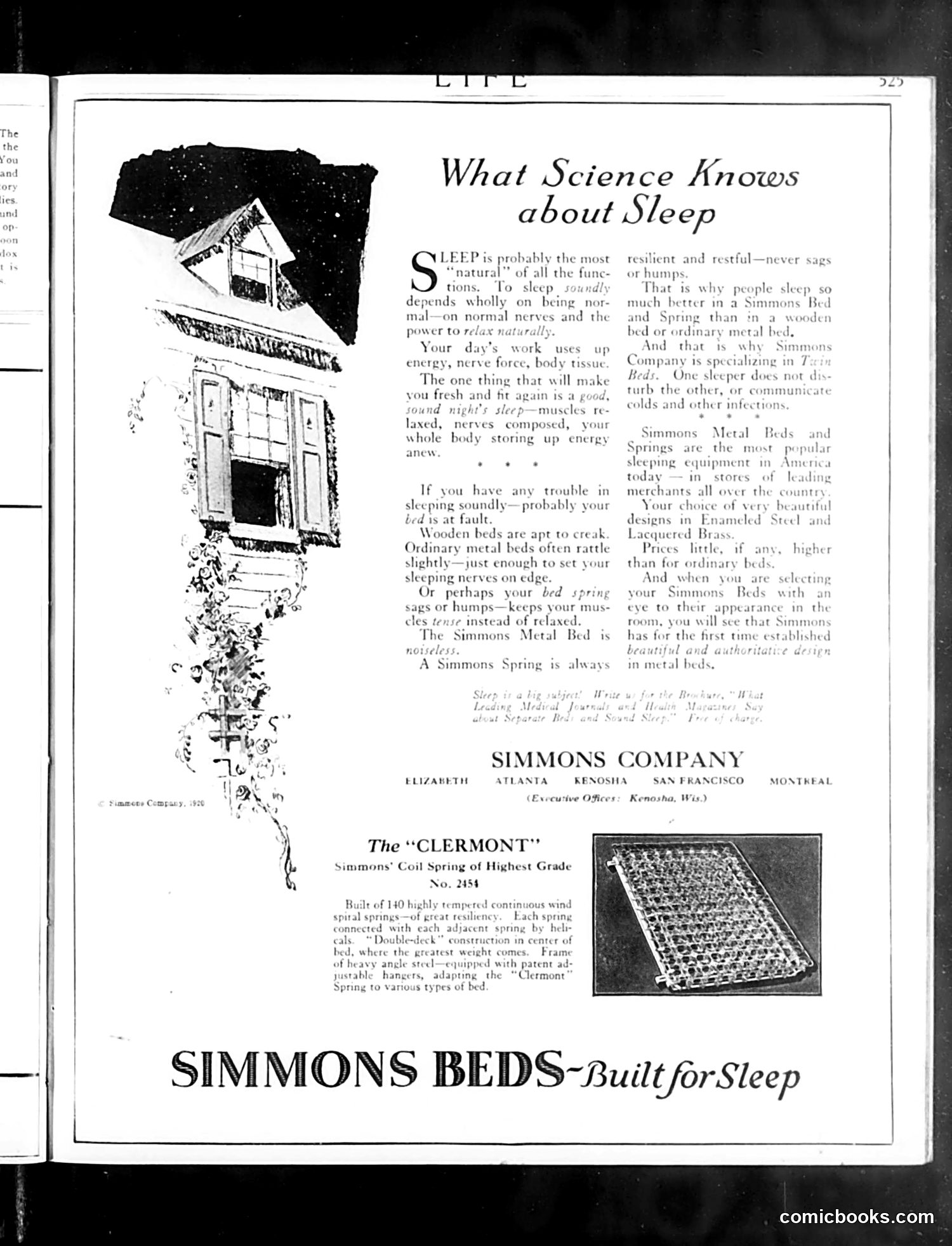
This is **primarily an advertisement**, not satire or political commentary. The Simmons Company uses pseudo-scientific claims about sleep to sell beds and mattress springs. The text claims that poor sleep results from faulty beds—wooden beds creak, metal beds rattle, springs sag. The solution: Simmons Metal Beds with their "Clermont" coil spring system, presented as scientifically superior for "relaxation." The accompanying illustration shows a cross-section of a bedroom at night, emphasizing the bed as central to rest and health. **For modern readers:** This reflects early 20th-century marketing strategy—dressing commercial products in scientific language ("nerve force," "resilient") to suggest medical necessity rather than luxury. The claim that bed quality directly controls sleep quality would seem exaggerated today, though mattress marketing still uses similar tactics. There is no identifiable political satire or cartoon humor on this page—it's straightforward period advertising.
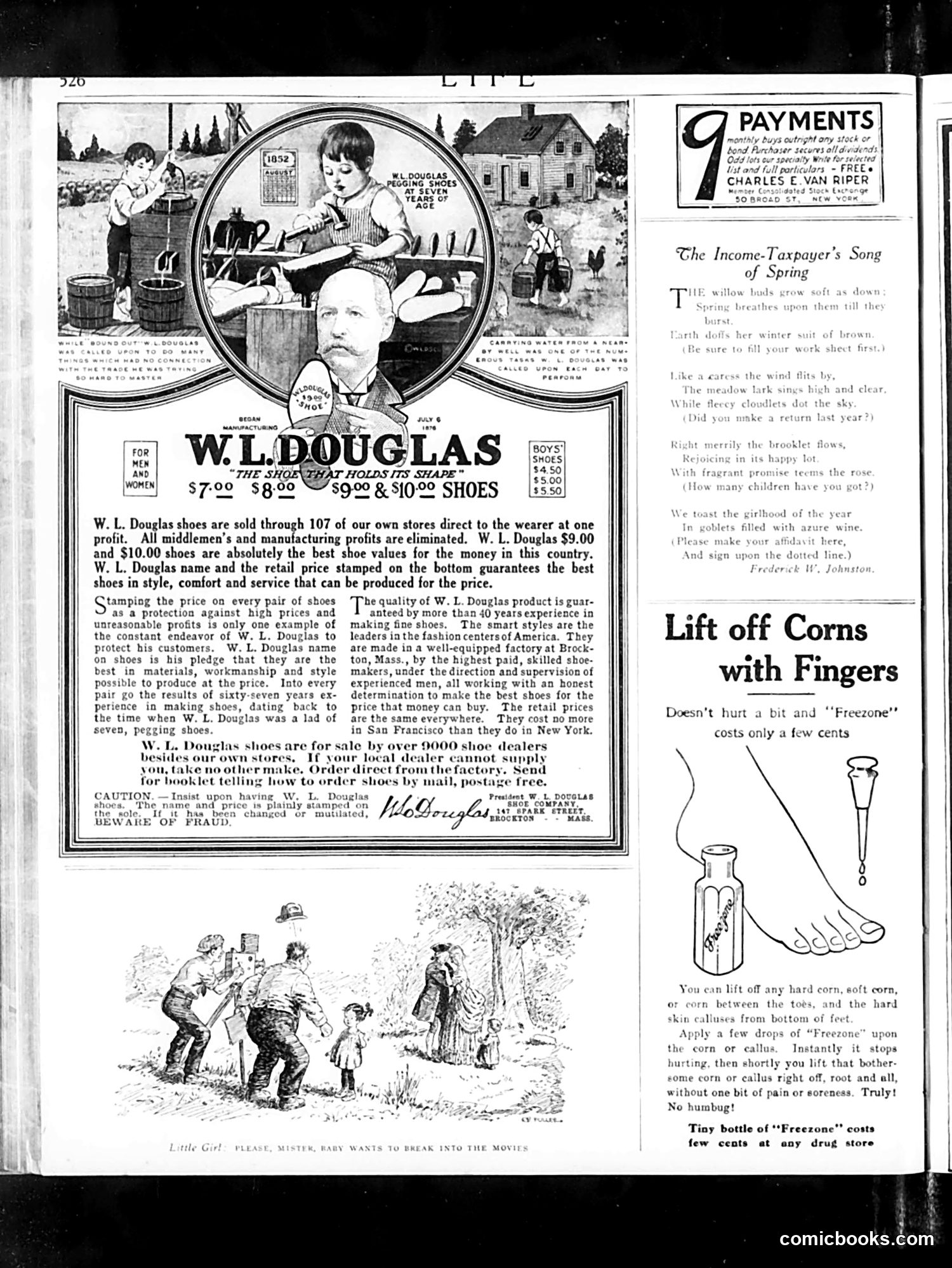
This page is primarily **advertising**, not political satire. It contains two major commercial advertisements: 1. **W.L. Douglas Shoes** (center/left): A large ad featuring the shoe manufacturer emphasizing direct-to-consumer sales, eliminating middlemen profits, and price transparency. The circular vignette shows Douglas as a successful businessman; the narrative emphasizes his 67 years of shoemaking experience and ethical pricing practices—a notable selling point in an era when retail markup and fraud were common consumer concerns. 2. **"Freezone" Corn Remover** (right): A medical product advertisement claiming painless corn removal using a liquid applicator. 3. **"The Income-Taxpayer's Song of Spring"** (upper right): A poem expressing taxpayer frustration about spring obligations—likely referencing tax season, though specific historical context is unclear. The page reflects early-20th-century consumer culture emphasizing value, transparency, and direct manufacturing relationships as selling points—and the prevalence of home remedies for common ailments.
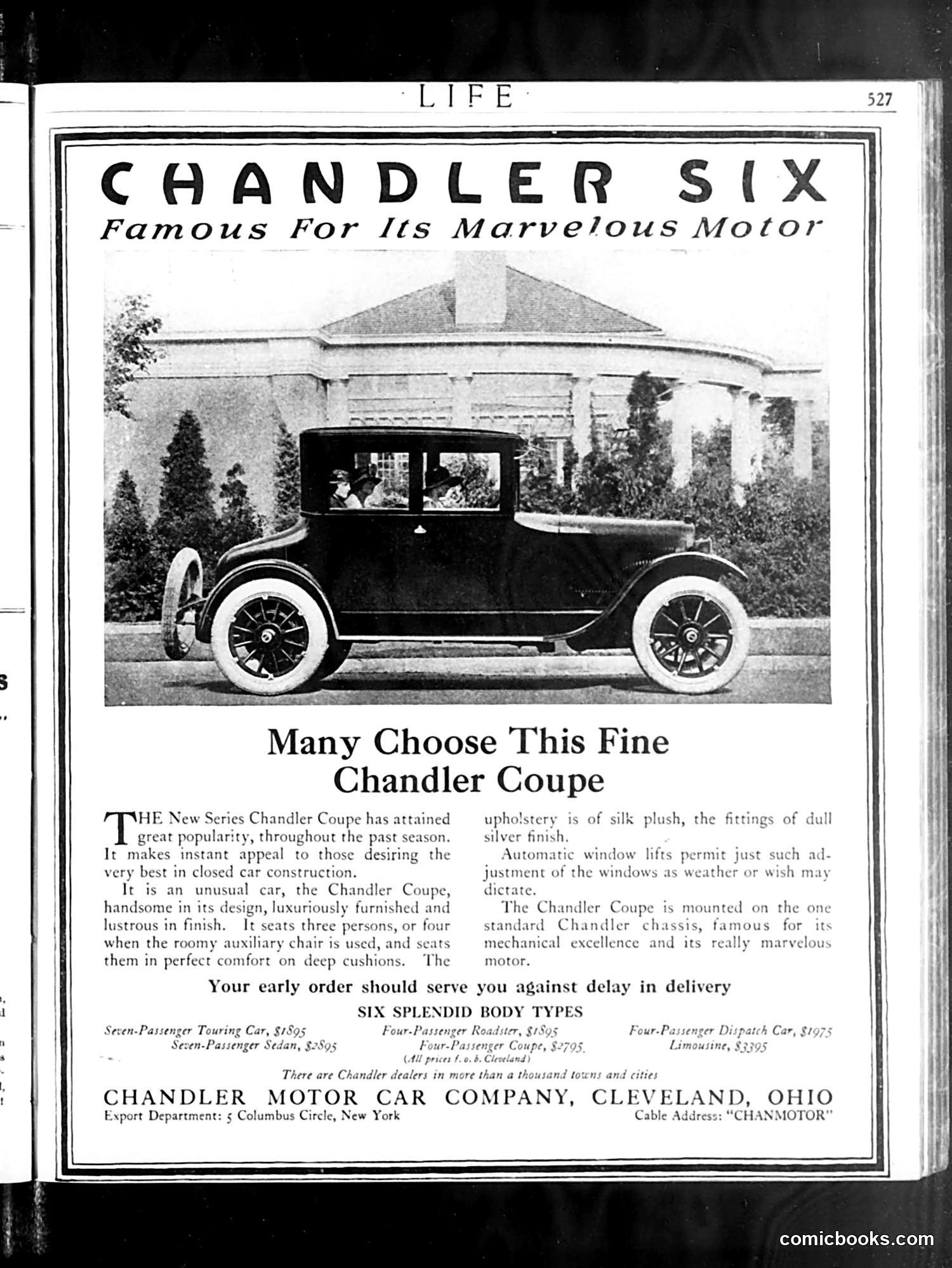
The page features a vintage car ad from Life magazine promoting the Chandler Six luxury automobile. The image shows a black coupe-style car parked in front of an elegant building with classical columns. The ad emphasizes the car's features: silk plush upholstery, automatic window lifts, seating for three to four passengers, and most importantly, its "marvelous motor"—the Chandler Six engine, which was apparently the car's distinguishing selling point. The advertisement lists six body types available and includes pricing information ($1,895-$3,395). It's directed at affluent buyers seeking quality closed-car construction and luxury appointments. The copy urges "early order" to avoid delivery delays, suggesting strong demand. There is no satire or political content here—this is straightforward automotive marketing aimed at the wealthy during what appears to be the 1920s automobile boom.
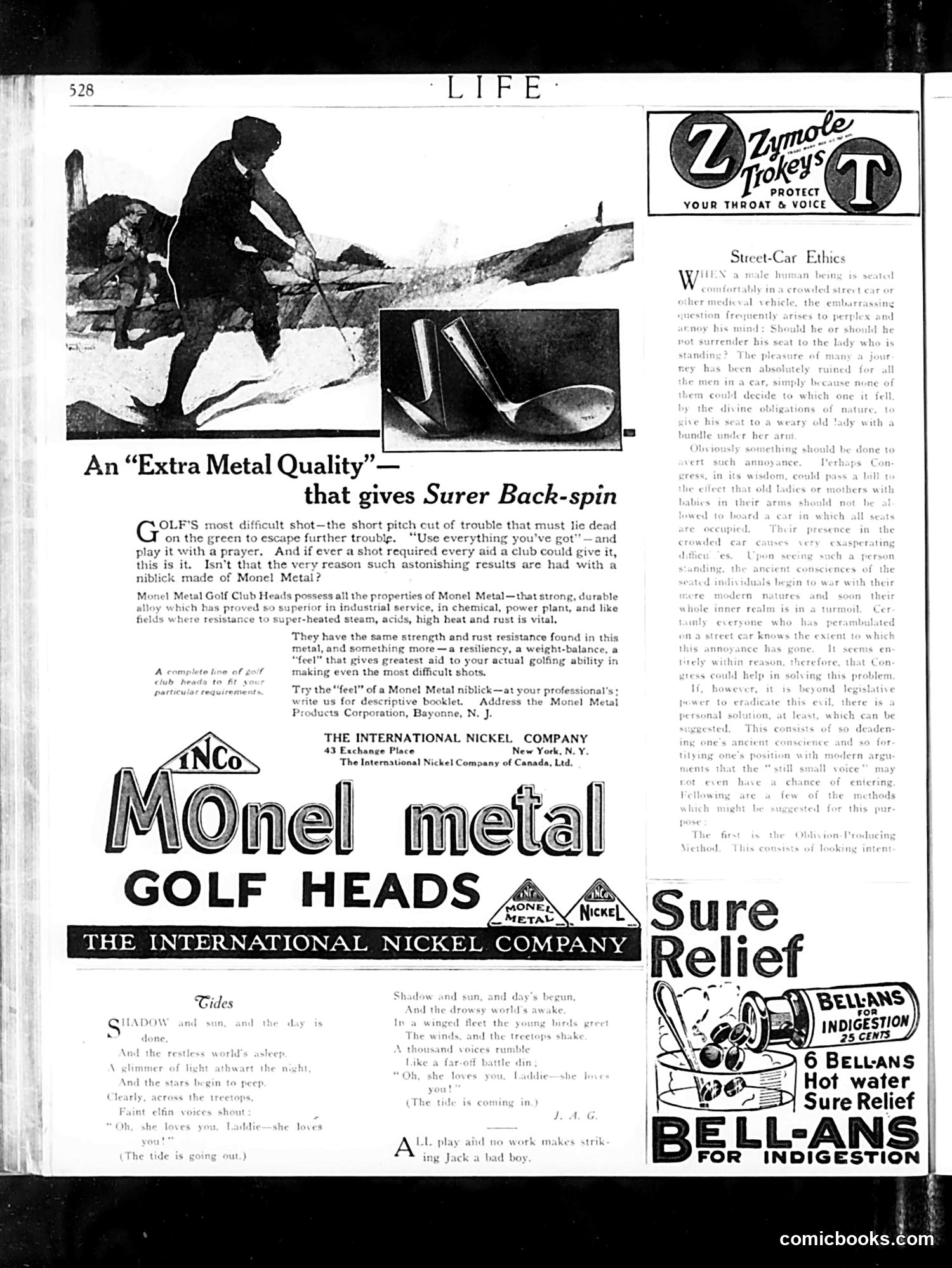
This page is primarily **advertising**, not political satire. It contains three distinct ads: 1. **Monel Metal Golf Heads** (center): The International Nickel Company promotes golf club heads made from their nickel alloy, claiming superior durability and performance for difficult shots. The image shows a golfer mid-swing. 2. **Zymole Trokeys** (top right): A throat lozenge product claiming to protect "your throat & voice." 3. **Bell-Ans for Indigestion** (bottom right): An antacid remedy advertised as providing "Sure Relief" via hot water. The page also includes a poem titled "Tides" (lower left), unrelated to the ads. There is **no political cartoon or satire** visible here. This is a standard magazine page from Life's advertising section, typical of early-to-mid 20th century publications mixing editorial content with commercial pitches. The products reflect period concerns: golf equipment, vocal health, and digestive remedies.
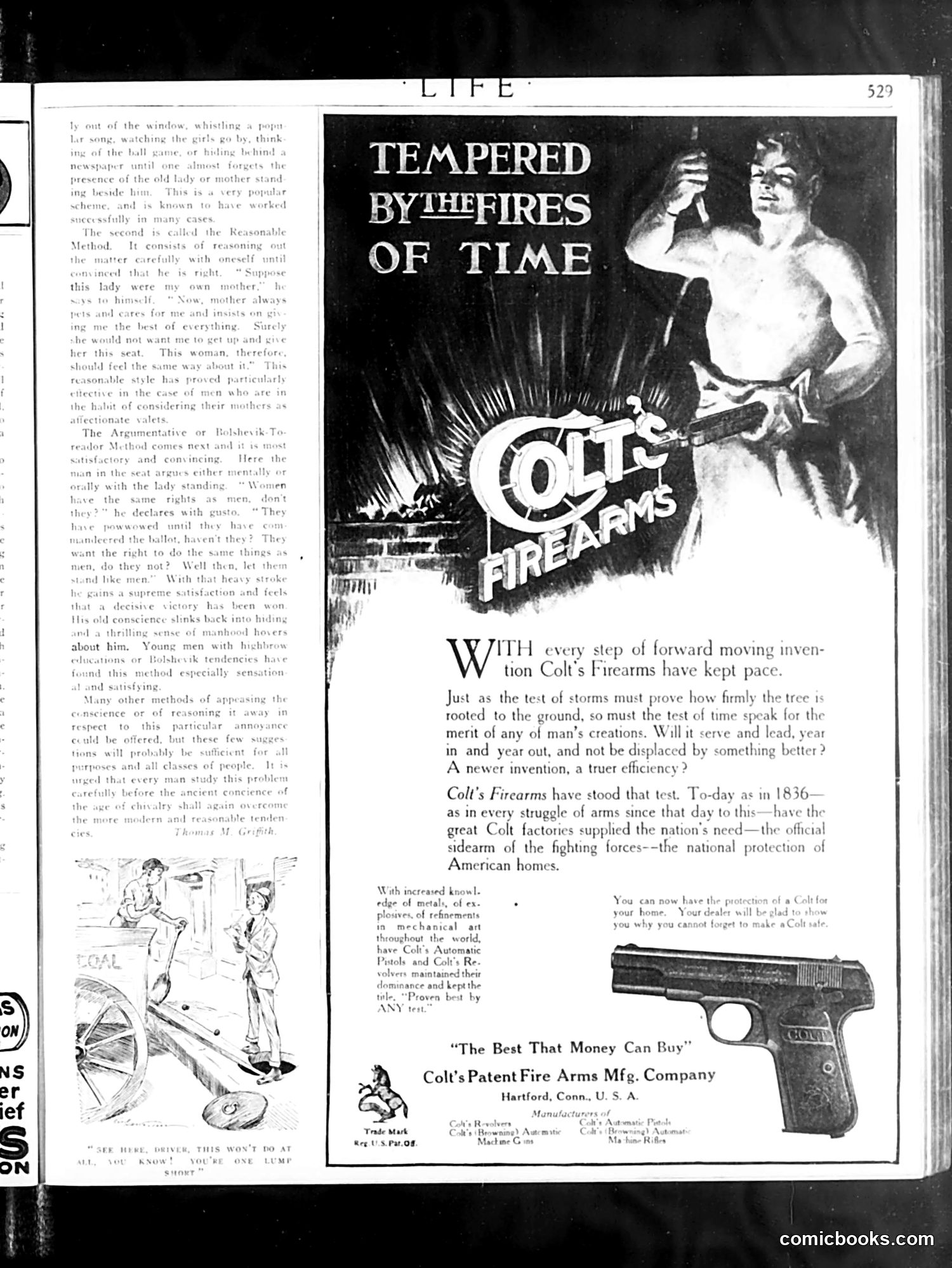
This page is primarily a **Colt Firearms advertisement**, not political satire. The ad uses the metaphor of trees weathering storms to argue that Colt guns have proven their durability and reliability since 1836. The small cartoon at lower left appears unrelated—it shows figures with a bicycle and contains text "HERE, DRIVER, THIS WON'T DO AT ALL, YOU KNOW—YOU'RE ONE LUMP SHORT," suggesting a separate humorous illustration about a delivery or transport mishap. The main advertisement's message is straightforward marketing: Colt firearms have endured through American history and remain "the official sidearm of the fighting forces" and protector of "American homes." The imagery of women and fire emphasizes domestic security. This reflects early 20th-century advertising that promoted guns as essential household protection. The page contains no identifiable political cartoon or satire—it's primarily commercial content from Life magazine.
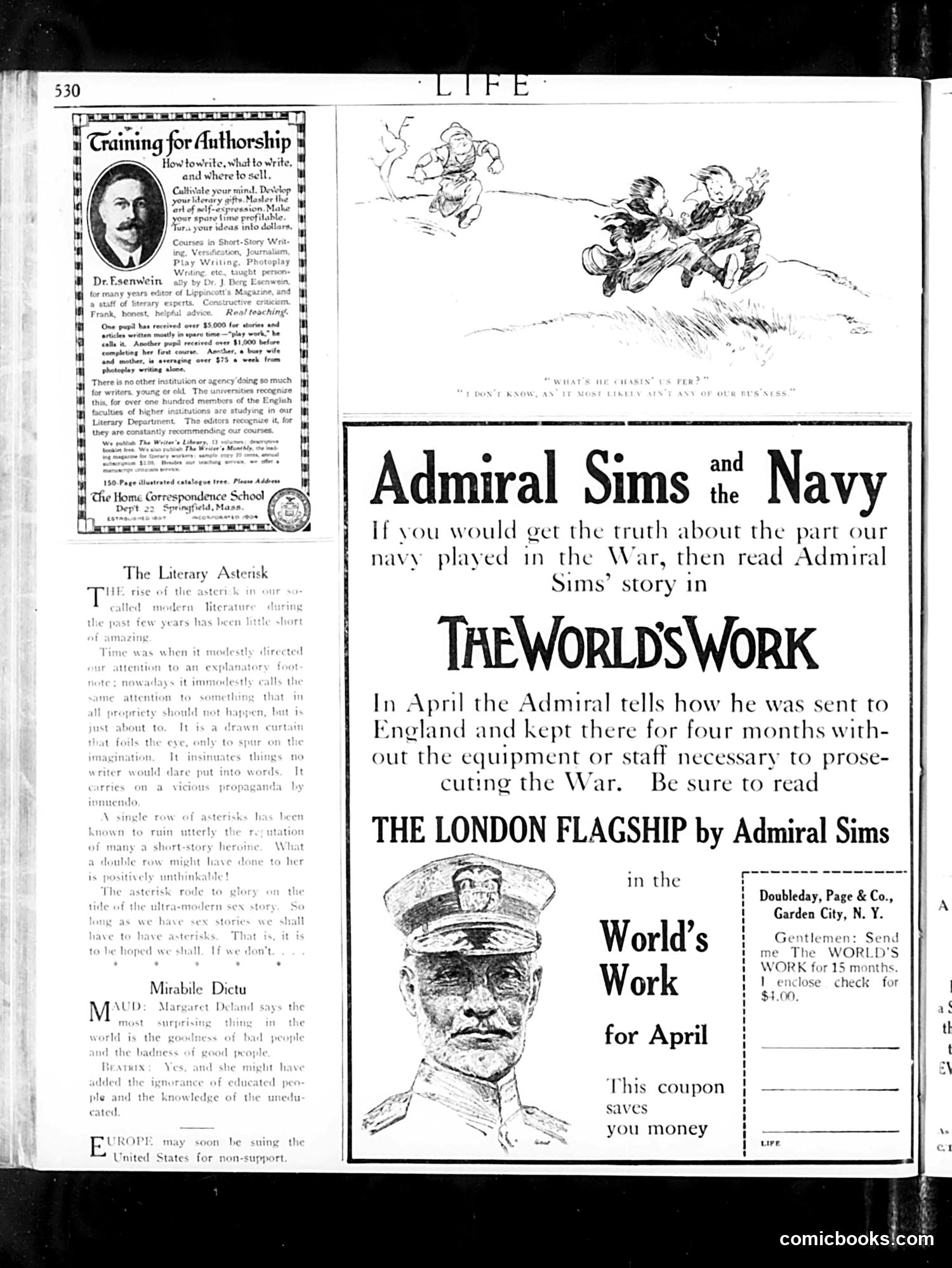
This page combines editorial content with advertising. The left side features two short opinion pieces: "The Literary Asterisk" discusses the rise of asterisks in modern literature as a narrative device, and "Mirabile Dictu" presents a witty exchange between "Maud" and "Harris" about educated people and ignorance. The dominant content is a large advertisement for *The World's Work* magazine, promoting Admiral William Sims's serialized account of his naval service in World War I. The ad emphasizes Sims's account of being sent to England for four months without adequate equipment or staff—a historical controversy about American military preparedness. The piece "The London Flagship" appears to be his firsthand account of this experience. This represents early 20th-century magazine advertising that combined popular historical narratives with subscription pitches, using credible public figures' controversial experiences to attract readers interested in insider war accounts.
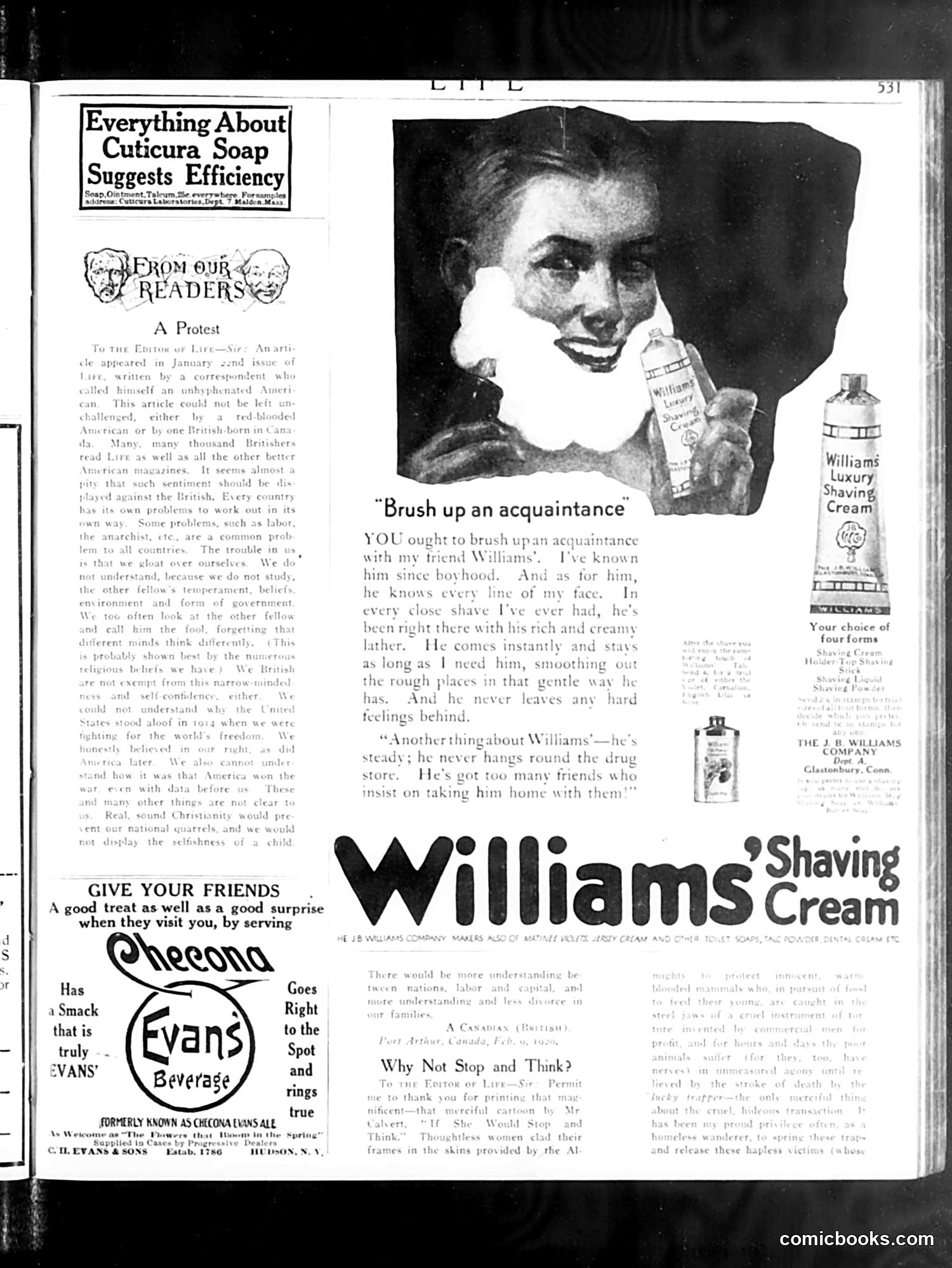
This page is primarily **advertising**, not political satire. It features: **Main Advertisement:** Williams' Shaving Cream dominates the right side, using a testimonial format ("Brush up an acquaintance") where a male character endorses the product's quality and reliability. **Secondary Ads:** - Cuticura Soap (top left) - Cheona Evans Beverage (bottom left) — a soft drink marketed as having "a smack that is truly Evans'" and "goes right to the spot" **Reader Letter:** A "Protest" section criticizes a previous Life article for anti-British sentiment, arguing for understanding between nations rather than conflict. **Overall Context:** This appears to be from the early 20th century based on typography and design. The page reflects period advertising conventions emphasizing product reliability and social propriety. The reader's letter suggests Life magazine occasionally published political commentary, but this particular page is dominated by commercial messaging rather than editorial satire.
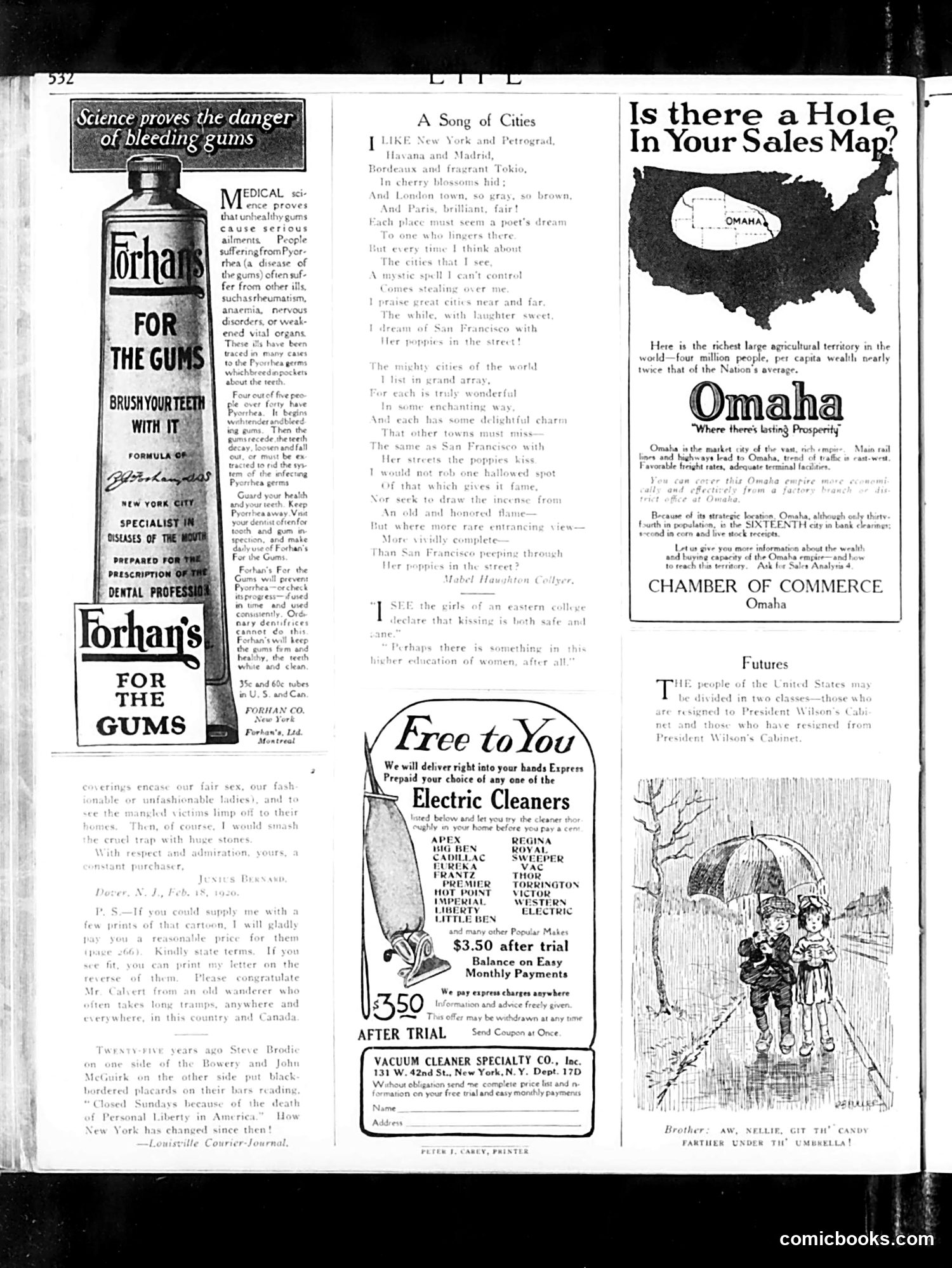
This page is primarily **advertising content** from an early 20th-century American magazine, with minimal satirical cartoons. The main advertisements include: 1. **Forhans toothpaste** — promoting gum health with medical claims (reflecting early 1900s advertising that made direct health assertions before FDA regulations) 2. **Omaha Chamber of Commerce** — a civic booster ad highlighting Omaha's agricultural wealth and inviting business investment, with a map showing the city's location 3. **Electric vacuum cleaners** — offering home delivery and installment payments ($3.50 after trial, balance on easy monthly payments), listing multiple popular brands of the era (Apex, Eureka, Hoover, etc.) 4. **"A Song of Cities"** — a poem celebrating major world cities (New York, Petrograd, Madrid, London, Paris, San Francisco) 5. **"Futures"** — a brief text piece about U.S. political divisions The page reflects **consumer culture and national expansion** themes typical of the period, with no significant political satire visible.
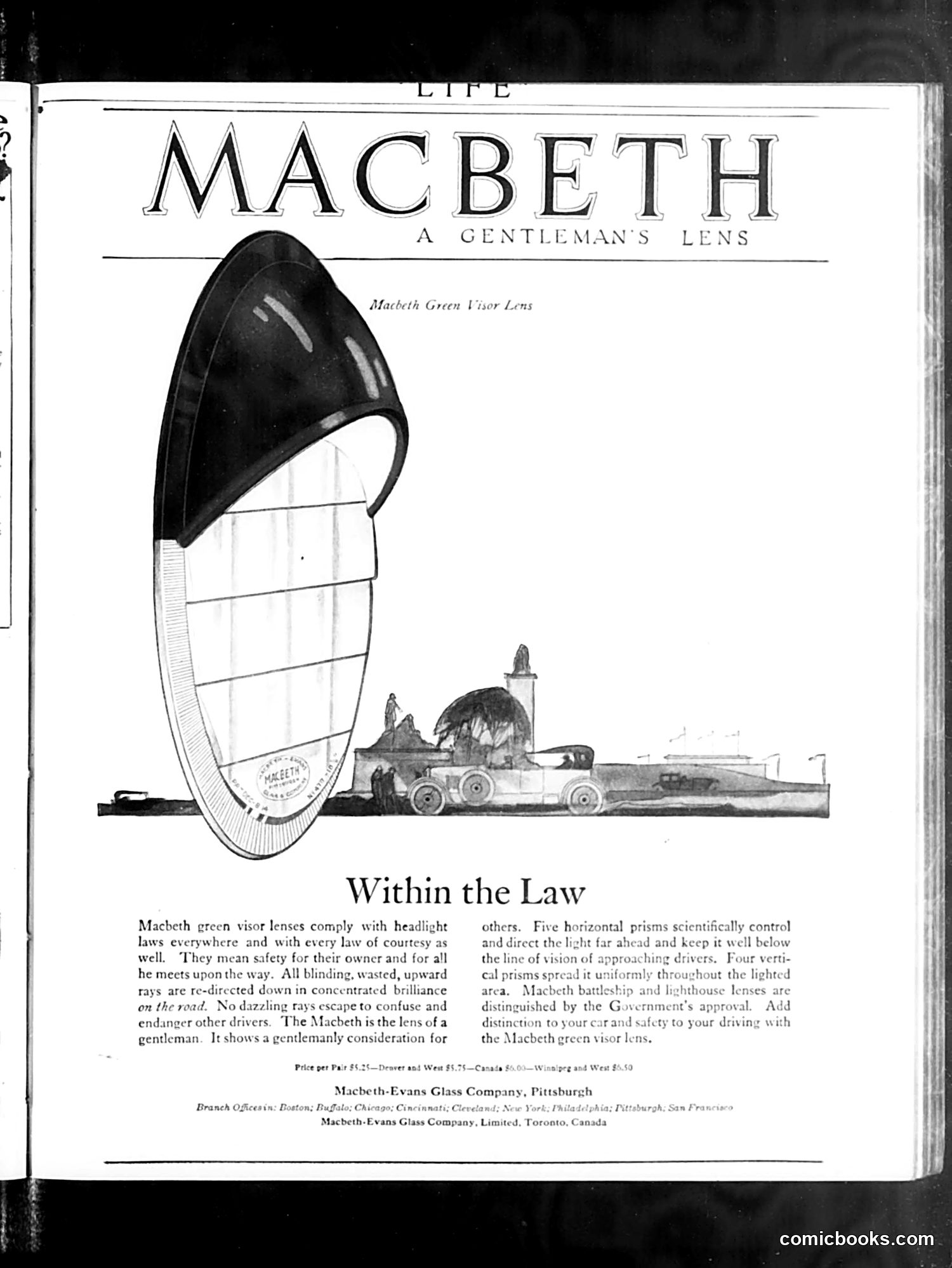
This is primarily a **product advertisement**, not political satire. It promotes Macbeth brand green-tinted automobile visor lenses made by Macbeth-Evans Glass Company. The ad uses the framing device of "Within the Law" to market safety features: the green lenses comply with headlight regulations while redirecting glare downward, protecting both the driver and other motorists. The small illustration shows a vintage automobile on a road, emphasizing the automotive context. The "gentleman's lens" language appeals to contemporary values of courteous, responsible driving—positioning the product as the choice of considerate drivers who protect fellow road users from dangerous glare. This is straightforward early 20th-century consumer advertising using appeals to legality, safety, and gentlemanly conduct rather than satire or political commentary.
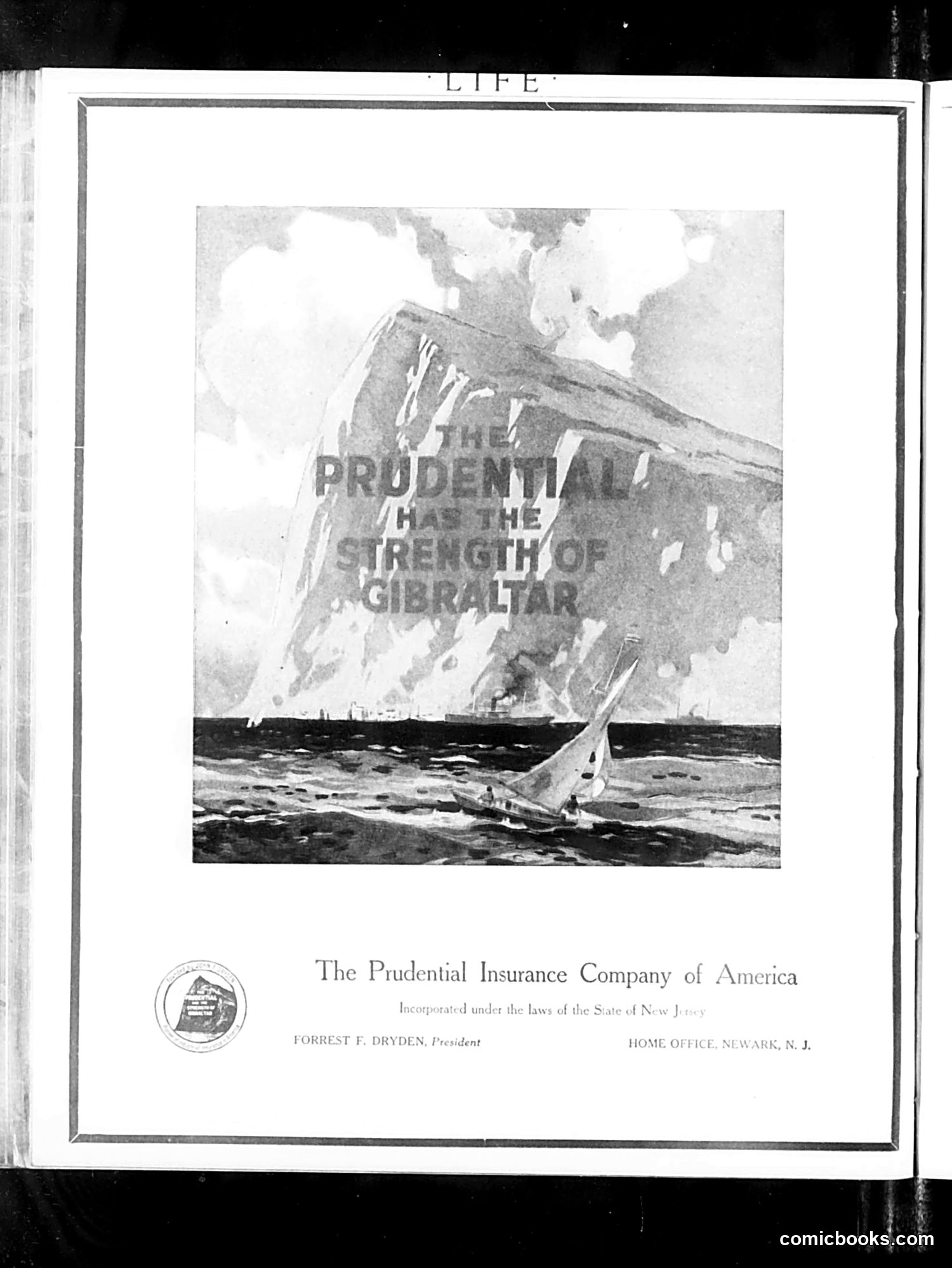
This is a **Prudential Insurance Company advertisement** from *Life* magazine, not a political cartoon or satire. The image shows a sailboat navigating rough seas near the Rock of Gibraltar, with text overlaid: "The Prudential has the strength of Gibraltar." **What this means:** The ad uses a classical metaphor comparing the insurance company's reliability to Gibraltar—the famous, immovable rock formation at the entrance to the Mediterranean. The implication is that Prudential provides stable, dependable protection (like the rock) during life's turbulent circumstances (like the stormy seas). The visual metaphor was common in early 20th-century advertising: Gibraltar symbolized permanence and strength, making it an ideal comparison for an insurance company wanting to reassure customers of financial security.
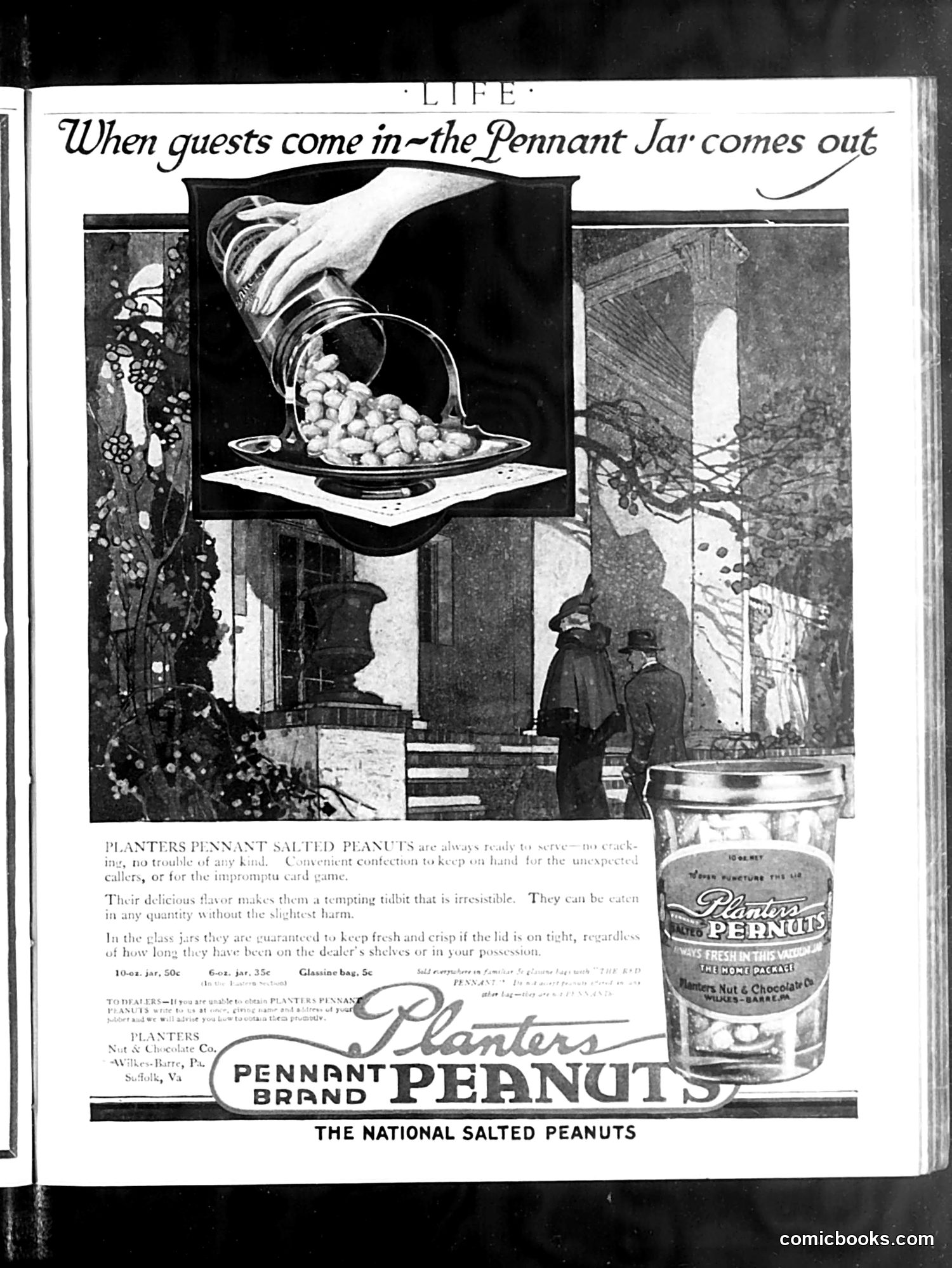
This is primarily an **advertisement**, not political satire. It promotes Planters' Pennant Brand salted peanuts as a convenient snack to serve guests. The visual joke centers on a large jar of peanuts being dramatically presented to arriving visitors—suggesting the product is impressive enough to display prominently. The text emphasizes that Pennant peanuts are "always ready to serve—no cracking, no trouble of any kind" and stay "fresh and crisp" in their sealed jar. The advertisement targets middle-class homeowners seeking convenient, shelf-stable refreshments for entertaining. The theatrical presentation (with people gesturing toward the jar) exaggerates the product's appeal as an effortless, dignified hostess choice. There is no political commentary or caricature here—it's straightforward commercial messaging from Life magazine's advertising section.
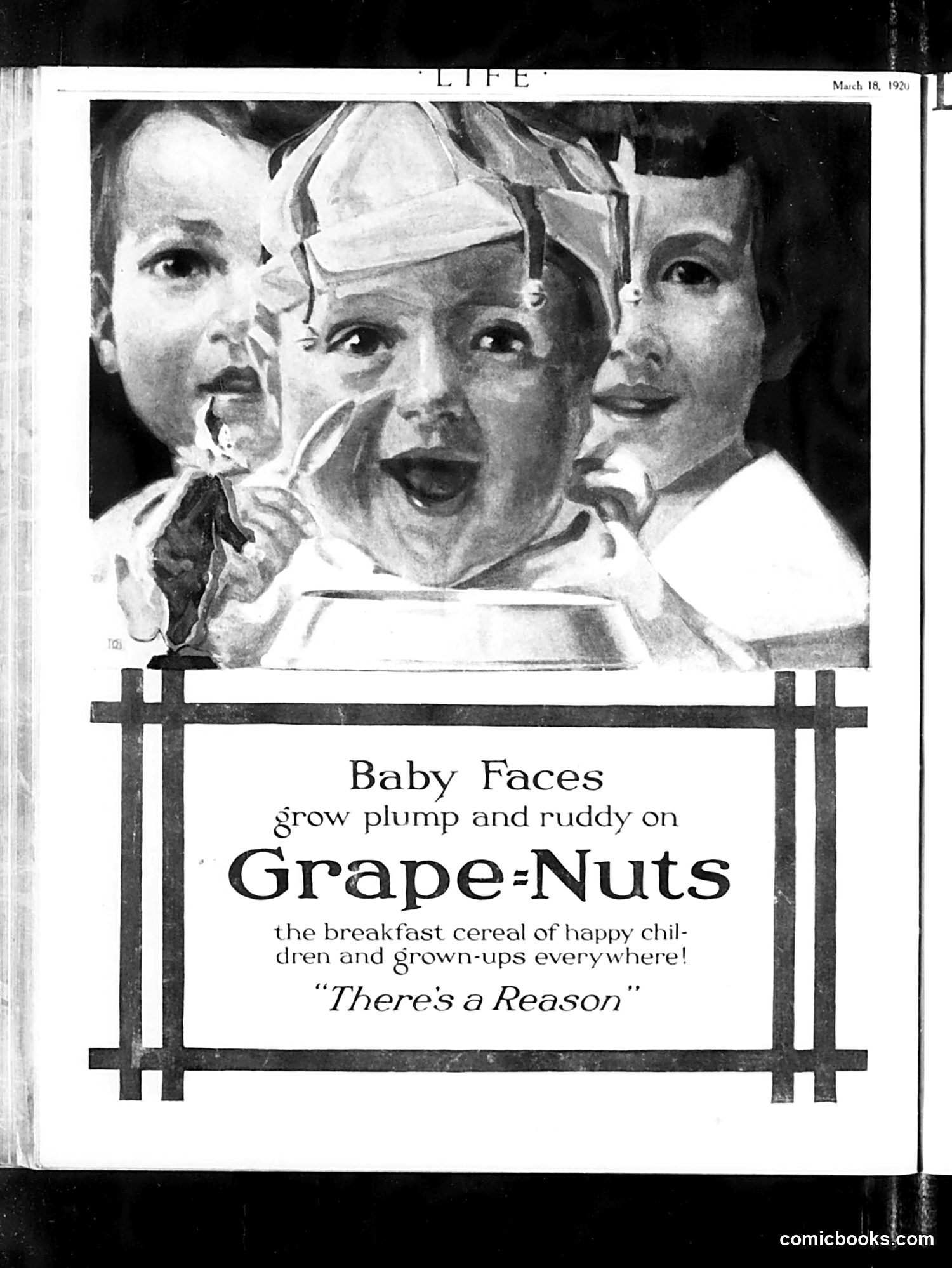
This is a **Grape-Nuts cereal advertisement**, not political satire. The page shows three babies or young children's faces with exaggerated expressions of delight, apparently eating or enjoying the product. The ad claims the cereal makes "baby faces grow plump and ruddy," appealing to early 20th-century notions that chubbiness indicated health and good nutrition. The tagline "There's a Reason" was Grape-Nuts's actual advertising slogan from this era. The ad targets parents concerned with child nutrition and development. By modern standards, the imagery and health claims would be considered misleading—the emphasis on making children "plump" contrasts sharply with contemporary nutrition standards, and such product claims wouldn't be permitted in modern advertising.