
Life, 1920-03-18 · page 5 of 54
Life — March 18, 1920 — page 5: what you’re looking at
What you’re looking at
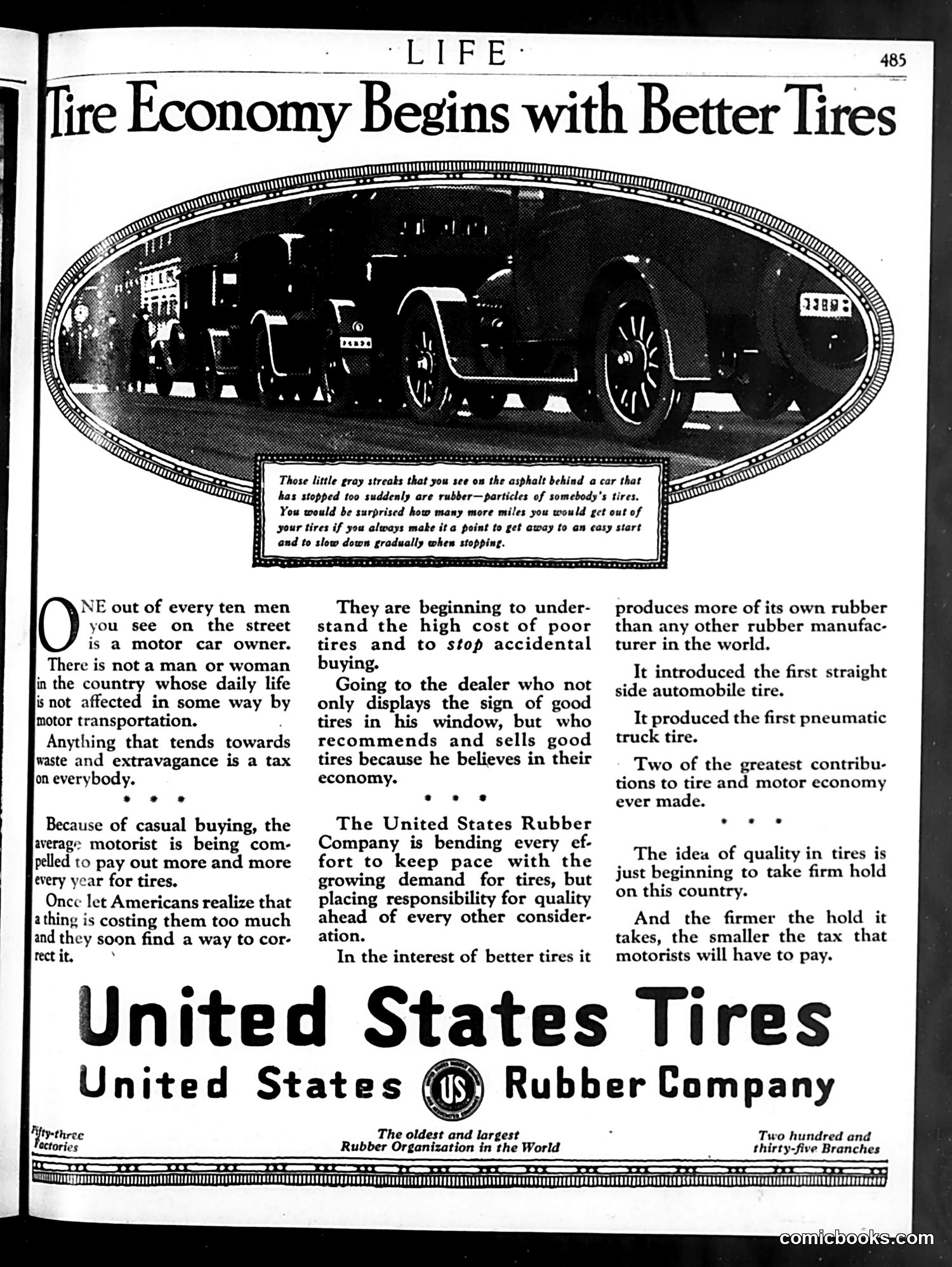
This is primarily **advertising content**, not satire or political commentary. The page promotes United States Rubber Company's tires through an article framed as consumer advice. The article argues that poor tire quality wastes money through excessive replacement and unsafe driving. It credits U.S. Rubber with innovations like the first straight-side automobile tire and first pneumatic truck tire, positioning the company as quality-focused and economically responsible. The satirical element is minimal—the opening illustration shows tire debris on a road, captioned as evidence of wasteful tire failure. The broader message conflates tire economy with patriotic frugality: buying quality tires is presented as a moral duty to reduce waste and taxes. The piece reflects 1920s-era consumer capitalism messaging that linked product quality to civic responsibility.
📄 Transcribed text from this page (OCR, searchable)
Machine-transcribed from the original scan — historical spelling and the odd misread are preserved.
“EP Re Es” WNW LEE, Wm < ee so SY ‘Fr NE out of every ten men you see on the street is a motor car owner. There is not a man or woman in the country whose daily life is not affected in some way by motor transportation. Anything that tends towards waste and extravagance is a tax on everybody. * * * Because of casual buying, the average motorist is being com- pelled to pay out more and more every year for tires. Once let Americans realize that athing is costing them too much and they soon find a way to cor- rect it. : Aty-three @ctories CT AUUUtaUUUNeveneeeeUUeT CUTE Those little gray streaks that you see on the asphalt behind a car that has stopped too suddenly are rubber—particles of somebody's tires. You would be surprised how many more miles you would get out of your tires if you always make ita point to get away to an easy start and to slow down gradually when stopping. They are beginning to under- stand the high cost of poor tires and to stop accidental buying. Going to the dealer who not only displays the sign of good tires in his window, but who recommends and sells good tires because he believes in their economy. . * s The United States Rubber Company is bending every ef- fort to keep pace with the growing demand for tires, but placing responsibility for quality ahead of every other consider- ation. In the interest of better tires it The oldest and largest Rubber Organization in the World a xxx rx — UAUOTATTvvecvovuacaracundeaunduaatarTaatacanneTaaTtti 485 ire aaa Begins with Better Tires produces more of its own rubber than any other rubber manufac- turer in the world. It introduced the first straight side automobile tire. It produced the first pneumatic truck tire. Two of the greatest contribu- tions to tire and motor economy ever made. 8 « The idea of quality in tires is just beginning to take firm hold on this country. And the firmer the hold it takes, the smaller the tax that motorists will have to pay. United States Tires United States @® Rubber Company Two hundred and thirty-five Branches Comicbooks-com