
Life, 1920-03-18 · page 30 of 54
Life — March 18, 1920 — page 30: what you’re looking at
What you’re looking at
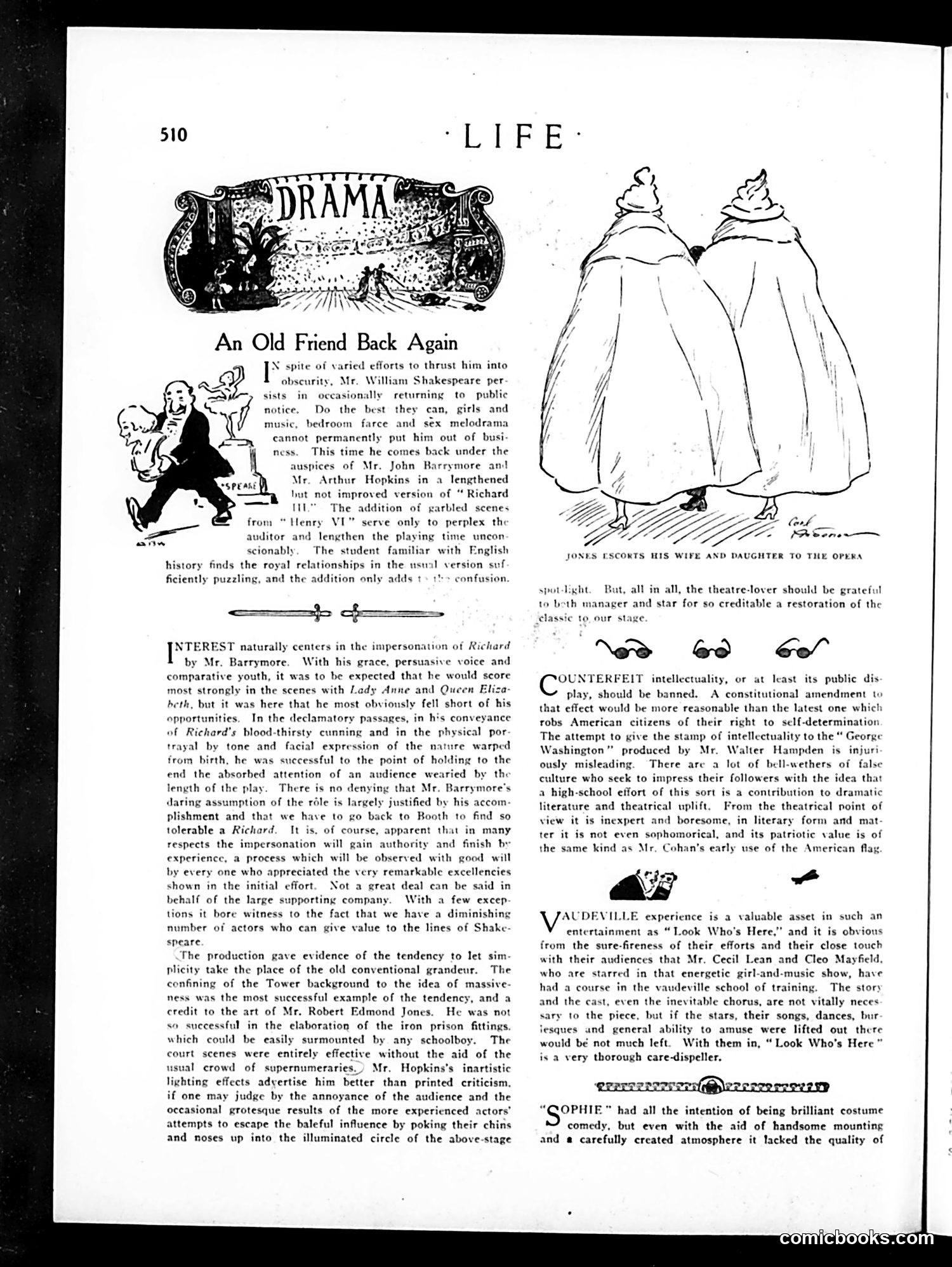
This page reviews John Barrymore's 1920 production of *Richard III*, directed by Arthur Hopkins. The critic praises Shakespeare's enduring appeal despite efforts to displace him with modern entertainment (farce, melodrama, sex comedies). **The main review** analyzes Barrymore's performance as Richard—finding him effective in physical portrayal and cunning passages but weak in romantic scenes with Lady Anne and Queen Elizabeth. The critic credits the supporting production design (Robert Edmond Jones's set work) while criticizing Hopkins's theatrical lighting and the weak supporting cast. **The illustration** shows a man escorting two women in large coats to the opera—likely meant as social commentary about theatre attendance or fashion. **The secondary articles** critique "counterfeit intellectuality" in recent theatrical productions, suggesting some plays use intellectual pretense to elevate mediocre material, and discuss the vaudeville experience of "Look Who's Here" and costume comedy "Sophie." The overall tone reflects early 1920s theatre criticism valuing classical drama and artistic merit over commercial sensationalism.
📄 Transcribed text from this page (OCR, searchable)
Machine-transcribed from the original scan — historical spelling and the odd misread are preserved.
An Old Friend Back Again I spite of varied efforts to thrust him into ‘ obscurity, Mr. William Shakespeare per f sists in returning to public occasionally notice. Do the best they can, girls and music, bedroom farce and sex melodrama cannot permanently put him out of busi- ness. This time he comes back under the auspices of Mr. John Barrymore amt Mr. Arthur Hopkins in a lengthened lust not improved version of “ Richard IIL" The addition of garbled scenes “Henry VI" serve only to perplex the from auditor and lengthen the playing time uncon scionably, The student familiar with English history finds the royal relationships in the ustal version suf ficiently puzzling, and the addition only adds ¢ confusion NTEREST naturally centers in the impersonation of Richard by Mr. Barrymore. With his grace, persuasive voice and comparative youth, it was to be expected that he would score most strongly in the scenes with Lady Anne and Queen Eliza- beth, but it was here that he most obviously fell short of his opportunities. In the declamatory passages, in his conveyance of Richard's blood-thirsty cunning and in the physical por trayal by tone and facial expression of the nature warped from birth, he was successful to the point of holding to the end the absorbed attention of an audience wearied by the length of the play. There is no denying that Mr. Barrymore's daring assumption of the rile is largely justified by his accom plishment and that we have to go back to Booth to find so tolerable a Richard. It is, of course, apparent that in many respects the impersonation will gain authority and finish be experience, a process which will be observed with good will by every one who appreciated the very remarkable excellencies shown in the initial effort. Not a great deal can be said in behalf of the large supporting company. With a few excep tions it bore witness to the fact that we have a diminishing number of actors who can give value to the lines of Shake- speare. The production gave evidence of the tendency to let sim plicity take the place of the old conventional grandeur. The confining of the Tower background to the idea of massive- ness was the most successful example of the tendency, and a credit to the art of Mr. Robert Edmond Jones. He was not so successful in the elaboration of the iron prison fittings. which could be easily surmounted by any schoolboy. The court scenes were entirely effective without the aid of the usual crowd of supernumeraries.) Mr. Hopkins’s inartistic lighting effects advertise him better than printed criticism. one may judge by the annoyance of the audience and the occasional grotesque results of the more experienced actors’ attempts to escape the baleful influence by poking their chins and noses up into the illuminated circle of the above-stage JONES ESCORTS HIS WIFE AND DAUGHTER TO THE OPERS spot-Lght. But, all in all, the theatre-lover should be grateful to both manager and star for so creditable a restoration of the @ Ce intellectuality, or at least its public dis classic to our stage. Nee CouNtEnrel: play, should be banned. that effect would be more reasonable than the latest one wh robs American citizens of their right to self-determinatio The attempt to give the stamp of intellectuality to the “ George Washington” produced by Mr. Walter Hampden is injuri ously misleading. There are a lot of bell-wethers of false culture who seek to impress their followers with the idea that a high-school effort of this sort is a contribution to dramatic literature and theatrical uplift. From the theatrical point of view it is inexpert and boresome, in literary form and mat- ter it is not even sophomorical, and its patriotic value is of the same kind as Mr. Cohan’s early use of the American flag. as “ UDEVILLE experience is a valuable asset in such an entertainment as “Look Who's Here,” and it is obvious from the sure-fireness of their efforts and their close touch with their audiences that Mr. Cecil Lean and Cleo Mayfield, who are starred in that energetic girl-and-music show, have had a course in the vaudeville school of traini and the cast, even the inevitable chorus, are not vitally neces sary to the piece, but if the stars, their songs, dances, bur jesques and general ability to amuse were lifted out there would bé not much left. With them in, “Look Who's Here” is a very thorough care-dispeller, A constitutional amendment to rrr. 22. “QOPHIE™ had all the intention of being brilliant costume comedy, but even with the aid of handsome mounting and @ carefully created atmosphere it lacked the quality of