
Life, 1920-03-18 · page 42 of 54
Life — March 18, 1920 — page 42: what you’re looking at
What you’re looking at
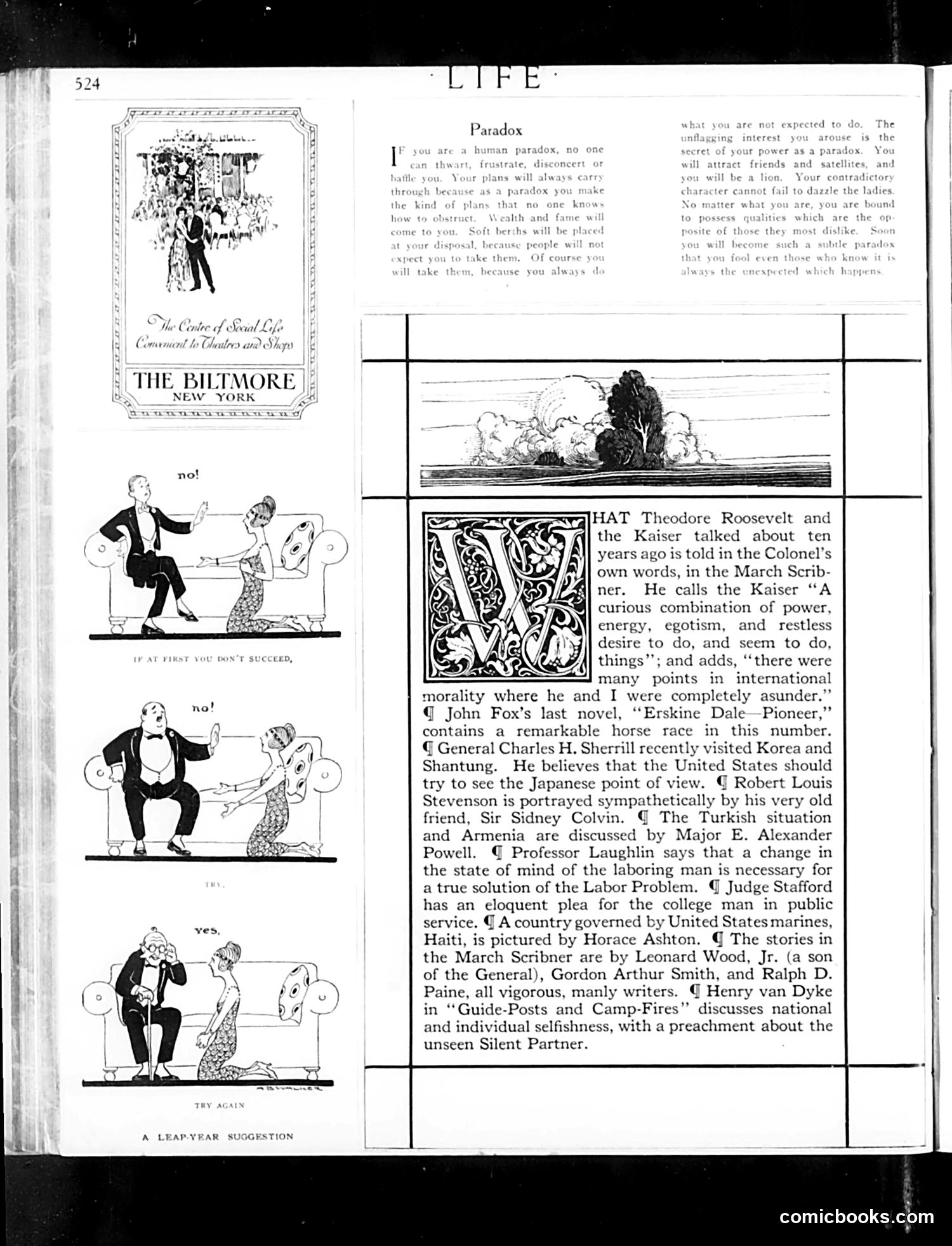
**The "Paradox" Section (top right):** This essay about human paradoxes describes the contradictions inherent in success—that ambitious plans often fail unexpectedly, and that one's greatest strengths become liabilities. **"A Leap-Year Suggestion" Cartoons (left side):** Three sequential panels show a man and woman on a couch. In panels 1-2, he repeatedly says "no!" to her proposal. In panel 3, he says "yes." The joke plays on leap-year tradition where women could propose to men—the cartoon humorously depicts persistence finally breaking male resistance. **Right Column:** Appears to be a magazine contents/preview section referencing articles in *Scribner's* magazine, including pieces by Theodore Roosevelt discussing the Kaiser, John Fox's novel, and contributions by Leonard Wood Jr., Henry van Dyke, and others on contemporary topics (labor problems, Haiti, Turkey). This is primarily **editorial/advertising content** rather than political satire, showcasing *Life's* lighter humor style of the era.
📄 Transcribed text from this page (OCR, searchable)
Machine-transcribed from the original scan — historical spelling and the odd misread are preserved.
I a radox : THE BILTMORE [b> S NEW YORK 5s Se HAT Theodore Roosevelt and <4 e the Kaiser talked about ten years ago is told in the Colonel’s own words, in the March Scrib- ner. He calls the Kaiser “A curious combination of power, energy, egotism, and restless desire to do, and seem to do, things’’; and adds, “there were many points in international morality where he and I were completely asunder.” @ John Fox’s last novel, ‘“‘Erskine Dale—Pioneer,” contains a remarkable horse race in this number. G General Charles H. Sherrill recently visited Korea and Shantung. He believes that the United States should try to see the Japanese point of view. @ Robert Louis Stevenson is portrayed sympathetically by his very old friend, Sir Sidney Colvin. @ The Turkish situation and Armenia are discussed by Major E. Alexander Powell. @ Professor Laughlin says that a change in the state of mind of the laboring man is necessary for a true solution of the Labor Problem. Judge Stafford has an eloquent plea for the college man in public service. { A country governed by United States marines, Haiti, is pictured by Horace Ashton. @ The stories in the March Scribner are by Leonard Wood, Jr. (a son of the General), Gordon Arthur Smith, and Ralph D. Paine, all vigorous, manly writers. @ Henry van Dyke in ‘‘Guide-Posts and Camp-Fires”’ discusses national and individual selfishness, with a preachment about the unseen Silent Partner. A LEAP-YRAR SUGGESTION comicbooks.com