
Life, 1920-03-18 · page 27 of 54
Life — March 18, 1920 — page 27: what you’re looking at
What you’re looking at
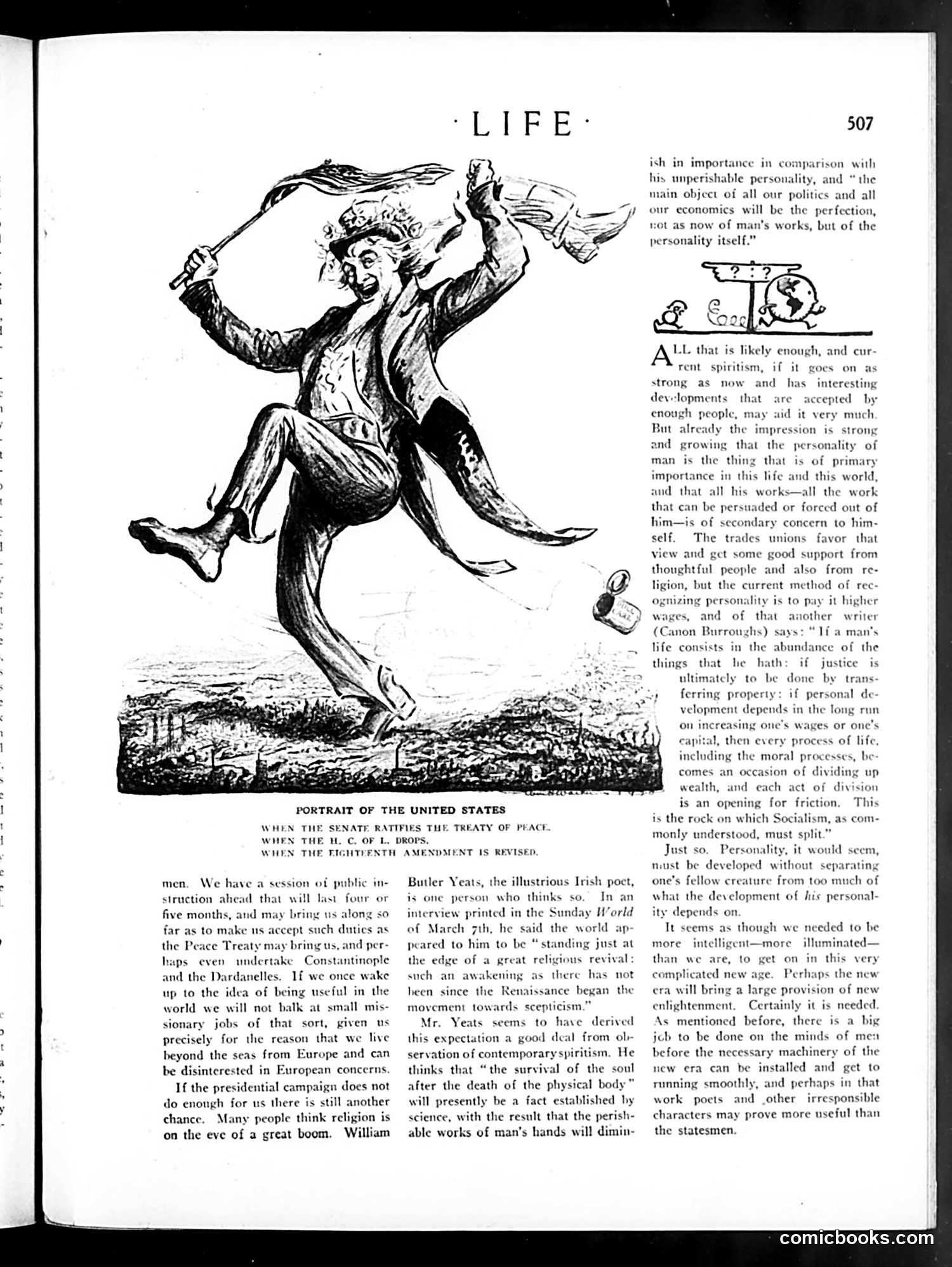
This satirical cartoon depicts Uncle Sam as a gleeful, energetic figure dancing while juggling multiple concerns. The caption's conditions—"When the Senate ratifies the Treaty of Peace / When the H.C. of L. drops / When the Eighteenth Amendment is revised"—suggest these are prerequisites for American prosperity that seem unlikely to occur simultaneously. The cartoon mocks post-WWI American optimism. It references: - The **Treaty of Peace** (likely the Treaty of Versailles) - **H.C. of L.** (High Cost of Living), a major postwar economic issue - The **Eighteenth Amendment** (Prohibition), controversial legislation The accompanying text quotes Irish poet William Butler Yeats on spiritual revival and discusses personality development versus material accumulation—drawing a contrast between idealistic hopes and practical concerns. The satire suggests America's problems are interconnected and won't simply resolve, despite public confidence.
📄 Transcribed text from this page (OCR, searchable)
Machine-transcribed from the original scan — historical spelling and the odd misread are preserved.
PORTRAIT OF THE UNITED STATES WHEN THE SENATF RATIFIES THE TREATY OF PEACE WHEN THE H, C, OF L. DROPS, WHEN THE FIGHTEENTH men. struction ahead that will last five months, and may bring us along so far as to make us accept such duties as We have a session of public in- four or the Peace Treaty may bring us, and per- undertake Constantinople 1f we once wake haps even and the Dardanelles. up to the idea of being useful in the world we will not balk at small mis- sionary jobs of that sort, given us precisely for the reason that we live beyond the seas from Europe and can be disinterested in European concerns. If the presidential campaign does not do enough for us there is still another chance, Many people think religion is on the eve of a great boom. William AMENDMENT IS REVISED. Butler Yeats, the illustrious Irish poct, In an interview printed in the Sunday H/orld of March 7th, he said the world ap is one person who thinks so. peared to him to be “standing just at the edge of a great religious revival: such an awakening as there has not heen since the Renaissance began the movement towards scepticism.” Mr. Yeats seems to have derived this expectation servation of contemporary spiritism. He thinks that “the survival of the soul after the death of the physical body” will presently be a fact established by good deal from ob- science, with the result that the perish- able works of man’s hands will dimin- 507 ish in importance in comparison with his unperishable personality, and “the main object of all our politics and all our economics will be the perfe ion, sot as now of man’s works, but of the personality itself.” Alt that is likely enough, and cur- rent spiritism, if it goes on as strong as now and has developments that accepted by enough people, may aid it very much But already the and growing that the personality of man is the thing that is of importance in this life and that interesting are impression is strong primary and this world, 1 his works—all the work that can be persuaded or forced out of him—is of secondary concern to him- self. The trades that view and get some good support from thoughtful people and also from re- unions favor ligion, but the current method of rec- ognizing personality is to pay it higher and of that an (Canon Burroughs) says wages, ther writer lf a man’s life consists in the abundance of the things that he ultimately ferring property: velopment depends in the long run hath: if justice is to be done by trans- if personal de on increasing one’s wages or one’s capital, then every process of life, including the moral processes, be comes an occasion of dividing up wealth, and each divisio This is the rock on which Socialism, as com- act of is an opening for friction. monly understood, must split.” Just so. niust be developed without separating Personality, it would see one’s fellow creature from too much of what the development of his personal- ity depends on It seems as though we needed to be illuminated— more intelligent—more than we are, to get on in this very complicated new age. Perhaps the new era will bring a large provision of new enlightenment. Certainly it is needed. As mentioned before, there is a big jcb to be done on the minds of men before the necessary machinery of the new era can be installed and get to running smoothly, and perhaps in that work poets other characters may prove more useful than the statesmen. and irresponsible comicbooks.com