
Life, 1920-03-18 · page 26 of 54
Life — March 18, 1920 — page 26: what you’re looking at
What you’re looking at
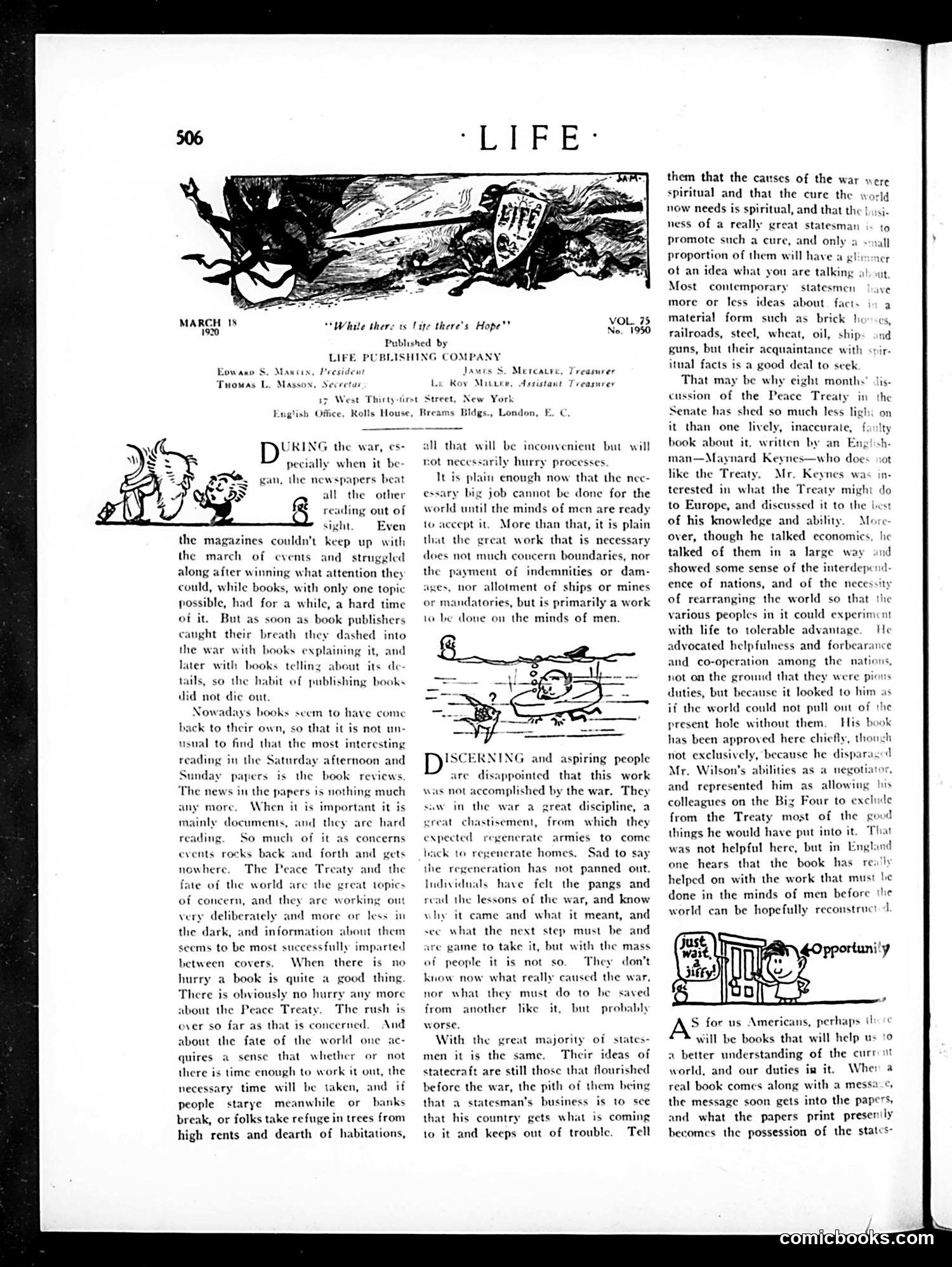
This March 1920 *Life* editorial discusses the post-WWI Peace Treaty negotiations and public disengagement from the process. The two small cartoons illustrate the main argument: The first cartoon (top) shows a dejected figure, representing public apathy—people have lost interest in treaty details now that the war's "rush" has ended. The second cartoon depicts someone in water, likely representing drowning in indifference or being overwhelmed by post-war chaos (homelessness, economic collapse mentioned in text). The editorial's core satire: statesmen still think in pre-war terms (territory, indemnities, ships), while spiritual and psychological reconstruction—the real work needed—requires reshaping human minds. Most people don't understand what caused the war or how to prevent another. The "hope" of the title is ironic: without genuine ideological change, the world remains adrift. Books, the author argues, can better convey this message than newspapers' daily coverage.
📄 Transcribed text from this page (OCR, searchable)
Machine-transcribed from the original scan — historical spelling and the odd misread are preserved.
MARCH 18 1920 “White ther. ts ize there's Hope"? Published by E PUBLISHIN Eowano S. Maxcix, Tuomas L. Masson, 17 West Office, Rolls House, reams Bldgs., Dt! pecially when it be- gan, the newspapers be all the other reading out of sight. Even the magazines couldn't keep up with the march of events and. struggled along after winning what attention they could, while books, with only one topic possible, had for a while, a hard time of it. But as soon as book publishers caught their breath they dashed into the war with books explaining it, and later with books telling about its de- tails, so the habit of publishing books did not dic out Nowadays books seem to have come iT to their own, so that it is not un- usual to find that the most interesting reading in the Saturday afternoon and unday ps book he news in the papers is nothing much When it is important it is mainly documents, and they are hard vers is the reviews. any more reading. So much of it as concerns events rocks back and forth and gets nowhere. The Peace Treaty and the fate of the world are the great topics of concern, and they are working out very deliberately and more or less in the dark, and information about them seems to be most successfully imparted between When there is no hurry a book is quite a good thing. There is obviously no hurry any more about the Peace Treaty. The rush is over so far as that is concerned. And about the fate of the world one a sense that whether or not time enough to work it out, the covers. quires there necessary time will be taken, and if people starye meanwhile or banks break, or folks take refuge in trees from high rents and dearth of habitations, COMPANY Jawes S. Mercatve Le Koy Mitre Treasurer Assistant Treasurer Thirty-tirst Street, New York London, E. C. all that will be inconvenient but will not necessarily hurry processes. It is plain enough now that the nec- essary big job cannot be done for the world until the minds of men are ready More than that, it is plain at work that is necessary to accept it that the gr does not much concern boundaries, nor the payment of indemnities or dam- ages, nor allotment of ships or mines ories, but is primarily a work to be done on the minds of men. and aspir are disappointed that this work Was not accomplished by the war. They saw in the war a great discipline, a great chastisement, from which they regenerate armies to come nerate homes. Sad to say expected back to re the regeneration has not panned out. felt the pangs and read the lessons of the war, and know Individuals have v it came and what it meant, and see what the next step must be and re game to take it, but with the mass of people it is not so. They don’t know now what really caused the war, nor what they must do to be save from another like it, but probably worse. With the great majority of men it is the same, Their ideas of statecraft are still those that flourished before the war, the pith of them being that a statesman’s business is to see gets what is coming Tell states- that his country to it and keeps out of trouble. them that the causes of the war were spiritual and that the cure the world now needs is spiritual, and that the Lusi ness of a really great statesman promote such a cure, and only proportion of them will have a gl ot an idea what you are talking Most contemporary statesmen more or less ideas about fact. material form such as brick 1} railroads, stecl, wheat, oil, ship guns, but their acquaintance with itual facts is a good deal to seek That may be why eight months cussion of the Peace Treaty in Senate has shed so much less ligi it than one livel: book about it, written by an E man—Maynard Keynes—who does like the Treaty, Mr. Keynes was in- terested in what the Treaty might do to Europe, and discussed it to the best of his knowledge and ability. More- over, though he talked economics, hic talked of them in a large way ond showed some sense of the interdepend- ence of nations, and of the necessity of rearranging the world so that the various peoples in it could experiment with life to tolerable advantage. He advocated helpfulness and forbearance and co-operation among the nations, not on the ground that they were pious duties, but because it looked to him as if the world could not pull out of the present hole without them. His book has been approved here chiefly, thongh use he disparaged inaccurate, {; not exclusively, ‘be Mr. Wilson's abilities as a negotiator, and represented him as allowing bis colleagues on the Biz Four to exchule from the Treaty most of the good things he would have put into it was not helpful here, but in England one hears that the book has res’! helped on with the work that must be done in the minds of men before the world can be hopefully reconstruct 4 for us Americans, perhaps thi Will be books that will help us !0 a better understanding of the curr at world, and our duties in it. Wher a real book comes along with a messa.¢, the message soon gets into the papers, and what the papers print presenily becomes the possession of the statcs-