
Life, 1920-03-18 · page 24 of 54
Life — March 18, 1920 — page 24: what you’re looking at
What you’re looking at
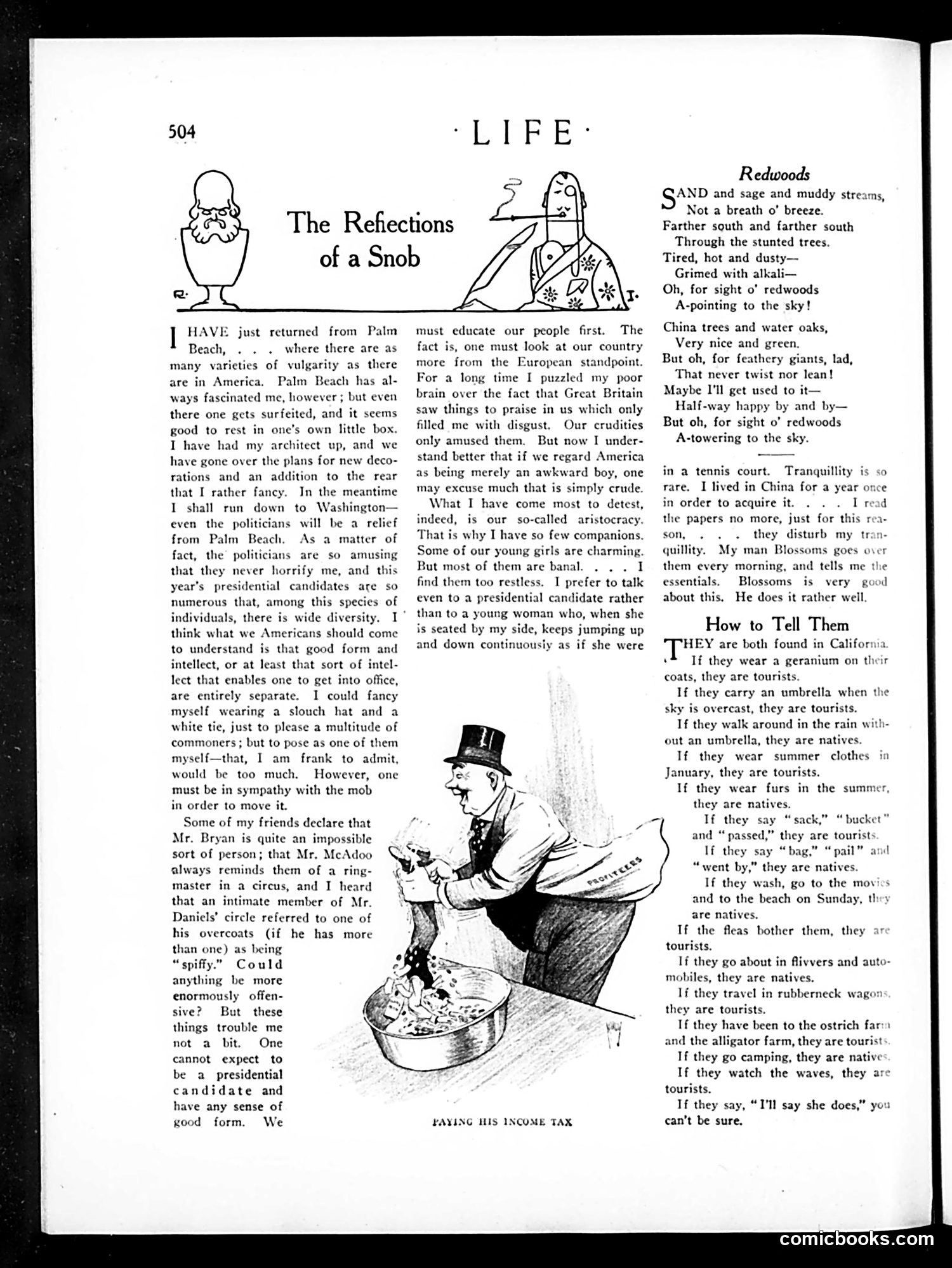
This page satirizes American snobbery and pretension through two main pieces: **"The Reflections of a Snob"** presents a wealthy narrator returning from Palm Beach who expresses contempt for American vulgarity while admitting he secretly envies European sophistication. The satire targets his hypocrisy: he claims disdain for the masses yet acknowledges politicians (Bryan, McAdoo, Daniels appear to be referenced) lack "good form," and he confesses he'd wear working-class attire to manipulate voters. The cartoon showing a man "paying his income tax" illustrates the disconnect between his refined self-image and ordinary financial obligations. **"How to Tell Them"** uses a humorous checklist to distinguish California tourists from natives—tourists wear umbrellas in rain, geraniums, summer clothes in January; natives do the opposite. This mocks both tourist behavior and locals' pretense of rugged individualism. Both pieces ridicule American upper-class affectation: the snob's self-deception about his own vulgarity, and California residents' performative authenticity. The satire suggests genuine refinement and authenticity are rare in America.
📄 Transcribed text from this page (OCR, searchable)
Machine-transcribed from the original scan — historical spelling and the odd misread are preserved.
The Refiections of a Snob ] HAVE just returned from Palm Beach, . . . where there are as many varieties of vulgarity as there are in America. Palm Beach has al- ways fascinated me, however; but even there one gets surfeited, and it seems good to rest in one’s own little box. I have had my architect up, and we have gone over the plans for new deco- rations and an addition to the rear that I rather fancy. In the meantime I shall run down to Washington— even the politicians will be a relief from Palm Beach. As a matter of fact, the politicians are so amusing that they never horrify me, and this year’s presidential candidates are so numerous that, among this species of individuals, there is wide diversity, I” think what we Americans should come to understand is that good form and intellect, or at least that sort of intel- lect that enables one to get into office, are entirely separate. I could fancy myself wearing a slouch hat and a white tie, just to please a multitude of commoners ; but to pose as one of them myself—that, I am frank to admit, would be too much. However, one must be in sympathy with the mob in order to move it. Some of my friends declare that Mr. Bryan is quite an impossible sort of person; that Mr. McAdoo always reminds them of a ring- master in a circus, and I heard that an intimate member of Mr. Daniels’ circle referred to one of his overcoats (if he has more than one) as being “spiffy.” Could anything be more enormously offen- sive? But these things trouble me not a bit. One cannot expect to be a presidential candidate and have any sense of good form. We must educate our people first. The fact is, one must look at our country more from the European standpoint. For a long time I puzzled my poor brain over the fact that Great Britain saw things to praise in us which only filled me with disgust. Our crudities only amused them. But now I under- stand better that if we regard America as being merely an awkward boy, one may excuse much that is simply crude. What I have come most to detest, indeed, is our so-called aristocracy. That is why I have so few companions. Some of our young girls are charming. But most of them are banal. . . . I find them too restless. I prefer to talk even to a presidential candidate rather than to a young woman who, when she is seated by my side, keeps jumping up and down continuousiy as if she were YAYING HIS INCOME TAX Redwoods SAxd and sage and muddy streams, Not a breath o” breeze. Farther south and farther south Through the stunted trees. Tired, hot and dusty— Grimed with alkali— Oh, for sight o' redwoods A-pointing to the sky! China trees and water oaks, Very nice and green. But oh, for feathery giants, lad, That never twist nor lean! Maybe I'll get used to it— Half-way happy by and by— But oh, for sight o’ redwoods A-towering to the sky. in a tennis court. Tranquillity is so 1 lived in China for a year once in order to acquire it. I read the papers no more, just for this they disturb my tr My man Blossoms goes o rare. son, s 2s quillity. them every morning, and tells me essentials. Blossoms is very g¢ about this. He does it rather weil How to Tell Them HEY are both found in California . If they wear a geranium on their coats, they are tourists. If they carry an umbrella when the sky is overcast, they are tourists. If they walk around in the rain with- out an umbrella, they are natives. If they wear summer clothes in January, they are tourists. If they wear furs in the summ they are natives. If they say “sack,” “bucket” and “passed,” they are tourists If they say “bag,” “pail” and “went by,” they are natives. If they wash, go to the movies and to the beach on Sunday, tl are natives. If the fleas bother them, they ar tourists. If they go about in flivvers and auto- mobiles, they are natives. If they travel in rubberneck wagon they are tourists. If they have been to the ostrich far: and the alligator farm, they are tourist If they go camping, they are native If they watch the waves, they are tourists. If they say, “I'll say she does,” you can’t be sure. comicbooks.com