
A complete issue · 42 pages · 1917
Life — April 12, 1917
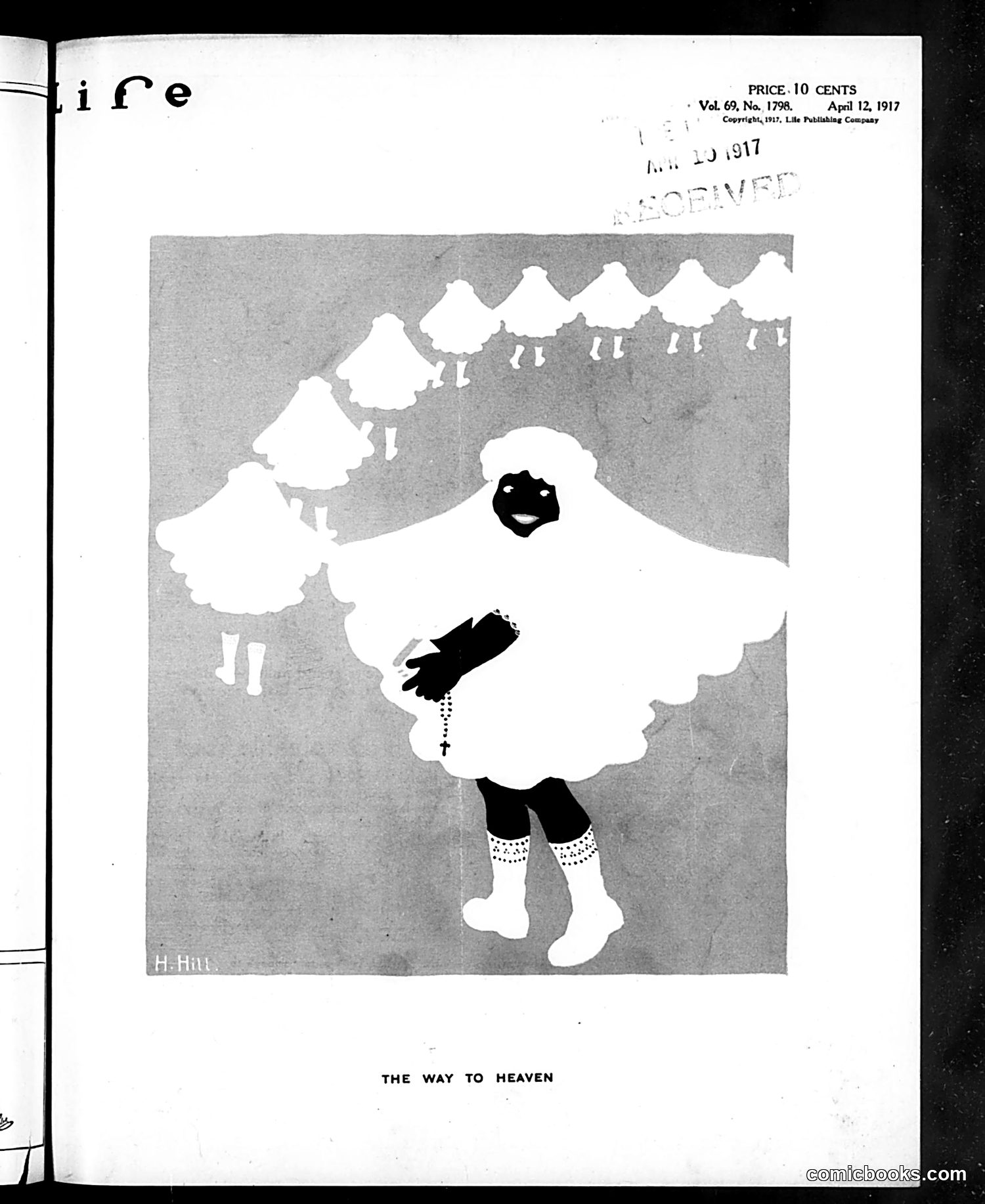
This cartoon by H. Hill depicts a figure climbing a steep, treacherous mountain path toward heaven (represented by tents at the summit). The figure carries a rifle and wears military attire with white socks and black boots—indicating a soldier. Published just days after America's April 6, 1917 declaration of entry into World War I, the cartoon presents military service as "the way to heaven." The steep, difficult ascent visualizes warfare as a perilous spiritual journey. The satirical implication appears to be commentary on how American soldiers—many newly conscripted—were being sent to their potential deaths, with their sacrifice framed in religious/patriotic language as a path to heavenly reward.
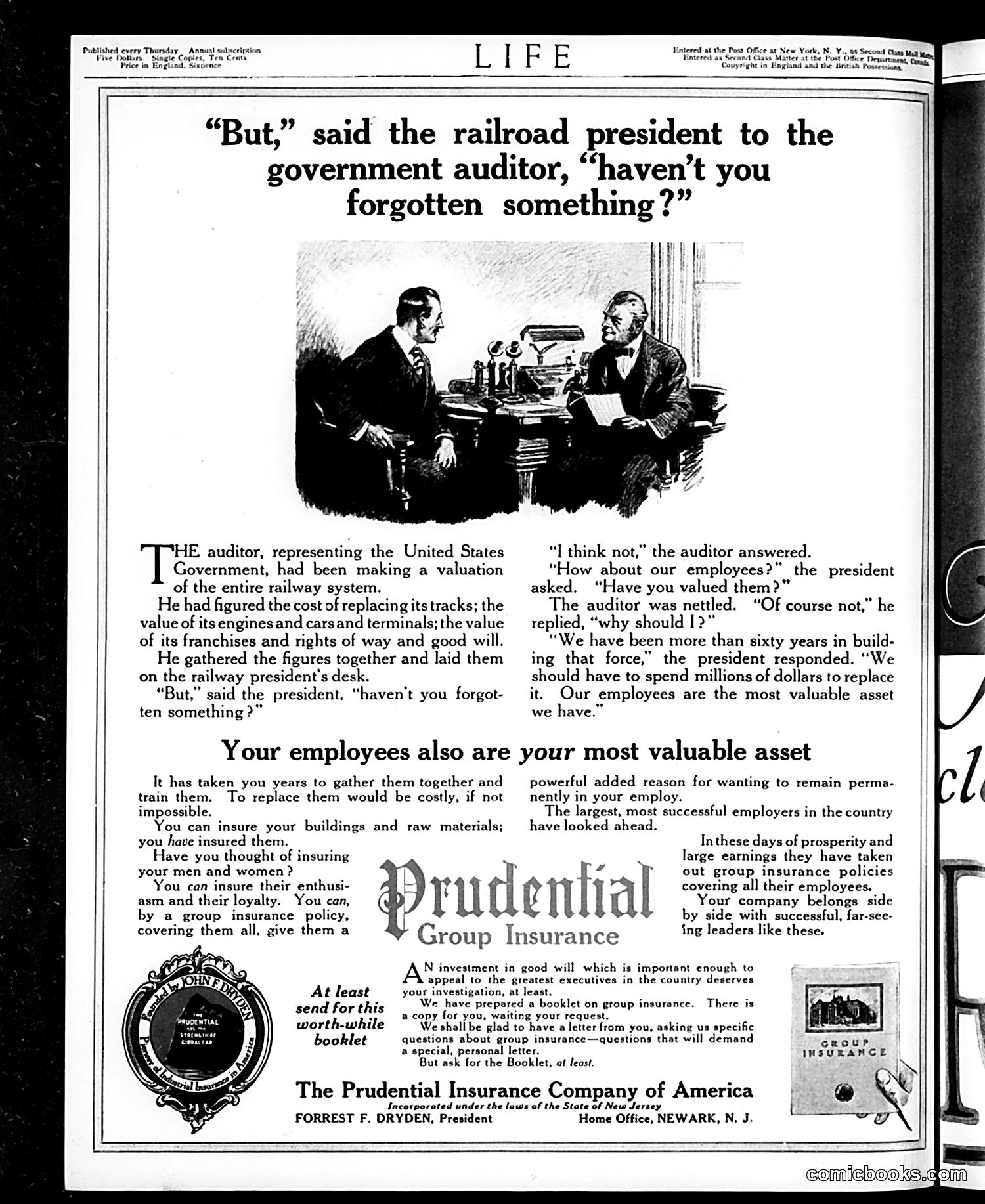
This page is primarily **advertising for Prudential Insurance**, using a satirical cartoon to make a business pitch. The cartoon depicts a government auditor meeting with a railroad president. The auditor has meticulously inventoried the company's physical assets—tracks, engines, terminals, franchises—but overlooked employees. The president points out this omission, arguing that after 60 years of development, employees are "the most valuable asset" and would cost millions to replace. The advertisement then pivots to Prudential's pitch: companies should insure their workforce through group insurance policies, like successful competitors already do. The joke satirizes both corporate auditing practices and the emerging business case for employee benefits during the early 20th century. This represents the period when group insurance was becoming a competitive recruiting and retention tool for major employers.
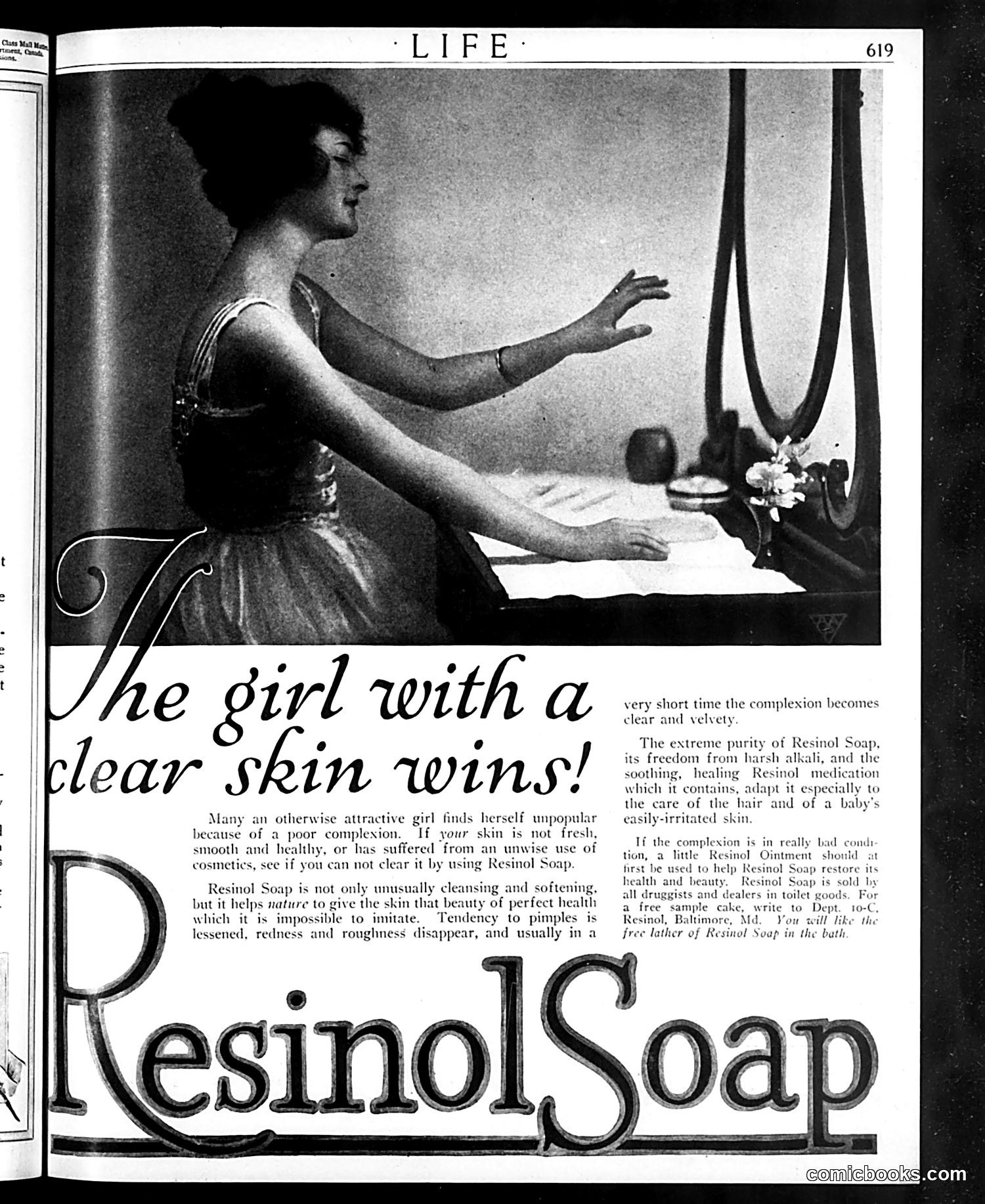
This page is **primarily a product advertisement**, not satire or political commentary. It promotes Resinol Soap, a real early-20th-century brand. The ad features a woman at what appears to be a vanity mirror, with the headline "The girl with a clear skin wins!" The copy emphasizes that clear, healthy skin attracts social success, and claims Resinol Soap can cure complexion problems through gentle cleansing and its medicinal properties. **The "satire" is implicit**: the ad reflects period attitudes that a woman's social worth depends on appearance and skin quality. For modern readers, this reveals dated gender norms and beauty standards—the assumption that romantic/social success hinges on female physical appearance. No specific political figures or events are referenced. This is straightforward vintage advertising reflecting period values.
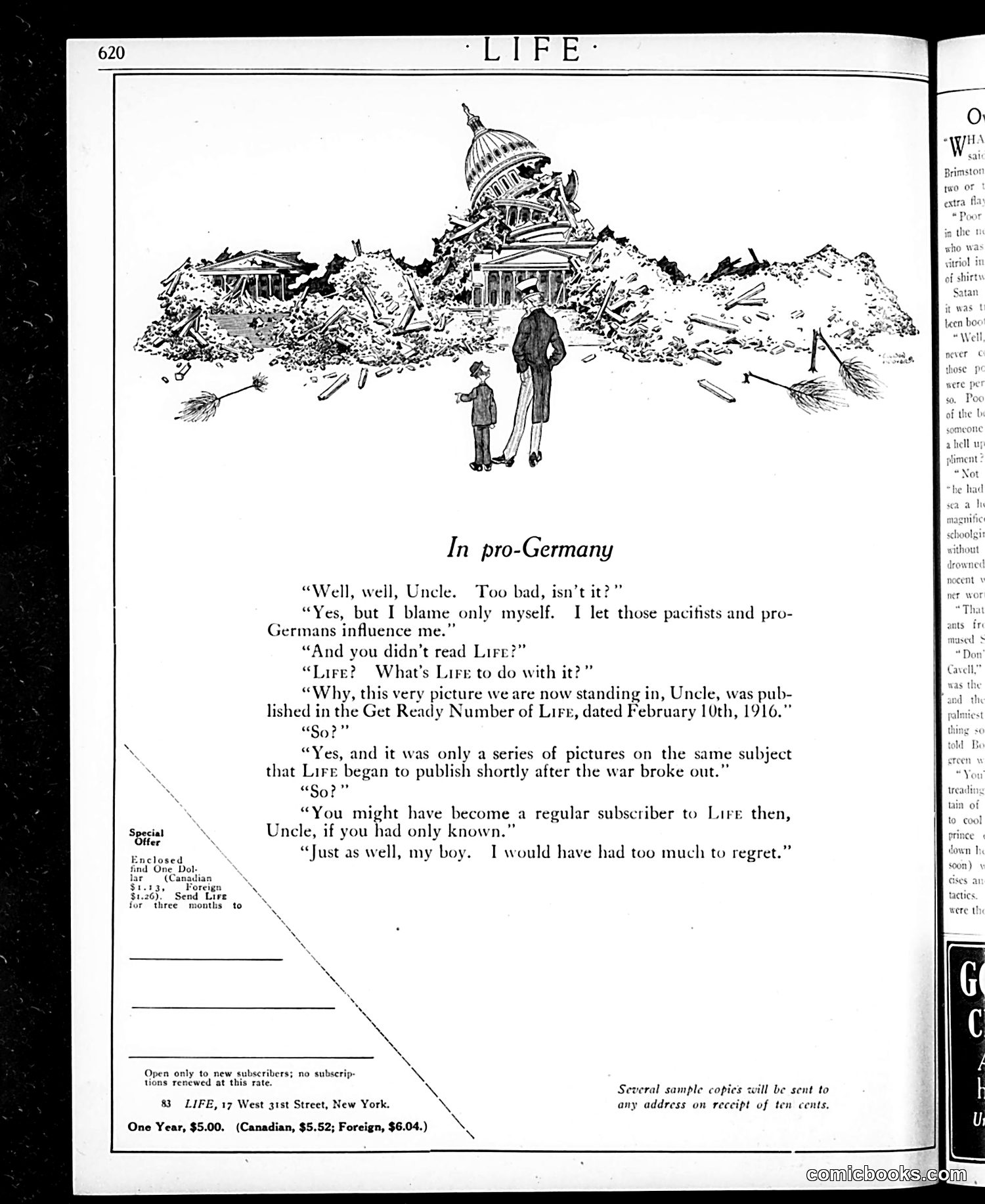
This 1916 political cartoon satirizes American isolationists and pro-German sympathizers during World War I. An adult and child stand before the Capitol building in ruins, contemplating destruction. The dialogue mocks someone who claimed ignorance of *Life* magazine's anti-German editorial stance. The cartoon's bitter punch: a subscriber who opposed *Life*'s pacifist critiques and pro-German leanings might have avoided the magazine—but couldn't escape the magazine's ultimate vindication when the U.S. entered the war and the predicted devastation occurred. The destroyed Capitol symbolizes the catastrophic consequences the magazine warned about. The satire targets American neutrality advocates and German sympathizers as dangerously deluded, proven wrong by historical events.
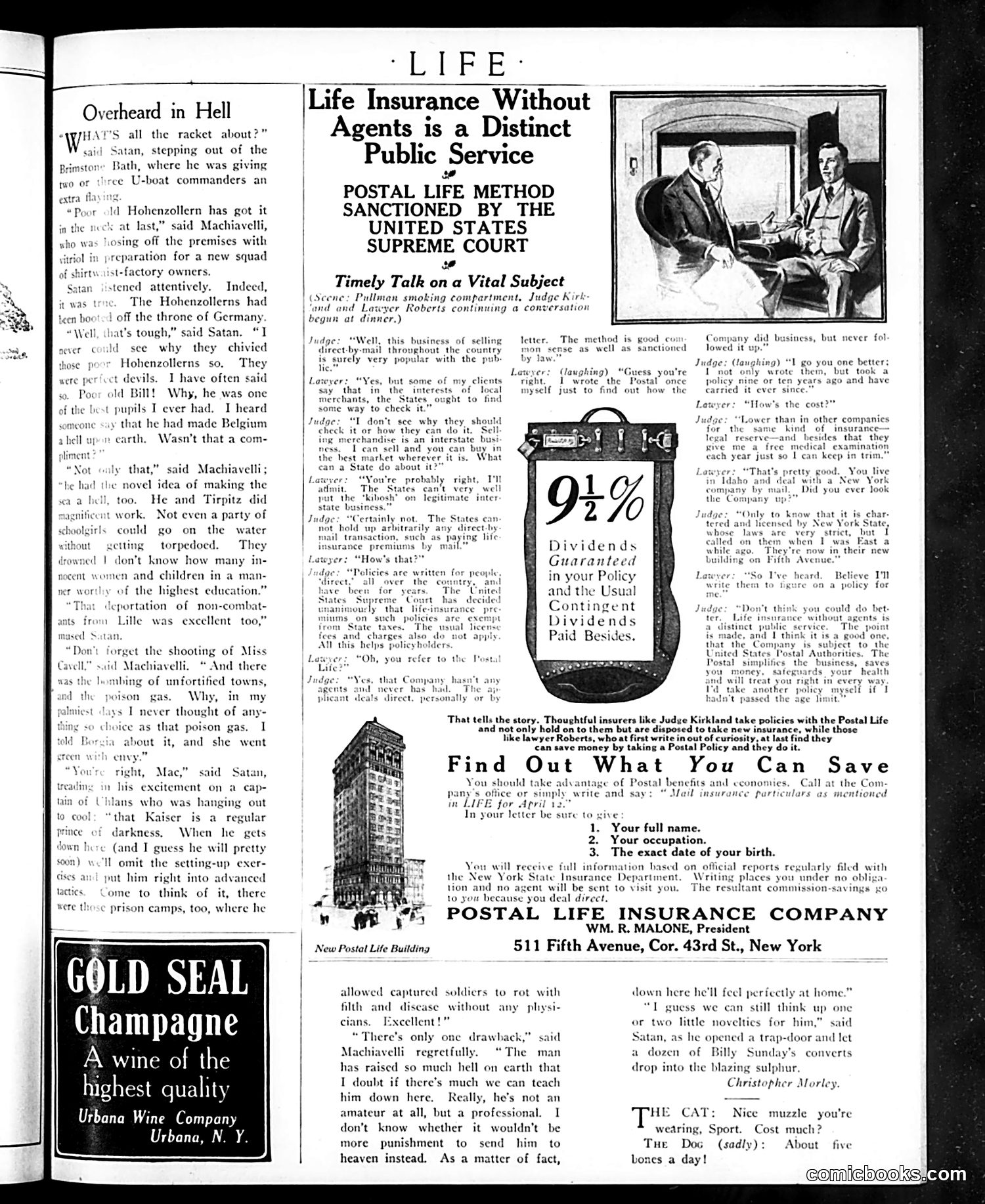
This page is primarily **advertising** for Postal Life Insurance Company, not political satire. The main content features a conversation between **Judge Kiddoo** and **Lawyer Roberts** discussing the merits of postal life insurance sold directly by mail, without insurance agents. The advertisement emphasizes this as a "public service" sanctioned by the U.S. Supreme Court. The left column contains an unrelated satirical dialogue titled "Overhead in Hell" featuring characters Satan and Machiavelli discussing historical figures like the Kaiser and General von Hindenburg—likely referencing World War I. A **Gold Seal Champagne advertisement** appears in the lower left corner. The page demonstrates how Life magazine combined editorial satire with substantial advertising to support publication costs.
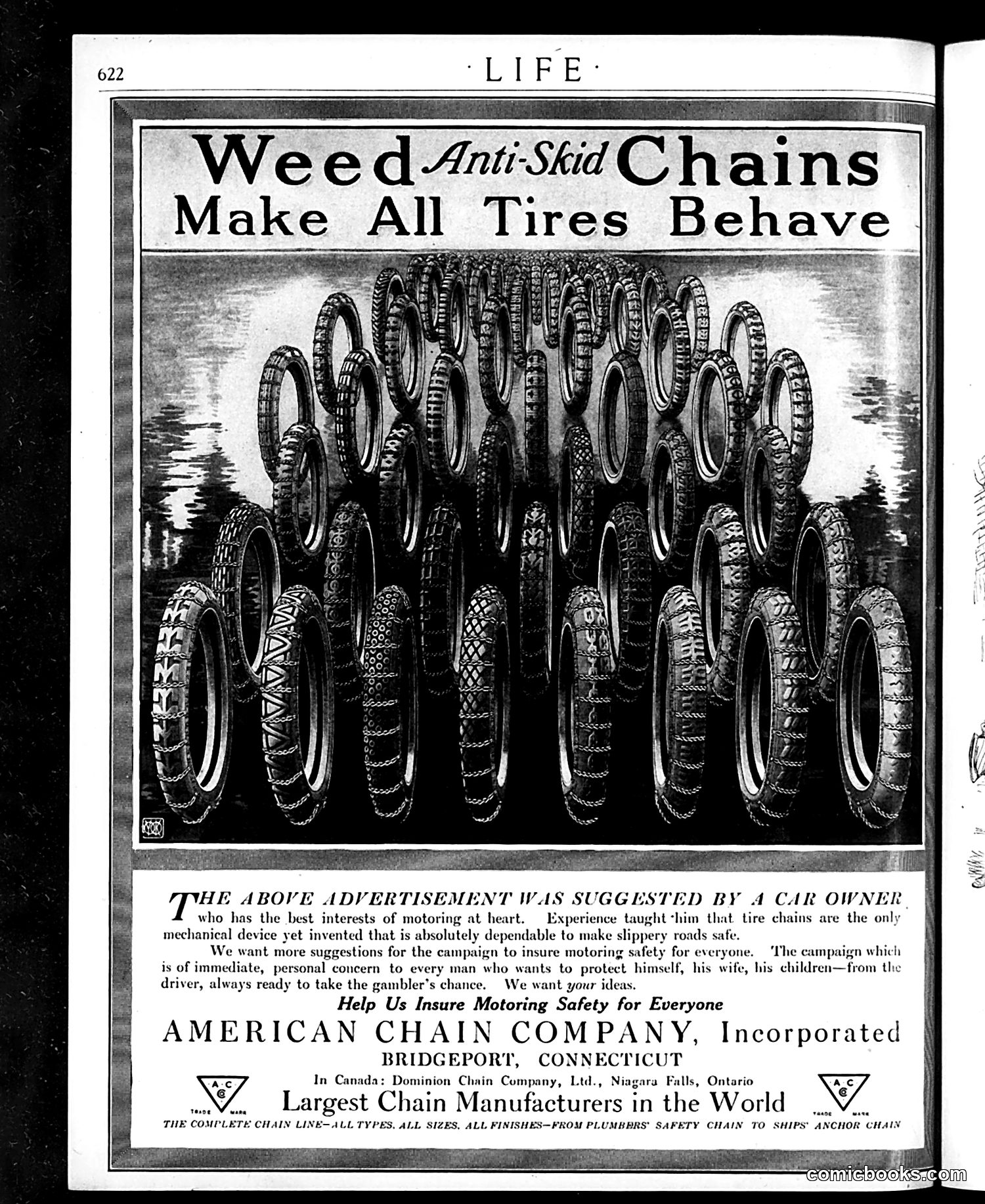
This page is primarily a **product advertisement** rather than political satire or editorial cartoon. The American Chain Company promotes "Weed Anti-Skid Chains" for automobile tires through a dramatic image showing numerous chains displayed against a snowy forest backdrop. The accompanying text frames the ad as a **public safety campaign**. It claims the advertisement was "suggested by a car owner" concerned with motoring safety, appealing to driver responsibility—particularly regarding families and children. The company solicits additional safety ideas from readers. The rhetorical strategy positions tire chains as essential safety equipment rather than optional accessories, targeting drivers' sense of social responsibility during winter driving conditions. This represents early automotive-era safety advocacy merged with commercial promotion.
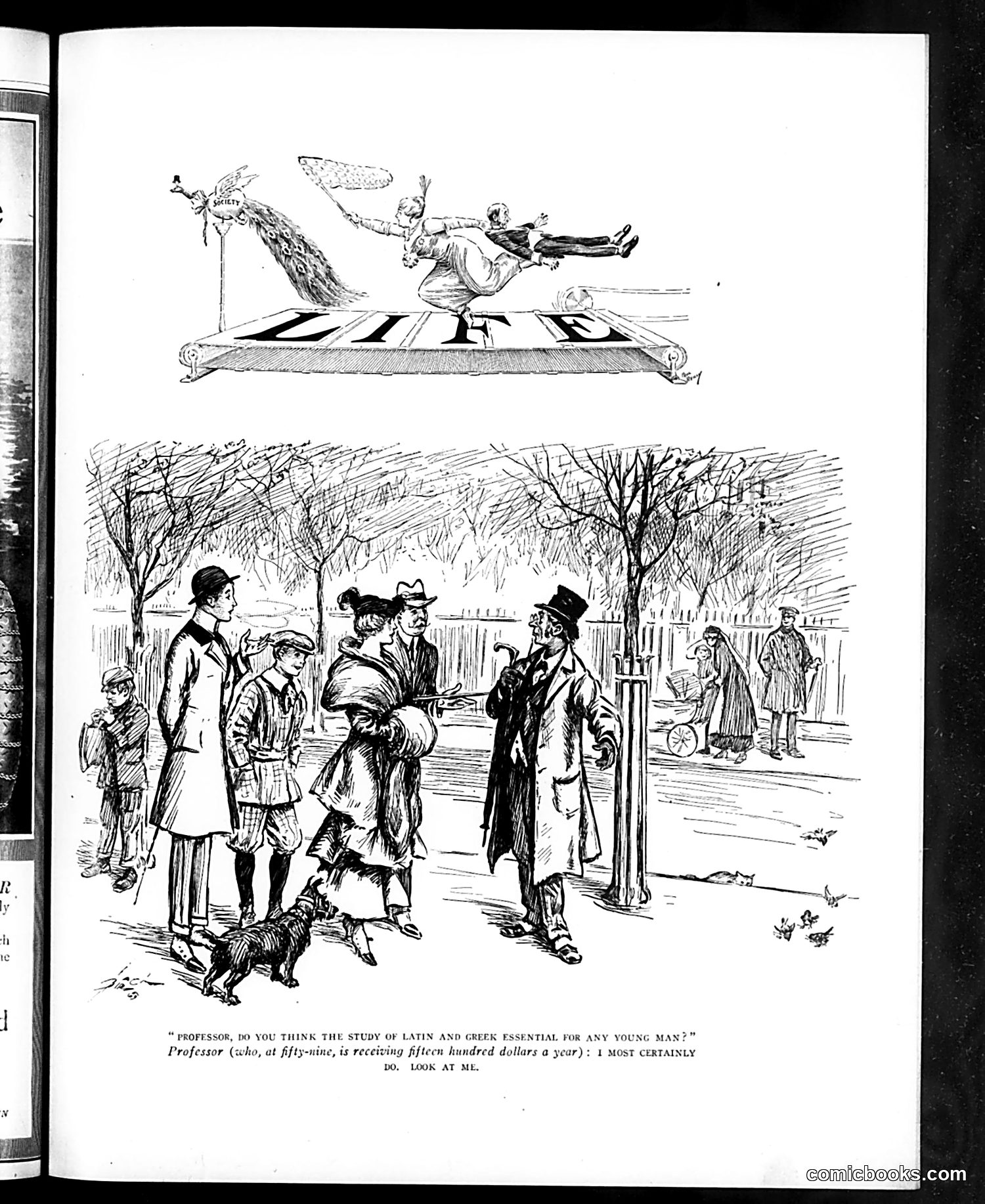
This page contains two satirical cartoons about education and social class. The **top cartoon** depicts "Society" (labeled on a pole) as an ethereal, winged figure presiding over what appears to be a social competition or "race," with figures tumbling on a striped platform—likely mocking the pursuit of high society status. The **bottom cartoon** shows a dialogue between a professor and a wealthy man in a park setting. The professor, earning fifteen hundred dollars yearly, is asked whether Latin and Greek study is "essential for any young man." His sardonic response—"I most certainly do. Look at me"—is self-deprecating satire: his classical education yielded meager financial reward, suggesting higher education's poor practical value for earning wealth. This mocks both academic pretension and the era's tension between intellectual cultivation and material success.
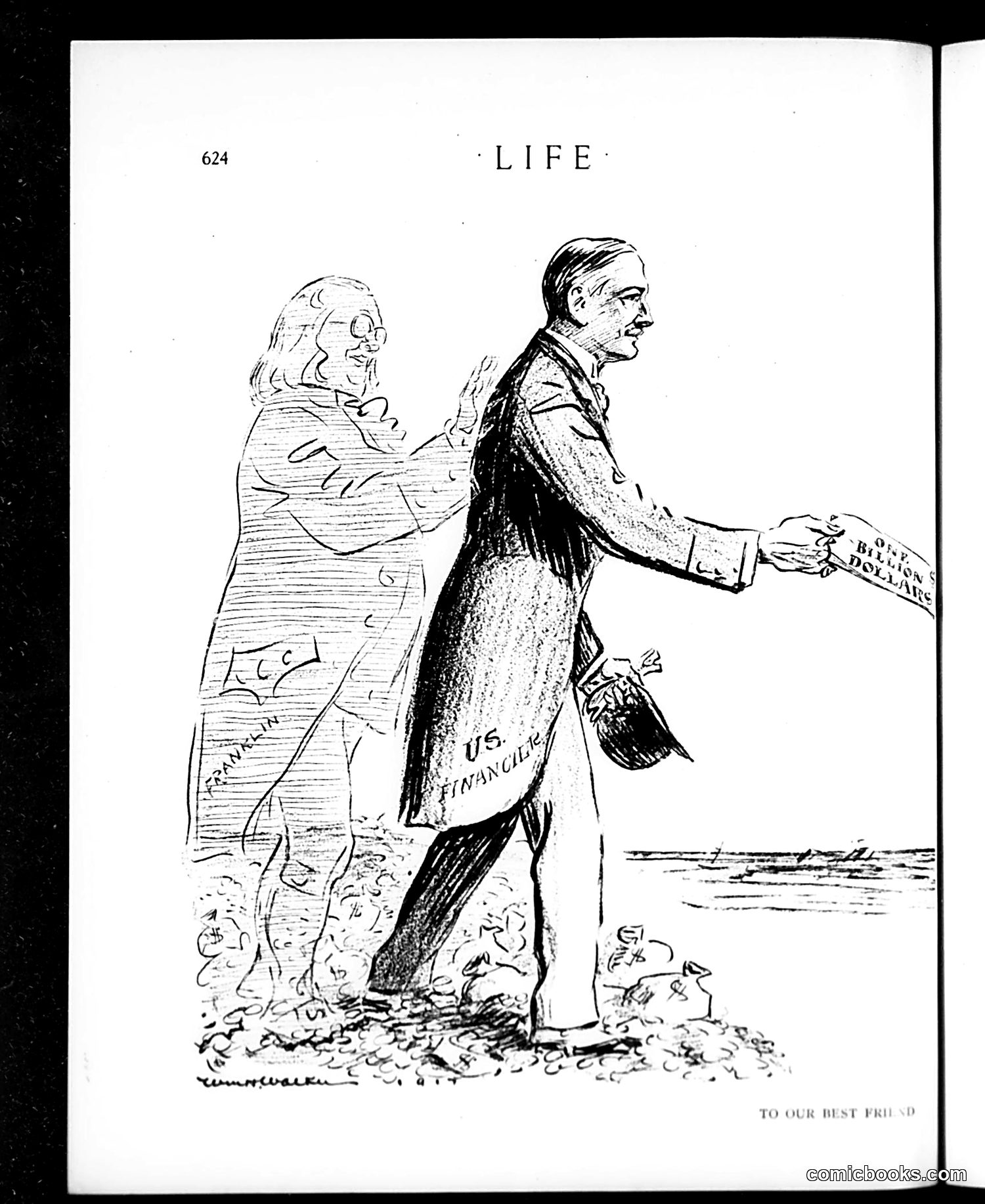
This is a satirical cartoon from *Life* magazine (page 624) titled "To Our Best Friend." The image depicts a man carrying a large sack labeled "U.S. FINANCES" while being grabbed from behind by a woman wrapped in what appears to be financial documents or ledgers. The man extends his hand offering "BOSTON POST LOANS" to someone out of frame. The satire critiques American financial mismanagement and debt. The woman likely represents fiscal responsibility or creditors pursuing the government, while the man—possibly representing a political figure or financial administrator—attempts to distribute money (loans) despite existing financial problems symbolized by the heavy sack he carries. The cartoon suggests poor financial stewardship and the irresponsibility of offering new loans while burdened by existing debt.
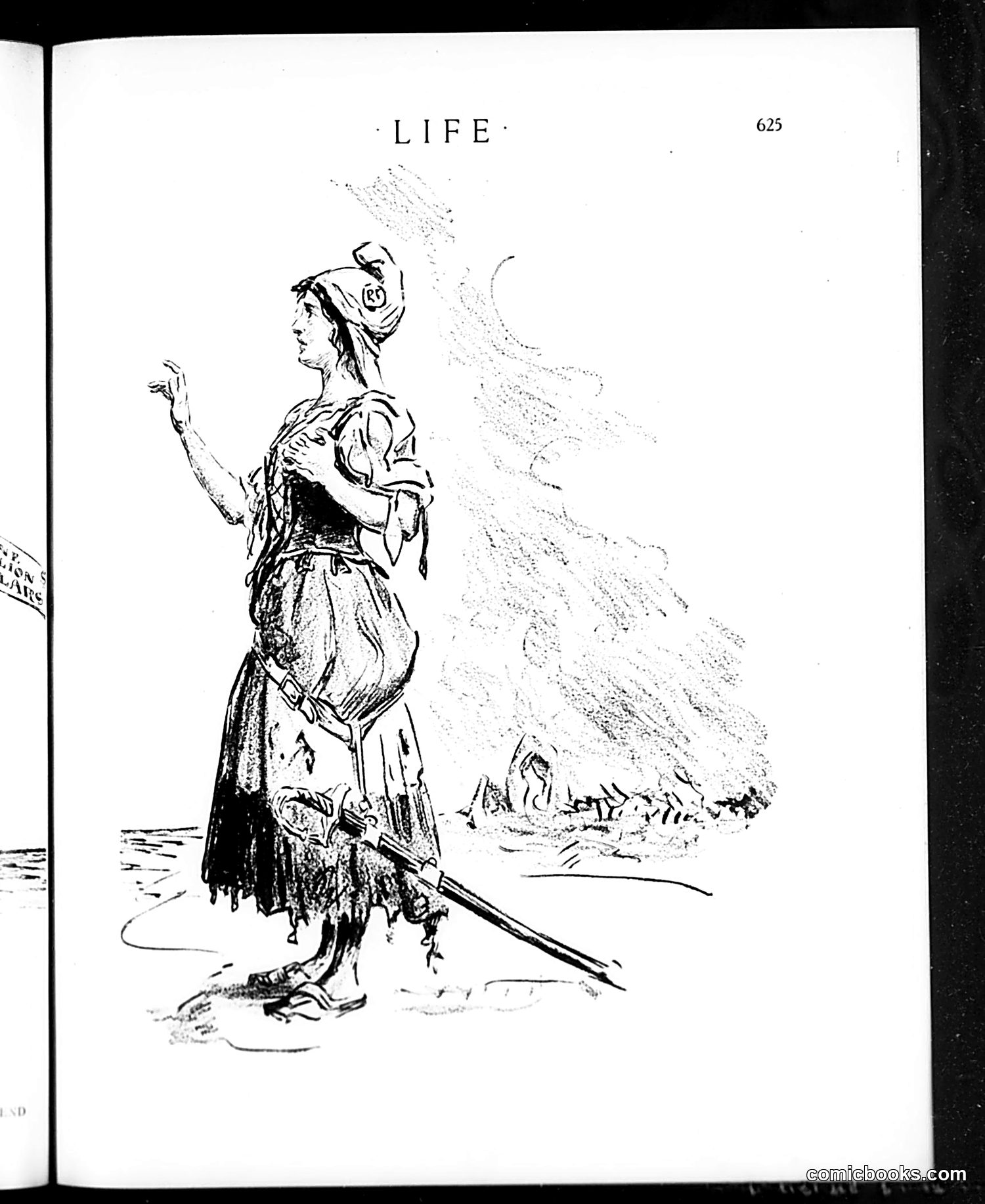
This page from *Life* magazine (page 625) features a single allegorical illustration titled simply "LIFE." The drawing depicts a classical female figure in flowing robes, holding a sword and gesturing upward. She wears a head covering and appears to be a personification of Liberty or Life itself—a common iconographic device in American political illustration. The figure stands against a sketchy landscape background. The artistic style and allegorical approach suggest this is likely a patriotic or inspirational image, possibly commenting on themes of freedom, resilience, or national purpose. Without additional textual context from the page, the specific historical moment or satirical target remains unclear, though the heroic posture and classical reference suggest weighty subject matter typical of *Life* magazine's editorial cartooning.
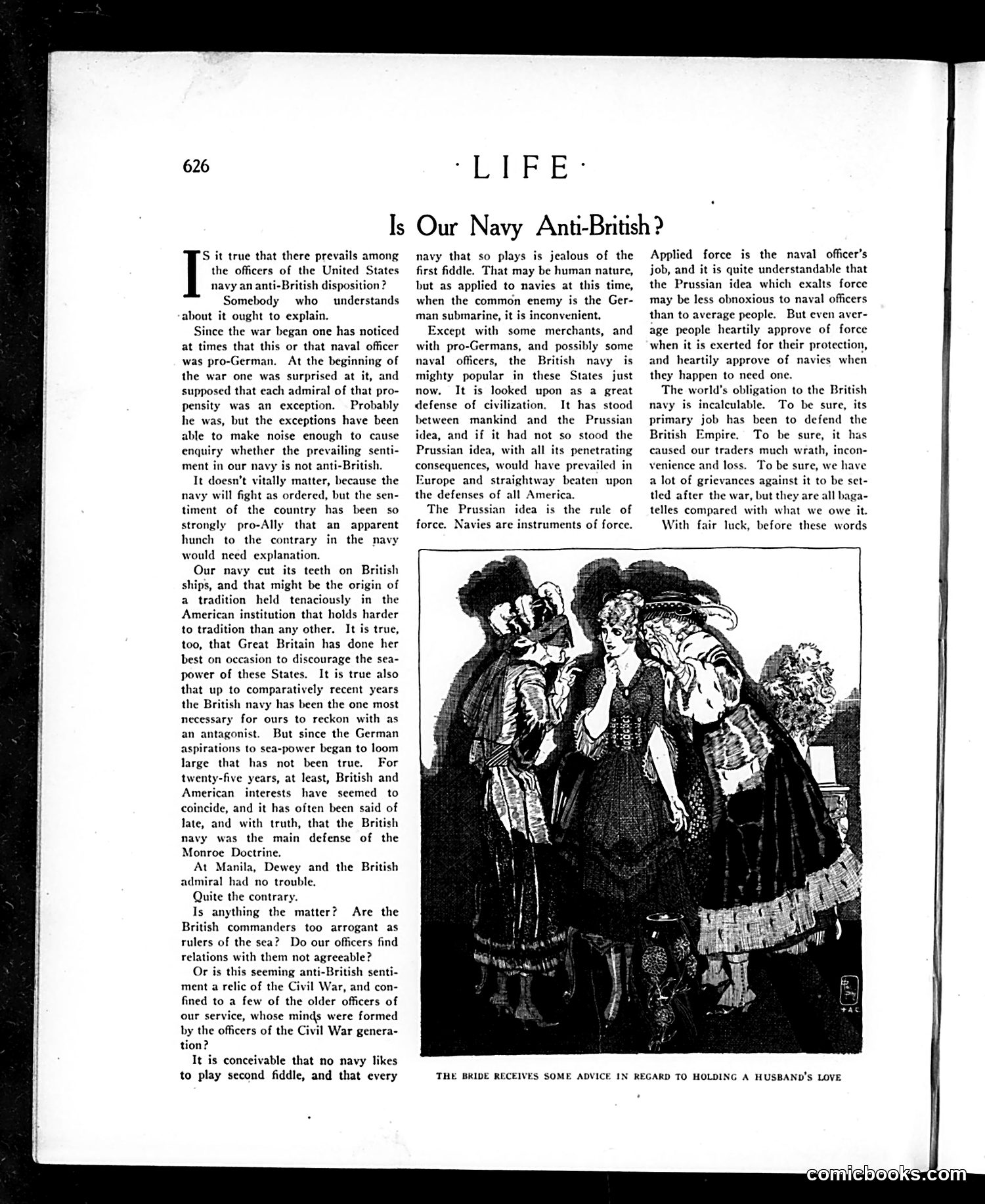
This page presents a satirical article questioning whether the U.S. Navy harbors anti-British sentiment. The author argues that while some American naval officers may have been pro-German historically, the British Navy has actually been America's best defense and aligned interest, particularly regarding the Monroe Doctrine. The accompanying illustration shows three women in period dress with the caption "THE BRIDE RECEIVES SOME ADVICE IN REGARD TO HOLDING A HUSBAND'S LOVE," appearing to use matrimonial metaphor for Anglo-American relations—suggesting the U.S. and Britain should maintain their partnership like a married couple. The article dismisses Civil War-era grievances as outdated and argues Britain and America's interests have long coincided against German expansion.
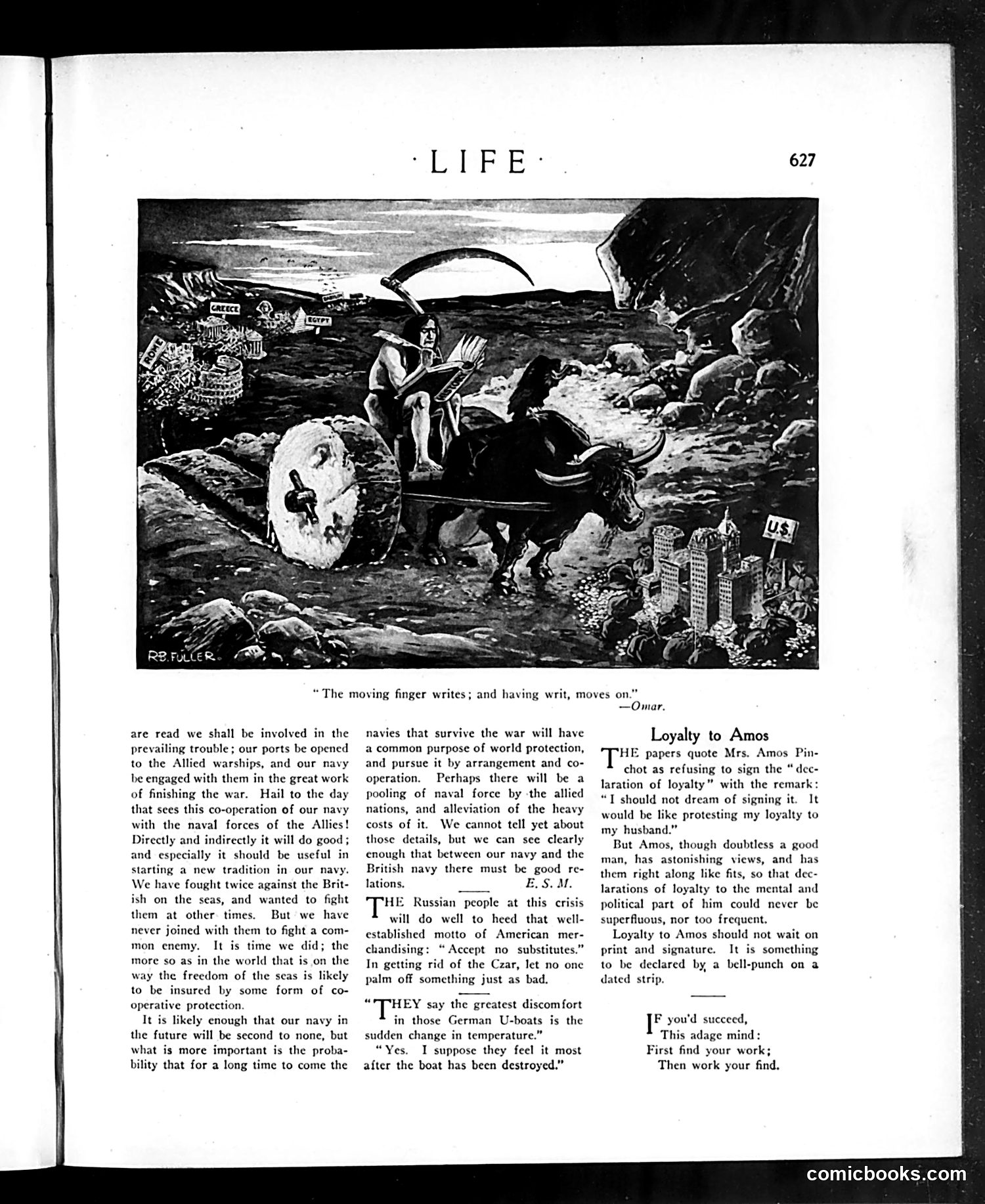
The main artwork is a satirical illustration by R.B. Fuller depicting the famous Omar Khayyam quote: "The moving finger writes; and having writ, moves on." The image shows a hand of fate or destiny writing upon a scroll or tablet, with a chaotic wartime scene below featuring military vessels, fortifications, and destruction. The accompanying text discusses naval cooperation between Allied forces during what appears to be WWI, emphasizing the importance of the British and American navies working together. It references Russian maritime concerns and jokes about German U-boat crews experiencing temperature shock. The satire suggests that historical forces move inevitably forward—war's momentum cannot be stopped, only managed through alliance and cooperation.
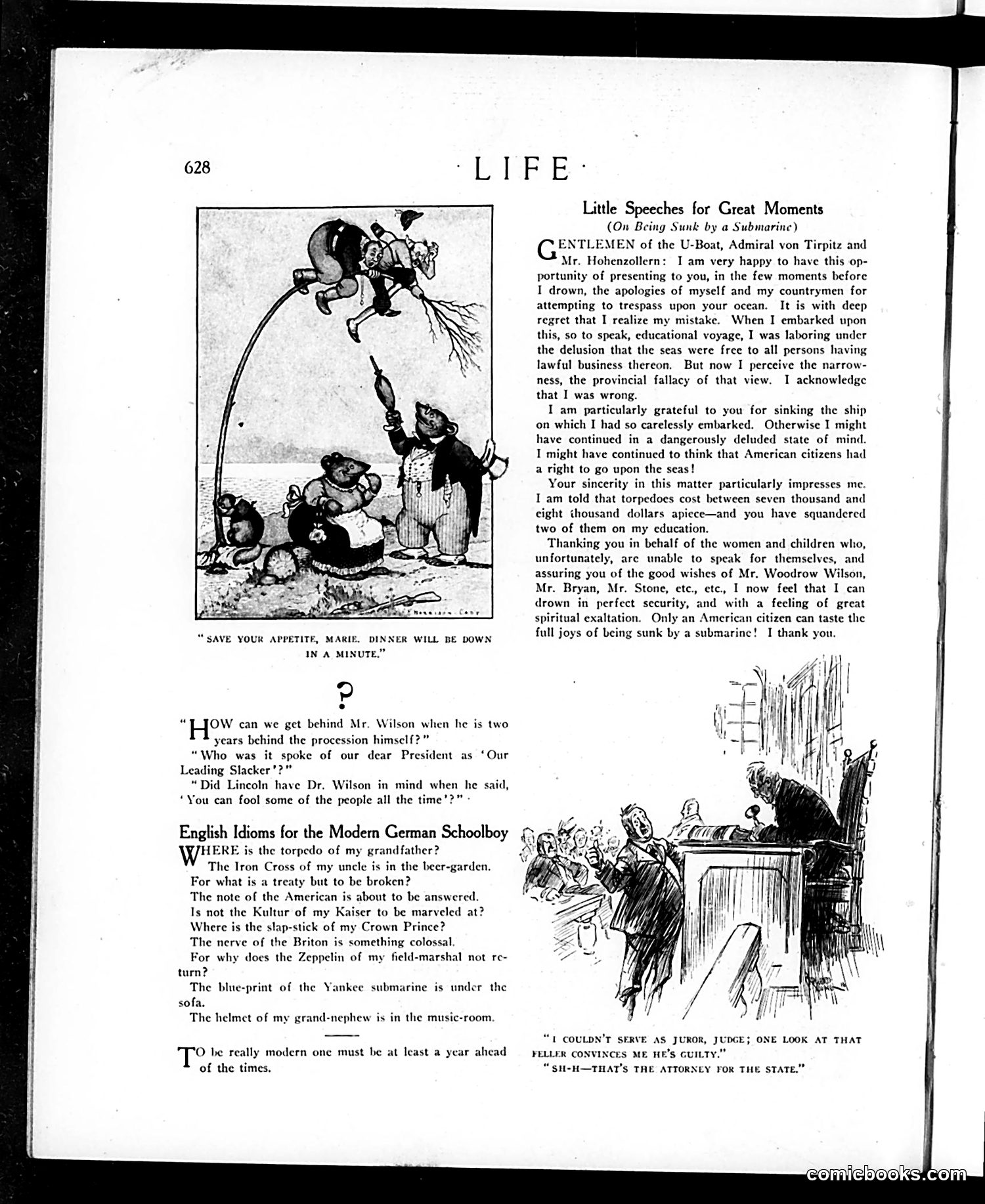
This page satirizes World War I submarine warfare and American politics. The top cartoon depicts sailors being rescued after a U-boat sinking, with a caption mocking preparation ("Save your appetite, Marie. Dinner will be down in a minute"). The main text is a fictional speech by a German U-boat commander (Admiral von Tirpitz) to American recipients (Hohenzollern), ironically thanking them for sinking his ship and apologizing for the "educational voyage." The satire targets American neutrality debates and those who opposed U.S. involvement. The lower section, "English Idioms for the Modern German Schoolboy," presents absurdist word-play mocking German militarism—references to lost battles, submarines, and German leaders—suggesting German defeat and humiliation. The page ridicules both German aggression and American isolationism during the pre-1917 period.
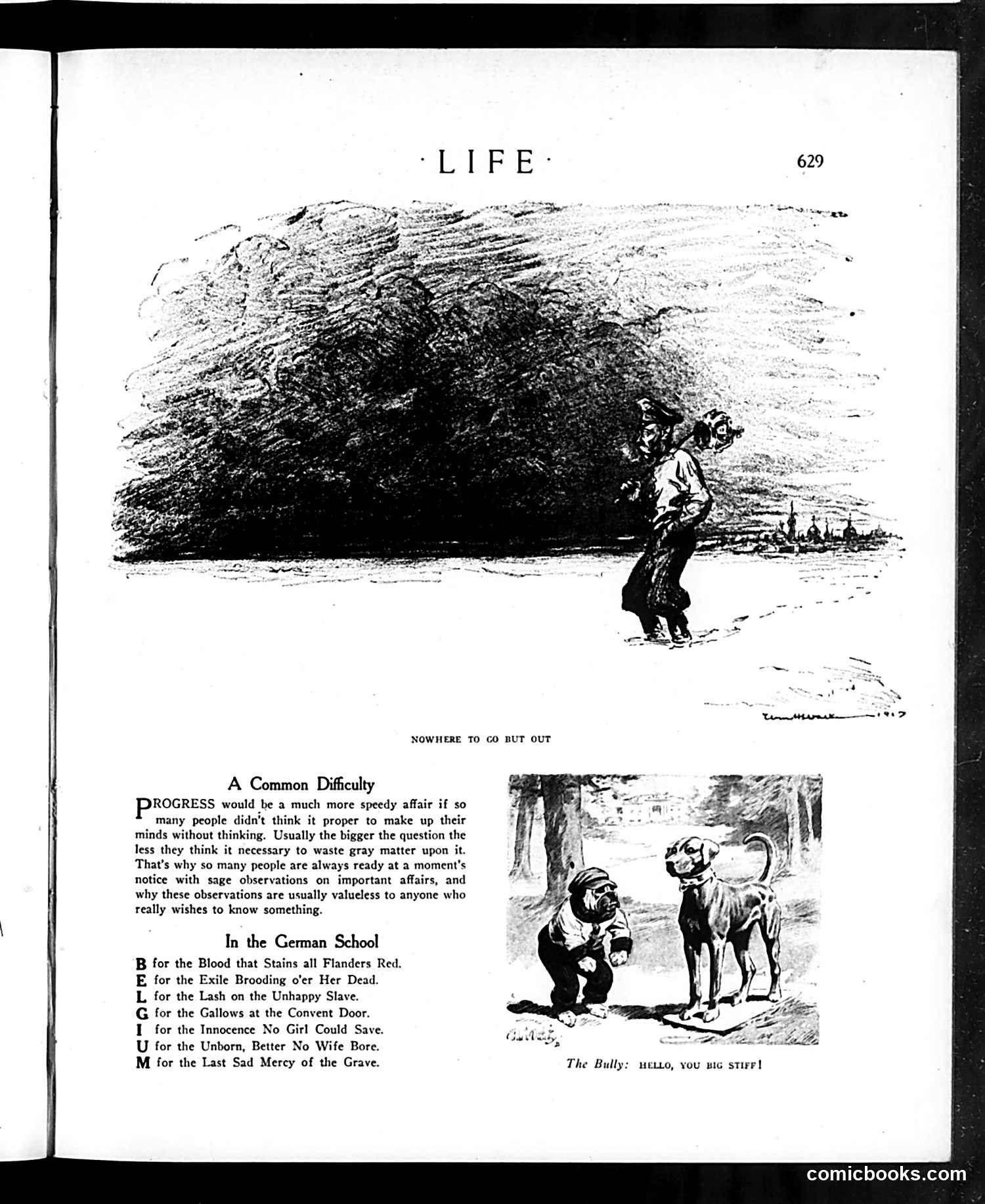
This page from *Life* magazine (page 629) contains two distinct pieces: **Top cartoon** ("Nowhere to Go But Out"): Shows a figure standing before a massive dark storm or cloud, gesturing helplessly. The image suggests futility or being trapped with no options. **Middle section** ("A Common Difficulty"): Satirizes people who don't think before speaking—those who make snap judgments on important matters without reflection. It critiques this as widespread behavior. **Bottom section** ("In the German School"): An acrostic poem using "BELGIUM" to list atrocities allegedly taught in German schools—including blood staining Flanders, exiles, whipping, gallows, and other brutalities. This appears to be WWI-era anti-German propaganda. **Right cartoon** ("The Bully"): Shows a figure confronting a dog, with caption "Hello, you big stiff!" This appears to be a separate satirical sketch about bullying or confrontation. The page reflects early 20th-century American political satire and wartime messaging.
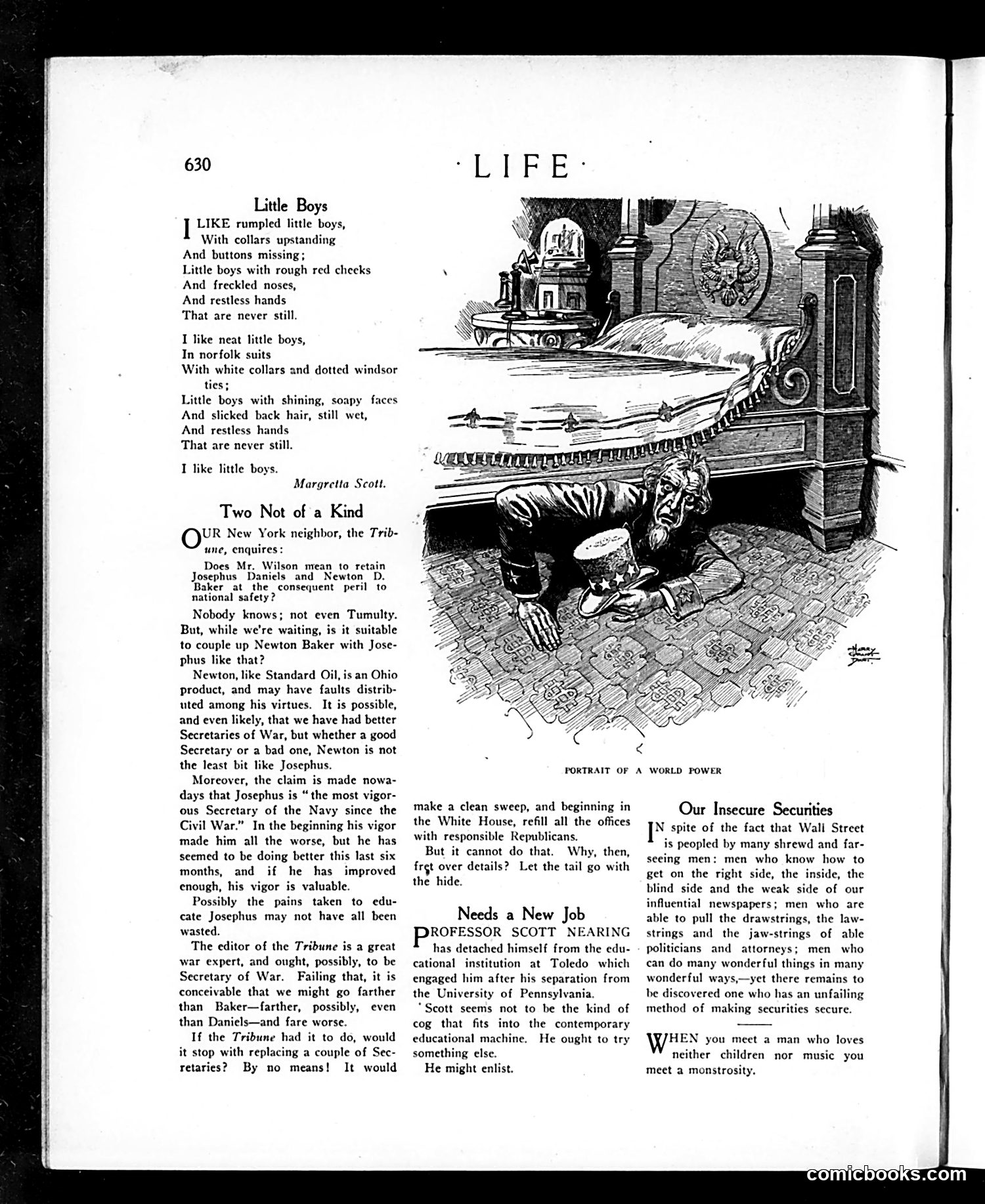
This page contains three distinct sections: 1. **"Little Boys" poem** by Margretta Scott—a lighthearted verse celebrating mischievous, energetic children. 2. **"Two Not of a Kind"** editorial about Secretary of the Navy Josephus Daniels, questioning whether he should retain officials Newton D. Baker and Joseph Daniels for national security. The piece suggests these figures may be ineffective or problematic administrators. 3. **The main cartoon** titled "Portrait of a World Power" depicts industrial/mechanical imagery—factories, gears, and machinery—suggesting commentary on American industrial or military power during what appears to be the World War I era. 4. **"Our Insecure Securities"** discusses Wall Street corruption and the need for financial market reform. The overall theme concerns government competence and national security during wartime.
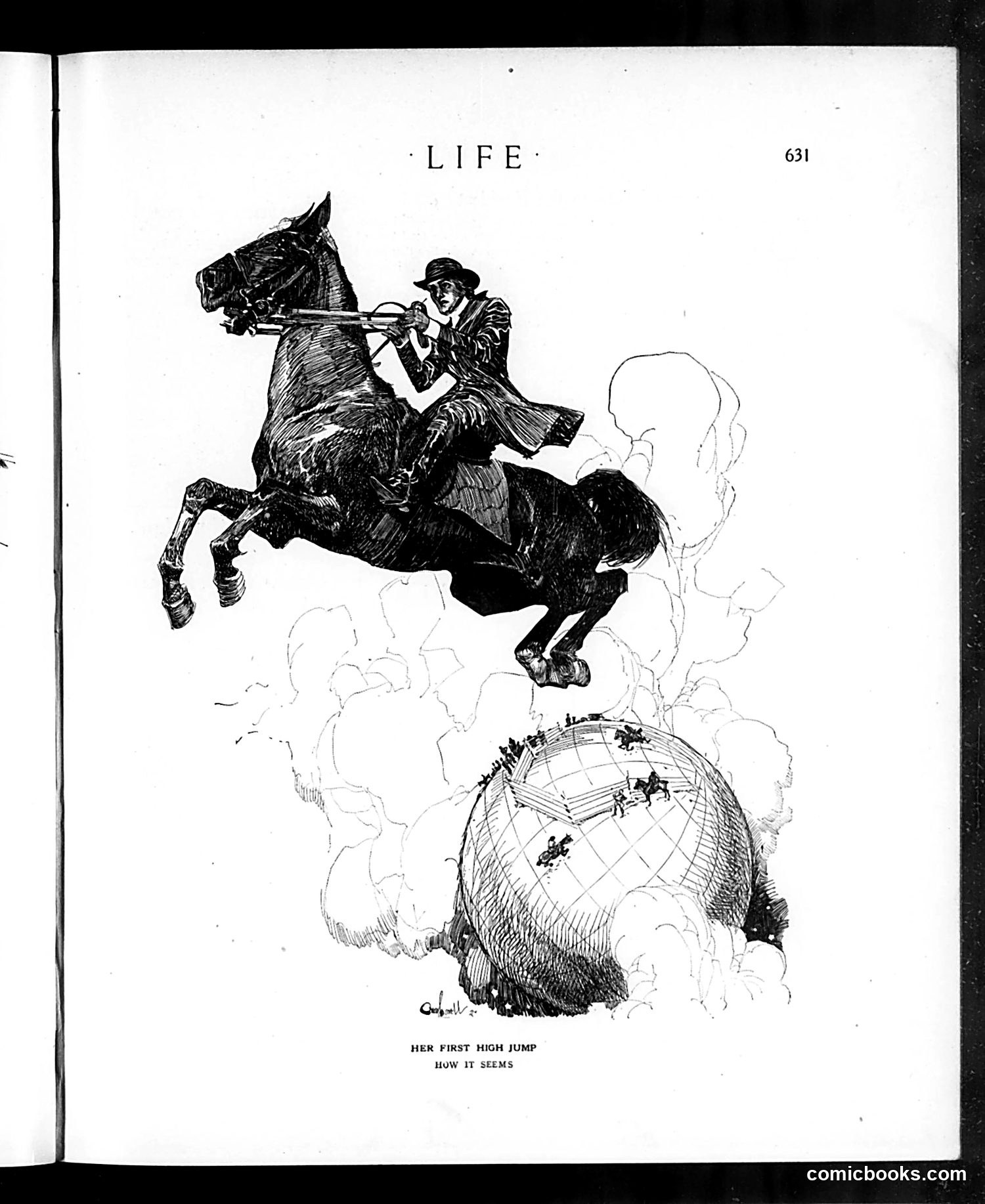
This satirical cartoon depicts a woman on horseback attempting an ambitious equestrian jump over a globe. The exaggerated perspective—with the Earth appearing enormous beneath her—suggests she's attempting something far beyond reasonable expectations. The caption's ironic tone ("How It Seems") indicates the cartoon is mocking women's aspirations, likely referencing early 20th-century debates about women's expanded social roles and ambitions. The impossibly massive globe emphasizes the satire: what appears to a woman as an achievable "first high jump" is depicted as a laughably impossible feat. This reflects contemporary attitudes dismissing women's professional and athletic ambitions as unrealistic overreach, a common theme in *Life* magazine's humor during this era.
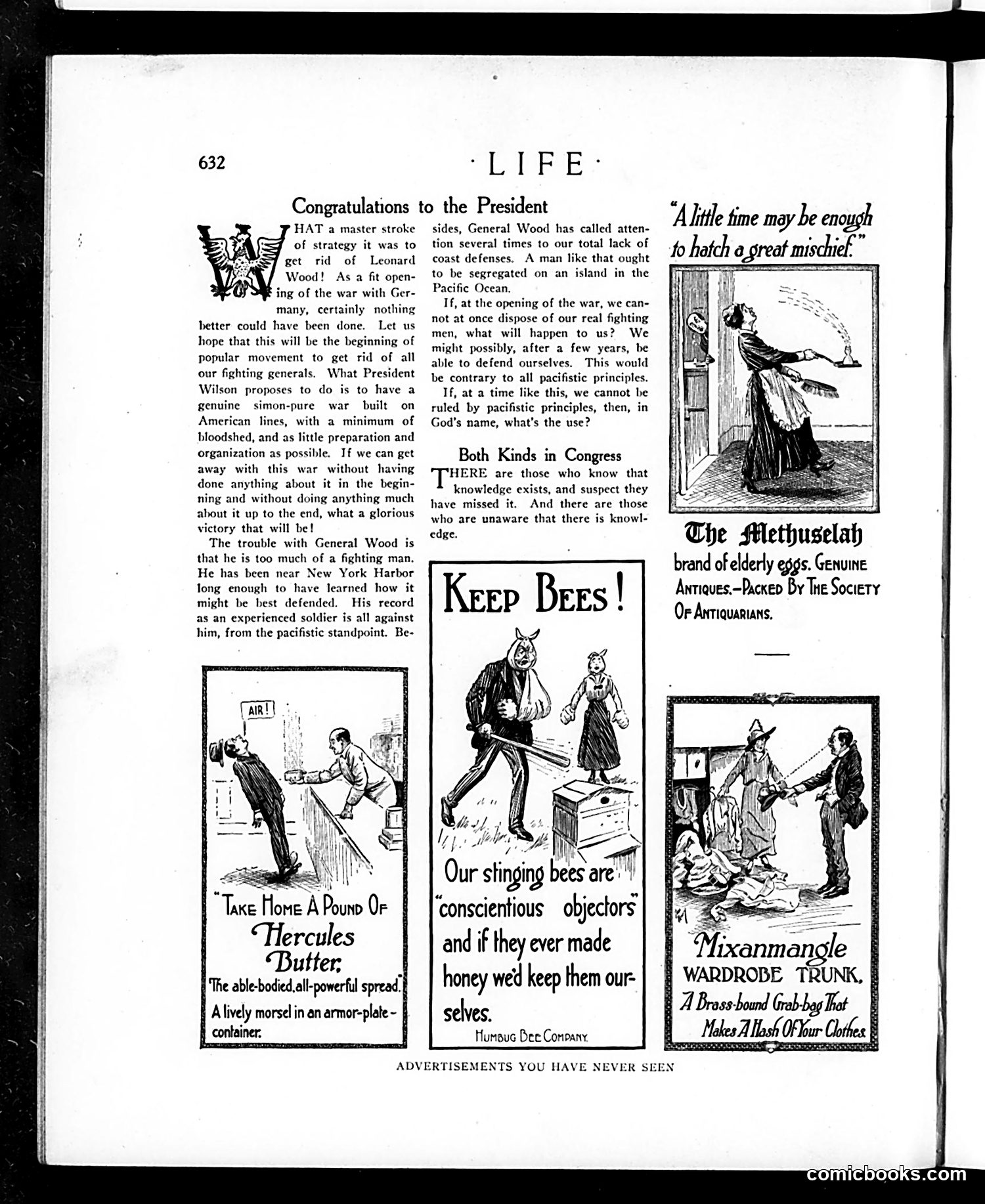
This page from *Life* magazine uses sharp irony to criticize President Wilson's military preparedness during World War I. The main article sarcastically "congratulates" Wilson for removing General Leonard Wood, a respected military strategist who had warned about inadequate coastal defenses. The satire argues that removing experienced fighting men in favor of pacifist principles is dangerously foolish—Wilson wants to fight a war with "minimum bloodshed" and "as little preparation" as possible, which the author presents as absurd. The section "Both Kinds in Congress" appears to mock Congress members divided between the knowledgeable and the ignorant. The advertisements are period parodies: "Hercules Butter," "Keep Bees" (with a pun on conscientious objectors), and "Methuselah eggs" mock consumer products while maintaining satirical commentary.
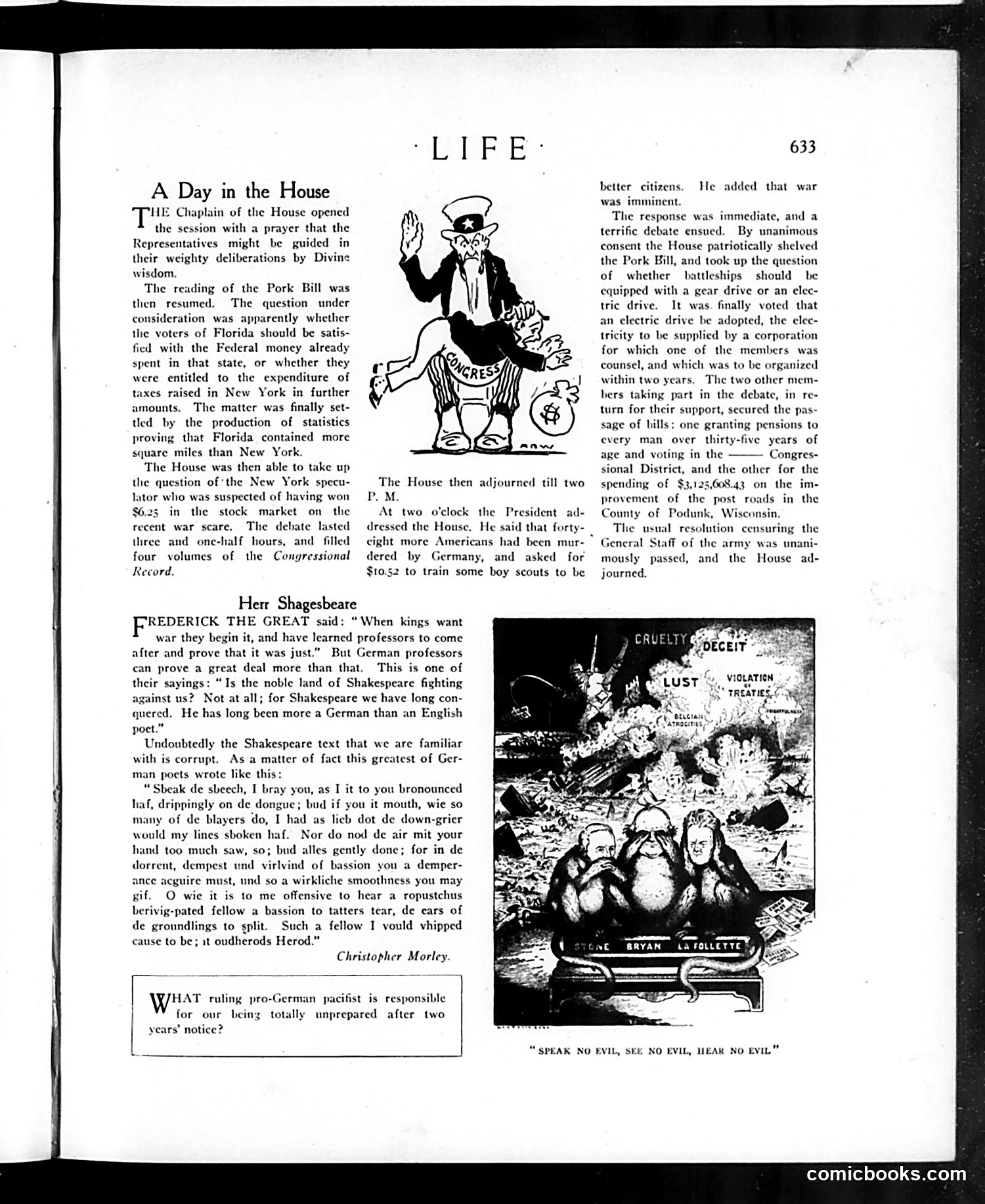
**"A Day in the House"** satirizes Congressional inefficiency and self-interest. The piece mocks how representatives debate trivial matters (Florida vs. New York spending, stock market speculation) with equal vigor as serious issues. When the President announces American deaths and war is imminent, Congress suddenly shelves the "Pork Bill"—but only to debate battleship drives while simultaneously securing pork-barrel legislation for their own districts (pensions, road improvements in "Podunk, Wisconsin"). The satire suggests patriotic rhetoric masks unchanged special-interest politics. **"Herr Shakespeare"** attacks German propaganda claims that Shakespeare was "more German than English." It parodies this by "translating" Shakespeare into comically mangled pseudo-German, mocking the absurdity of German cultural appropriation. The accompanying illustration shows demons labeled "Cruelty," "Deceit," and "Lust"—suggesting Germany's true character regardless of cultural claims. Both pieces criticize American unpreparedness for war (noted in the boxed question) and German deception, likely written circa 1916-1917, before U.S. entry into World War I.
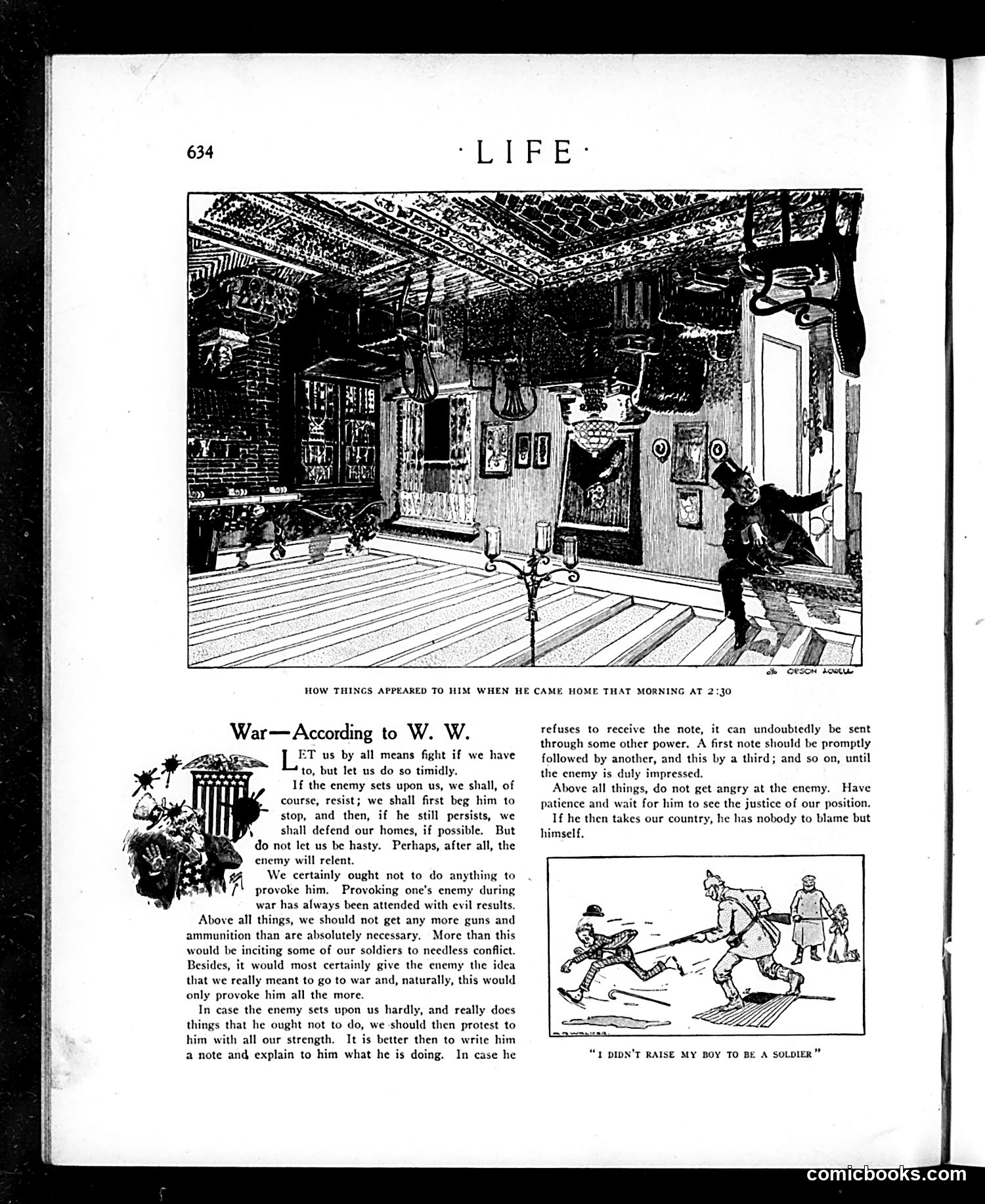
This page satirizes pacifist opposition to military preparedness, likely from WWI era. The top illustration shows a man arriving home at 2:30 AM to find his home ransacked—visualizing the consequences of the passive approach advocated in the accompanying text. The essay "War—According to W. W." mocks an overly cautious wartime philosophy: don't provoke the enemy, avoid excessive weapons, write polite protest notes instead of fighting back, and maintain patience even if the country is conquered. The satire suggests this approach is absurdly ineffectual. The bottom cartoon references the anti-war song "I Didn't Raise My Boy to Be a Soldier," showing a child caught in conflict—illustrating the irony that refusing military strength doesn't prevent war, it invites invasion. The target appears to be pacifist or anti-militarism activists whom *Life* viewed as dangerously naïve during wartime.
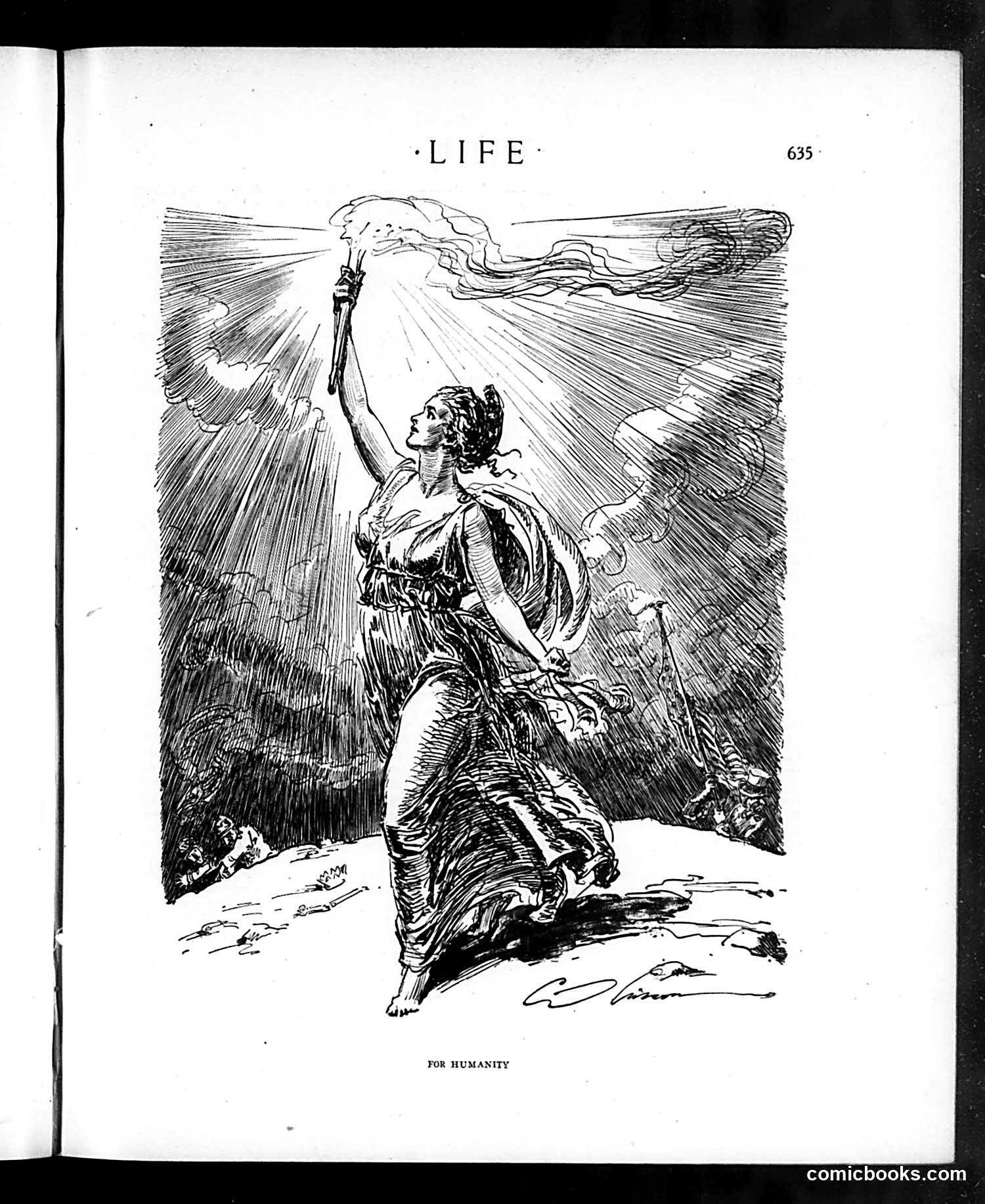
This is an allegorical illustration titled "For Humanity" from *Life* magazine (page 635). It depicts a classical female figure—likely representing Liberty, Progress, or Humanity itself—kneeling and raising a torch heavenward. The dramatic radiant lines and heroic pose suggest an appeal or prayer to higher powers. The figure's classical drapery and winglike forms reinforce the allegorical nature. The barren ground and modest scale of other elements emphasize the central figure's isolated plea. Without the magazine's date visible, the specific historical context remains unclear. However, the composition suggests commentary on humanitarian causes or social progress—potentially addressing war, injustice, or crisis. The "for humanity" caption indicates the image advocates for some noble cause, though *which* cause the original audience would have recognized from context we cannot definitively determine.
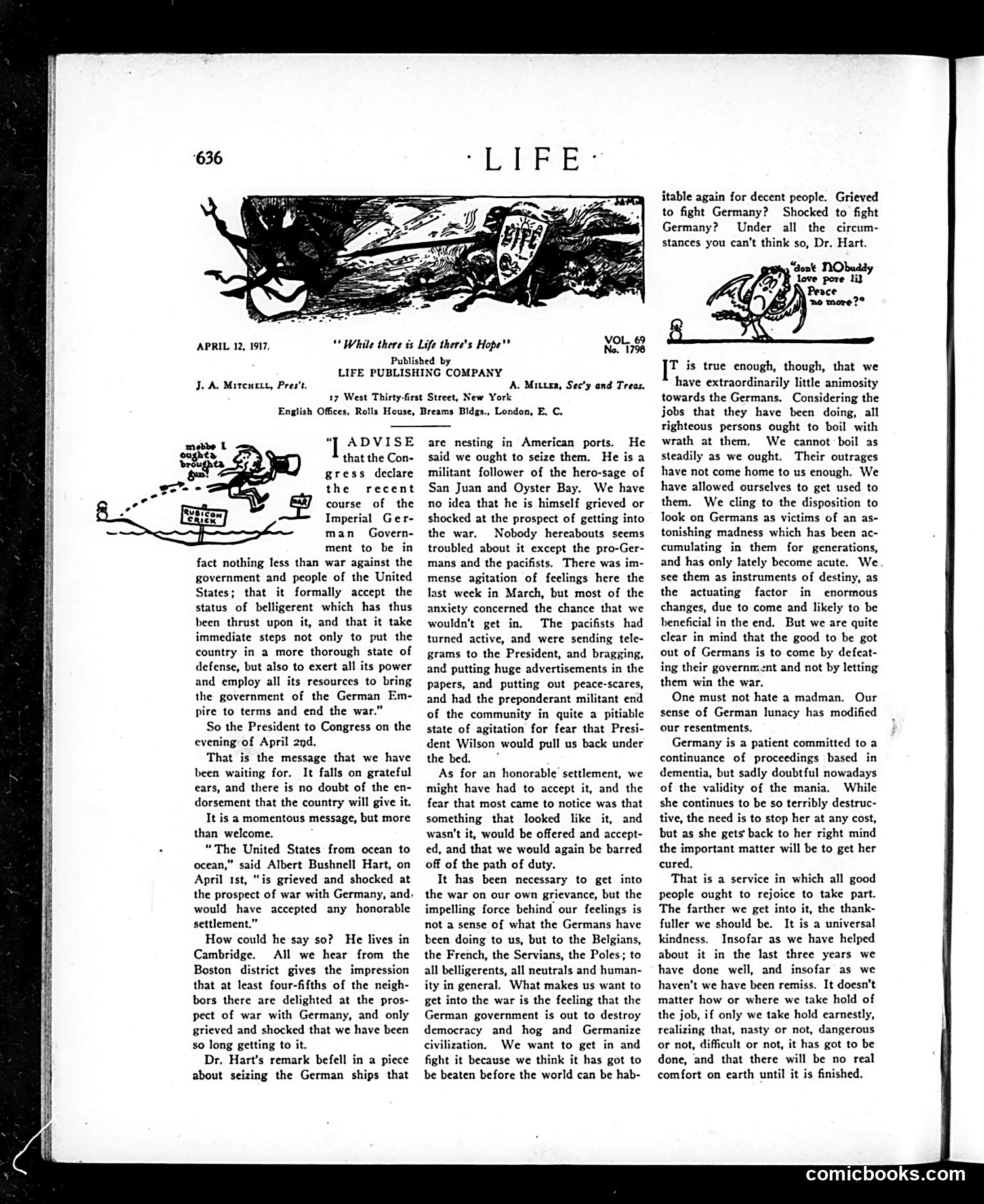
This issue appeared just days after President Wilson's April 2 war message to Congress asking for a declaration of war against Germany. The page is primarily editorial commentary rather than cartoon satire. The text addresses **Albert Bushnell Hart**, a Boston academic who claimed Americans were "grieved and shocked" at the prospect of war with Germany. Life's editors mock this characterization, asserting that Boston and most Americans actually *welcomed* entry into WWI. They dispute Hart's suggestion of accepting an "honorable settlement," arguing the real impetus behind American support for war isn't German attacks on U.S. ships, but rather Germany's aggression against Belgium, France, Serbia, and Poland—seen as threats to democracy itself. The cartoons (visible but small) appear to be decorative wartime illustrations supporting American entry into the war, though their specific imagery is unclear at this reproduction quality.
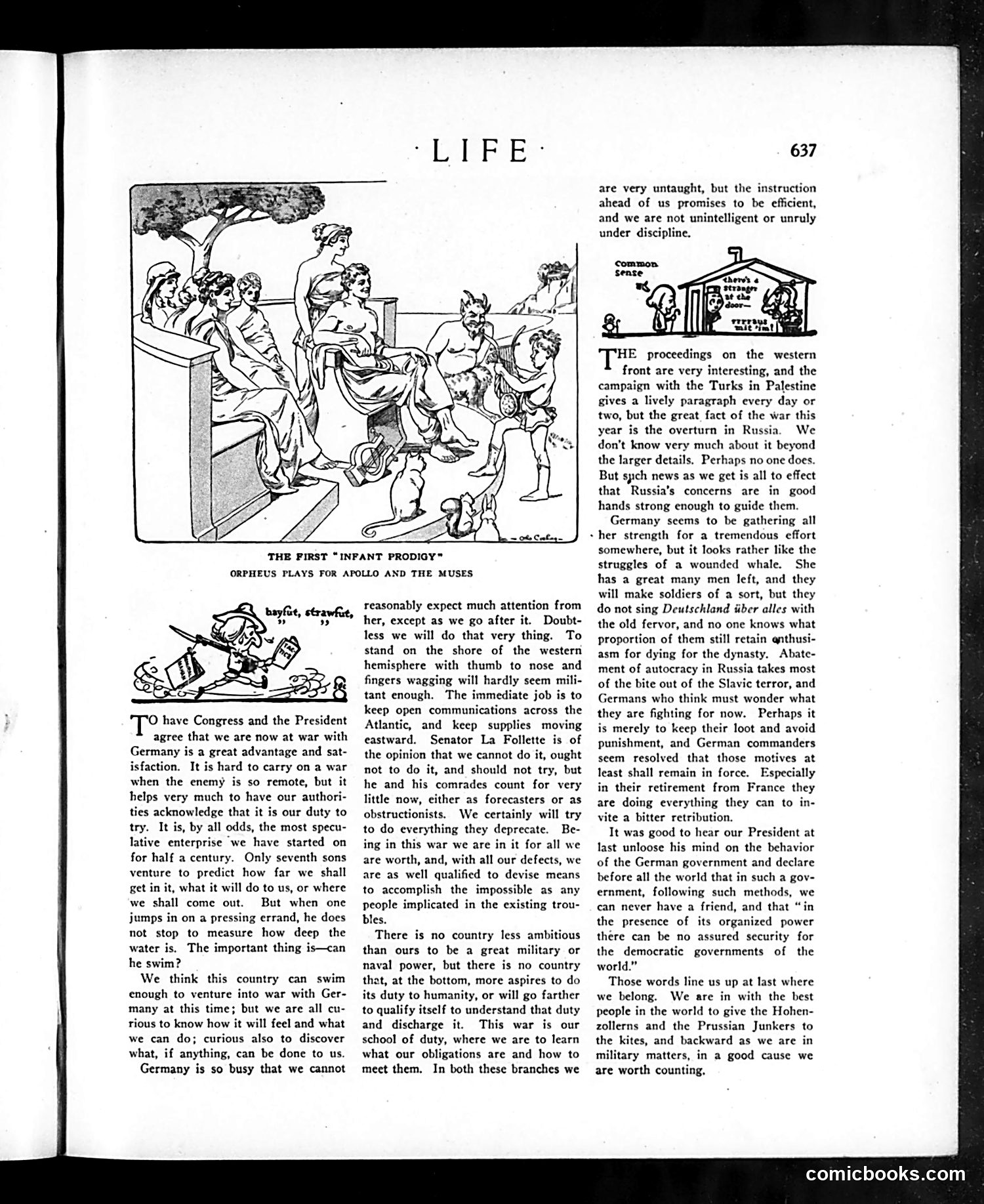
This page from *Life* magazine, published during America's involvement in World War I, contains a classical cartoon titled "The First 'Infant Prodigy': Orpheus Plays for Apollo and the Muses." The illustration depicts the mythological figure Orpheus performing for the gods—a satirical comment on wartime propaganda and public persuasion. The accompanying editorial discusses America's entry into the war against Germany. The author argues that despite uncertainties, the nation is capable of meeting its military and moral obligations. He dismisses Senator La Follette's antiwar opposition as ineffectual, expresses concern about Germany's remaining strength, and praises President Wilson for his moral clarity on the conflict. The "infant prodigy" metaphor sarcastically suggests America as a young nation learning through war—framed as a "school of duty." The classical reference humorously elevates American inexperience while endorsing the war effort as necessary and righteous.
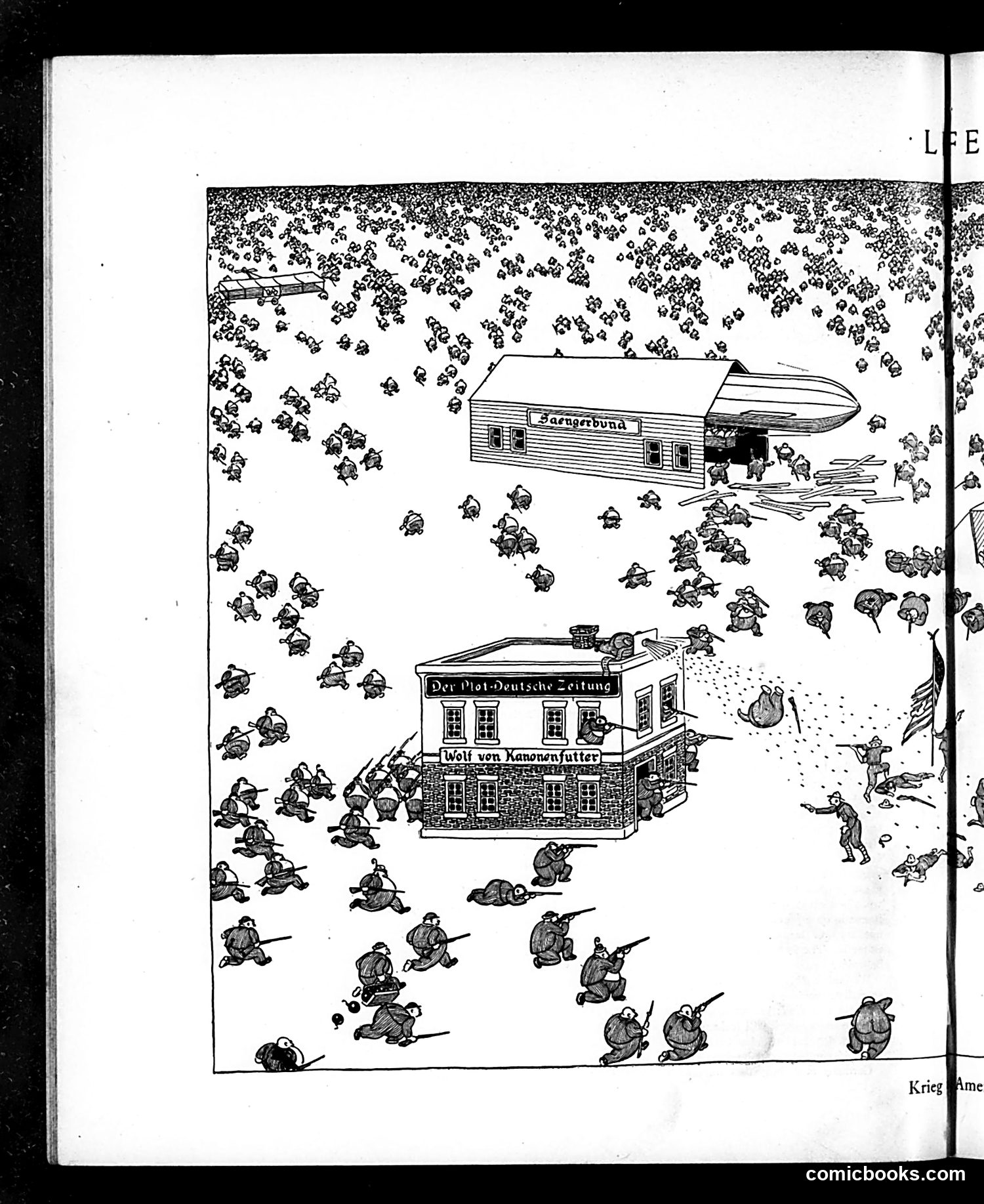
This appears to be a **WWI-era German satirical cartoon** showing a scene of military conflict. The image depicts: - A fortified German newspaper building labeled "Der Ost-Deutsche Zeitung" (East German Newspaper) and "Wolt von Kannenfutter" - Soldiers surrounding the structure in combat positions - An airship or zeppelin above - Scattered military figures across the landscape The satire likely mocks German military propaganda or journalism during wartime—perhaps criticizing how German newspapers reported on the Eastern Front or how the military promoted wartime narratives. The fortified newspaper building humorously suggests the press was a military target or weapon itself. The German text and style confirm this is **enemy propaganda** republished by Life magazine to ridicule German war efforts to American readers.
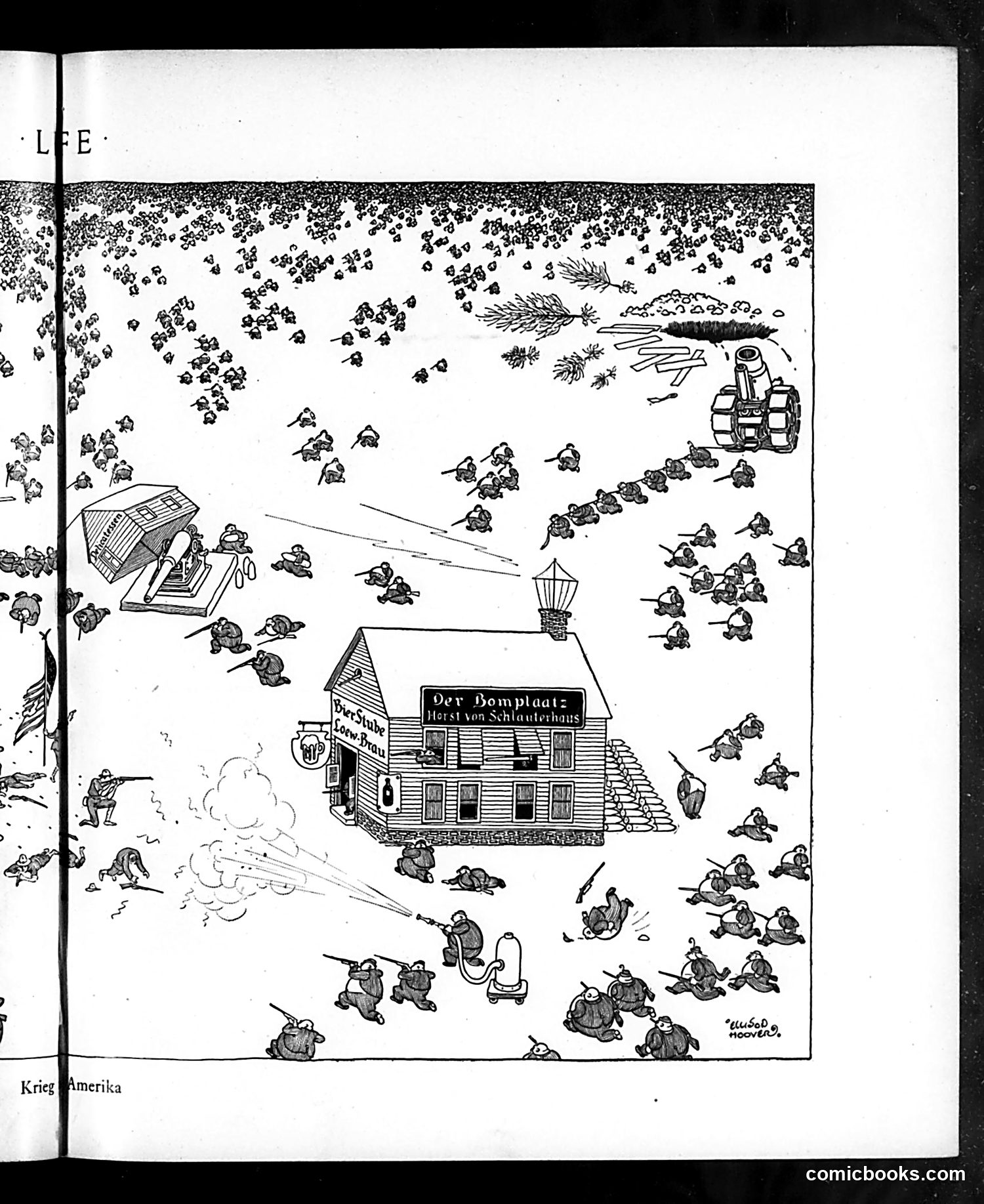
This German-language satirical cartoon depicts what appears to be a fortified homestead labeled "Der Homplaatz" (The Home Place) and "Horst von Schlauterhaus," surrounded by numerous armed soldiers or attackers in combat positions. The scene shows military assault with explosions, gunfire, and organized troops converging on a civilian dwelling. The title references "Krieg Amerika" (War America), suggesting this satirizes American military intervention or conflict. The cartoon likely critiques U.S. military aggression or imperialism by portraying disproportionate force deployed against a civilian target or settlement. The German publication context suggests this may comment on American foreign policy from a critical perspective, though the specific historical moment remains unclear without additional dating information.
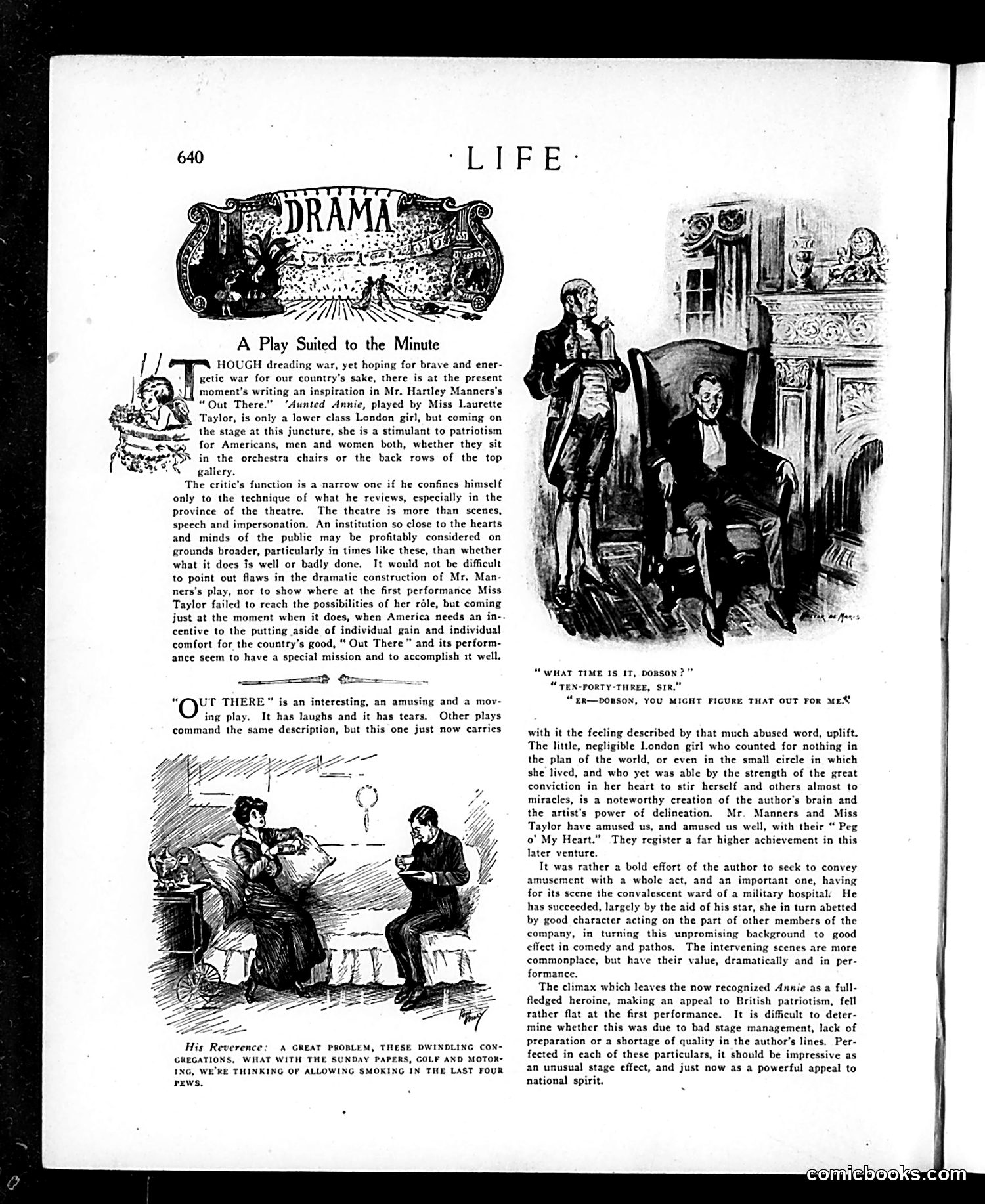
This page reviews Hartley Manners's play "Out There," starring Laurette Taylor as a working-class London girl named Annie. The critic argues the play deserves praise not purely on theatrical merit, but because of its *timely patriotic value*—it inspires American audiences during wartime to sacrifice personal comfort for country. The smaller cartoon below (captioned "His Reverence") satirizes a clergyman concerned that churches lose congregants to secular Sunday activities (newspapers, golf, motoring), so he considers permitting smoking in back pews to retain attendance—a joke about institutional desperation and misplaced priorities. The dialogue exchange about the time appears unrelated to the main review, possibly a separate comic feature mocking a servant's literalism or a master's forgetfulness. The page reflects WWI-era American culture where theatre served patriotic propaganda functions.
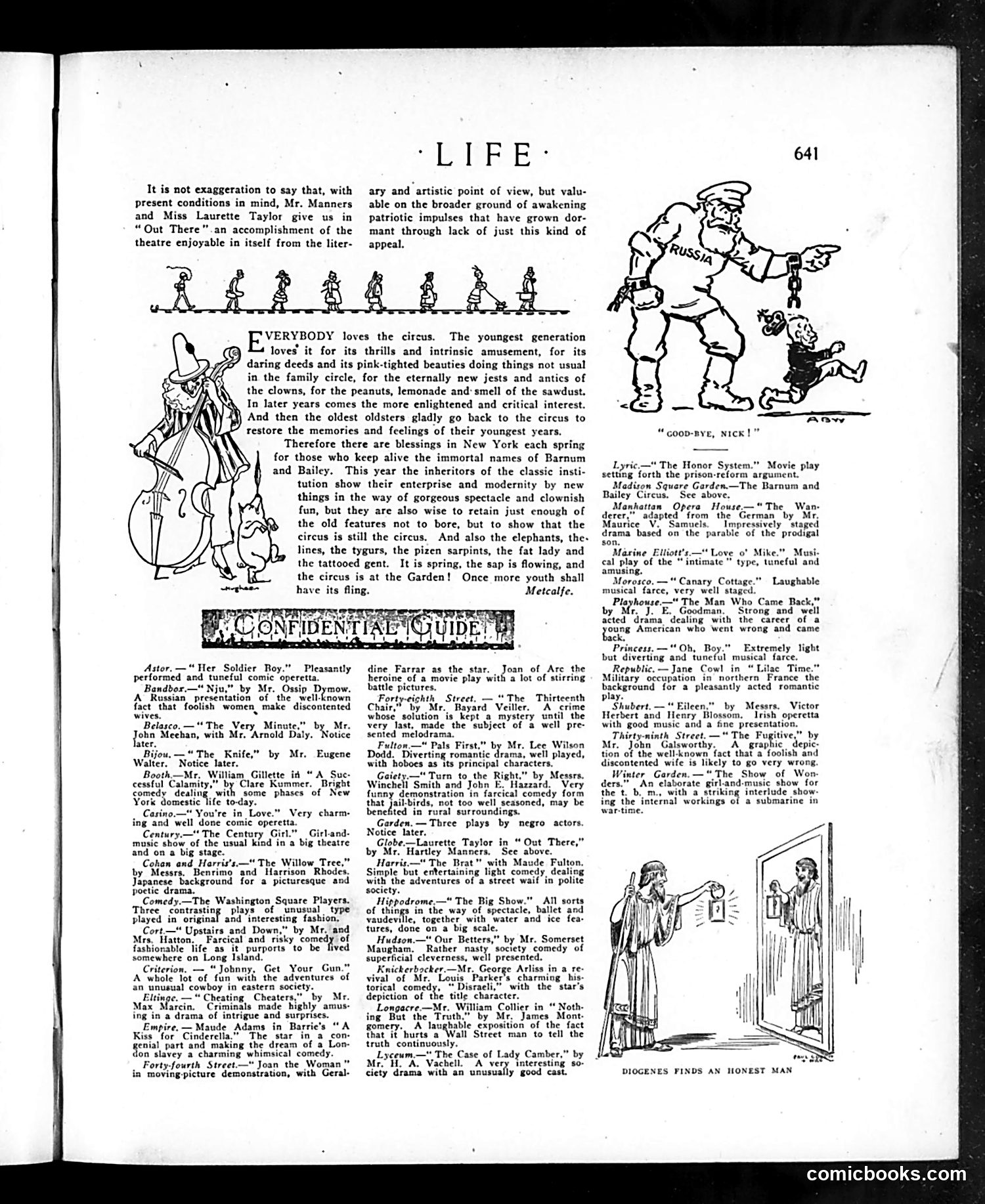
This page from *Life* magazine contains theater reviews and two cartoons about distinctly early-20th-century topics. **Upper cartoon**: Shows a line of soldiers marching, illustrating the text's reference to "Out There"—a play about WWI that aims to awaken "patriotic impulses" in audiences. The review praises it for combining entertainment with patriotic sentiment during wartime. **Right cartoon labeled "GOOD-BYE, NICK!"**: Depicts a caricatured Russian figure (representing Russia, labeled) saying goodbye. This likely references Russia's exit from WWI in 1917 (the Bolshevik Revolution/Treaty of Brest-Litovsk), when Russia withdrew from the war—a significant geopolitical shock to Allied nations like America. **Lower cartoon**: Shows what appears to be a domestic scene, accompanying reviews of comedies and dramas about everyday life and relationships. The page reflects American popular culture during WWI, when patriotic themes saturated entertainment and contemporary international events dominated public consciousness.
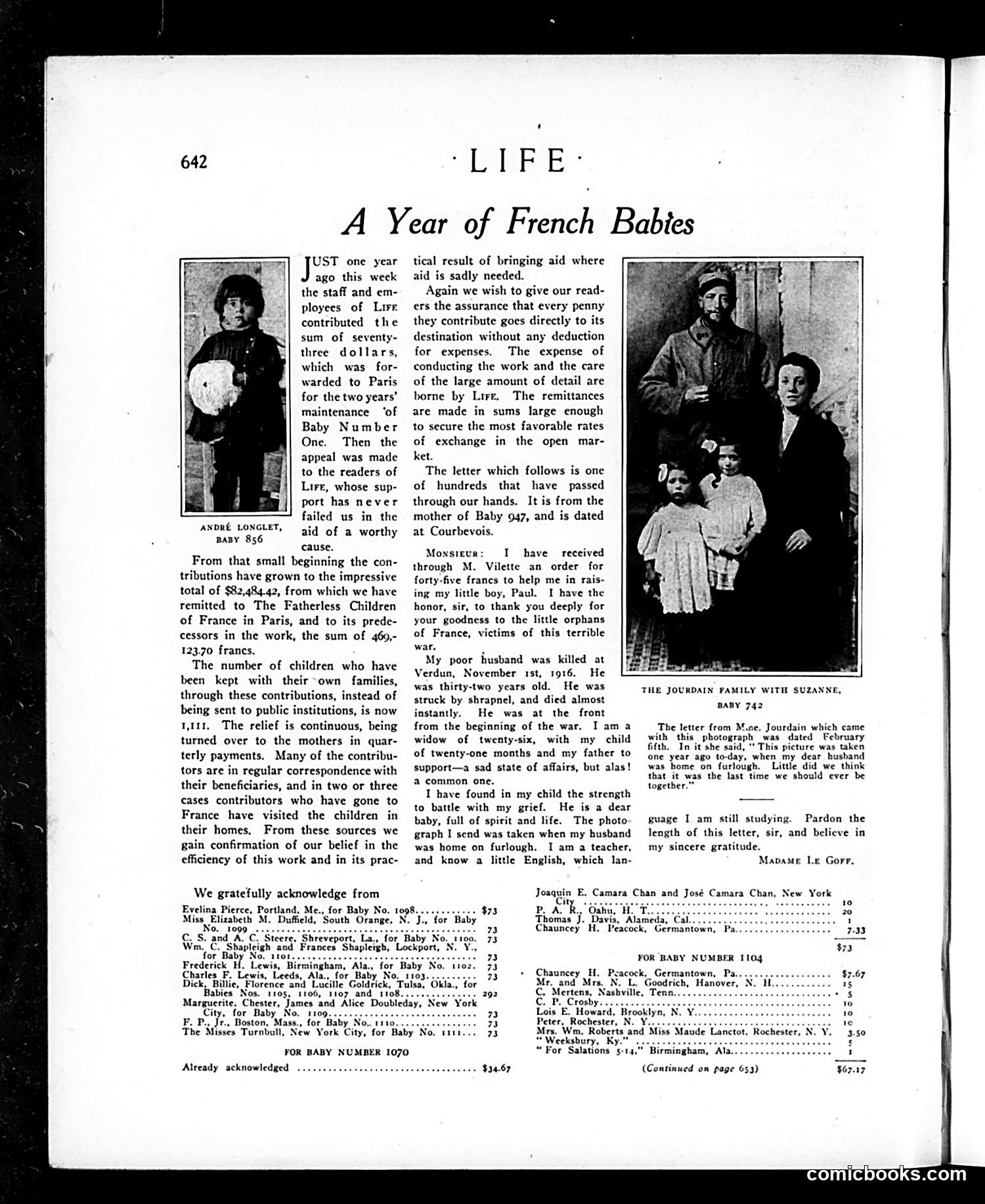
This page documents Life magazine's fundraising campaign for war orphans in post-WWI France. The article reports that readers have contributed over $82,000 to support 1,111 fatherless children kept with their families rather than institutionalized. The accompanying letter from "Madame Le Gorr" exemplifies the campaign's emotional appeal: a 26-year-old widow whose husband was killed at Verdun in 1916, now supporting her toddler son Paul and elderly father on a teacher's salary. The photographs show beneficiary children and families receiving aid. This represents American charitable mobilization during the humanitarian crisis following World War I, when European civilians—particularly women and children—faced severe poverty. The campaign emphasized direct aid with no administrative overhead, encouraging personal correspondence between American donors and French beneficiaries to build emotional investment in the cause.
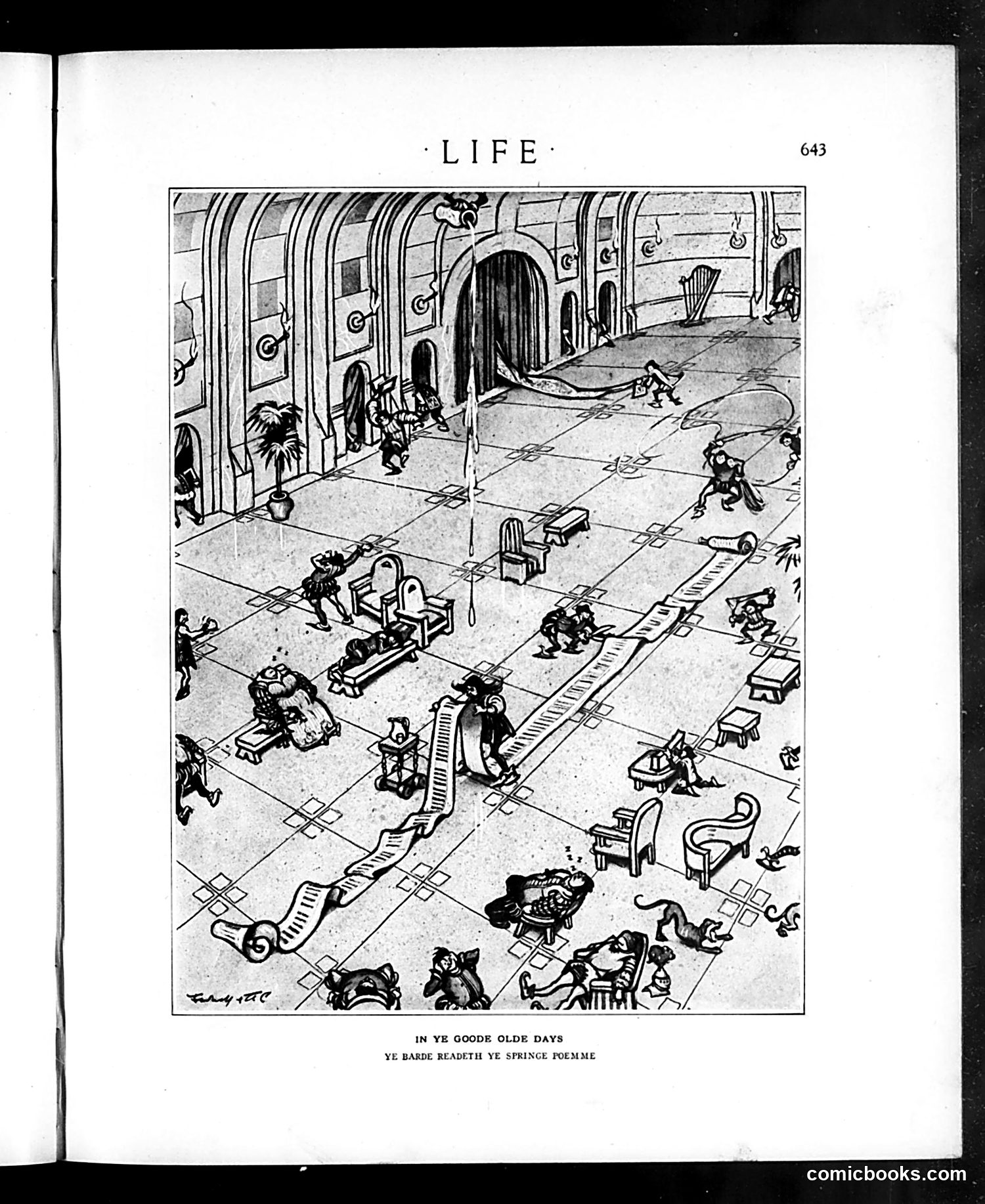
This is a satirical cartoon titled "In Ye Goode Olde Days" showing a medieval or Renaissance-era banquet hall scene. The subtitle reads "Ye Barde Readeth Ye Springe Poemme" (The Bard Reads the Spring Poem). The humor appears to target pretentious attempts to revive or romanticize antiquated literary and social customs. The crowded, chaotic scene with numerous figures in period dress—some appearing disheveled or engaged in undignified behavior—mocks the notion that such "olde days" were inherently more refined or poetic than modern times. The archaic spelling ("ye," "poemme") reinforces the satirical tone, suggesting contemporary affectation when adopting historical aesthetics. The cartoon likely critiques early 20th-century enthusiasm for medievalism or mock-historical entertainment among American society.
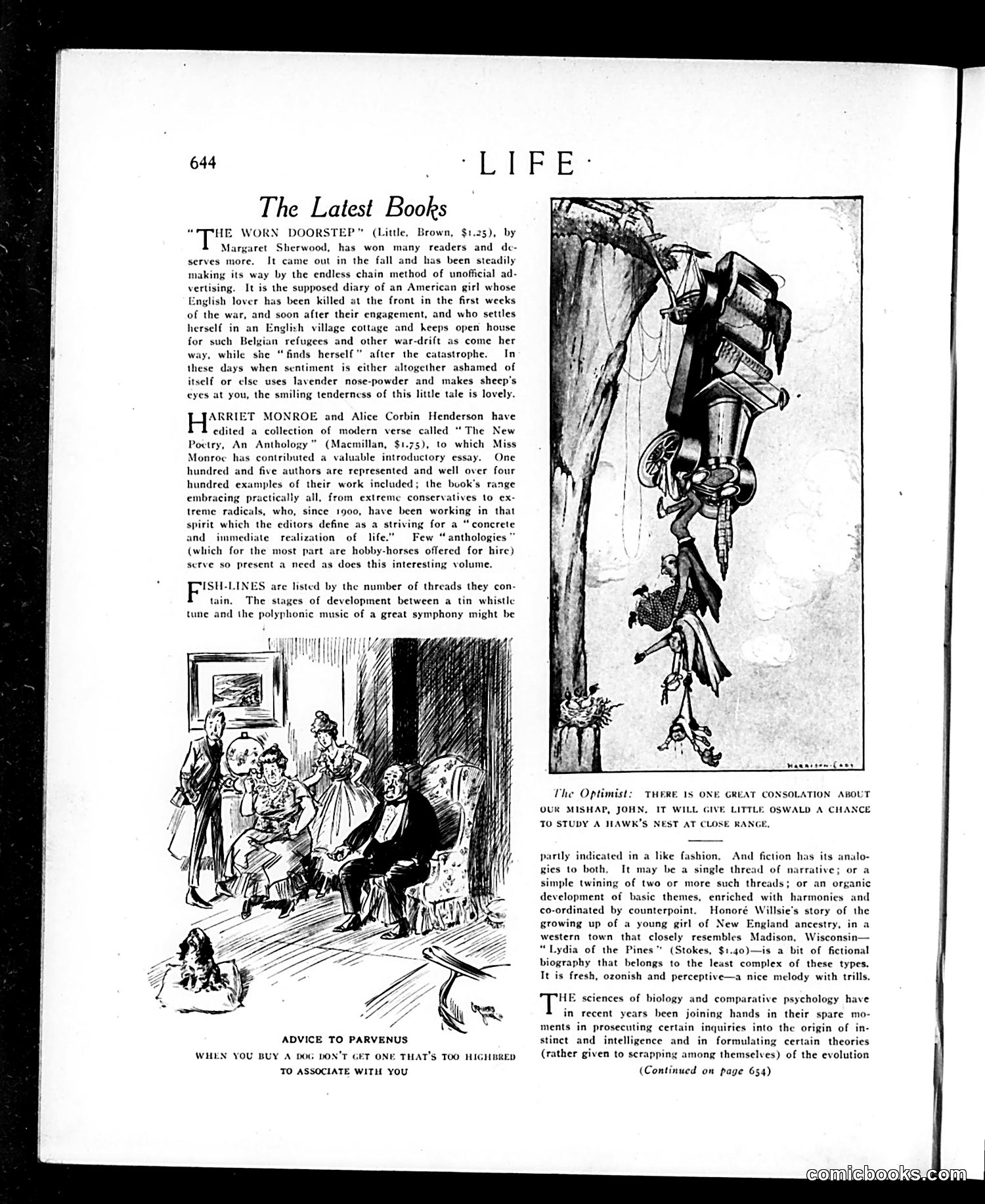
This page reviews recent books and includes two cartoons. **The cartoons:** The lower left cartoon, titled "Advice to Parvenas," satirizes social climbing and pretension—the joke being that newly wealthy people shouldn't buy dogs too "highbred" to associate with them, mocking the absurdity of status-conscious behavior. The upper right cartoon, "The Optimist," depicts a dark domestic scene where a child has apparently discovered a hawk's nest (possibly involving danger or destruction), and a parent finds "consolation" in this mishap as an educational opportunity. This satirizes misplaced optimism and rationalization in the face of obvious problems. **The book reviews** discuss wartime literature (including *The Worn Doorstep* about an American woman in a Belgian cottage during WWI), modern poetry anthologies, and works on biology and psychology. The content reflects early-20th-century intellectual interests and literary trends.
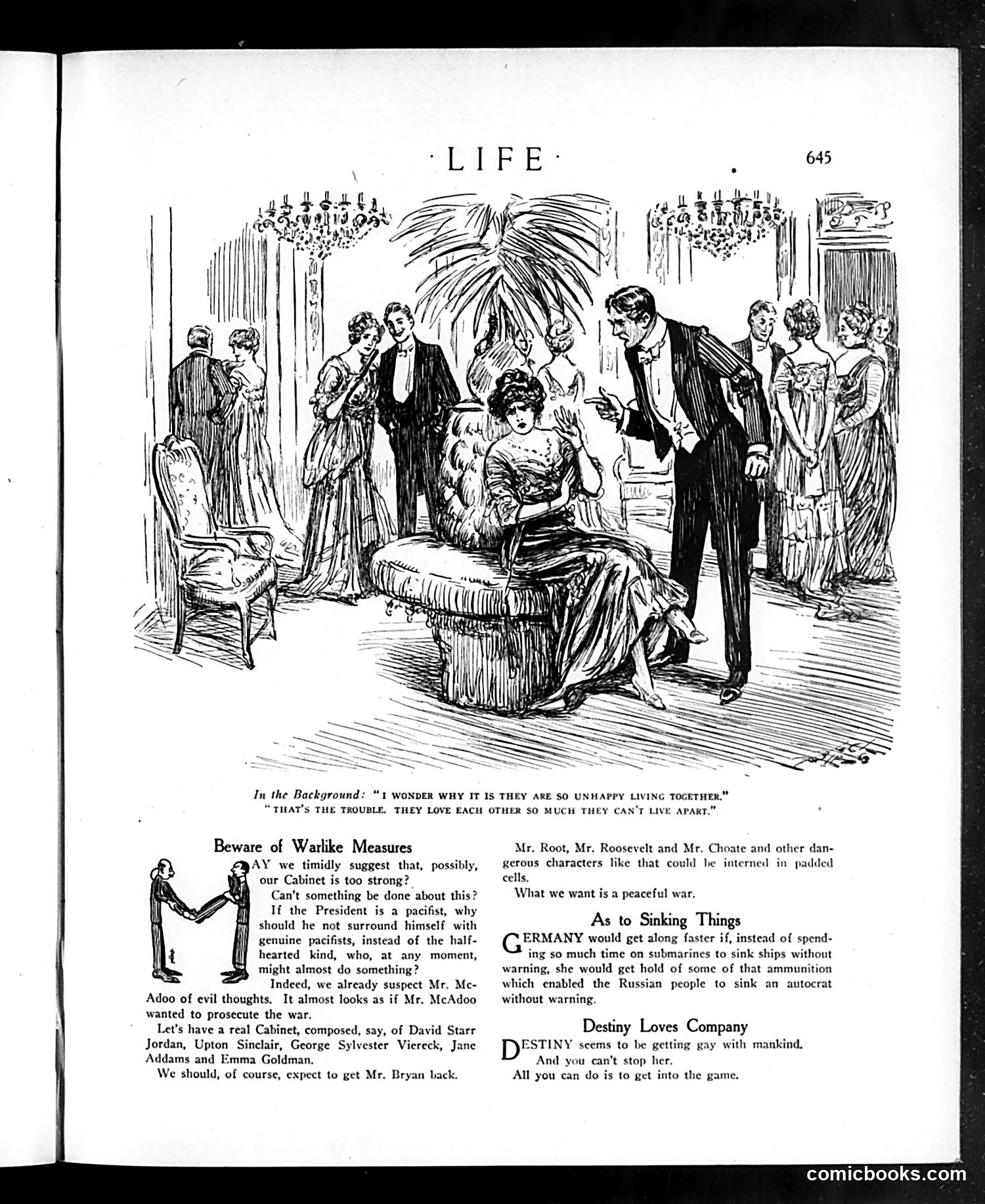
This page mocks American pacifism and anti-war sentiment during World War I. The main cartoon satirizes a troubled marriage where the couple "love each other so much they can't live apart"—likely referencing America's conflicted relationship with entering the war. The text sections target pacifist Cabinet members. "Beware of Warlike Measures" sarcastically suggests replacing hawks like Secretary of Treasury McAdoo with famous pacifists (David Starr Jordan, Upton Sinclair, Jane Addams, Emma Goldman) and interning Theodore Roosevelt and Elihu Root in "padded cells." The mockery is clear: these pacifists are portrayed as naive idealists. "As to Sinking Things" argues Germany should abandon submarines and instead focus on overthrowing its autocracy—a jab at both German militarism and the Russian Revolution's success in toppling the tsar. The overall message: pacifism is foolish; America must engage militarily.
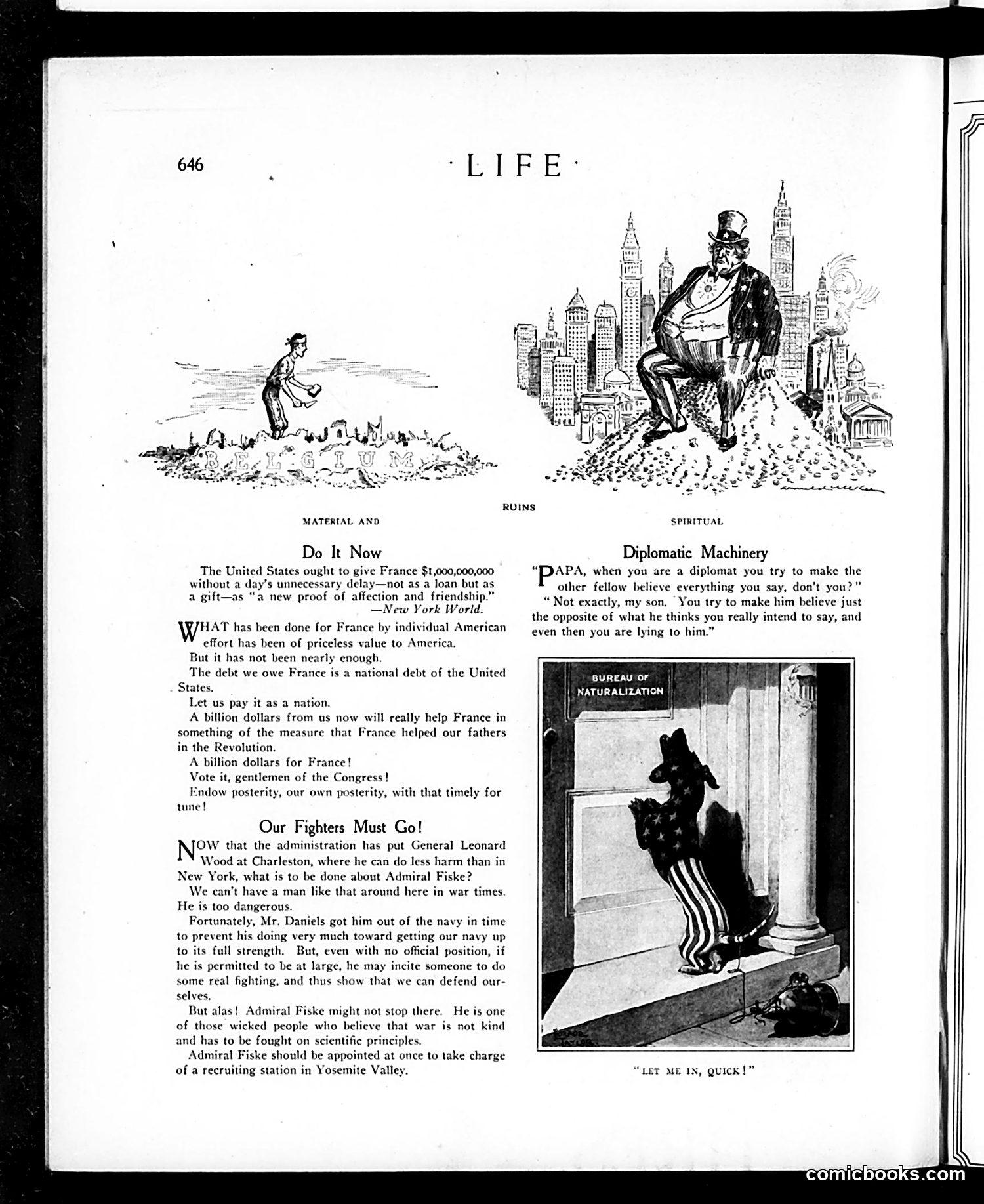
This page contains three satirical pieces from an era when America was debating post-WWI foreign policy and military readiness (likely early 1920s). **"Do It Now"** advocates gifting $1 billion to France as repayment for Revolutionary War aid, arguing this national debt should be paid outright rather than as a loan. **"Our Fighters Must Go!"** sarcastically criticizes the removal of General Leonard Wood and Admiral Fiske from positions of power. The piece mocks their exile to harmless posts (Charleston, Yosemite Valley), suggesting the administration fears strong military voices who believe war requires scientific preparation and serious fighting capability. **"Diplomatic Machinery"** presents a cynical father-son dialogue explaining that diplomacy involves deliberate deception—making others believe the opposite of your true intentions. **"Bureau of Naturalization" cartoon** (bottom) shows an immigrant desperately seeking entry, illustrating anxieties about immigration policy during this restrictive era. The overall tone is deeply sardonic about government competence, military leadership, and international relations.

This is a **straightforward advertisement**, not satire or political commentary. The Republic Rubber Company announces their "Prödium Process"—a rubber-compounding technique they claim extends tire life significantly. The ad makes bold claims: tires wear evenly "like steel," possess unprecedented tensile strength (a one-and-a-half-inch strip can suspend three tons), and have generated unprecedented demand (400-500 new customers daily). The company plans to triple production. The page features a photograph of an actual tire showing the tread pattern and sidewall branding. **Context for modern readers:** This represents early automotive-era advertising when tire technology was genuinely evolving and competitive. The hyperbolic language and emphasis on scientific process ("Prödium Process") was typical marketing of the 1910s-1920s, when manufacturers competed aggressively on durability claims. There is **no cartoon or satire** present—this is genuine period advertising from Life magazine's commercial section.
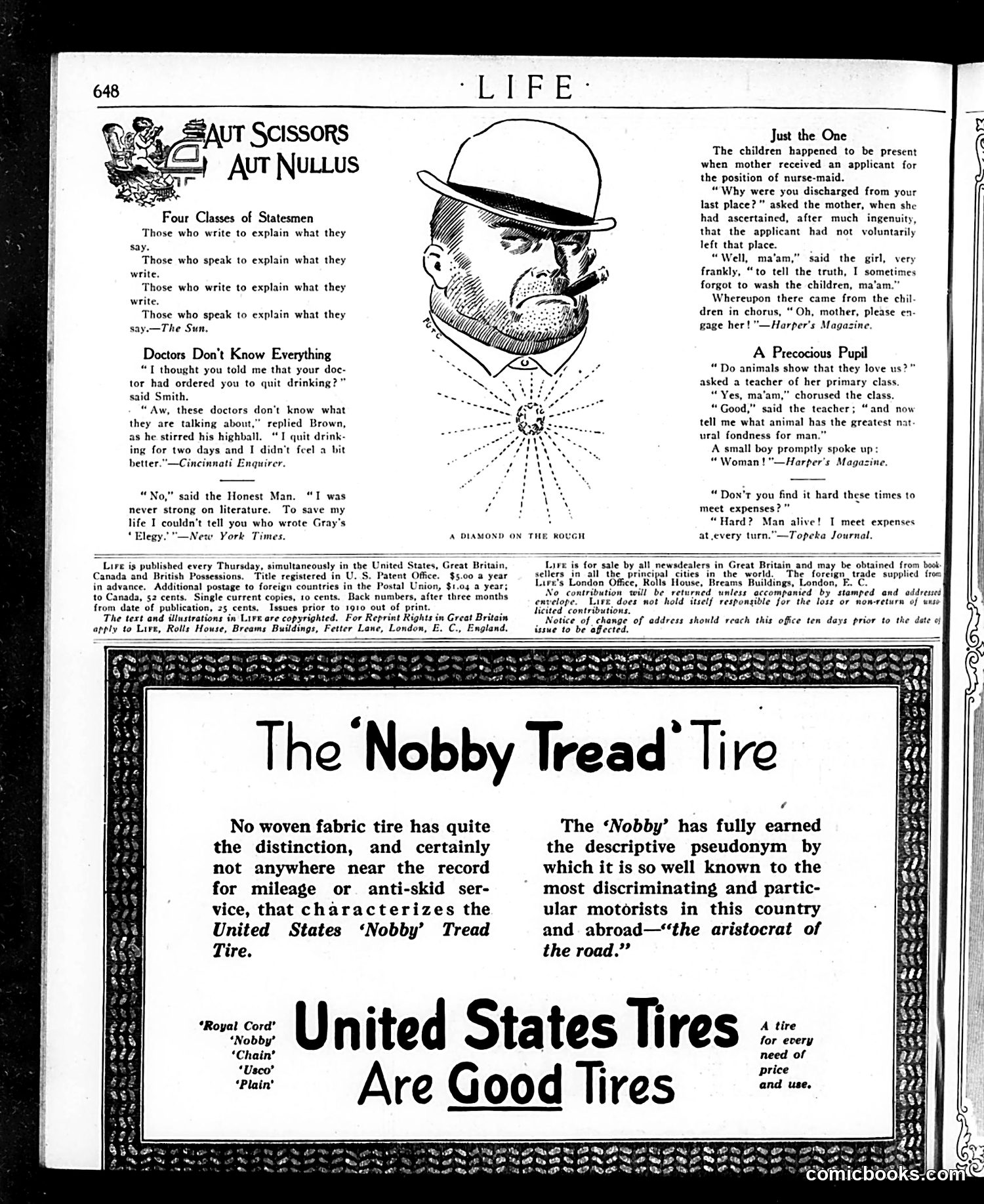
This page contains several short satirical pieces typical of Life's humor format, plus advertisements. **The cartoons/jokes mock:** 1. **"Four Classes of Statesmen"** — A circular logic joke about politicians who endlessly explain themselves, implying political speech is redundant and self-referential. 2. **"Doctors Don't Know Everything"** — Brown dismisses medical advice after quitting drinking for only two days, satirizing people who reject expert guidance based on minimal self-experimentation. 3. **"A Precocious Pupil"** — A child's joke answer that animals' greatest natural fondness is for "woman," playing on the era's domestic gender stereotypes. 4. **"Just the One"** — A nurse applicant admits forgetting to wash children; the children enthusiastically want to hire her anyway, satirizing children's preference for negligent caretakers. 5. **"A Diamond on the Rough"** — Appears to be a portrait illustration labeled as such. The page is primarily **humorous short-form content** typical of Life magazine's satirical approach, with one tire advertisement at the bottom. The humor relies on situational irony, logical absurdity, and period-appropriate social commentary.
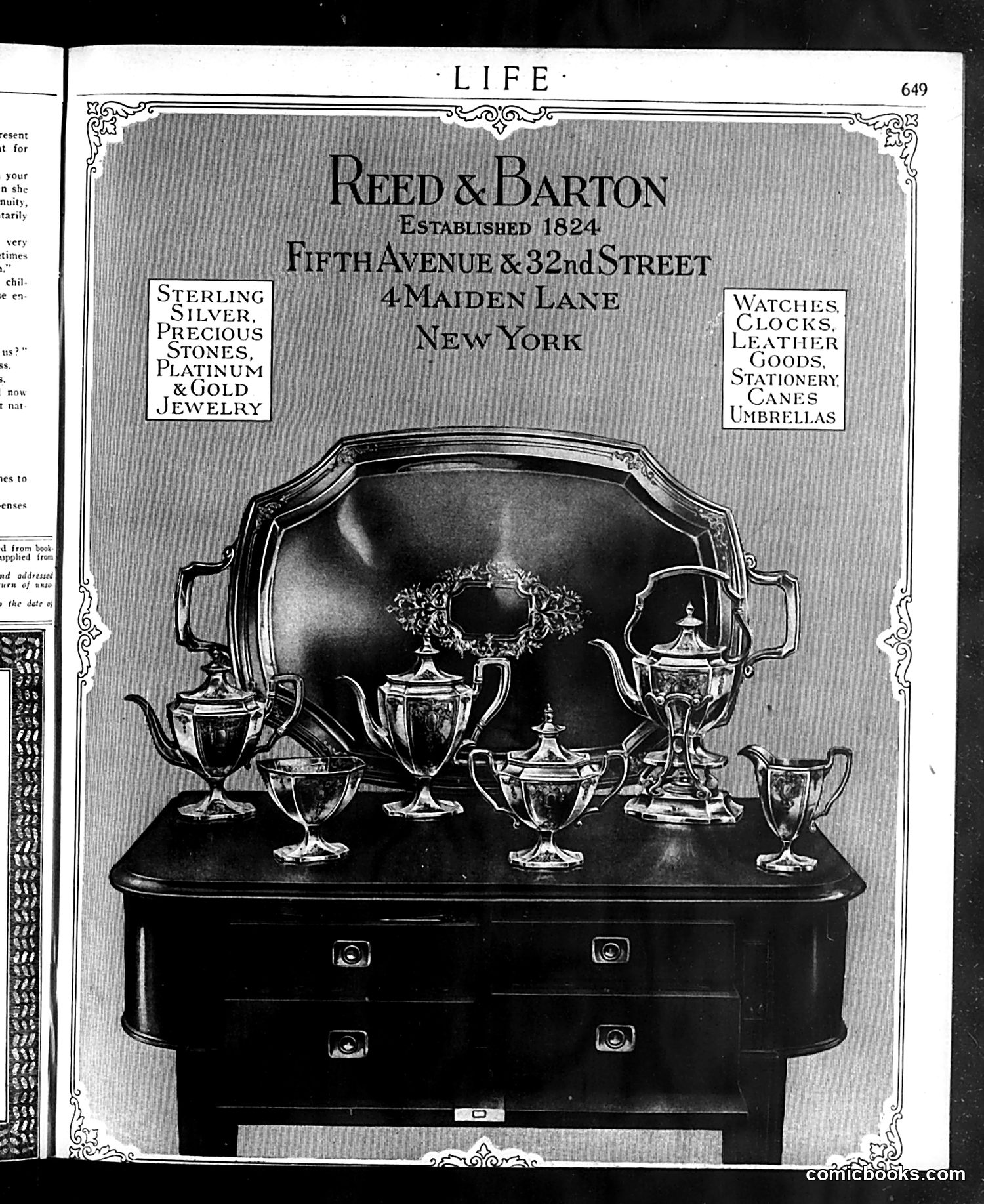
This is a Reed & Barton advertisement page from Life magazine, not a political cartoon. The image shows an ornate sterling silver tea and coffee service displayed on a black dresser with a large mirror behind it. The arrangement includes teapots, creamers, sugar bowls, and serving pieces—typical of formal dining displays from the early 20th century. The advertisement lists Reed & Barton's establishment date (1824) and New York addresses, promoting their luxury goods: sterling silver, precious stones, platinum, and gold jewelry on the left; watches, clocks, leather goods, stationery, canes, and umbrellas on the right. This is straightforward product marketing targeting wealthy consumers, with no satirical content visible.
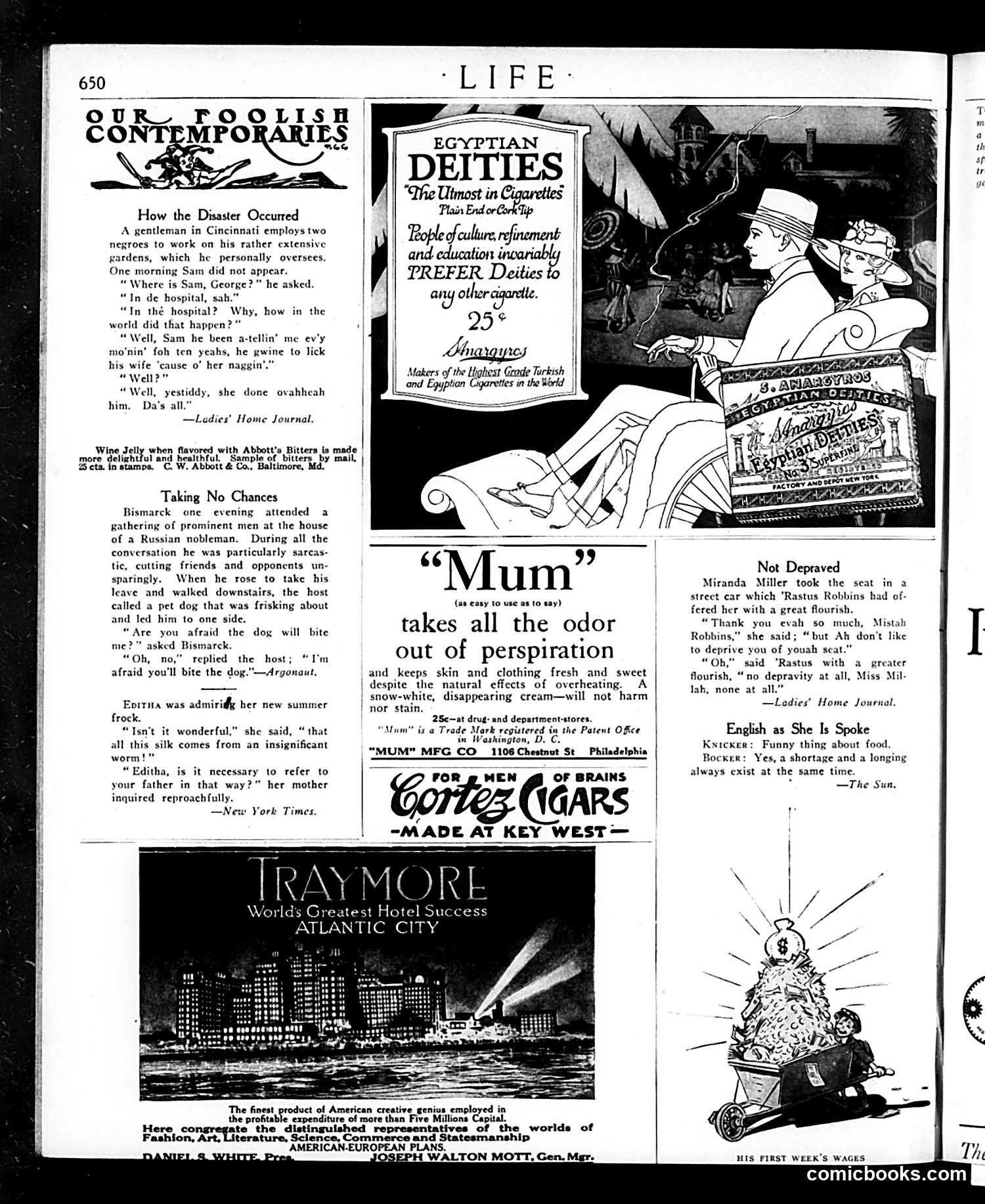
This page contains several racist humor pieces typical of early 20th-century American publications: **"How the Disaster Occurred"** mocks Black workers through dialect humor, presenting a story where a Black man's wife overhears his threat to beat her and acts first—treating domestic violence as comedic material. **"Not Depraved"** uses similar racial caricature ("'Rastus Robbins," "Ah"), making light of a Black man's malapropism ("depravity" for "deprivation") in a street-car encounter. The page also includes period advertisements (Egyptian Deities cigarettes, "Mum" deodorant, Cortez cigars) and hotel/hotel promotion typical of Life's commercial content. **Modern context**: These pieces reflect deeply offensive racial stereotypes—exaggerated dialect, intellectual inferiority, and violence—that were normalized in mainstream American humor of this era. They're historically significant as evidence of institutionalized racism in popular media, not as entertainment.
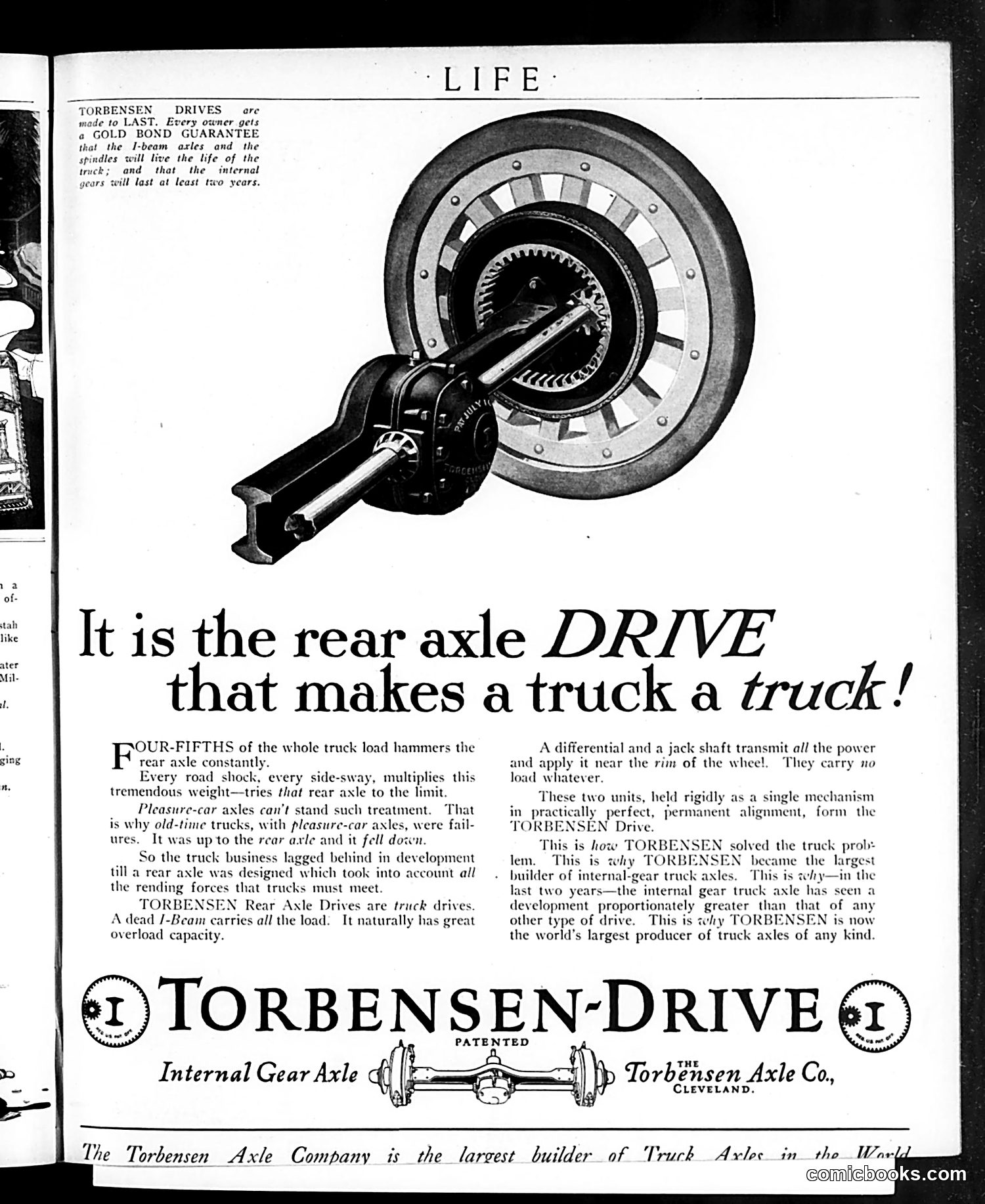
This is a **full-page advertisement**, not a cartoon or satire. It promotes the Torbensen-Drive rear axle for trucks, published in *Life* magazine. The page explains engineering to justify the product's superiority. The central image shows a cutaway of the rear axle assembly with visible gears and mechanical components. The text argues that truck rear axles experience extreme stress (carrying four-fifths of load weight) and that older "pleasure-car axles" failed under this demand. Torbensen solved this problem by designing an "internal gear" axle that distributes forces properly. The ad emphasizes durability (gold bond guarantee, two-year minimum lifespan) and market dominance ("largest builder of truck axles"). There is no satire or political content here—it's straightforward industrial marketing aimed at truck owners and fleet operators, using technical detail to establish credibility and competitive advantage during the early automotive era.
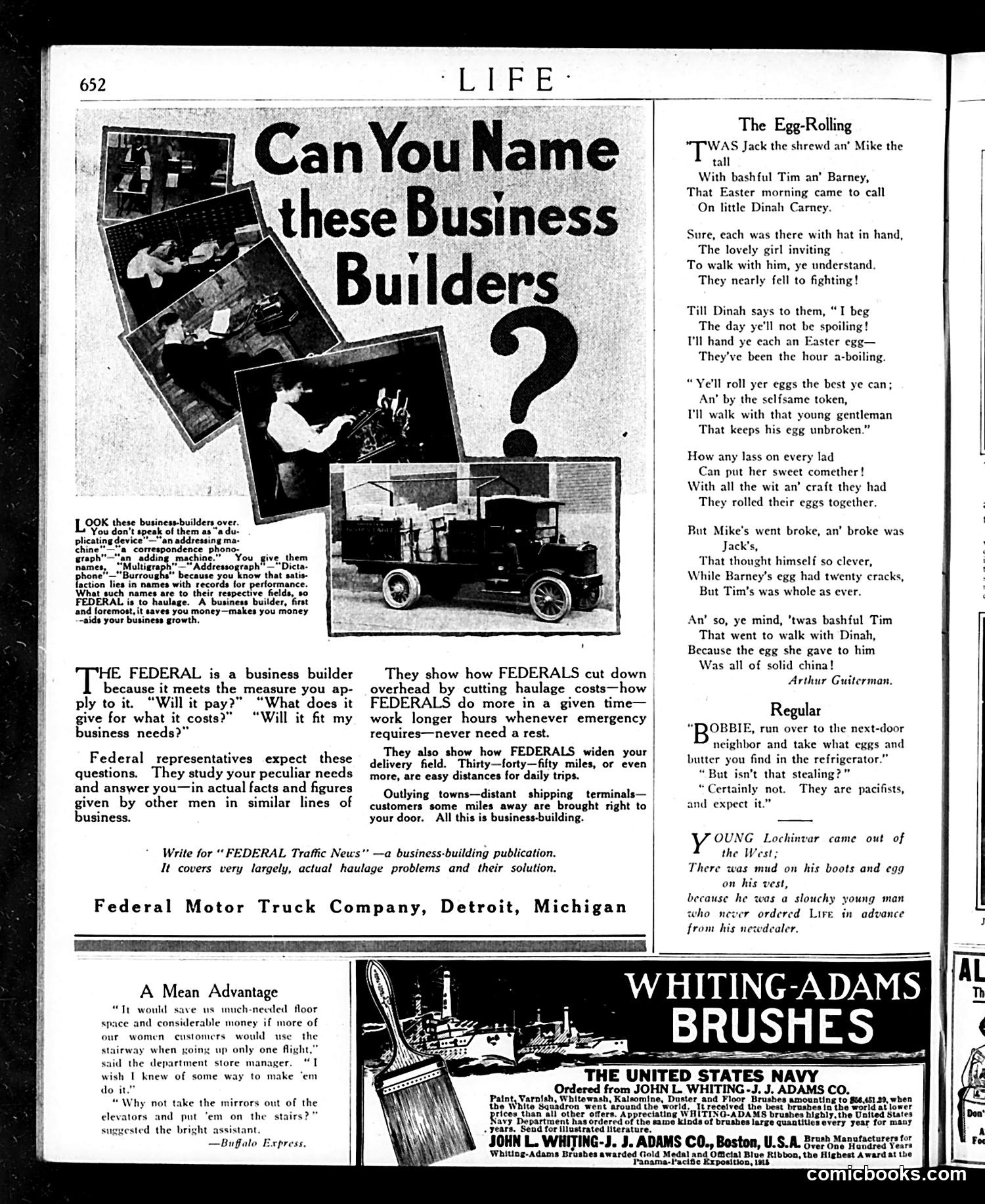
This page features an advertisement for Federal Motor Trucks disguised as an interactive quiz. The humor lies in the contrast between the grand headline ("Can You Name these Business Builders?") and the actual answer: the photograph shows not famous industrialists or entrepreneurs, but rather a Federal truck—which the ad argues performs business-building functions by reducing delivery costs and expanding market reach. The satirical point targets business jargon and advertising excess of the era. The ad treats the truck as a solution to mundane commercial problems ("Will it pay?" "Will it fit my business needs?") with an almost religious fervor typical of 1920s corporate messaging. The page also includes unrelated period content: a humorous poem about Easter egg-rolling determining which suitor wins a girl's affection, and various other advertisements, making this a typical LIFE magazine page mixing satire, verse, and commerce.
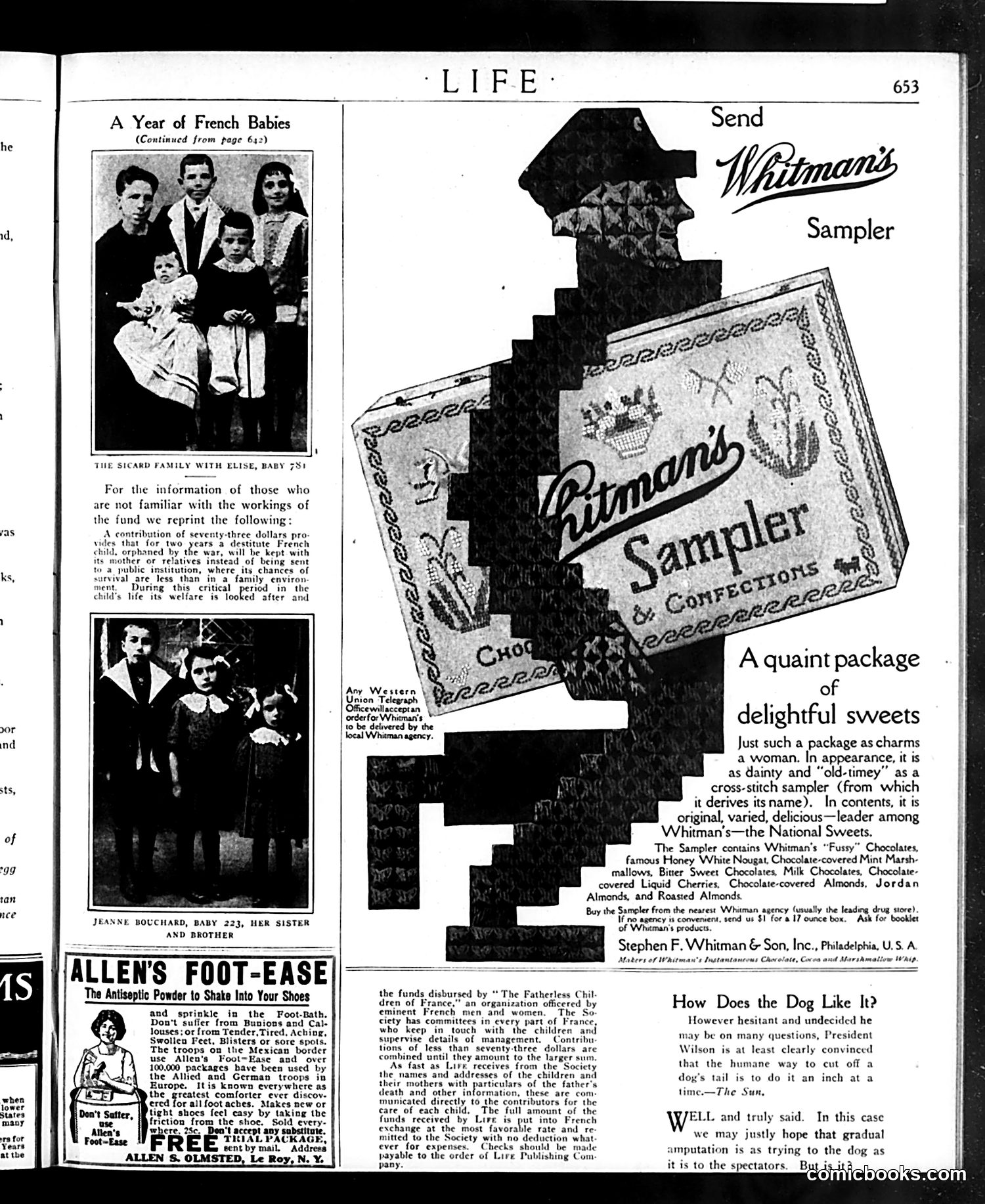
This page combines charitable content with period advertising. The main feature, "A Year of French Babies," documents a fundraising initiative supporting French war orphans. The photographs show French families (the Sicards and Bouchards) receiving aid—contributions of $73 enabled families to keep orphaned children at home rather than in institutions during the critical post-war period. The "Fatherless Children of France" organization, run by prominent French citizens, managed distribution and oversight. The advertisements reflect wartime concerns: Allen's Foot-Ease highlights military use (Mexican border troops and Allied/German forces in Europe), while Whitman's Sampler emphasizes refined domesticity—marketing luxury chocolates as an elegant gift. The "How Does the Dog Like It?" commentary references President Wilson's incremental approach to some policy (likely military intervention or peace terms), mocking gradual action through a dog-tail metaphor.
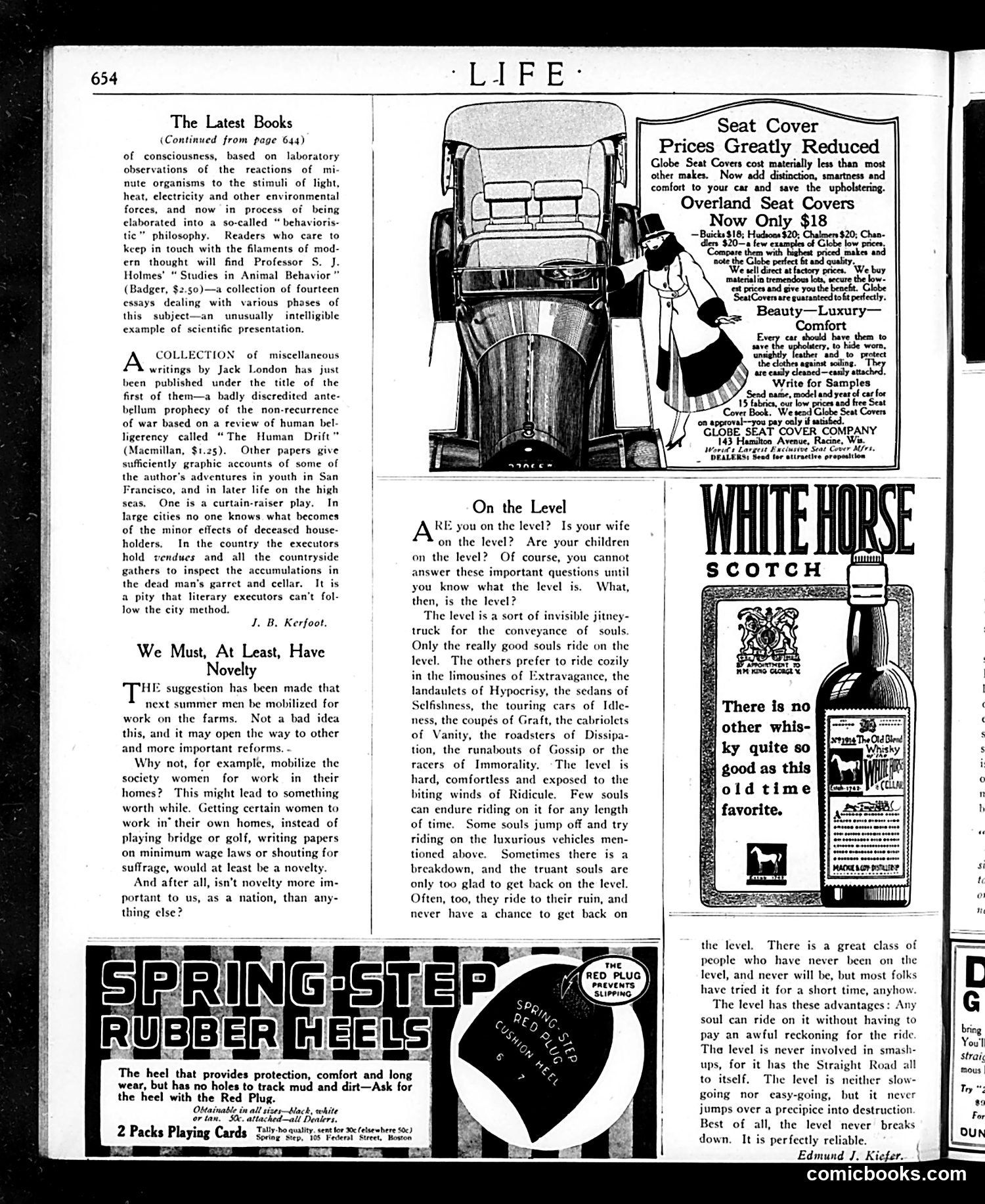
This page is primarily **advertising and literary commentary** rather than political satire. The main content includes: **Book Reviews:** Discussions of recent publications on animal behavior and Jack London's essays, with literary criticism by J.B. Kerfoot. **Social Commentary:** An essay titled "We Must, At Least, Have Novelty" sarcastically suggests mobilizing society women to work in their homes instead of playing bridge, golf, or advocating for suffrage—a dig at wealthy women's leisure activities and women's rights activism. **Allegorical Essay:** "On the Level" uses extended metaphor comparing moral living to riding an invisible "level" vehicle, contrasting it with luxurious conveyances representing vice (Extravagance, Hypocrisy, Selfishness, etc.). **Advertisements:** Car seat covers, whisky, and rubber heels dominate the visual space. The page reflects 1910s-era attitudes toward women's roles and social reform, but contains no discernible political cartoon or unified satirical message—it's a mixed editorial and advertising compilation.
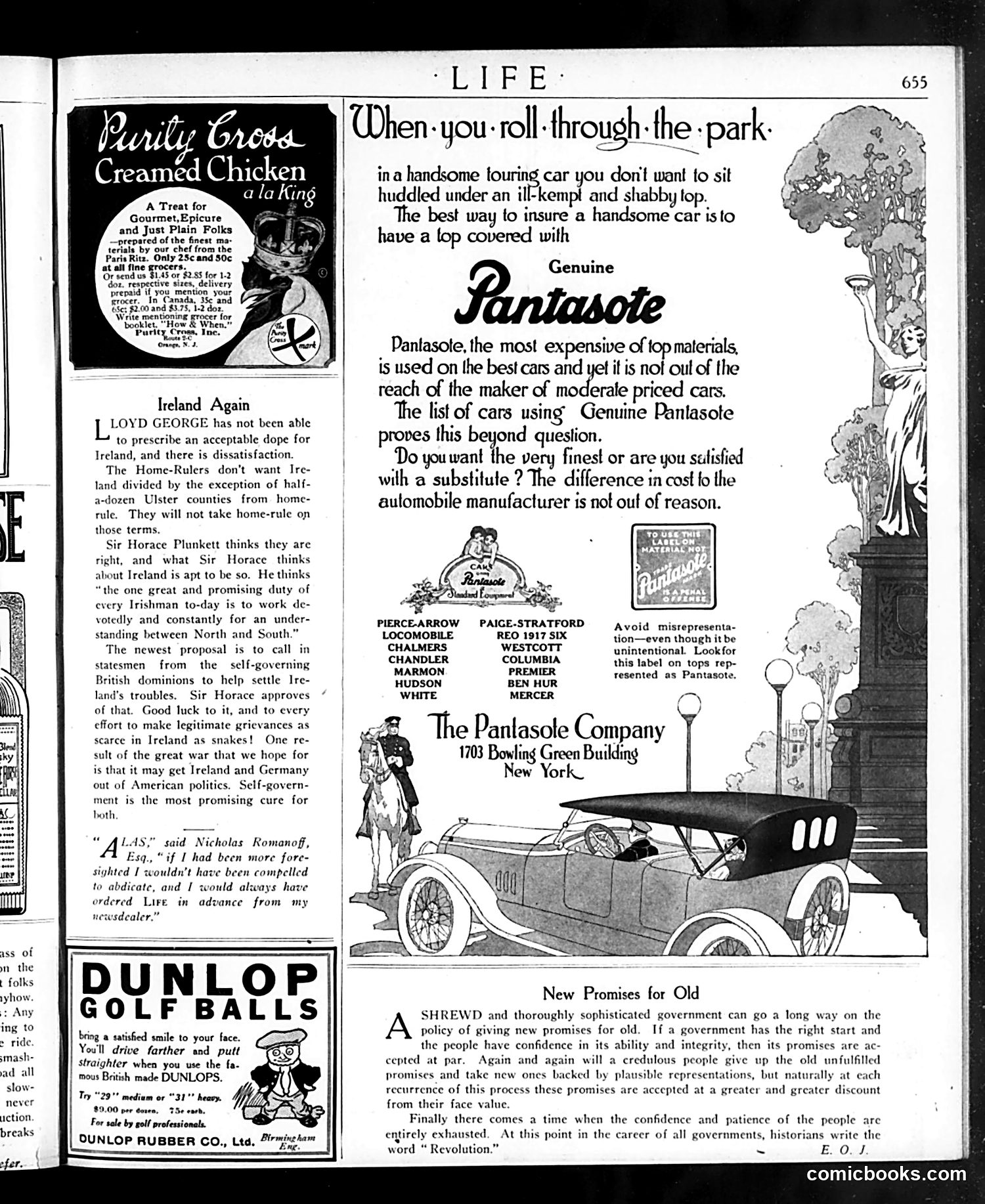
This page contains political commentary on the Irish independence crisis following World War I. The "Ireland Again" section discusses Lloyd George's failure to satisfy Irish Home Rule demands, particularly the refusal to include Ulster counties. Sir Horace Plunkett is quoted supporting Irish grievances and proposing that self-governing British dominion statesmen mediate the dispute. A satirical quote attributed to Tsar Nicholas II appears—claiming he wouldn't have been forced to abdicate had he anticipated unrest and "ordered Life in advance from my newsdealers"—a dark joke about how advance warning (via Life magazine) might have prevented revolution. The page's closing essay, "New Promises for Old," uses Ireland as implicit context, warning that governments repeatedly offering unfulfilled promises eventually exhaust public patience, leading to "Revolution." The advertisements (Pantasote car tops, Dunlop golf balls, Purity Gross chicken) are period commercial matter, not editorial content.
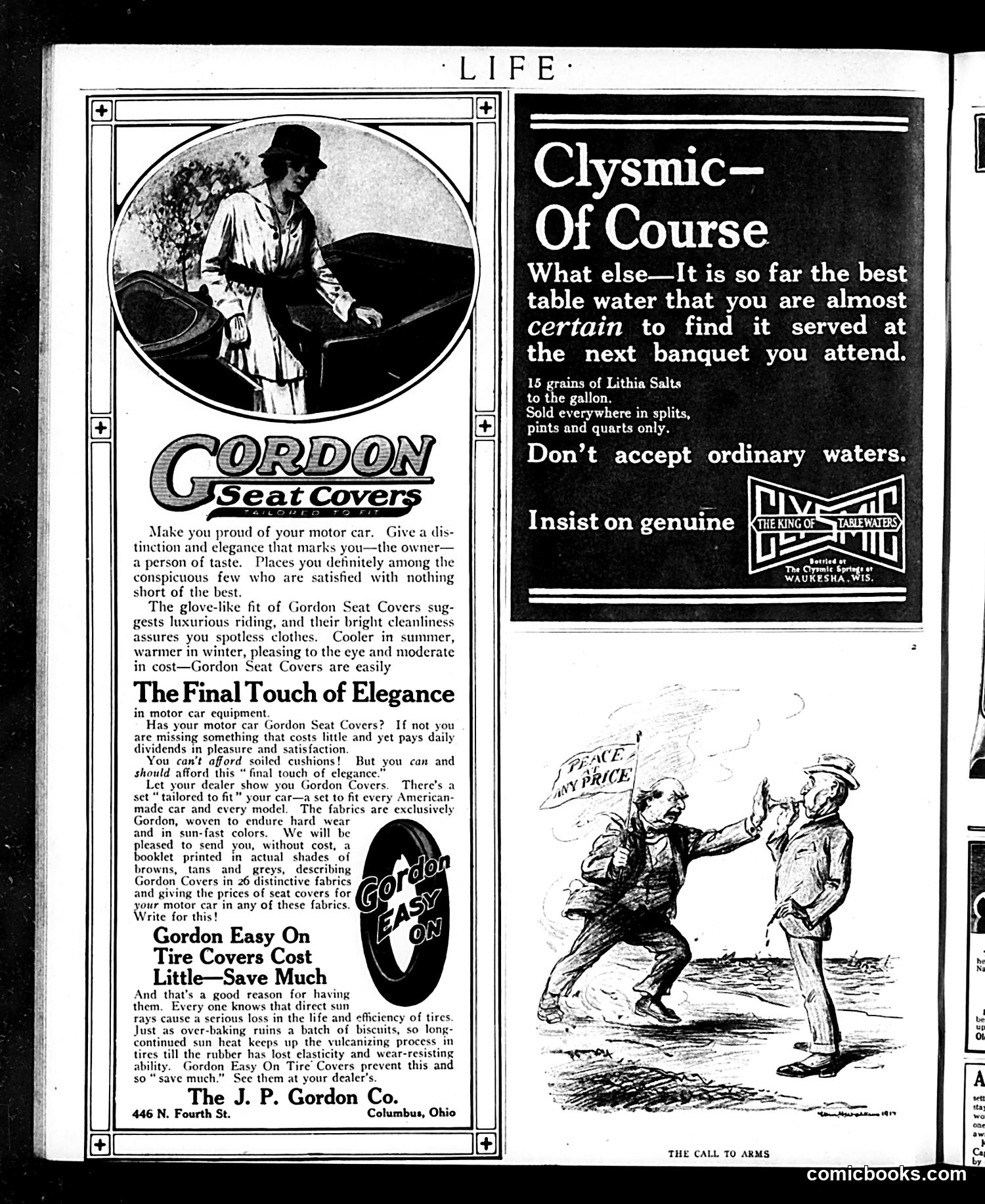
This page combines **automobile accessories advertising** (left and center) with **satirical cartoon commentary** (right). The **Gordon Seat Covers and Tire Covers ads** appeal to status-conscious car owners, emphasizing that these products signal good taste and social distinction—a typical early-20th-century marketing appeal to aspirational consumers. The **cartoon below** depicts two figures labeled "Peace" and "Any Price," likely referencing debate over America's involvement in World War I. One figure appears to be pressuring or confronting the other, suggesting tension between those advocating for peace versus those willing to pay any cost (militarily or financially) for entry into the war. The cartoonist appears skeptical of the "Any Price" position. The **Clysmic water advertisement** markets lithia-salt water as a luxury beverage for high-society banquets, playing on similar status anxieties as the automobile ads. The page overall reflects pre-1920s American consumer culture alongside contemporary political anxieties about potential war involvement.
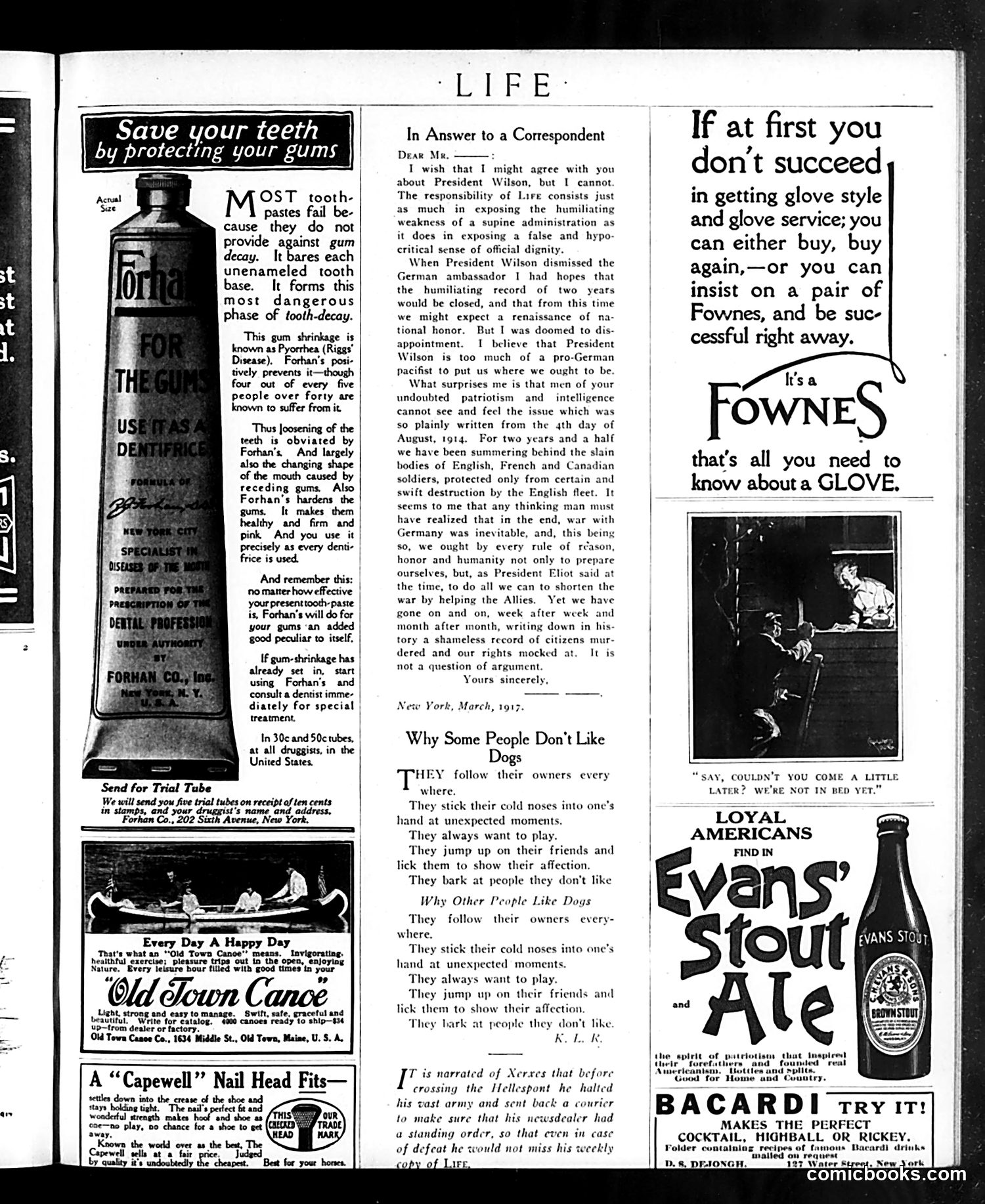
This page mixes advertisements with editorial content reflecting pre-American entry into World War I tensions. **The Main Content:** A letter to the editor responds to criticism of President Wilson's foreign policy. The writer attacks Wilson as a "pro-German pacifist," arguing the U.S. should have entered the war immediately after August 4, 1914 (when Germany invaded Belgium). The letter expresses fury that America continues protecting itself behind the British Navy while French and Canadian soldiers die—calling this a "shameless record." **Historical Context:** This was written in March 1917, just weeks before the U.S. declared war. Wilson faced intense criticism from interventionists who saw his neutrality as cowardice. The letter represents that hawkish viewpoint, blaming Wilson for delay and moral weakness. **The Advertisements:** Forhan's toothpaste, Old Town Canoes, Fownes Gloves, and Evans Stout—typical period products. A humorous section contrasts why some people dislike dogs versus why others do, offering no substantive point. The page captures a nation divided on war involvement, with Life's editorial voice clearly interventionist.
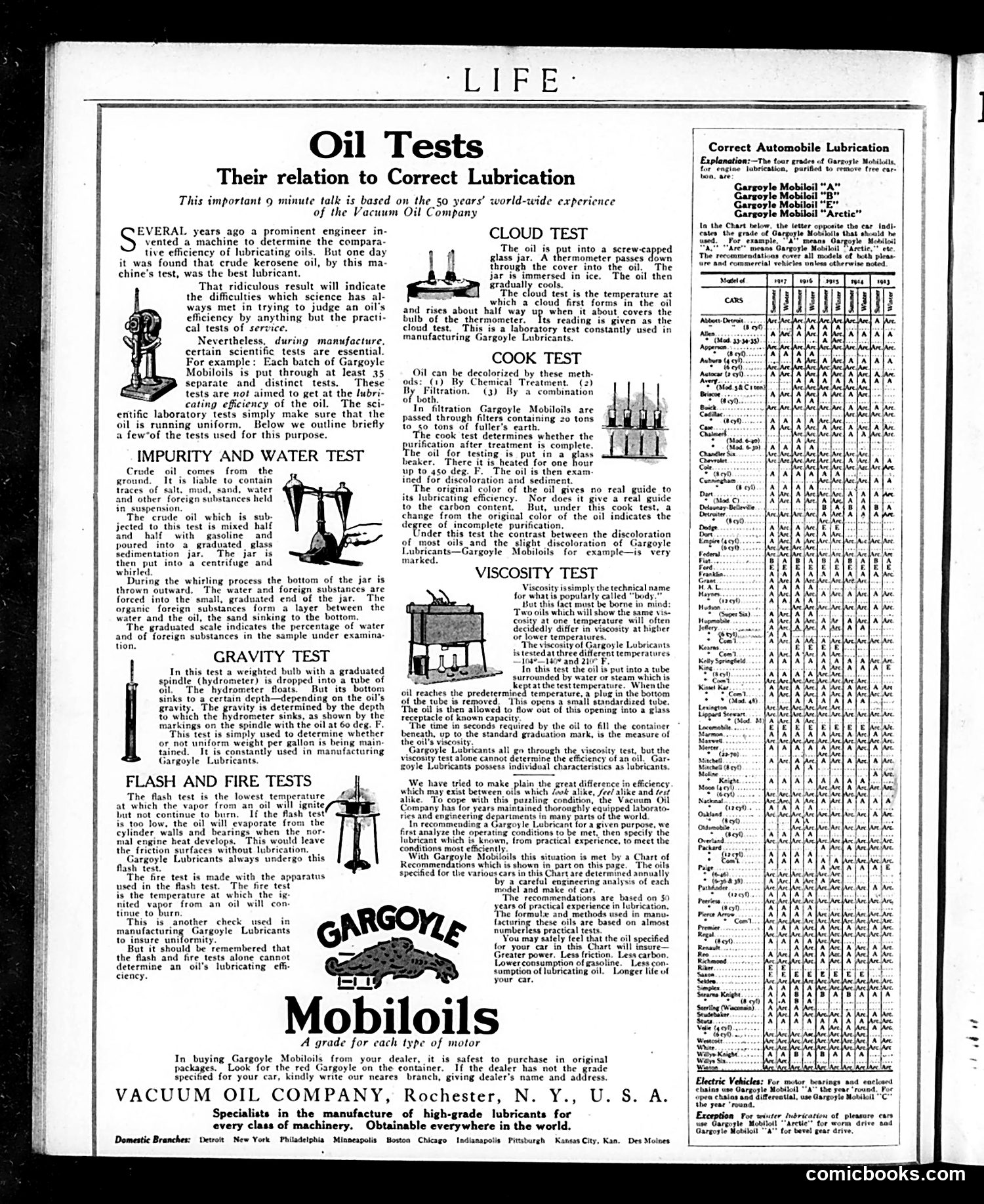
This is primarily **advertising content**, not satire or political commentary. The page promotes Gargoyle Mobiloils, a lubricating oil product made by the Vacuum Oil Company (based in Rochester, N.Y.). The article explains nine laboratory tests used to ensure oil quality—impurity/water, gravity, flash/fire, cloud, cook, and viscosity tests. These validate that oil meets manufacturing standards, though the text acknowledges that laboratory tests alone cannot measure an oil's actual lubricating efficiency. The accompanying chart on the right lists recommended Gargoyle Mobiloil grades for various automobile models. **Context for modern readers**: This represents early 20th-century corporate consumer education. The article attempts to build consumer confidence by explaining scientific testing procedures, which would have seemed sophisticated and reassuring to contemporary readers. The tone is educational rather than satirical—a common advertising strategy in *Life* magazine during this era.