
Life, 1917-04-12 · page 25 of 42
Life — April 12, 1917 — page 25: what you’re looking at
What you’re looking at
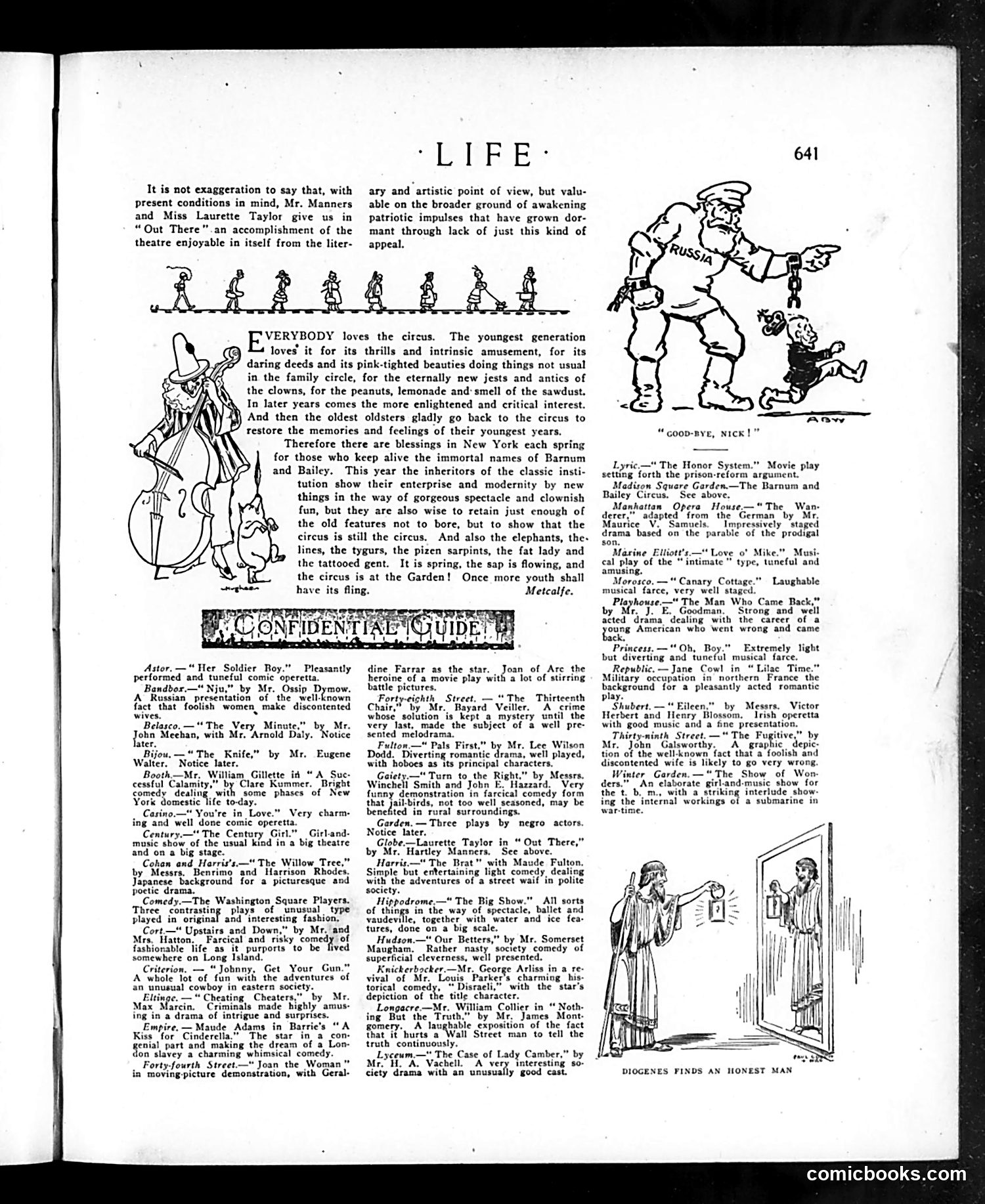
This page from *Life* magazine contains theater reviews and two cartoons about distinctly early-20th-century topics. **Upper cartoon**: Shows a line of soldiers marching, illustrating the text's reference to "Out There"—a play about WWI that aims to awaken "patriotic impulses" in audiences. The review praises it for combining entertainment with patriotic sentiment during wartime. **Right cartoon labeled "GOOD-BYE, NICK!"**: Depicts a caricatured Russian figure (representing Russia, labeled) saying goodbye. This likely references Russia's exit from WWI in 1917 (the Bolshevik Revolution/Treaty of Brest-Litovsk), when Russia withdrew from the war—a significant geopolitical shock to Allied nations like America. **Lower cartoon**: Shows what appears to be a domestic scene, accompanying reviews of comedies and dramas about everyday life and relationships. The page reflects American popular culture during WWI, when patriotic themes saturated entertainment and contemporary international events dominated public consciousness.
📄 Transcribed text from this page (OCR, searchable)
Machine-transcribed from the original scan — historical spelling and the odd misread are preserved.
It is not exaggeration to say that, with Present conditions in mind, Mr. Manners and Miss Laurette Taylor give us in “Out There”.an accomplishment of the theatre enjoyable in itself from the liter- VERYBODY loves the circus. EEE ary and artistic point of view, but valu- able on the broader ground of awakening patriotic impulses that have grown dor- mant through lack of just this kind of The youngest generation loves’ it for its thrills and intrinsic amusement, for its daring deeds and its pink-tighted beauties doing things not usual in the family circle, for the eternally new jests and antics of the clowns, for the peanuts, lemonade and: smell of the sawdust. In later years comes the more enlightened and critical interest. And then the oldest oldsters gladly go back to the circus to restore the memories and feelings of their youngest years. Therefore there are blessings in New York each spring for those who keep alive the immortal names of Barnum and Bailey. This year the inheritors of the classic insti- tution show their enterprise and modernity by new things in the way of gorgeous spectacle and clownish fun, but they are also wise to retain just enough of the old features not to bore, but to show that the circus is still the circus. And also the elephants, the. lines, the tygurs, the pizen sarpints, the fat lady and the tattooed gent. the circus is at the Garden! have its fling. Astor. —"Her Soldier Roy." Pleasant! performed and tuneful comic operetta. Bandbor.—" Niu,” by Mr. Ossip Dymow. A Russian presentation of the well-known fact that foolish women make discontented wives. be Belasco. —‘‘The Very Minute,” by i Meehan, with Mr, Arnold Daly. ater. Bijou. —" The Knife," by Mr. Walter. Notice 1 Booth—Mr, William, Gillette if “A Suc- cessful Calamity,’ Clare Kummer. Bright gpredy dealing’ with some phases of New Yore domestic life to-day. Casino.—" You're in Love.” Very charm- ing and well done comic operetta. Century.—" The Century Girl.” Girland- music show of the usual kind in a big theatre and on a big stage. Cohan and Harris’ The Willow Tree,” by Messrs. Benrimo and Harrison Rhodes, Japanese background for a picturesque and poetic drama, Comedy.—The Washington Square Players. Three contrasting plays of unusual type played in original and interesting fashion, Cort—" Upstairs and Down," by Mr, and Mrs, Hatton, Farcical and risky comedy of fashionable life as it purports to be lived somewhere on Long Island. Criterion. — “Johnny, Get Your Gun.” A whole lot of fun with the adventures of an unusual cowboy in eastern societ; Eltinge, —“ Cheating Cheaters,” by Mr. Max Marci Criminals made highly amus- ing in a drama of intrigue and surprises. Empire. — Maude Adams in Barrie's “A Kiss for Cinderella.” The star in a con- genial part and making the dream of a Lon- don slavey a charming whimsical comedy. Forty-fourth Street.—" Joan the Woman” in movingpicture demonsiration, with Geral- Mr. Notice Eugene It is spring, the sap is flowing, and Once more youth shall Metcalfe. dine Farrar as the star. Joan of Are the heroine of a movie play with a lot of stirring battle pictures. Forty-eighth Street, — ‘The Thirteenth Chair,” by Mr. Bayard Veiller. A crime whose solution is kept a mystery until the very last, made the subject of a well pre- sented melodrama. Fulton. —" Pals First.” by Mr. Lee Wilson Dodd, Diverting romantic drama, well played, with hoboes as its principal characters. Gaiety—" Turn to the Right,” by Messrs. Winchell Smith and John E. Hazzard. Very funny demonstration in farcical comedy form that Jail birds, not too well, seasoned, may be benefited in rural surroundings. Garden.—Three plays by negro actors. Notice later. Globe—Laurette Taylor in “ Out There,” by ‘Mr. Hartley Manners. See above. Harris.—" The Brat” with Maude Fulton, Simple but entertaining light comedy, dealing with the adventures of a street waif in polite society. Hippodrome—“ The Big Show." All sorts of things in the way of spectacle, ballet and vaudeville, together with water and ice fea- tures, done on a big scal Hudson.—" Our Betters,” by Mr. Somerset Maugham. Rather nasty "society comedy of superficial cleverness, well presente Knickerbocker. —Mr. George Arliss in a re- vival of Mr. Louis Parker's charming his- torical comedy, “Disraeli,” with the star's depiction of the title character. Longacre—Mr. William Collier in “ Noth- ing But the Truth,” by Mr. James Mont. gomery. A laughable exposition of the fact that it hurts a Wall Street man to tell the truth continuously, Lyceum.—" The Case of Lady Camber,” by MroW. A. Vachell.” A. very - ciety drama with an unusually good cast. “ coop-nye, Nick!” Lyric.—" The Honor System.” Movie play setting forth the prison-reform argument. Madison Square Garden.—The Barnum and Bailey Circus. See above. Manhattan Opera House—“The Wan- derer,” adapted from the German by Mr, Maurice V. Samuels. npressively staged drama based on the parable of the prodigal son, Marine Eltiott’s—" Love o' Mike.” Musi- cal play of the “intimate” type, tuneful and amusing. Morosco. —" Canary Cottage.” Laughable musical farce, very well staged. The Man Who Came Back,” Goodman, Strong and well Playhouse. by Mr J. acted drama dealing with the career of a ‘oung American who went wrong and came ck. Princess. —"'Oh, Boy.” Extremely light but diverting and tuneful musical farce. Republic. —Jane Cowl in “Lilac Time.” Military occupation in northern France the background for a pleasantly acted romantic play. Shubert. — Eileen.” by Messrs, Victor Herbert and Henry Blossom. Irish operetta with good music and a fine presentation. Thirty-ninth Street, —“ The Fu Mr. John Galsworthy, A graphic tion of the well-known fact that a foolish discontented wife is likely to go very wron Winter Garden.—" The Show of Won- ders.” An elaborate girl-and-music show for the t. b. m,, with a striking interlude show: ing the internal workings of a submarine in wartime. DIOGENES FINDS AN HONEST MAN comicbooks.com