
Life, 1917-04-12 · page 28 of 42
Life — April 12, 1917 — page 28: what you’re looking at
What you’re looking at
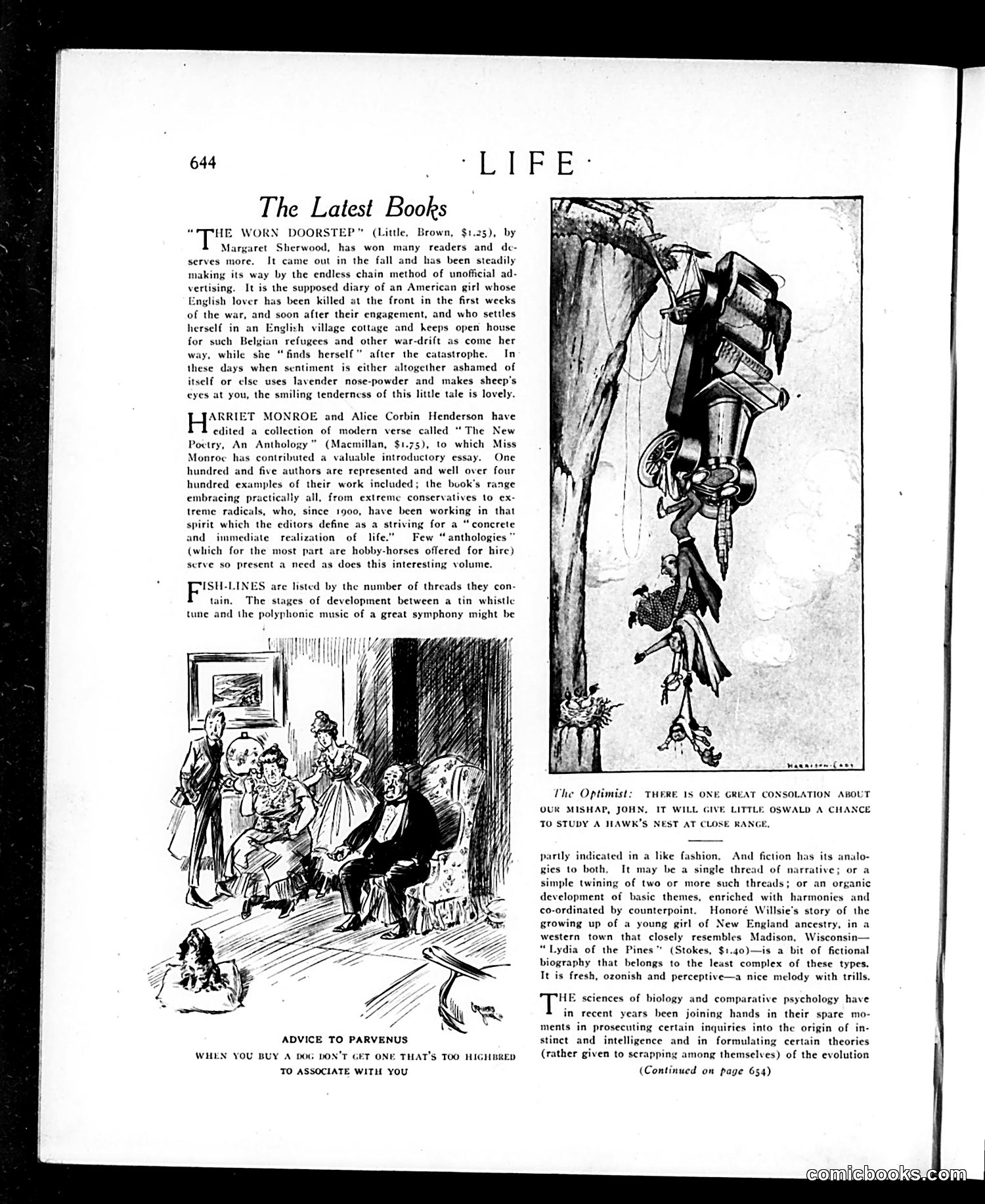
This page reviews recent books and includes two cartoons. **The cartoons:** The lower left cartoon, titled "Advice to Parvenas," satirizes social climbing and pretension—the joke being that newly wealthy people shouldn't buy dogs too "highbred" to associate with them, mocking the absurdity of status-conscious behavior. The upper right cartoon, "The Optimist," depicts a dark domestic scene where a child has apparently discovered a hawk's nest (possibly involving danger or destruction), and a parent finds "consolation" in this mishap as an educational opportunity. This satirizes misplaced optimism and rationalization in the face of obvious problems. **The book reviews** discuss wartime literature (including *The Worn Doorstep* about an American woman in a Belgian cottage during WWI), modern poetry anthologies, and works on biology and psychology. The content reflects early-20th-century intellectual interests and literary trends.
📄 Transcribed text from this page (OCR, searchable)
Machine-transcribed from the original scan — historical spelling and the odd misread are preserved.
The Latest Books T E WORN DOORSTEP” (Little, Brown, $1.25), by Margaret Sherwood, has won many readers and de- serves more. It came out in the fall and has been steadily making its way by the endless chain method of unofficial ad- vertising. It is the supposed diary of an American girl whose English lover has been killed at the front in the first weeks of the war, and soon after their engagement, and who settles herself in nglish village cottage and keeps open house for such Belgian refugees and other war-drift as come her way, while she “finds herself” after the catastrophe. In these days when sentiment is either altogether ashamed of itself or clse uses lavender nose-powder and makes sheep's eyes at you, the smiling tenderness of this little tale is lovely. ARRIET MONROE and Alice Corbin Henderson have edited a collection of modern verse called “The New Poetry, An Anthology” (Macmillan, $1.75), to which Miss Monroc has contributed a valuable introductory essay. One hundred and five authors are represented and well over four hundred examples of their work included; the book's range embracing practically all, from extreme conservatives to ex- treme radicals, who, since 1900, have been working in that spirit which the editors define as a striving for a “ concre and immediate realization of life.” Few “anthologi (which for the most part are hobby-horses offered for hire) serve so present a need as docs this interesting volume. ISH-LINES are listed by the number of threads they con- tain, The stages of development between a tin whistle tune and the polyphonic music of a great symphony might be ADVICE TO PARVENUS WHEN YOU BUY A DOG DON'T GET ONE THAT'S TOO HIGHBRED TO ASSOCIATE WITH YoU Maeasten-Coey The Optimist: OUK MISHAP, JOHN, IT WILL GIVE LITTLE OSWALD A CHANCE THERE 1S ONE GREAT CONSOLATION ABOUT TO STUDY A ITAWK’S NEST AT CLOSE RA‘ And fiction has its analo- It may be a single thread of narrative; or a partly indicated in a like fashion, gies to both, simple twining of two or more such threads; or an organic development of basic themes, enriched with harmonics and co-ordinated by counterpoint. Honoré Willsie’s story of the growing up of a young girl of New England ancestry, in a western town that closely resembles Madison, Wisconsin— ydia of the Pines” (Stokes, $1.40)—is a bit of fictio ography that belongs to the least complex of these types. It is fresh, ozonish and perceptive—a nice melody with trills. HE. sciences of biology and comparative psychology have in recent years been joining hands in their spare mo- ments in prosecuting certain inquiries into the origin of in- stinct and intelligence and in formulating certain theories (rather given to scrapping among themselves) of the evolution (Continued on page 654)