
Life, 1917-04-12 · page 10 of 42
Life — April 12, 1917 — page 10: what you’re looking at
What you’re looking at
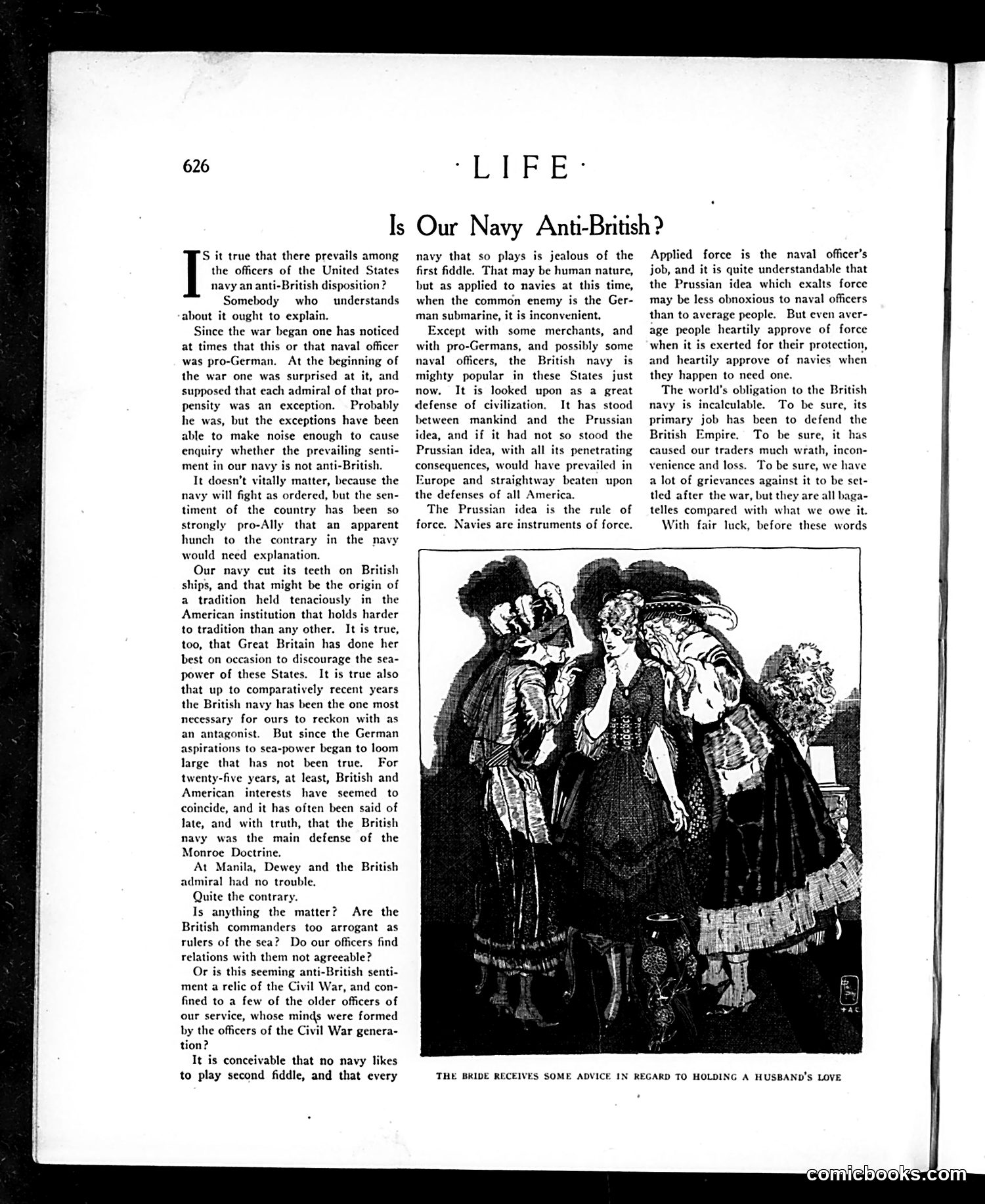
This page presents a satirical article questioning whether the U.S. Navy harbors anti-British sentiment. The author argues that while some American naval officers may have been pro-German historically, the British Navy has actually been America's best defense and aligned interest, particularly regarding the Monroe Doctrine. The accompanying illustration shows three women in period dress with the caption "THE BRIDE RECEIVES SOME ADVICE IN REGARD TO HOLDING A HUSBAND'S LOVE," appearing to use matrimonial metaphor for Anglo-American relations—suggesting the U.S. and Britain should maintain their partnership like a married couple. The article dismisses Civil War-era grievances as outdated and argues Britain and America's interests have long coincided against German expansion.
📄 Transcribed text from this page (OCR, searchable)
Machine-transcribed from the original scan — historical spelling and the odd misread are preserved.
*LEPE - Is Our Navy Ant-Bnitish? S it true that there prevails among the officers of the United States navy an anti-British disposition ? Somebody who understands about it ought to explain. Since the war began one has noticed at times that this or that naval officer was pro-German. At the beginning of the war one was surprised at it, and supposed that each adm of that pro- pensity was an exception. Probably he was, but the exceptions have been able to make noise enough to cause enquiry whether the prevailing senti- ment in our navy is not anti-British. It doesn’t vitally matter, because the navy will fight as ordered, but the sen- timent of the country has been so strongly pro-Ally that an apparent hunch to the contrary in the navy would need explanation. Our navy cut its teeth on British ships, and that might be the origin of a tradition held tenaciously in the American institution that holds harder to tradition than any other. It is true, too, that Great Britain has done her best on occasion to discourage the sea- power of these States. It is true also that up to comparatively recent years the British navy has been the one most necessary for ours to reckon with as an antagonist. But since the German aspirations to sea-power began to loom large that has not been true. For twenty-five years, at least, British and American interests have seemed to coincide, and it has often been said of late, and with truth, that the British navy was the main defense of the Monroe Doctrine. At Manila, Dewey and the British admiral had no trouble. Quite the contrary. Is anything the matter? Are the British commanders too arrogant as rulers of the sea? Do our officers find relations with them not agreeable? Or is this seeming anti-British senti- ment a relic of the Civil War, and con- fined to a few of the older officers of our service, whose minds were formed by the officers of the Civil War genera- tion? It is conceivable that no navy likes to play second fiddle, and that every navy that so plays is jealous of the first fiddle. That may be human nature, but as applied to navies at this time, when the common enemy is the Ger- man submarine, it is inconvenient, Except with some merchants, and with pro-Germans, and possibly some naval officers, the British navy is mighty popular in these States just now. It is looked upon as a great defense of civilization. It has stood between mankind and the Prussian idea, and if it had not so stood the Prussian idea, with all its penetrating consequences, would have prevailed in Europe and straightway beaten upon the defenses of all America. The Prussian idea is the rule of force. Navies are instruments of force. Applied force is the naval officer’s job, and it is quite understandable that the Prussian idea which exalts force may be less obnoxious to naval officers than to average people. But even aver- age people heartily approve of force when it is exerted for their protection, and heartily approve of navies when they happen to need one. The world’s obligation to the British navy is incalculable. To be sure, its primary job has been to defend the British Empire. To be sure, it has caused our traders much wrath, incon- venience and loss. To be sure, we have a lot of grievances against it to be set- tled after the war, but they are all ba; telles compared with what we owe it. With fair luck, before these words THE BRIDE RECEIVES SOME ADVICE IN REGARD TO HOLDING A HUSBAND'S LOVE