
Life, 1917-04-12 · page 17 of 42
Life — April 12, 1917 — page 17: what you’re looking at
What you’re looking at
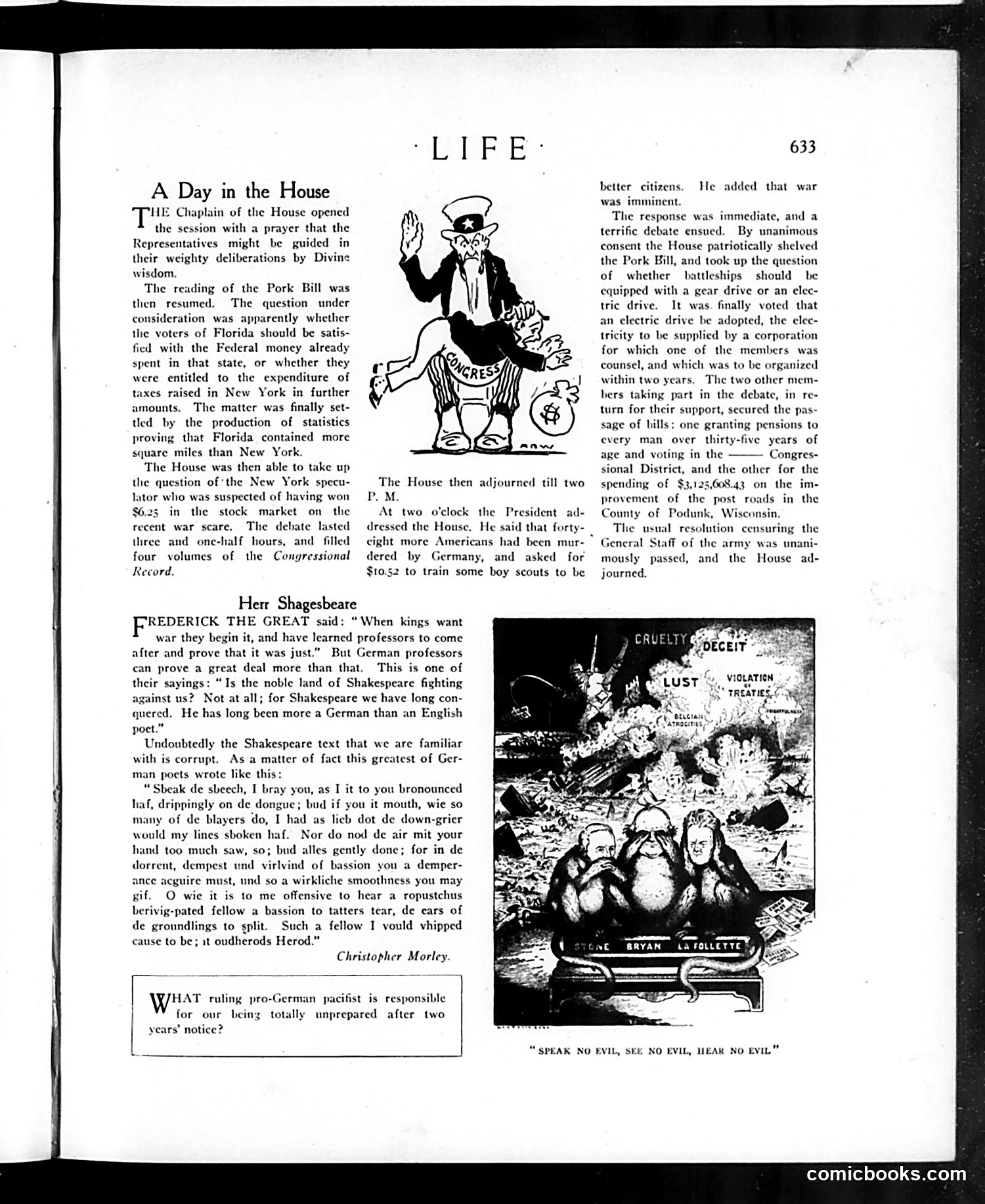
**"A Day in the House"** satirizes Congressional inefficiency and self-interest. The piece mocks how representatives debate trivial matters (Florida vs. New York spending, stock market speculation) with equal vigor as serious issues. When the President announces American deaths and war is imminent, Congress suddenly shelves the "Pork Bill"—but only to debate battleship drives while simultaneously securing pork-barrel legislation for their own districts (pensions, road improvements in "Podunk, Wisconsin"). The satire suggests patriotic rhetoric masks unchanged special-interest politics. **"Herr Shakespeare"** attacks German propaganda claims that Shakespeare was "more German than English." It parodies this by "translating" Shakespeare into comically mangled pseudo-German, mocking the absurdity of German cultural appropriation. The accompanying illustration shows demons labeled "Cruelty," "Deceit," and "Lust"—suggesting Germany's true character regardless of cultural claims. Both pieces criticize American unpreparedness for war (noted in the boxed question) and German deception, likely written circa 1916-1917, before U.S. entry into World War I.
📄 Transcribed text from this page (OCR, searchable)
Machine-transcribed from the original scan — historical spelling and the odd misread are preserved.
A Day in the House T! = Chaplain of the House opened the session with a prayer that the Representatives might be guided in their weighty deliberations by wisdom. The reading of the Pork Bill was then resumed. The question under consideration was apparently whether the voters of Florida should be satis- fied with the Federal money already spent in that state, or whether they were entitled to the expenditure of es raised in New York in further amounts, The matter was finally set- tled by the production of statistics proving that Florida contained more square miles than New York. The House was then able to take up the question of ‘the New York specu- lator who was suspected of having won $ in the stock market on the recent war scare. The debate lasted three and one-half hours, and_ filled four volumes of the Congressional The House then adjourned till two P.M. At two o'clock the President ad- dressed the House, He said that forty. cight more Americans had been mur dered by Germany, and asked for 633 better citizens. He added that war was imminent. The response was immediate, and a terrific debate ensued. By unanimous consent the House patriotically shelved the Pork Bill, and took up the question of whether battleships should be equipped with a gear drive or an elec- tric drive. It finally voted that an electric drive be adopted, the elec- tricity to be supplied by a corporation for which one of the members was counsel, and which was to be organized within two years. The two other mem- hers taking part in the debate, in re- turn for their support, secured the pas- sage of bills: one granting pensions to every man over thirty-five years of age and voting in the Congres- sional District, and the other for the spending of $3,125,60843 on the im- provement of the post roads in the County of Podunk, Wisconsin. The usual resolution censuring the General Staff of the army was unani- mously passed, and the House ad- Record. 2 to train some boy scouts to be journed. Herr Shagesbeare REDERICK THE GREAT said: “When kings want war they begin it, and have learned professors to come after and prove that it was just.” But German professors can prove a great deal more than that. This is one of their sayings: “Is the noble land of Shakespeare fighting nst us? Not at all; for Shakespeare we have long con- quered. He has long been more a German than an English poet.” Undoubtedly the Shakespeare text that we are familiar with is corrupt. As a matter of fact this greatest of Ger- man poets wrote like this: “Sbeak de sbeech, I bray you, as I it to you bronounced haf, drippingly on de dongue; bud if you it mouth, wie so many of de blayers do, I had as lich dot de down-grier would my lines sboken haf. Nor do nod de air mit your hand too much saw, so; bud alles gently done; for in de dempest und virlvind of bassion you a demper- ance acguire must, und so a wirkliche smoothness you may gif. O wie it is to me offensive to hear a ropustchus berivig-pated fellow a bassion to tatters tear, de cars of de groundlings to split. Such a fellow I vould vhipped cause to be; at oudherods Herod.” VIOLATION |: TREATIES,¢- dorr Christopher Morley. | HAT ruling pro-German pacifist is responsible after two for our being totally unprepared | years’ notice? “ SPEAK NO EVIL, SEE NO EVIL, HEAR NO EVIL” comicbooks.com