
Life, 1917-04-12 · page 24 of 42
Life — April 12, 1917 — page 24: what you’re looking at
What you’re looking at
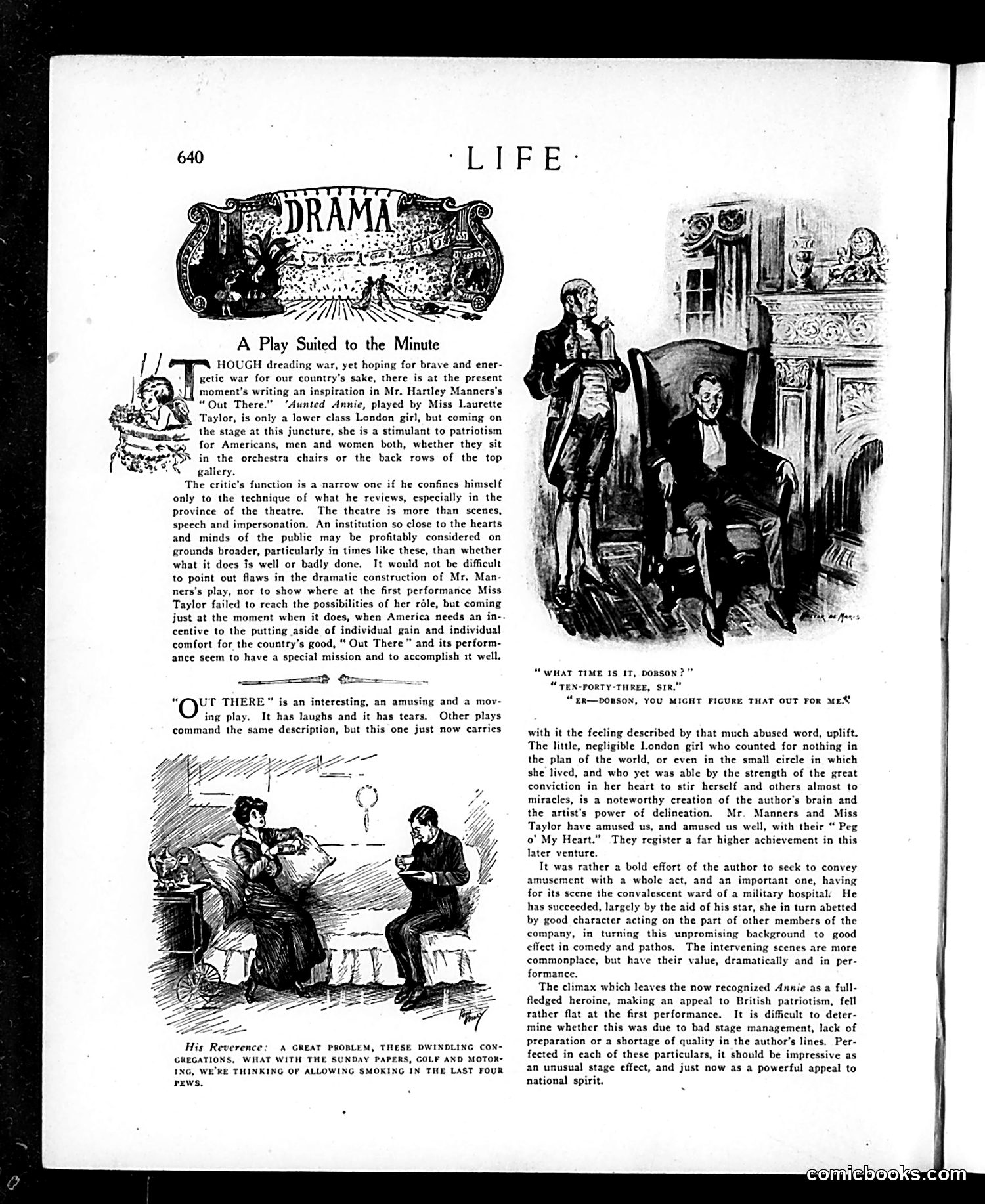
This page reviews Hartley Manners's play "Out There," starring Laurette Taylor as a working-class London girl named Annie. The critic argues the play deserves praise not purely on theatrical merit, but because of its *timely patriotic value*—it inspires American audiences during wartime to sacrifice personal comfort for country. The smaller cartoon below (captioned "His Reverence") satirizes a clergyman concerned that churches lose congregants to secular Sunday activities (newspapers, golf, motoring), so he considers permitting smoking in back pews to retain attendance—a joke about institutional desperation and misplaced priorities. The dialogue exchange about the time appears unrelated to the main review, possibly a separate comic feature mocking a servant's literalism or a master's forgetfulness. The page reflects WWI-era American culture where theatre served patriotic propaganda functions.
📄 Transcribed text from this page (OCR, searchable)
Machine-transcribed from the original scan — historical spelling and the odd misread are preserved.
A Play Suited to the Minute HOUGH dreading war, yet hoping for brave and ener- getic war for our country’s sake, there is at the present moment's writing an inspiration in Mr. Hartley Manners’s “Out There.” ‘Aunted Annie, played by Miss Laurette Taylor, is only a lower class London girl, but coming on the stage at this juncture, she is a stimulant to patriotism for Americans, men and women both, whether they sit in the orchestra chairs or the back rows of the top gallery. The critic’s function is a narrow one if he confines himself only to the technique of what he reviews, especially in the province of the theatre. The theatre is more than scenes, speech and impersonation, An institution so close to the hearts and minds of the public may be profitably considered on grounds broader, particularly in times like these, than whether what it does is well or badly done. It would not be difficult to point out flaws in the dramatic construction of Mr. Man- ners’s play, nor to show where at the first performance Miss Taylor failed to reach the possibilities of her réle, but coming just at the moment when it does, when America needs an in-- centive to the putting aside of individual gain and individual comfort for the country’s good, “ Out There” and its perform- ance seem to have a special mission and to accomplish 1t well, ey JT THERE” is an interesting, an amusing and a mov- ing play. It has laughs and has tears. Other plays command the same description, but this one just now carries His Reverence: A GREAT PROBLEM, THESE DWINDLING CON- GREGATIONS, WHAT WITH THE SUNDAY PAPERS, GOLP AND MOTOR- ING, WE'RE THINKING OF ALLOWING SMOKING IN THE LAST FOUR PEWS, Dee C NIG “WHAT TIME 1S IT, DOBSO: “ TEN-PORTY-THREE, SIR. “ER—DOBSON, YOU MIGHT FIGURE THAT OUT FoR MEX’ with it the feeling described by that much abused word, uplift. The little, negligible London girl who counted for nothing in the plan of the world, or even in the small circle in which she lived, and who yet was able by the strength of the great conviction in her heart to stir herself and others almost to miracles, is a noteworthy creation of the author's brain and the artist's power of delineation. Mr. Manners and Miss Taylor have amused us, and amused us well, with their “ Peg o” My Heart.” They register a far higher achievement in this later venture. It was rather a bold effort of the author to seck to convey amusement with a whole act, and an important one, having for its scene the convalescent ward of a military hospital: He has succeeded, largely by the aid of his star, she in turn abetted by good character acting on the part of other members of the company, in turning this unpromising background to good effect in comedy and pathos. The intervening scenes are more commonplace, but have their value, dramatically and in per- formance. The climax which leaves the now recognized Annie as a full- fledged heroine, making an appeal to British patriotism, fell rather flat at the first performance. It is difficult to deter- mine whether this was due to bad stage management, lack of preparation or a shortage of quality in the author's lines, Per- fected in each of these particulars, should be impressive as an unusual stage effect, and just now as a powerful appeal to national spirit.