
Life, 1917-04-12 · page 20 of 42
Life — April 12, 1917 — page 20: what you’re looking at
What you’re looking at
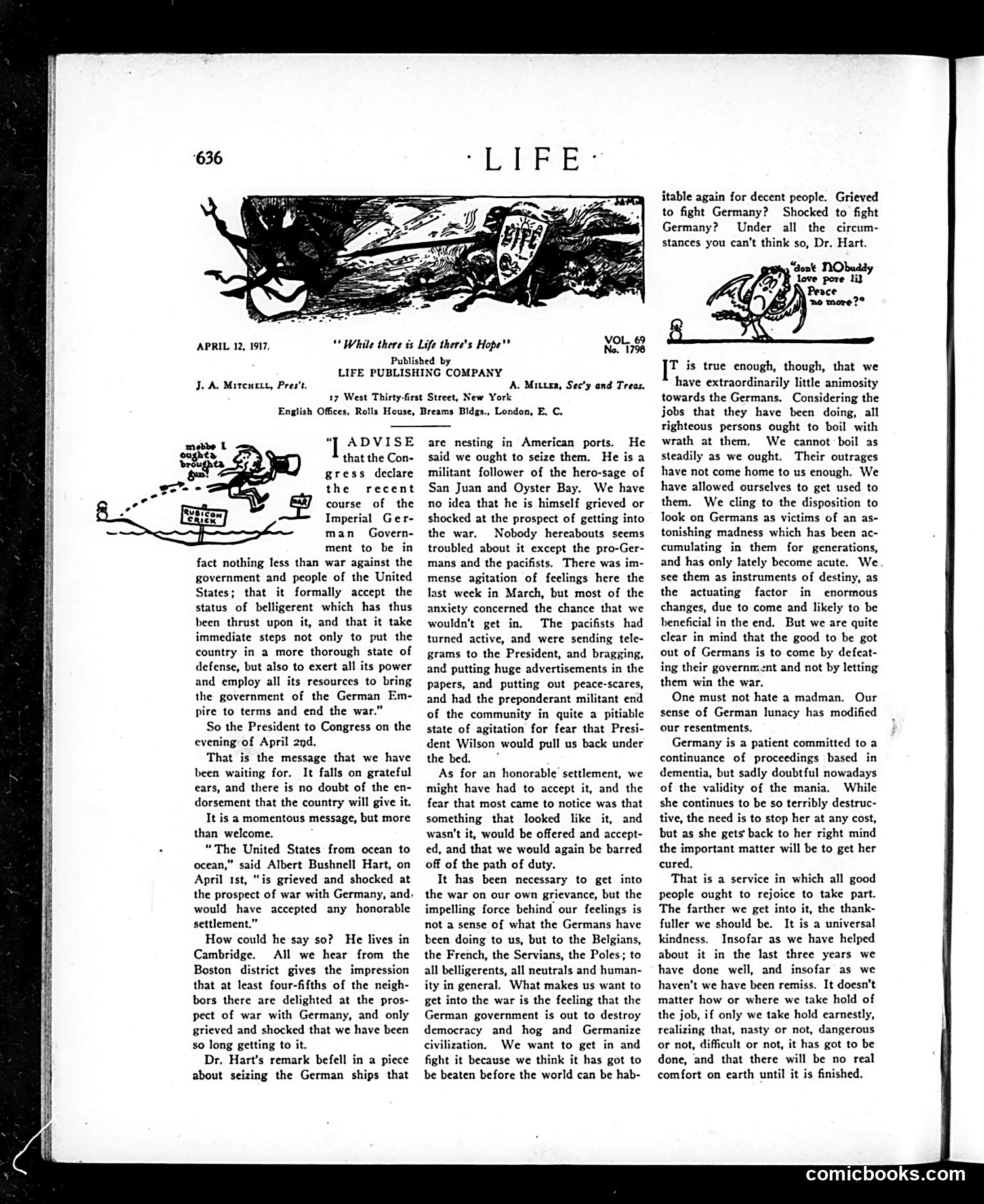
This issue appeared just days after President Wilson's April 2 war message to Congress asking for a declaration of war against Germany. The page is primarily editorial commentary rather than cartoon satire. The text addresses **Albert Bushnell Hart**, a Boston academic who claimed Americans were "grieved and shocked" at the prospect of war with Germany. Life's editors mock this characterization, asserting that Boston and most Americans actually *welcomed* entry into WWI. They dispute Hart's suggestion of accepting an "honorable settlement," arguing the real impetus behind American support for war isn't German attacks on U.S. ships, but rather Germany's aggression against Belgium, France, Serbia, and Poland—seen as threats to democracy itself. The cartoons (visible but small) appear to be decorative wartime illustrations supporting American entry into the war, though their specific imagery is unclear at this reproduction quality.
📄 Transcribed text from this page (OCR, searchable)
Machine-transcribed from the original scan — historical spelling and the odd misread are preserved.
APRIL 12, 1917. “While there is Life there's Hope" VOL. 69 No, 1796 Published by LIFE PUBLISHING COMPANY J. A. Mircnete, Pres’t. “T ADVISE that the Con- gress declare the recent course of the Imperial Ger- man _ Govern- ment to be in fact nothing less than war against the government and people of the United States; that it formally accept the status of belligerent which has thus been thrust upon it, and that it take immediate steps not only to put the country in a more thorough state of defense, but also to exert all its power and employ all its resources to bring the government of the German Em- pire to terms and end the war.” So the President to Congress on the evening of April 2nd. That is the message that we have been waiting for. It falls on grateful ears, and there is no doubt of the en- dorsement that the country will give it. It is a momentous message, but more than welcome. “The United States from ocean to ocean,” said Albert Bushnell Hart, on April ist, “is grieved and shocked at the prospect of war with Germany, and, would have accepted any honorable settlement.” How could he say so? He lives in Cambridge. All we hear from the Boston district gives the impression that at least four-fifths of the neigh- bors there are delighted at the pros- pect of war with Germany, and only grieved and shocked that we have been so long getting to it. Dr. Hart's remark befell in a piece about seizing the German ships that A. Mitten, Sec’y ond Treas. 17 West Thirty-first Street, New York English Offices, Rolls House, Breams Bldgs., London, E. C. are nesting in American ports. He said we ought to seize them. He is a militant follower of the hero-sage of San Juan and Oyster Bay. We have no idea that he is himself grieved or shocked at the prospect of getting into the war. Nobody hereabouts seems troubled about it except the pro-Ger- mans and the pacifists. There was im- mense agitation of feelings here the last week in March, but most of the anxiety concerned the chance that we wouldn't get in. The pacifists had turned active, and were sending tele- grams to the President, and bragging, and putting huge advertisements in the papers, and putting out peace-scares, and had the preponderant militant end of the community in quite a pitiable state of agitation for fear that Presi- dent Wilson would pull us back under the bed. 7 As for an honorable settlement, we might have had to accept it, and the fear that most came to notice was that something that looked like it, and wasn’t it, would be offered and accept- ed, and that we would again be barred off of the path of duty. It has been necessary to get into the war on our own grievance, but the impelling force behind our feelings is not a sense of what the Germans have been doing to us, but to the Belgians, the French, the Servians, the Poles; to all belligerents, all neutrals and human- ity in general. What makes us want to get into the war is the feeling that the German government is out to destroy democracy and hog and Germanize civilization, We want to get in and fight it because we think it has got to be beaten before the world can be hab- itable again for decent people. Grieved to fight Germany? Shocked to fight Germany? Under all the circum- stances you can’t think so, Dr. Hart. - is true enough, though, that we have extraordinarily little animosity towards the Germans. Considering the jobs that they have been doing, all righteous persons ought to boil with wrath at them. We cannot boil as steadily as we ought. Their outrages have not come home to us enough. We have allowed ourselves to get used to them. We cling to the disposition to look on Germans as victims of an as- tonishing madness which has been ac- cumulating in them for generations, and has only lately become acute. We see them as instruments of destiny, as the actuating factor in enormous changes, due to come and likely to be beneficial in the end. But we are quite clear in mind that the good to be got out of Germans is to come by defeat- ing their government and not by letting them win the war. One must not hate a madman. Our sense of German lunacy has modified our resentments. Germany is a patient committed to a continuance of proceedings based in dementia, but sadly doubtful nowadays of the validity of the mania. While she continues to be so terribly destruc- tive, the need is to stop her at any cost, but as she gets back to her right mind the important matter will be to get her cured, That is a service in which all good people ought to rejoice to take part. The farther we get into it, the thank- fuller we should be. It is a universal kindness. Insofar as we have helped about it in the last three years we have done well, and insofar as we haven't we have been remiss. It doesn’t matter how or where we take hold of the job, if only we take hold earnestly, realizing that, nasty or not, dangerous or not, difficult or not, it has got to be done, and that there will be no real comfort on earth until it is finished. comicbooks.com