
Life, 1917-04-12 · page 21 of 42
Life — April 12, 1917 — page 21: what you’re looking at
What you’re looking at
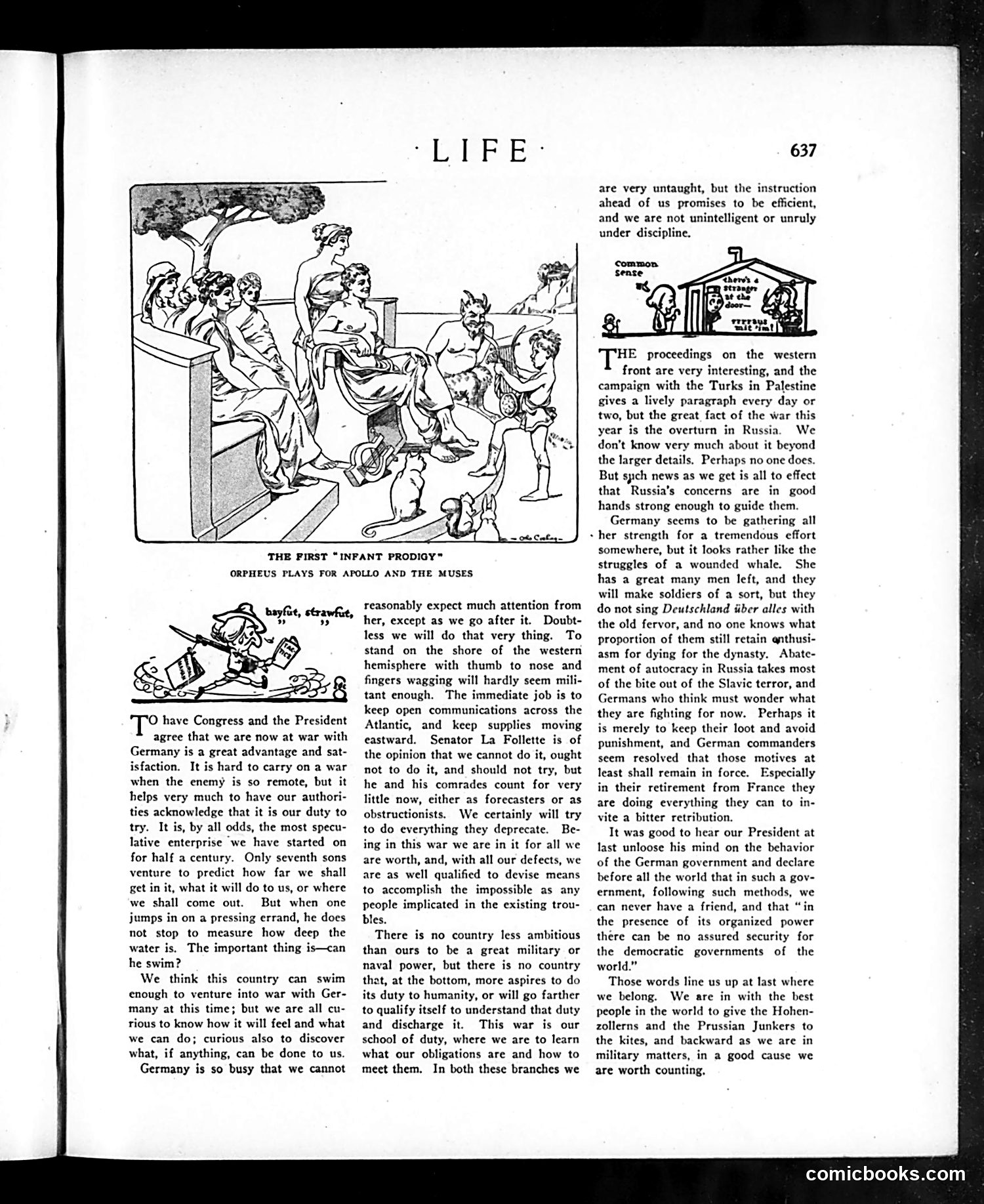
This page from *Life* magazine, published during America's involvement in World War I, contains a classical cartoon titled "The First 'Infant Prodigy': Orpheus Plays for Apollo and the Muses." The illustration depicts the mythological figure Orpheus performing for the gods—a satirical comment on wartime propaganda and public persuasion. The accompanying editorial discusses America's entry into the war against Germany. The author argues that despite uncertainties, the nation is capable of meeting its military and moral obligations. He dismisses Senator La Follette's antiwar opposition as ineffectual, expresses concern about Germany's remaining strength, and praises President Wilson for his moral clarity on the conflict. The "infant prodigy" metaphor sarcastically suggests America as a young nation learning through war—framed as a "school of duty." The classical reference humorously elevates American inexperience while endorsing the war effort as necessary and righteous.
📄 Transcribed text from this page (OCR, searchable)
Machine-transcribed from the original scan — historical spelling and the odd misread are preserved.
THE FIRST “INFANT PRODIGY” ORPHEUS PLAYS FOR APOLLO AND THE MUSES 'O have Congress and the President agree that we are now at war with Germany is a great advantage and sat- isfaction. It is hard to carry on a war when the enemy is so remote, but it helps very much to have our authori- ties acknowledge that it is our duty to try. It is, by all odds, the most specu- lative enterprise we have started on for half a century. Only seventh sons venture to predict how far we shall get in it, what it will do to us, or where we shall come out. But when one jumps in on a pressing errand, he does not stop to measure how deep the water is. The important thing is—can he swim? We think this country can swim enough to venture into war with Ger- many at this time; but we are all cu- rious to know how it will feel and what we can do; curious also to discover what, if anything, can be done to us. Germany is so busy that we cannot reasonably expect much attention from her, except as we go after it. Doubt- less we will do that very thing. To stand on the shore of the western hemisphere with thumb to nose and fingers wagging will hardly seem mili- tant enough. The immediate job is to keep open communications across the Atlantic, and keep supplies moving eastward. Senator La Follette is of the opinion that we cannot do it, ought not to do it, and should not try, but he and his comrades count for very little now, either as forecasters or as obstructionists. We certainly will try to do everything they deprecate. Be- ing in this war we are in it for all we are worth, and, with all our defects, we are as well qualified to devise means to accomplish the impossible as any people implicated in the existing trou- bles. There is no country less ambitious than ours to be a great military or naval power, but there is no country that, at the bottom, more aspires to do its duty to humanity, or will go farther to qualify itself to understand that duty and discharge it. This war is our school of duty, where we are to learn what our obligations are and how to meet them. In both these branches we 637 are very untaught, but the instruction ahead of us promises to be efficient, and we are not unintelligent or unruly under discipline. a A “(oe proceedings on the western front are very interesting, and the campaign with the Turks in Palestine gives a lively paragraph every day or two, but the great fact of the war this year is the overturn in Russia. We don't know very much about it beyond the larger details, Perhaps no one does. But spich news as we get is all to effect that Russia’s concerns are in good hands strong enough to guide them. Germany seems to be gathering all her strength for a tremendous effort somewhere, but it looks rather like the struggles of a wounded whale. She has a great many men left, and they will make soldiers of a sort, but they do not sing Deutschland iiber alles with the old fervor, and no one knows what proportion of them still retain qnthusi- asm for dying for the dynasty. Abate- ment of autocracy in Russia takes most of the bite out of the Slavic terror, and Germans who think must wonder what they are fighting for now. Perhaps it is merely to keep their loot and avoid punishment, and German commanders seem resolved that those motives at least shall remain in force. Especially in their retirement from France they are doing everything they can to in- vite a bitter retribution. It was good to hear our President at last unloose his mind on the behavior of the German government and declare before all the world that in such a gov- ernment, following such methods, we can never have a friend, and that “in the presence of its organized power there can be no assured security for the democratic governments of the world.” Those words line us up at last where we belong. We are in with the best people in the world to give the Hohen- zollerns and the Prussian Junkers to the kites, and backward as we are in military matters, in a good cause we are worth counting, comicbooks.com