
A complete issue · 42 pages · 1917
Life — March 8, 1917
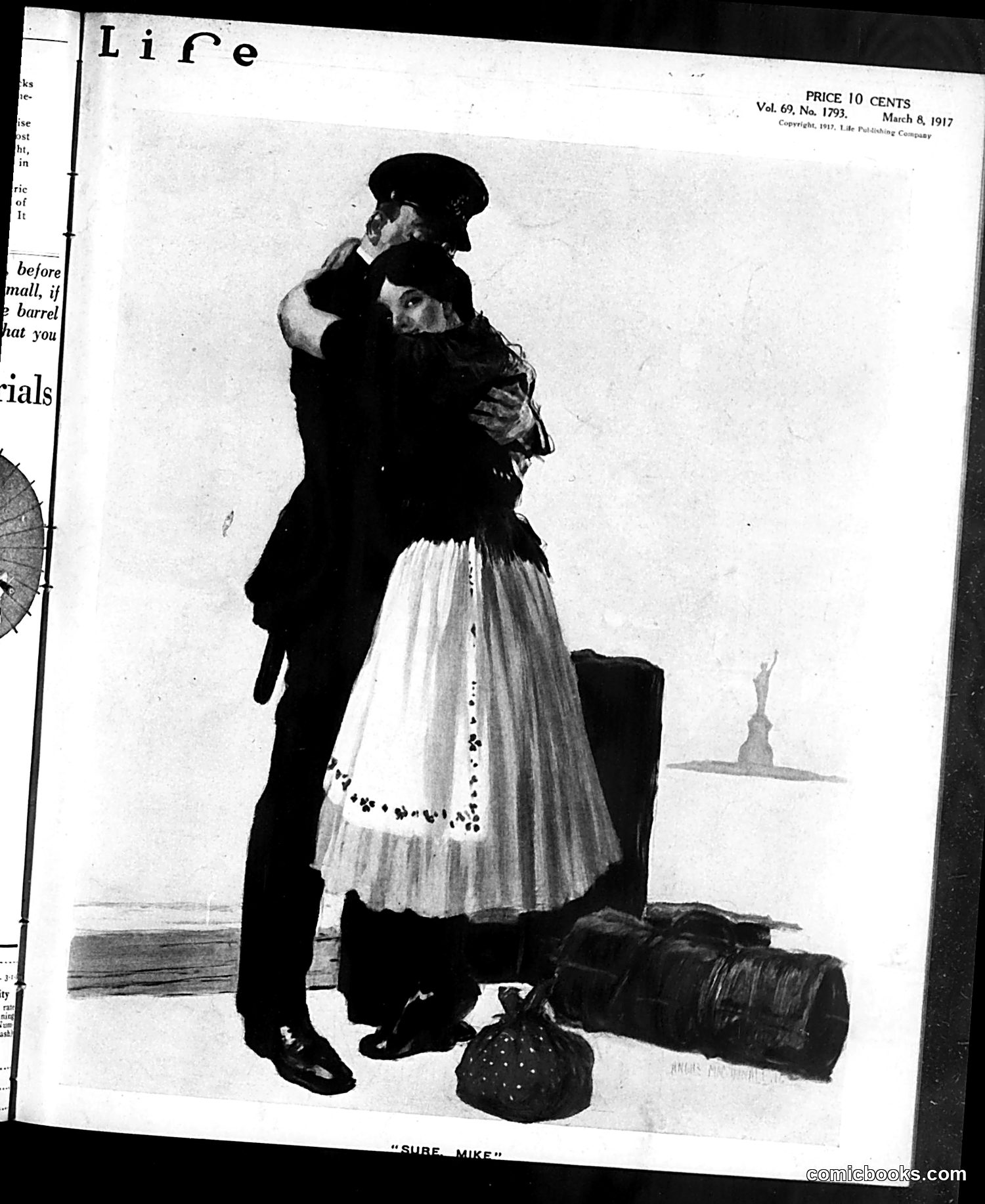
This Life magazine cover from March 8, 1917 depicts a man in dark clothing holding a child, standing beside luggage and a barrel, with the Statue of Liberty visible in the background. The caption "Sure, Mike" suggests an Irish immigrant character. The image likely satirizes American immigration policy and concerns of the era. The figure appears to represent an Irish immigrant ("Mike" being a stereotypical Irish name), shown with meager possessions arriving in America. Given the 1917 date—just as America entered World War I—this may reference contemporary debates about immigration, assimilation, or the treatment of immigrants during wartime. The casual caption suggests irony about American promises versus the modest reality facing newly arrived immigrants.
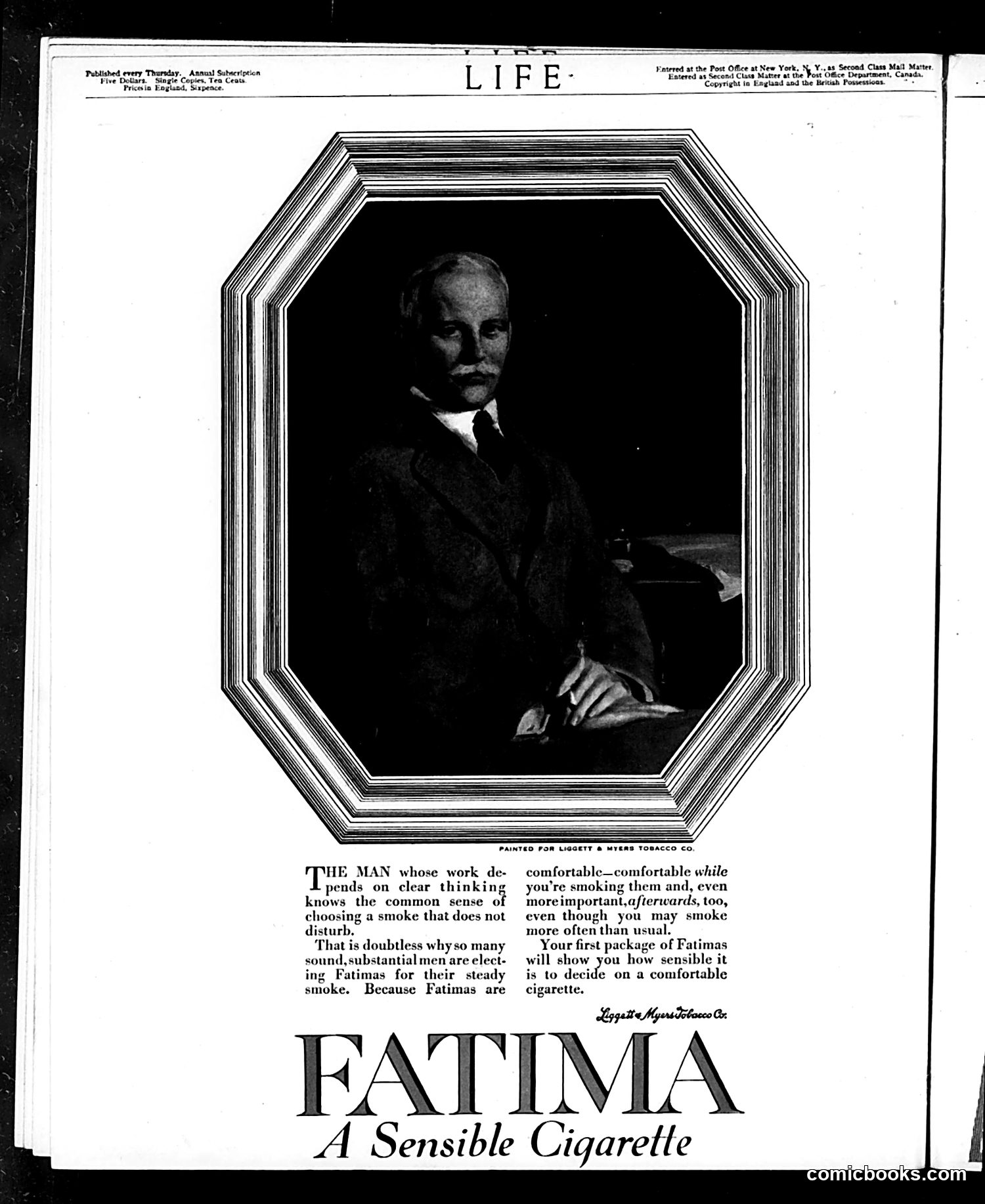
This page is primarily a **cigarette advertisement**, not political satire. It's a Fatima brand cigarette ad from Life magazine, featuring a formal portrait of an unidentified well-dressed man in an octagonal frame. The advertisement appeals to "sound, substantial men" by positioning Fatima cigarettes as "sensible" and promoting the comfort of smoking them. The copy emphasizes that smoking these cigarettes won't disturb one's clear thinking—a marketing angle suggesting the product suits serious, professional men. The portrait's formal style and the advertisement's tone reflect early 20th-century marketing strategies that associated consumer products with respectability, masculinity, and rational decision-making. There is no apparent political cartoon or satire on this page—it is straightforward commercial advertising from the era.
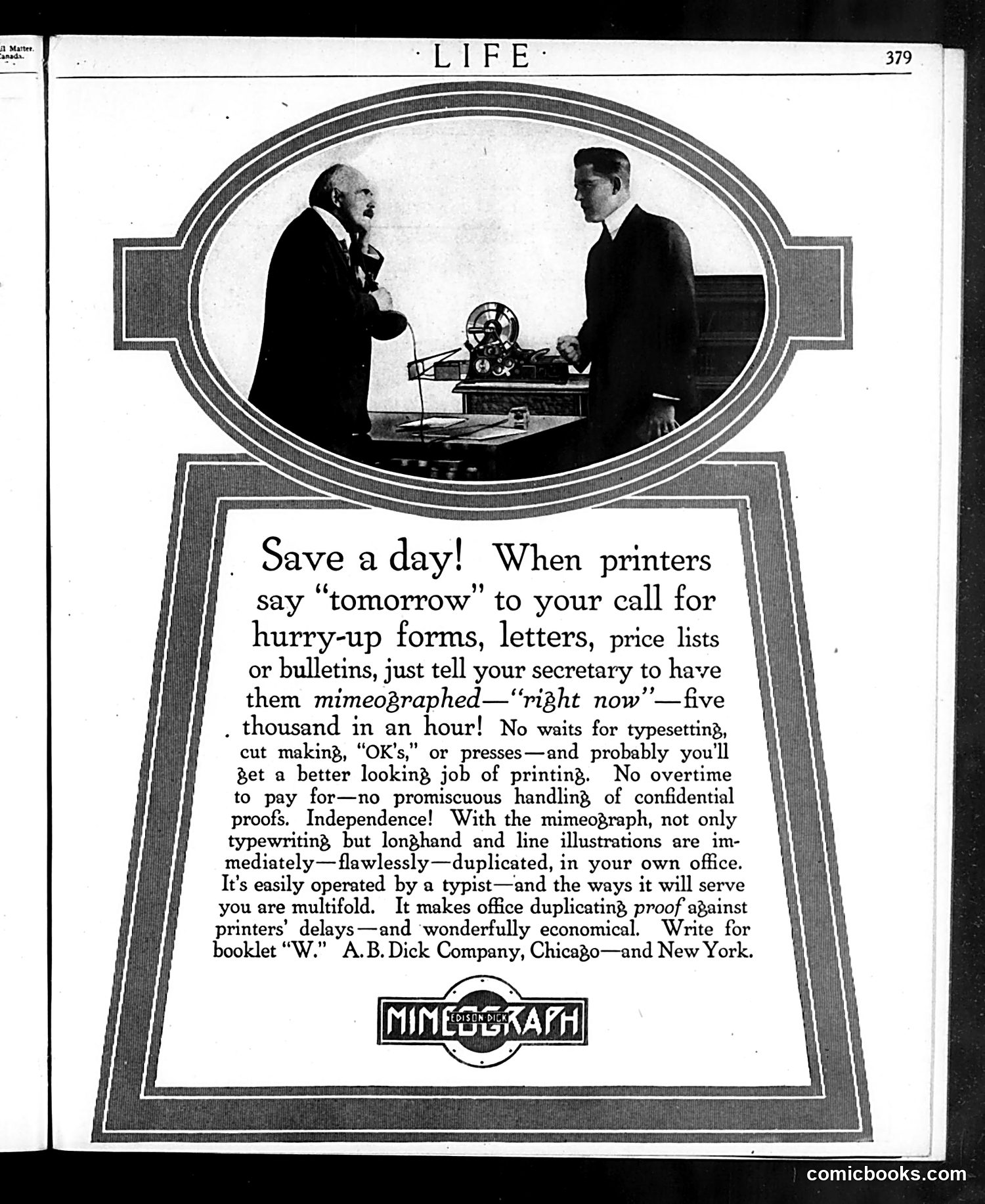
This page is primarily **advertising, not satire or political commentary**. It's a A.B. Dick Company advertisement for the Mimeograph machine, placed in *Life* magazine (page 379). The ad shows two businessmen in an office setting with a mimeograph machine between them. The headline "Save a day!" pitches the mimeograph as a solution to printing delays. The copy promises that instead of waiting for printers to typeset and produce documents, secretaries could use the mimeograph to duplicate "forms, letters, price lists or bulletins" immediately—"five thousand in an hour." The appeal targets office efficiency and cost-savings, positioning the mimeograph as a way to bypass traditional printing shops and maintain confidentiality. This reflects early-20th-century office modernization.
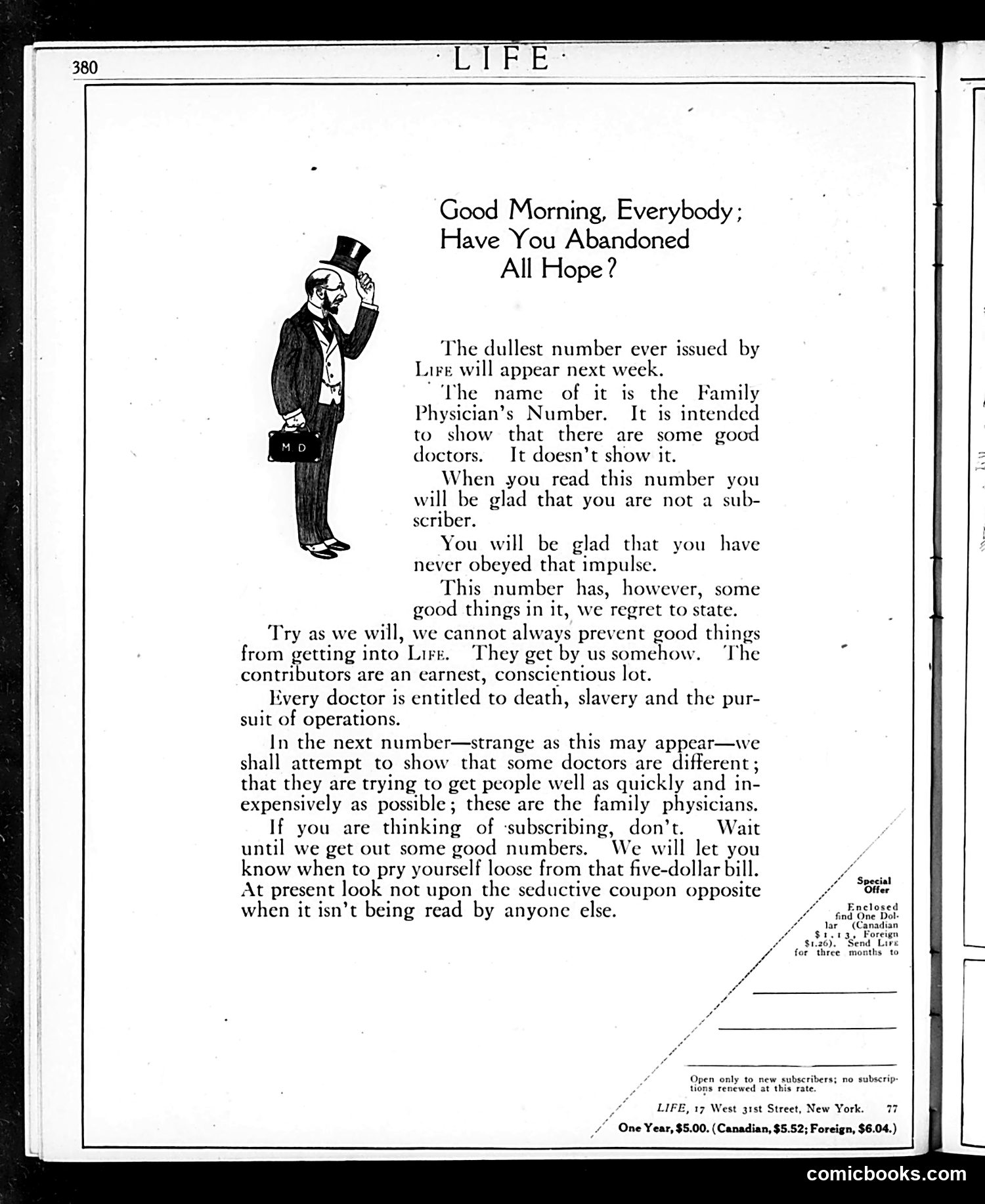
This page is primarily an editorial announcement rather than a cartoon. The illustration shows a well-dressed man in a top hat labeled "M.D." (Medical Doctor), tipping his hat in greeting. The text announces an upcoming "Family Physician's Number" of *Life* magazine, which the editors acknowledge will be "the dullest number ever issued." The satire targets doctors: the piece suggests that while doctors deserve criticism for greed and poor ethics, some physicians genuinely try to help patients efficiently. The editors paradoxically warn potential subscribers *not* to subscribe yet, promising to announce when future issues contain worthwhile content worth paying for. The joke is self-deprecating—*Life* admits it will publish something boring, but frames it as necessary social commentary on the medical profession's failings and occasional virtues.
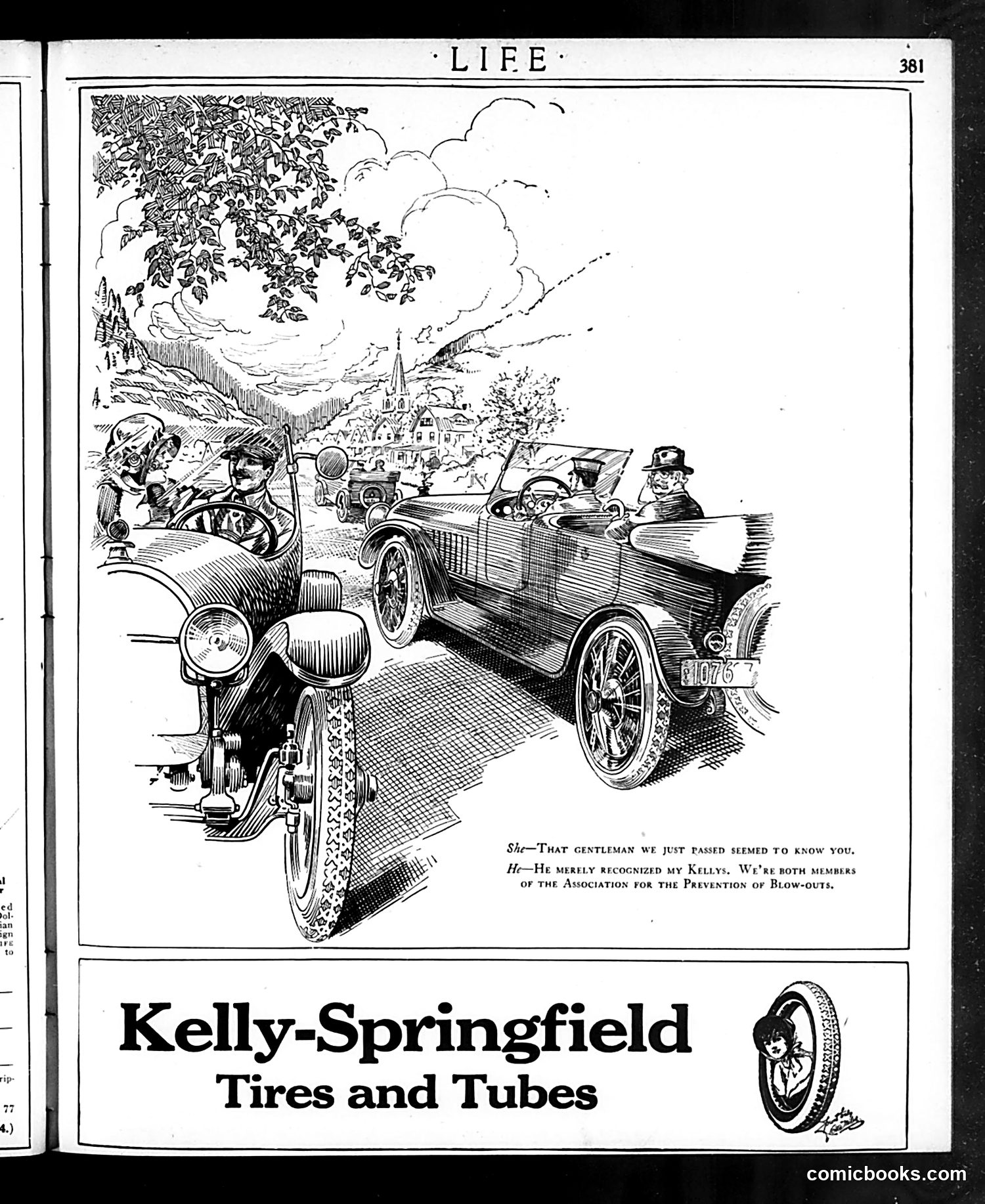
This page is primarily a **Kelly-Springfield Tires advertisement** rather than political satire. The illustration depicts an early automobile scene with two cars meeting on a country road near a village. The caption describes a social encounter: two gentlemen recognize each other and are identified as members of "the Association for the Prevention of Blow-outs." This is a humorous, invented organization whose name plays on a common automotive problem of the era—tire blowouts were frequent and serious concerns for early motorists. The ad's joke is that Kelly-Springfield tires are so reliable they've created a fictional club for people who *don't* experience blow-outs. It's gentle period advertising humor targeting car owners concerned about tire safety and durability.
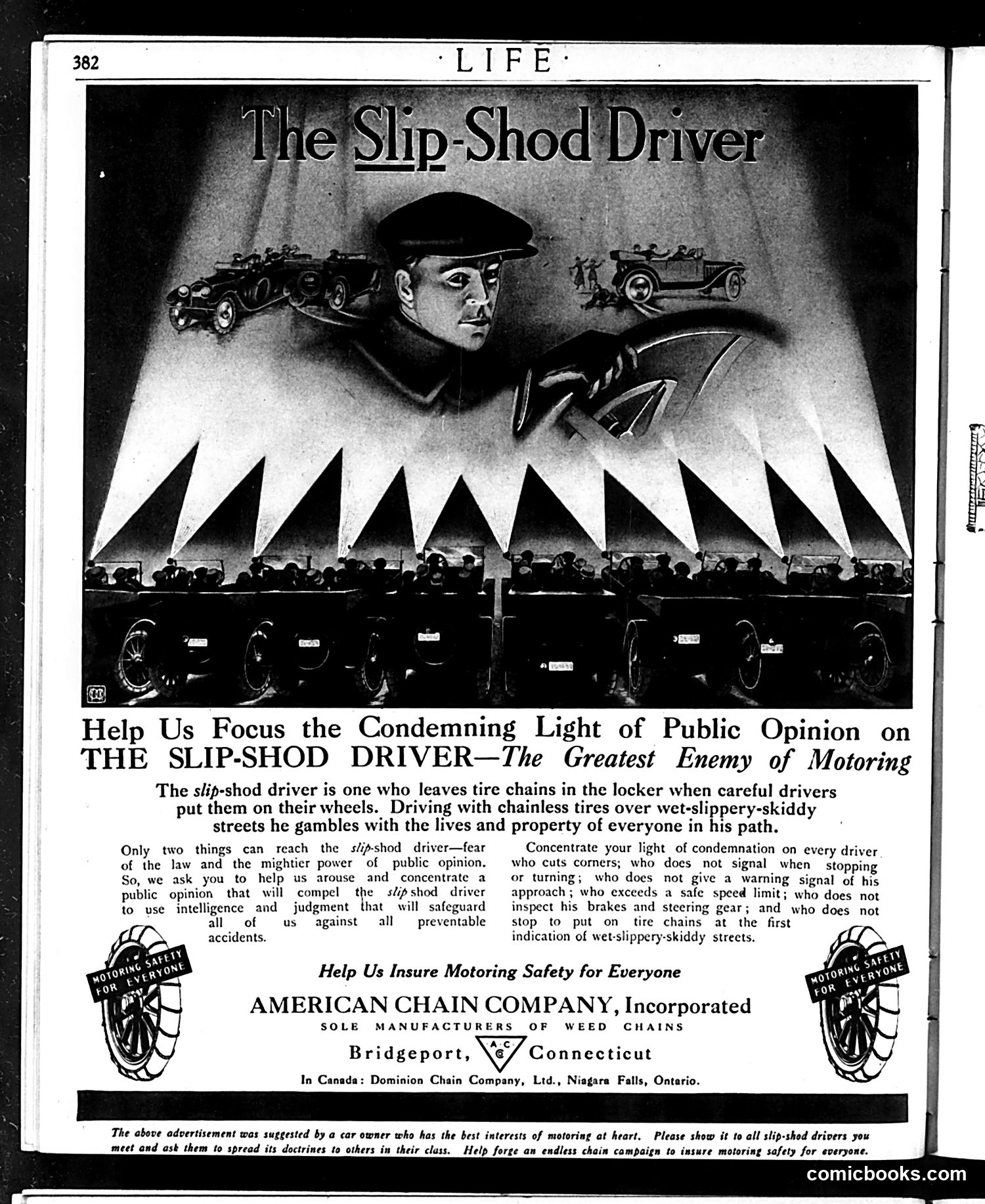
This is primarily a **safety advertisement**, not political satire. The American Chain Company uses dramatic imagery to warn against "slip-shod drivers"—those who remove tire chains in winter conditions, creating hazards for others. The illustration shows a menacing figure (representing reckless drivers) looming over a row of cars, with jagged threatening shapes suggesting danger. The ad appeals to public opinion and "the condemning light" of social judgment to pressure negligent drivers into safe practices. The message targets specific unsafe behaviors: not using chains on wet/slippery roads, improper signaling, excessive speed, and neglecting vehicle maintenance. Rather than satire, this uses moral shame and fear as motivational tactics—common advertising strategies of the era.
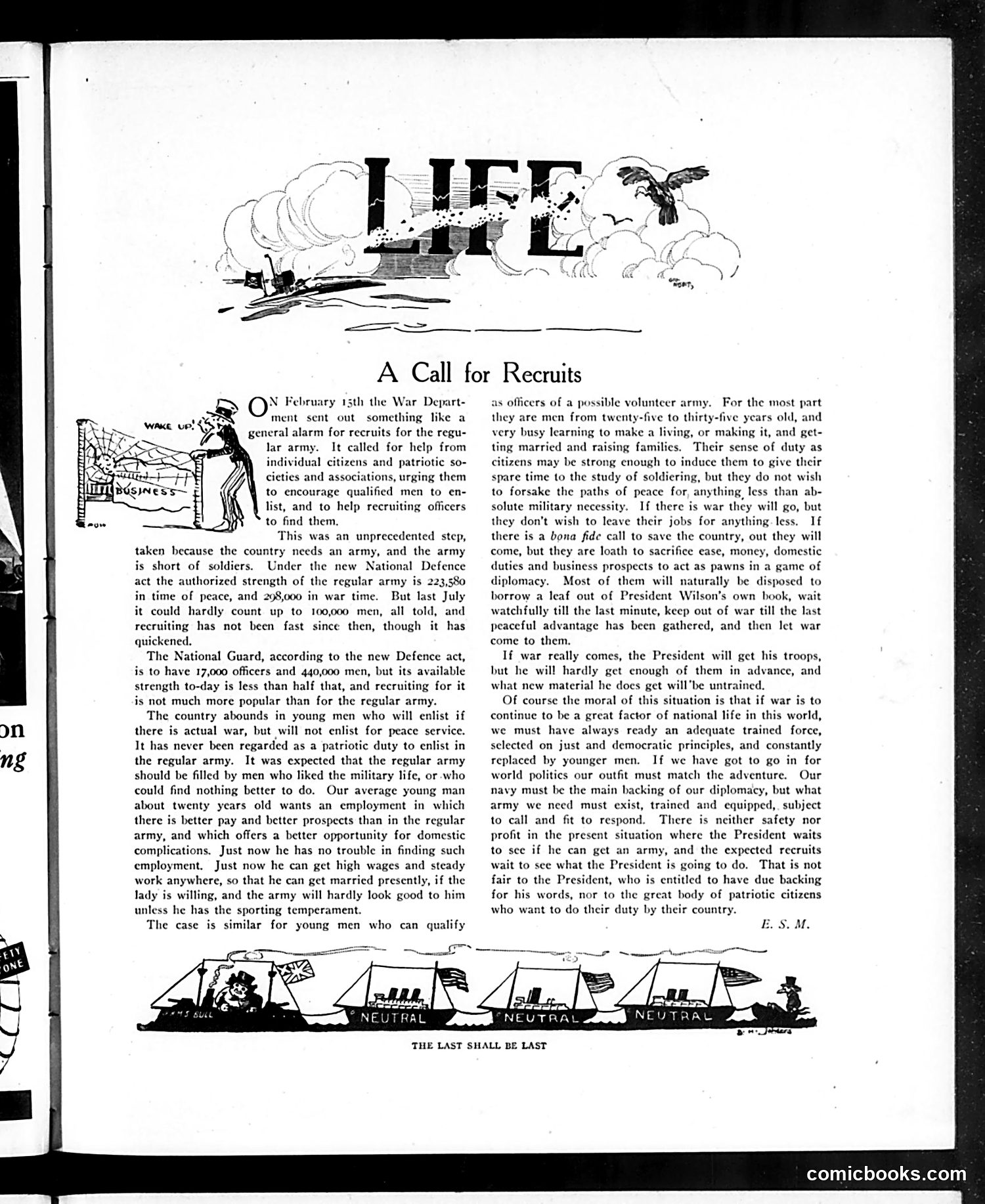
This article satirizes the U.S. military recruitment crisis following President Wilson's February 13th call for volunteer soldiers. The piece mocks the contradiction between the country's urgent need for 223,580 soldiers in peacetime and 298,000 in wartime, versus young men's reluctance to enlist. The satire targets the government's optimistic framing: officers are portrayed as hoping recruits will sacrifice "domestic duties and business prospects" while actually protecting American interests abroad. The author critiques that the President will struggle obtaining sufficient troops quickly, and that many young men prefer higher civilian wages to military service. The bottom cartoon—showing increasingly neutral ships—appears to satirize American neutrality policy amid global conflict, suggesting inevitable involvement despite official neutrality claims.
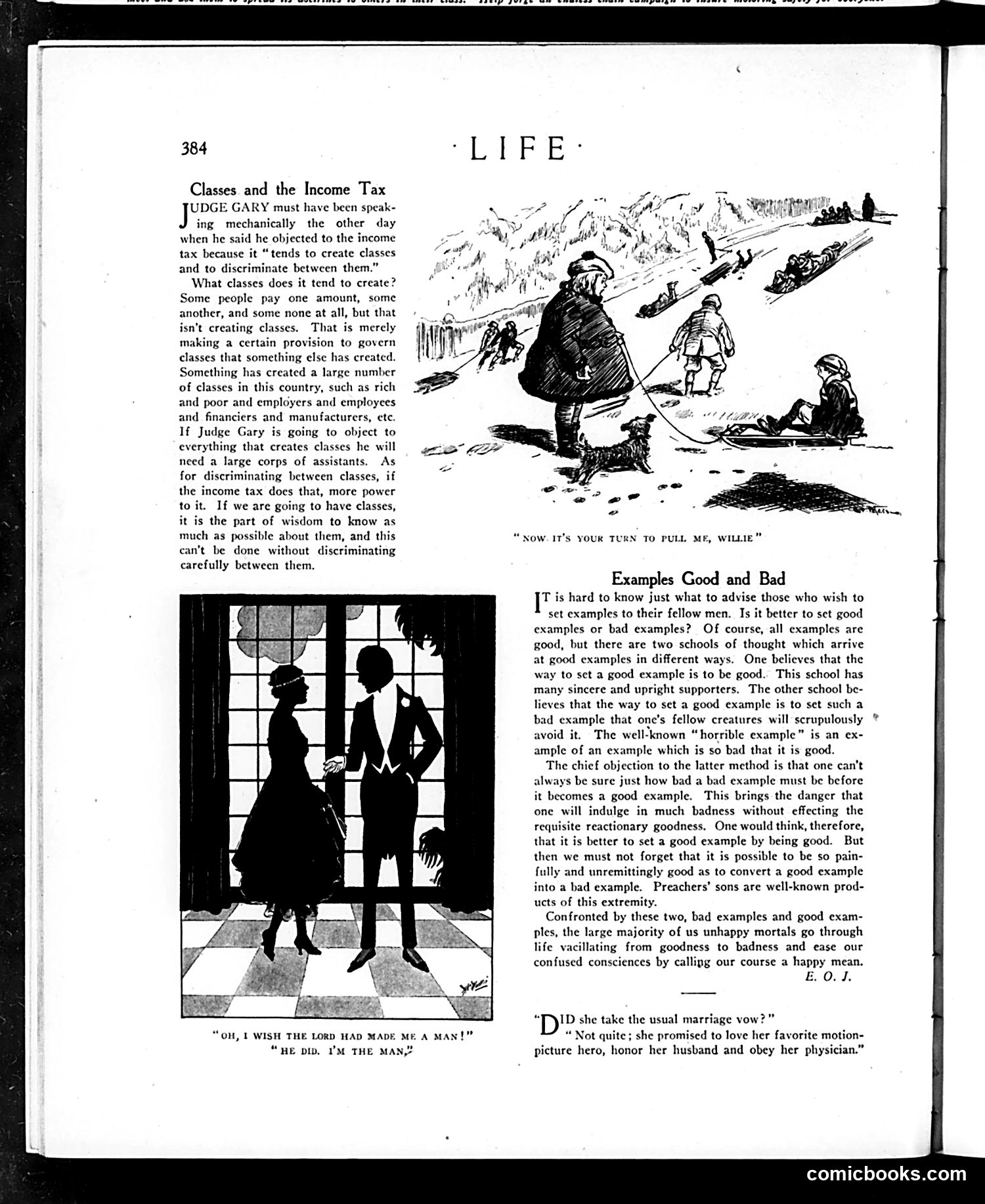
This page contains two distinct editorial cartoons: 1. **Top cartoon** (skiing scene): Shows an adult pulling a child on skis with caption "Now it's your turn to full me, Willie." This satirizes role-reversal and generational expectations—likely about children eventually supporting aging parents, or about inheritance/economic responsibility. 2. **Bottom cartoon** (indoor scene): Captioned "Oh, I wish the Lord had made me a man!" / "He did. I'm the man?" This jokes about gender roles and marital dynamics—the woman regrets her sex, while the man sarcastically suggests she's already wearing the pants in their relationship. The accompanying article, "Examples Good and Bad," discusses moral leadership and setting examples, suggesting these cartoons illustrate social contradictions of the era.
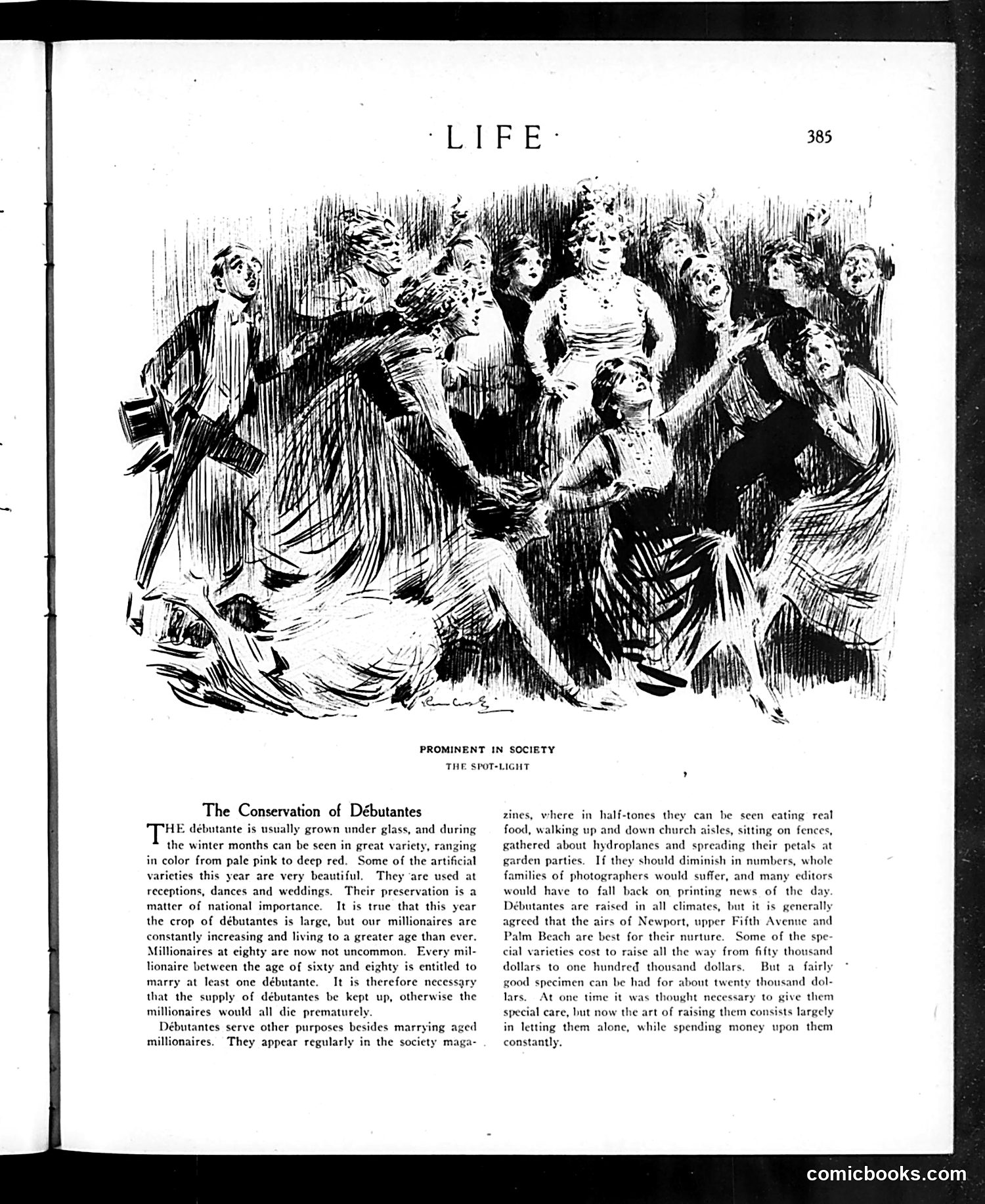
This satirical piece mocks wealthy American society's obsession with debutantes—young women from rich families formally introduced to society. The accompanying sketch shows an elaborate social gathering where debutantes are displayed. The text humorously argues that debutantes should be "conserved" like an endangered crop, since millionaires increasingly marry them. It suggests that wealthy men are depleting the supply faster than it can be replenished, making debutante preservation "a matter of national importance." The satire targets the artificial, commodified nature of the debutante system, where young women serve primarily as marriage prospects for wealthy men. It critiques both the excess of millionaires and the treatment of debutantes as valuable social commodities requiring careful management and financial investment to maintain.
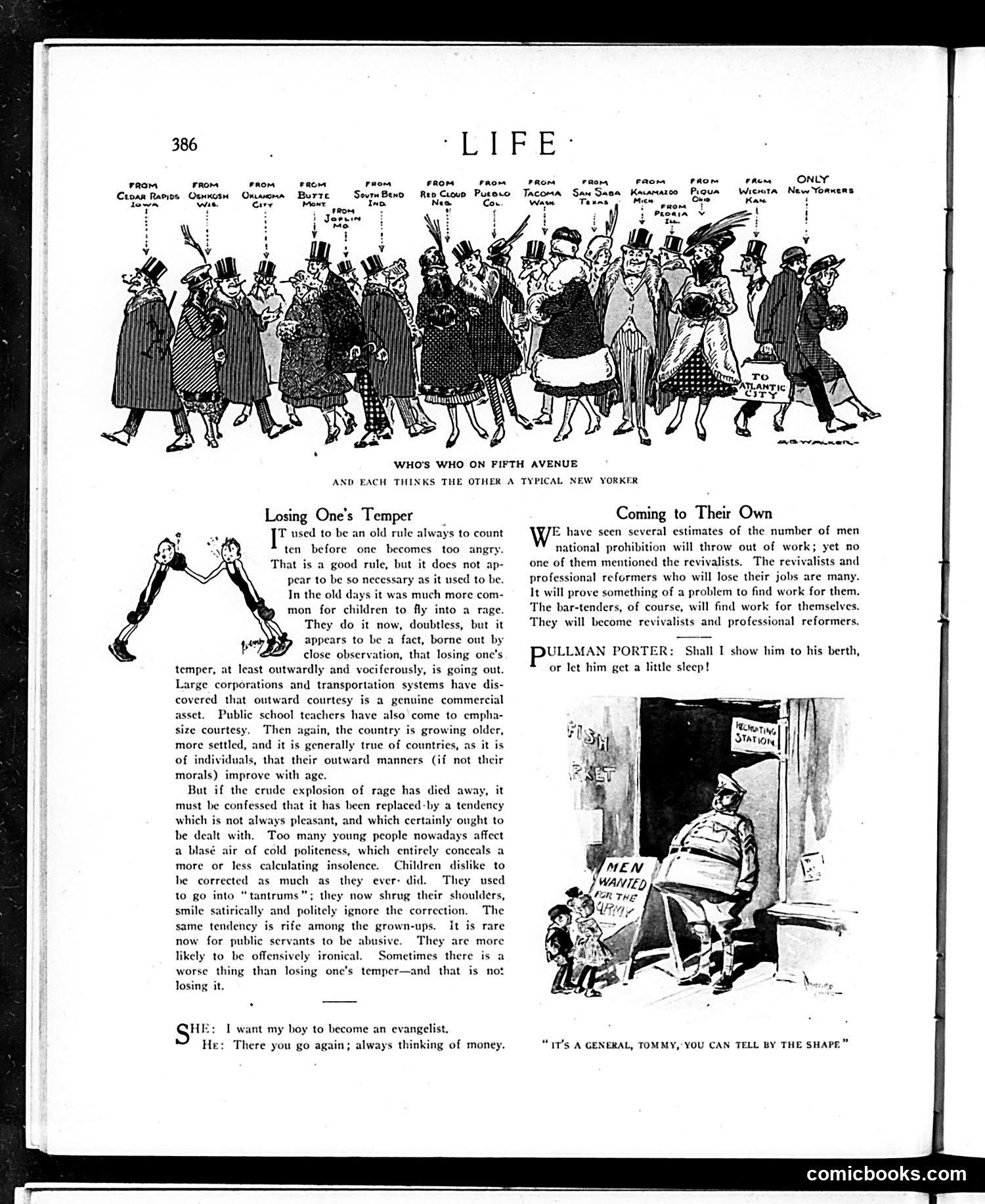
This page satirizes early 20th-century New York society and manners. The top illustration shows diverse Fifth Avenue characters labeled by their origins (Cedar Rapids, Omaha, etc.), mocking how New Yorkers stereotyped out-of-towners. **"Losing One's Temper"** critiques changing American civility—complaining that outward politeness has replaced genuine emotion, replaced by calculated coldness among both children and adults. **"Coming to Their Own"** discusses Prohibition's aftermath, noting bar-tenders and revivalists will find new work when saloons close. A small cartoon at bottom shows a woman telling her husband she wants their son to be an evangelist; he replies sarcastically that she's "always thinking of money"—mocking religious hypocrisy. The Pullman Porter illustration appears unrelated social commentary.
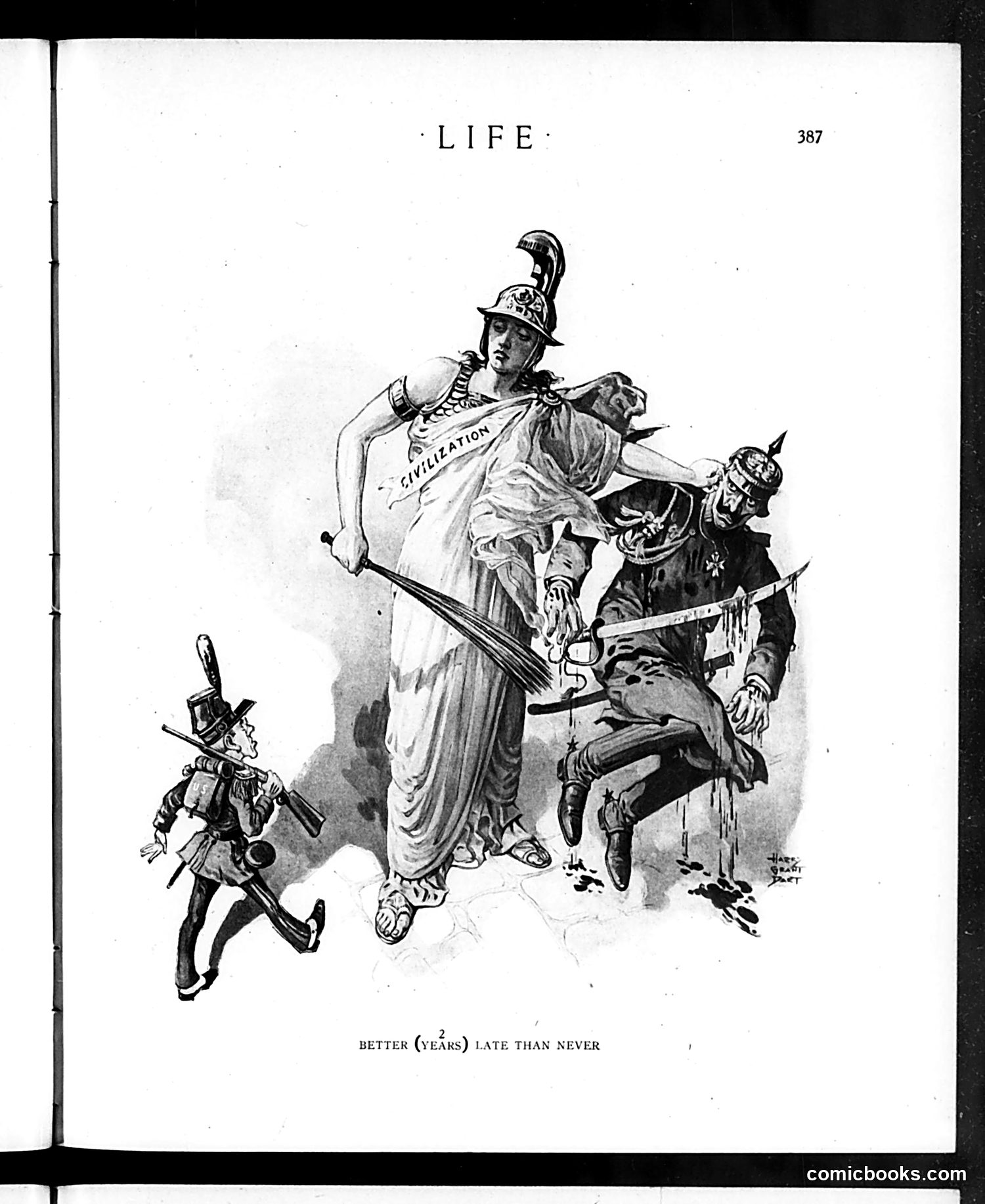
This satirical cartoon depicts **Civilization** (labeled on the tall figure's sash) as a classical female warrior being attacked or restrained by what appear to be **military or political figures** in Prussian/German-style uniforms with spiked helmets. A smaller figure on the left, possibly representing a nation or political entity, runs alongside. The caption "Better (Years) Late Than Never" suggests the cartoon critiques delayed military or political intervention. Given the German military imagery and the apparent struggle, this likely comments on **entering World War I**, suggesting nations intervened too late to protect civilization from militaristic aggression. The cartoon satirizes the cost of delayed action against aggressive powers.
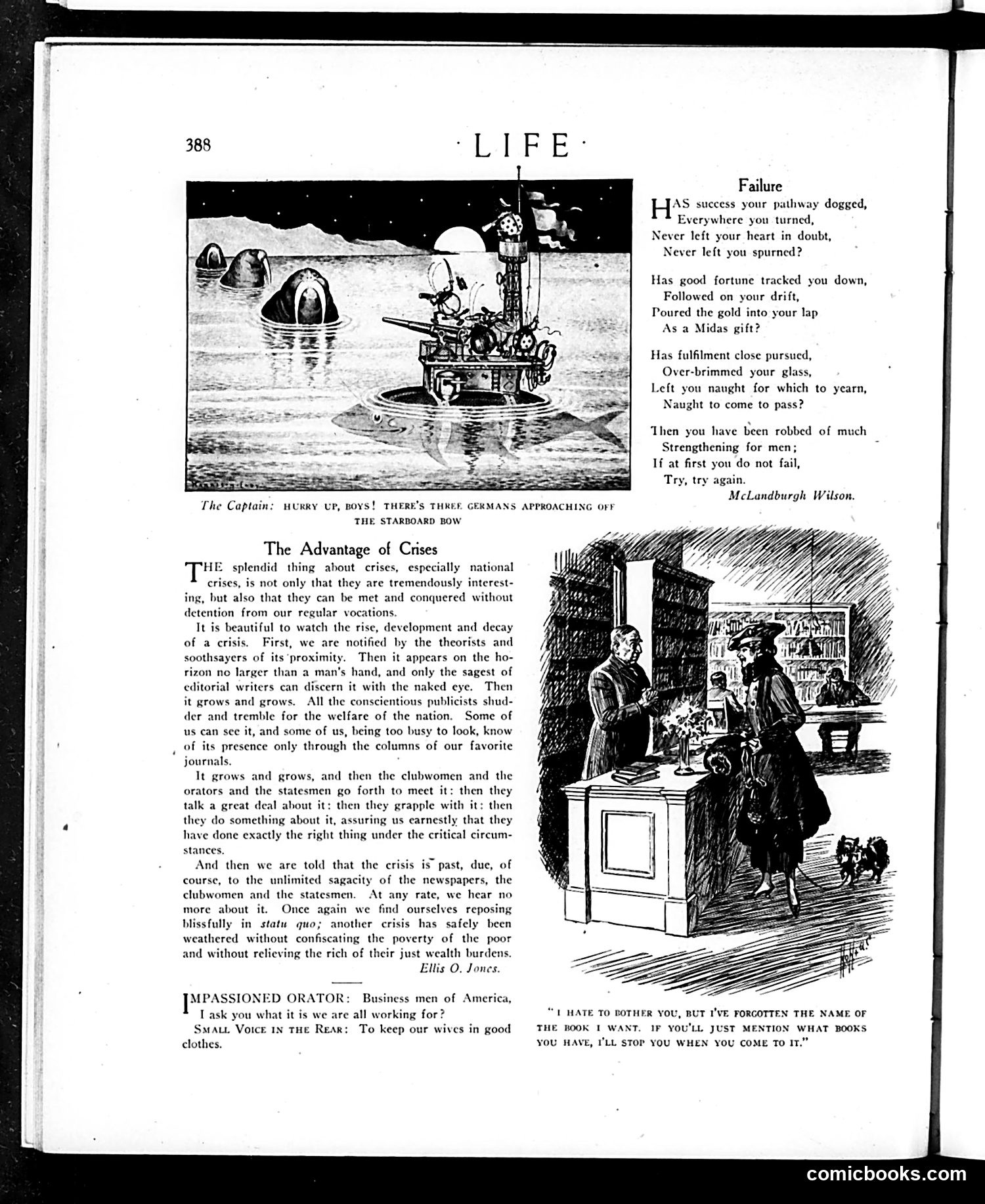
**Top Illustration**: "The Captain" depicts a WWI-era naval scene with a submarine or vessel under attack ("Hurry up, boys! There's three Germans approaching off the starboard bow"). This reflects American anxieties about German naval warfare during or around World War I. **"Failure" Poem**: By McLandburgh Wilson, it's an inspirational verse advising persistence through setbacks—offering consolation that early failure strengthens character if one perseveres. **"The Advantage of Crises"**: An essay by Elia O. Jones arguing that national crises, while serious, create opportunity for public discourse and eventual resolution, though media coverage can be sensationalized. **Bottom Cartoon**: A library scene where a patron urgently seeks a book title they've forgotten, humorously depicting the frustration of imperfect memory. The page blends war commentary, self-help sentiment, and domestic humor typical of the era.
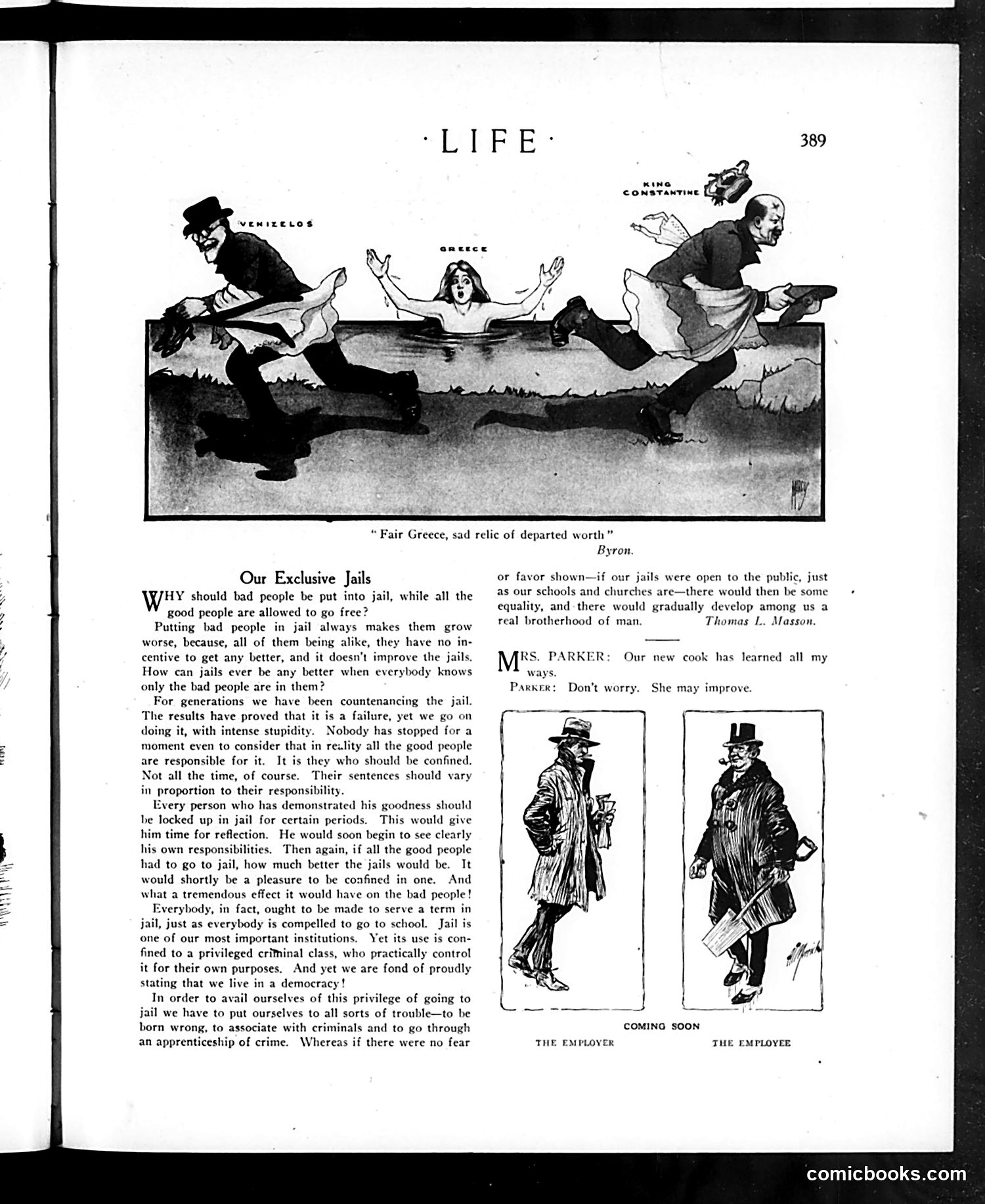
**Main Cartoon (top):** A satirical scene showing three figures in an underworld or hellish setting labeled with classical references—"Aeneas," "Orfice" (Orpheus), and "King Constantine." The cartoon appears to mock historical or mythological figures experiencing some form of punishment or torment, likely critiquing their earthly deeds through classical allusion. The Byron quote about "departed worth" suggests ironic commentary on their legacies. **Article & Lower Cartoons:** "Our Exclusive Jails" argues that imprisoning bad people while freeing good ones would improve society and deter crime. The two sketches labeled "Coming Soon—The Employer" and "The Employee" appear to satirize class distinctions, suggesting these figures will soon occupy jail roles based on their social status—a commentary on unequal justice.
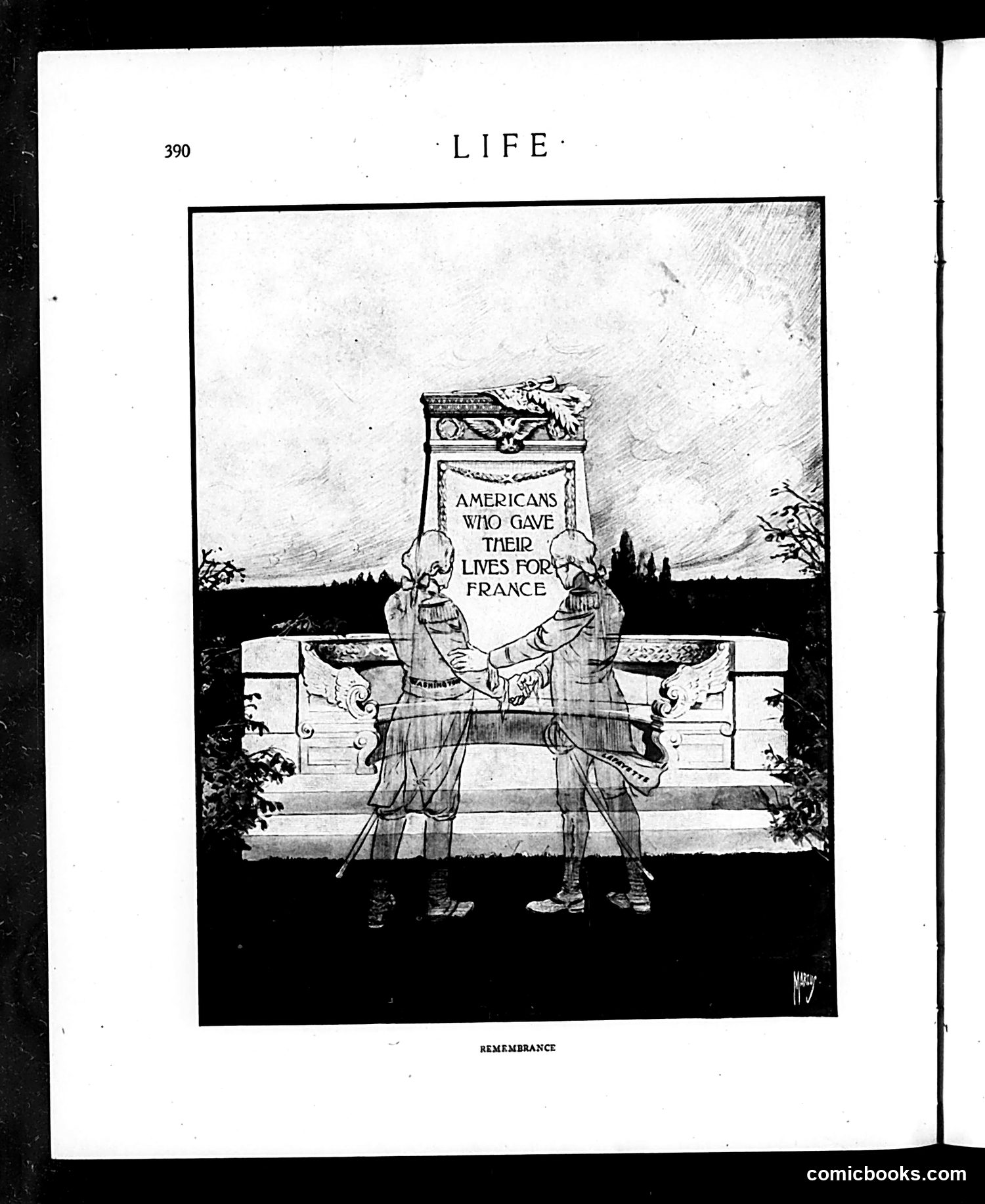
This WWI-era cartoon from *Life* magazine honors American soldiers who died fighting in France. Two uniformed American soldiers stand at attention before a memorial monument inscribed "AMERICANS WHO GAVE THEIR LIVES FOR FRANCE." The monument features an eagle atop it and appears to be a formal cenotaph or war memorial. The cartoon's title, "Remembrance," suggests it's a tribute piece rather than satirical commentary. It reflects the American public's solemn commemoration of war casualties and the historical alliance with France during World War I. The formal, reverent composition—soldiers saluting the memorial against a skyline featuring French architecture—emphasizes patriotic duty and sacrifice in a straightforward, dignified manner rather than through humor or political critique.
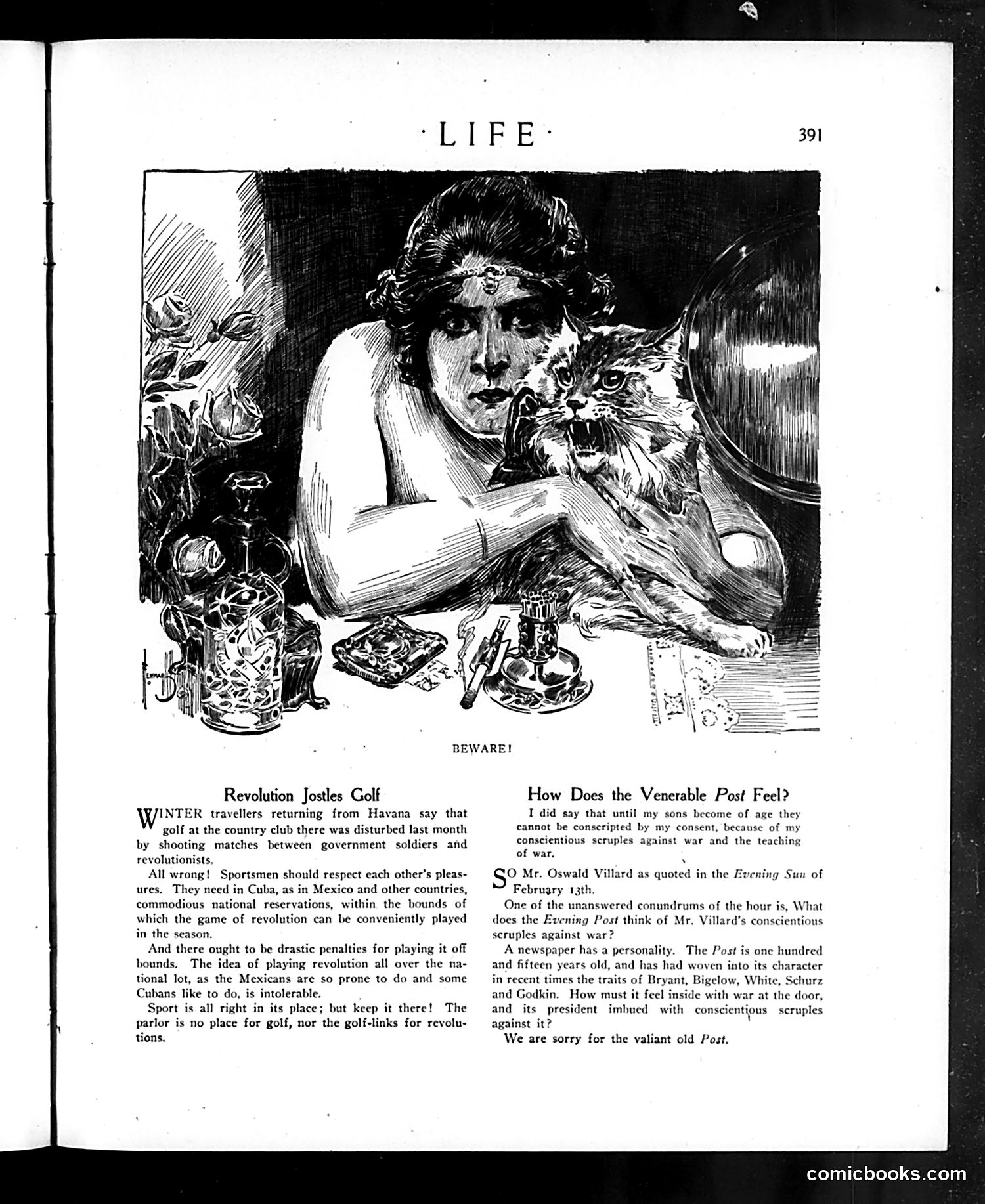
The top illustration labeled "BEWARE!" depicts a woman with a cat, surrounded by cosmetics and grooming items. This appears to be a cautionary image about vanity or superficiality, though the exact satirical target is unclear from the image alone. Below are two separate articles. "Revolution Jostles Golf" criticizes winter travelers from Havana who played golf during Cuba's political upheaval, arguing that sportsmen should respect national crises and not treat revolutionary unrest as a backdrop for leisure. The piece advocates keeping golf-links separate from politics. The second article, "How Does the Venerable *Post* Feel?", defends the *Evening Post* newspaper against criticism that it holds "conscientious scruples against war," suggesting the publication deserves sympathy for maintaining ethical positions during wartime.
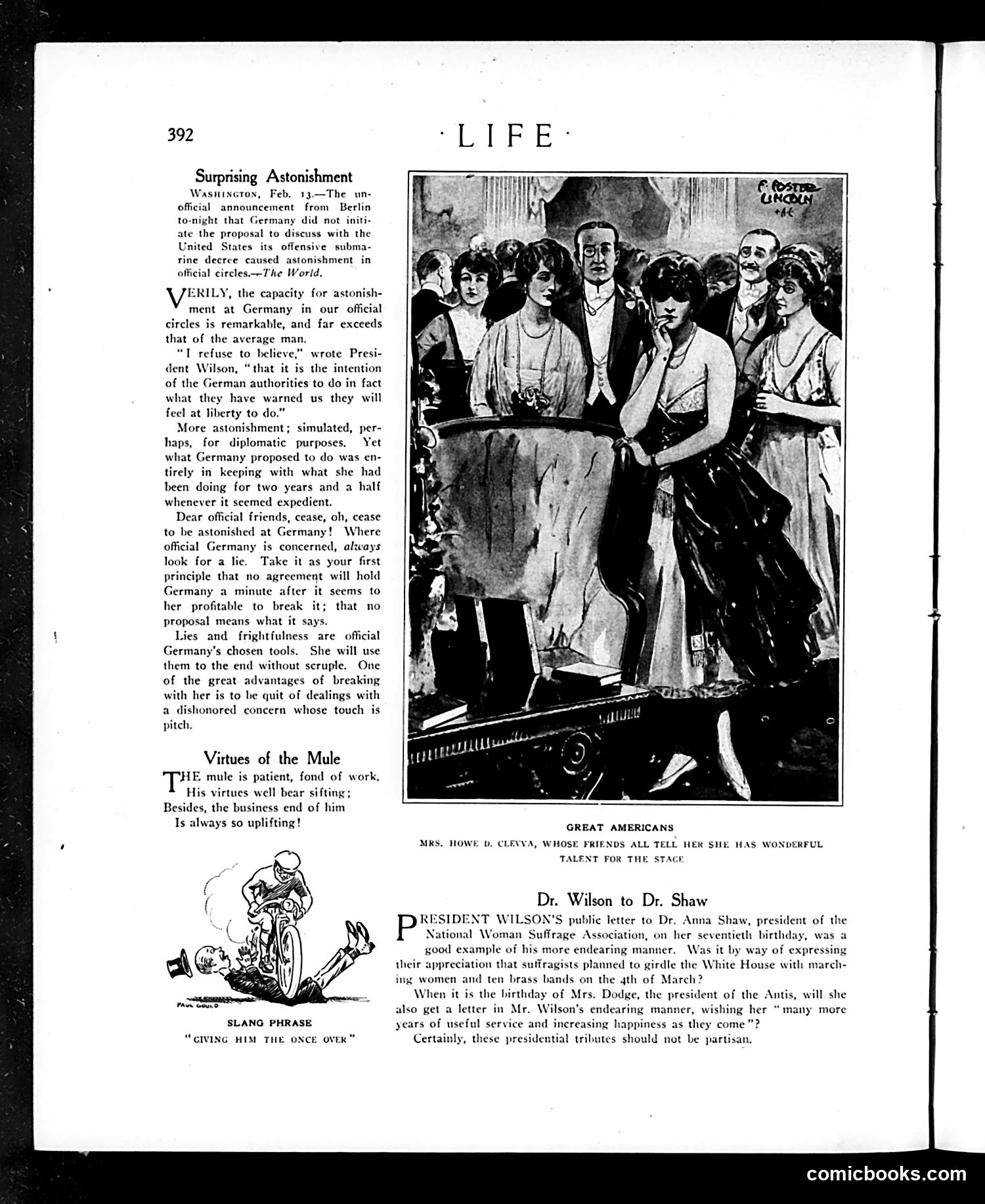
This 1916 *Life* magazine page critiques German diplomacy during World War I and American official naivety about it. **Main article**: Sarcastically mocks U.S. government officials for expressing "astonishment" that Germany denied initiating submarine warfare negotiations. The author argues this is foolish—Germany has consistently acted aggressively for 2.5 years and repeatedly broken agreements. The piece advises treating any German proposal as inherently dishonest, calling the nation "a dishonored concern." **"Virtues of the Mule"**: A brief humorous poem praising mules' patience and work ethic. **"Dr. Wilson to Dr. Shaw"**: References President Wilson's congratulatory letter to Dr. Anna Shaw (National Woman Suffrage Association president) on her 70th birthday. The satirist questions whether Wilson would similarly honor Mrs. Dodge, president of the anti-suffrage movement, suggesting presidential courtesy should be politically neutral rather than favoring suffragists. **Photo caption**: Shows Mrs. Howe D. Clevva, praised for stage talent. The page reflects American pre-WWI skepticism of Germany and contemporary suffrage movement debates.
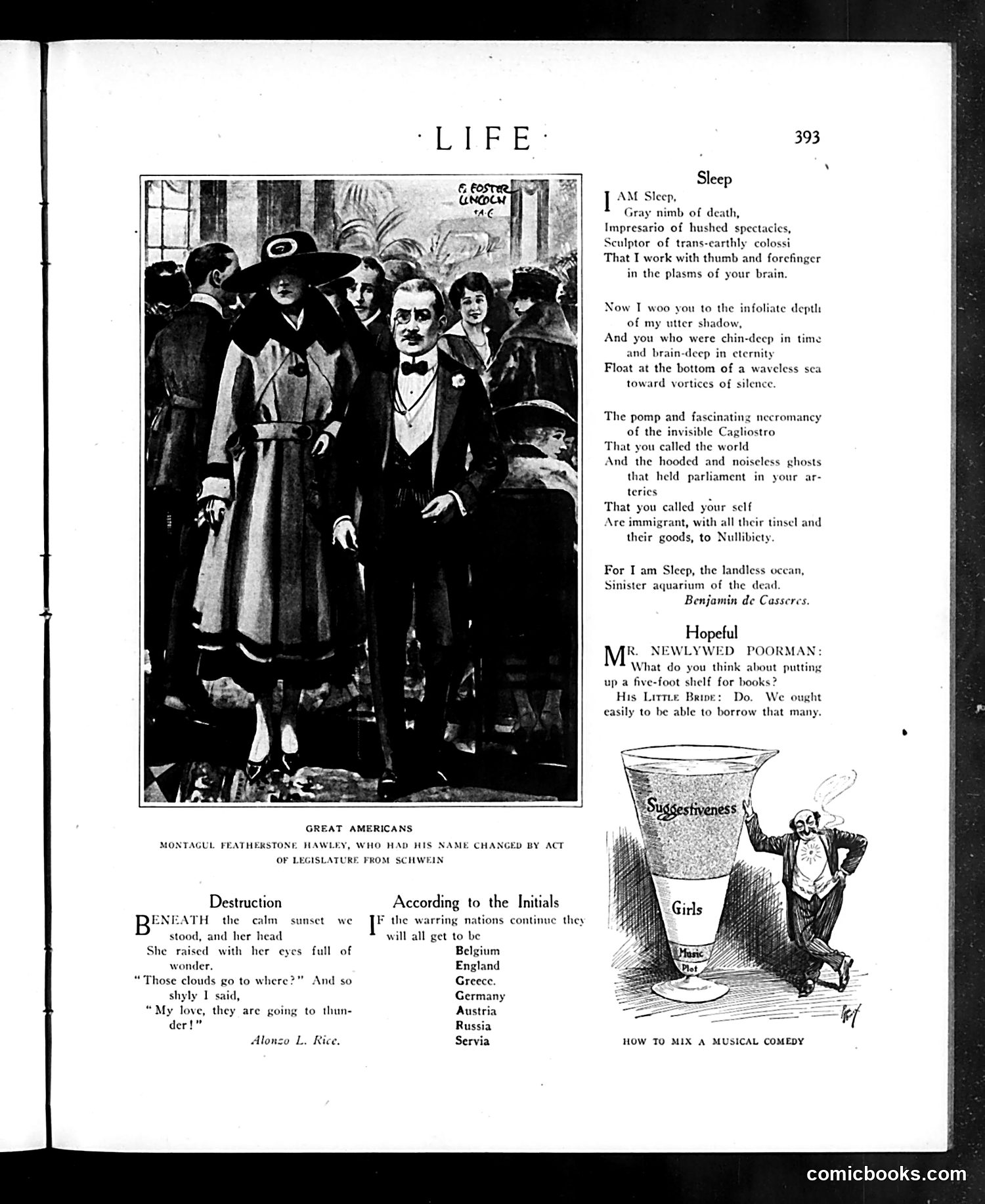
**Top Section - "Great Americans":** The caption identifies "Montagul Featherstone Hawley" as someone whose name was legislatively changed from "Schwein" (German for "pig"). This is WWI-era anti-German satire, mocking Americans of German descent who Americanized their names to avoid suspicion during wartime tensions. **Middle Section - "According to the Initials":** A dark joke predicting that if European war continues, all nations listed (Belgium, England, Greece, Germany, Austria, Russia, Serbia) will become "Belgium"—likely meaning they'll be destroyed/invaded like Belgium was, or reduced to similar devastation. **Bottom Right - "How to Mix a Musical Comedy":** A cartoon showing "Suggestiveness" poured into a glass labeled "Girls," implying that musical comedies were formulaic combinations of attractive women and innuendo—contemporary commentary on Broadway entertainment conventions. The poetry sections appear to be contemporary literary contributions unrelated to the satire.
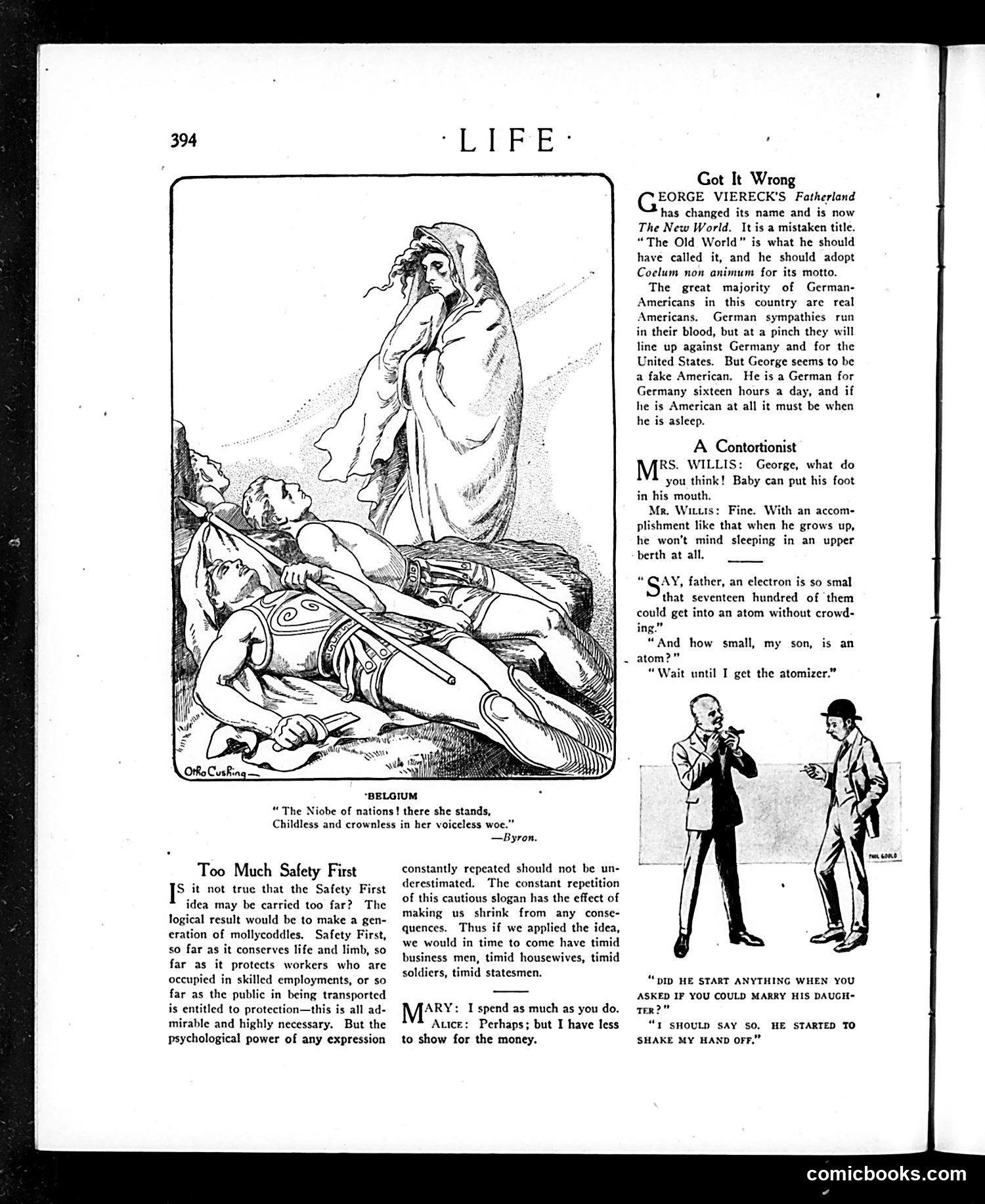
This page contains multiple satirical pieces typical of Life's editorial approach: **Main Cartoon (Belgium):** Depicts a grieving woman (Belgium personified, referencing Byron's poem) mourning over fallen soldiers. This reflects WWI devastation and Belgium's suffering under German occupation. **"Got It Wrong":** Criticizes George Viereck, editor of *Fatherland* magazine (renamed *The New World*). The piece attacks Viereck as a German propagandist masquerading as American, suggesting his loyalties lie with Germany rather than the United States—a serious accusation during the pre-WWI period when German-American sympathies were contentious. **"Too Much Safety First":** Argues the popular "Safety First" slogan, while well-intentioned, risks creating timid, risk-averse citizens—a critique of overcautious social policy. **Minor Pieces:** Include jokes about contortionism, atoms/electrons, and marriage proposal reactions—typical light humor filler. The page reflects American anxieties about German influence and national identity during the early 20th century.
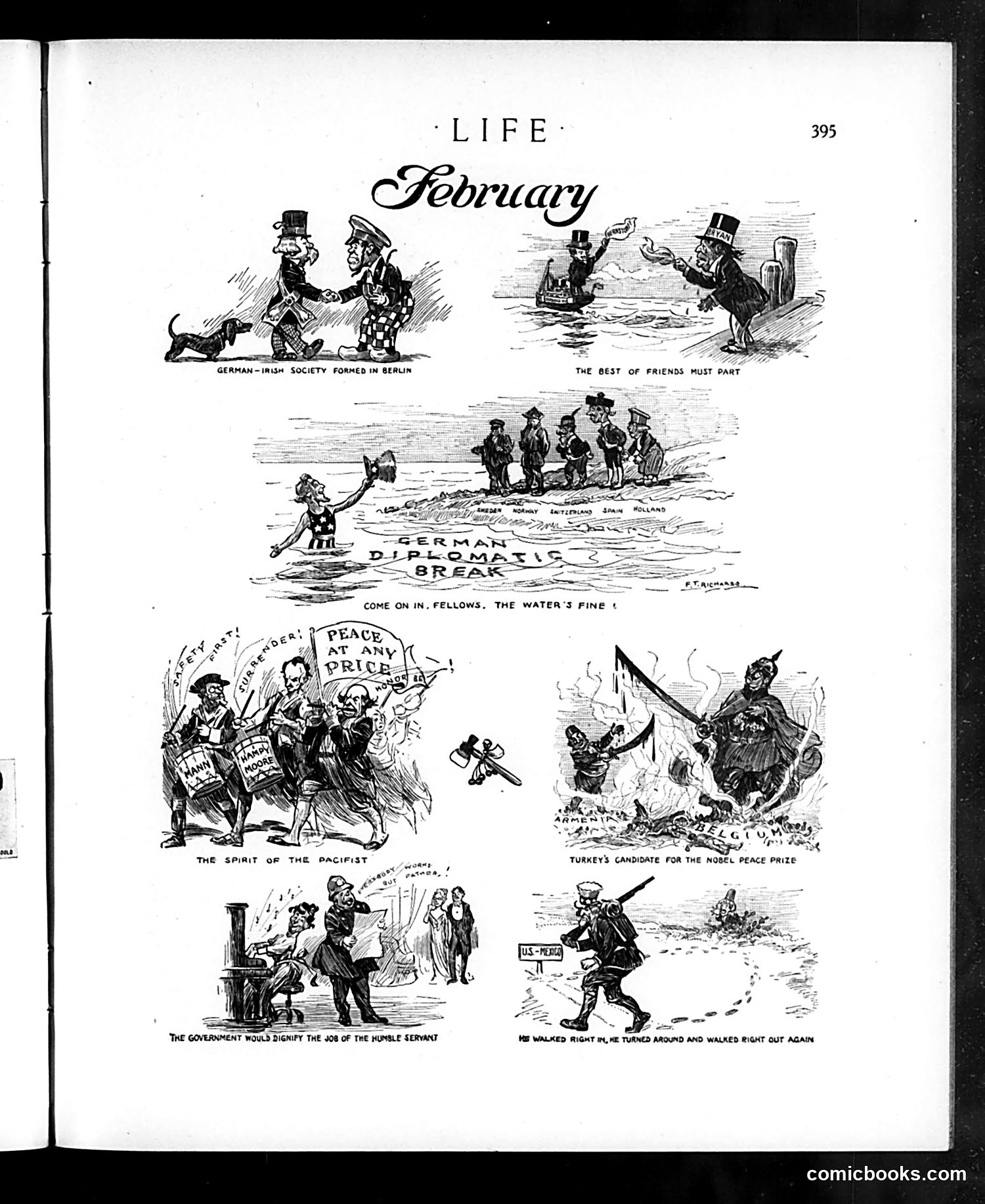
This page satirizes early 20th-century international politics through six cartoons: **Top sections** mock German-Irish relations and diplomatic tensions, depicting characters in formal dress engaged in awkward interactions. **"German Diplomatic Break"** shows diplomats wading into water, sarcastically suggesting peace negotiations are welcoming ("water's fine"). **"Spirit of the Pacifist"** depicts a ghostly, chaotic figure amid conflict—mocking pacifist movements as ineffectual amid real tensions. **"Turkey's Candidate for Nobel Peace Prize"** presents a militaristic Ottoman figure, sarcastically suggesting Turkey's warlike stance contradicts peace ideals. **Bottom cartoons** address labor and political absurdities: one shows government negotiations over servant wages; another depicts a figure walking in circles, suggesting futile political maneuvering. The overall theme: Life ridicules diplomatic pretense, pacifism, and government hypocrisy during a period of international instability.
This page satirizes the gap between bold public declarations and actual government action regarding German U-boat attacks on American shipping. The text reproduces a February 26th newspaper advertisement signed by prominent figures (Taft, Root, Parker, and others) demanding President Wilson take "effectual measures" to protect American vessels from German blockade. Life's editorial voice is mockingly impatient: it praises these sentiments while sarcastically noting Germany's "hand on our windpipe does not feel good" and criticizing the delay. The piece reports Wilson has asked Congress for authority to arm merchant ships with defensive weapons ("gunners"). The satire lies in the tension between the urgent rhetoric about German aggression and the slow bureaucratic response—Life essentially says: yes, yes, these are fine words, but *act already*. The editor expresses relief that Congress will likely grant Wilson's request, given they'd be "still more afraid to refuse." This reflects pre-U.S. entry debates over neutrality and preparedness (America entered WWI in April 1917).
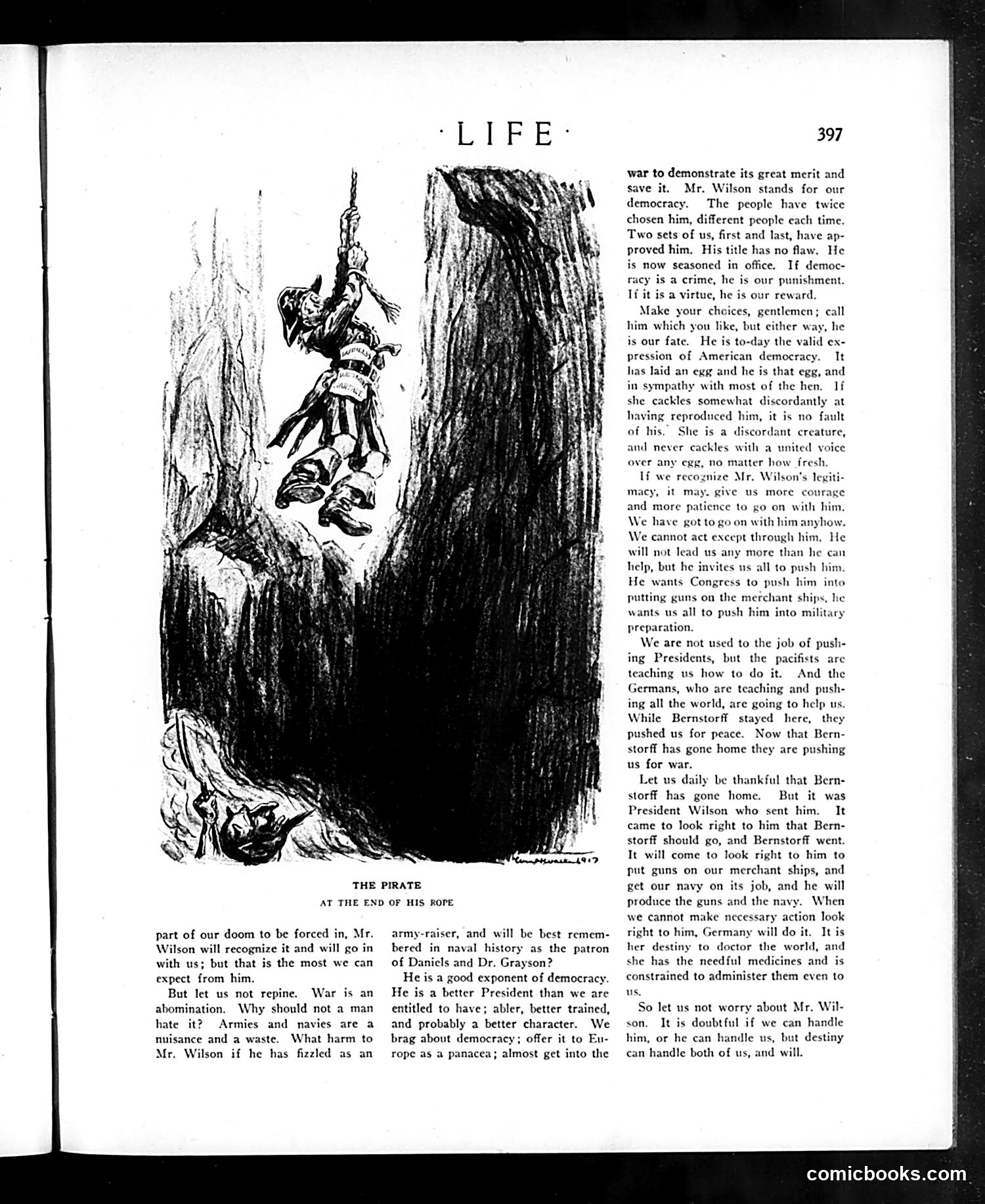
This 1917 *Life* cartoon satirizes President Woodrow Wilson's reluctant movement toward World War I entry. The image depicts Wilson as a hanged pirate—suggesting he's cornered and facing execution. The accompanying text is deeply ironic, ostensibly defending Wilson while actually condemning his leadership. The author argues Wilson represents American democracy itself, yet criticizes his passive approach to the war: he won't lead but only responds to pressure from Congress, pacifists, and especially Germany. The "pirate" metaphor appears sarcastic—Wilson isn't a bold leader but a trapped figure. Key references include Secretary of the Navy Josephus Daniels and German Ambassador Bernstorff (recently expelled), whose departure signaled Germany's shift from pushing for peace to pushing for American military involvement. The satire's point: Wilson lacks genuine conviction and merely reacts to events rather than directing them, making him an inadequate steward of democracy during this critical moment.
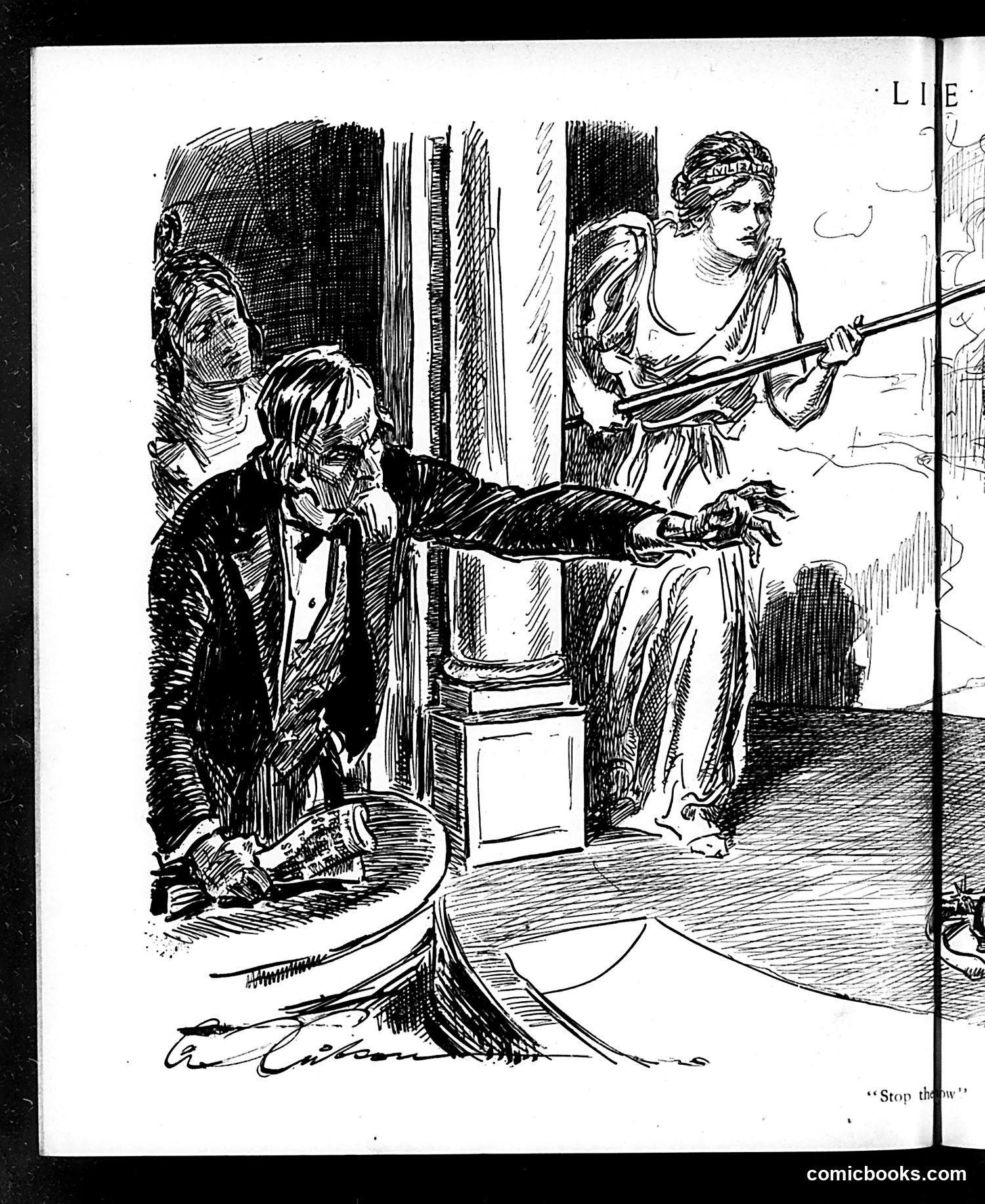
This satirical cartoon depicts a dramatic scene with classical allegorical figures. A woman representing Liberty or Justice (identifiable by her headband and classical dress) points a rifle at a man in formal attire who gestures pleadingly. A statue or pedestal stands between them, while additional figures appear in the background. The caption reads "Stop th@pw" (likely "Stop the pow[er]" or similar, though OCR is unclear). The cartoon appears to critique abuse of authority or power, with the classical female figure—representing law, justice, or democracy—confronting a man of apparent privilege or political influence. The allegorical language suggests commentary on governmental overreach or corruption during the early 20th century period of *Life* magazine's publication. Without clearer text or date visibility, specific political references remain uncertain.
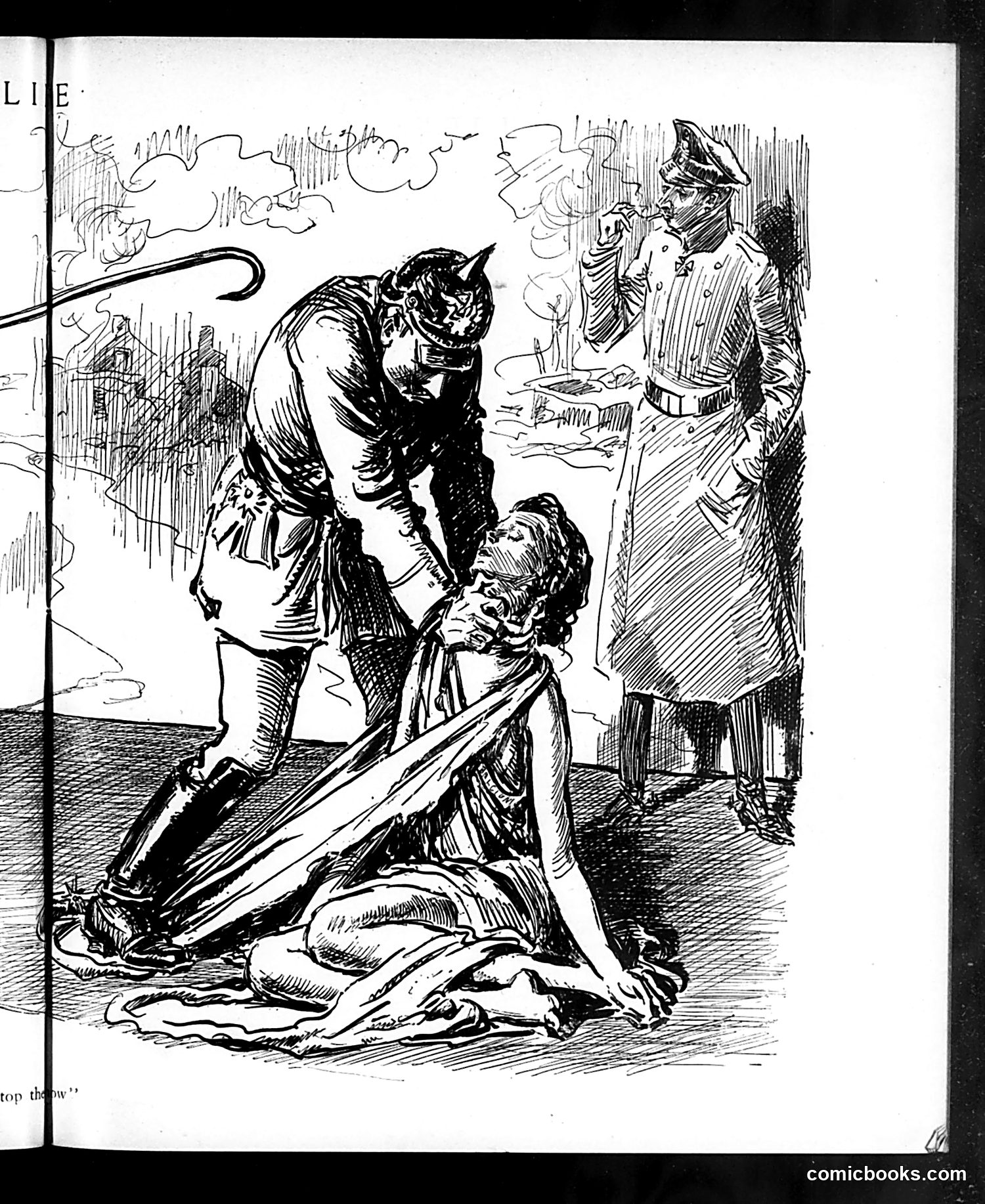
This is a political cartoon from *Life* magazine depicting a scene of police or military authority figures confronting civilians. The central figure appears to be a uniformed officer with exaggerated facial features (characteristic of period satirical cartooning) interacting with a kneeling or prostrate person below. Another uniformed figure stands to the right observing the scene. Without clearer OCR text or a visible date/caption, I cannot definitively identify the specific political event being satirized. However, the composition suggests commentary on **abuse of authority, police power, or military conduct**. The exaggerated caricature style and the power dynamic depicted—with uniformed officials towering over a vulnerable civilian—implies social criticism of institutional overreach or brutality. The exact historical context remains unclear without additional identifying information.
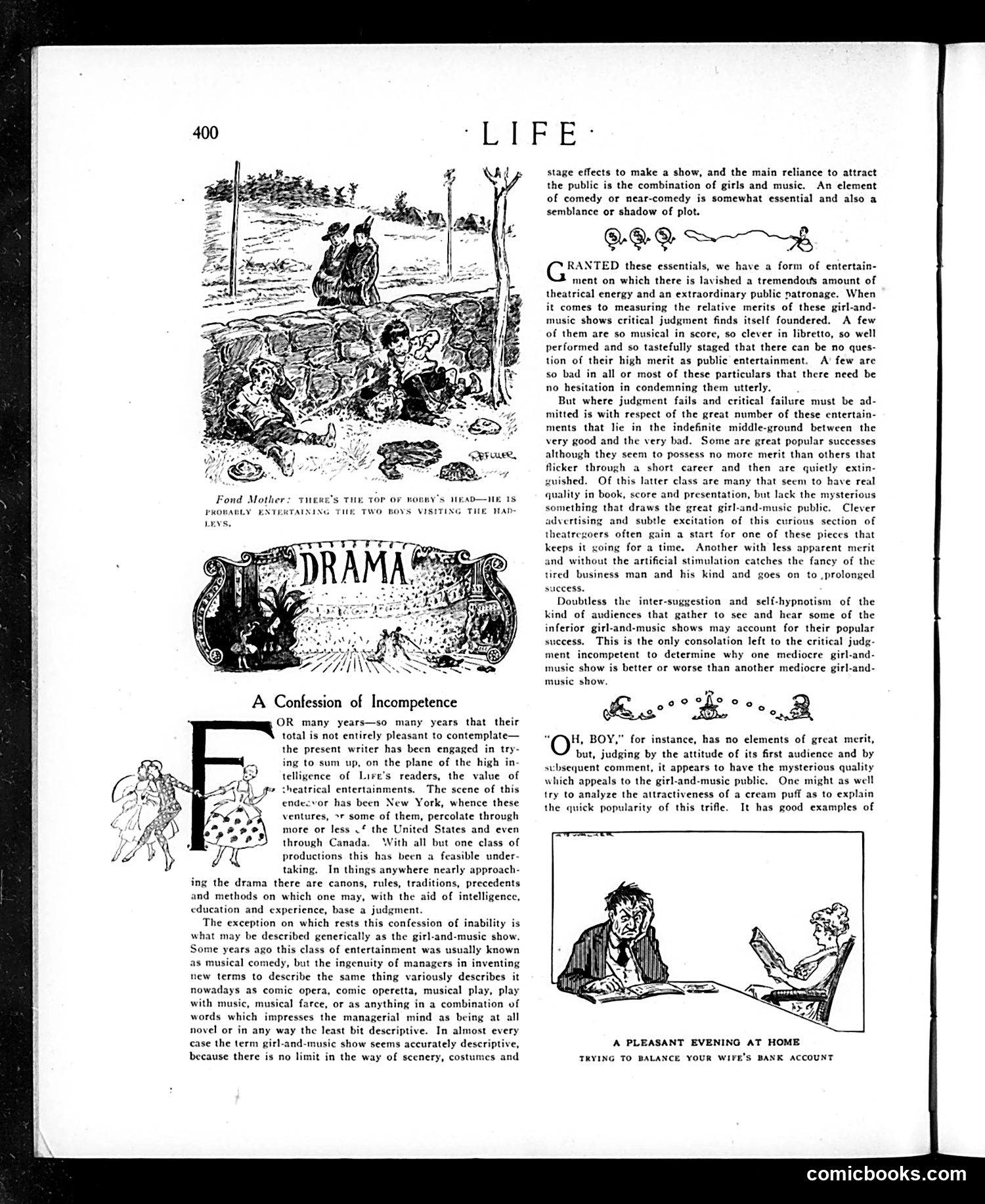
This page discusses the critical dilemma posed by "girl-and-music shows"—what we'd now call musicals or operettas. The author confesses inability to judge these productions fairly, unlike traditional drama which follows established critical standards. The top illustration shows a "Fond Mother" entertained by Nobby (likely a character or performer), visiting "the Hadleys"—a domestic scene. The lower cartoon, "A Pleasant Evening at Home," depicts a husband attempting to balance a wife's bank account, humorously suggesting the mathematical confusion mirrors the critic's confusion about musicals. **The satire's point**: Girl-and-music shows succeed through unclear, mysterious appeal rather than merit. Some mediocre productions become hits through advertising or audience "self-hypnotism," while better-made shows fail—making rational critical evaluation impossible. The husband's baffled accounting mirrors the critic's bafflement before popular entertainment's illogical economics.
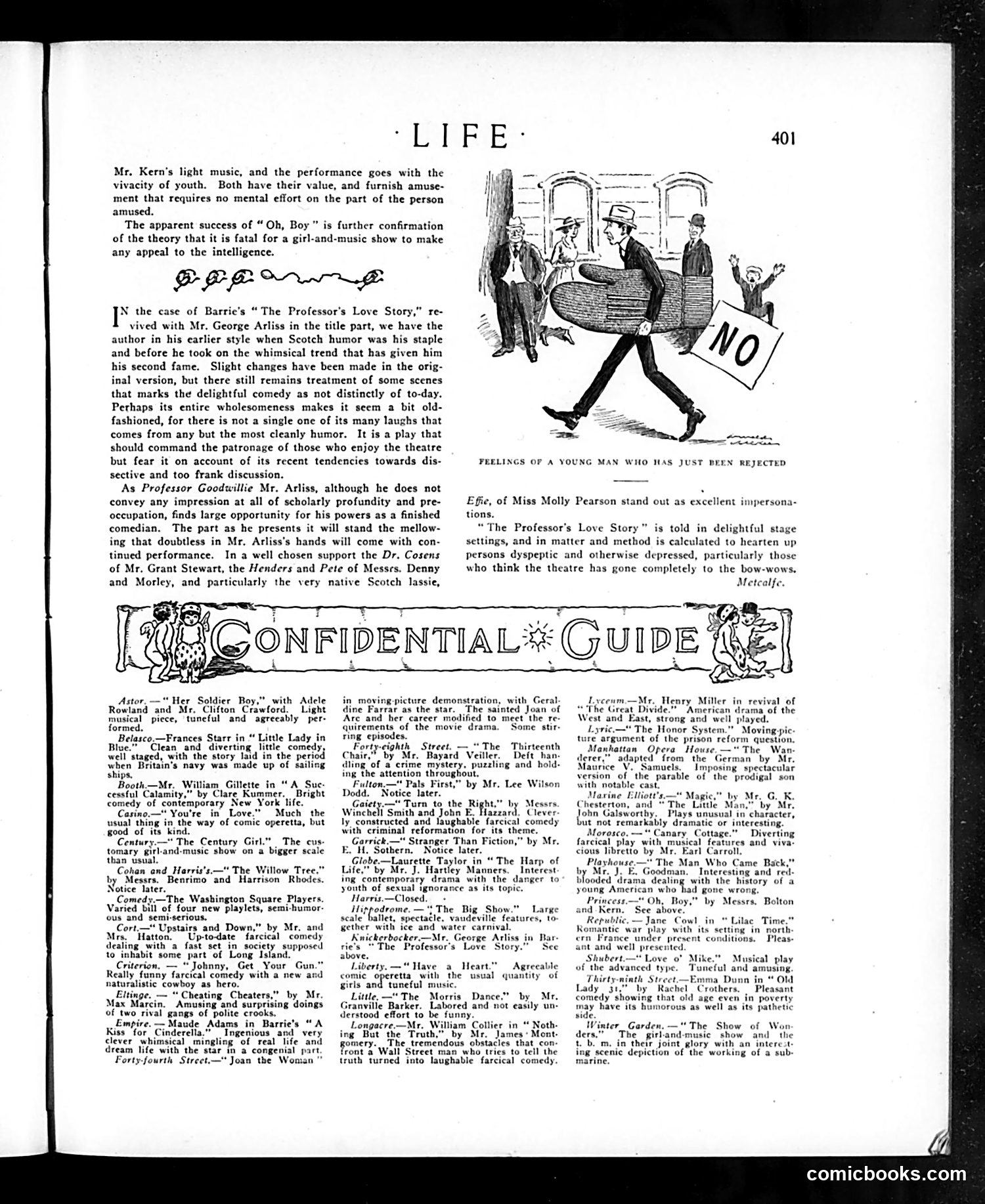
The cartoon depicts a young man carrying a large sign reading "NO"—a visual metaphor for romantic rejection. He appears distressed as he walks past several well-dressed men in what looks like a street or public space. The joke is straightforward satire of social humiliation: the exaggerated size of the rejection sign makes his personal romantic failure comically public. The other figures—appearing indifferent or amused—emphasize his isolation and embarrassment. This reflects early 20th-century Life magazine's typical humor, which often mocked young men's romantic misadventures and social awkwardness. The cartoon appears alongside theater reviews, suggesting it was entertainment for the magazine's educated, urban readership. The satire targets the universal experience of rejection rather than any specific political or social issue.
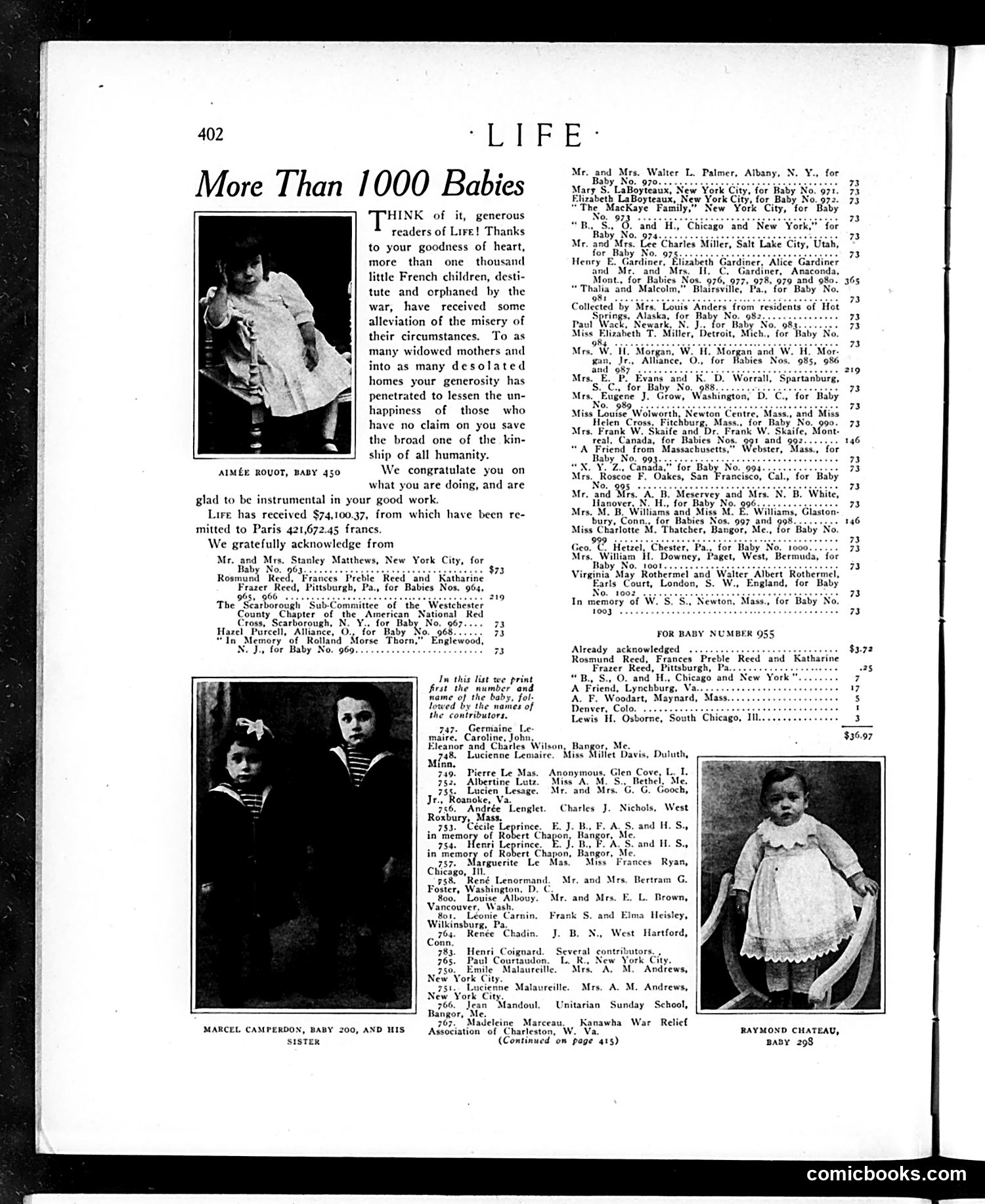
This page documents **Life magazine's fundraising campaign for French war orphans** following World War I. The headline "More Than 1000 Babies" refers to over 1,000 French children orphaned by the war whom Life readers sponsored. ## The Purpose The editorial text appeals to readers' generosity, asking them to help alleviate suffering among French widows and destitute children. Life had collected $74,100.37, sending 421,672.45 francs to Paris. ## The Photos The three photographs show individual French orphans (identified by number) sponsored through the campaign—Aimee Root (Baby 450), Marcel Camperson and his sister (Baby 200), and Raymond Chateau (Baby 298). ## The List The bulk of the page consists of **donor acknowledgments**—names of Life readers who contributed funds, organized by the baby number they sponsored. **Context for modern readers:** This reflects post-WWI American charitable efforts and the magazine's role mobilizing public sympathy and donations for European war relief.
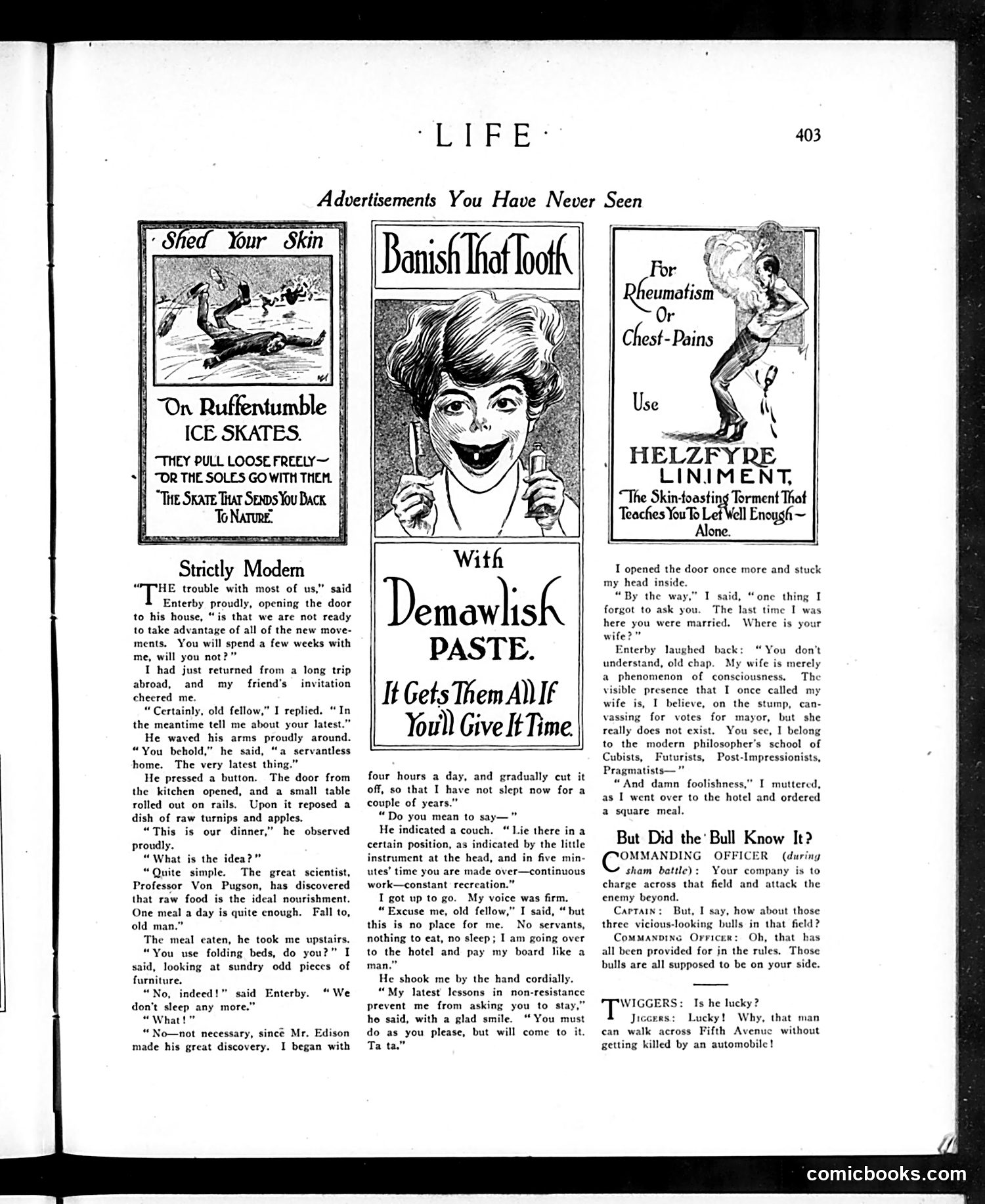
This page contains satirical fiction and advertisements mocking early 20th-century fads and pseudo-scientific trends. **Main Story ("Strictly Modern"):** A character named Enterby embodies absurd modernist excess—he's eliminated servants, sleeps zero hours (following Edison's purported discoveries), eats only raw food daily, and dismisses his wife as merely a "phenomenon of consciousness" while she campaigns for mayor. The narrator finds this lifestyle ridiculous and escapes to a hotel for a proper meal. The satire targets both the gullible adoption of new technologies/philosophies and the era's nascent feminism (the wife's political involvement). **Fake Advertisements:** The upper section parodies patent medicines and dubious products—ice skates that shed skin, tooth-whitening paste, rheumatism liniment—representing the era's rampant medical quackery. **"But Did the Bull Know It?":** A brief joke about military incompetence, where an officer assures soldiers that charging at bulls is safe because "rules" supposedly control them. The overall message satirizes blind faith in progress, scientific claims, and modern movements.
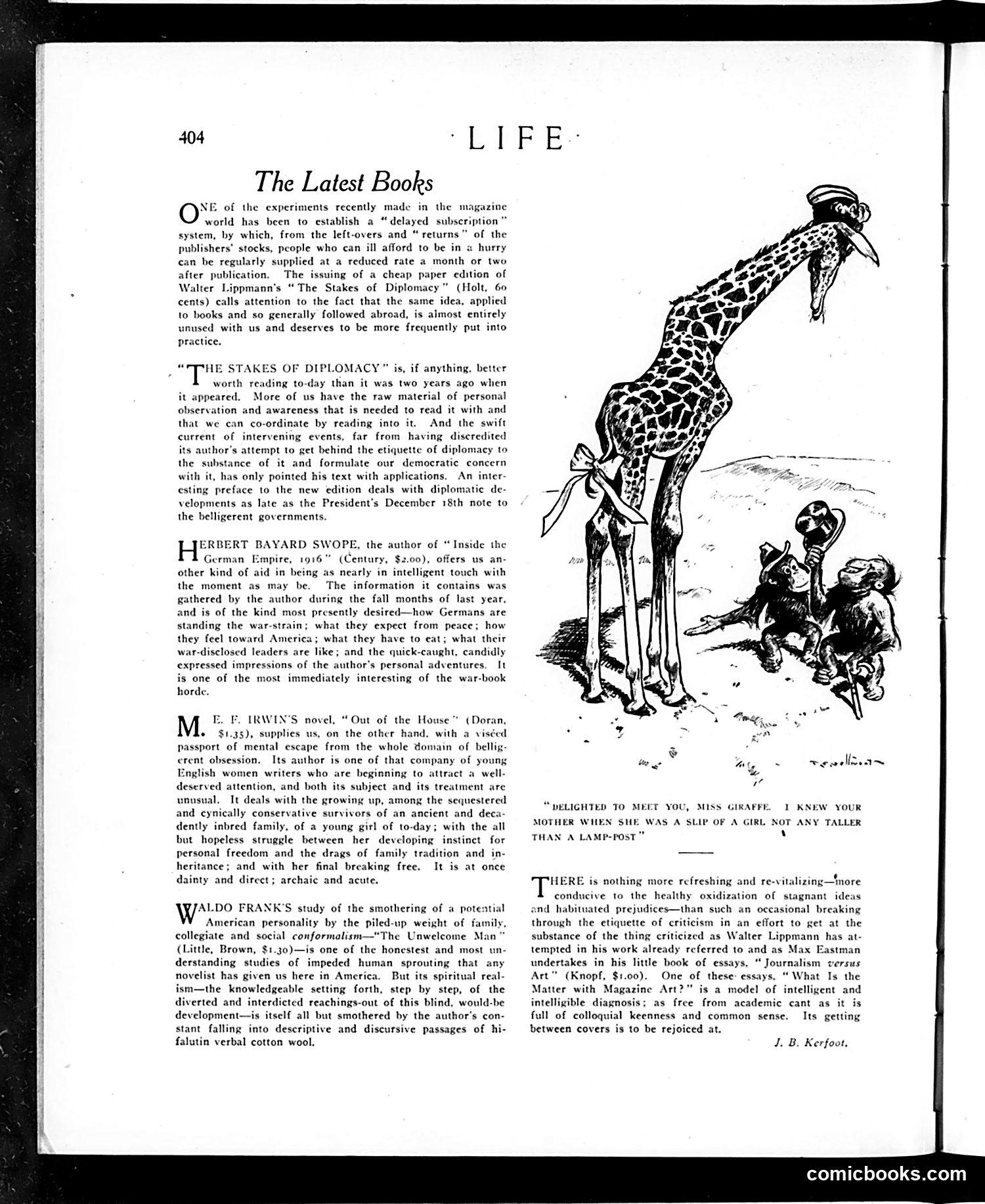
This page reviews recent books, with one cartoon illustrating a social joke about meeting someone's mother. **The Cartoon:** A tall giraffe meets two smaller animals (appears to be monkeys or similar creatures). One says he knew the giraffe's mother when "she was a slip of a girl not any taller than a lamp-post." The humor relies on visual absurdity—giraffes are famously tall, so the claim that the mother was once "lamp-post height" is ridiculous, yet presented deadpan as a polite social compliment. **The Point:** This is gentle satirical humor mocking banal small-talk and insincere compliments people exchange when meeting someone's relatives. The speaker is ostensibly flattering by claiming the giraffe has grown impressively, but the exaggeration is so obvious it becomes funny. **Context:** Published during WWI (references to "belligerent governments" and war books), this appears in Life's book review section—lighthearted filler between serious literary criticism.
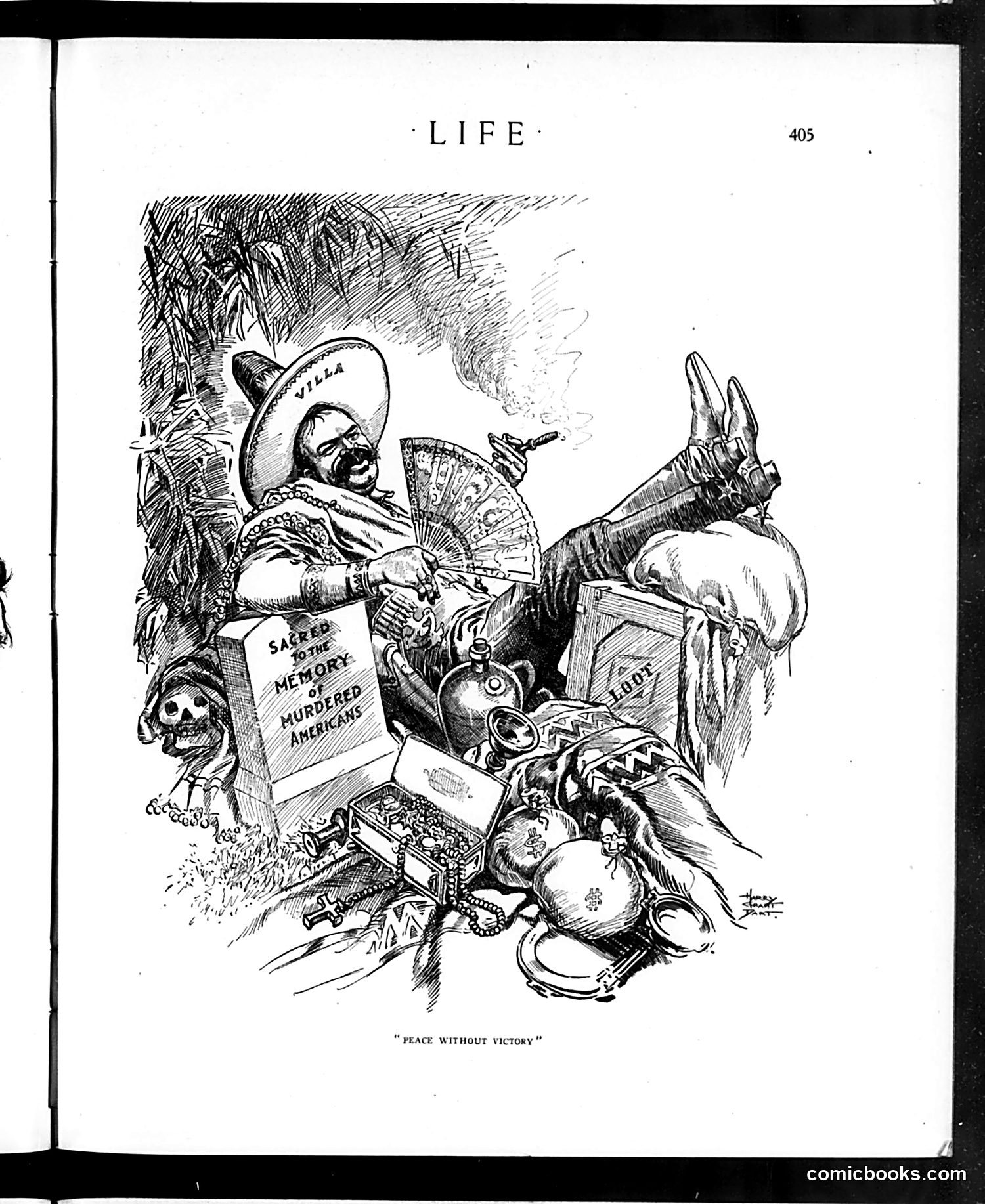
This political cartoon satirizes what appears to be a Mexican military figure (indicated by the sombrero labeled "VILLA") lounging luxuriously while American interests suffer. The figure reclines among treasures and military spoils, holding a decorative fan, while a skull and a book titled "SACRED TO THE MEMORY OF MURDERED AMERICANS" lie nearby—referencing deaths of American civilians or soldiers. The cartoon's title, "Peace Without Victory," suggests criticism of a diplomatic settlement perceived as rewarding aggression without decisive military triumph. This likely references early-20th-century tensions with Mexico, particularly involving Pancho Villa's raids into American territory (1916). The satire criticizes what the cartoonist views as a weak negotiated peace that fails to punish Mexican violence against Americans.
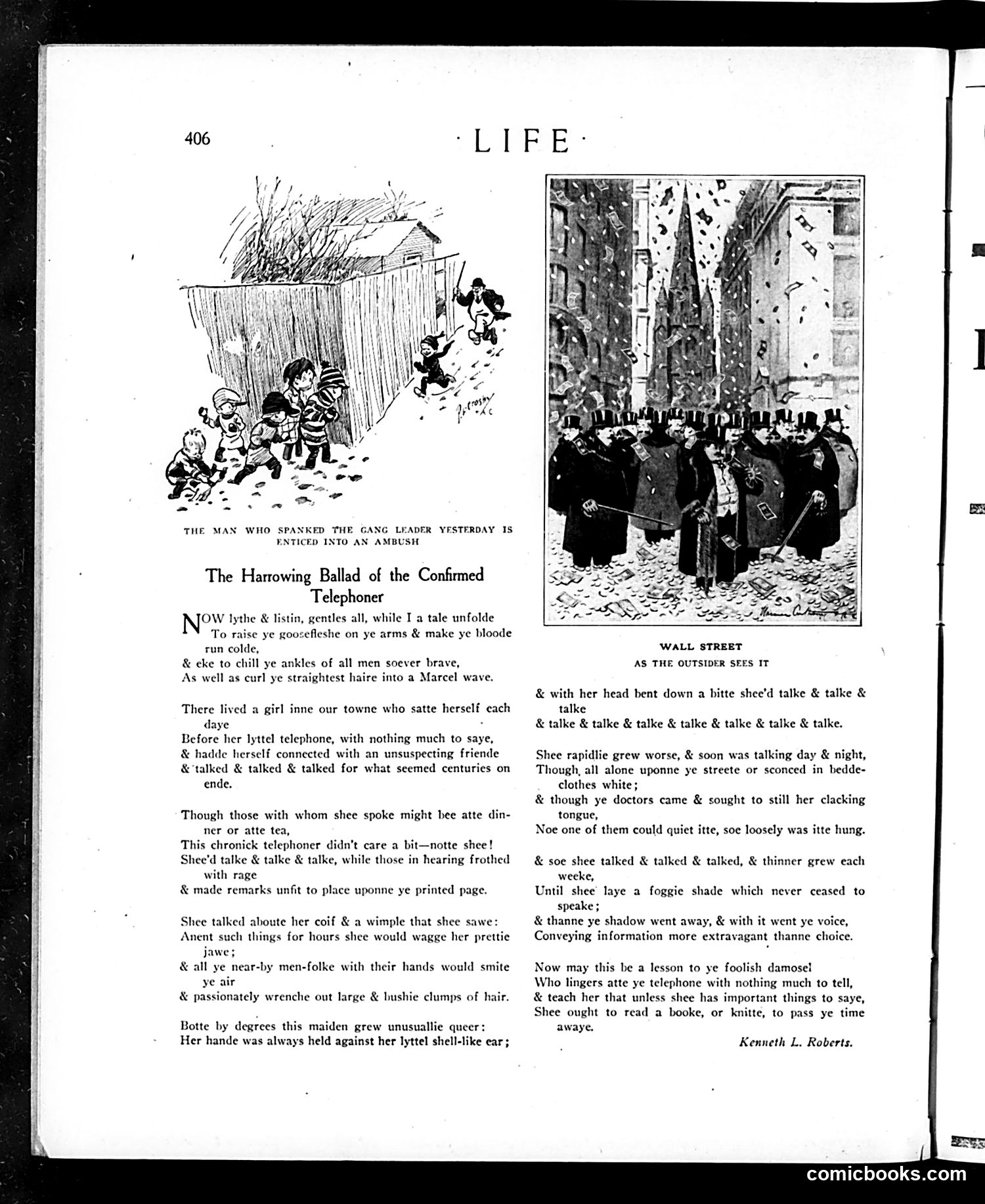
This page satirizes the emerging social problem of excessive telephone use. The main ballad, written in mock-archaic verse by Kenneth L. Roberts, tells of a young woman who becomes obsessed with talking on the telephone for hours, discussing trivial matters like hairstyles and fashion ("coif & a wimple"). The satire targets: - **The telephone itself**: newly common technology enabling wasteful social behavior - **Women's chattiness**: a gendered stereotype about female conversation - **Social disruption**: her endless calls plague those trying to dine or work - **Addiction**: she deteriorates physically and mentally, ultimately wasting away The moral lesson warns young women to use phones only for important matters, otherwise spend time on productive activities like reading or knitting. The right panel titled "Wall Street as the Outsider Sees It" appears unrelated—likely a separate cartoon about financial markets (unclear without better image resolution).
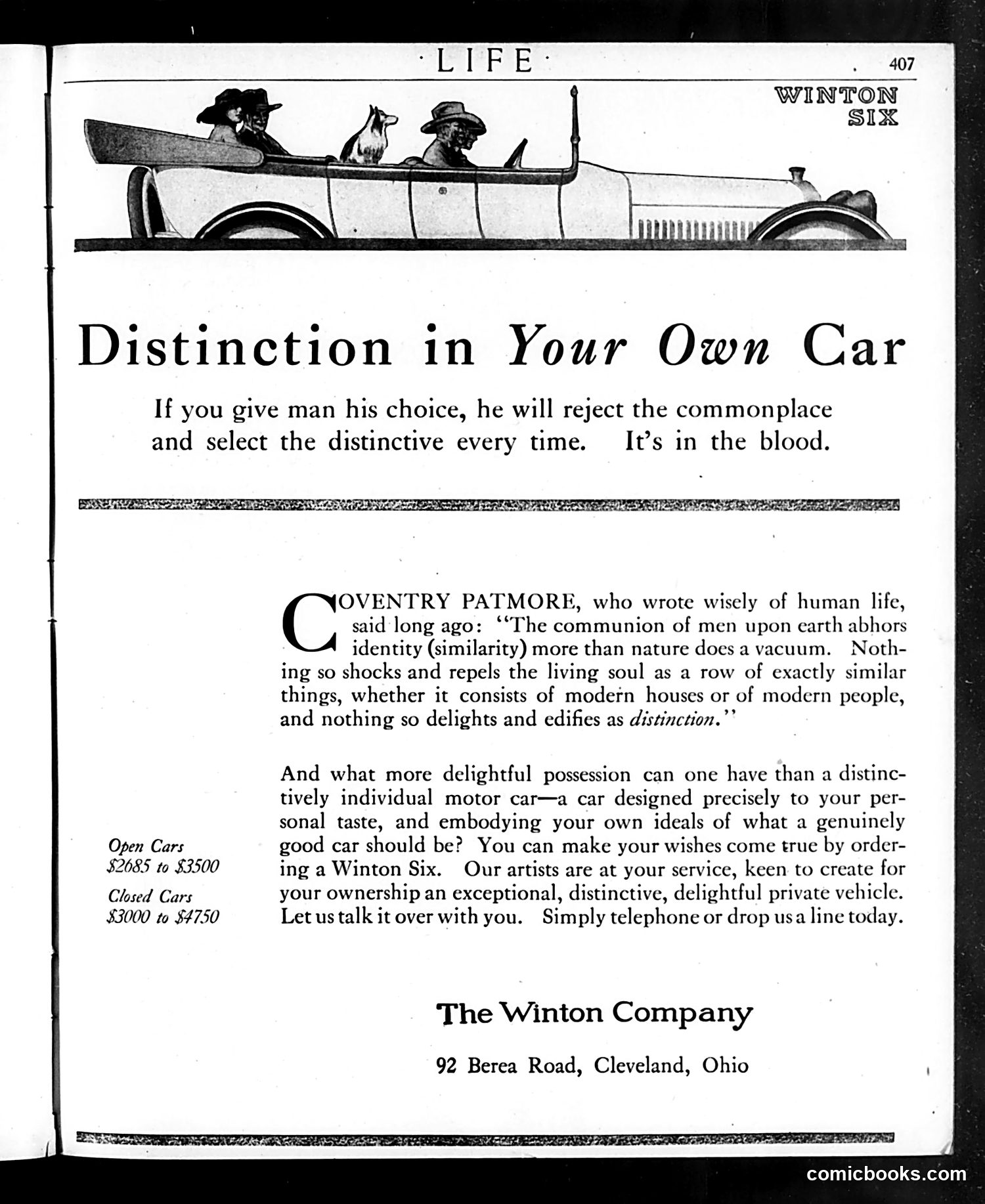
This is primarily a **luxury automobile advertisement**, not political satire. The Winton Company markets their "Winton Six" car by appealing to individualism and distinction. The ad quotes Coventry Patmore (a 19th-century poet) to argue that humans naturally reject uniformity and crave individual expression. The message: buying a custom Winton car satisfies this deep human need for distinction rather than conforming to mass production. The illustration at top shows a cartoon car with exaggerated, whimsical passengers—likely meant to convey personality and uniqueness rather than mock anyone specifically. **Historical context**: This reflects the 1920s transition in automobile marketing. Early cars were marketed as practical machines; by this era, manufacturers began emphasizing personal customization and status. The ad's philosophy—that individuality is inherent ("in the blood")—is typical luxury-brand positioning of the period. The pricing ($2,685–$4,750) indicates this was a high-end vehicle aimed at affluent consumers.
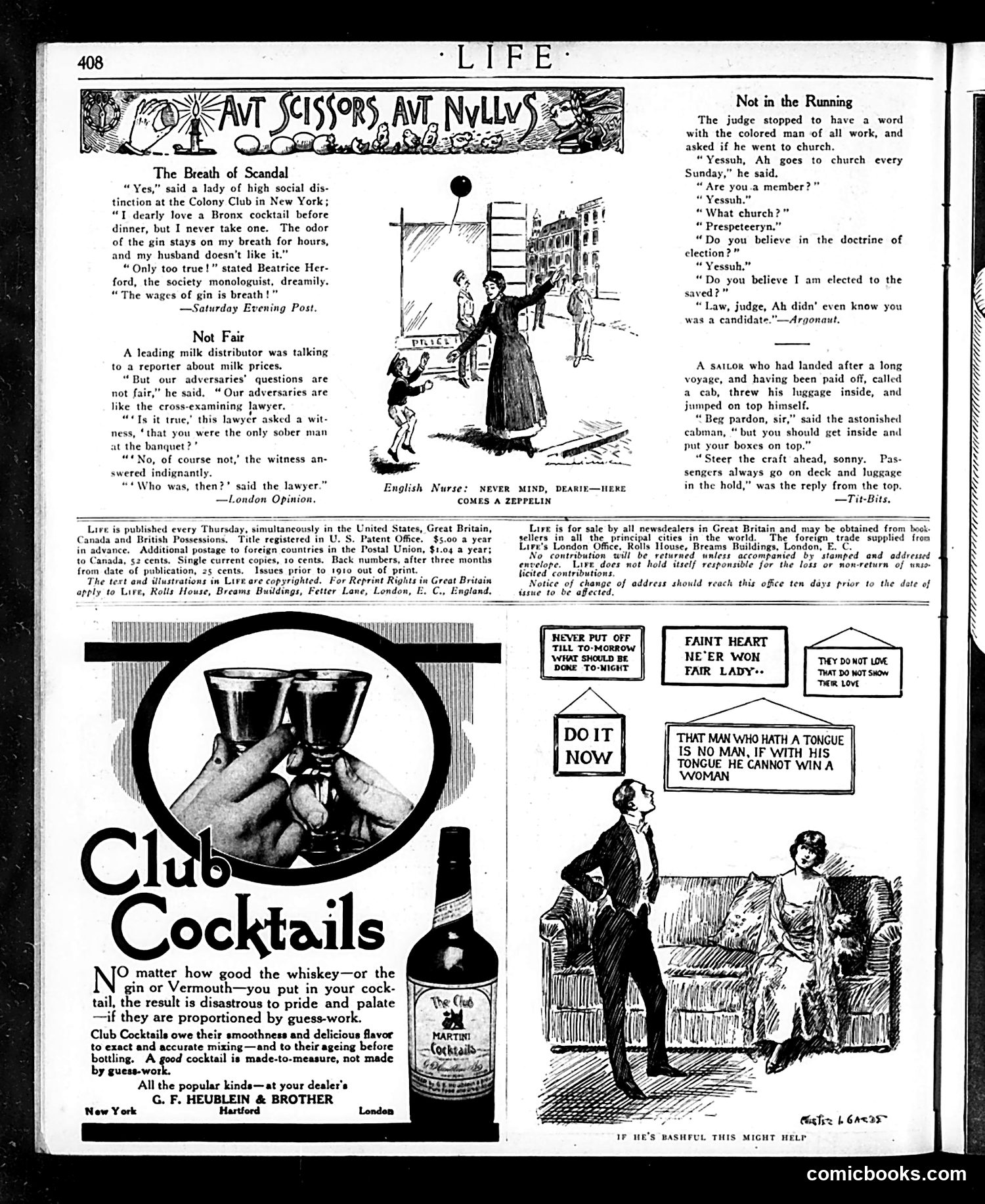
This page blends short humorous anecdotes with advertising. The opening jokes mock social pretension: a wealthy woman admits loving gin cocktails but avoids them due to breath odor, and a milk distributor complains about "unfair" cross-examination—comparing it to a lawyer's trick question about who was sober at a banquet. The "English Nurse" cartoon references WWI-era Zeppelin (German airship) attacks on Britain, suggesting even aerial bombardment is preferable to the nurse's current situation. Other brief jokes satirize class distinctions: a sailor's confusion about cabin hierarchy, and a judge's interaction with a Black churchgoer who doesn't understand the theological term "election." The large "Club Cocktails" advertisement dominates the lower half, promoting proper cocktail preparation as precision work rather than guesswork—a sales pitch dressed in pseudo-scientific language typical of early 20th-century advertising. The page reflects period attitudes while mixing commercial and editorial content characteristic of Life's format.
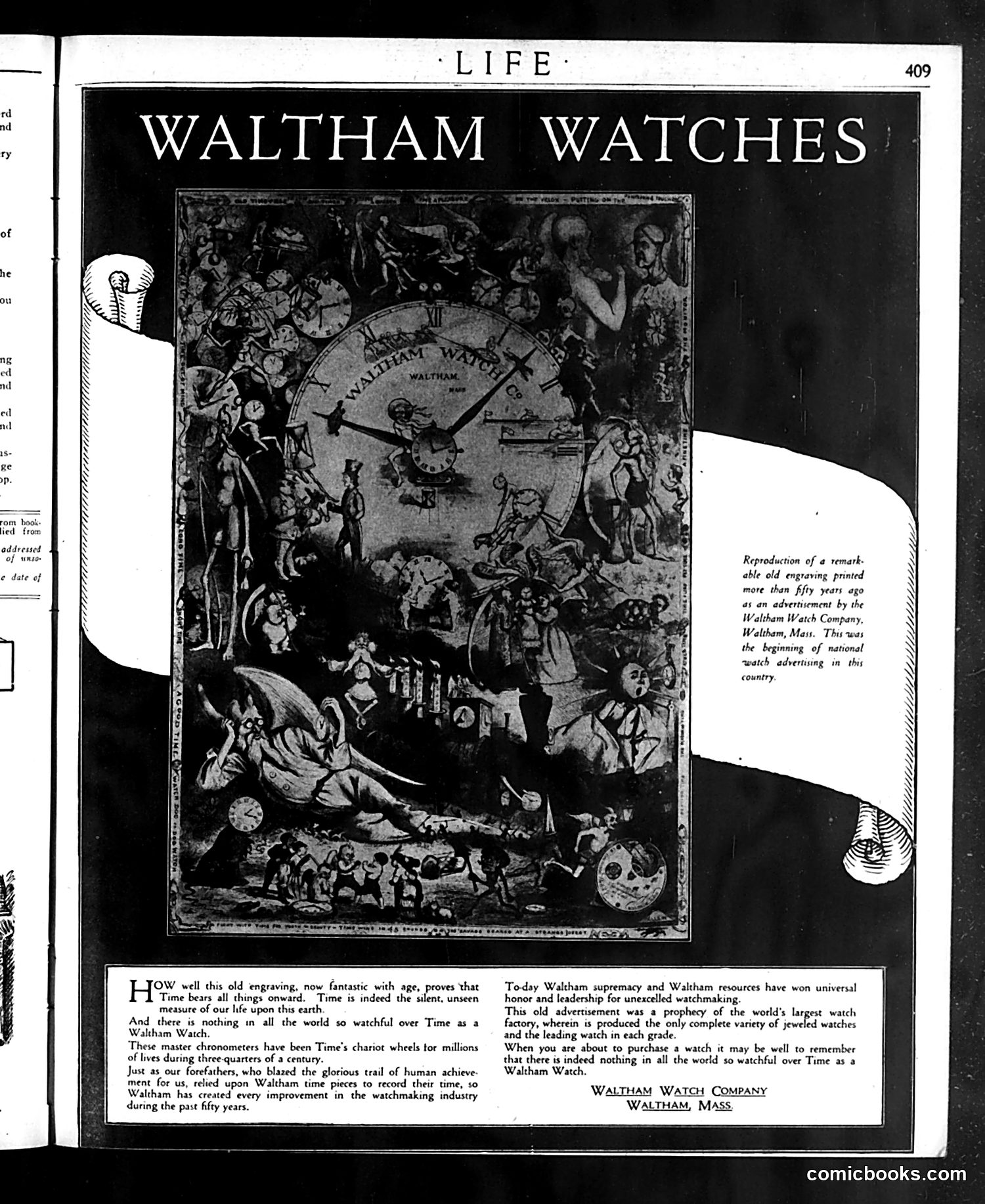
This is **not satire or political commentary**—it's a straightforward **advertisement** for Waltham watches, published in Life magazine (page 409). The elaborate engraving shows **Time personified as a central figure** surrounded by allegorical imagery depicting human achievement and progress across centuries. The ad uses this historical aesthetic to establish Waltham's authority: the company claims to have been "Time's chariot wheels" for 75 years, serving as reliably as their forefathers did. The text explicitly states this is a **reproduction of an advertisement from 50+ years prior**, framed as the "beginning of national watch advertising in this country." The message is straightforward brand positioning: Waltham watches are trustworthy timekeepers connected to America's progress and human advancement. For modern readers: this represents early **institutional advertising**—companies selling reliability and heritage rather than features or price.
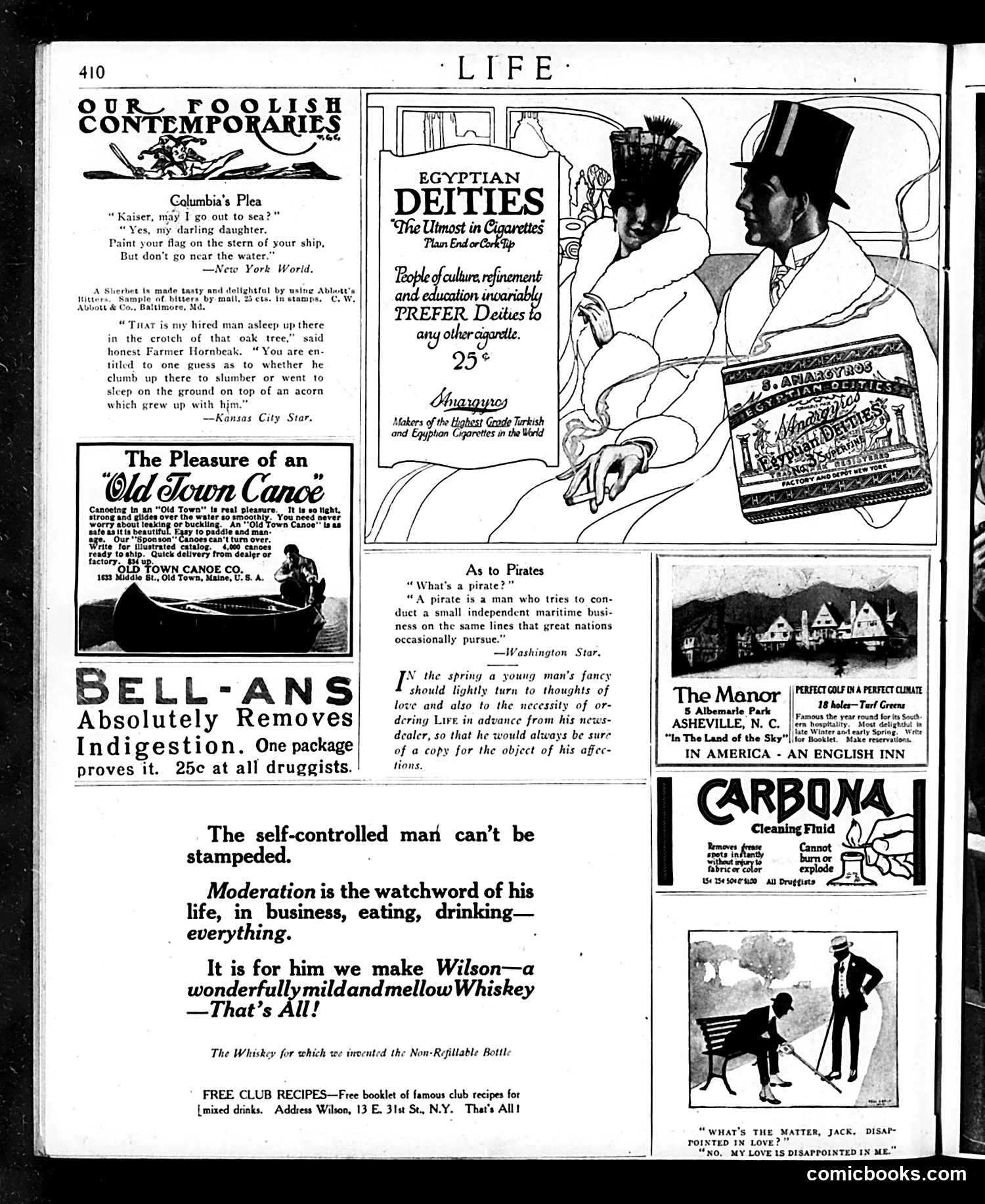
This page from *Life* magazine contains primarily **advertisements and humor pieces** rather than political satire. The main content includes: **"Our Foolish Contemporaries"** section: Brief humorous anecdotes, including one where a farmer's hired man falls asleep in a tree (the joke being the absurd explanation for how he got there). **Central cartoon**: Two gentlemen in formal dress examining Egyptian Deities cigarettes. The satire appears to mock the marketing practice of using exotic or culturally prestigious imagery (Egyptian imagery) to sell cigarettes—implying educated, refined people would "prefer" these cigarettes based on cultural associations rather than actual product quality. **"As to Pirates"** quote: A cynical joke equating pirate maritime business practices with those of legitimate great nations—commentary on imperialism and economic exploitation. The remainder is mostly **product advertising** (canoes, indigestion medicine, whiskey, cleaning fluid, golf resort)—typical of *Life*'s mixed editorial-commercial format. The page reflects early-20th-century consumer culture and advertising trends rather than specific political events.
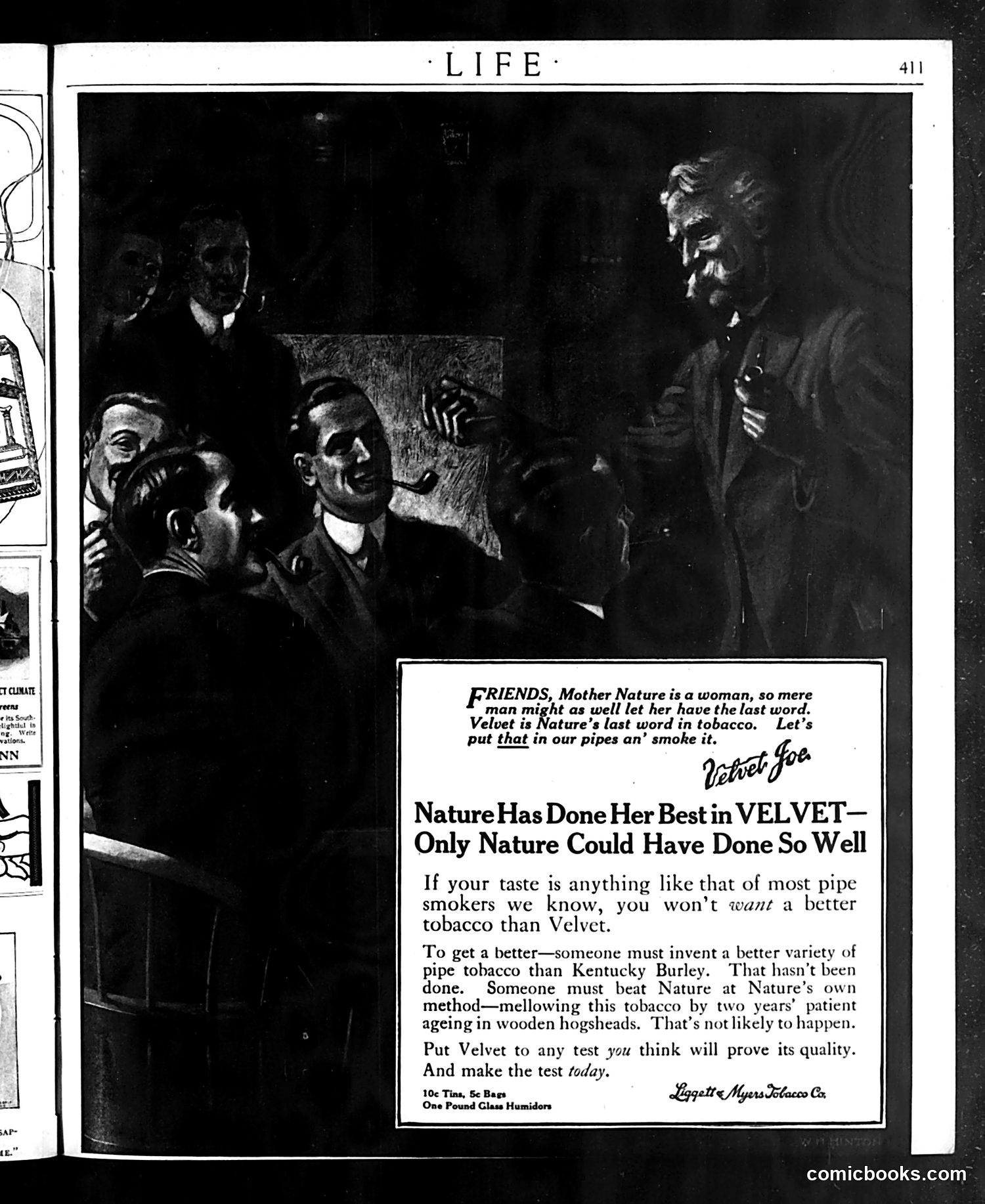
This page is primarily a **tobacco advertisement** for Velvet brand pipe tobacco, not a political cartoon. The dark illustration shows several men in an interior setting examining tobacco, but it functions as product imagery rather than satire. The ad's rhetorical strategy uses a pseudo-humorous appeal: it frames tobacco quality through a personified "Mother Nature," suggesting that Velvet represents nature's perfection and that competing brands cannot improve upon it. The phrase "Let's put that in our pipes an' smoke it" is a colloquial expression meaning "let's accept this idea." **For modern readers:** This reflects early 20th-century advertising norms that normalized smoking and made health-unrelated quality claims. The "two years' patient ageing in wooden hogsheads" appeal to natural processes was a common marketing tactic. This advertisement would be illegal today due to tobacco marketing restrictions. The page appears to be from Life magazine's advertising section rather than its editorial/satirical content.
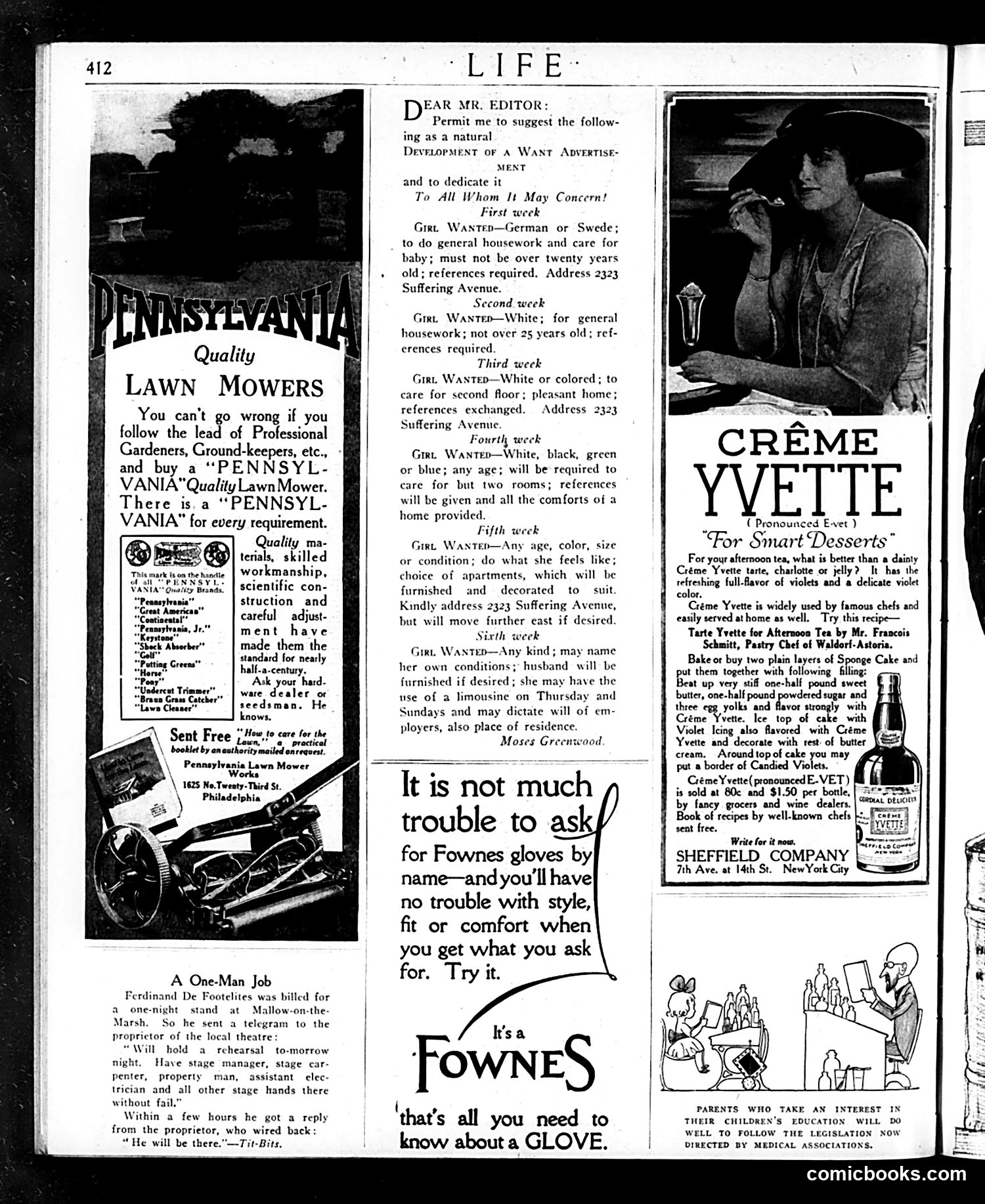
This page contains mostly advertisements interspersed with satirical content from Life magazine. The main satirical piece, titled "Development of a Want Advertisement," presents a humorous commentary on domestic labor. Written as a letter to the editor by Moses Greenwood, it traces how a job posting for a housemaid evolves over six weeks. The employer's requirements progressively relax—from insisting on specific national origin and age restrictions, to eventually accepting "any kind" of applicant and even offering absurd perks like a husband and limousine access. The satire mocks how desperation forces employers to abandon their initial prejudiced standards when they cannot fill positions. It critiques both employment discrimination and the reality that housework was so undesirable that employers must eventually accept anyone willing to do it. The other content is advertising: Pennsylvania lawn mowers, Crème Yvette liqueur, and Fownes gloves.
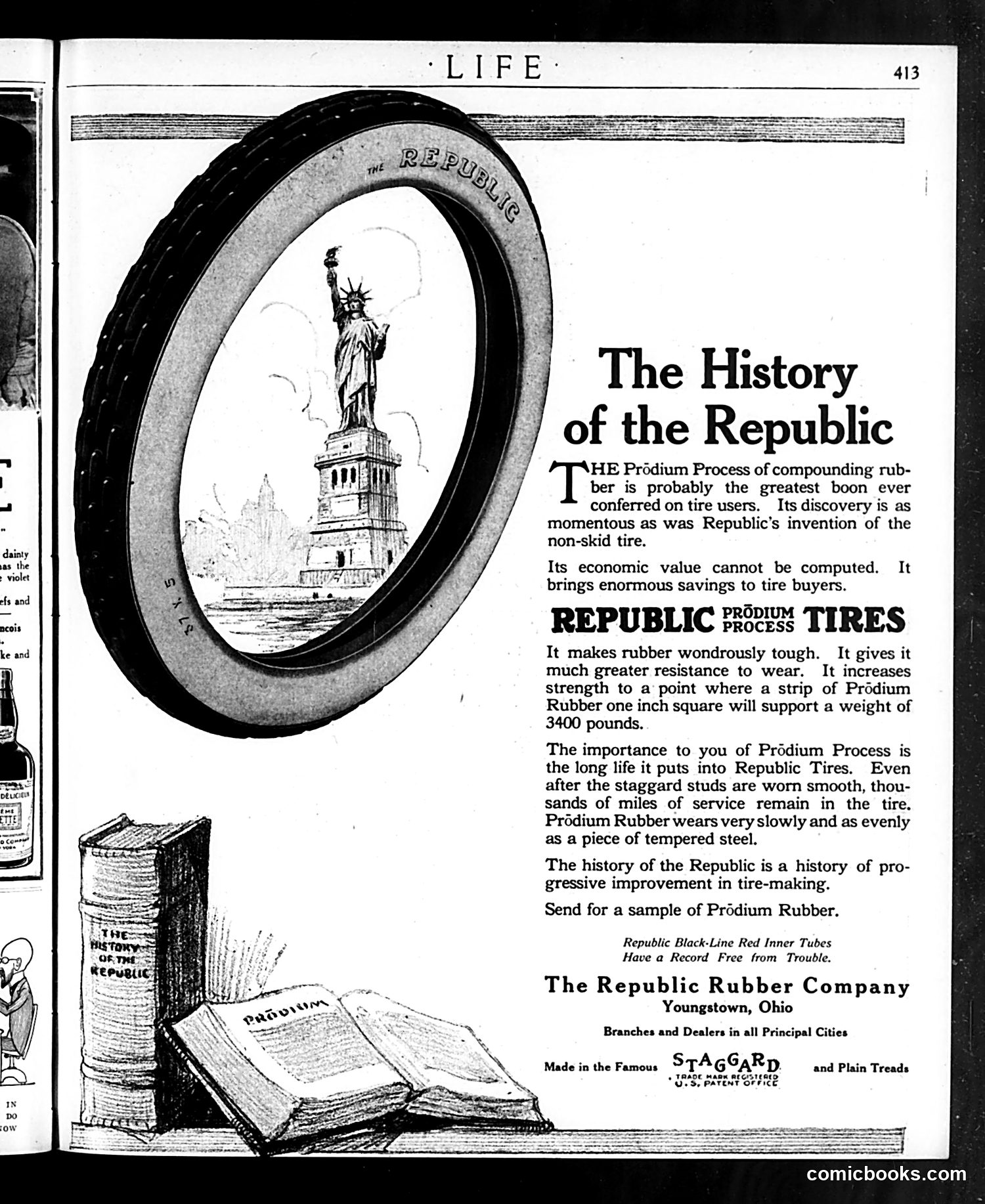
This is **not a cartoon or satire**—it's a straightforward advertisement for Republic Rubber Company tires, placed in Life magazine. The page features a large tire framing the Statue of Liberty, using patriotic imagery to associate the product with American progress and innovation. The company claims their "Prédium Process" for rubber compounding represents a major technological breakthrough, comparing it to Republic's earlier invention of the non-skid tire. The accompanying text emphasizes durability ("one inch square will support a weight of 3400 pounds") and longevity, arguing the tire's economic value justifies its cost. The lower section shows product literature and brand materials. The only mild wordplay appears in the headline "The History of the Republic"—a pun conflating the tire company's name with American history—but this is gentle corporate branding rather than satire. This is period advertising using nationalist symbolism to promote consumer goods.
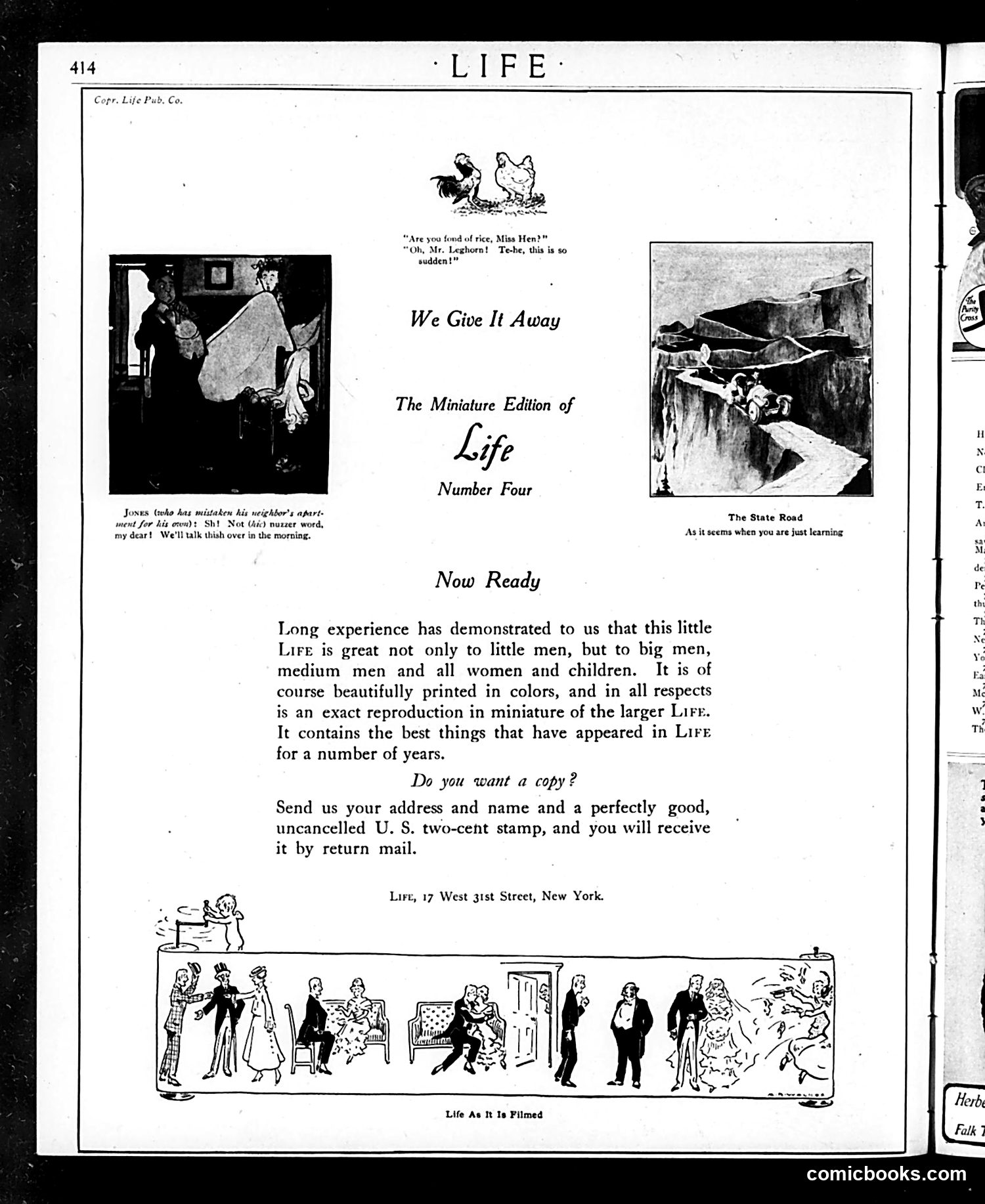
This page is primarily **advertising for a miniature edition of Life magazine** (Number Four), not political satire. The top contains **two unrelated cartoon jokes**: one depicting anthropomorphic farmyard animals (a rooster named "Mr. Leghorn" flirting with a hen), and another showing a drunk man mistaking his neighbor's apartment for his own—both standard humor of the era. The main content is a **promotional pitch** explaining that this condensed version of Life reproduces the magazine's best content in miniature form, appealing to readers of all sizes. The copy uses light humor ("great not only to little men, but to big men"). At bottom, "Life As It Is Filmed" shows various life scenes, promoting the magazine's comprehensive coverage. **No significant political commentary or satire appears here**—this is straightforward early-20th-century magazine marketing using period-appropriate cartoon humor and accessible language to drive subscriptions via mail.
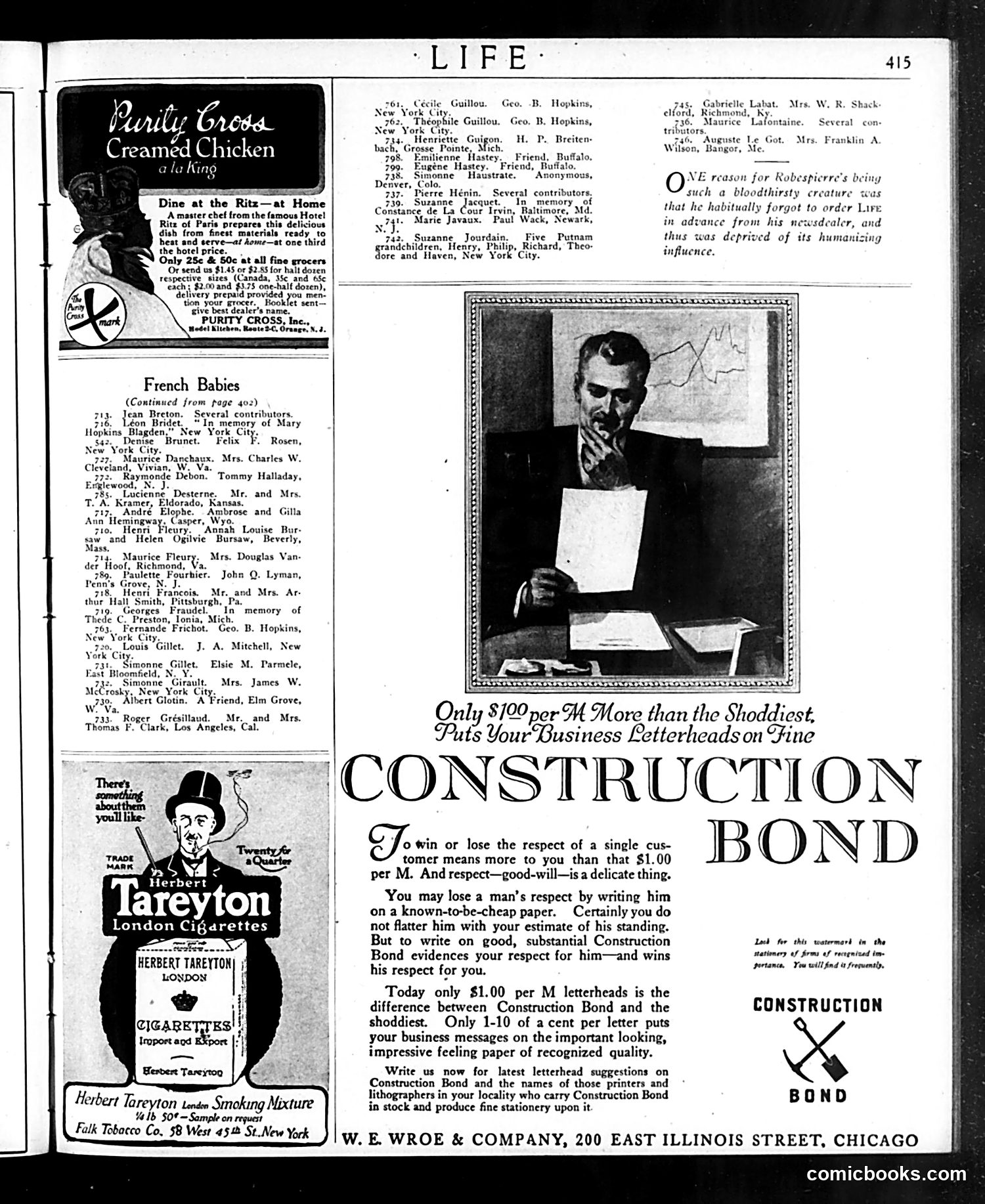
This page is primarily **advertising and donor lists**, not satire or political commentary. The main content includes: - **Purity Cross creamed chicken** advertisement (left) - **French Babies** donor acknowledgments (continuation from page 402)—listing names of contributors to what appears to be a charitable fundraising effort - **Herbert Tareyton London Cigarettes** advertisement (bottom left) - **Construction Bond** letterhead advertisement (right side, large)—emphasizing that quality paper ($1.00 per M letterheads) shows business respect and costs only slightly more than cheap alternatives The only potentially satirical element is a brief text excerpt about **Robespierre** (French Revolution figure), suggesting he was too bloodthirsty to remember ordering *Life* magazine in advance, thus missing "its humanizing influence." This appears to be gentle mockery promoting *Life*'s civilizing value. Otherwise, this is a standard early 20th-century magazine page mixing donor recognition with commercial advertising.
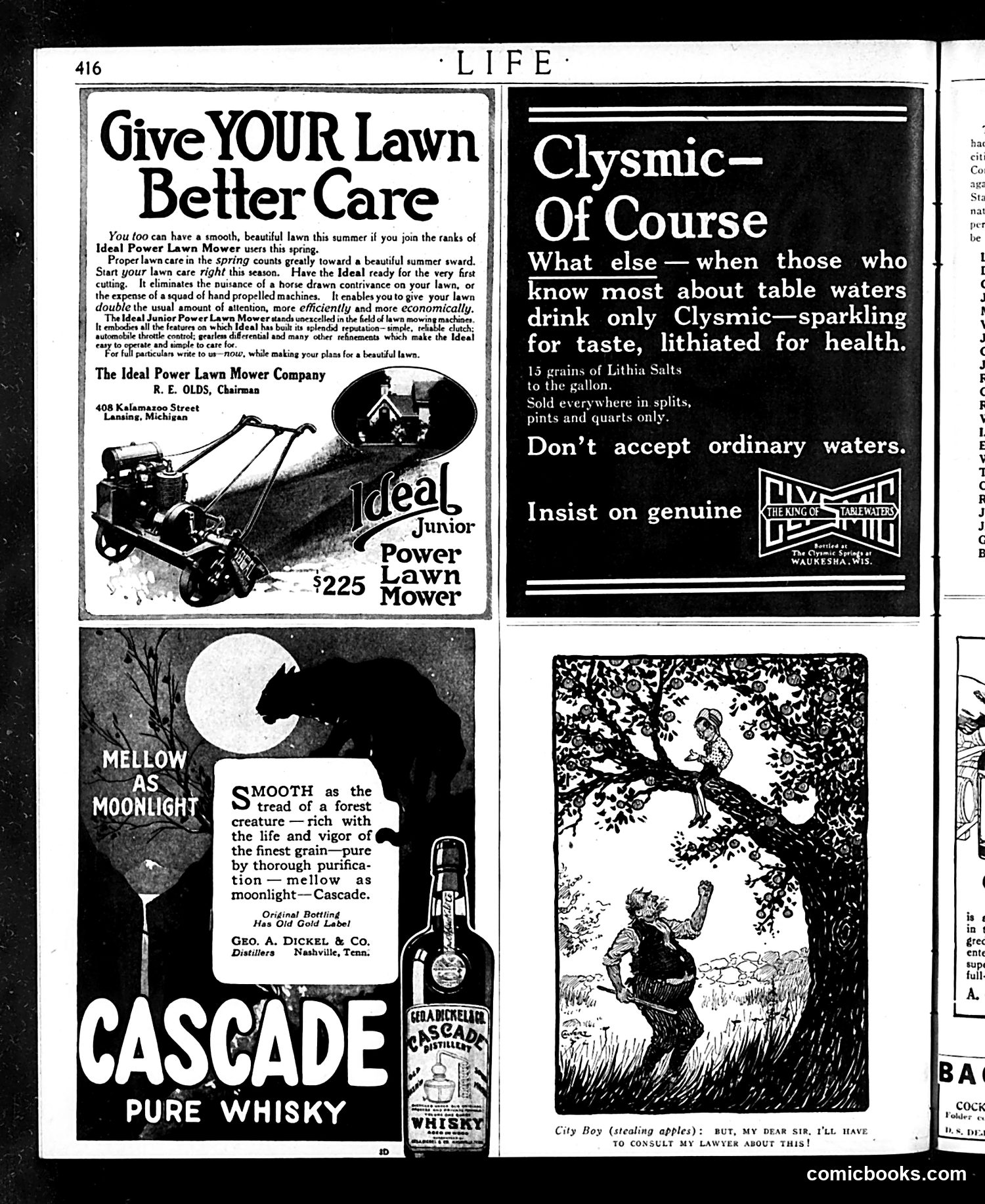
This page consists primarily of **advertisements**, not political satire. The only cartoon is the small illustration at bottom right, captioned "City Boy (stealing apples)." The cartoon depicts a child stealing apples from a tree, then comically responding to being caught by declaring he'll "consult my lawyer"—a joke about urban sophistication and legalism. The humor lies in the absurd contrast: a child thief adopting formal adult legal language rather than simply running away or apologizing, mocking both citified pretension and the litigious nature of modern life. The other content advertises consumer products: the Ideal Power Lawn Mower ($225), Cascade whiskey ("smooth as moonlight"), and Clysmic table water (containing lithium salts, marketed for health benefits). These ads reflect early 20th-century consumer culture and period medical misconceptions about lithium.
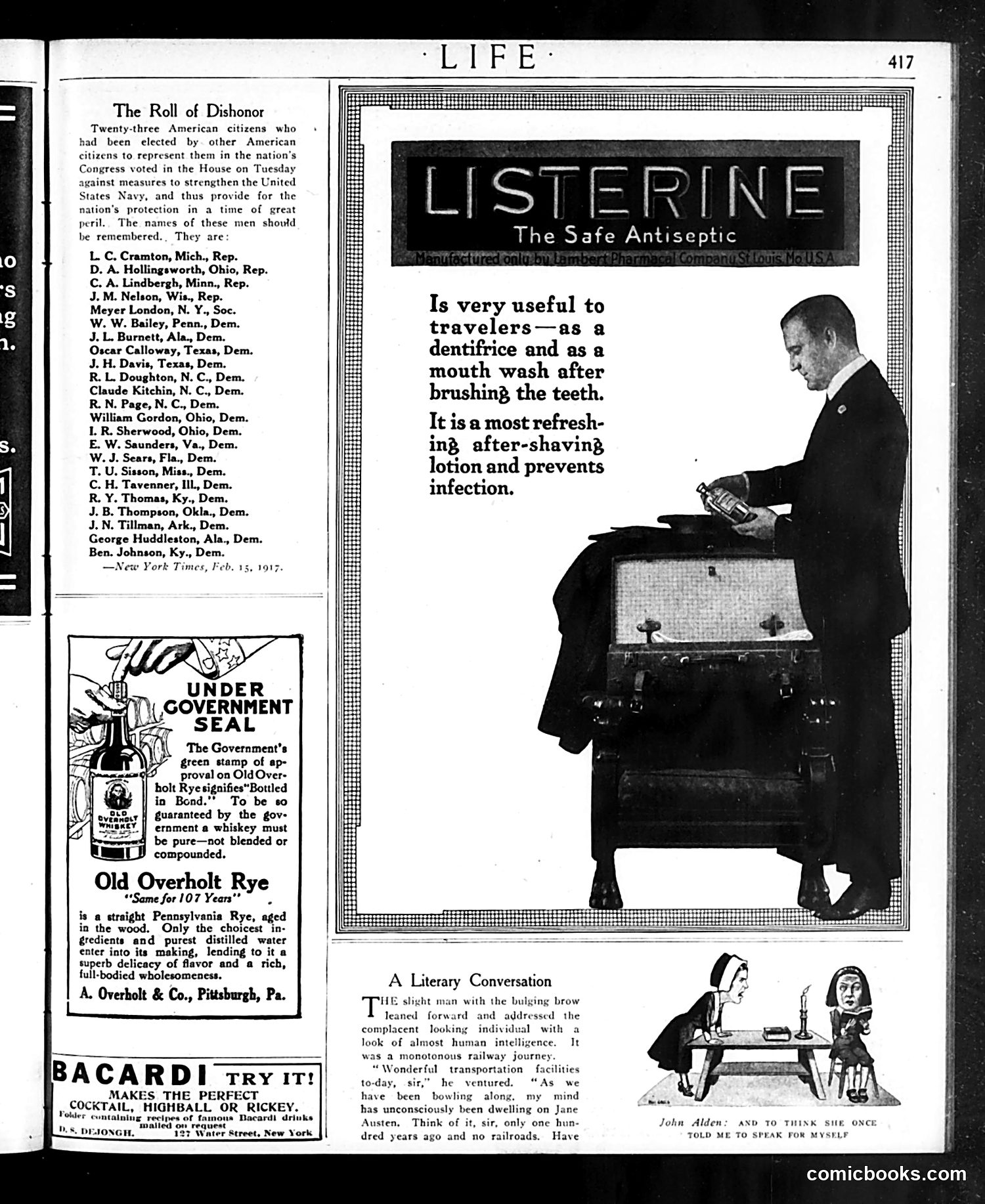
This page from *Life* magazine (dated February 13, 1917, per the source credit) is a **political attack on Congressional opposition to military spending**. The main feature lists 23 members of Congress—mostly Democrats, but also some Republicans—who voted *against* strengthening the U.S. Navy. The magazine labels them a "Roll of Dishonor," suggesting their patriotism is questionable. This reflects the pre-World War I period when interventionists viewed military preparedness as essential, while isolationists opposed it. Notably, **C. A. Lindbergh, Minn., Rep.** appears on this list—likely Charles Lindbergh's father, a congressman known for opposing military expansion and U.S. intervention. The surrounding advertisements (Old Overholt Rye, Listerine, Bacardi) are standard magazine filler. The bottom illustration, "A Literary Conversation," is unrelated social humor about railway travel and Jane Austen. The satire's point: *Life* was shaming elected officials for voting against military preparedness, framing it as unpatriotic.
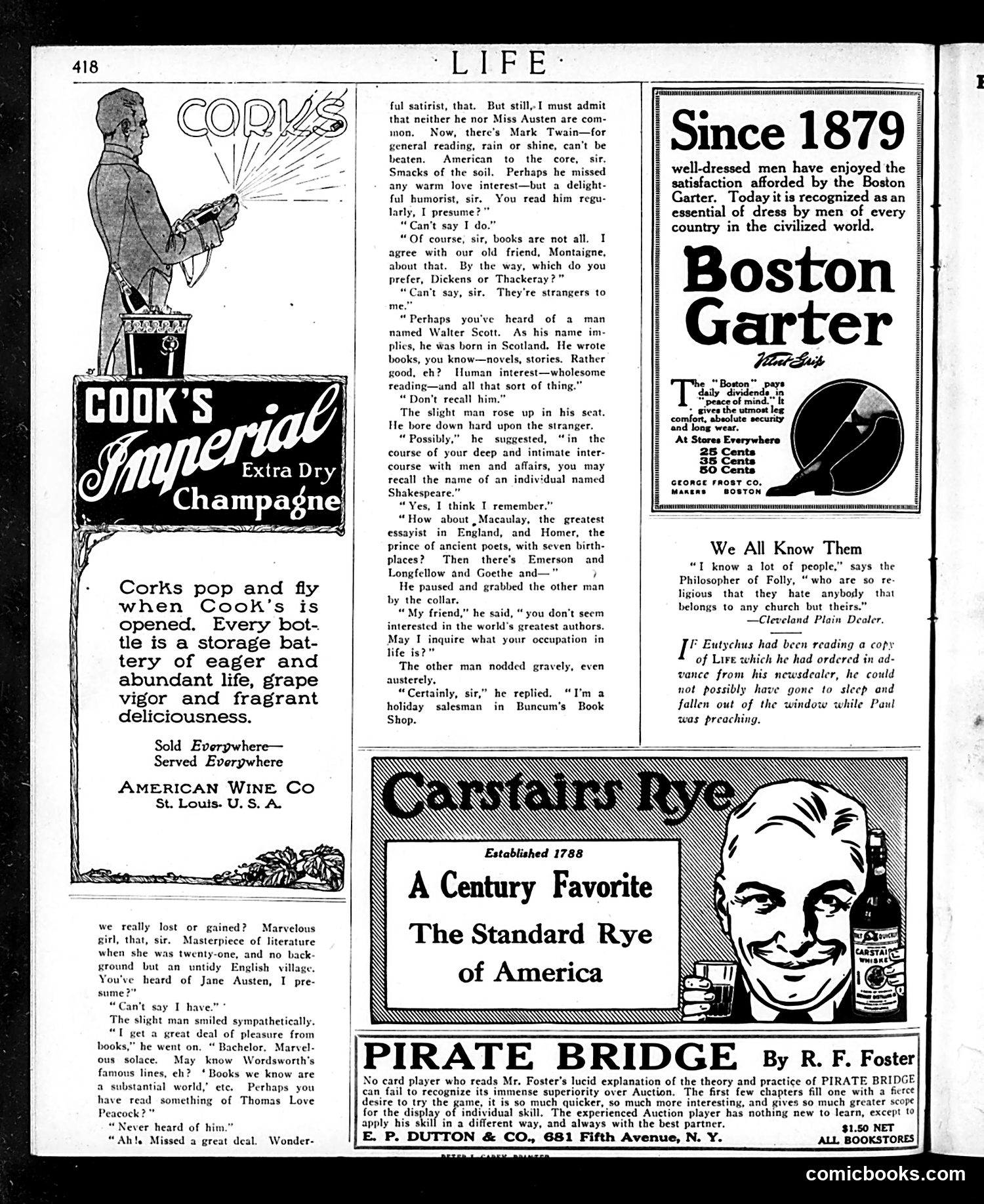
This page is primarily **advertising and miscellaneous content** rather than political satire. The visible elements include: - **Cook's Imperial Champagne ad** (left): Standard product advertising emphasizing quality and availability - **Boston Garter ad** (right): Men's hosiery marketed as an "essential of dress" since 1879 - **"We All Know Them"** section: A brief humorous piece about people who claim familiarity with famous authors they haven't actually read - **Crystal Rye whiskey ad** (bottom): Positioned as "A Century Favorite" and "The Standard Rye of America" - **Pirate Bridge card game ad** (bottom right): Promoting a bridge instruction book The page reflects early 20th-century consumer culture with luxury goods advertising interspersed with light social commentary. No significant political satire is present.