
Life, 1917-03-08 · page 7 of 42
Life — March 8, 1917 — page 7: what you’re looking at
What you’re looking at
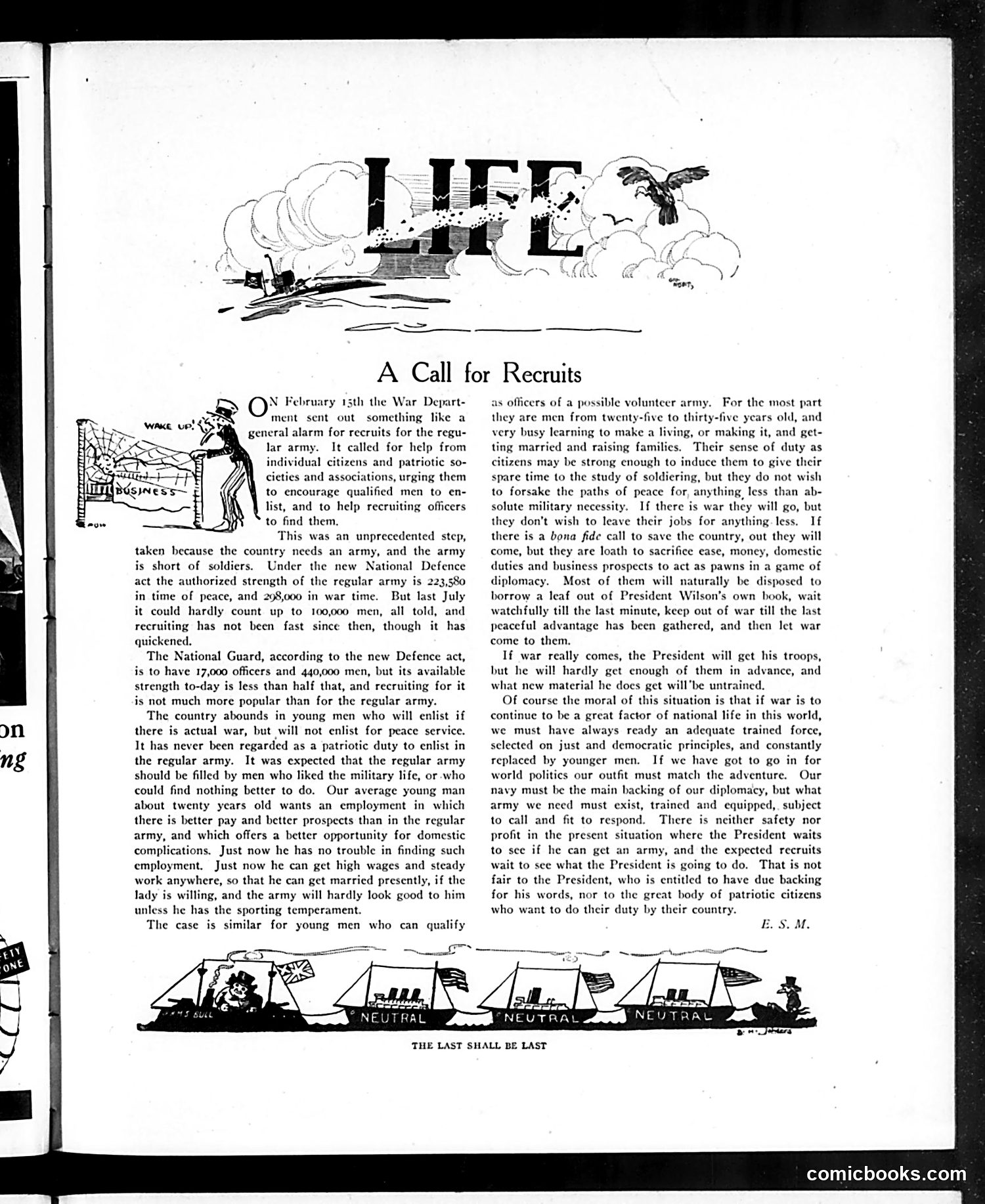
This article satirizes the U.S. military recruitment crisis following President Wilson's February 13th call for volunteer soldiers. The piece mocks the contradiction between the country's urgent need for 223,580 soldiers in peacetime and 298,000 in wartime, versus young men's reluctance to enlist. The satire targets the government's optimistic framing: officers are portrayed as hoping recruits will sacrifice "domestic duties and business prospects" while actually protecting American interests abroad. The author critiques that the President will struggle obtaining sufficient troops quickly, and that many young men prefer higher civilian wages to military service. The bottom cartoon—showing increasingly neutral ships—appears to satirize American neutrality policy amid global conflict, suggesting inevitable involvement despite official neutrality claims.
📄 Transcribed text from this page (OCR, searchable)
Machine-transcribed from the original scan — historical spelling and the odd misread are preserved.
A Call for Recruits ear ment sent out something like a <s % general alarm for recruits for the regu- lar army. It called for help from individual citizens and patriotic so- cieties and associations, urging them to encourage qualified men to en- list, and to help recruiting officers to find them, This was an unprecedented step, taken because the country needs an army, and the army is short of soldiers. Under the new National Defence act the authorized strength of the regular army is 223,580 in time of peace, and 298,000 in war time. But last July it could hardly count up to 100,000 men, all told, and recruiting has not been fast since then, though it has quickened. The National Guard, according to the new Defence act, is to have 17,000 officers and 440,000 men, but its available strength to-day is less than half that, and recruiting for it is not much more popular than for the regular army. The country abounds in young men who will enlist if there is actual war, but will not enlist for peace service. It has never been regarded as a patriotic duty to enlist in the regular army. It was expected that the regular army should be filled by men who liked the military life, or who could find nothing better to do. Our average young man about twenty years old wants an employment in which there is better pay and better prospects than in the regular army, and which offers a better opportunity for domestic complications. Just now he has no trouble in finding such employment. Just now he can get high wages and steady work anywhere, so that he can get married presently, if the lady is willing, and the army will hardly look good to him unless he has the sporting temperament. The case is similar for young men who can qualify ~ O*’ February 13th the War Depart- as officers of a possible volunteer army. For the most part they are men from twenty-five to thirty-five years old, and very busy learning to make a living, or making it, and get- ting married and raising families. Their sense of duty as citizens may be strong enough to induce them to give their spare time to the study of soldiering, but they do not wish to forsake the paths of peace for, anything less than ab- solute military necessity. If there is war they will go, but they don’t wish to leave their jobs for anything. less. If there is a bona fide call to save the country, out they will come, but they are loath to sacrifice ease, money, domestic duties and business prospects to act as pawns in a game of diplomacy. Most of them will naturally be disposed to borrow a leaf out of President Wilson’s own book, wait watchfully till the last minute, keep out of war till the last peaceful advantage has been gathered, and then let war come to them. If war really comes, the President will get his troops, but he will hardly get enough of them in advance, and what new material he does get will’be untrained. Of course the moral of this situation is that if war is to continue to be a great factor of national life in this world, we must have always ready an adequate trained force, selected on just and democratic principles, and constantly replaced by younger men. If we have got to go in for world politics our outfit must match the adventure. Our navy must be the main backing of our diplomacy, but what army we need must exist, trained and equipped, subject to call and fit to respond. There is neither safety nor profit in the present situation where the President waits to sce if he can get an army, and the expected recruits wait to sce what the President is going to do. That is not fair to the President, who is entitled to have due backing for his words, nor to the great body of patriotic citizens who want to do their duty by their country. THE LAST SHALL BE LAST comicbooks.com