
Life, 1917-03-08 · page 10 of 42
Life — March 8, 1917 — page 10: what you’re looking at
What you’re looking at
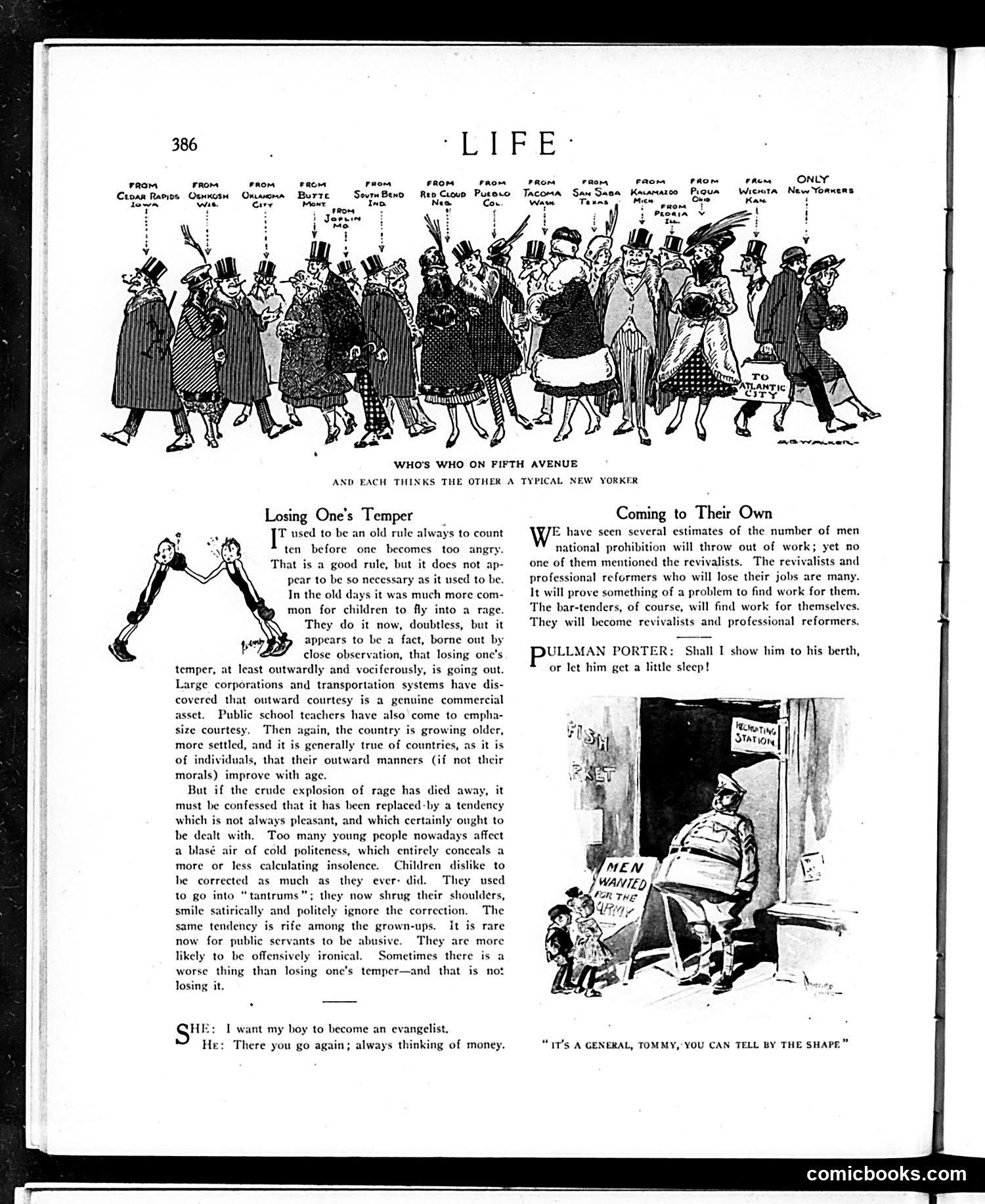
This page satirizes early 20th-century New York society and manners. The top illustration shows diverse Fifth Avenue characters labeled by their origins (Cedar Rapids, Omaha, etc.), mocking how New Yorkers stereotyped out-of-towners. **"Losing One's Temper"** critiques changing American civility—complaining that outward politeness has replaced genuine emotion, replaced by calculated coldness among both children and adults. **"Coming to Their Own"** discusses Prohibition's aftermath, noting bar-tenders and revivalists will find new work when saloons close. A small cartoon at bottom shows a woman telling her husband she wants their son to be an evangelist; he replies sarcastically that she's "always thinking of money"—mocking religious hypocrisy. The Pullman Porter illustration appears unrelated social commentary.
📄 Transcribed text from this page (OCR, searchable)
Machine-transcribed from the original scan — historical spelling and the odd misread are preserved.
386 “COUPE - prom rao = PROM pres ONLY Tacoma San Sana Karanazoo Wiewta New Yornens Wave Tanne 7 rRom From rRom = FROM rao FROM = FRom Croan Rarins Osnnosn Oxianoma Borie Sov Beno Ren Coup Puroro town wis. ‘Cary Mowe Ino, Ne Cow. i Jove Mo i v f ‘WHO'S WHO ON FIFTH AVENUE AND EACH THINKS THE OTHER A TYPICAL NEW YORKER Losing One’s Temper Coming to Their Own e T used to be an old rule always to count E have seen several estimates of the number of men 4 ten before one becomes too angry. national prohibition will throw out of work; yet no one of them mentioned the revivalists. The revivalists and professional reformers who will lose their jobs are many. It will prove something of a problem to find work for them. ‘The bar-tenders, of course, will find work for themselves. They will become revivalists and professional reformers. That is a good rule, but it does not ap- pear to be so necessary as it used to be. In the old it was much more com- mon for children to fly into a rage. They do it now, doubtless, but it appears to be a fact, borne out by - close observation, that losing one’s ULLMAN PORTER: Shall I show him to his berth, temper, at least outwardly and vociferously, is going out. or Iet him get a little sleep! Large corporations and transportation systems have dis- covered that outward courtesy is a genuine commer asset. Public school teachers have also come to empha- size courtesy. Then again, the country is growing older, more settled, and it is generally true of countries, as it is of individuals, that their outward manners (if not their morals) improve with age. But if the crude explosion of rage has died away, it must be confessed that it has been replaced-by a tendency which is not always pleasant, and which certainly ought to be dealt with. Too many young people nowadays affect a blasé air of cold politeness, which entirely conceals a more or less calculating insolence. Children dislike to be corrected as much as they ever: did. They used to go into “tantrums”; they now shrug their shoulders, smile satirically and politely ignore the correction. The same tendency is rife among the grown-ups. It is rare now for public servants to be abusive. They are more likely to be offensively ironical. Sometimes there is a worse thing than losing one’s temper—and that is n losing it. HE: I want my boy to become an evangelist, He: There you go again; always thinking of money. “11's A GENERAL, TOMMY, YOU CAN TELL BY THE SHAPE” comicbooks.com