
Life, 1917-03-08 · page 30 of 42
Life — March 8, 1917 — page 30: what you’re looking at
What you’re looking at
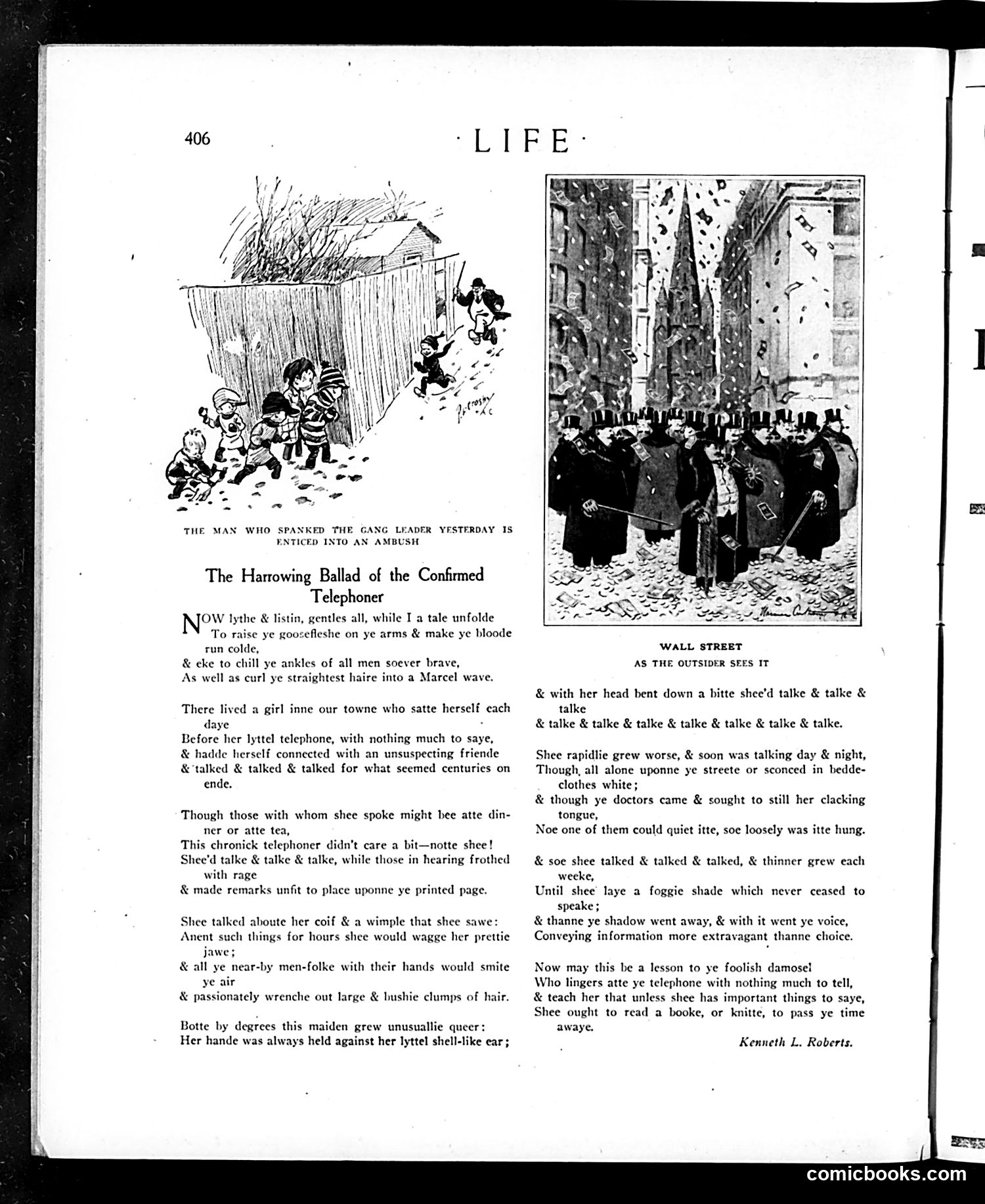
This page satirizes the emerging social problem of excessive telephone use. The main ballad, written in mock-archaic verse by Kenneth L. Roberts, tells of a young woman who becomes obsessed with talking on the telephone for hours, discussing trivial matters like hairstyles and fashion ("coif & a wimple"). The satire targets: - **The telephone itself**: newly common technology enabling wasteful social behavior - **Women's chattiness**: a gendered stereotype about female conversation - **Social disruption**: her endless calls plague those trying to dine or work - **Addiction**: she deteriorates physically and mentally, ultimately wasting away The moral lesson warns young women to use phones only for important matters, otherwise spend time on productive activities like reading or knitting. The right panel titled "Wall Street as the Outsider Sees It" appears unrelated—likely a separate cartoon about financial markets (unclear without better image resolution).
📄 Transcribed text from this page (OCR, searchable)
Machine-transcribed from the original scan — historical spelling and the odd misread are preserved.
THE MAN WHO SPANKED THE G LEADER YESTERDAY 1S ENTICED INTO AD s The Harrowing Ballad of the Confirmed Telephoner ‘OW lythe & listin, gentles all, while I a tale unfolde To raise ye goosefleshe on ye arms & make ye bloode run colde, & eke to chill ye ankles of all men soever brave, As well as curl ye straightest haire into a Marcel wave. There lived a girl inne our towne who satte herself cach daye . Before her lyttel telephone, with nothing much to saye, & hadde herself connected with an unsuspecting friende & talked & talked & talked for what seemed centuries on ende. Though those with whom shee spoke might bee atte din- ner or atte tea, This chronick telephoner didn’t care a bit—notte shee! Shee'd talke & talke & talke, while those in hearing frothed with rage & made remarks unfit to place uponne ye printed page. Shee talked aboute her coif & a wimple that shee sawe: Anent such things for hours shee would wagge her prettie jawe; & all ye near-by men-folke with their hands would smite ye air & passionately wrenche out large & bushie clumps of hair. Botte by degrees this maiden grew unusuallie queer: Her hande was always held against her lyttel shell-like ear ; ‘WALL STREET AS THE OUTSIDER SEES IT & with her head bent down a bitte shee’d talke & talke & talke & talke & talke & talke & talke & talke & talke & talke. Shee rapidlie grew worse, & soon was talking day & night, Though, all alone uponne ye streete or sconced in bedde- clothes white; & though ye doctors came & sought to still her clacking tongue, Noe one of them could quiet itte, soe loosely was itte hung. & soe shee talked & talked & talked, & thinner grew each weeke, Until shee’ laye a foggie shade which never ceased to speake ; & thanne y Conveying shadow went away, & with it went ye voice, formation more extravagant thanne choice. Now may this be a lesson to ye foolish damosel Who lingers atte ye telephone with nothing much to tell, & teach her that unless shee has important things to saye, Shee ought to read a booke, or knitte, to pass ye time awaye. Kenneth L. Roberts. comicbooks.com