
Life, 1917-03-08 · page 28 of 42
Life — March 8, 1917 — page 28: what you’re looking at
What you’re looking at
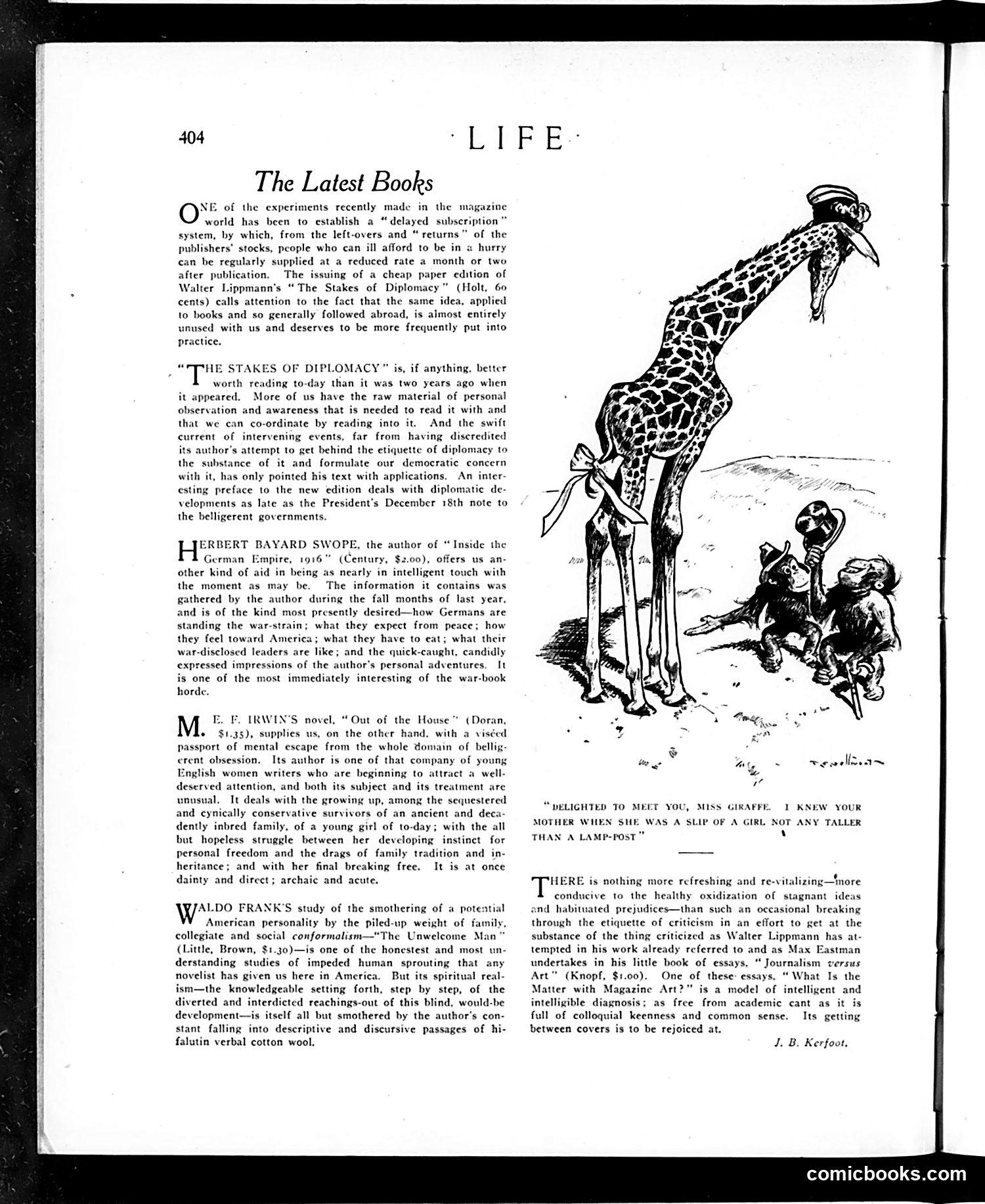
This page reviews recent books, with one cartoon illustrating a social joke about meeting someone's mother. **The Cartoon:** A tall giraffe meets two smaller animals (appears to be monkeys or similar creatures). One says he knew the giraffe's mother when "she was a slip of a girl not any taller than a lamp-post." The humor relies on visual absurdity—giraffes are famously tall, so the claim that the mother was once "lamp-post height" is ridiculous, yet presented deadpan as a polite social compliment. **The Point:** This is gentle satirical humor mocking banal small-talk and insincere compliments people exchange when meeting someone's relatives. The speaker is ostensibly flattering by claiming the giraffe has grown impressively, but the exaggeration is so obvious it becomes funny. **Context:** Published during WWI (references to "belligerent governments" and war books), this appears in Life's book review section—lighthearted filler between serious literary criticism.
📄 Transcribed text from this page (OCR, searchable)
Machine-transcribed from the original scan — historical spelling and the odd misread are preserved.
“LIPFE- The Latest Books NE of the experiments recently made in the ma world has been to establish a “delayed subscription” system, by which, from the left-overs and “returns” of the publishers’ stocks, pcople who can ill afford to be in a hurry can be regularly supplied at a reduced rate a month or two The issuing of a cheap paper edition of Walter Lippmann’s “The Stakes of Diplomacy” (Holt, 60 cents) calls attention to the fact that the same idea, applied to books and so generally followed abroad, is almost entirely unused with us and deserves to be more frequently put into practice. after publication. _ “CHE STAKES OF DIPLOMACY" is, if anything, better ding to-day than it was two years ago when it appeared. More of us have the raw material of personal observation and awareness that is needed to read it with and that we can co-ordinate by reading into it. And the swift current of intervening events, far from having discredited its author's attempt to get behind the etiquette of diplomacy to the substance of it and formulate our democratic concern with it, has only pointed his text with applications. An inter- esting preface to the new edition deals with diplomatic de- velopments as late as the President's December 18th note to the belligerent governments. worth 1 ZRBERT BAYARD SWOPE, the author of “Inside the German Empire, 1916" (Century, $2.00), offers us an- other kind of aid in being as nearly in intelligent touch with the moment as may be. The information it contains was gathered by the author during the fall months of last year, and is of the kind most presently desired—how Germans are standing the war-strain; what they expect from peace; how they feel toward America; what they have to eat; what their war-disclosed leaders are like; and the quick-caught, candidly expressed impressions of the author's personal adventures, It is one of the most immediately interesting of the war-book horde. M . F. IRWIN'S novel, “Out of the House” (Doran, $1.35), supplies us, on the other hand. with a viséed Passport of mental escape from the whole domain of bellig- erent obsession. Its author is one of that company of young English women writers who are beginning to attract a well- deserved attention, and both its subject and its treatment are unusual. It deals with the growing up, among the sequestered and cynically conservative survivors of an ancient and deca dently inbred family, of a young girl of to-day; with the a but hopeless struggle between her developing instinct for personal freedom and the drags of family tradition and in- heritance; and with her final breaking free. It is at once dainty and direct; archaic and acute. LDO FRANK'S study of the smothering of a potential American personality by the piled-up weight of family, collegiate and social conformalism—"The Unwelcome Man” (Little, Brown, $1.30)—is one of the honestest and most un- derstanding studies of impeded human sprouting that any novelist has given us here in America. But its spiritual real- ism—the knowledgeable setting forth, step by step, of the diverted and interdicted reachings-out of this blind, would-be development—is itself all but smothered by the author's con: stant falling into descriptive and discursive passages of hi- falutin verbal cotton wool. we wellaean “DELIGHTED TO MEET YOU, MISS GIRAFFE. 1 KNEW YOUR SHE WAS A SLIP OF A GIRL NOT ANY TALLER ry MOTHER WHEN THAN A LAMP-POST” HERE is nothing more refreshing and re-vitalizing—tnore conducive to the healthy oxidization of stagnant ideas and habituated prejudices—than such an occasional breaking through the etiquette of criticism in an effort to get at the substance of the thing criticized as Walter Lippmann has at- tempted in his work already referred to and as Max Eastman undertakes in his little book of essays, “Journalism versus Art” (Knopf, $1.00). One of these: essays, “ What Is the Matter with Magazine Art?" is a model of intelligent and intelligible diagnosis; as free from academic cant as it is full of colloquial keenness and common sense. Its getting between covers is to be rejoiced at. J. B. Kerfoot. comicbooks.com