
Life, 1917-03-08 · page 8 of 42
Life — March 8, 1917 — page 8: what you’re looking at
What you’re looking at
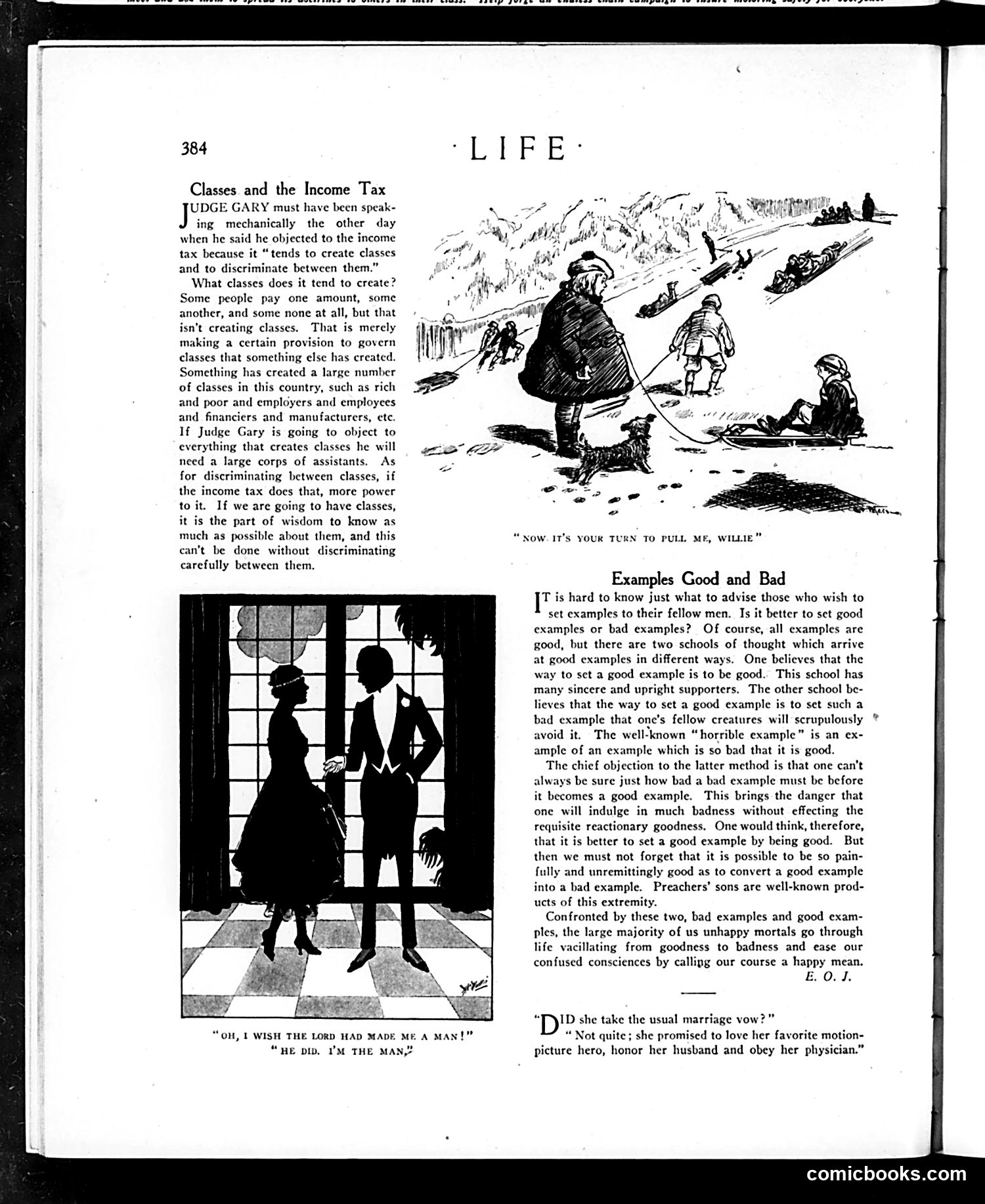
This page contains two distinct editorial cartoons: 1. **Top cartoon** (skiing scene): Shows an adult pulling a child on skis with caption "Now it's your turn to full me, Willie." This satirizes role-reversal and generational expectations—likely about children eventually supporting aging parents, or about inheritance/economic responsibility. 2. **Bottom cartoon** (indoor scene): Captioned "Oh, I wish the Lord had made me a man!" / "He did. I'm the man?" This jokes about gender roles and marital dynamics—the woman regrets her sex, while the man sarcastically suggests she's already wearing the pants in their relationship. The accompanying article, "Examples Good and Bad," discusses moral leadership and setting examples, suggesting these cartoons illustrate social contradictions of the era.
📄 Transcribed text from this page (OCR, searchable)
Machine-transcribed from the original scan — historical spelling and the odd misread are preserved.
Rated ofl faa 384 Classes and the Income Tax UDGE GARY must have been speak- ing mechanically the other day when he said he objected to the income tax because it “tends to create classes and to discriminate between them.” What classes does it tend to create? Some people pay one amount, some another, and some none at all, but that isn’t creating classes. That is merely making a certain provision to govern classes that something else has created. Something has created a large number of classes in this country, such as rich and poor and employers and employees and financiers and manufacturers, ete. If Judge Gary is going to object to everything that creates classes he will need a large corps of assistants. As for discriminating between classes, if the income tax does that, more power to it. If we are going to have classes, it is the part of wisdom to know as much as possible about them, and this “NOW. IT'S YOUR TURN TO PULL ME, WILLIE” can’t be done without discriminating carefully between them, Examples Good and Bad T is hard to know just what to advise those who wish to set examples to their fellow men. Is it better to set good examples or bad examples? Of course, all examples are good, but there are two schools of thought which arrive at good examples in different ways. One believes that the way to set a good example is to be good.. This school has many sincere and upright supporters. The other school be- lieves that the way to set a good example is to set such a bad example that one’s fellow creatures will scrupulously avoid it, The well-known “horrible example” is an ex- ample of an example which is so bad that it is good. The chief objection to the latter method is that one can’t always be sure just how bad a bad example must be before it becomes a good example. This brings the danger that one will indulge in much badness without effecting the requisite reactionary goodness. One would think, therefore, that it is better to set a good example by being good. But then we must not forget that it is possible to be so pain- fully and unremittingly good as to convert a good example into a bad example. Preachers’ sons are well-known prod- ucts of this extremity. Confronted by these two, bad examples and good exam- ples, the large majority of us unhappy mortals go through life vacillating from goodness to badness and ease our confused consciences by callipg our course a happy mean. E. 0. J. )” “Sane Se a: D”?. she take the usual marriage vow?” “On, | WISH THE LORD HAD MADE ME A MAN!” “ Not quite; she promised to love her favorite motion- “HE bib, I'M THE MAN? picture hero, honor her husband and obey her physician.” comicbooks.com