
Life, 1917-03-08 · page 13 of 42
Life — March 8, 1917 — page 13: what you’re looking at
What you’re looking at
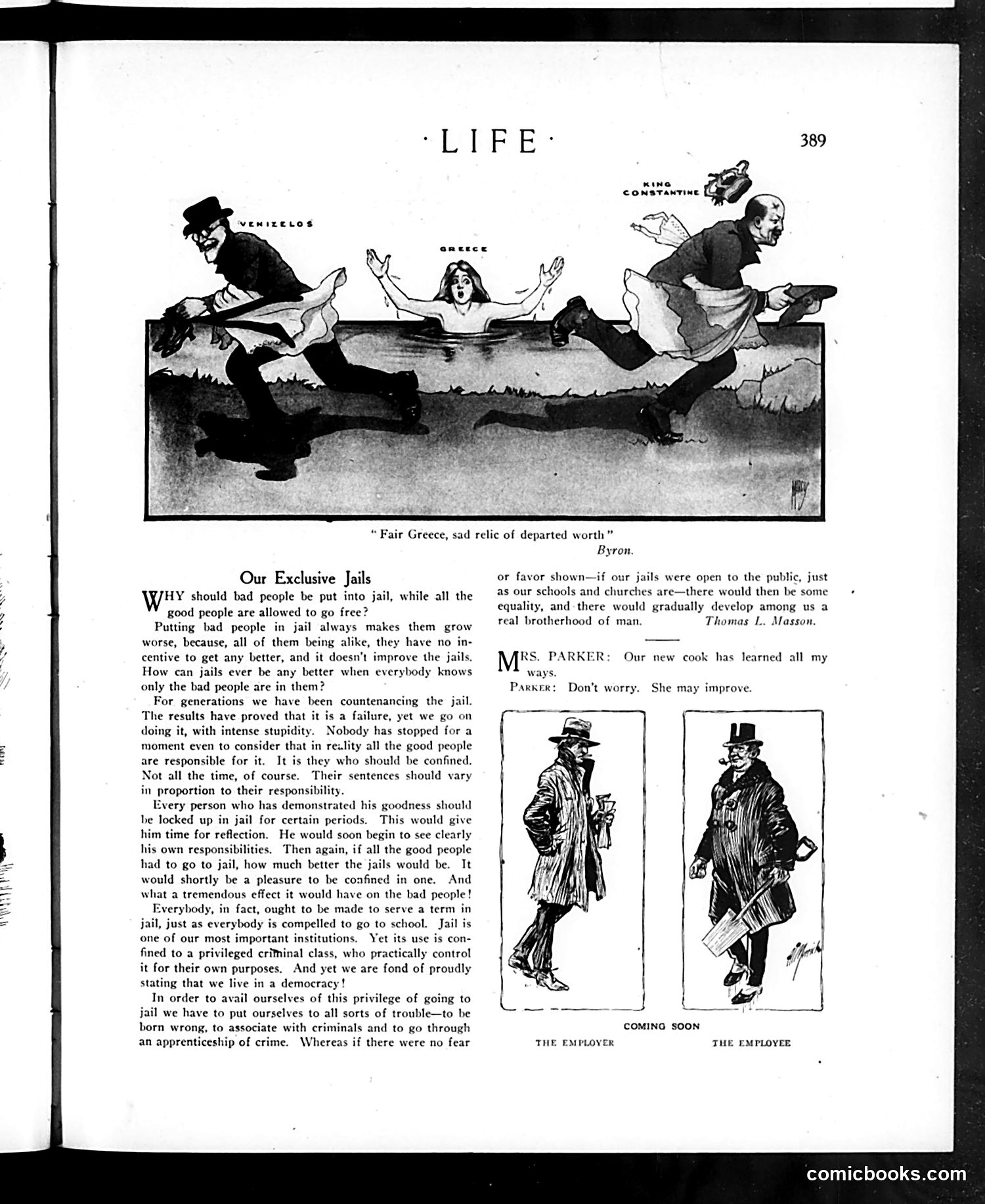
**Main Cartoon (top):** A satirical scene showing three figures in an underworld or hellish setting labeled with classical references—"Aeneas," "Orfice" (Orpheus), and "King Constantine." The cartoon appears to mock historical or mythological figures experiencing some form of punishment or torment, likely critiquing their earthly deeds through classical allusion. The Byron quote about "departed worth" suggests ironic commentary on their legacies. **Article & Lower Cartoons:** "Our Exclusive Jails" argues that imprisoning bad people while freeing good ones would improve society and deter crime. The two sketches labeled "Coming Soon—The Employer" and "The Employee" appear to satirize class distinctions, suggesting these figures will soon occupy jail roles based on their social status—a commentary on unequal justice.
📄 Transcribed text from this page (OCR, searchable)
Machine-transcribed from the original scan — historical spelling and the odd misread are preserved.
Kine CONSTANTINE “Fair Greece, sad relic of departed worth” Our Exclusive Jails HY should bad people be put into jail, while all the good people are allowed to go free? Putting bad people in jail always makes them grow worse, because, all of them being alike, they have no in- centive to get any better, and it doesn’t improve the jails. How can jails ever be any better when everybody knows only the bad people are in them? For generations we have been countenancing the jail. The results have proved that it is a failure, yet we go on doing it, with intense stupidity. Nobody has stopped for a moment even to consider that in reality all the good people are responsible for it, It is they who should be confined. Not all the time, of course. Their sentences should vary in proportion to their responsibility. Every person who has demonstrated his goodness should be locked up in jail for certain periods. This would give him time for reflection. He would soon begin to see clearly his own responsibilities. Then again, if all the good people had to go to jail, how much better the jails would be. It would shortly be a pleasure to be confined in one. And what a tremendous effect it would have on the bad people! Everybody, in fact, ought to be made to serve a term in jail, just as everybody is compelled to go to school. Jail is one of our most important institutions. Yet its use is con- fined to a privileged criMinal class, who practically control it for their own purposes. And yet we are fond of proudly stating that we live in a democracy ! In order to avail ourselves of this privilege of going to jail we have to put ourselves to all sorts of trouble—to be born wrong, to associate with criminals and to go through an apprenticeship of crime. Whereas if there were no fear Byron. or favor shown—if our jails were open to the public, just as our schools and churches are—there would then be some equality, and-there would gradually develop among us a real brotherhood of man. Thomas 1. Masson. MES: PARKER: Our new cook has learned all my ways. Parker: Don't worry. She may improve. COMING SOON THE EMPLOYER THE EMPLOYEE comicbooks.com