
Life, 1917-03-08 · page 25 of 42
Life — March 8, 1917 — page 25: what you’re looking at
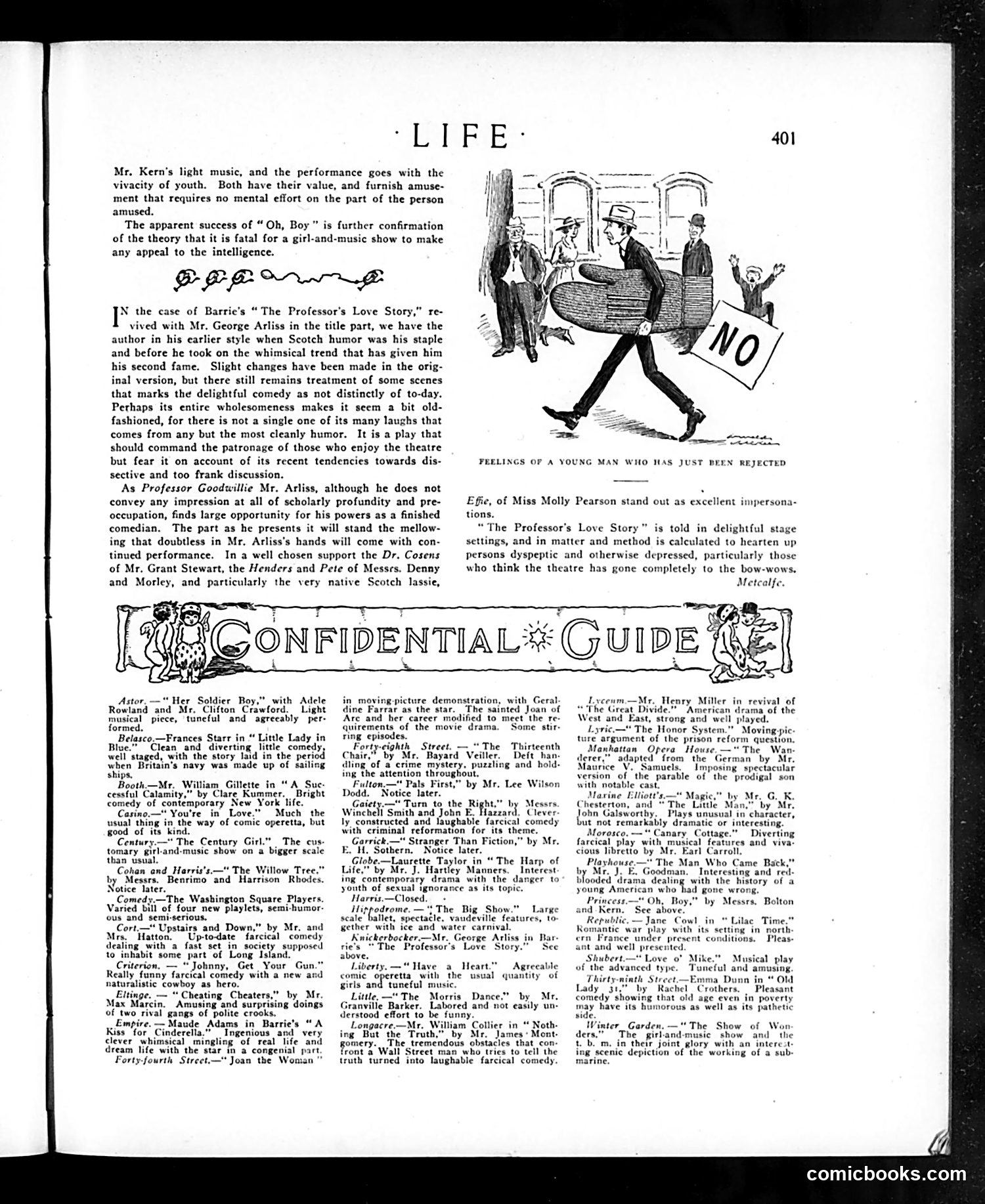
What you’re looking at
The cartoon depicts a young man carrying a large sign reading "NO"—a visual metaphor for romantic rejection. He appears distressed as he walks past several well-dressed men in what looks like a street or public space. The joke is straightforward satire of social humiliation: the exaggerated size of the rejection sign makes his personal romantic failure comically public. The other figures—appearing indifferent or amused—emphasize his isolation and embarrassment. This reflects early 20th-century Life magazine's typical humor, which often mocked young men's romantic misadventures and social awkwardness. The cartoon appears alongside theater reviews, suggesting it was entertainment for the magazine's educated, urban readership. The satire targets the universal experience of rejection rather than any specific political or social issue.
📄 Transcribed text from this page (OCR, searchable)
Machine-transcribed from the original scan — historical spelling and the odd misread are preserved.
“ES BE* Mr. Kern's light music, and the performance goes with the vivacity of youth. Both have their value, and furnish amuse- ment that requires no mental effort on the part of the person amused. The apparent success of “Oh, Boy” is further confirmation of the theory that it is fatal for a girl-and-music show to make any appeal to the intelligence. PLLAWWL I N the case of Barrie's “The Professor's Love Story, vived with Mr. George Arliss in the title part, we have the author in his earlier style when Scotch humor was his staple and before he took on the whimsical trend that has given him his second fame. Slight changes have been made in the orig- inal version, but there still remains treatment of some scenes that marks the delightful comedy as not distinctly of to-day. Perhaps its entire wholesomeness makes it seem a bit old- fashioned, for there is not a single one of its many laughs that comes from any but the most cleanly humor. It is a play that should command the patronage of those who enjoy the theatre but fear it on account of its recent tendencies towards dis- sective and too frank discussion. As Professor Goodwillie Mr. Arliss, although he does not convey any impression at all of scholarly profundity and pre- occupation, finds large opportunity for his powers as a finished comedian. The part as he presents it will stand the mellow- ing that doubtless in Mr. Arliss’s hands will come with con- tinued performance. In a well chosen support the Dr. Cosens of Mr. Grant Stewart, the Henders and Pete of Messrs. Denny and Morley, and particularly the very native Scotch lassie, FEELINGS OP A YOUNG MAN WHO MAS JUST DEEN REJECTED Effie, of Miss Molly Pearson stand out as excellent impersona- tions. “The Professor's Love Story” is told in delightful stage settings, and in matter and method is calculated to hearten up persons dyspeptic and otherwise depressed, particularly those who think the theatre has gone completely to the bow-wows. Set ONFIDENTIAL* GUIDE Astor, —"Her Soldier Boy,” with Adele Rowland and Mr. Clifton Crawford. Light musical piece, tuneful and agreeably per- formed. pibelseaasFrances Stare in * Little Lady in 1 Hue.” well staged, with the story laid in the period when Britain's navy was made up of sailing episodes. Chair," moving-picture demonstration, with Geral. ine Farrar as the star. Are and her career m quirements of the movie drama. ified to meet the re- Clean and diverting little comedy, rty-eighth Street, — “ The by Mr. Bayard Veiller. dling ‘of a crime mystery, puzzling and hold- Lyceum —Mr. Henry Miller in revival of « The Great Divide.” American drama of the West and East, strong and well played. Lyric.—" The Honor System.” Moving'pi ture argument of the prison reform questio Manhattan Opera House. —“ The Wan- derer,” adapted from the German by Mr. Maurice V. Samuels. Imposing spectacular The sainted Joan of Some stir- Thirteenth Deft han- ships, Booth—Mr. William Gillette in “A Suc- cessful Calamity,” by Clare Kummer, | Bright comedy of contemporary New York life. Casine.—" You're in Love.” Much the usual thing in the way of comic operetta, but good of its kind. Century.—" The Century Girl.” The cus- tomary girland-music show on a bigger scale than usual. Cohan ond Harris's.—" The Willow Tree.” by Messrs, Benrimo and Harrison Rhodes. Notice later. Comedy.—The Washington Square Players. Varied bili of four new playlets, semi-humor- ous and semi-serious. Cort.— Upstairs and Down,” by Mr. and Mrs. Hatton. Up-to-date farcical "comedy dealing with 'a fast set in society supposed habit some part of Long Island. .— “Johnny, Get Your Gun.” ny farcical comedy with a new and naturalistic cowboy as hero. Eltinge, — “Cheating Cheaters,” by Mr. Max Marcin. Amusing and surprising doings of two rival gangs of polite crooks. Empire. — Maude Adams in Barrie's “A $3 for Cinderella.” Ingenious and very clever whimsical mingling of real life and dream life with the star in a congenial part Forty-fourth Street-—" Joan the Woman ” ing the attention throughout. Fulton—" Pals First,” by Mr, Lee Wilson Dodd, Notice later. Gaiety. —" Turn to the Right,” by Messrs Winchell Smith and Joba E. flazzard. Clever ly constructed and laughable farcical comedy With criminal reformation for its theme. Garrick —" Stranger Than Fiction,” by Mr. EH. Sothern. Notice later. Globe.—Laurette Taylor. in “The Harp of cx” by Mr. J. Hartiey Manners. Interest ing contemporary drama with the danger to youth of sexual ignorance as its topic, Harris.—Closed, > iitpodrome.—": The Big Show." Large scale ballet, spectatle, vaudeville features, to: gether with ice and water carnival. Knickerbocker-—Mr. George Arliss in Rar- ries The Professor's Love Story.” See above. Liberty. —" Have a Heart." Agrecable comic operetta with the usual quantity. of girls and tuneful music. Little, "The Morris Dance.” by Mr. Granville Barker. Labored and not easily un: derstood effort to be funny. Longacre,—Mr, William Collier in Noth. ing But the Truth,” by Mr. James: Mont. Fomery. The, tremendous otniaclen that con: ront a Wall Street man who tries to tell the truth turned into laughable farcical comedy. version of ‘the parable of the prodigal son with notable cast, Marine Elliott's.— Magic,” by Mr. GK. Chesterton, and “The Little Man,” by Mr. John Galsworthy. Plays unusual in character, but not remarkably dramatic or interesting. Morosco.—" Canary Cottage.” Diverting farcical play with musical features and viva- cious libretto by Mr, Earl Carroll, Playhouse.—" The Man Who Came Back,” by Mr, J. E. Goodman, Interesting and red- blooded ‘drama dealing with the history of a young American who had gone wrong. Prin *Oh, Boy,” by Messrs. Bolton and Kern. See above. Republic. — Jane Cowl Romantic war ilac Time. in north Pleas- ant and well presented Shubert.—" Love o° Mike." Musical play of the advanced type. Tuneful and amusing Thirty-ninth Street—Emma Dunn in “ Old Lady 31,” by Rachel Crothers. Pleasant comedy showing that old age even in poverty may have its humorous as well as its pathetic Winter, Garden. —"The Show of Won ders.” The girland-music show and th t. b. m, in their joint glory with an intere ing scenic depiction of the working of a sub- marine. comicbooks.com