
Life, 1917-03-08 · page 20 of 42
Life — March 8, 1917 — page 20: what you’re looking at
What you’re looking at
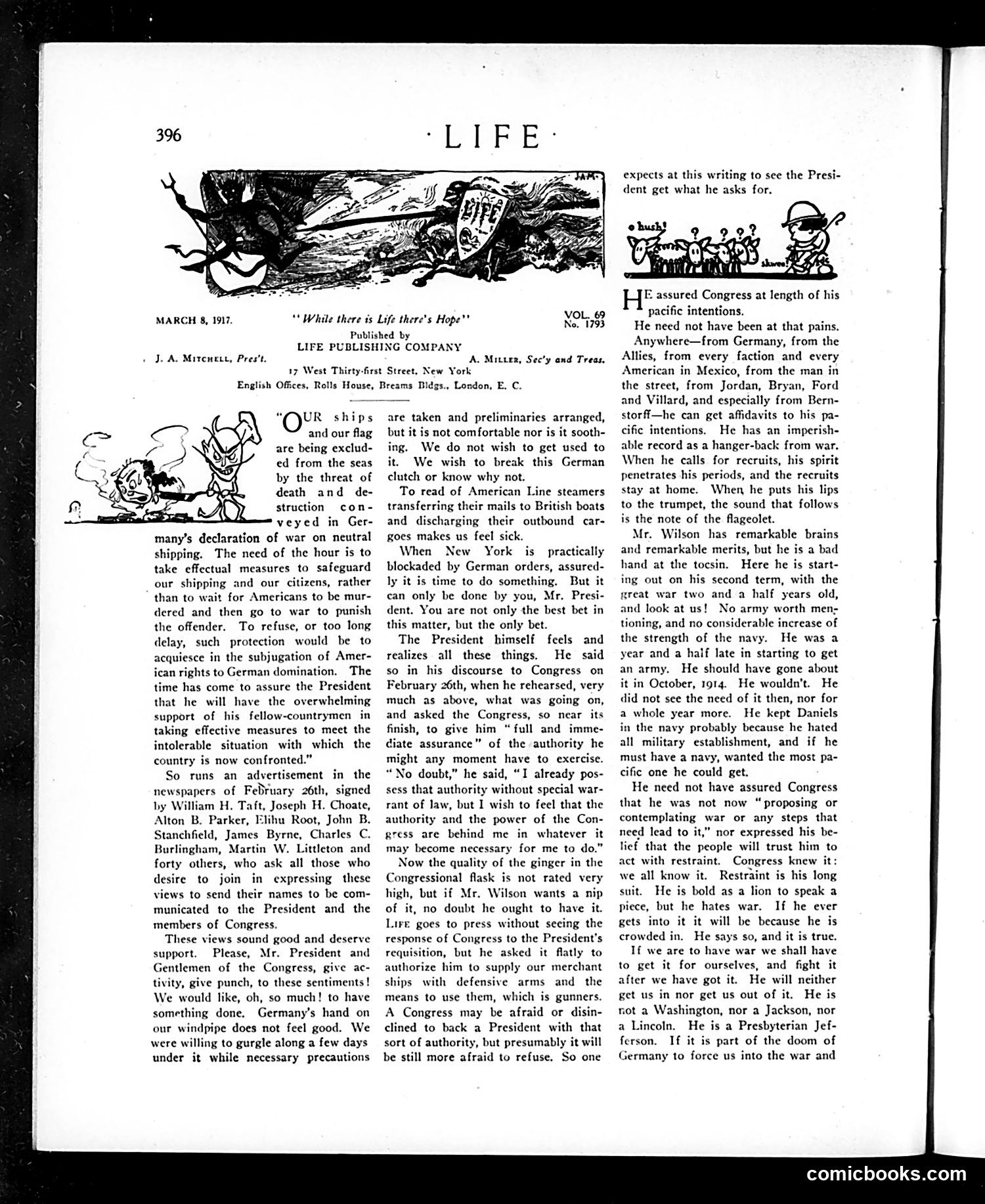
This page satirizes the gap between bold public declarations and actual government action regarding German U-boat attacks on American shipping. The text reproduces a February 26th newspaper advertisement signed by prominent figures (Taft, Root, Parker, and others) demanding President Wilson take "effectual measures" to protect American vessels from German blockade. Life's editorial voice is mockingly impatient: it praises these sentiments while sarcastically noting Germany's "hand on our windpipe does not feel good" and criticizing the delay. The piece reports Wilson has asked Congress for authority to arm merchant ships with defensive weapons ("gunners"). The satire lies in the tension between the urgent rhetoric about German aggression and the slow bureaucratic response—Life essentially says: yes, yes, these are fine words, but *act already*. The editor expresses relief that Congress will likely grant Wilson's request, given they'd be "still more afraid to refuse." This reflects pre-U.S. entry debates over neutrality and preparedness (America entered WWI in April 1917).
📄 Transcribed text from this page (OCR, searchable)
Machine-transcribed from the original scan — historical spelling and the odd misread are preserved.
MARCH 8, 1917. “While there ts Life there's Hope’" No. 1793 Published by LIFE PUBLISHING COMPANY J. A. Mitement, Pres’t. “CYUR ships and our flag are being exclud- ed from the seas by the threat of death and de- struction con- veyed in Ger- many’s declaration of war on neutral shipping. The need of the hour is to take effectual measures to safeguard our shipping and our citizens, rather than to wait for Americans to be mur- dered and then go to war to punish the offender. To refuse, or too long delay, such protection would be to acquiesce in the subjugation of Amer- ican rights to German domination. The time has come to assure the President that he will have the overwhelming support of his fellow-countrymen in taking effective measures to meet the intolerable situation with which the country is now confronted.” So runs an advertisement in the newspapers of February 26th, signed by William H. Taft, Joseph H. Choate, Alton B. Parker, Elihu Root, John B. Stanchfield, James Byrne, Charles C. Burlingham, Martin W. Littleton and forty others, who ask all those who desire to join in expressing these views to send their names to be com- municated to the President and the members of Congress. These views sound good and deserve support. Please, Mr. President and Gentlemen of the Congress, give ac- tivity, give punch, to these sentiments! We would like, oh, so much! to have something done. Germany’s hand on our windpipe does not feel good. We were willing to gurgle along a few days under it while necessary precautions A. Mitirr, Sec'y ond Treas. 17 West Thirty-first Street, New York English Offices, Rolls House, Breams Didgs., London, E. C. are taken and preliminaries arranged, but it is not comfortable nor is it sooth- ing. We do not wish to get used to it. We wish to break this German clutch or know why not. To read of American Line steamers transferring their mails to British boats and discharging their outbound car- goes makes us feel sick. When New York is practically blockaded by German orders, assured- ly it is time to do something. But it can only be done by you, Mr. Presi- dent. You are not only the best bet in this matter, but the only bet. The President himself feels and realizes all these things. He said so in his discourse to Congress on February 26th, when he rehearsed, very much as above, what was going on, and asked the Congress, so near its finish, to give him “full and imme- diate assurance” of the authority he might any moment have to exercise. “No doubt,” he said, “I already pos- sess that authority without special war- rant of law, but I wish to feel that the authority and the power of the Con- gress are behind me in whatever it may become necessary for me to do.” Now the quality of the ginger in the Congressional flask is not rated very high, but if Mr. Wilson wants a nip of it, no doubt he ought to have it. Lire goes to press without secing the response of Congress to the President's requisition, but he asked it flatly to authorize him to supply our merchant ships with defensive arms and the means to use them, which is gunners. A Congress may be afraid or disin- clined to back a President with that sort of authority, but presumably it will be still more afraid to refuse, So one expects at this writing to see the Presi- dent get what he asks for. HE assured Congress at length of his pacific intentions. He need not have been at that pains. Anywhere—from Germany, from the Allies, from every faction and every American in Mexico, from the man in the street, from Jordan, Bryan, Ford and Villard, and especially from Bern- storff—he can get affidavits to his pa- cific intentions. He has an imperish- able record as a hanger-back from war. When he calls for recruits, his spirit penetrates his periods, and the recruits stay at home. When he puts his lips to the trumpet, the sound that follows is the note of the flageolet. Mr. Wilson has remarkable brains and remarkable merits, but he is a bad hand at the tocsin. Here he is start- ing out on his second term, with the great war two and a half years old, and look at us!’ No army worth men; tioning, and no considerable increase of the strength of the navy. He was a year and a half late in starting to get an army. He should have gone about it in October, 1914. He wouldn't. He did not see the need of it then, nor for a whole year more. He kept Daniels in the navy probably because he hated all military establishment, and if he must have a navy, wanted the most pa- cific one he could get. He need not have assured Congress that he was not now “proposing or contemplating war or any steps that need lead to it,” nor expressed his be- lief that the people will trust him to act with restraint. Congress knew it: we all know it. Restraint is his long suit. He is bold as a lion to speak a piece, but he hates war. If he ever gets into it it will be because he is crowded in. He says so, and it is true. If we are to have war we shall have to get it for ourselves, and fight it after we have got it. He will neither get us in nor get us out of it. He is not a Washington, nor a Jackson, nor a Lincoln. He is a Presbyterian Jef- ferson. If it is part of the doom of Germany to force us into the war and comicbooks.com