
Life, 1917-03-08 · page 24 of 42
Life — March 8, 1917 — page 24: what you’re looking at
What you’re looking at
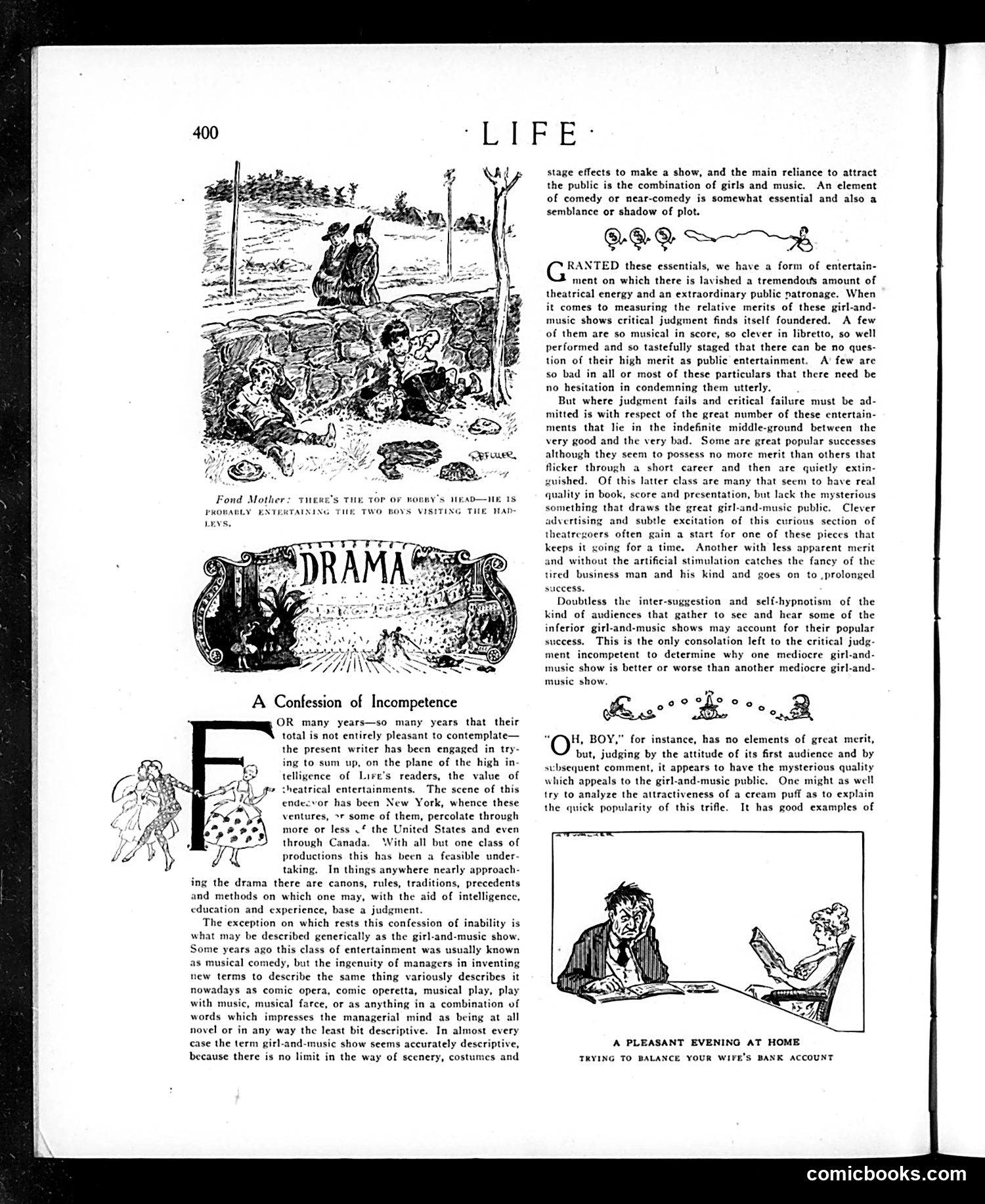
This page discusses the critical dilemma posed by "girl-and-music shows"—what we'd now call musicals or operettas. The author confesses inability to judge these productions fairly, unlike traditional drama which follows established critical standards. The top illustration shows a "Fond Mother" entertained by Nobby (likely a character or performer), visiting "the Hadleys"—a domestic scene. The lower cartoon, "A Pleasant Evening at Home," depicts a husband attempting to balance a wife's bank account, humorously suggesting the mathematical confusion mirrors the critic's confusion about musicals. **The satire's point**: Girl-and-music shows succeed through unclear, mysterious appeal rather than merit. Some mediocre productions become hits through advertising or audience "self-hypnotism," while better-made shows fail—making rational critical evaluation impossible. The husband's baffled accounting mirrors the critic's bafflement before popular entertainment's illogical economics.
📄 Transcribed text from this page (OCR, searchable)
Machine-transcribed from the original scan — historical spelling and the odd misread are preserved.
‘LLP E* THE TOP OF NOnBY'S HEAD—ME 1S VS VISITING THE MAD- Fond Mother: tee’: PROBABLY ENTERTAINING THE TWO A Confession of Incompetence OR many years—so many years that their total is not entirely pleasant to contemplate— the present writer has been engaged in try- ing to sum up, on the plane of the high in telligence of Lire’s readers, the value of theatrical entertainments. The scene of this endecvor has been New York, whence these ventures, > some of them, percolate through more or less .* the United States and even through Canada. With all but one class of productions this has been a feasible under- taking. In things anywhere nearly approach- ing the drama there are canons, rules, traditions, precedents and methods on which one may, with the aid of intelligence, education and experience, base a judgment. The exception on which rests this confession of inability is what may be described generically as the girl-and-music show. Some years ago this class of entertainment was usually known as musical comedy, but the ingenuity of managers in inventing new terms to describe the same thing variously describes it nowadays as comic opera, comic operetta, musical play, play with music, musical farce, or as anything in a combination of words which impresses the managerial mind as being at all novel or in any way the least bit descriptive. In almost every case the term girl-and-music show seems accurately descriptive, because there is no limit in the way of scenery, costumes and stage effects to make a show, and the main reliance to attract the public is the combination of girls and music. An element of comedy or near-comedy is somewhat essential and also a semblance or shadow of plot. OBO S~ HK RANTED these essentials, we have a form of entertain- ment on which there is lavished a tremendotfs amount of theatrical energy and an extraordinary public patronage. When it comes to measuring the relative merits of these girl-and- music shows critical judgment finds itself foundered. A few of them are so musical in score, so clever in libretto, so well performed and so tastefully staged that there can be no ques- tion of their high merit as public entertainment. A’ few are so bad in all or most of these particulars that there need be no hesitation in condemning them utterly. But where judgment fails and critical failure must be ad- mitted is with respect of the great number of these entertain- ments that lie in the indefinite middle-ground between the very good and the very bad. Some are great popular successes although they seem to possess no more merit than others that flicker through a short career and then are quietly extin- guished. Of this latter class are many that seem to have real quality in book, score and presentation, but lack the mysterious something that draws the great girl-and-music public. Clever advertising and subtle excitation of this curious section of theatregoers often gain a start for one of these pieces that keeps it xoing for a time. Another with less apparent merit and without the artificial stimulation catches the fancy of the tired business man and his kind and goes on to ,prolonged success. Doubtless the inter-suggestion and self-hypnotism of the kind of audiences that gather to see and hear some of the inferior girl-and-music shows may account for their popular success. This is the only consolation left to the critical judg- ment incompetent to determine why one mediocre girl-and- music show is better or worse than another mediocre girl-and- music show. * 09 Cfo og Aas? re Se. : H, BOY,” for instance, has no elements of great merit, but, judging by the attitude of its first audience and by subsequent comment, it appears to have the mysterious quality which appeals to the girl-and-music public. One might as well try to analyze the attractiveness of a cream puff as to explain the quick popularity of this trifle. It has good examples of A PLEASANT EVENING AT HOME TRYING TO BALANCE YOUR WIPE’S BANK ACCOUNT comicbooks.com