
Life, 1917-03-08 · page 12 of 42
Life — March 8, 1917 — page 12: what you’re looking at
What you’re looking at
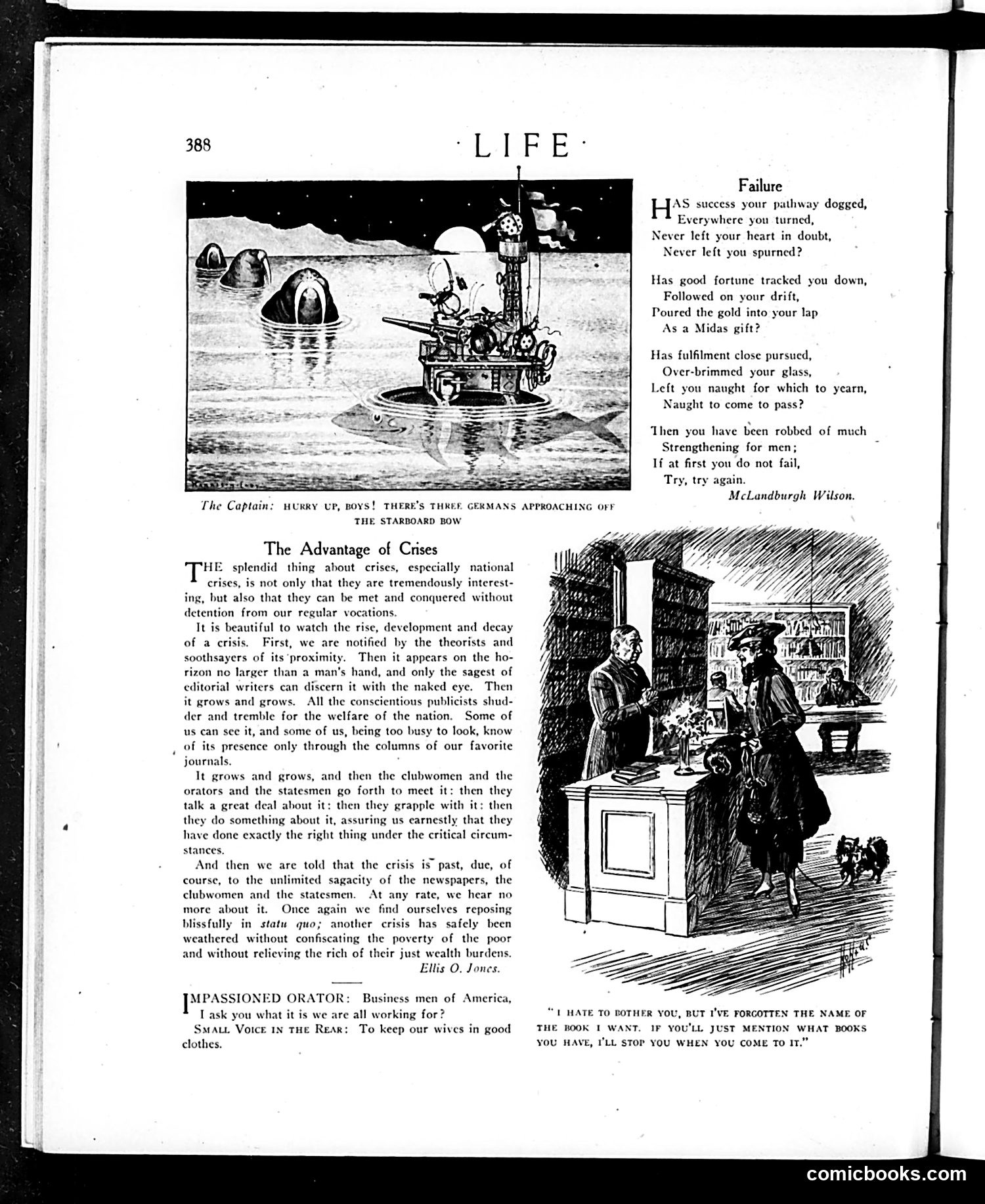
**Top Illustration**: "The Captain" depicts a WWI-era naval scene with a submarine or vessel under attack ("Hurry up, boys! There's three Germans approaching off the starboard bow"). This reflects American anxieties about German naval warfare during or around World War I. **"Failure" Poem**: By McLandburgh Wilson, it's an inspirational verse advising persistence through setbacks—offering consolation that early failure strengthens character if one perseveres. **"The Advantage of Crises"**: An essay by Elia O. Jones arguing that national crises, while serious, create opportunity for public discourse and eventual resolution, though media coverage can be sensationalized. **Bottom Cartoon**: A library scene where a patron urgently seeks a book title they've forgotten, humorously depicting the frustration of imperfect memory. The page blends war commentary, self-help sentiment, and domestic humor typical of the era.
📄 Transcribed text from this page (OCR, searchable)
Machine-transcribed from the original scan — historical spelling and the odd misread are preserved.
The Captain: Woeny uP, Boys! THERE'S THREE GERMANS THE STARBOARD BOW The Advantage of Crises splendid thing about. crises, especially national is not only that they are tremendously interest- ing, but also that they can be met and conquered without detention from our regular vocations. It is beautiful to watch the rise, development and decay of a crisis. First, we are notified by the theorists and soothsayers of its ‘proximil Then it appears on the ho- rizon no larger than a man’s hand, and only the sagest of editorial writers can discern it with the naked eye. Then it grows and grows. All the conscientious publicists shud- der and tremble for the welfare of the nation. Some of us can see it, and some of us, being too busy to look, know of its presence only through the columns of our favorite journals. It grows and grows, and then the clubwomen and the orators and the statesmen go forth to meet it: then they talk a great deal about it: then they grapple with it: then they do something about it, assuring us earnestly that they have done exactly the right thing under the critical circum- stances. And then we are told that the crisis is past, due, of course, to the unlimited sagacity of the newspapers, the clubwomen and the statesmen. At any rate, we hear no more about it. Once again we find ourselves reposing Dlissfully in statu quo; another crisis has safely been weathered without confiscating the poverty of the poor and without reli g the rich of their just wealth burdens. Ellis O. Jones. MPASSIONED ORATOR: Business men of America, Task you what it is we are all working for? Sau Voice 1n tHe Rear: To keep our wives in good clothes. “1 MATE TO BOTHER Yo THE BOOK I WANT. Failure S success your pathy Everywhere you turned, Never left your heart in doubt, dogged, Never left you spurned? Has good fortune tracked you down, Followed on your drift, Poured the gold into your lap As a Midas gift? Has fulfilment close pursued, Over-brimmed your glass, Left you naught for which to yearn, Naught to come to pass? ‘Then you have been robbed of much Strengthening for men; If at first you do not fail, again. McLandburgh Wilson. BUT I'VE FORGOTTEN THE NAME OF IF YOU'LL JUST MENTION WHAT BOOKS YOU HAVE, I'LL STOP YOU WHEN YOU COME To IT,” comicbooks.com