
A complete issue · 48 pages · 1916
Life — January 6, 1916
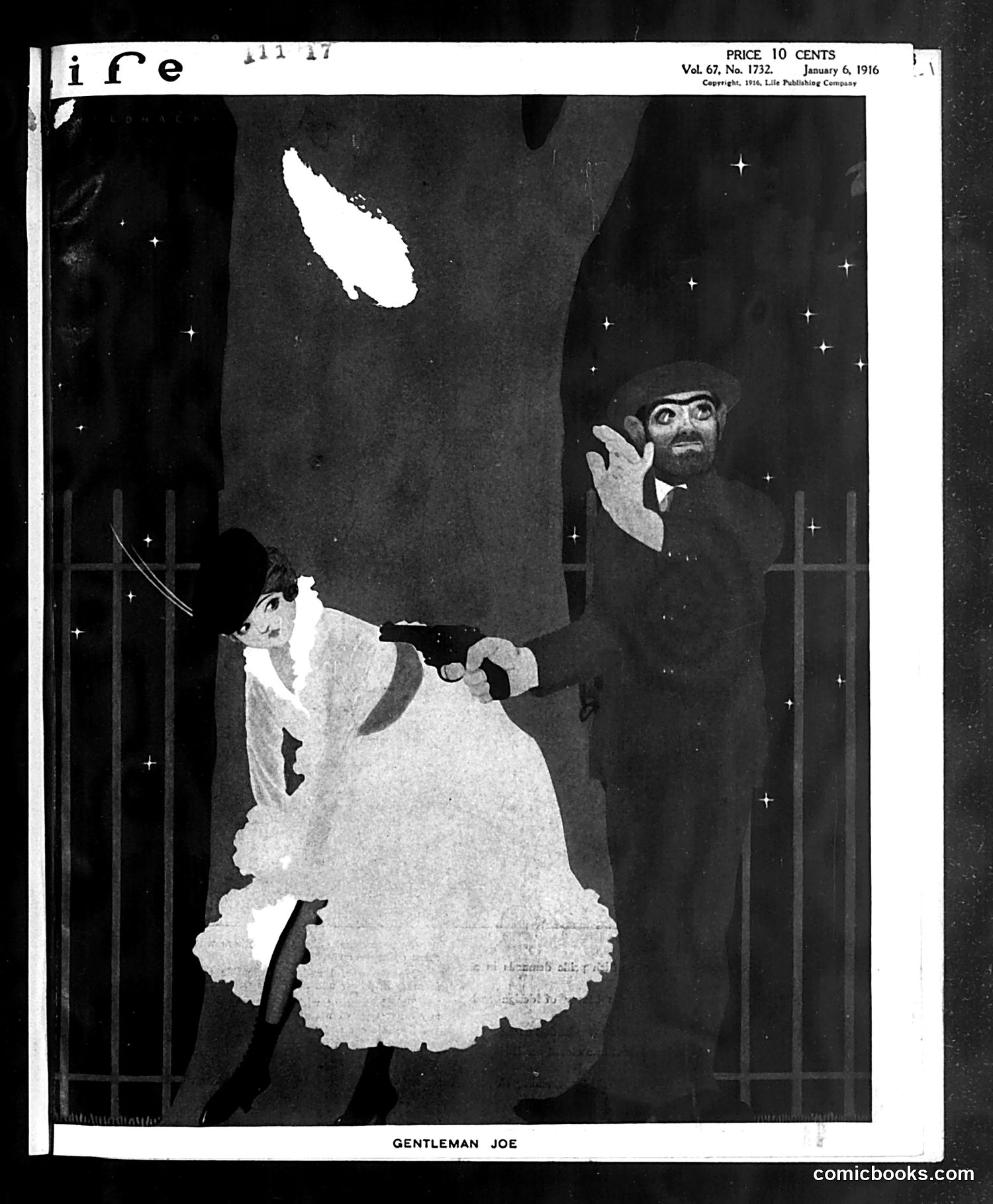
This cartoon depicts a romantic or seduction scene with a man in formal attire (top hat and coat) gesturing dramatically toward a woman in an elaborate white dress who holds a pistol. The title "Gentleman Joe" suggests the male figure is a character known for courtly behavior. The satirical point appears to concern the contrast between genteel, polite manners and underlying danger or deception. The woman's armed readiness suggests she's defending herself against unwanted advances despite the man's refined appearance and courteous demeanor. Without additional context, the specific "Joe" character referenced remains unclear—this could reference a popular stage character, political figure, or social archetype of the era known for using charm as a manipulation tactic.
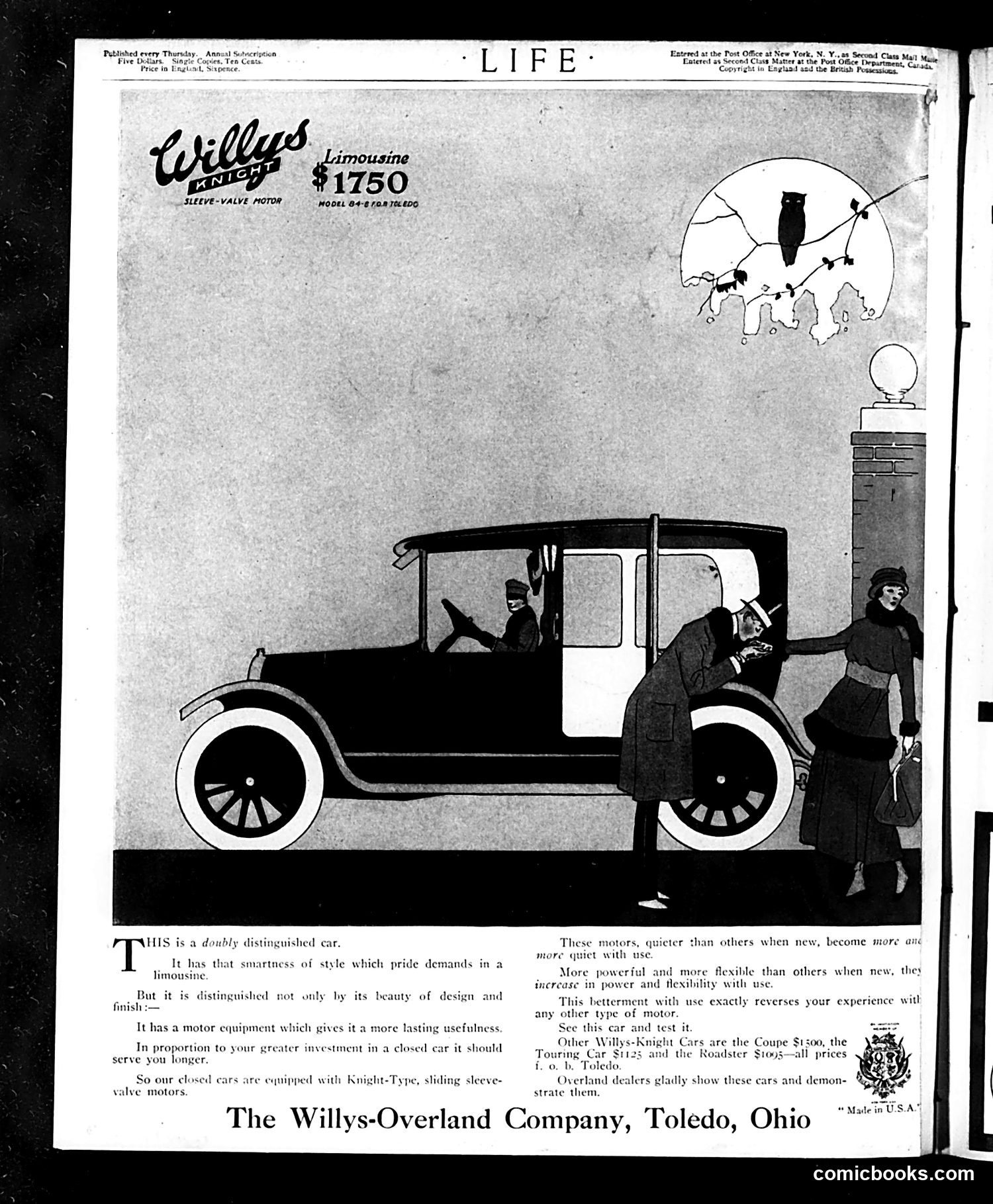
This page is primarily **advertising**, not satire or political commentary. It's a Willys-Knight automobile advertisement from *Life* magazine, promoting a Limousine model priced at $1,750. The advertisement emphasizes the car's "distinguished" design and superior engineering, particularly its "Knight-Type, sliding sleeve-valve motors," which the text claims become "quieter" and "more powerful" with use—a selling point distinguishing it from competitors. The illustration shows a well-dressed couple with their automobile, suggesting affluence and social status. The small inset illustration depicting travelers and a map reinforces the vehicle's reliability for journeys. The ad is credited to the Willys-Overland Company of Toledo, Ohio, and includes typical period marketing language about durability and investment value.

This page is primarily a **Columbia Records advertisement**, not satirical content. The upper illustration shows a classroom or school setting where children are listening to Columbia Records on a Gramophone, with teachers or authority figures present. The advertising text emphasizes that Columbia Records and Gramofonolas have been officially adopted by New York City schools based on competitive testing proving Columbia's superiority in "tone." The copy argues these records aid children's mental development and education. The lower portion shows a Columbia Grafonola Model 110 phonograph priced at $110. This represents early 20th-century corporate marketing leveraging institutional endorsements (school adoption) to promote consumer products to middle-class families. There is no political satire evident on this page.
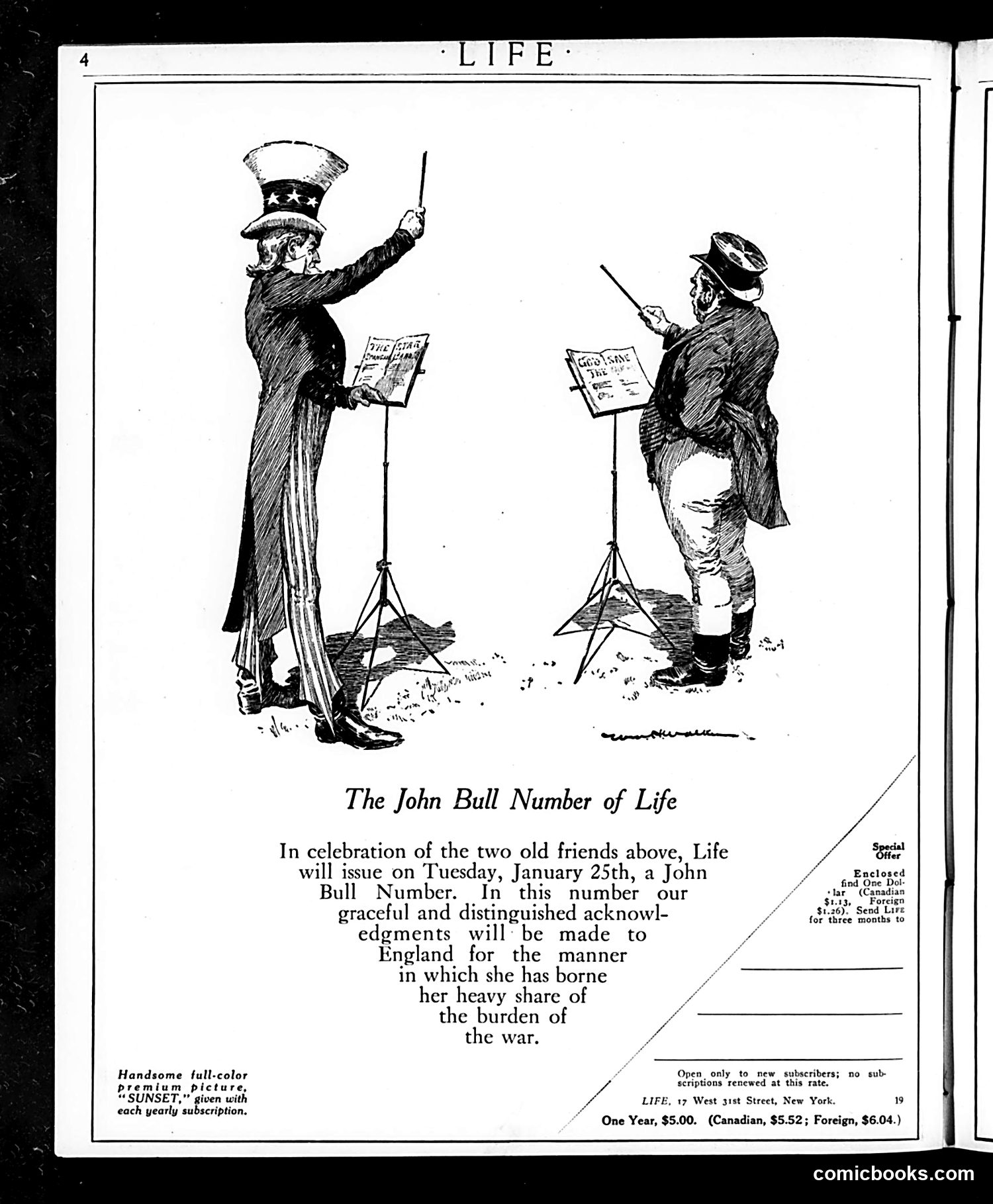
This page announces a special issue of Life magazine (January 25th) celebrating two "old friends"—Uncle Sam (left, in starred top hat) and John Bull (right, in British attire), shown conducting orchestras. The cartoon represents the United States and Britain as allied conductors, likely referencing their cooperation during World War I (the text mentions "the burden of the war"). The satire honors England's wartime contributions. John Bull is a traditional personification of Britain; Uncle Sam represents America. Their parallel positioning as musicians suggests coordinated effort. The announcement offers this issue as a premium subscription incentive, with a full-color "SUNSET" picture included for new yearly subscribers at $5 (Canadian $5.52; Foreign $6.04).
This is an advertisement for the Chalmers automobile, specifically its new 3400 r.p.m. (revolutions per minute) engine model. The text celebrates the car's popularity—100,000 people visited showrooms in two months following its $22,000,000 launch. The key appeal was **acceleration and speed**. The advertisement emphasizes that 3400 r.p.m. represented the highest engine speed available for American stock cars, contrasting with European vehicles that used smaller, less powerful engines due to high fuel costs and tax structures based on horsepower. The simple line drawing shows a car on a country road, illustrating the "great treat of a run in the open country" promised by the accelerator. This is straightforward automotive marketing, not political satire—it's celebrating American engineering superiority and the consumer appeal of a powerful, fast automobile.
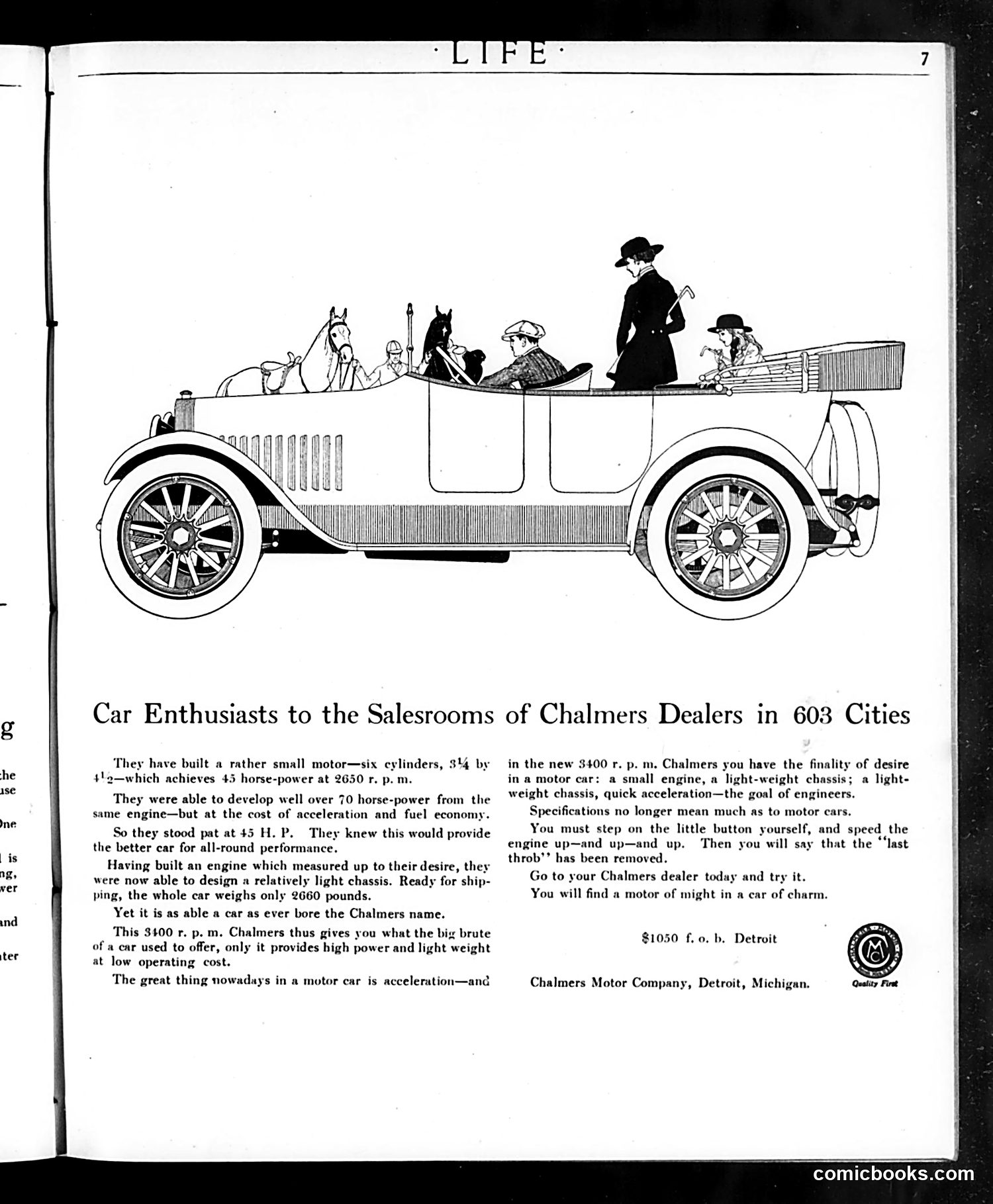
This is an advertisement for Chalmers automobiles, not a political cartoon. The image shows an early motorcar loaded with passengers and cargo—horses, people in period dress, household goods—illustrating the vehicle's capacity and practicality. The ad targets "Car Enthusiasts" and emphasizes the Chalmers' modest specifications: a six-cylinder engine producing 3,400 RPM and 2,660-pound weight. The copy focuses on acceleration as the key selling point ("the great thing nowadays in a motor car is acceleration"), positioning this as superior to raw horsepower. The price listed is $1,050 f.o.b. Detroit. The message essentially argues that a lighter car with good acceleration outperforms heavier, more powerful vehicles—a practical selling point for early automotive buyers choosing between competing technologies.
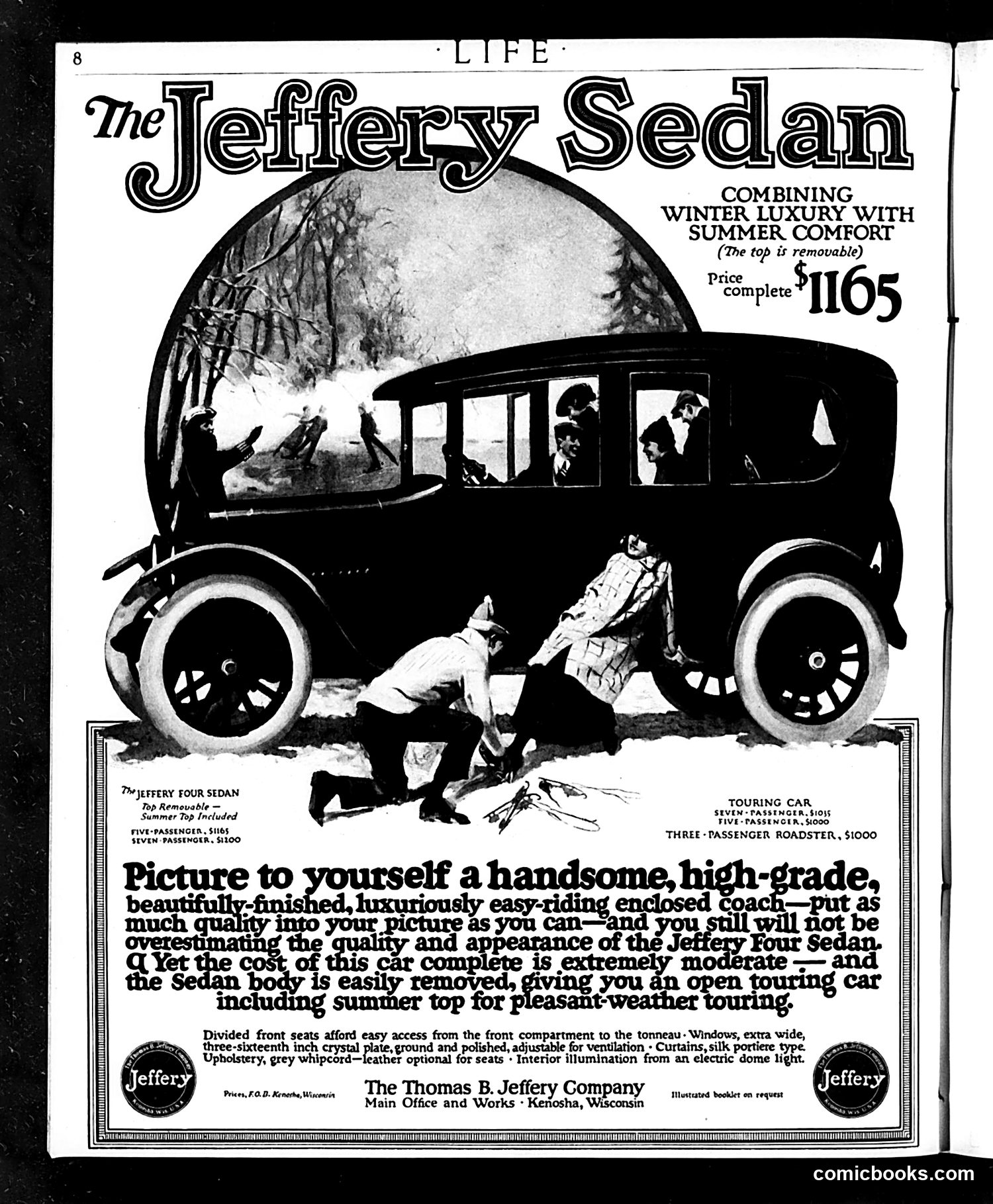
This is a **car advertisement**, not political satire. It promotes the Jeffery Sedan automobile, manufactured by The Thomas B. Jeffery Company of Kenosha, Wisconsin. The ad emphasizes the car's dual functionality: it combines "winter luxury with summer comfort" through a removable top, priced at $1,105 complete. The illustration shows a couple relaxing beneath the vehicle in pleasant weather, suggesting leisure and comfort. The copy appeals to buyers wanting quality craftsmanship at a "moderate" cost. It highlights practical features like removable body panels for ventilation, silk curtains, and an electric dome light—luxury amenities for early-1900s automobiles. This represents typical automotive marketing from the era, targeting middle-to-upper-class consumers interested in modern conveniences.
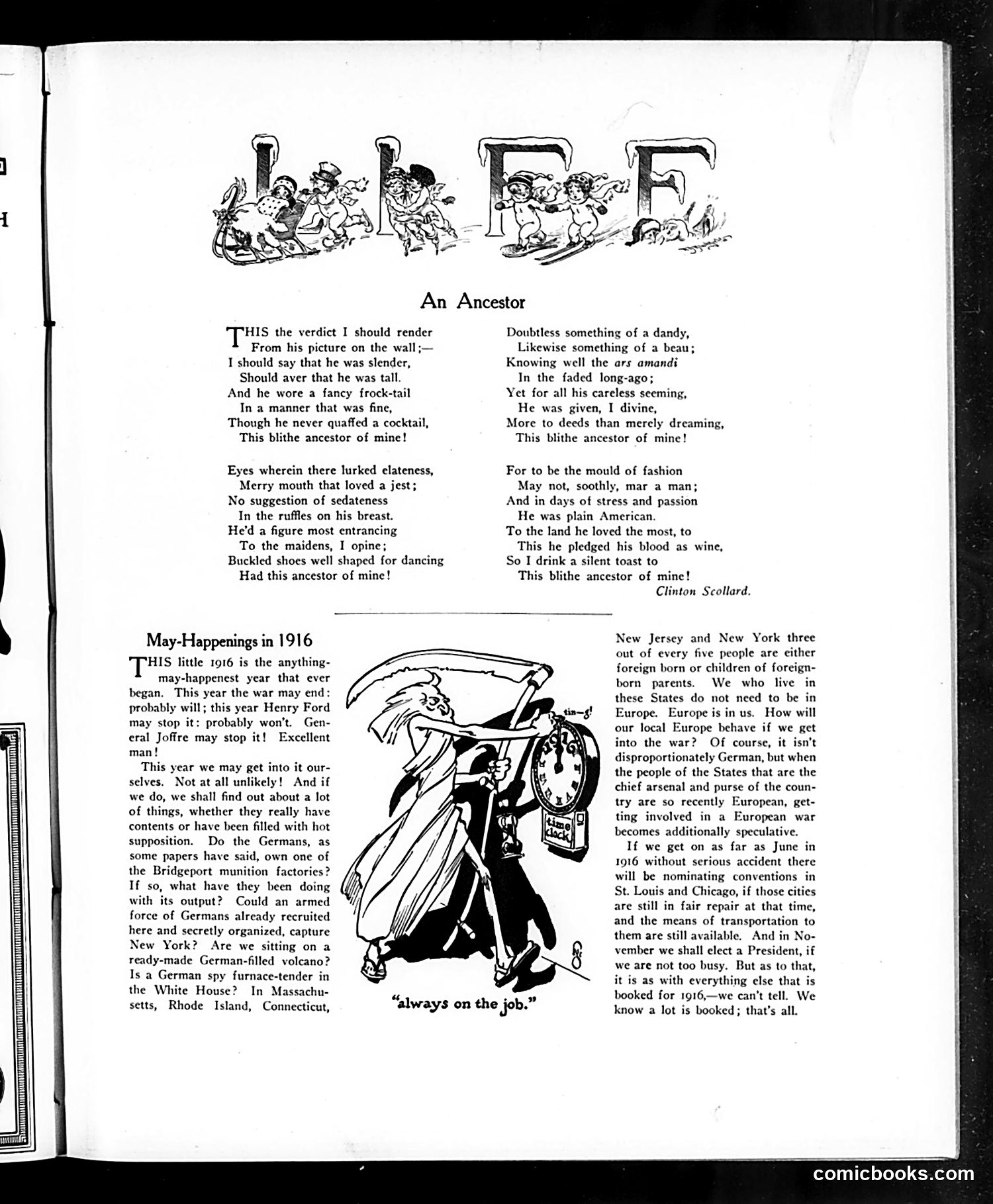
**"An Ancestor"** is a poem by Clinton Scollard describing an elegant colonial ancestor—a dandy who was "slender" and "tall," wore fine clothes, and was "divine." The satire mocks the narrator's pride in this frivolous forebear, contrasting his fashionable idleness with the ancestor's supposed superiority. The decorative header with cherubs emphasizes the pretentious veneration of aristocratic ancestry. **"May-Happenings in 1916"** presents speculative anxieties about German sabotage during World War I. The cartoon depicts Time as a laborer "always on the job," while the accompanying text voices paranoid concerns: Could Germans capture New York? Infiltrate the White House? Sabotage munitions factories? These fears reflect American anxiety about potential enemy agents and war involvement as 1916 progressed.
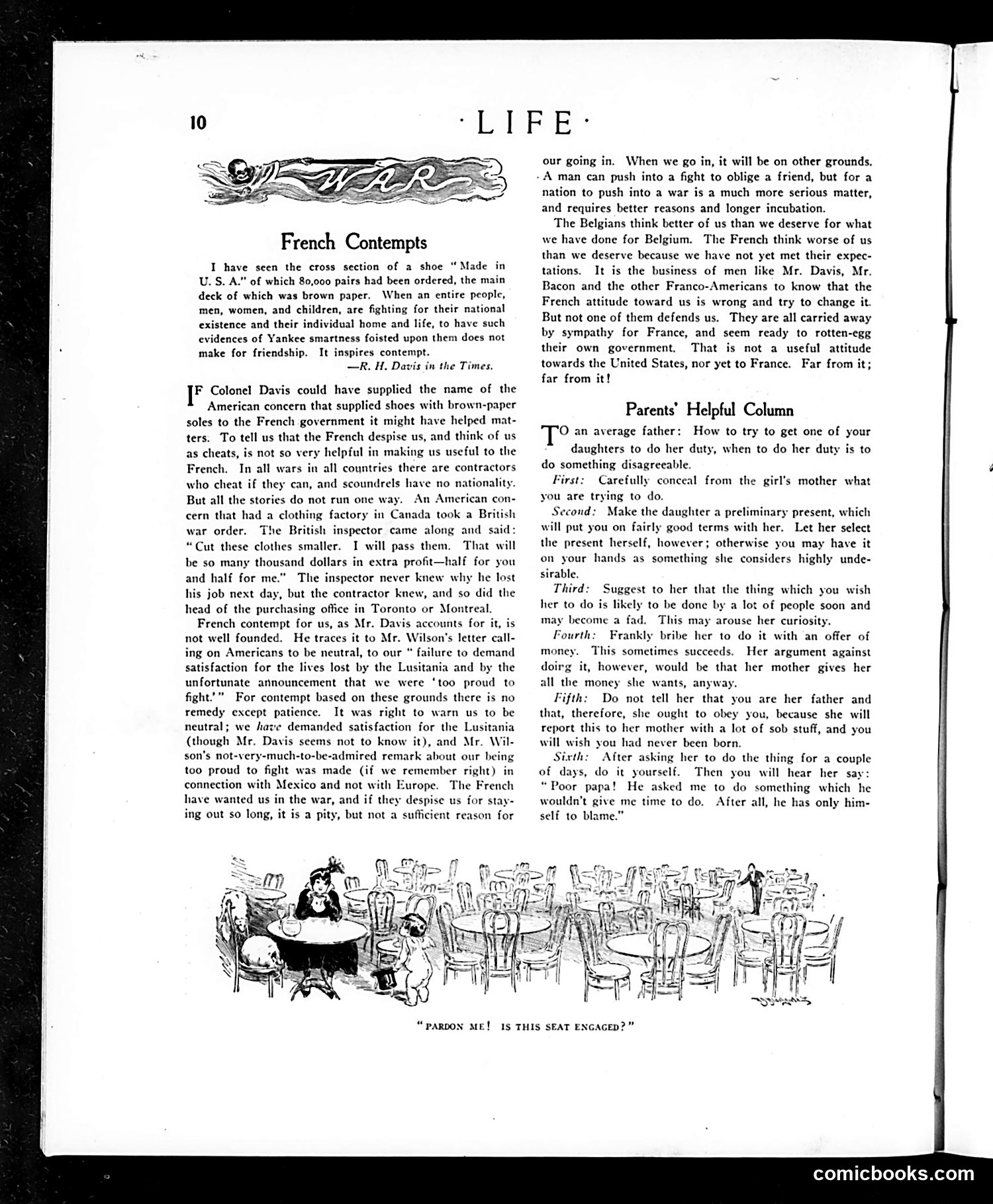
**"French Contempts" article**: R.H. Davis criticizes French attitudes toward Americans during WWI. Davis argues the French resent American soldiers' presence and view Americans as profiteers rather than allies. He references specific grievances: French contempt stems from America's initial neutrality, reluctance to enter the war, and perceived pride about fighting Mexico instead of Europe. Davis defends against accusations that American soldiers are cheaters and profiteers, attributing such behavior to universal wartime corruption rather than American character. **"Parents' Helpful Column"**: A satirical advice column offering six increasingly absurd methods to manipulate a daughter into performing an undesirable task—using concealment, bribery, psychology, and emotional manipulation. **Cartoon**: The illustration depicts a crowded restaurant or café scene with the caption "Pardon me! Is this seat engaged?"—likely a humorous social commentary on public etiquette or wartime social dynamics.
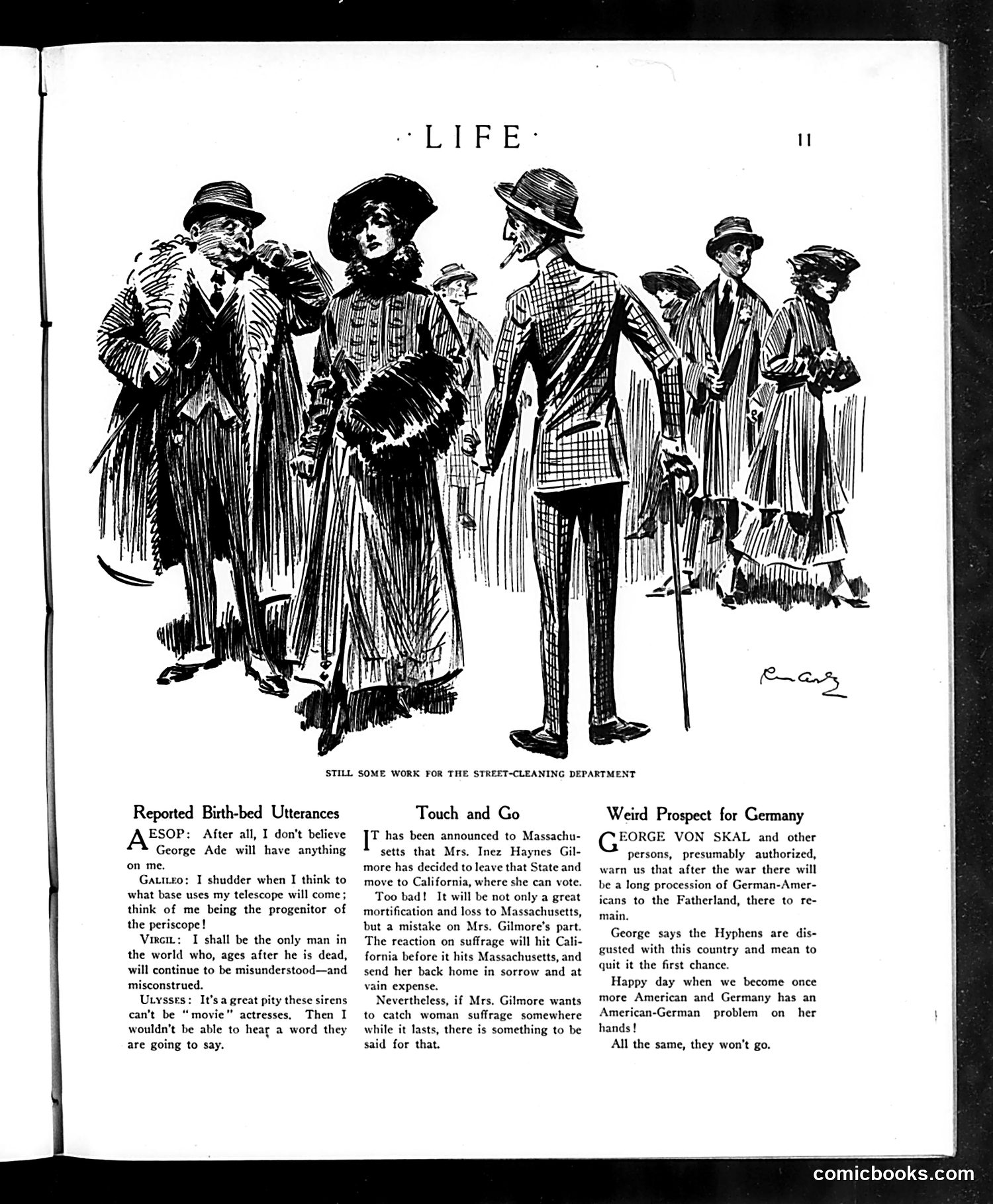
**The Cartoon:** "Still Some Work for the Street-Cleaning Department" depicts a well-dressed man (center, with cane) observing a group of shabby figures—likely homeless, poor, or unemployed people—with apparent disdain. The title's satirical point suggests these marginalized people are "trash" needing removal by city sanitation. **The Text Sections** address contemporary early-20th-century issues: - Women's suffrage (Mrs. Gilmore, Massachusetts) - Immigration concerns (George von Skal warning of post-war German-American tensions) **The Satire:** The cartoon mocks wealthy indifference to urban poverty, while text sections satirize both progressive causes (women's voting rights) and xenophobic fears about German immigrants—capturing period class tensions and nativist anxieties.
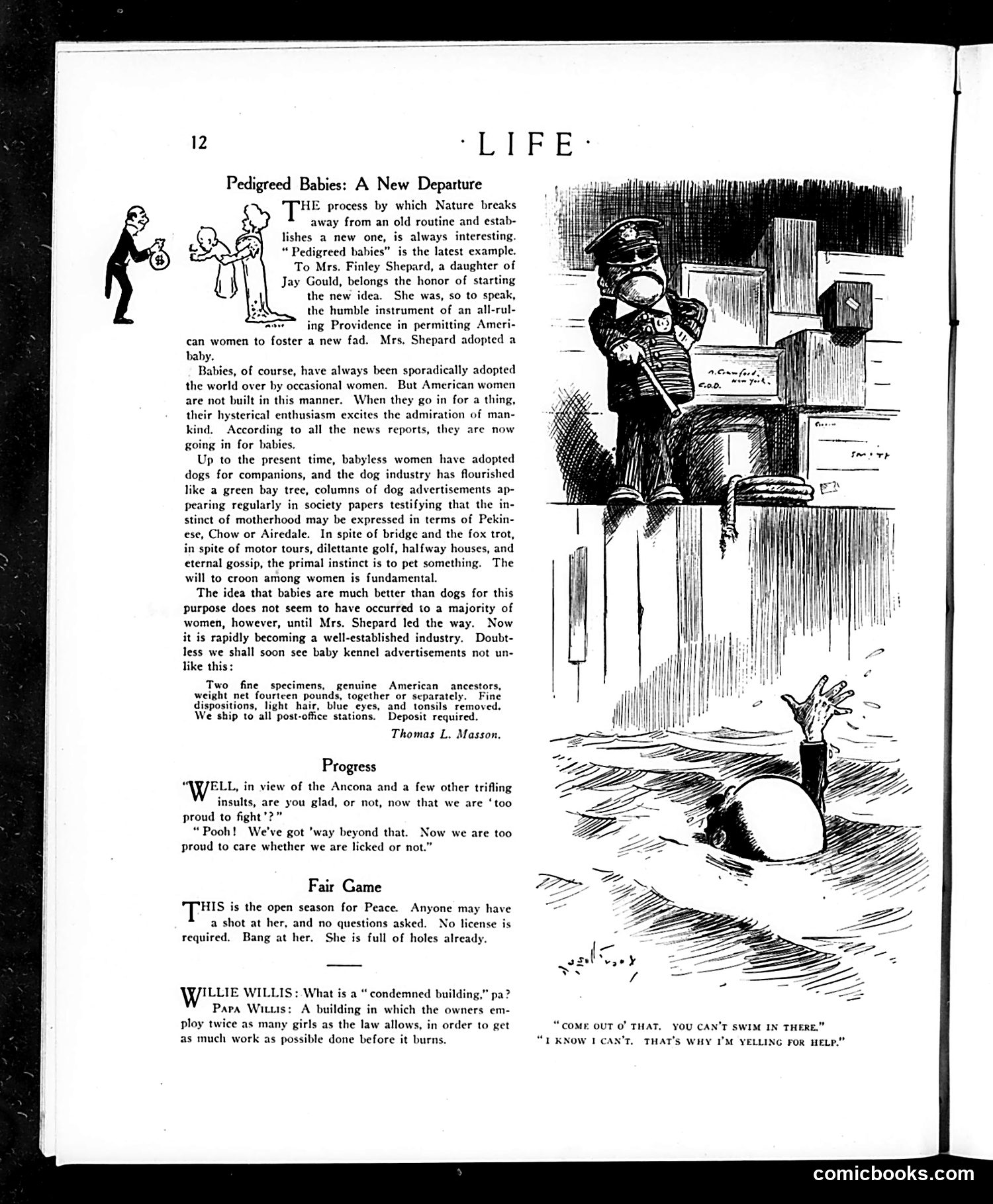
This page contains three distinct satirical pieces: 1. **"Pedigreed Babies"** mocks a new trend among wealthy American women adopting babies as fashionable accessories, similar to how they previously adopted dogs. The text credits Mrs. Finley Shepard with starting this fad. The satire suggests women's superficial desire to "pet something" drives this behavior. 2. **"Progress"** and **"Fair Game"** are brief humorous dialogues about social attitudes—one about pride, one about Peace season (appearing to reference hunting season for women, a dark joke about violence). 3. **"Willie Willis"** defines "condemned building" as one where owners employ excessive workers before demolition to maximize profits—a critique of labor exploitation and safety violations in construction. The cartoons use exaggerated illustration to amplify the satire's bite.
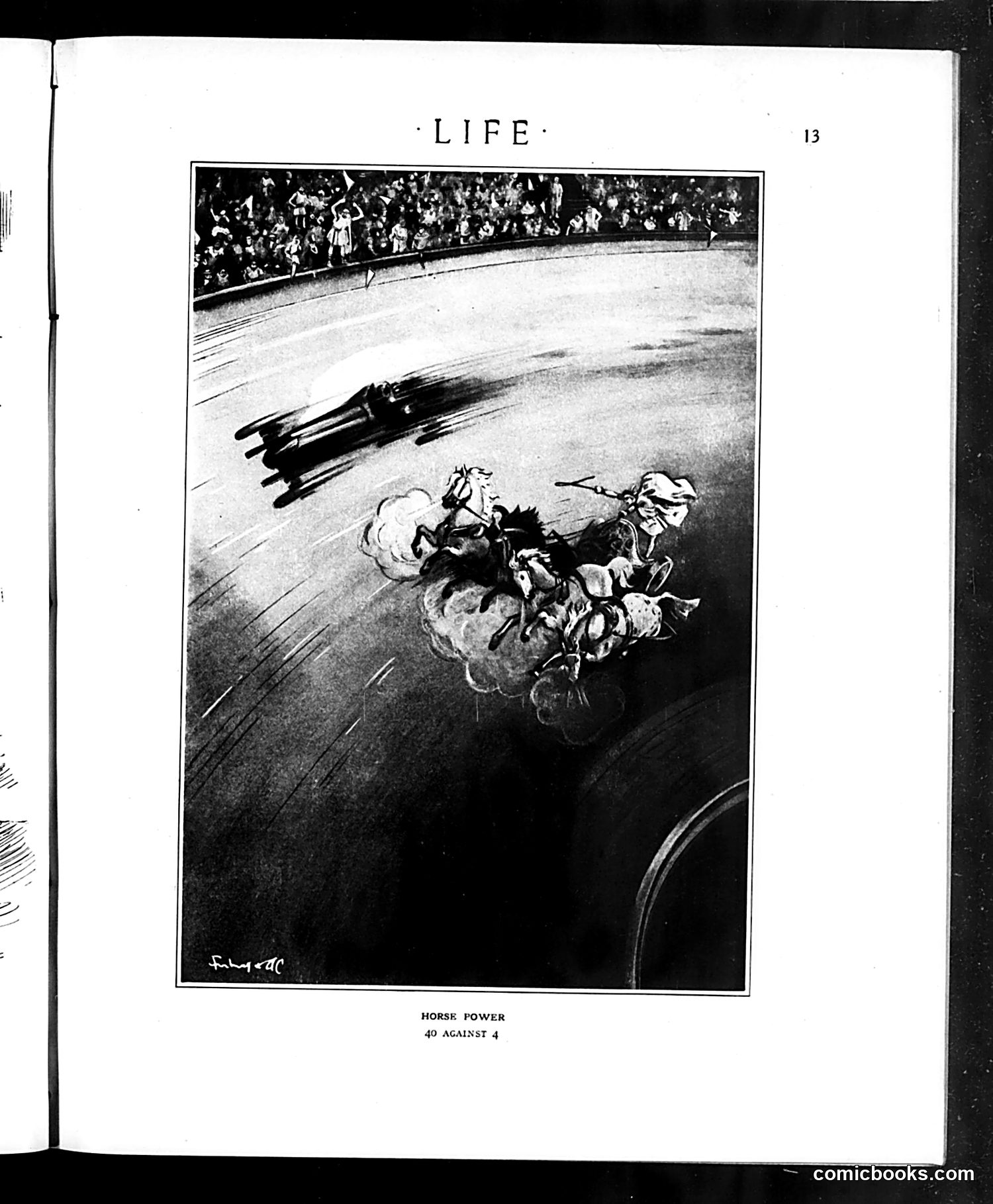
This political cartoon depicts a horse-drawn chariot or cart being pulled by four horses at high speed around what appears to be a racetrack or arena, with spectators visible in the stands above. The caption reads "Horse Power: 40 Against 4," suggesting a comparison of forces or power. The cartoon likely satirizes a political or social conflict where one side (represented by "40") is pitted against a much smaller opposition (the "4"). Without additional context about the specific date and political circumstances of this Life magazine issue, the exact figures or events referenced remain unclear. The dramatic speed and composition suggest the cartoon comments on an imbalanced struggle or competition.
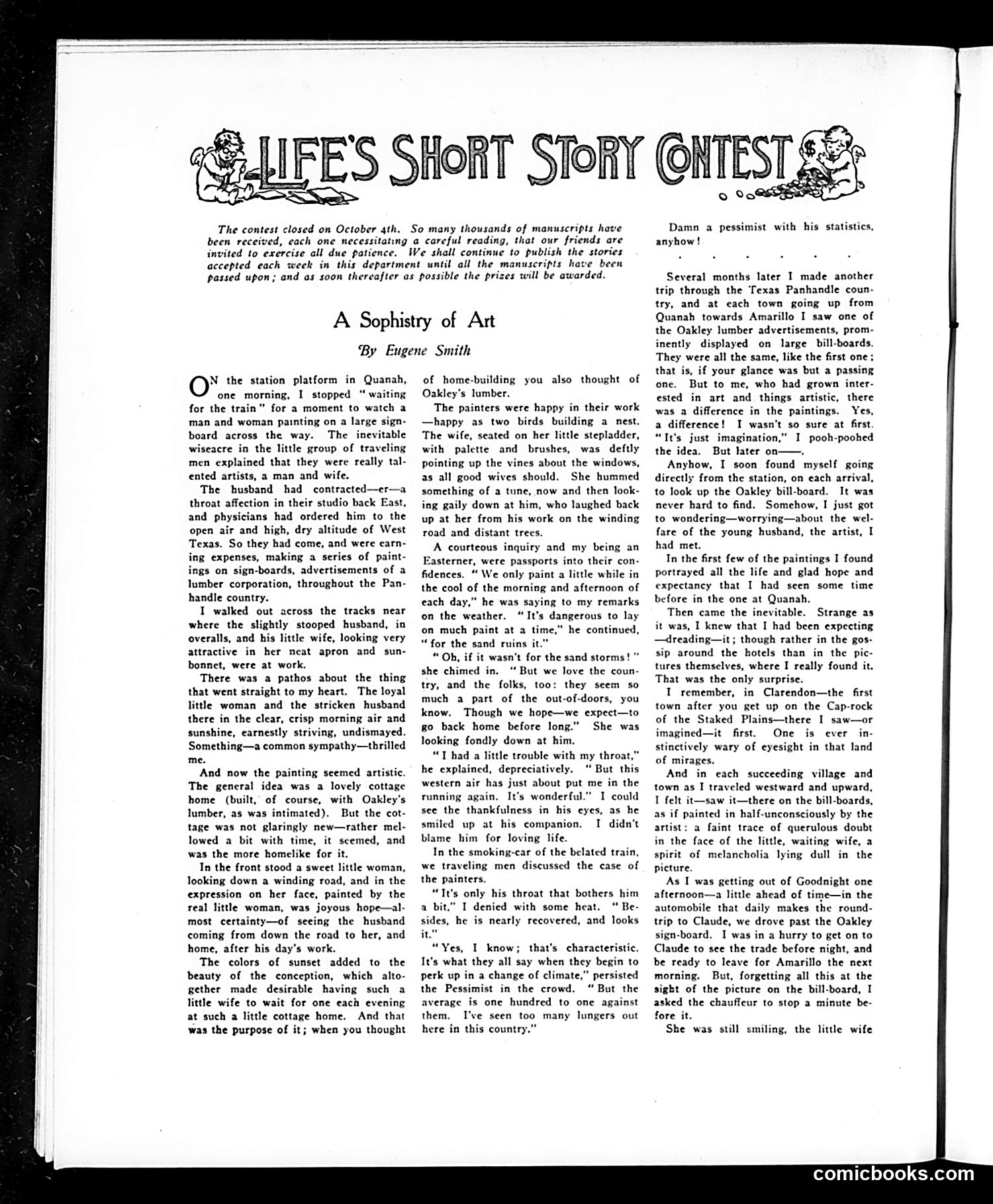
This page presents "A Sophistry of Art" by Eugene Smith, a contest-winning short story from Life's 1920s short story contest (closed October 4th). The story describes a narrator's journey through the Texas Panhandle who repeatedly encounters the same Oakley lumber company billboard advertisements displayed on large signs in various towns. What initially appears to be a charming painting of a cottage home—featuring a wife waiting for her husband—becomes increasingly uncanny as the narrator recognizes it's the identical image repeated everywhere. The "sophistry" refers to the clever deception: what seems like authentic, heartfelt art is actually mass-produced commercial propaganda designed to manipulate emotions and sell lumber through idealized domestic imagery. The story satirizes early 20th-century advertising's cynical use of sentimentality to create false emotional connections to products.
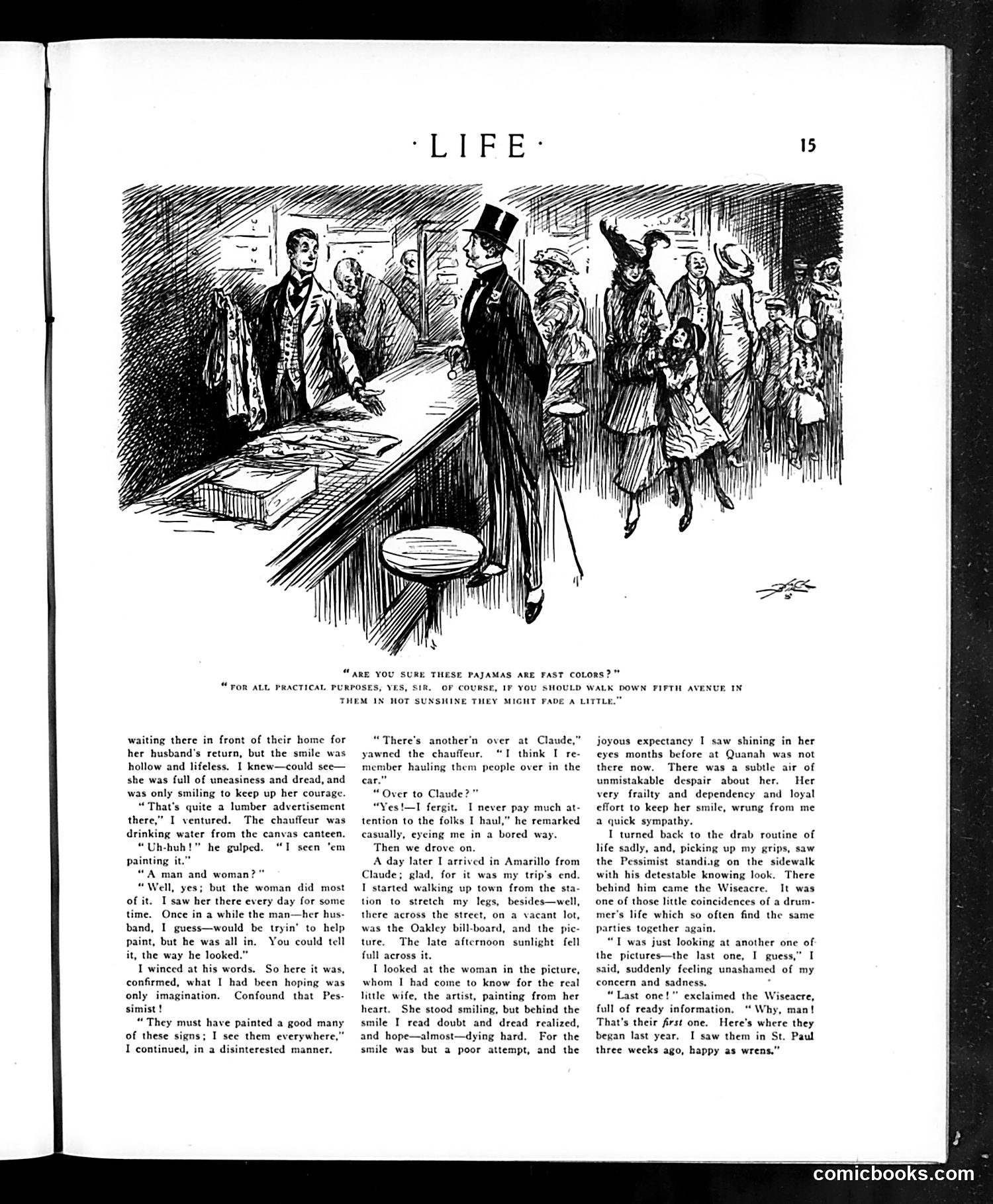
This page contains a single cartoon and accompanying narrative text about an art exhibition or gallery opening. The cartoon depicts a well-dressed man in a top hat viewing what appears to be amateur paintings, surrounded by various visitors in formal attire. The caption's joke concerns *fast-fading pajamas*: a gentleman asks another if certain pajamas are "fast colors," then suggests that for "practical purposes," if someone walked them down Fifth Avenue in hot sunshine, "they might fade a little." The satire targets the pretentiousness of casual gallery-goers and possibly dubious product claims. The narrative describes the speaker's encounter with a portrait of a woman—the artist's wife—painted with such poor technique that her hopeless expression reads as genuine anguish. The humor relies on contrasting artistic ambition with incompetent execution.
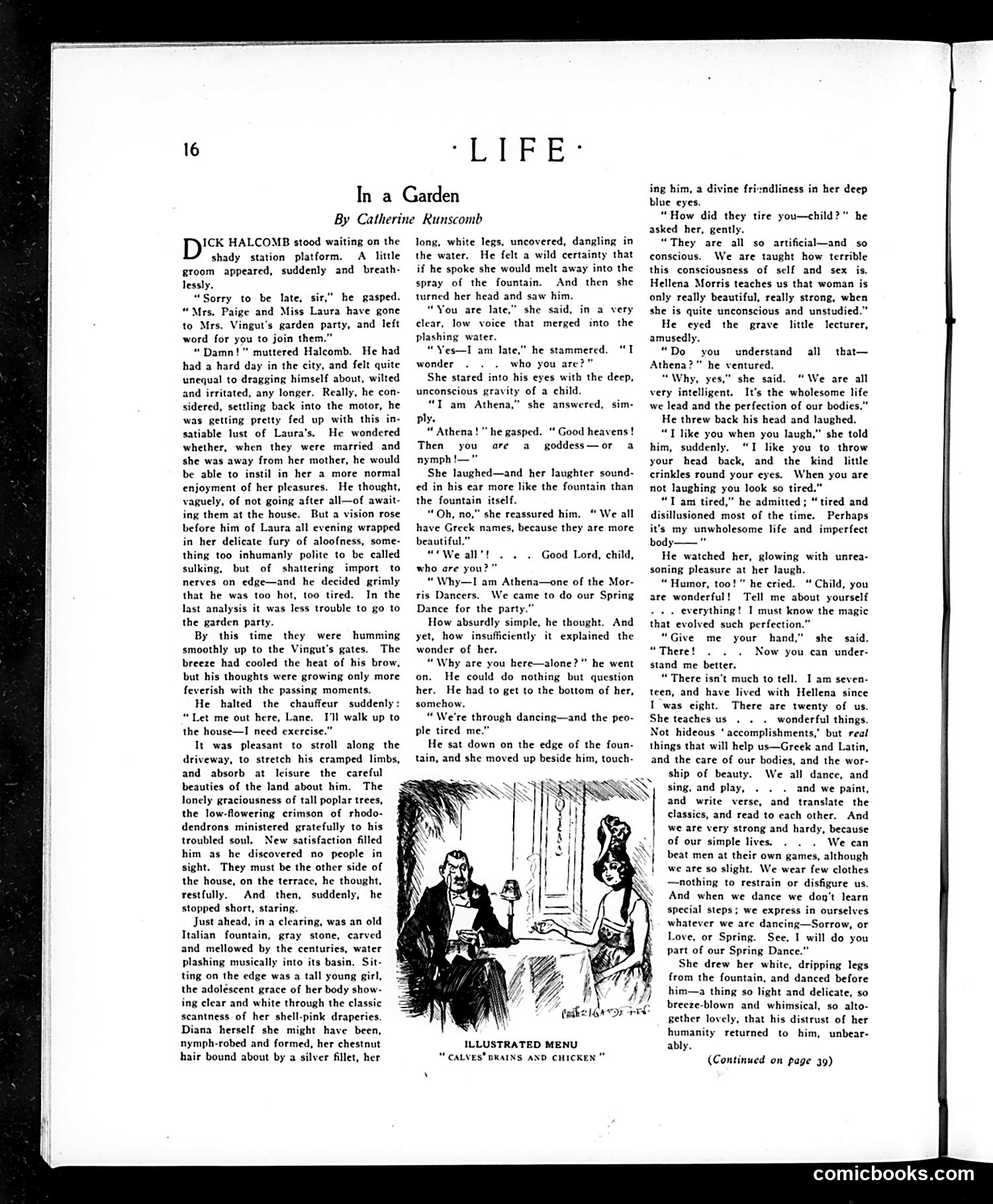
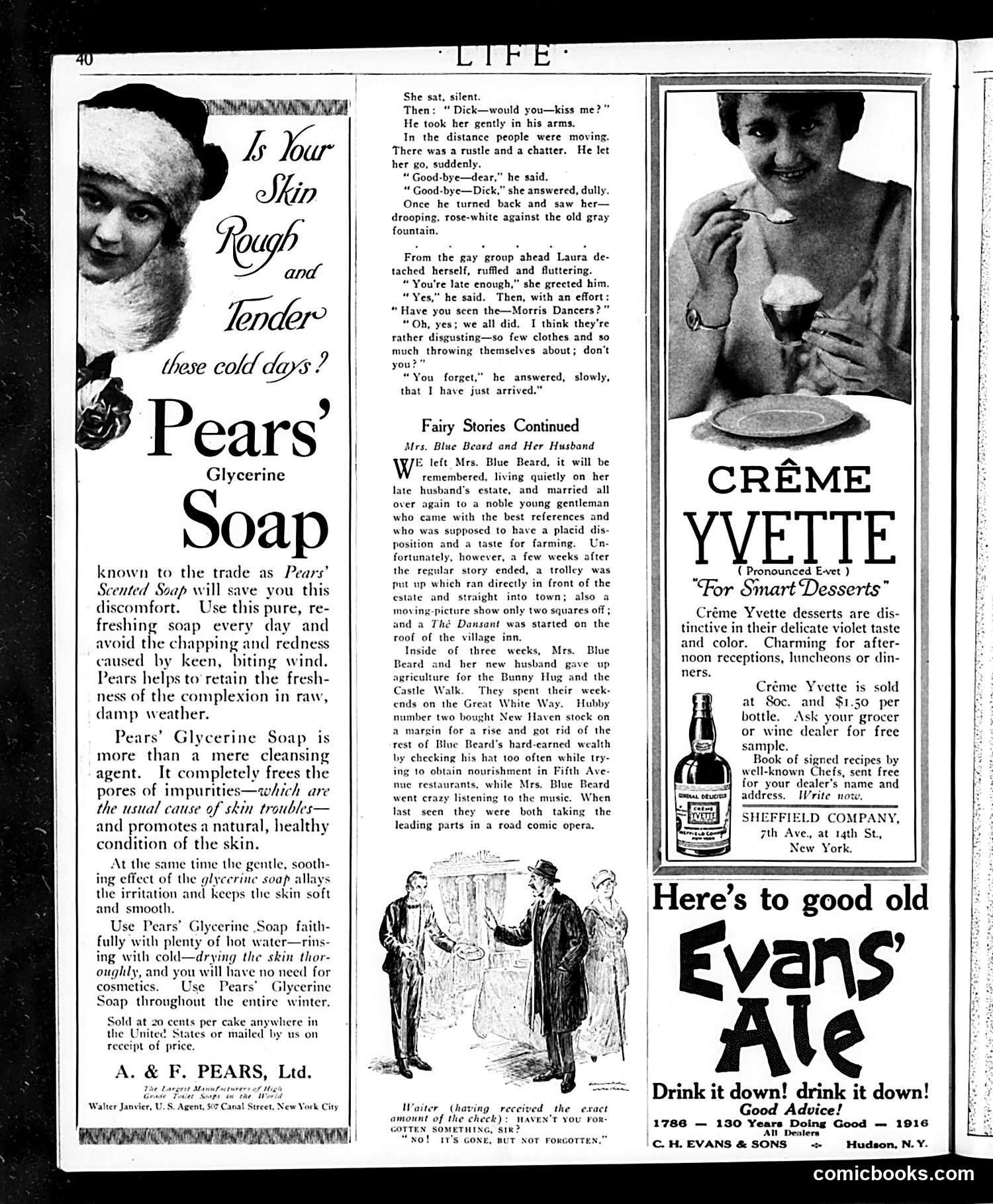
This page contains a short story by Catherine Runscomb titled "In a Garden," not political cartoon or satire. It depicts a romantic narrative: a man named Dick Halcomb reluctantly attends a garden party and encounters a young woman named Athena by a fountain. She's one of the "Morris Dancers" (a traditional English folk-dancing group) hired to perform at the party. The story explores class and attraction—Halcomb is initially enchanted by her ethereal, goddess-like appearance, only to learn she's simply a performer. The illustration shows them by the fountain in conversation. This is **literary fiction**, typical of Life magazine's content alongside satire and humor pieces. It contains no political references or social commentary beyond subtle class dynamics.
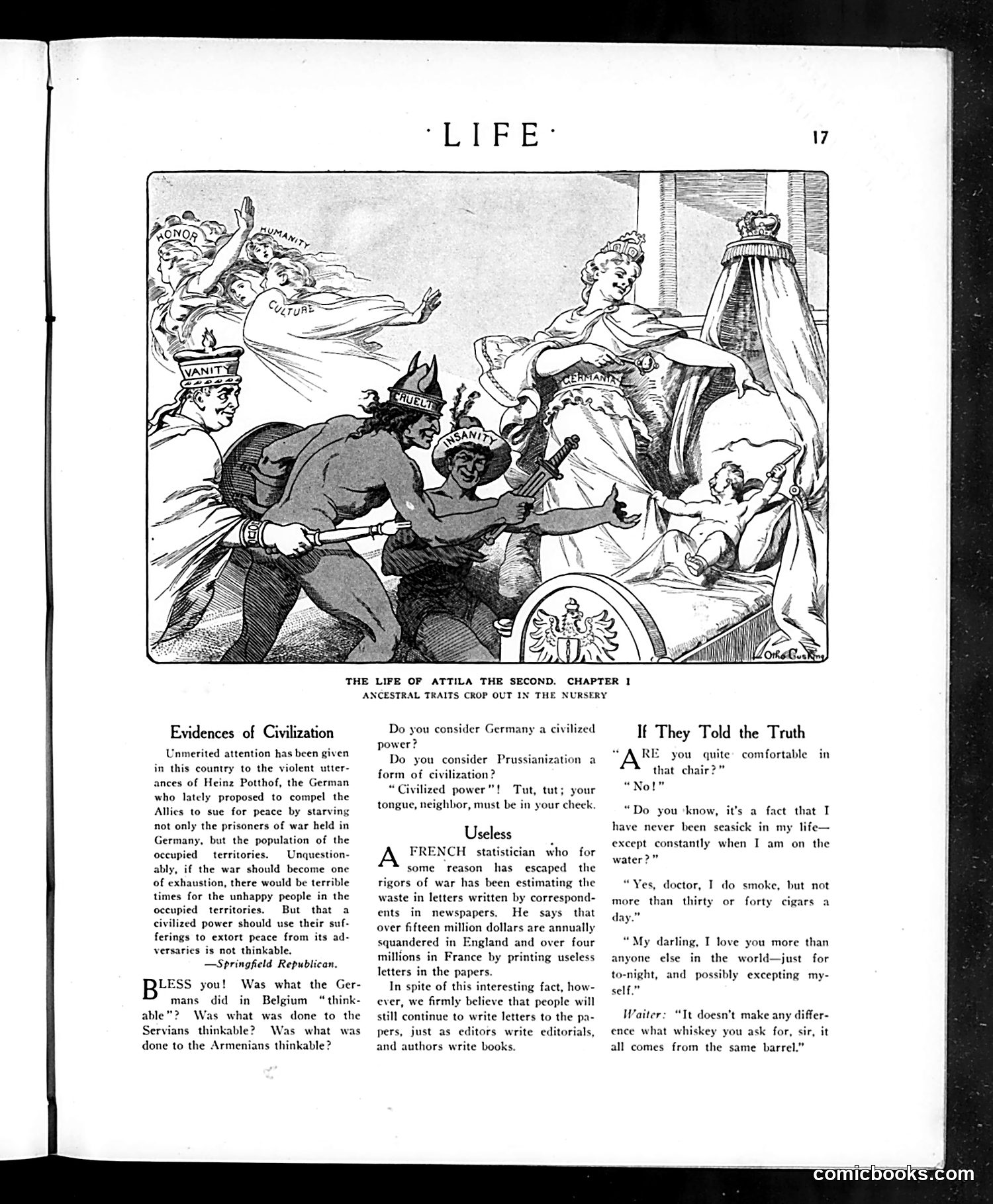
This satirical cartoon mocks German claims of being a "civilized power" during World War I. The main illustration depicts chaotic violence—figures labeled with virtues like "Humanity," "Culture," and "Chivalry" are shown attacking or attacking others, suggesting these noble ideals are being violated. The accompanying text references Heinz Potthof, a German who proposed starving Allied prisoners and occupied populations into submission. The satire's core point: Germany cannot claim civilization while committing such atrocities. The repeated rhetorical questions—"Was what the Germans did in Belgium thinkable? Was what was done to the Serbs/Armenians thinkable?"—underscore the hypocrisy of calling Germany "civilized" given documented atrocities in occupied territories and against Armenian populations. The cartoon equates Germany's conduct with Attila the Hun, suggesting it represents barbarism rather than civilization.
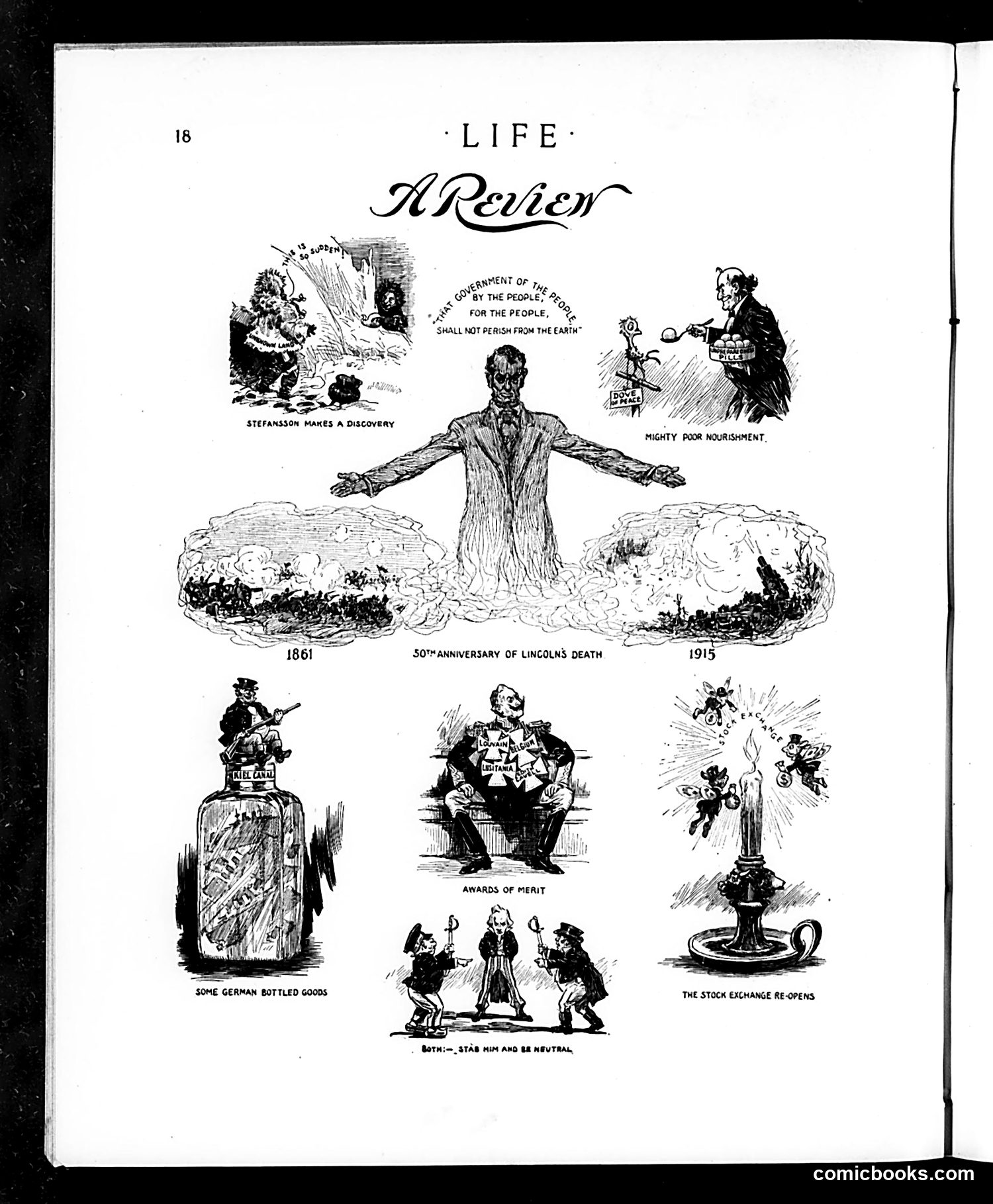
This page satirizes American events during World War I (circa 1915, based on the "50th Anniversary of Lincoln's Death" reference). The central figure with outstretched arms appears to represent America balancing competing pressures: - **Left side**: "Stefansson Makes a Discovery" and "Some German Bottled Goods" mock German imports and possibly espionage - **Right side**: "Mighty Poor Nourishment" criticizes inadequate policies - **Center panels**: "Awards of Merit" and the figure straddling 1861-1915 suggest tension between Lincoln's ideals and present circumstances - **Bottom**: "Bath—Star Him and Be Neutral" parodies American neutrality debates - **Stock Exchange panel**: References financial/economic disruption from the war The cartoons collectively critique American wavering on WWI involvement, economic impacts, and whether founding principles ("government of the people...") remained intact during wartime pressures.
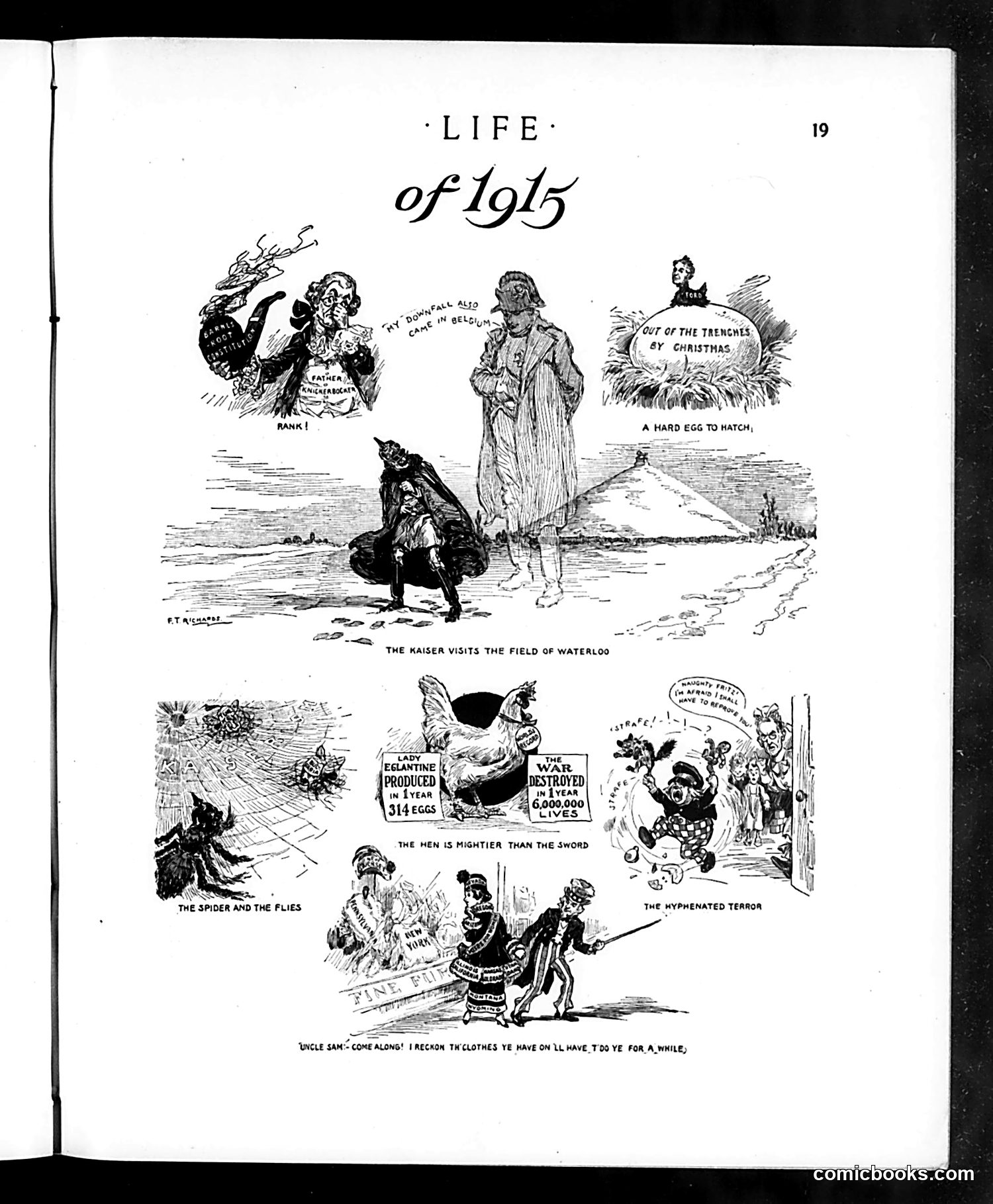
This 1915 *Life* magazine page satirizes World War I through multiple political cartoons. The central image shows "The Kaiser Visits the Field of Waterloo"—Germany's leader surveying a battlefield, paired with captions about war's human cost ("6,000,000 lives destroyed in 1 year"). "The Spider and the Flies" depicts entanglement in war. "The Men is Mightier than the Sword" contrasts military might with human lives. The bottom cartoon shows Uncle Sam (America) telling someone to prepare for a long conflict—likely referencing American concerns about potential involvement in the ongoing European war. The "hard egg to hatch" caption and Christmas reference suggest skepticism about war's promised quick resolution. Overall, the page expresses American anxiety about the war's scale and duration, circa 1915—before the U.S. officially entered in 1917.
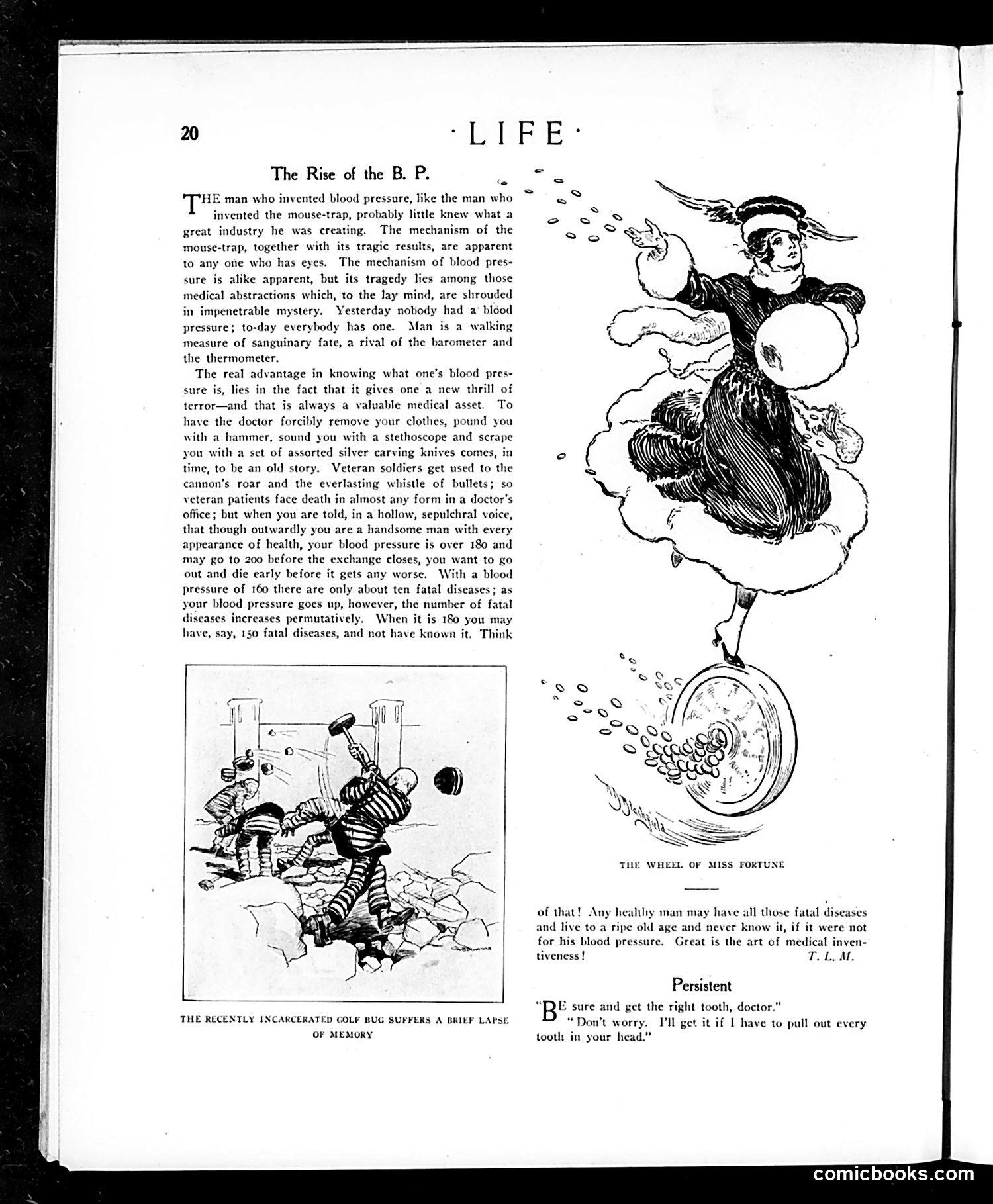
This page satirizes the early 20th-century popularization of blood pressure measurement as a medical diagnostic tool. The article mocks how this newly-available measurement created widespread anxiety among patients who previously had no knowledge of their blood pressure. The satire's central joke: blood pressure readings give people a "new thrill of terror" by revealing numerical values that doctors interpret as harbingers of numerous fatal diseases. A reading of 180 means "150 fatal diseases" you didn't know you had—creating needless medical panic. **The illustrations** reinforce this: "The Wheel of Miss Fortune" shows a figure spinning on a blood pressure gauge, suggesting randomness and fate. The golf bug cartoon (lower left) appears unrelated—a brief comedic aside. The piece critiques medical anxiety-creation and the gap between what doctors measure and what laypeople understand, arguing that ignorance about such numbers was bliss.
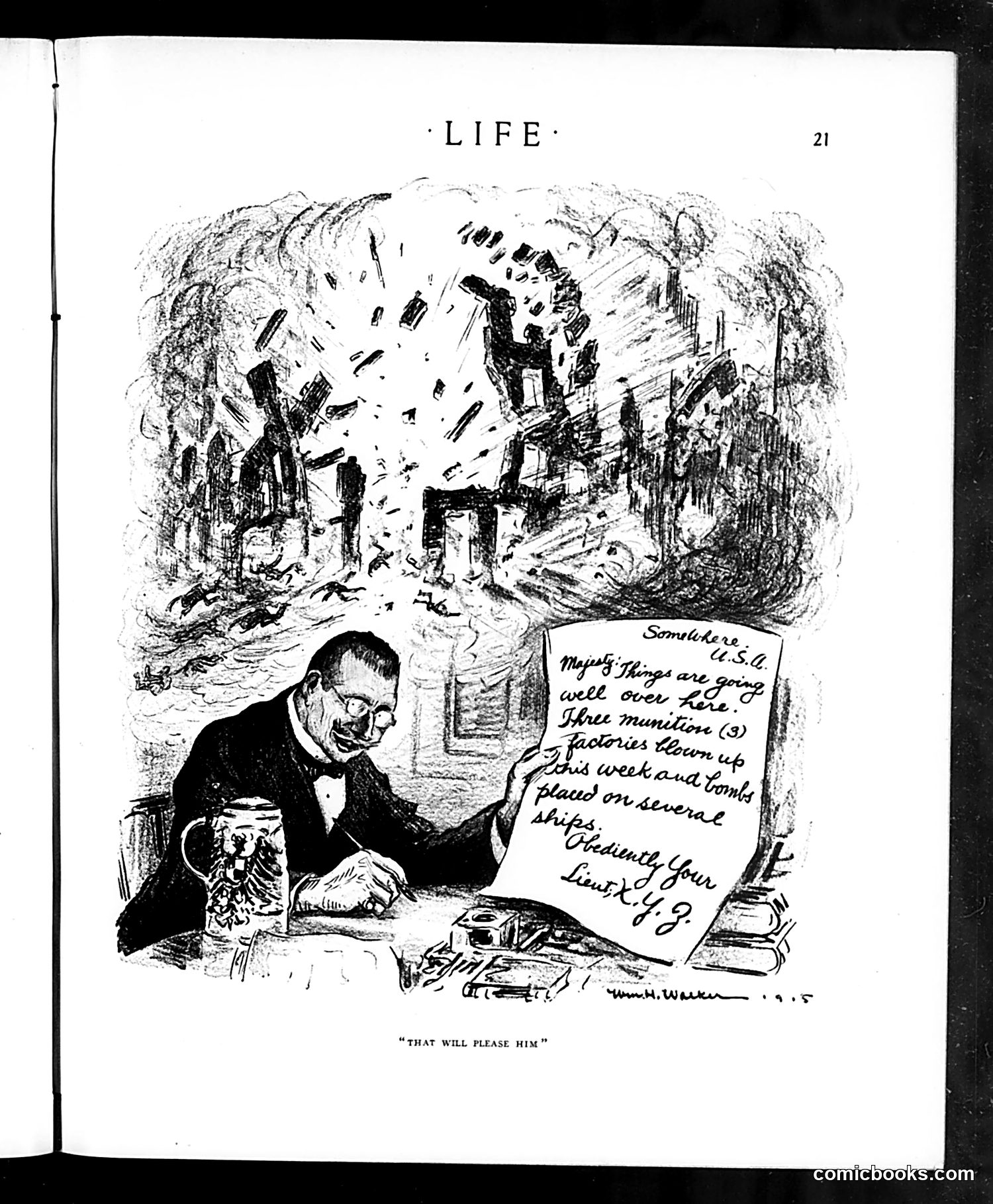
This 1915 Life magazine cartoon depicts a man at a desk reading correspondence about military/industrial matters. The handwritten note visible mentions "Things are going well over here," references "three munitions factories shut up," and notes "bombs placed on several ships," signed "Obediently your [servant]." The cartoon satirizes German-American relations during WWI's early years. The man appears to be a German official or sympathizer receiving reports of sabotage and munitions disruption in America. The chaotic explosive scene in the background emphasizes the destruction being caused. The satire targets suspected German intelligence operations in the U.S.—a genuine historical concern at the time, as Germany did conduct sabotage campaigns against American munitions plants supplying the Allies before America entered the war in 1917.
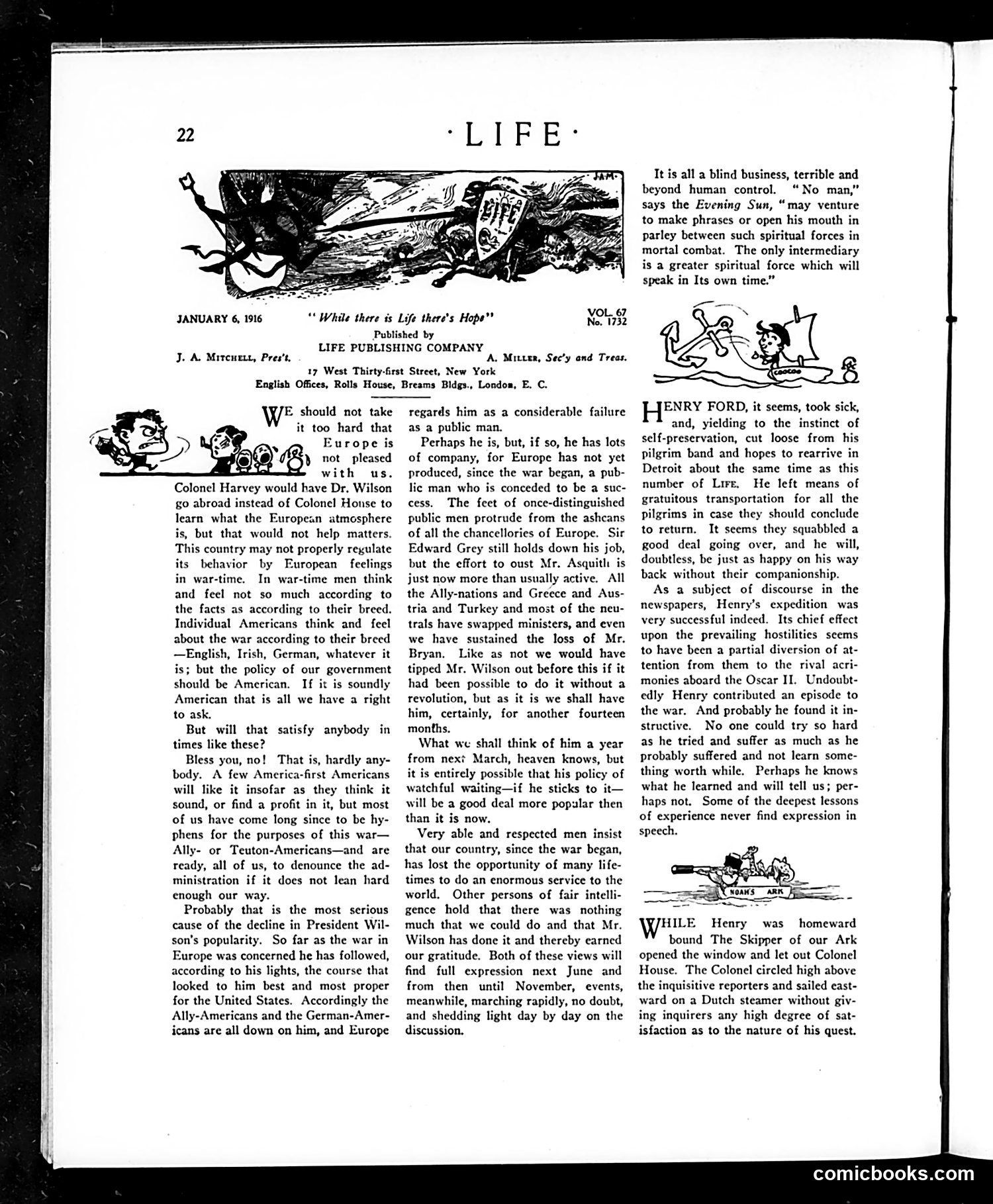
This Life editorial critiques President Wilson's neutrality stance during World War I. The author defends Wilson against criticism from hyphenated Americans—those of British, German, Irish, and other ethnic backgrounds who pressure the administration to favor their ancestral homelands. The piece argues that Wilson correctly pursues *American* interests rather than bowing to European demands or domestic ethnic lobbying. It notes that European leaders themselves face similar unpopularity, suggesting Wilson's decline stems from impossible wartime circumstances rather than failure. The final paragraph about Henry Ford (appearing to reference his peace efforts) suggests even prominent industrial figures struggle with war's moral complexities. The cartoons throughout use satirical imagery of conflict, reinforcing the text's theme that wartime emotions override rational policy-making—a timely concern as America approached its 1917 entry into the war.
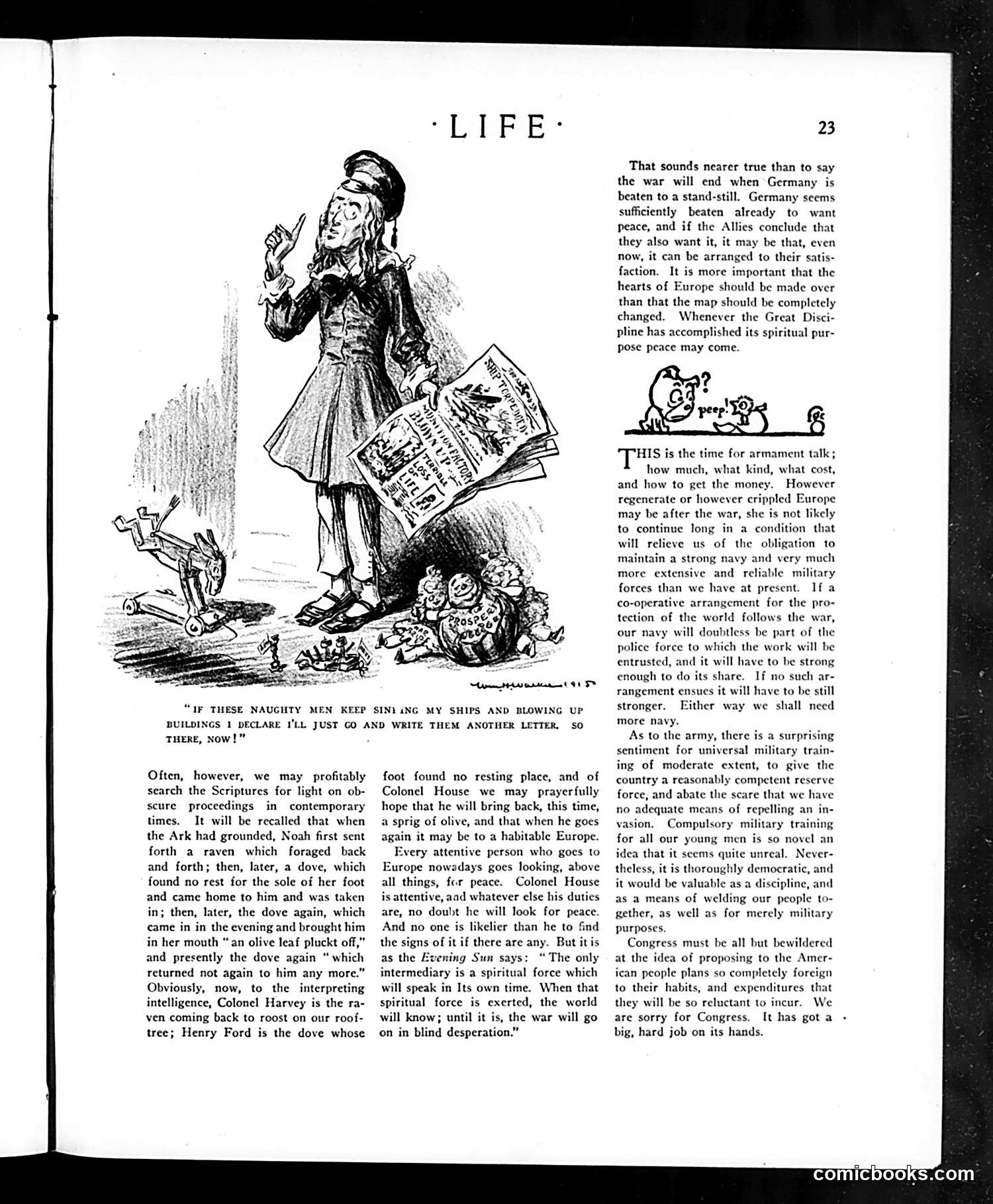
**The Main Cartoon:** The illustration depicts a woman in period dress, appearing exasperated, holding torn documents labeled as ships and buildings. The caption shows her threatening to respond to attacks by writing "another letter" — a satirical jab at weak diplomatic responses to serious wartime aggression. **Historical Context:** This appears to date from World War I, likely referencing peace negotiation efforts. The accompanying text uses biblical metaphors: Colonel Harvey is "the raven," Henry Ford "the dove," and Colonel House an envoy seeking peace (the "olive branch"). **The Satire:** The cartoon mocks ineffectual diplomatic protest — merely writing letters in response to military destruction. It suggests that words alone cannot address the devastation of war. The exasperated female figure embodies the futility of strongly-worded complaints as a substitute for actual military or political action. The page's broader argument addresses post-war military preparedness and universal military training, presenting these as necessary despite American reluctance toward such "foreign" concepts.
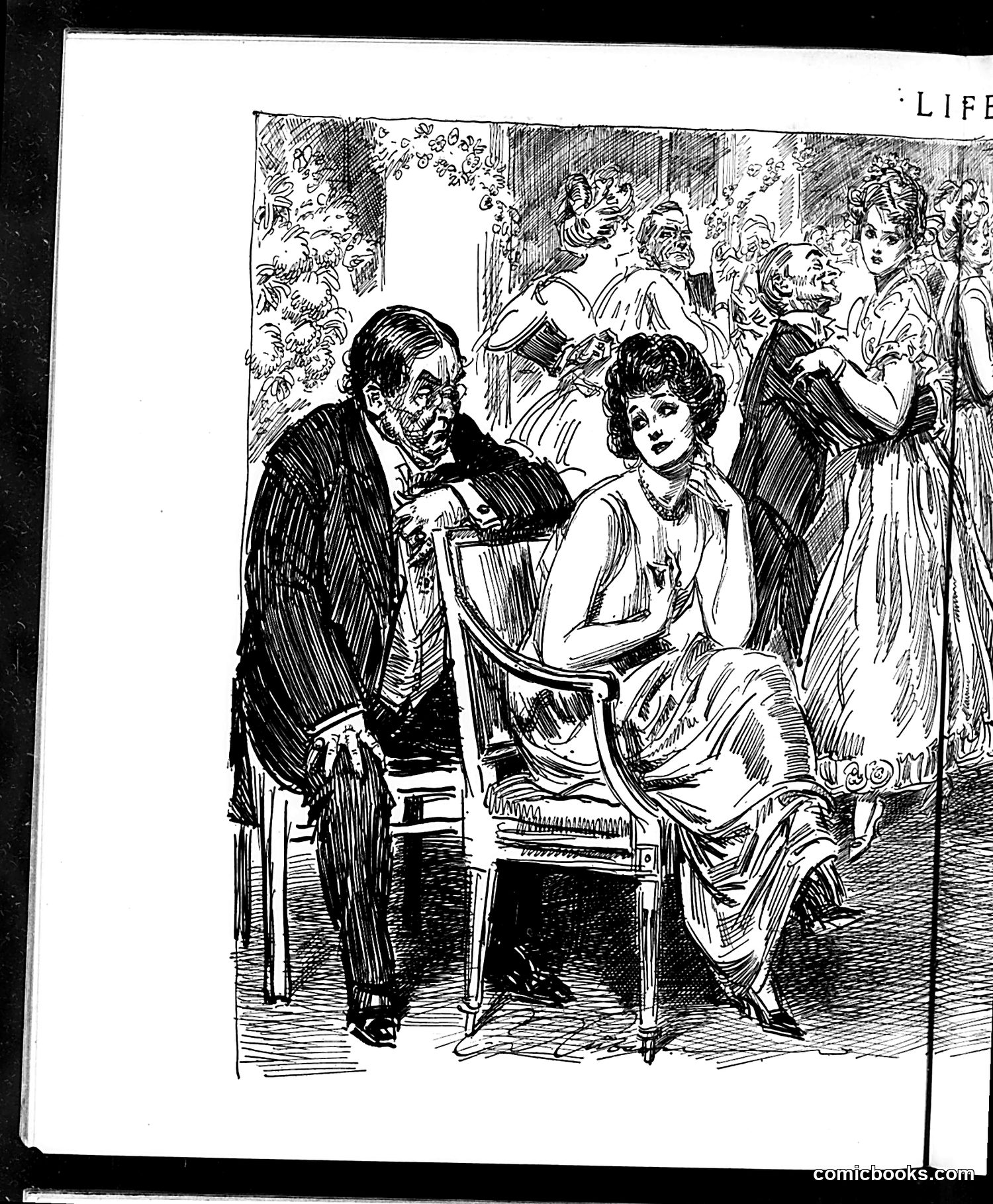
This is a black and white sketch from Life magazine showing a social scene at what appears to be an elegant gathering or salon. A well-dressed older gentleman in a dark suit leans toward a seated woman in flowing light-colored dress who wears jewelry and has styled hair. Multiple other figures appear in the background, suggesting a formal party or social event. Without visible caption text or clear OCR content identifying specific figures or the cartoon's intended subject, I cannot definitively explain the satire's target or political/social meaning. The sketch style and setting suggest commentary on high society or social pretension typical of Life's satirical approach, but the specific reference remains unclear from this image alone.
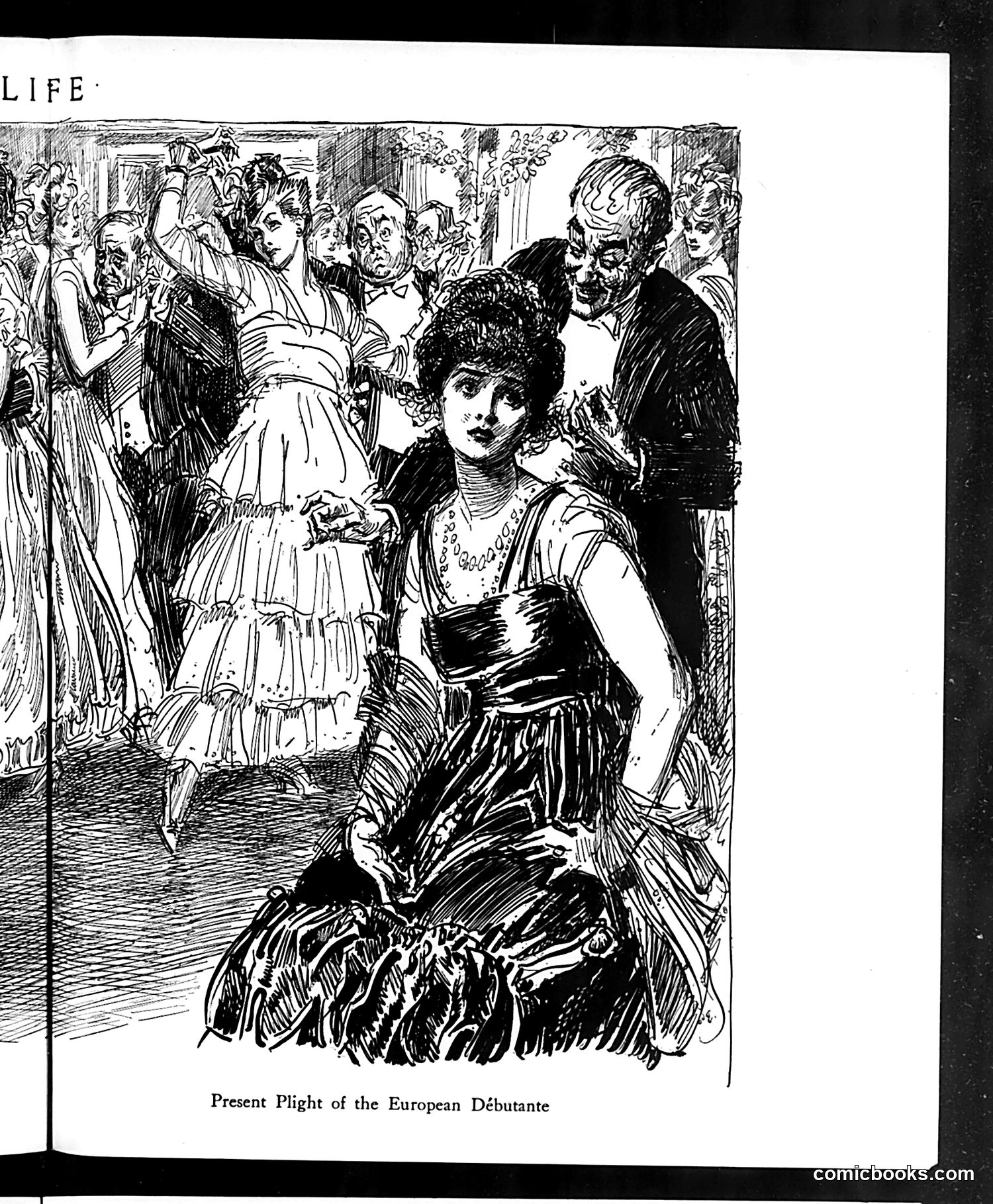
This satirical illustration from *Life* magazine depicts a social commentary on European young women entering society. The caption "Present Plight of the European Débutante" suggests criticism of the debutante tradition—the formal presentation of unmarried women to aristocratic society as marriageable candidates. The image shows a woman in the foreground seated in an elegant black dress amid a crowded ballroom scene. Her expression appears troubled or resigned rather than celebratory. The surrounding crowd of formally-dressed men and women suggests the competitive, scrutinizing social environment these young women faced. The satire likely critiques how European debutantes were treated as objects on display for matrimonial purposes, reducing them to commodities in the marriage market during this period. The woman's apparent discomfort underscores the satirical point.
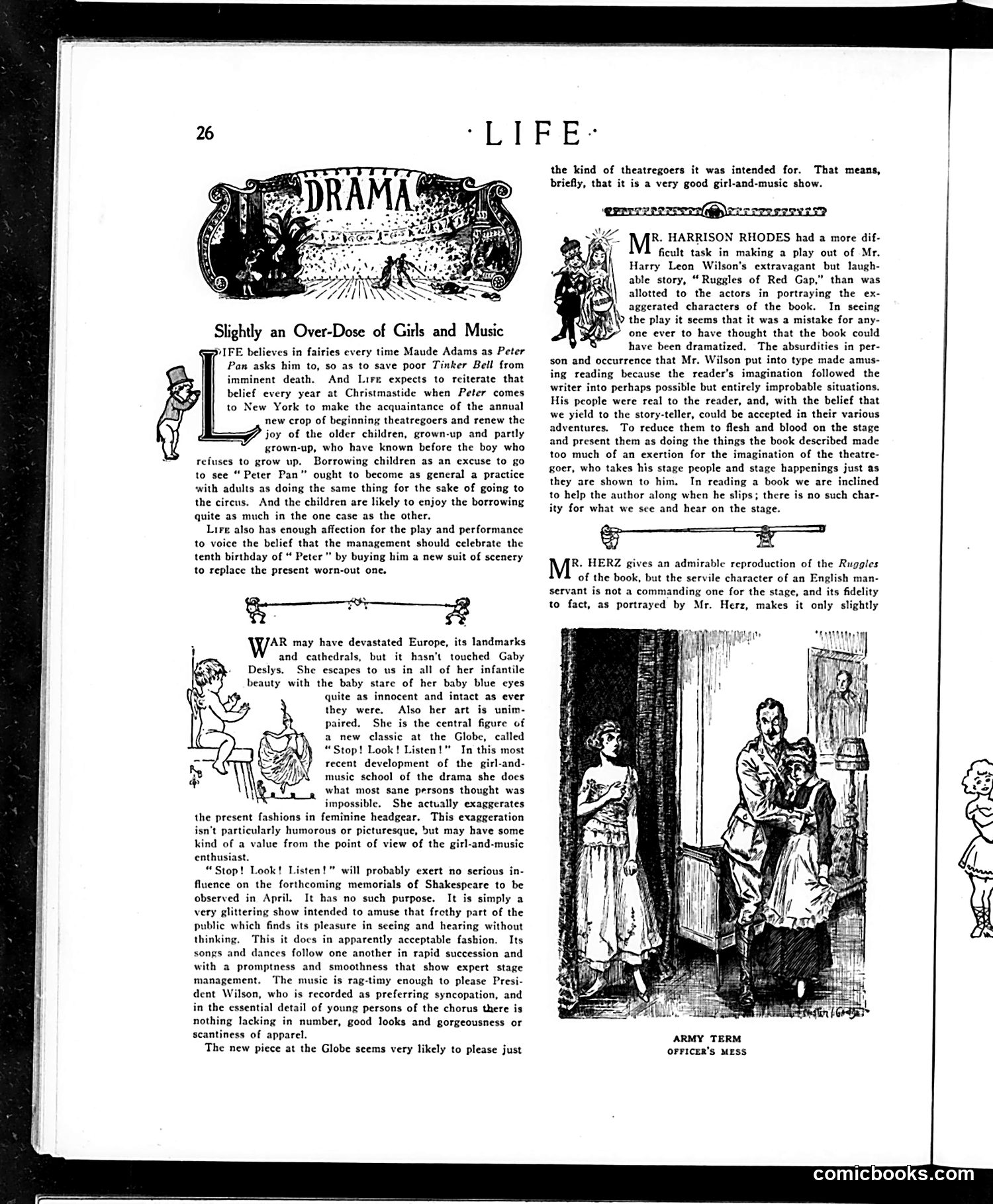
This page reviews three theatrical productions from the early 1910s: **"Peter Pan"**: Life celebrates the annual New York production starring Maude Adams, endorsing it as wholesome entertainment for both children and nostalgic adults. The magazine advocates that the theater replace its worn scenery for the play's tenth anniversary. **"Stop! Look! Listen!"**: A musical revue starring French entertainer Gaby Deslys. Life dismisses it as frivolous "girl-and-music" entertainment—deliberately vapid spectacle designed for audiences "which finds its pleasure in seeing and hearing without thinking." The satire mocks Deslys's exaggerated fashions and the show's reliance on scantily-clad chorus girls and ragtime music (President Wilson's alleged preference is mentioned sarcastically). **"Ruggles of Red Gap"**: An adaptation of Harry Leon Wilson's novel that Life judges a failed dramatization—the absurdities that worked humorously on the page become unconvincing when physically performed on stage. The overall tone critiques lowbrow theatrical entertainment while praising intellectually respectable drama.
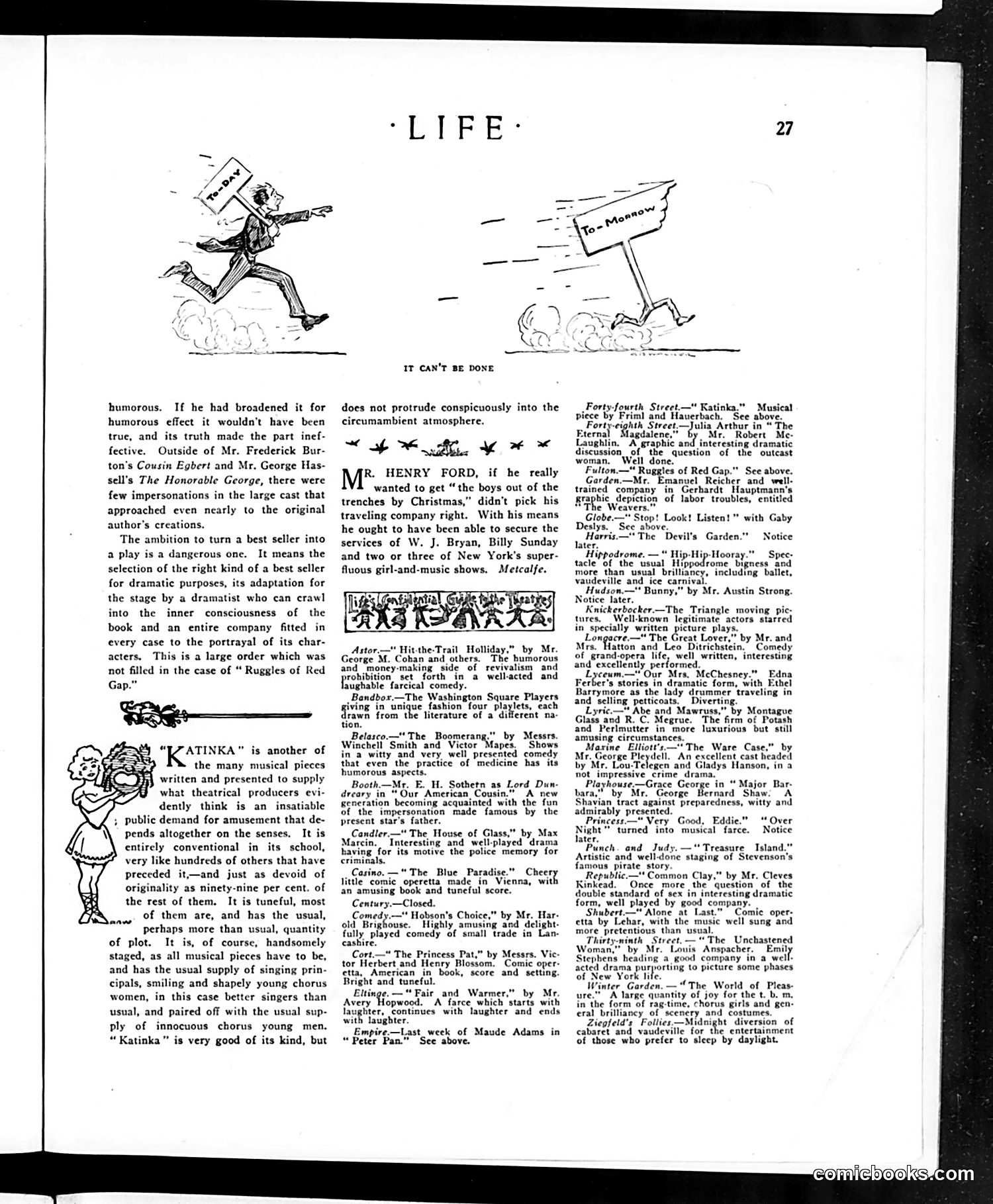
This cartoon satirizes Henry Ford's 1915 peace mission. The left figure represents Ford, rushing forward with determination carrying a banner reading "Peace," while the right panel shows "Tomorrow" receding on a platform, illustrating the futility of his effort. The accompanying text by Metcalfe mocks Ford's ambitious plan to end World War I by assembling a "Peace Ship" delegation. Ford claimed he could "get the boys out of the trenches by Christmas" but, the satire suggests, assembled the wrong team—offering showmen and entertainers (W.J. Bryan, Billy Sunday, vaudeville acts) instead of genuine diplomatic muscle. The joke: Ford's earnest but naive belief that American optimism and celebrity could solve a complex international conflict was absurdly misguided. The "tomorrow" that never arrives symbolizes the impossible deadline and the gap between Ford's grand ambitions and reality.
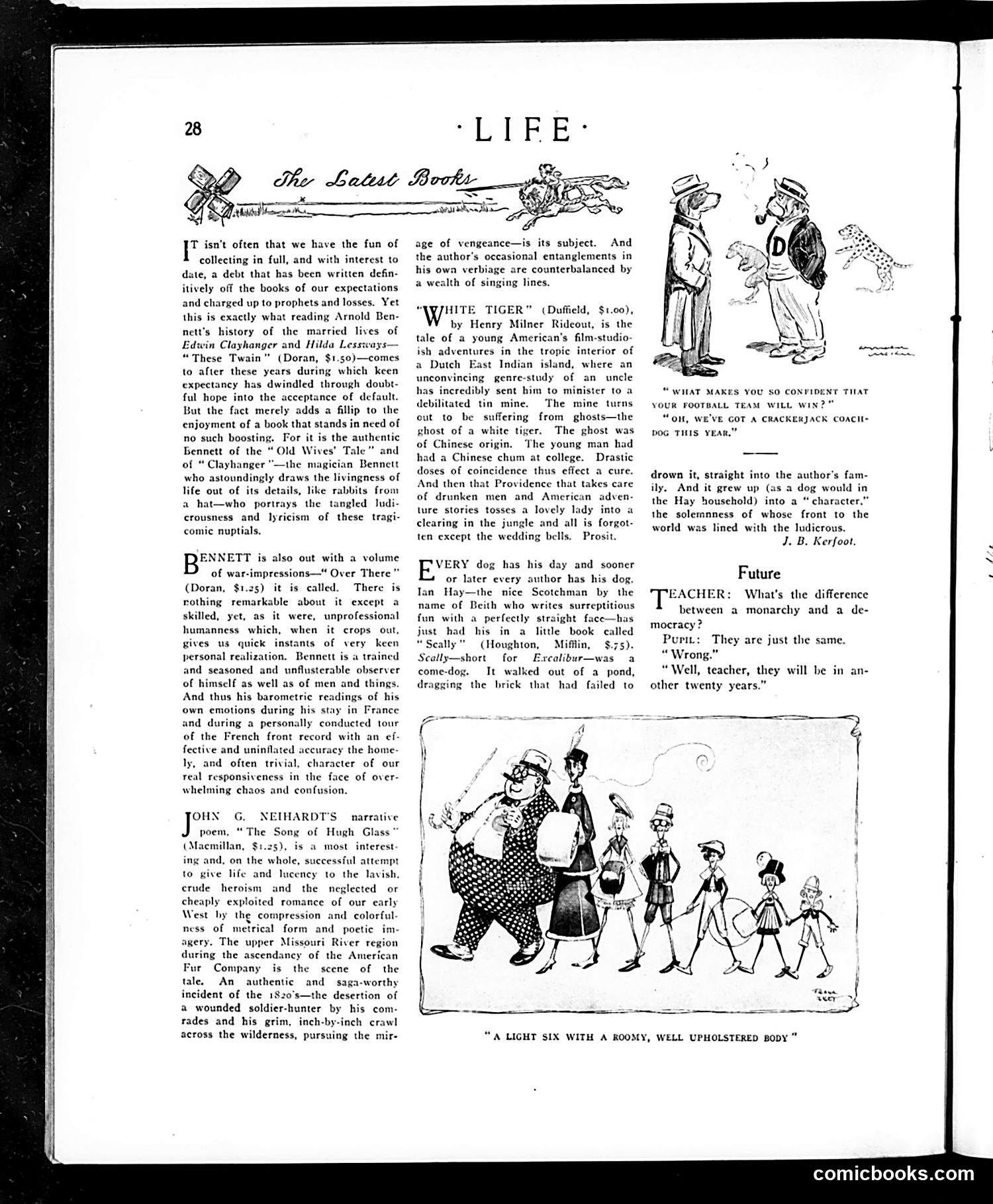
This page from *Life* magazine presents book reviews rather than political cartoons. The content discusses four recent publications: **Arnold Bennett's "These Twain"** — praised as authentic character work depicting married life with emotional depth. **Bennett's war memoir "Over There"** — critiqued as humanistic but unprofessional, capturing ordinary emotional responses to WWI's chaos. **John Neihardt's "The Song of Hugh Glass"** — a narrative poem about an 1820s frontier incident where a wounded fur-trapper crawls across wilderness for vengeance. **Henry Milner Rideout's "White Tiger"** and **Ian Hay's "Seally"** — adventure and animal stories reviewed with light mockery of their contrived plots. The cartoon below shows a coach confidently claiming his football team will win because "we've got a crackerjack dog this year"—a humorous visual reinforcing Hay's story about a dog that became central to the team's success. The joke satirizes how absurdly arbitrary sporting success can seem.
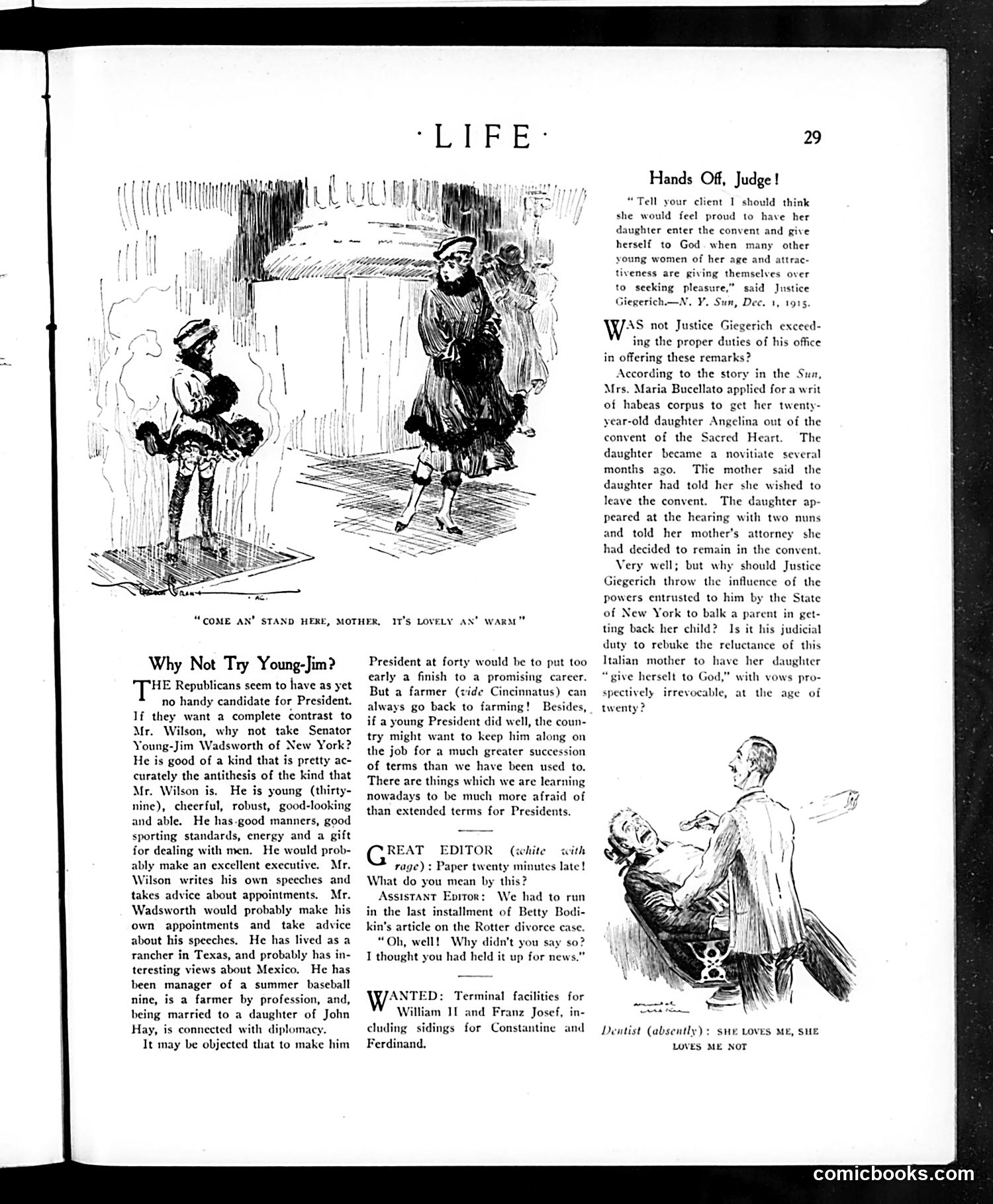
**"Hands Off, Judge!"** criticizes Justice Gigeritch for overstepping his authority. An Italian mother (Maria Bucellato) sought a writ of habeas corpus to remove her 20-year-old daughter Angelina from a convent. Though the daughter appeared to choose staying, the Justice lectured the mother about the honor of religious service. The article argues a judge shouldn't use his state-granted power to impose moral judgments on parental decisions, especially when influencing a young woman's irreversible vows at age twenty. **"Why Not Try Young-Jim?"** proposes Senator James Wadsworth of New York as a Republican presidential alternative to Wilson. The piece contrasts their personalities: Wadsworth is described as robust, good-looking, and decisive (making his own appointments), versus Wilson's literary approach. It notes Wadsworth could "return to farming" like Cincinnatus if defeated. The underlying irony: promoting a privileged aristocrat as an "antithesis" to Wilson while acknowledging concerns about extended presidential terms. The minor cartoons mock editorial priorities and romantic indecision.
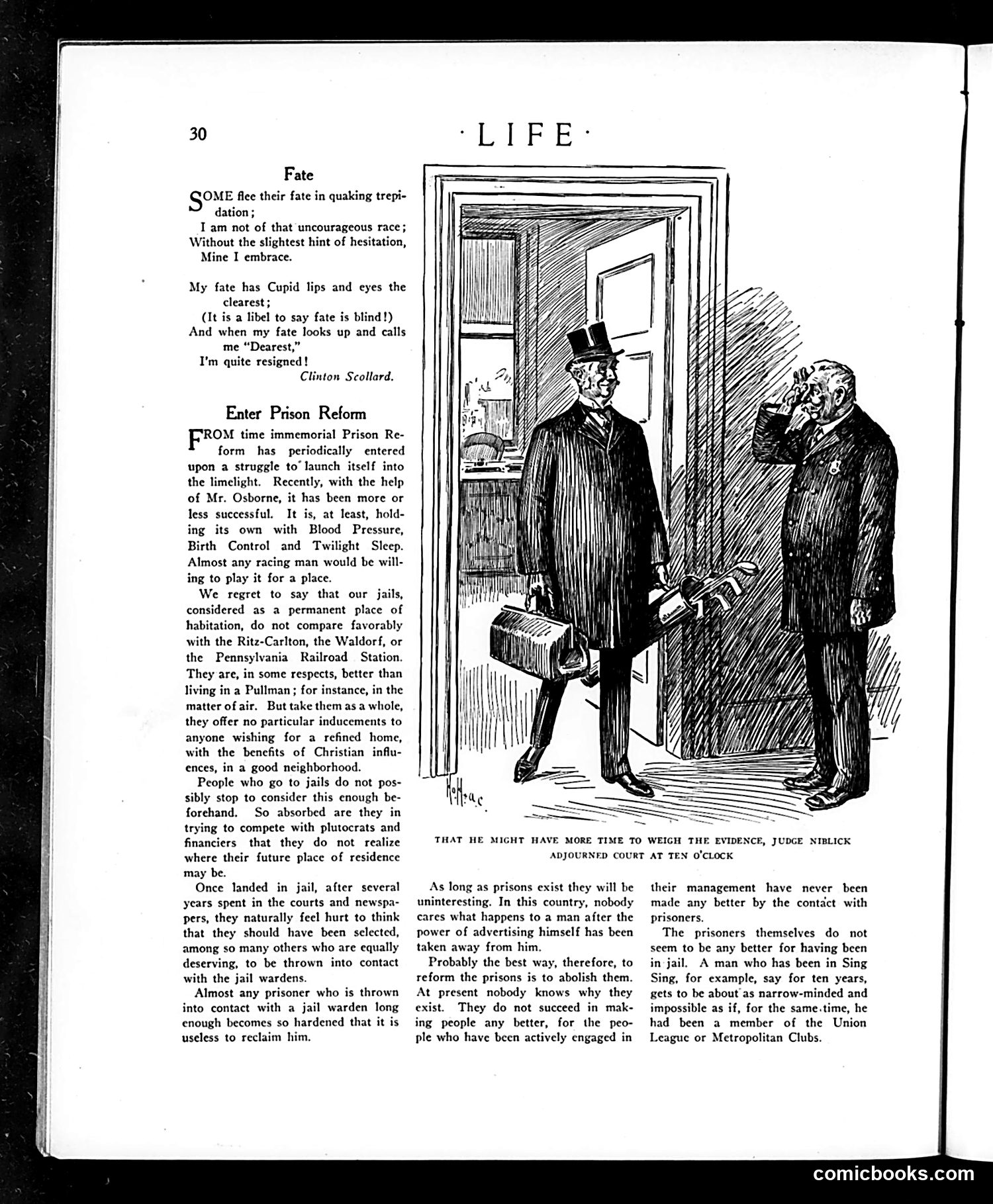
The page contains two distinct sections: **"Fate" Poem**: A light romantic verse by Clinton Scollard about accepting one's romantic destiny with good humor. **"Enter Prison Reform" Section**: A satirical essay critiquing American prison reform efforts and the justice system. The accompanying illustration shows Judge Niblick adjourning court to weigh evidence—the caption's irony suggesting judicial laziness. The essay's satire operates through exaggeration: it compares jails unfavorably to luxury hotels (Ritz-Carlton, Waldorf) and railroad Pullman cars, then absurdly suggests abolishing prisons entirely as the "best way" to reform them. The piece mocks prisoners for not considering jail consequences while competing with "plutocrats and financiers," and claims that contact with jail wardens and even jail time itself hardens rather than reforms inmates. The final jab suggests imprisoned criminals become no worse morally than respectable club members—attacking both the criminal justice system's effectiveness and upper-class hypocrisy simultaneously.
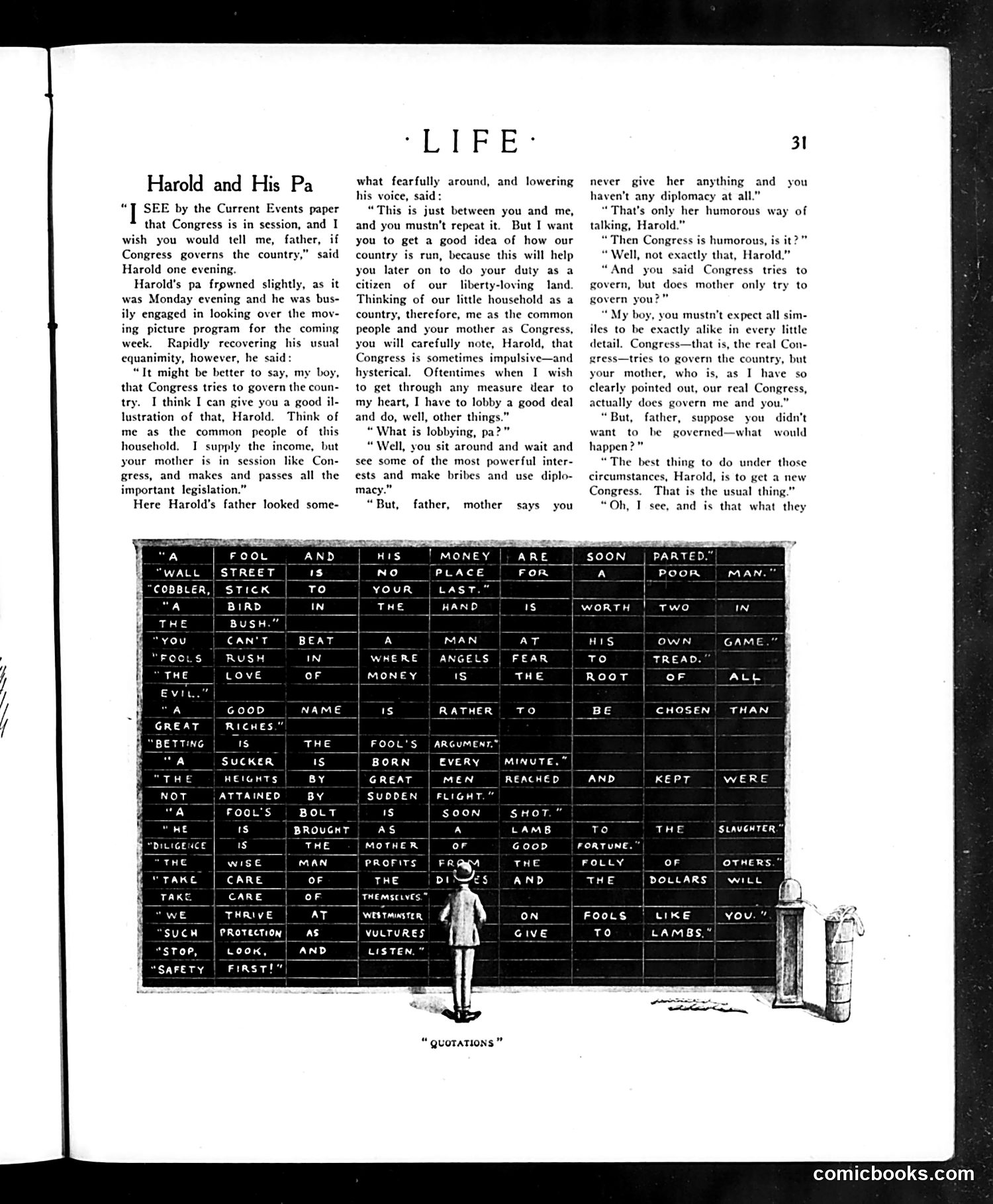
This comic strip uses a domestic analogy to satirize how Congress actually governs America. Harold's father explains that Congress, like his wife, "tries to govern the country" but often acts "impulsive—and hysterical." The father admits to "lobbying" Congress through bribes and diplomacy to pass measures he wants—mirroring how special interests manipulate the actual legislative body. The joke's cynicism emerges when Harold notes his mother doesn't merely "try" to govern; she actually does. The father deflates this observation, insisting the analogy isn't perfect. The final panel—a grid of financial aphorisms about "fools," "money," and poor judgment—reinforces the satirical point: Congress is corrupted by lobbyists and special interests, making it fundamentally ineffective at genuine governance. The satire targets Progressive Era anxieties about congressional corruption and corporate influence.
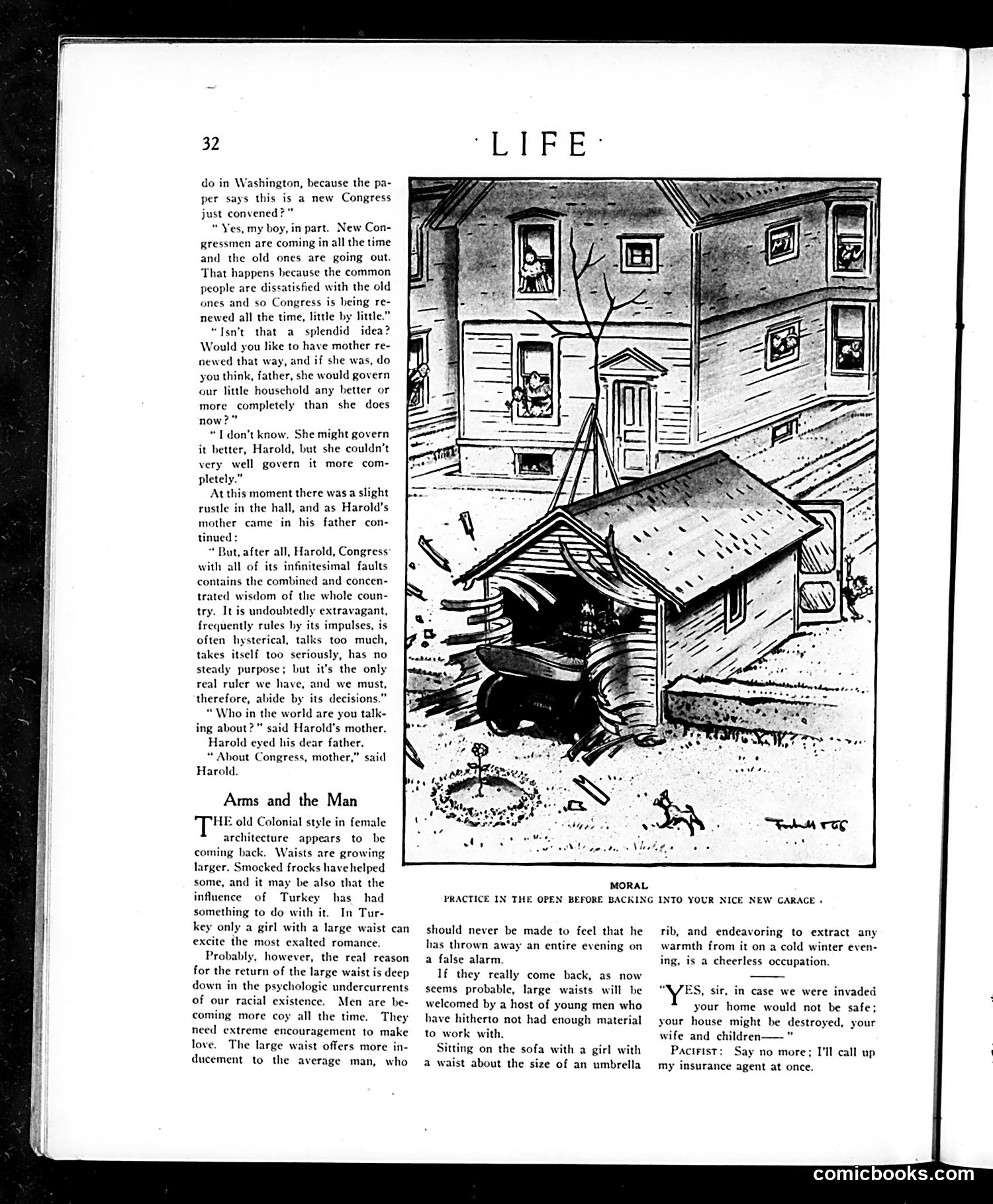
The main cartoon depicts a father and son discussing Congress. The boy naively suggests Congress should be "renewed" like household members—replacing old members with new ones. The father explains this actually happens through democratic rotation, then launches into praise of Congress as "the only real ruler we have," despite acknowledging its flaws: extravagance, impulsiveness, hysteria, and excessive talk. The joke lands when the mother enters—the father has been sarcastically describing *her* governance of the household using Congress's own faults, creating a humorous comparison between parliamentary dysfunction and domestic management. The lower section, "Arms and the Man," is a lighthearted social commentary about fashion (the return of larger waists) and courtship, suggesting men need more "material to work with" romantically. The final item is a brief joke about pacifism: a pacifist won't defend his home against invasion, but will call his insurance agent instead—mocking pacifist ideology as impractical self-interest.
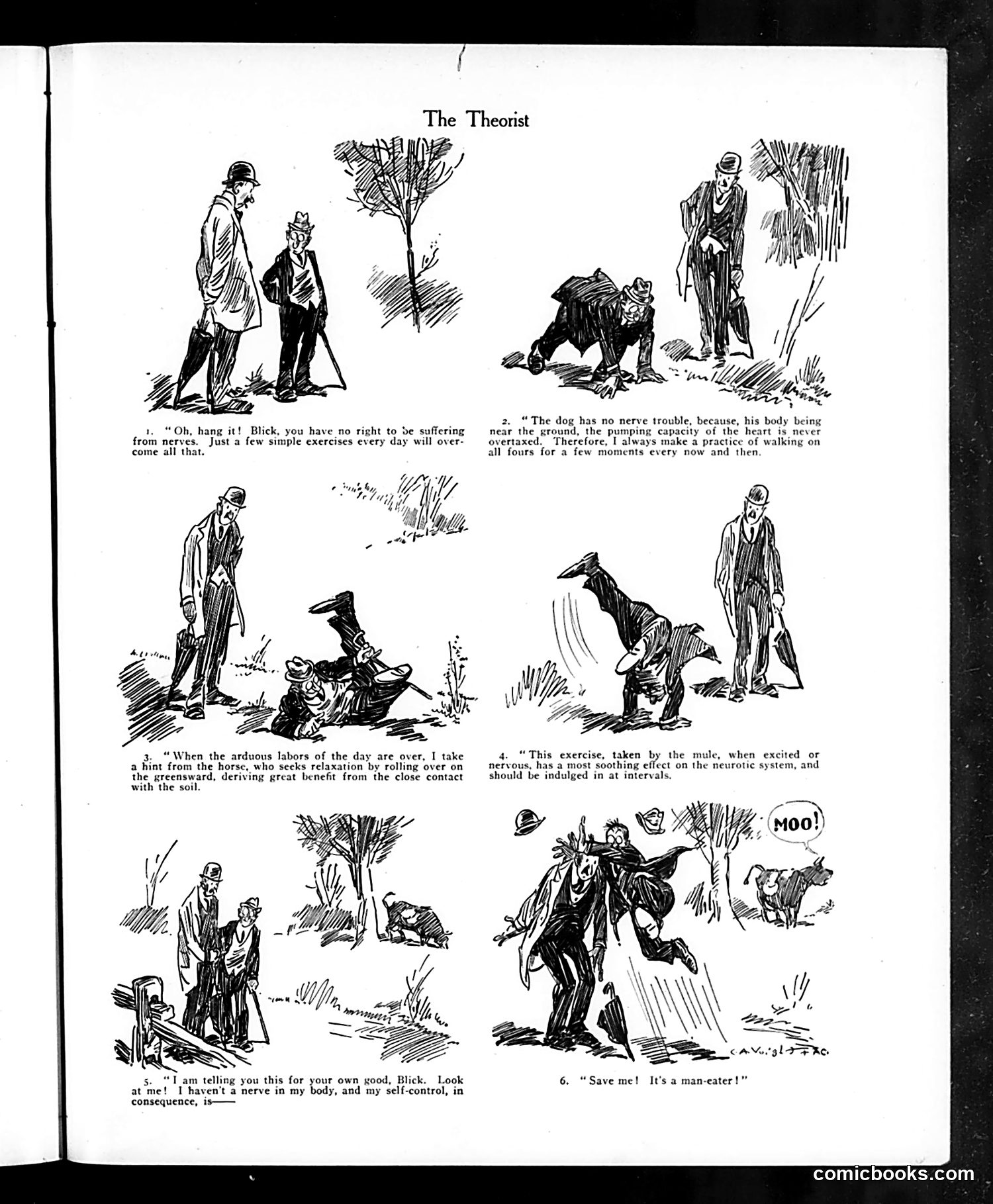
This comic page satirizes pseudoscientific health advice popular in the early 20th century. A well-dressed "theorist" (likely representing a wellness guru or amateur health expert) lectures his nervous friend "Blick" on elaborate, absurd remedies for nervousness. The joke: The theorist advocates mimicking animals—rolling like horses, walking on all fours like dogs, doing handstands like mules—claiming physical contact with earth and animal behavior cure nerves. He boasts of his own "perfect" health while demonstrating these ridiculous exercises. The satire mocks overly confident amateur doctors and the era's faddish, often illogical health movements. The final panel's punchline—where his theories literally backfire (a cow charges him)—reinforces that such impractical advice deserves ridicule. The cartoon targets the gap between theoretical health knowledge and practical reality, poking fun at those who confidently dispense untested wellness schemes.
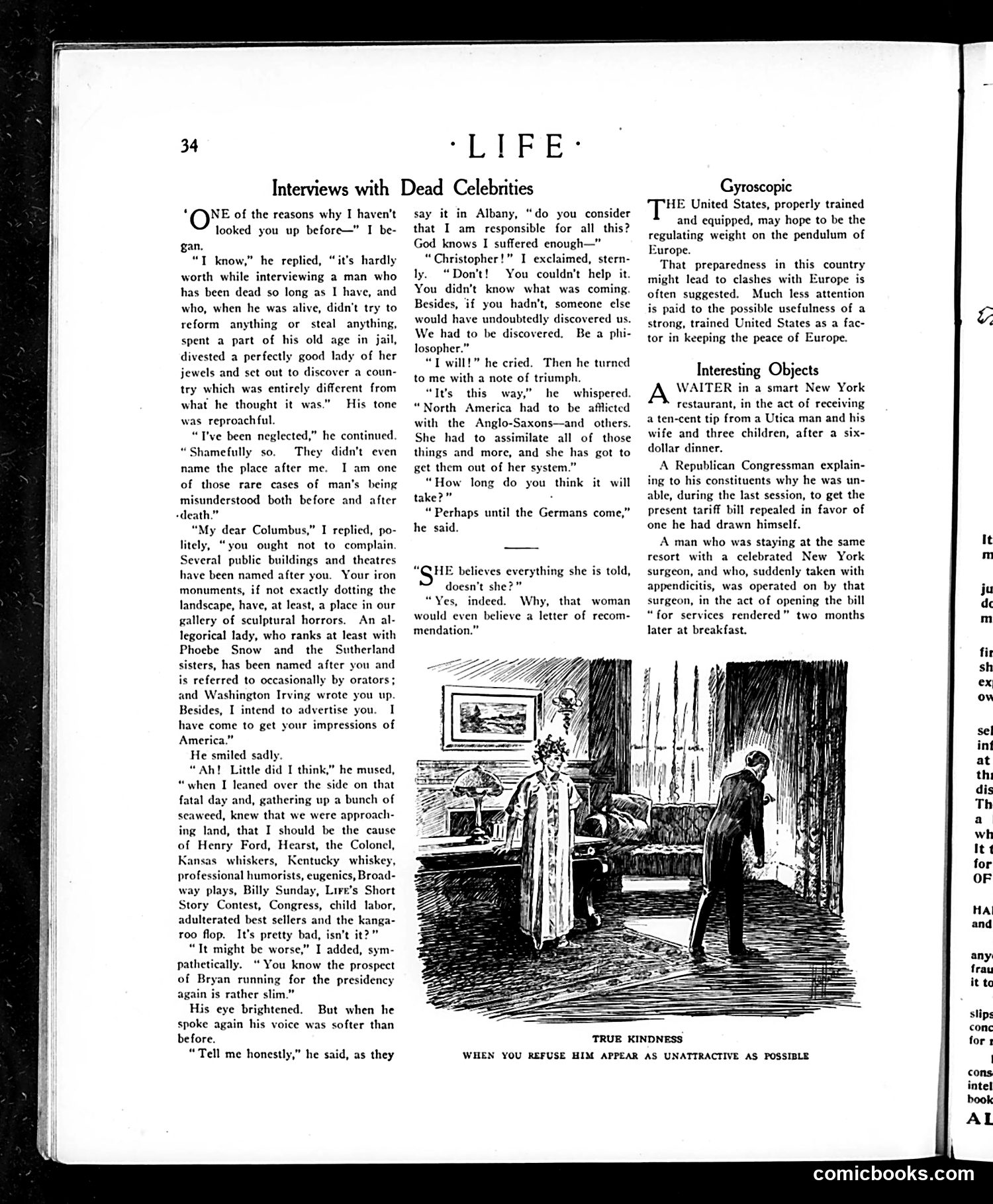
This page satirizes American society through an interview with Columbus, depicted as a ghost lamenting his discovery's consequences. The satire is scathing: Columbus is made to regret that his voyage led to the emergence of "Henry Ford, Hearst, the Colonel, Kansas whiskers, Kentucky whiskey, professional humorists, eugenics, Broadway plays, Billy Sunday...child labor, adulterated best sellers and the kangaroo flop"—a rapid-fire list of early 20th-century American ills. The cartoon below illustrates "True Kindness: When You Refuse His Appearance as Unattractive as Possible," depicting a woman refusing a man entry, likely satirizing hypocrisy about charity. The "Interesting Objects" section uses deadpan humor to mock small social absurdities: a waiter receiving a dime tip after serving a six-dollar dinner, and a congressman unable to pass his own tariff bill. The satire targets American materialism, political corruption, and social pretense characteristic of pre-WWI Life magazine's satirical voice.
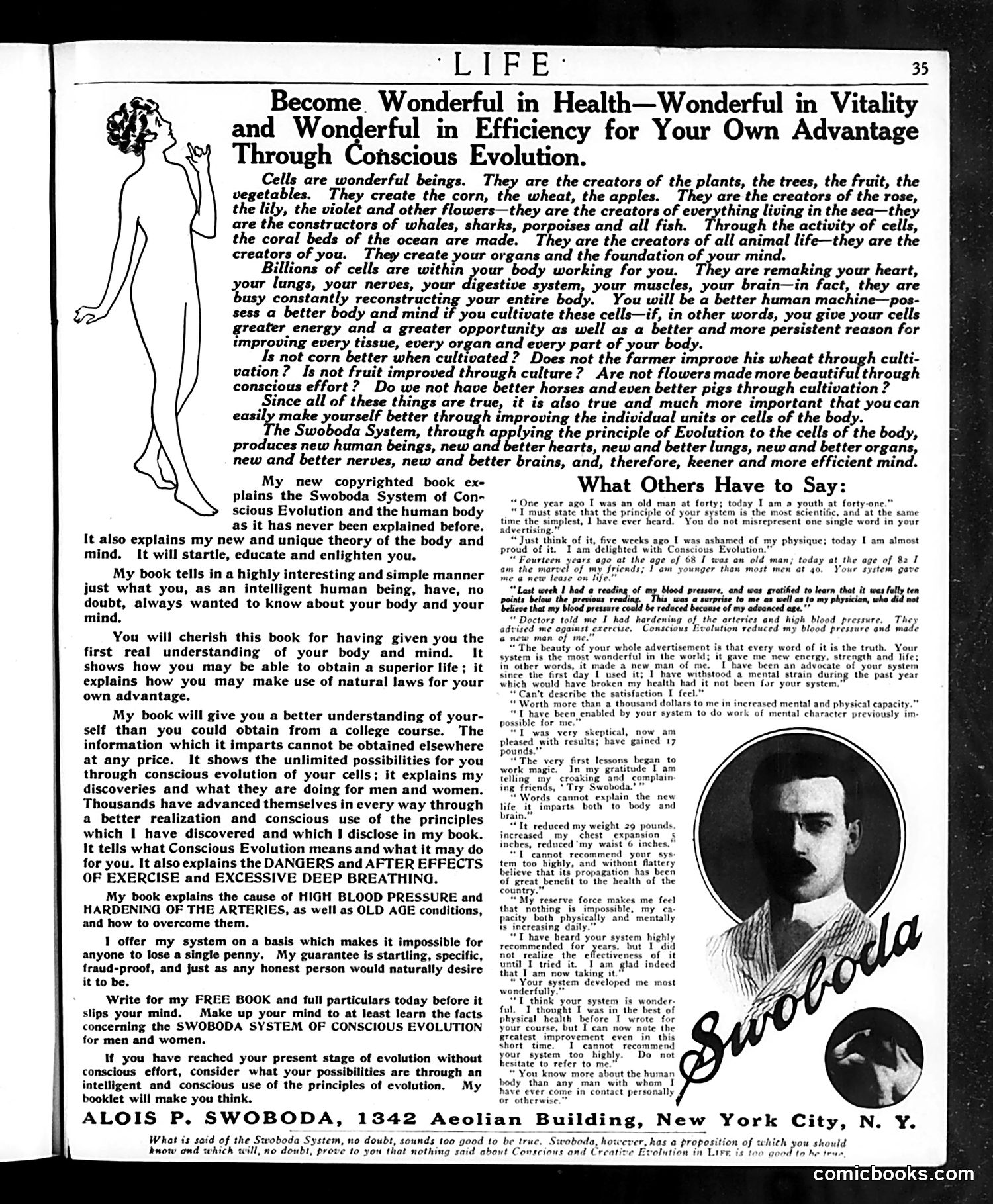
This page is primarily **advertising disguised as health editorial content**—a common early-20th-century marketing technique. **The "Content":** Alois P. Swoboda promotes his book on "Conscious Evolution," claiming cells can be improved like cultivated crops, promising better health, vitality, and mental capacity through his system. He claims to explain "HIGH BLOOD PRESSURE," "HARDENING OF THE ARTERIES," and "OLD AGE conditions." **The Satire/Critique:** Life magazine, known for satirizing pseudoscience and health quackery, appears to be **mocking this self-help pitch**. The vague promises ("wonderful in health," "keener and more efficient mind"), the comparison of human cells to farm crops, and the grandiose claims without evidence were classic markers of dubious wellness schemes that Life regularly lamppooned. **The Portrait:** The right side shows a photograph (likely Swoboda himself), emphasizing the pitch's personal-testimonial marketing approach—another target of period satire about charlatan health promoters.
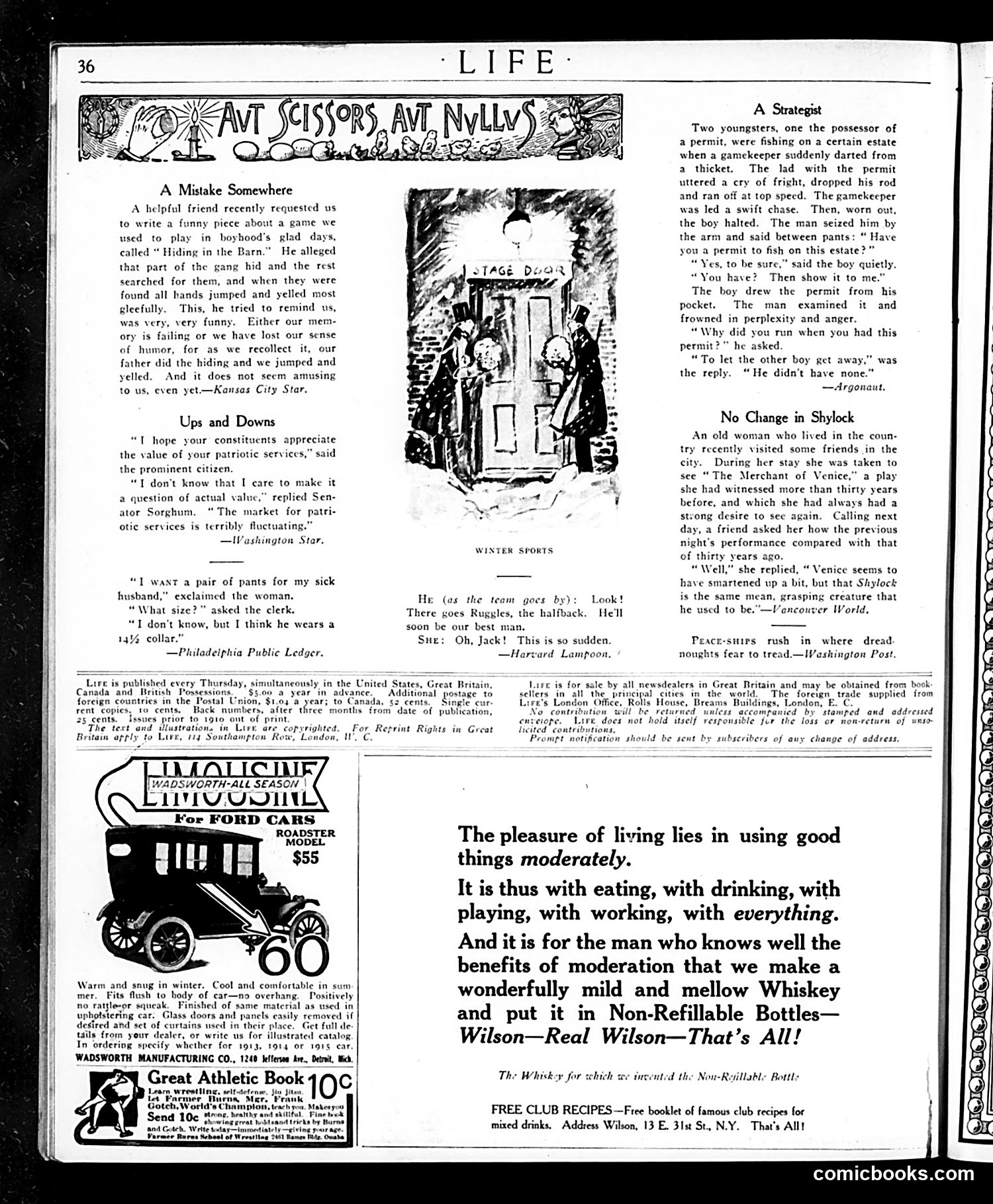
This page from *Life* magazine contains several satirical anecdotes mocking contemporary absurdities: **"A Mistake Somewhere"** jokes about nostalgia—a friend asks the editor to write funny reminiscence about childhood "Hiding in the Barn," but the editor points out the real humor was unintentional: his father did the hiding while children were the ones genuinely frightened. **"Ups and Downs"** satirizes a senator's evasion when asked if constituents appreciate his patriotic service. He dodges by claiming "patriotic services" have volatile market value—mocking politicians' cynical self-interest. **"A Strategist"** depicts two fishing boys: one with a permit runs when a gamekeeper approaches, letting his unpermitted friend escape. The joke critiques deceptive cleverness. **"Winter Sports"** (Harvard Lampoon) shows a woman excited that a football player ("Ruggles the halfback") will "soon be our best man"—she's misheard romantic proposal in a marriage context, not athletics. The page primarily contains humor columns rather than visual political cartoons. These pieces target institutional hypocrisy, misunderstandings, and sentimental phoniness typical of *Life*'s satirical approach.
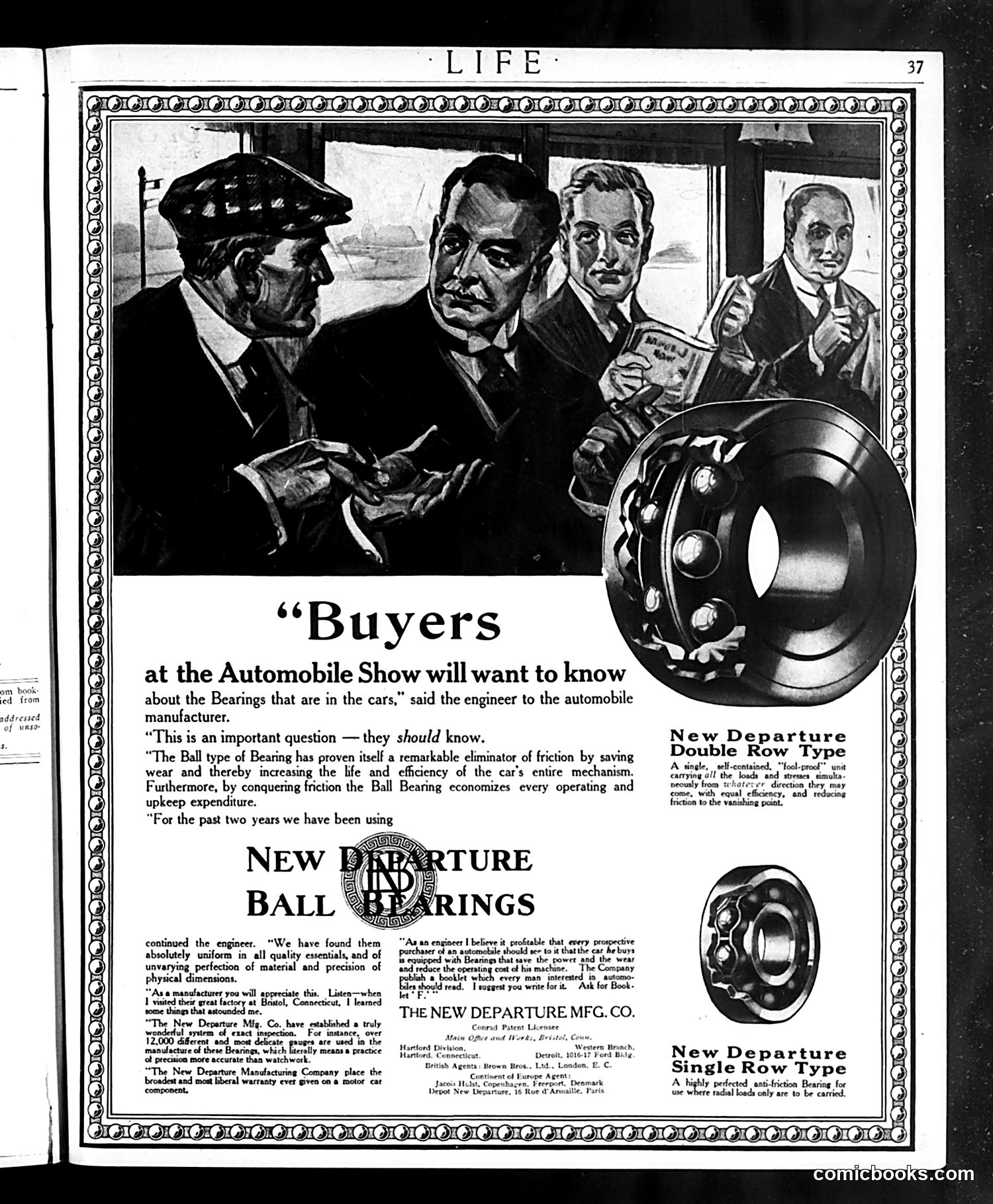
This page is primarily **advertising**, not satire or political commentary. It promotes New Departure ball bearings for automobiles, presented as a dialogue between an engineer and manufacturer at an Automobile Show. The framing device uses four illustrated male figures (likely representing automobile industry figures, though none are identified by name) to lend credibility to the pitch. The engineer character explains that ball bearings reduce friction, improve efficiency, and lower operating costs—key selling points for early automotive buyers. The "New Departure" brand emphasizes precision manufacturing (12,000 different gauges used) and quality control as competitive advantages. Two bearing designs are illustrated: a "Double Row Type" and "Single Row Type," each suited to different load requirements. For modern readers: this represents early 1900s automotive advertising strategy—using technical expertise and expert testimony to convince consumers that a seemingly invisible component (ball bearings) justifies choosing one manufacturer over competitors. The appeal is to rational calculation rather than emotion.
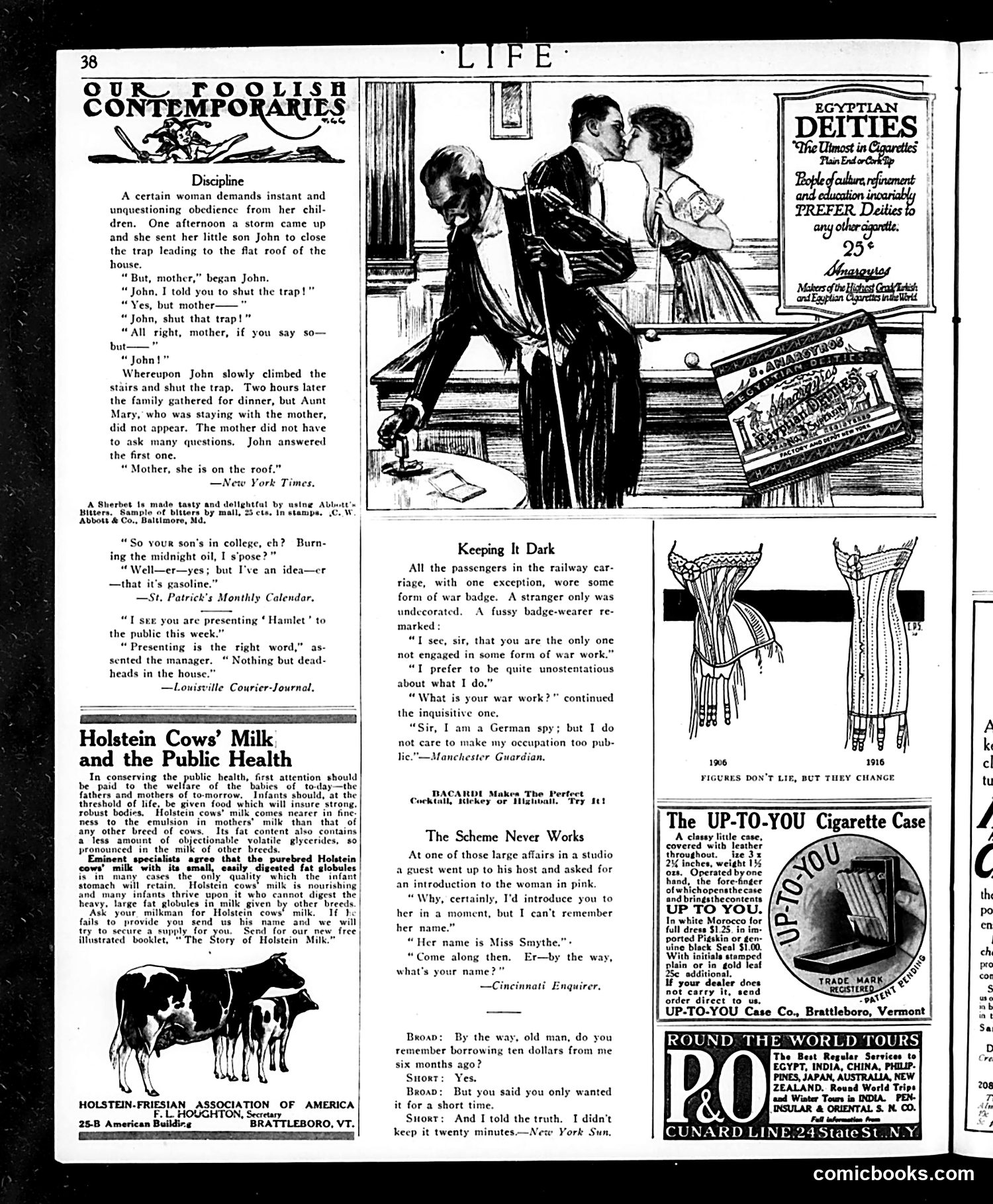
The main cartoon illustrates a cautionary tale about blind obedience. A mother commands her young son John to close a trap door to the roof during a storm without listening to his protests. John obeys without question, trapping his Aunt Mary on the roof, where she apparently remains for hours unnoticed. The satire critiques rigid parental discipline that demands "instant and unquestioning obedience" without allowing children to explain circumstances or use judgment. The joke's dark humor shows the absurd consequences: the aunt's safety is endangered because the mother refused to hear John's attempted explanation (presumably that the aunt was on the roof). For modern readers, this reflects early 20th-century debates about child-rearing philosophy—challenging the "children should be seen and not heard" doctrine—suggesting that authoritarian parenting without reasoning produces harmful outcomes. The attribution to the *New York Times* suggests this was presented as social commentary on contemporary parenting practices.
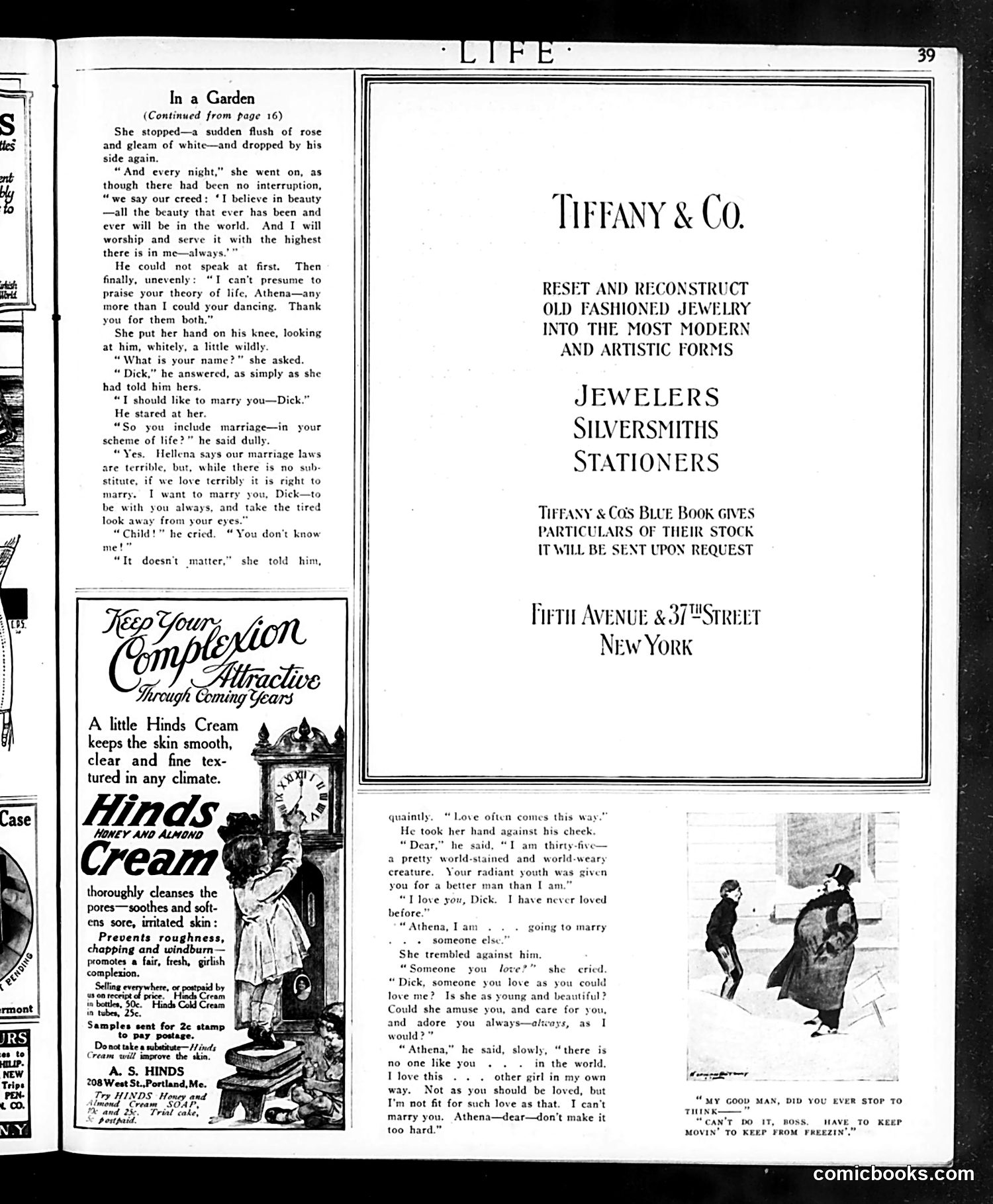
This page contains the continuation of a serialized short story about two characters, Dick and Athena, with a romantic and philosophical bent. Athena proposes marriage to Dick, declaring her belief in beauty as a life creed and her love for him. Dick, revealed to be thirty-five and world-weary, reluctantly refuses—he's already in love with someone else, though not in the idealistic way Athena describes. The narrative emphasizes the generational and experiential divide: her youthful idealism versus his jaded maturity. The story appears to explore early-20th-century attitudes toward marriage, female agency, and romantic love among educated, artistic types. The page also includes period advertisements (Hinds Cream, Tiffany & Co.) typical of *Life* magazine's content model, and a small cartoon at the bottom about homelessness and cold weather—unrelated to the main story.
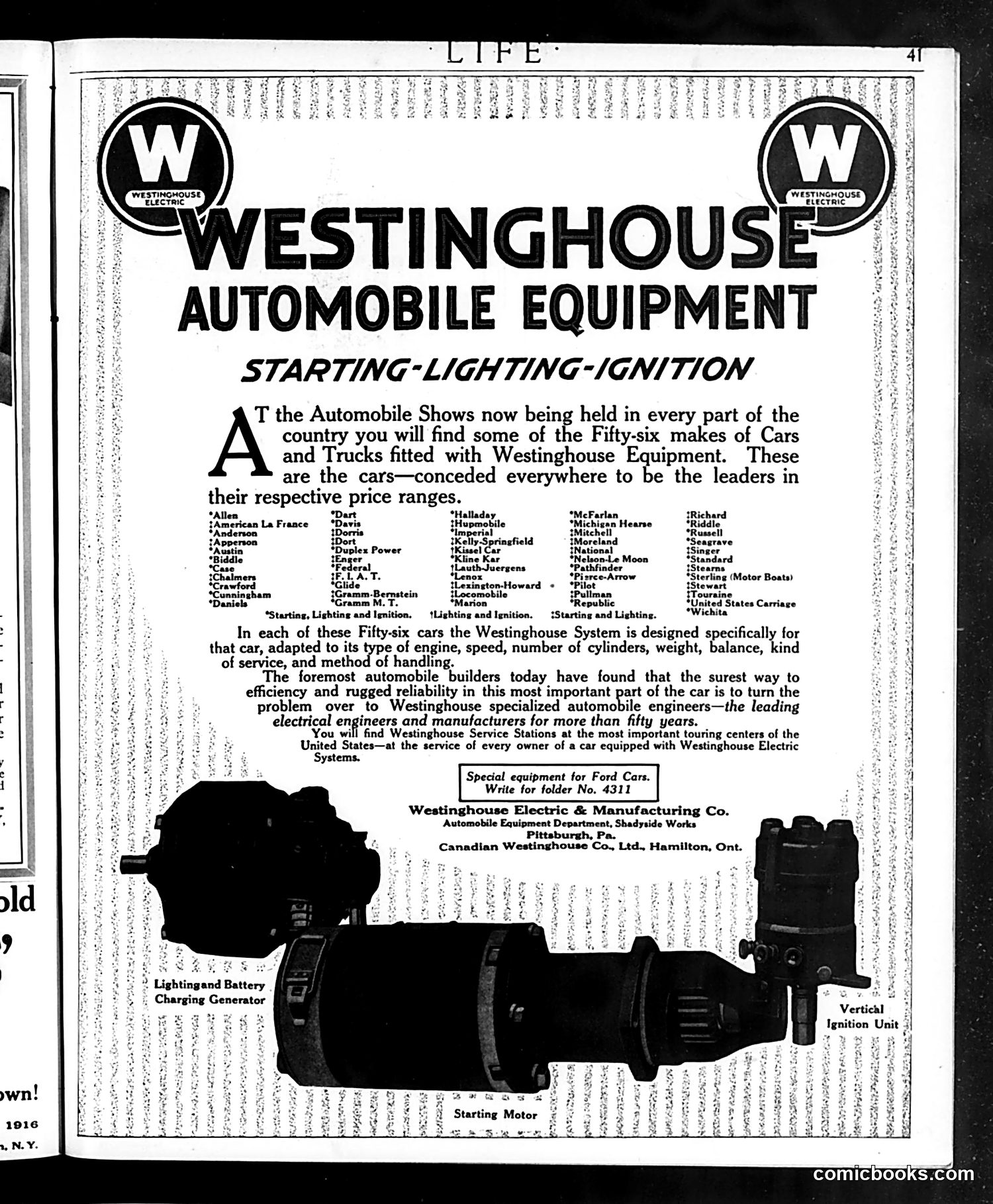
This is a **straightforward advertisement**, not a cartoon or satire. It promotes Westinghouse Electric's automobile electrical equipment (starters, lighting, ignition systems). The page lists 56 automobile manufacturers—from mass-market brands (Ford, Dodge) to luxury marques (Packard, Pierce-Arrow) to obscure makes now forgotten (Halladay, Wichita)—claiming they all use Westinghouse systems. This was a significant marketing claim: Westinghouse positioned itself as the trusted electrical supplier across the entire automotive industry. The mechanical drawings show starter motors, generators, and ignition units—the cutting-edge technology that made hand-cranking obsolete. For modern readers, the key context is that **reliable electric starting was revolutionary** in the 1910s; this ad essentially argues Westinghouse made cars actually *work*. The sheer number of car brands listed reflects the fragmented pre-consolidation automotive market—dozens of small manufacturers competed before Ford's dominance and later industry consolidation.
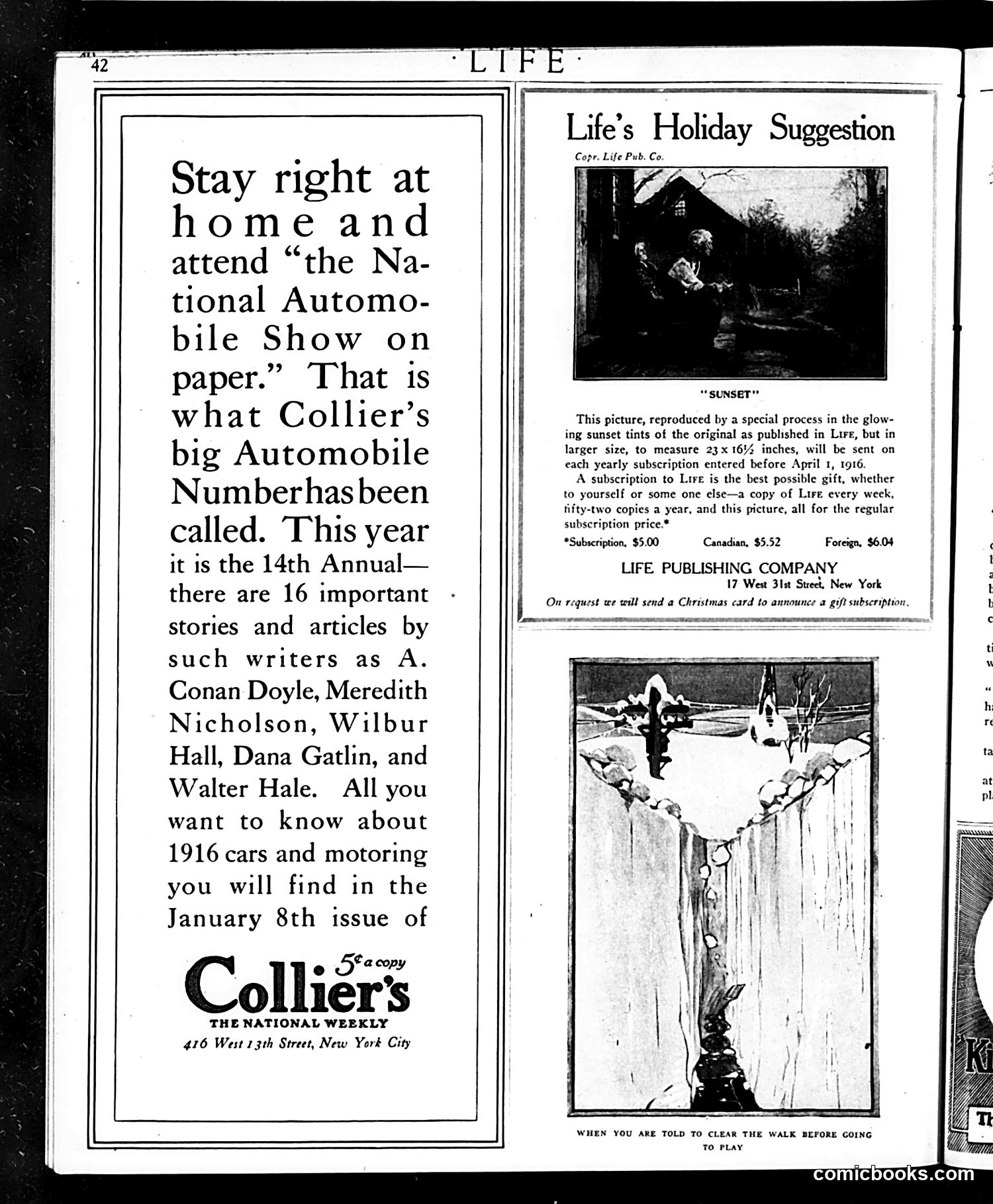
This page contains two separate advertisements from competing magazines. **Left side:** Collier's advertises its "National Automobile Number" (the 14th annual), calling it a way to "attend the National Automobile Show on paper" from home. It promotes 16 articles by notable writers (A. Conan Doyle, Meredith Nicholson, and others) about 1916 cars and motoring. This is a straightforward pitch to stay home and read about automobiles instead of attending a physical show. **Right side:** Life magazine advertises a subscription gift with a reproduction of a winter landscape artwork titled "Sunset." The lower image shows a snowy scene captioned "When You Are Told to Clear the Walk Before Going to Play"—a nostalgic scene of children's winter responsibilities. Both are holiday gift subscription pitches. The satire isn't evident from this page alone—it's simply competing magazine advertising circa 1915-1916.
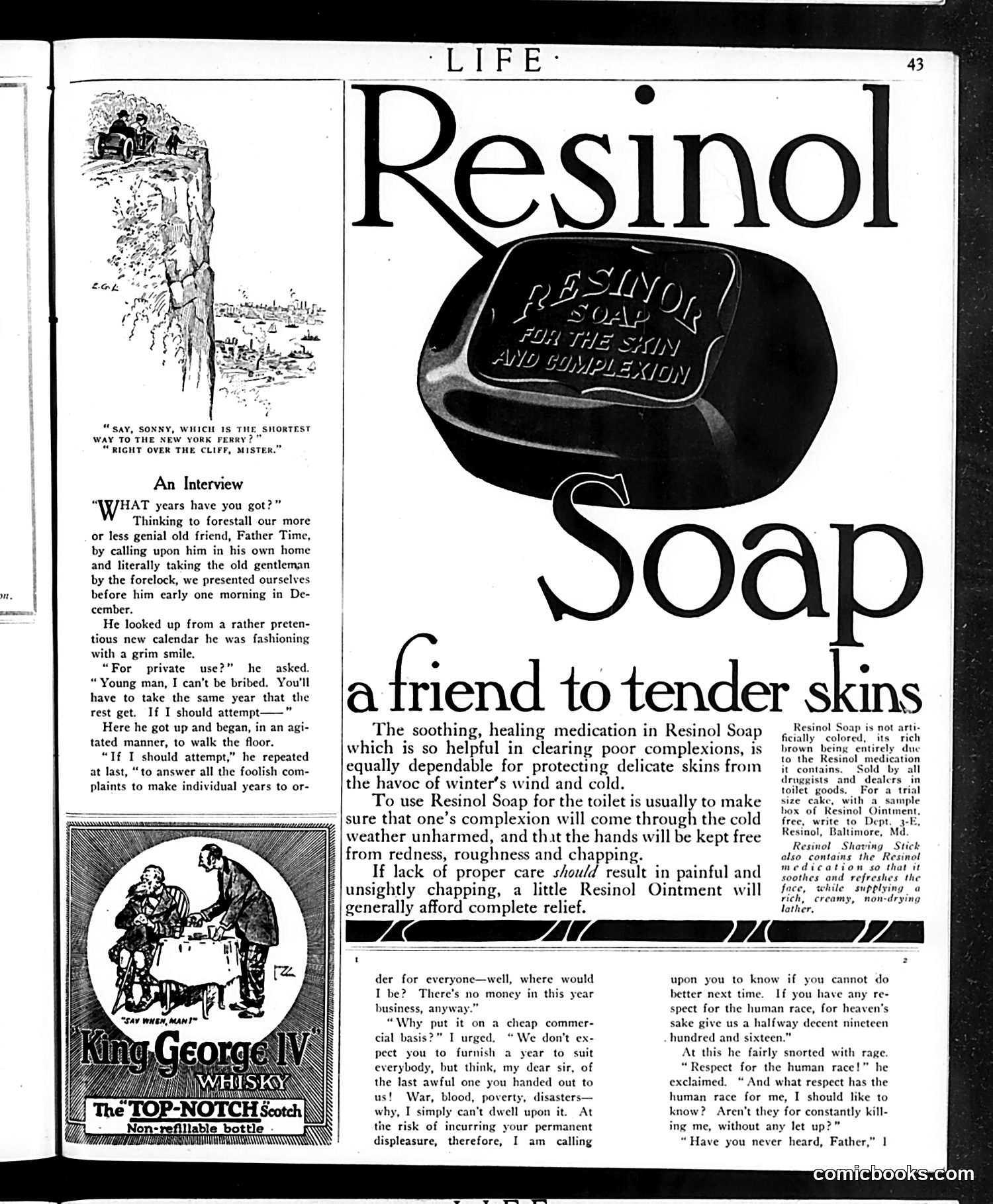
This Life magazine page combines satirical content with period advertising. **The Cartoons/Satire:** The main interview satirizes "Father Time" as a character complaining about humanity's treatment of him. A visitor confronts Time about the terrible year (1915) he's provided—referencing World War I, blood, poverty, and disasters. Father Time responds sarcastically that humans constantly kill/waste time anyway, so why should he care about giving them a good year? The small cartoon above shows a lost person being directed over a cliff, darkly mocking New York geography. **Historical Context:** This reflects 1915-1916 anxieties about World War I's devastation and social upheaval. The satire critiques both the year's events and human nature's self-destructive patterns. **The Advertisement:** The large Resinol Soap ad promotes a medicinal soap for skin protection during winter, a common health concern of the era. Below appears a King George IV Whisky ad—both typical period product placements.
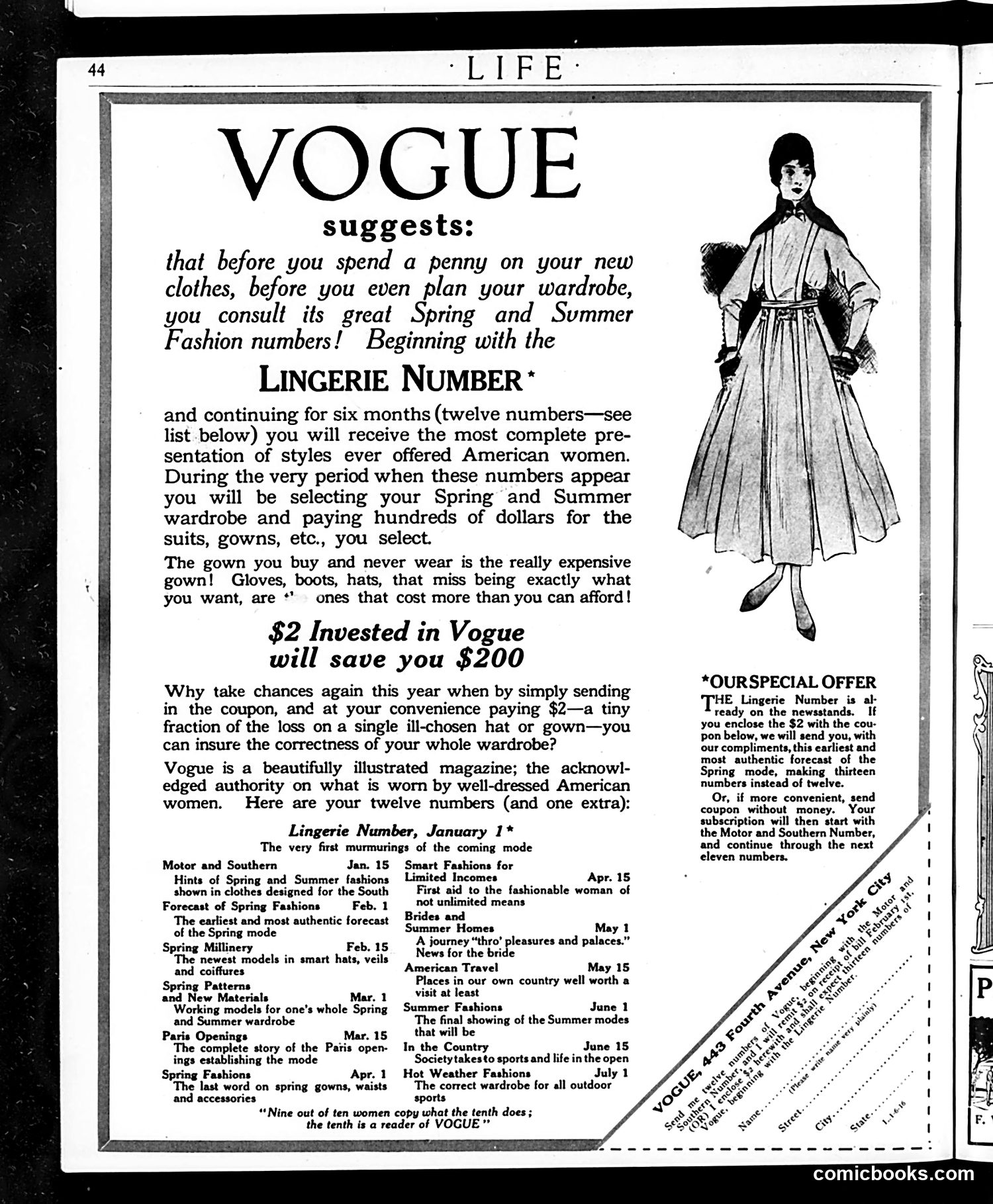
This is **not a cartoon but an advertisement**—a full-page promotion for Vogue magazine subscriptions, appearing in Life's editorial pages. The pitch targets women's anxieties about fashion mistakes: buying expensive clothes that don't match their needs or taste. By subscribing to Vogue ($2 for twelve monthly issues), readers are promised to "save $200" by making better purchasing decisions through expert fashion guidance. The accompanying illustration shows a fashionable woman in a mid-length dress, embodying the "well-dressed American woman" ideal that Vogue claims to represent. The satire (if any) is subtle: the tagline—"Nine of ten women copy what the tenth does; the tenth is a reader of VOGUE"—simultaneously flatters subscribers while admitting that fashion is about conformity, not individuality. The promise to prevent costly mistakes through expert consultation appeals to both vanity and thrift, reflecting 1920s-era consumer culture anxieties about propriety and expenditure.
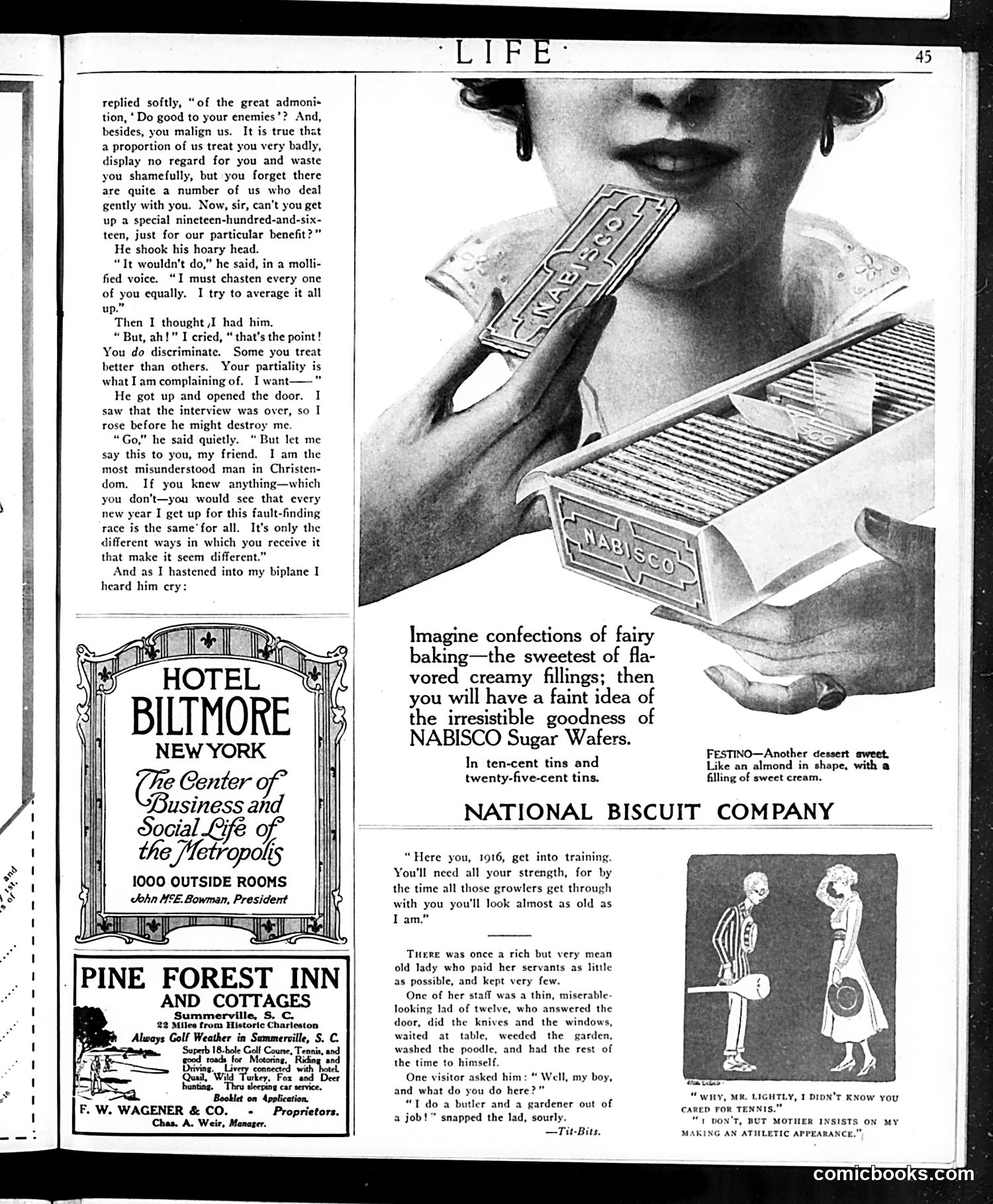
This page contains a satirical dialogue between a person and what appears to be **personified "1916"** (the year itself, depicted as an elderly man). The joke plays on New Year's tradition: the narrator complains that 1916 treats people unfairly—some face hardship while others are spared. The year responds that it distributes challenges equally to everyone; people simply experience them differently. The satire targets human tendency to blame external forces (fate, the calendar year) for misfortune while ignoring that life's inequities stem from how individuals and society *receive* or *manage* circumstances—not from inherent favoritism. The page also includes period advertisements (Hotel Biltmore, Pine Forest Inn, Nabisco wafers) and a brief moral tale about an overworked servant boy, illustrating class exploitation. A cartoon caption shows someone forced into tennis "to make an athletic appearance"—mocking social pretense. The content reflects 1916 concerns: class disparity, personal responsibility, and social conformity pressures.
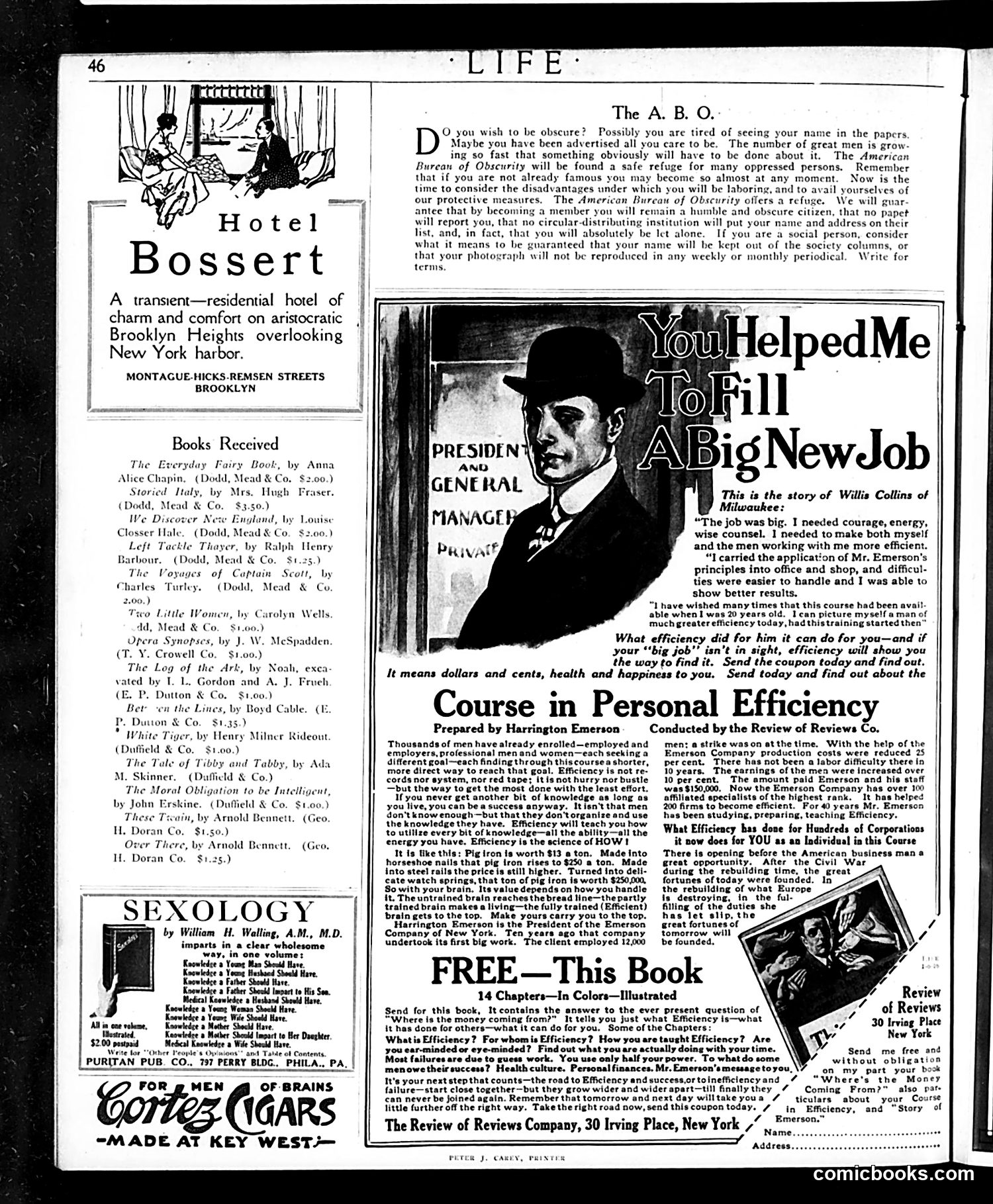
This page is primarily **advertising** rather than political satire. The main content includes: **"The A.B.O." section** (top right): A satirical advertisement for a fictional "American Bureau of Obscurity"—a humorous service promising to keep people OUT of newspapers and society columns. It mocks the era's obsession with publicity and fame, suggesting that becoming famous is now involuntary and inescapable. The joke targets the modern celebrity-industrial complex emerging in the 1910s-1920s. **"You Helped Me Fill a Big New Job"** (center-right): A testimonial advertisement for Harrington Emerson's "Course in Personal Efficiency." It features a portrait of what appears to be a businessman and promotes efficiency training for corporate success. This reflects early-20th-century obsession with scientific management and self-improvement. **Left side**: Book reviews and hotel advertisements—typical magazine filler. **Bottom**: A cigar advertisement. The page reflects period concerns with ambition, publicity, and self-improvement rather than specific political commentary.
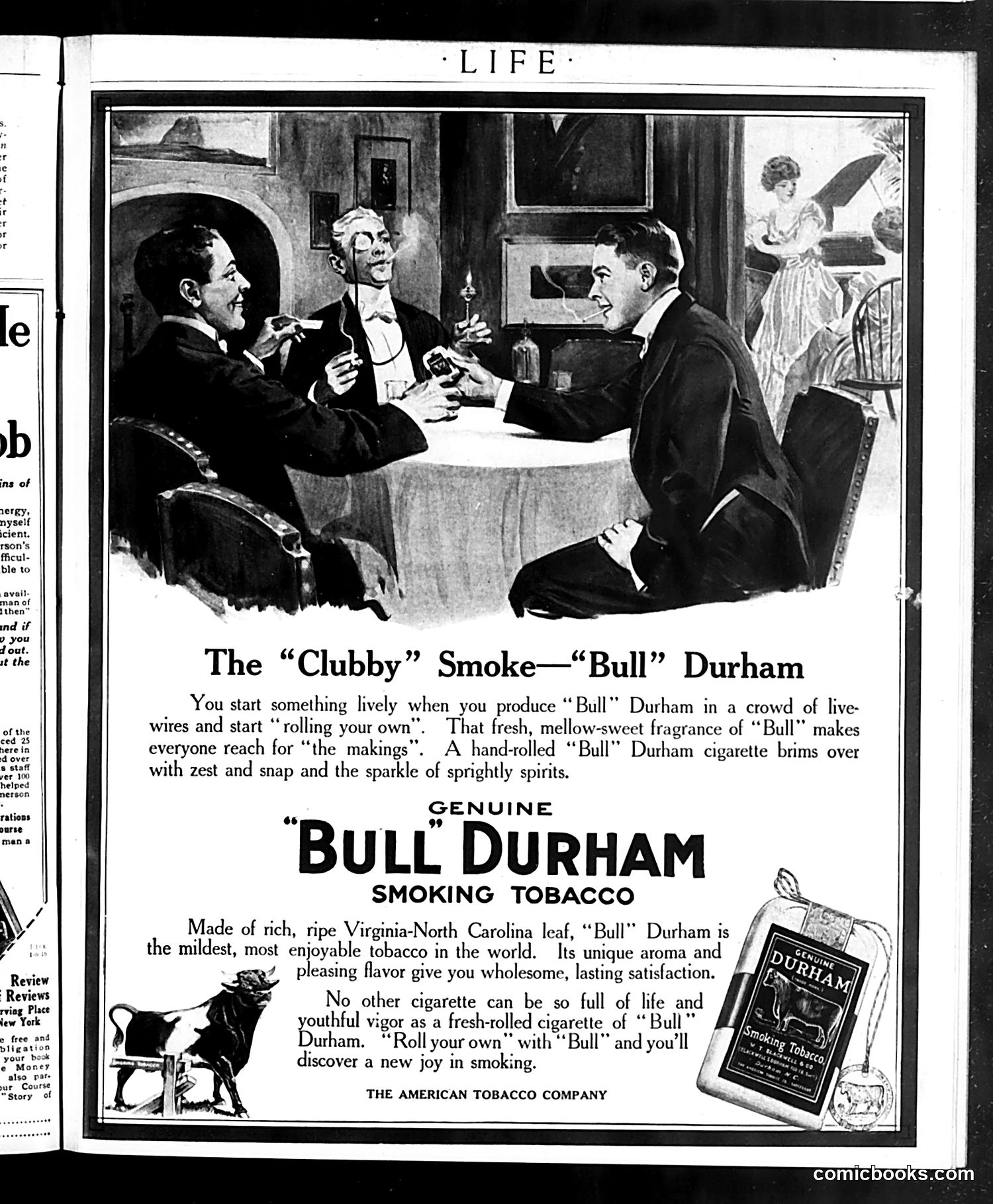
This is a **tobacco advertisement**, not political satire. It's a full-page ad for "Bull Durham" smoking tobacco from The American Tobacco Company. The illustration shows three well-dressed men in what appears to be a gentleman's club or social setting, with the caption "The 'Clubby' Smoke." The ad promotes Bull Durham as a product for "rolling your own" cigarettes—loose tobacco you'd manually roll rather than pre-made cigarettes. The appeal is entirely social: the ad suggests that producing hand-rolled Bull Durham cigarettes creates a lively, attractive moment among peers ("you start something lively"). The imagery emphasizes masculine sophistication and camaraderie. By modern standards, this is striking primarily for its **casual promotion of tobacco to mass audiences** without health warnings—standard practice in early 20th-century American advertising. The gendered, class-conscious marketing (gentlemen's club setting, references to "youthful vigor") would also be notable today.

This is primarily a **product advertisement**, not satire. It promotes the Victrola (Victor's phonograph) by featuring **Melba**, the famous Australian opera singer Dame Nellie Melba, one of the world's most celebrated performers of the era. The ad's central claim—"Both are Melba"—equates hearing her Victor recording with experiencing her live performance. A portrait of Melba in profile appears alongside the phonograph record, visually suggesting they're equivalent. The advertisement leverages Melba's international fame (noted as "beloved of three continents") to convince consumers that recorded music faithfully captured a live artist's voice. This was a major selling point in the early phonograph era, when sound quality was still questionable. The copy emphasizes Victor Records' superiority and encourages purchase of machines priced $10–$400. This reflects early 20th-century consumer marketing that used celebrity endorsements to legitimize new recording technology.