
Life, 1916-01-06 · page 23 of 48
Life — January 6, 1916 — page 23: what you’re looking at
What you’re looking at
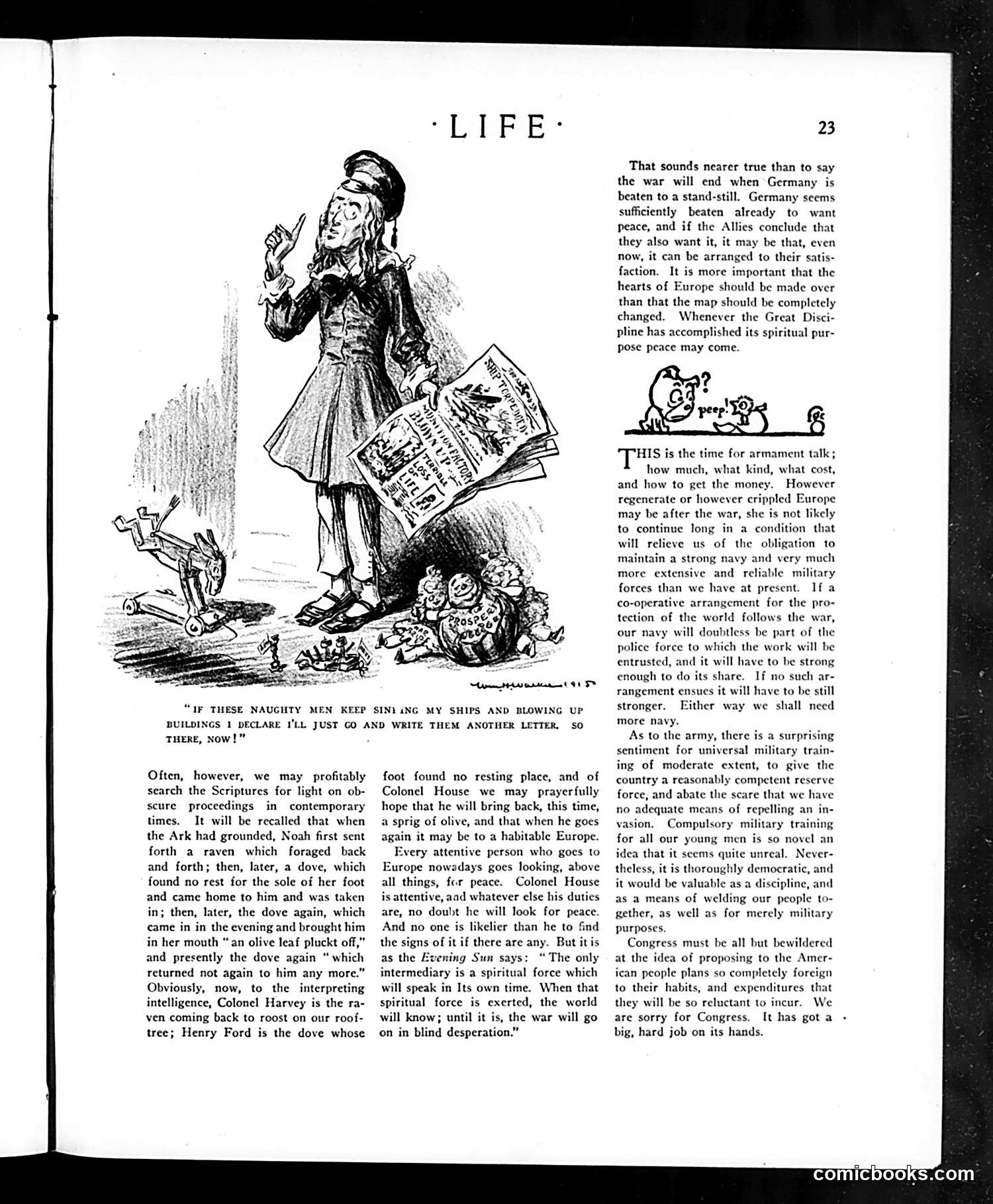
**The Main Cartoon:** The illustration depicts a woman in period dress, appearing exasperated, holding torn documents labeled as ships and buildings. The caption shows her threatening to respond to attacks by writing "another letter" — a satirical jab at weak diplomatic responses to serious wartime aggression. **Historical Context:** This appears to date from World War I, likely referencing peace negotiation efforts. The accompanying text uses biblical metaphors: Colonel Harvey is "the raven," Henry Ford "the dove," and Colonel House an envoy seeking peace (the "olive branch"). **The Satire:** The cartoon mocks ineffectual diplomatic protest — merely writing letters in response to military destruction. It suggests that words alone cannot address the devastation of war. The exasperated female figure embodies the futility of strongly-worded complaints as a substitute for actual military or political action. The page's broader argument addresses post-war military preparedness and universal military training, presenting these as necessary despite American reluctance toward such "foreign" concepts.
📄 Transcribed text from this page (OCR, searchable)
Machine-transcribed from the original scan — historical spelling and the odd misread are preserved.
“iF THESE NAUGHTY MEN KEEP SIN) iNG MY SHIPS AND BLOWING UP BUILDINGS I DECLARE I'LL JUST GO AND WRITE THEM ANOTHER LETTER, SO THERE, Now!” Often, however, we may profitably search the Scriptures for light on ob- scure proceedings in contemporary times. It will be recalled that when the Ark had grounded, Noah first sent forth a raven which foraged back and forth; then, later, a dove, which found no rest for the sole of her foot and came home to him and was taken in; then, later, the dove again, which came in in the evening and brought him in her mouth “an olive leaf pluckt off,” and presently the dove again “ which returned not again to him any more.” Obviously, now, to the interpreting intelligence, Colonel Harvey is the ra- ven coming back to roost on our roof- tree; Henry Ford is the dove whose foot found no resting place, and of Colonel House we may prayerfully hope that he will bring back, this time, a sprig of olive, and that when he goes again it may be to a habitable Europe. Every attentive person who goes to Europe nowadays goes looking, above all things, fer peace. Colonel House is attentive, aad whatever else his duties are, no doubt he will look for peace. And no one is likelier than he to find the signs of it if there are any. But itis as the Evening Sun says: “The only intermediary is a spiritual force which will speak in Its own time. When that spiritual force is exerted, the world will know; until it is, the war will go on in blind desperation.” 23 That sounds nearer true than to say the war will end when Germany is beaten to a stand-still. Germany seems sufficiently beaten already to want peace, and if the Allies conclude that they also want it, it may be that, even now, it can be arranged to their satis- faction. It is more important that the hearts of Europe should be made over than that the map should be completely changed. Whenever the Great Disci- pline has accomplished its spiritual pur- Pose peace may come. HIS is the time for armament talk; how much, what kind, what cost, and how to get the money. However regenerate or however crippled Europe may be after the war, she is not likely to continue long in a condition that will relieve us of the obligation to maintain a strong navy and very much more extensive and reliable military forces than we have at present. If a co-operative arrangement for the pro- tection of the world follows the war, our navy will doubtless he part of the police force to which the work will be entrusted, and it will have to be strong enough to do its share. If no such ar- rangement ensues it will have to be still stronger. Either way we shall need more navy. As to the army, there is a surprising sentiment for universal military train- ing of moderate extent, to give the country a reasonably competent reserve force, and abate the scare that we have no adequate means of repelling an in- vasion. Compulsory military training for all our young men is so novel an idea that it seems quite unreal. Never- theless, it is thoroughly democratic, and it would be valuable as a discipline, and as a means of welding our people to- gether, as well as for merely military purpos Congress must be all but bewildered at the idea of proposing to the Amer- ican people plans so completely foreign to their habits, and expenditures that they will be so reluctant to incur. We are sorry for Congress. It has gota + big, hard job on its hands, comicbooks.com