
Life, 1916-01-06 · page 12 of 48
Life — January 6, 1916 — page 12: what you’re looking at
What you’re looking at
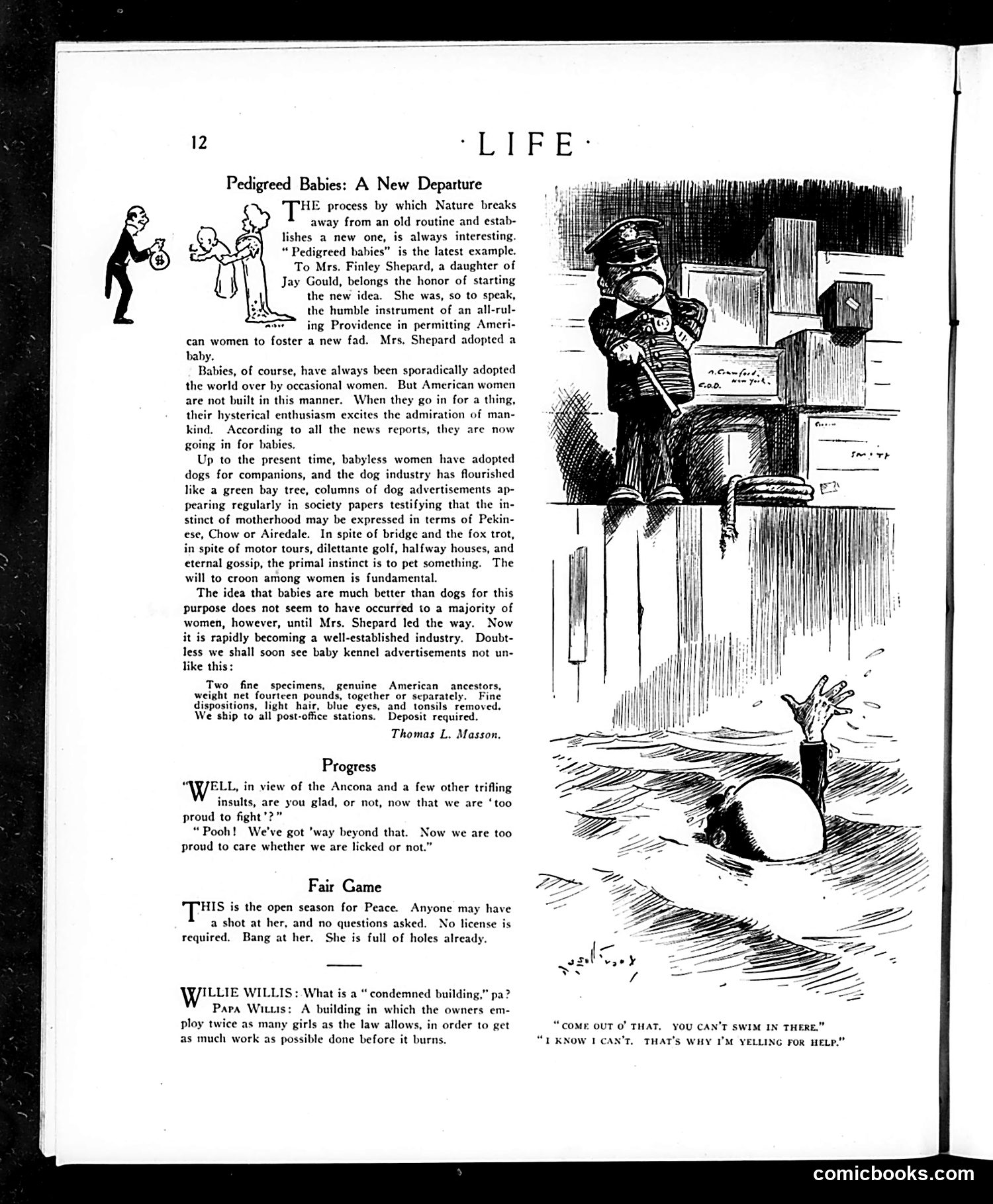
This page contains three distinct satirical pieces: 1. **"Pedigreed Babies"** mocks a new trend among wealthy American women adopting babies as fashionable accessories, similar to how they previously adopted dogs. The text credits Mrs. Finley Shepard with starting this fad. The satire suggests women's superficial desire to "pet something" drives this behavior. 2. **"Progress"** and **"Fair Game"** are brief humorous dialogues about social attitudes—one about pride, one about Peace season (appearing to reference hunting season for women, a dark joke about violence). 3. **"Willie Willis"** defines "condemned building" as one where owners employ excessive workers before demolition to maximize profits—a critique of labor exploitation and safety violations in construction. The cartoons use exaggerated illustration to amplify the satire's bite.
📄 Transcribed text from this page (OCR, searchable)
Machine-transcribed from the original scan — historical spelling and the odd misread are preserved.
‘LIP E* Pedigreed Babies: A New Departure HE process by which Nature breaks away from an old routine and estab- lishes a new one, is always interesting. “ Pedigreed babies” is the latest example. To Mrs. Finley Shepard, a daughter of Jay Gould, belongs the honor of starting the new idea. She was, so to speak, the humble instrument of an all-rul- ing Providence in permitting Ameri- can women to foster a new fad. Mrs, Shepard adopted a baby. Babies, of course, have always been sporadically adopted the world over by occasional women. But American women are not built in this manner, When they go in for a thing, their hysterical enthusiasm excites the admiration of man- kind. According to all the news reports, they are now going in for babies. Up to the present time, babyless women have adopted dogs for companions, and the dog industry has flourished like a green bay tree, columns of dog advertisements ap- pearing regularly in society papers testifying that the in- stinct of motherhood may be expressed in terms of Pekin- ese, Chow or Airedale. In spite of bridge and the fox trot, in spite of motor tours, dilettante golf, halfway houses, and eternal gossip, the primal instinct is to pet something. The will to croon among women is fundamental. The idea that babies are much better than dogs for this purpose does not seem to have occurred to a majority of women, however, until Mrs. Shepard led the way. Now it is rapidly becoming a well-established industry. Doubt- less we shall soon see baby kennel advertisements not un- like this: Two fine specimens, genuine American ancestors, weight net fourteen pounds, together or separately. Fine dispositions, light hair, blue eyes, and tonsils removed. We ship to all post-office stations. Deposit required. Thomas L. Masson. Progress “Wr in view of the Ancona and a few other trifling insults, are you glad, or not, now that we are ‘too proud to fight “Pooh! We've got 'way beyond that. Now we are too proud to care whether we are licked or not.” Fair Game THs is the open season for Peace. Anyone may have a shot at her, and no questions asked. No license is required. Bang at her. She is full of holes already. TLLIE WILLIS : What is a “ condemned building,” pa? Para Wits: A building in which the owners em- ploy twice as many girls as the law allows, in order to get as much work as possible done before it burns. “COME OUT O' THAT, YOU CAN'T SWIM IN THERE.” “1 KNOW 1 CAN'T, THAT'S WHY I'M YELLING FOR HELP.” comicbooks.com