
Life, 1916-01-06 · page 15 of 48
Life — January 6, 1916 — page 15: what you’re looking at
What you’re looking at
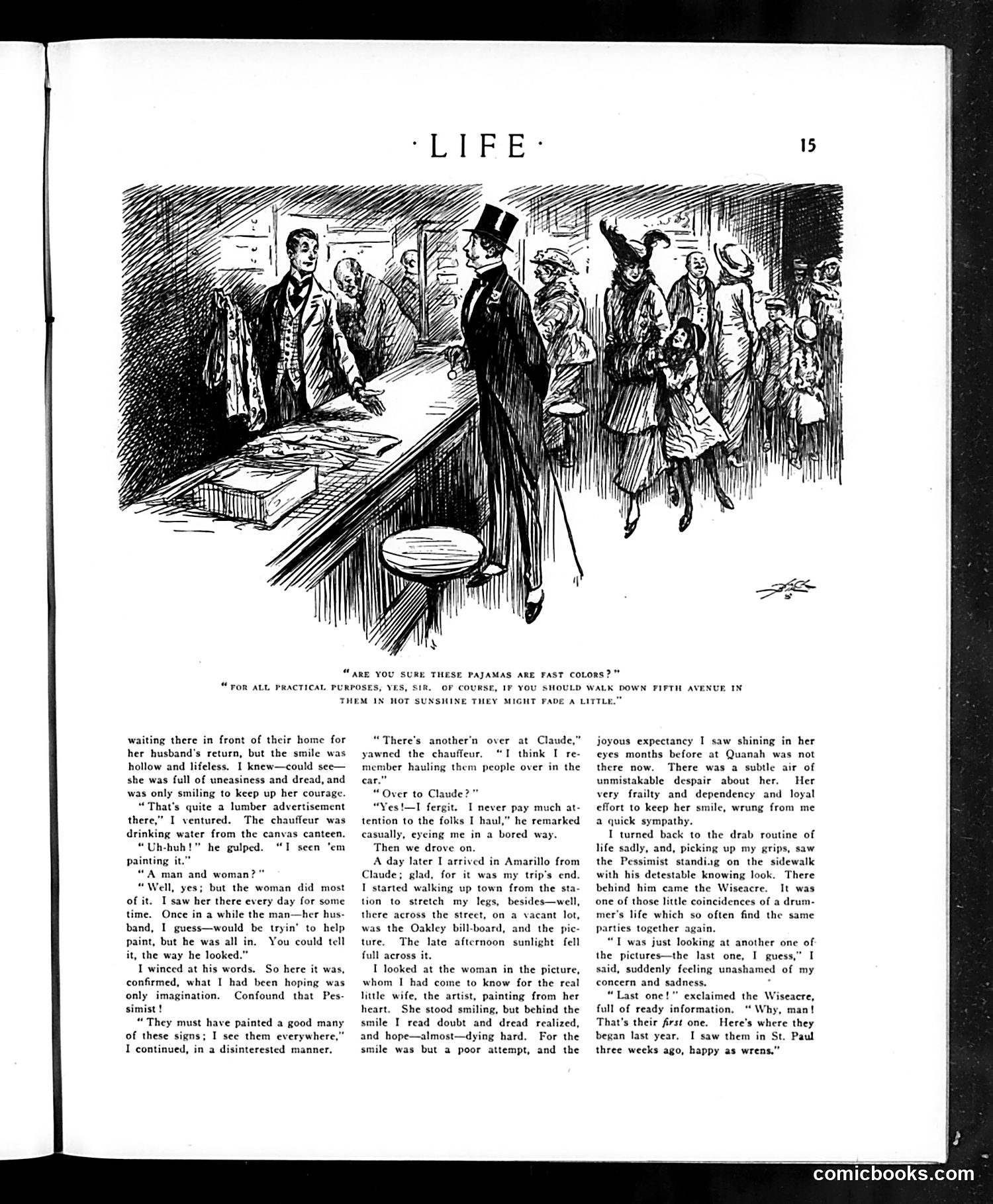
This page contains a single cartoon and accompanying narrative text about an art exhibition or gallery opening. The cartoon depicts a well-dressed man in a top hat viewing what appears to be amateur paintings, surrounded by various visitors in formal attire. The caption's joke concerns *fast-fading pajamas*: a gentleman asks another if certain pajamas are "fast colors," then suggests that for "practical purposes," if someone walked them down Fifth Avenue in hot sunshine, "they might fade a little." The satire targets the pretentiousness of casual gallery-goers and possibly dubious product claims. The narrative describes the speaker's encounter with a portrait of a woman—the artist's wife—painted with such poor technique that her hopeless expression reads as genuine anguish. The humor relies on contrasting artistic ambition with incompetent execution.
📄 Transcribed text from this page (OCR, searchable)
Machine-transcribed from the original scan — historical spelling and the odd misread are preserved.
“ARE YOU SURE THESE PAJAMAS ARE FAST COLORS?” “TOR ALL PRACTICAL PURPOSES, YES, SIR, oF course, FP YOU SHOULD WALK DOWN FIFTH AVENUE IN THEM IN HOT SUNSHINE THEY MIGHT PADE A LITTLE.” waiting there in front of their home for her husband's return, but the smile was hollow and lifeless. I knew—could see— she was full of uneasiness and dread, and was only smiling to keep up her courage. “That's quite a lumber advertisement there,” I ventured. The chauffeur was drinking water from the canvas canteen. “Uh-huh!” he gulped. “I seen ‘em Well, yes; but the woman did most of it. I saw her there every day for some time. Once in a while the man—her hus- band, I guess—would be tryin’ to help paint, but he was all in, You could tell it, the way he looked.” I winced at his words. So here it was, confirmed, what I had been hoping was only imagination. Confound that Pes- simist! “They must have painted a good many of these signs; I see them everywhere,” I continued, in a disinterested manner. “There's another'n over at Claude,” yawned the chauffeur. “I think I re- member hauling them people over in the es!—I fergit. I never pay much at- tention to the folks I haul,” he remarked casually, eyeing me in a bored way. Then we drove on. A day later I arrived in Amarillo from Claude; glad, for it was my trip's end. I started walking up town from the sta- to stretch my legs, besides—well, there across the street, on a vacant lot, was the Oakley bill-board, and the pic- ture. The late afternoon sunlight fell full across it. I looked at the woman in the picture, whom I had come to know for the real little wife, the artist, painting from her heart, She stood smiling, but behind the smile I read doubt and dread realized, and hope—almost—dying hard. For the smile was but a poor attempt, and the tion joyous expectancy I saw shining in her eyes months before at Quanah was not there now. There was a subtle air of unmistakable despair about her. Her very frailty and dependency and loyal effort to keep her smile, wrung from me a quick sympathy. I turned back to the drab routine of life sadly, and, picking up my grips, saw the Pessimist standiag on the sidewalk with his detestable knowing look. There behind him came the Wiseacre. It was one of those little coincidences of a drum- mer's life which so often find the same parties together again. “T was just looking at another one of the pictures—the last one, I guess,” I said, suddenly feeling unashamed of my concern and sadnes : “Last one!" exclaimed the Wiseacre, full of ready information. ‘“ Why, man! That's their first one. Here's where they began last year. I saw them in St. Paul three weeks ago, happy as wrens.”