
Life, 1916-01-06 · page 22 of 48
Life — January 6, 1916 — page 22: what you’re looking at
What you’re looking at
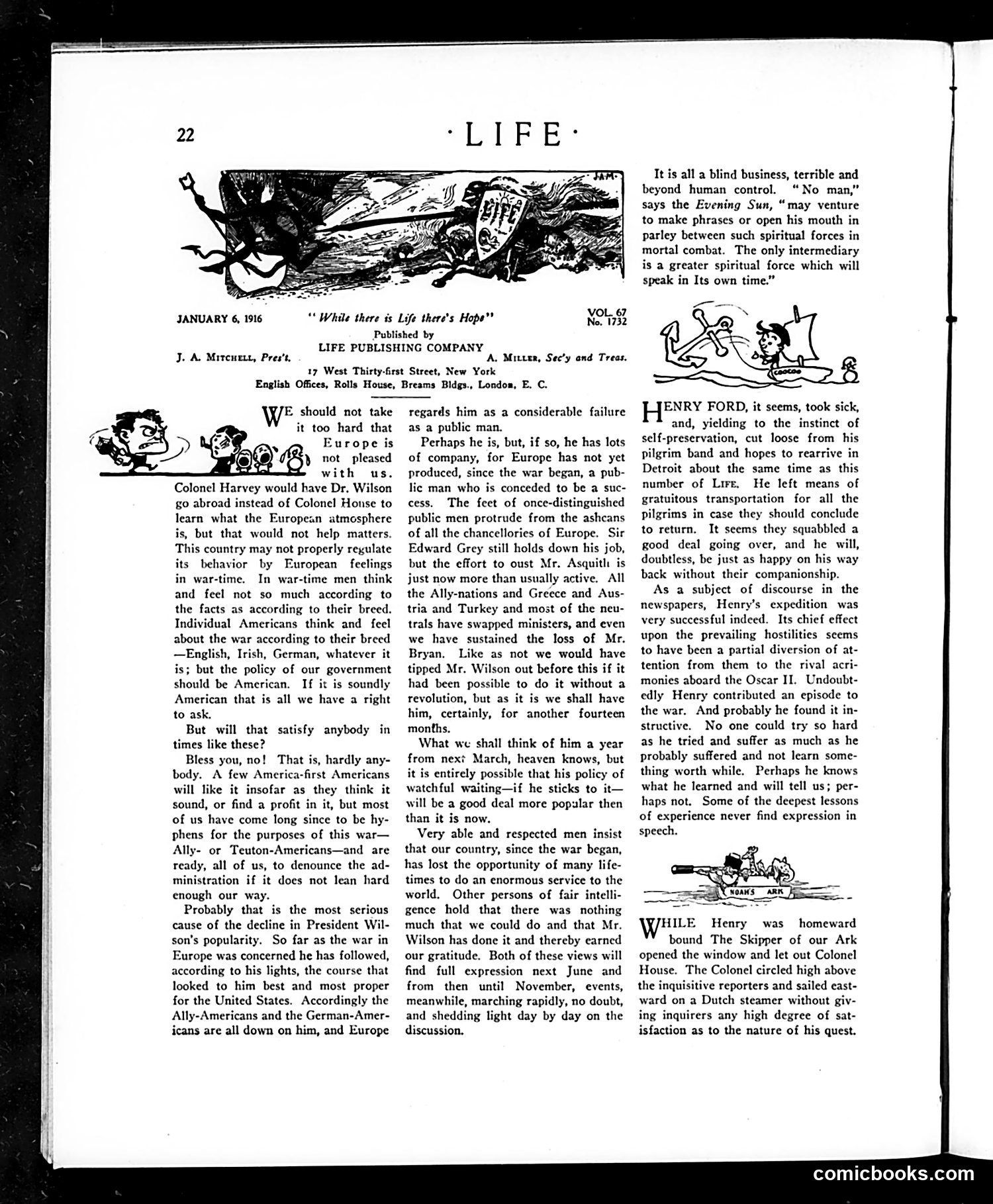
This Life editorial critiques President Wilson's neutrality stance during World War I. The author defends Wilson against criticism from hyphenated Americans—those of British, German, Irish, and other ethnic backgrounds who pressure the administration to favor their ancestral homelands. The piece argues that Wilson correctly pursues *American* interests rather than bowing to European demands or domestic ethnic lobbying. It notes that European leaders themselves face similar unpopularity, suggesting Wilson's decline stems from impossible wartime circumstances rather than failure. The final paragraph about Henry Ford (appearing to reference his peace efforts) suggests even prominent industrial figures struggle with war's moral complexities. The cartoons throughout use satirical imagery of conflict, reinforcing the text's theme that wartime emotions override rational policy-making—a timely concern as America approached its 1917 entry into the war.
📄 Transcribed text from this page (OCR, searchable)
Machine-transcribed from the original scan — historical spelling and the odd misread are preserved.
JANUARY 6, 1916 “While there is Life there's Hope” VOL. 67 No, 1732 Published by LIFE PUBLISHING COMPANY J. A. Mitcueit, Pres’t, E should not take it too hard that Europe is Cyd not pleased with us. Colonel Harvey would have Dr. Wilson go abroad instead of Colonel Honse to learn what the European atmosphere is, but that would not help matters. This country may not properly regulate its behavior by European feelings in war-time. In war-time men think and feel not so much according to the facts as according to their breed. Individual Americans think and feel about the war according to their breed —English, Irish, German, whatever it is; but the policy of our government should be American. If it is soundly American that is all we have a right to ask, But will that satisfy anybody in times like these? Bless you, no! That is, hardly any- body. A few America-first Americans will like it insofar as they think it sound, or find a profit in it, but most of us have come long since to be hy- phens for the purposes of this war— Ally- or Teuton-Americans—and are ready, all of us, to denounce the ad- ministration if it does not lean hard enough our way. Probably that is the most serious cause of the decline in President Wil- son's popularity. So far as the war in Europe was concerned he has followed, according to his lights, the course that looked to him best and most proper for the United States. Accordingly the Ally-Americans and the German-Amer- icans are all down on him, and Europe A. Mutter, Sec’y and Treas. 17 West Thirty-first Street, New York English Offices, Rolls House, Breams Bldgs., London, E. C. regards him as a considerable failure as a public man. Perhaps he is, but, if so, he has lots of company, for Europe has not yet produced, since the war began, a pub- lic man who is conceded to be a suc- cess. The feet of once-distinguished public men protrude from the ashcans of all the chancellories of Europe. Sir Edward Grey still holds down his job, but the effort to oust Mr. Asquith is just now more than usually active. All the Ally-nations and Greece and Aus- tria and Turkey and most of the neu- trals have swapped ministers, and even we have sustained the loss of Mr. Bryan, Like as not we would have tipped Mr. Wilson out before this if it had been possible to do it without a revolution, but as it is we shall have him, certainly, for another fourteen months. What we shall think of him a year from next March, heaven knows, but it is entirely possible that his policy of watchful waiting—if he sticks to it— will be a good deal more popular then than it is now. Very able and respected men insist that our country, since the war began, has lost the opportunity of many life- times to do an enormous service to the world, Other persons of fair intelli- gence hold that there was nothing much that we could do and that Mr. Wilson has done it and thereby earned our gratitude. Both of these views will find full expression next June and from then until November, events, meanwhile, marching rapidly, no doubt, and shedding light day by day on the discussion, It is all a blind business, terrible and beyond human control. “No man,” says the Evening Sun, “may venture to make phrases or open his mouth in parley between such spiritual forces in mortal combat. The only intermediary is a greater spiritual force which will speak in Its own time.” ENRY FORD, it seems, took sick, and, yielding to the instinct of self-preservation, cut loose from his pilgrim band and hopes to rearrive in Detroit about the same time as this number of Lire, He left means of gratuitous transportation for all the pilgrims in case they should conclude to return. It seems they squabbled a good deal going over, and he will, doubtless, be just as happy on his way back without their companionship. As a subject of discourse in the newspapers, Henry’s expedition was very successful indeed. Its chief effect upon the prevailing hostilities seems to have been a partial diversion of at- tention from them to the rival acri- monies aboard the Oscar II. Undoubt- edly Henry contributed an episode to the war. And probably he found it in- structive. No one could try so hard as he tried and suffer as much as he probably suffered and not learn some- thing worth while. Perhaps he knows what he learned and will tell us; per- haps not. Some of the deepest lessons of experience never find expression in 'HILE Henry was homeward bound The Skipper of our Ark opened the window and let out Colonel House. The Colonel circled high above the inquisitive reporters and sailed east- ward on a Dutch steamer without giv- ing inquirers any high degree of sat- isfaction as to the nature of his quest. comicbooks.com