
Life, 1916-01-06 · page 14 of 48
Life — January 6, 1916 — page 14: what you’re looking at
What you’re looking at
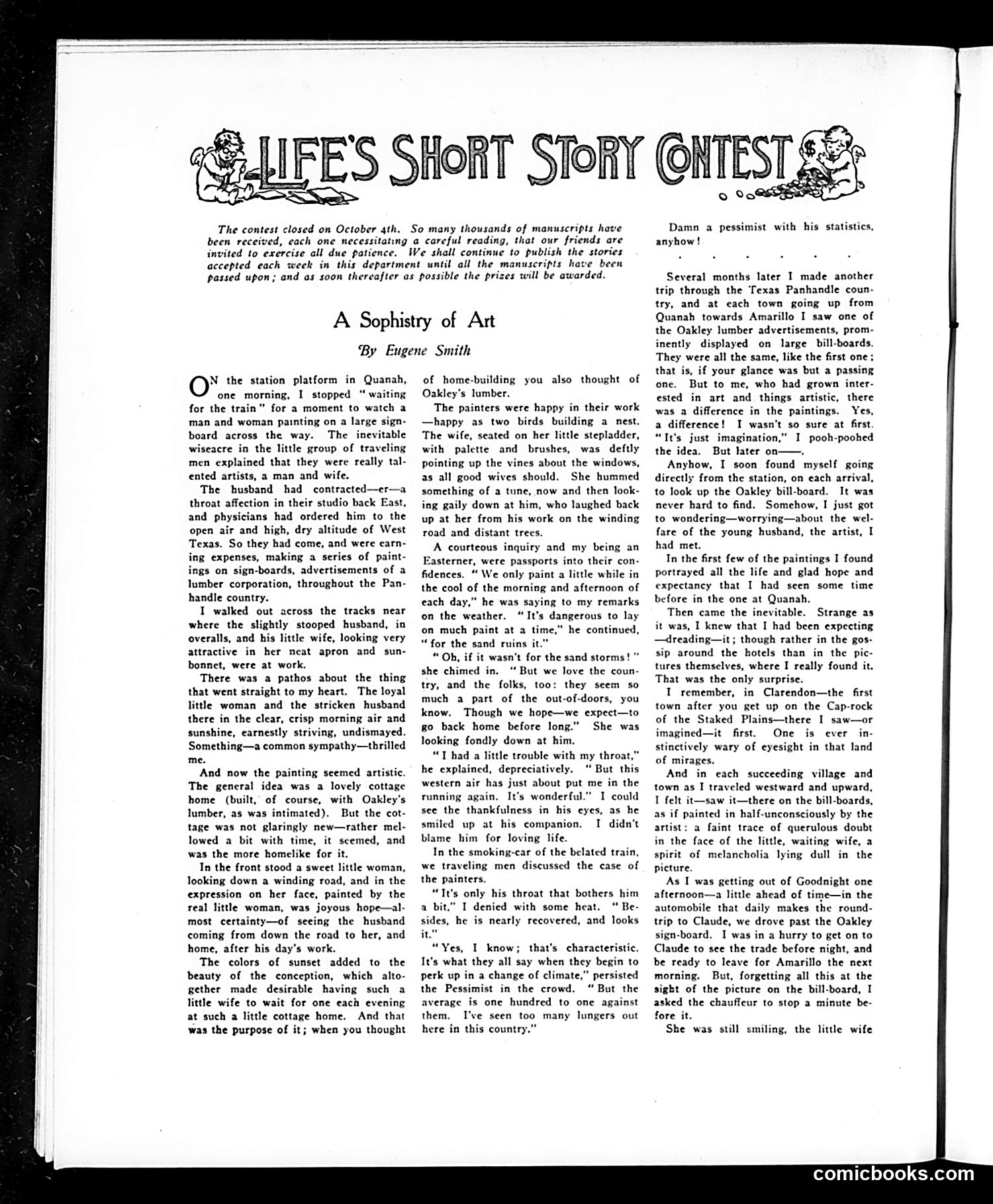
This page presents "A Sophistry of Art" by Eugene Smith, a contest-winning short story from Life's 1920s short story contest (closed October 4th). The story describes a narrator's journey through the Texas Panhandle who repeatedly encounters the same Oakley lumber company billboard advertisements displayed on large signs in various towns. What initially appears to be a charming painting of a cottage home—featuring a wife waiting for her husband—becomes increasingly uncanny as the narrator recognizes it's the identical image repeated everywhere. The "sophistry" refers to the clever deception: what seems like authentic, heartfelt art is actually mass-produced commercial propaganda designed to manipulate emotions and sell lumber through idealized domestic imagery. The story satirizes early 20th-century advertising's cynical use of sentimentality to create false emotional connections to products.
📄 Transcribed text from this page (OCR, searchable)
Machine-transcribed from the original scan — historical spelling and the odd misread are preserved.
The contest closed on October 4th. FES SHORT SIOR So many thousands of manuscripts have been received, each one necessitating a careful reading, that our friends are invited to exercise all due patience. We shall continue to publish the stories accepted each week in this department until all the manuscripts have been passed upon; and as soon thereafter as possible the prises will be awarded. A Sophistry of Art By Eugene Smith N the station platform in Quanah, one morning, I stopped “ waiting for the train” for a moment to watch a man and woman painting on a large sign- board across the way. The inevitable wiseacre in the little group of traveling men explained that they were really tal- ented artists, a man and wife. The husband had contracted—er—a throat affection in their studio back East, and physicians had ordered him to the open air and high, dry altitude of West Texas. So they had come, and were earn- ing expenses, making a series of paint- ings on sign-boards, advertisements of a lumber corporation, throughout the Pan- handle country. I walked out across the tracks near where the slightly stooped husband, in overalls, and his little wife, looking very attractive in her neat apron and sun- bonnet, were at work, There was a pathos about the thing that went straight to my heart. The loyal little woman and the stricken husband there in the clear, crisp morning air and sunshine, earnestly striving, undismayed. Something—a common sympathy—thrilled me. And now the painting seemed artistic. The general idea was a lovely cottage home (built, of course, with Oakley's lumber, as was intimated). But the cot- tage was not glaringly new—rather mel- lowed a bit with time, it scemed, and was the more homelike for it. In the front stood a sweet little woman, looking down a winding road, and in the expression on her face, painted by the real little woman, was joyous hope—al- most certainty—of seeing the husband coming from down the road to her, and home, after his day's work. The colors of sunset added to the beauty of the conception, which alto- gether made desirable having such a little wife to wait for one each evening at such a little cottage home. And that was the purpose of it; when you thought of home-building you also thought of Oakley's lumber. The painters were happy in their work —happy as two birds building a nest. The wife, seated on her little stepladder, with palette and brushes, was deftly pointing up the vines about the windows, as all good wives should. She hummed something of a tune, now and then look- ing gaily down at him, who laughed back up at her from his work on the winding road and distant trees. A courteous inquiry and my being an Easterner, were passports into their con- fidences. “ We only paint a little while in the cool of the morning and afternoon of each day,” he was saying to my remarks on the weather. “It's dangerous to lay on much paint at a time,” he continued, “for the sand ruins it.” “ Oh, if it wasn’t for the sand storms!” she chimed in. “‘ But we love the coun- try, and the folks, too: they seem so much a part of the out-of-doors, you know. Though we hope—we expect—to go back home before long.” She was looking fondly down at him. “Thad a little trouble with my throat,” he explained, depreciatively. “ But this western air has just about put me in the running again. It's wonderful.” I could see the thankfulness in his eyes, as he smiled up at his companion. I didn't blame him for loving life. In the smoking-car of the belated train, we traveling men discussed the case of the painters. “It's only his throat that bothers him a bit,” I denied with some heat. “ Be- sides, he is nearly recovered, and looks it.” “Yes, I know; that’s characteristic. It’s what they all say when they begin to perk up in a change of climate,” persisted the Pessimist in the crowd. “But the average is one hundred to one against them. I've seen too many lungers out here in this country.” OMTstgg Damn a pessimist with his statistics, anyhow! Several months later I made another trip through the Texas Panhandle coun- try, and at each town going up from Quanah towards Amarillo I saw one of the Oakley lumber advertisements, prom- inently displayed on large bill-boards. They were all the same, like the first one; that is, if your glance was but a passing one. But to me, who had grown inter- ested in art and things artistic, there was a difference in the paintings. Yes, a difference! I wasn't so sure at first “Tt's just imagination,” I pooh-poohed the idea. But later on—. Anyhow, I soon found myself going directly from the station, on each arrival, to look up the Oakley bill-board. It was never hard to find. Somehow, I just got to wondering—worrying—about the wel- fare of the young husband, the artist, I had met. In the first few of the paintings I found portrayed all the life and glad hope and expectancy that I had seen some time before in the one at Quanah. Then came the inevitable. Strange as it was, I knew that I had been expecting —dreading—it ; though rather in the go: sip around the hotels than in the pi tures themselves, where I really found it. That was the only surprise. I remember, in Clarendon—the first town after you get up on the Cap-rock of the Staked Plains—there I saw—or imagined—it first. One is ever in- stinctively wary of eyesight in that land of mirages. And in each succeeding village and town as I traveled westward and upward, I felt it—saw it—there on the bill-boards, as if painted in half-unconsciously by the artist: a faint trace of querulous doubt in the face of the little, waiting wife, a spirit of melancholia lying dull in the picture. As I was getting out of Goodnight one afternoon—a little ahead of time—in the automobile that daily makes the round- trip to Claude, we drove past the Oakley sign-board. I was in a hurry to get on to Claude to see the trade before night, and be ready to leave for Amarillo the next morning. But, forgetting all this at the sight of the picture on the bill-board, I asked the chauffeur to stop a minute be- fore it. She was still smiling, the little wife comicbooks.com