
Life, 1916-01-06 · page 27 of 48
Life — January 6, 1916 — page 27: what you’re looking at
What you’re looking at
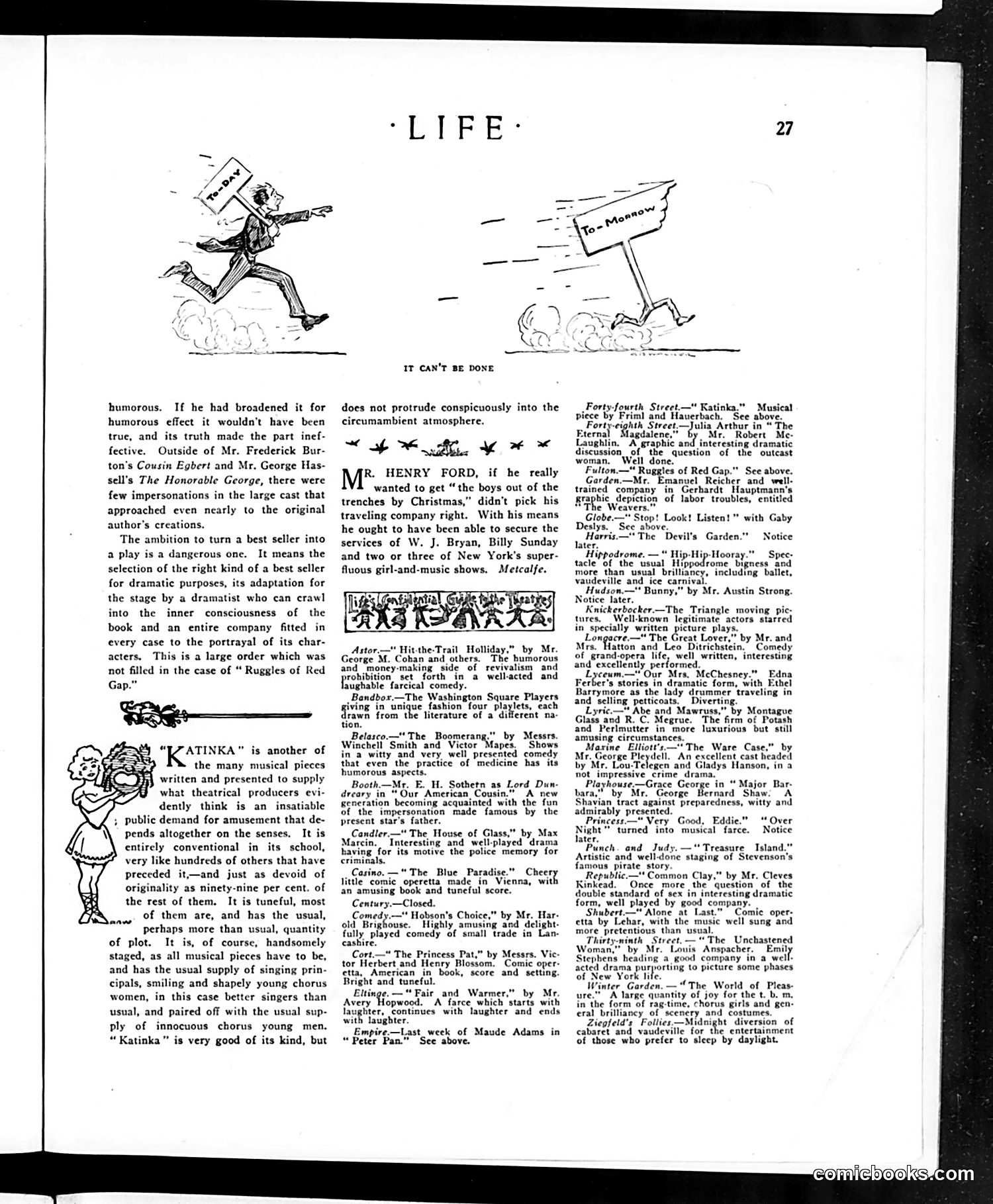
This cartoon satirizes Henry Ford's 1915 peace mission. The left figure represents Ford, rushing forward with determination carrying a banner reading "Peace," while the right panel shows "Tomorrow" receding on a platform, illustrating the futility of his effort. The accompanying text by Metcalfe mocks Ford's ambitious plan to end World War I by assembling a "Peace Ship" delegation. Ford claimed he could "get the boys out of the trenches by Christmas" but, the satire suggests, assembled the wrong team—offering showmen and entertainers (W.J. Bryan, Billy Sunday, vaudeville acts) instead of genuine diplomatic muscle. The joke: Ford's earnest but naive belief that American optimism and celebrity could solve a complex international conflict was absurdly misguided. The "tomorrow" that never arrives symbolizes the impossible deadline and the gap between Ford's grand ambitions and reality.
📄 Transcribed text from this page (OCR, searchable)
Machine-transcribed from the original scan — historical spelling and the odd misread are preserved.
humorous. If he had broadened it for humorous effect it wouldn't have been true, and its truth made the part inef- fective. Outside of Mr. Frederick Bur- ton’s Cousin Egbert and Mr. George Has- sell’s The Honorable George, there were few impersonations in the large cast that approached even nearly to the original author's creations. The ambition to turn a best seller into a play is a dangerous one. It means the selection of the right kind of a best seller for dramatic purposes, its adaptation for the stage by a dramatist who can crawl into the inner consciousness of the book and an entire company fitted in every case to the portrayal of its char- acters, This is a large order which was not filled in the case of “ Ruggles of Red Gap.’ “IZ ATINKA” is another of the many musical pieces written and presented to supply what theatrical producers evi- dently think is an insatiable ; Public demand for amusement that de- pends altogether on the senses. It is entirely conventional in its school, very like hundreds of others that have preceded it—and just as devoid of originality as ninety-nine per cent. of the rest of them. It is tuneful, most of them are, and has the usual, perhaps more than usual, quantity of plot. It is, of course, handsomely staged, as all musical pieces have to be, and has the usual supply of singing prin- cipals, smiling and shapely young chorus women, in this case better singers than usual, and paired off with the usual sup- ply of innocuous chorus young men. “ Katinka" is very good of its kind, but IT CAN'T BE DONE does not protrude conspicuously into the circumambient atmosphere. “of LS M*. HENRY FORD, if he really wanted to get “the boys out of the trenches by Christmas,” didn’t pick his traveling company right. With his means he ought to have been able to secure the services of W. J. Bryan, Billy Sunday and two or three of New York's super- fluous girl-and-music shows. Metcalfe. Hit-the-Trail, Holliday,” by Mr. George M. Coban and others. The humorous and money-making side of revivalism and prohibition set forth in a well-acted and [ughable farcical comedy. Bandbox.—The Washington Square Players ving’ in unique fashion four playlets, each awn from the literature of a different na- tion, Belasco.—" The Winchell Smith and Victor Mapes. “Shows in a witty and very well presented comedy that even the practice of medicine has its humorous aspects. Mr. E. H. Sothetn as Lord Dun- dreary in “ Our American Cousin.” A new generation becoming acquainted with the fun of the impersonation made famous by the present star's father. Candler.—“ The House of Glass,” by Max Marcin, Interesting and well-played drama having for its motive the police memory for criminals. Casino. —“The Blue Paradise.” Cheer little comic operetta made in Vienna, wit an amusing book and tuneful score. Century.—Closed. Comedy.—" Hobson's Choice,” by Mr. Har- old Brighouse. Highly amusing and delight- fully played comedy of small trade in Lan- cashire. Cort.—" The Princess Pat,” by Messrs. Vic- tor Herbert and Henry Blossom. Comic oper- etta, American in book, score and setting. Bright and tuneful. Eltinge.—" Fair and Warmer,” by Mr. Avery Hopwood. A farce which ‘starts with laughter, continues with laughter and ends with laughter. Empire—Last_week of Maude Adams in “Peter Pan.” See above. Boomerang.’ by Messrs. Maj _Forty-fourth Street—" Katinka.” Musical piece by Friml and Hauerbach. See above. _ Forty-eighth Street—Julia Arthur in “ The Eternal | Magdalene, Mr. Robert Me- Laughlin. A graphic and teresting dramatic discussion of the question of the outcast woman, Well done. Fulton.—" Ruggles of Red Gap." See above. Garden.—Mr. Emanuel Reicher and well trained company in Gerhardt Hauptmann's Araphie depiction of labor troubles, entitled “The Weavers.” —"" Stop! Look! Listen!” with Gaby See above. is—""The Devil's Garden.” Notice Hippodrome. —“ Hip-Hip-Hooray.” Spec tacle of the usual Hippodrome bigness. and more than usual brilliancy, including ballet, vaudeville and ice carniv: , Hudson.—" Bunny,” by Mr. Austin Strong. Notice later. Knickerbocker—The Triangle moving pic- tures. Well-known legitimate actors starred in specially written picture plays. Longacre.—" The Great Lover,” by Mr. and Mrs. Hatton and Leo Ditrichstein. Comedy of grand-opera life, well written, interesting and excellently performed. Lyceum.—" Our Mrs, McChesney.” Edna Ferber's stories in dramatic form, with Ethel Barrymore as the lady drummer traveling in and Selling petticoats. Diverting. Lyric.—" Abe and Mawruss,” by Montague Glass and R.C. Megrue. The firm of Potash and Perlmutter in more luxurious but still amusing circumstances. Maxine Elliott's—" The Ware Case,” by Mr. George Fleydell. An excellent cast headed by Mr. Lou-Telegen and Gladys Hanson, in a not impressive crime drama, Playhouse.—Grace George in “ Major Bar- by Mr. George Bernard Shaw. A Shavian tract against preparedness, witty and admirably presented. Princess—" Very Good, Edd Night” turned into musical farce. later. Punch. and Judy, —" Treasure Island.” Artistic and well-done staging of Stevenson's famous pirate story. Republic." Common Clay,” by Mr. Cleves Kinkead. Once more the question of the double standard of sex in interesting dramatic form, well played by good company. Shubert—" Alone at Last.” Comic oper- etia by Lehar, with the music well sung and more pretentious than usual. Thirty-ninth Street, —" The Woman,” by Mr. Louis Anspacher. Emil Stephens heading a good company in a well- acted drama purporting to picture some phases of New York lite. Winter Garden. — “The World of Pleas- A large quantity of joy for the t. b, m, ihe form of rag-time, chorus girls and gei eral brilliancy of scenery and costumes. Ziegfeld’s Follies.—Midnight diversion of cabaret and vaudeville for the entertainment of those who prefer to sleep by daylight. Over Notice Unchastened